Latest News

a, Arts & Entertainment

Miley Cyrus—inspiration or abomination?

Despite her hit songís title, Miley should stop

Fan or not, you’ve heard of Miley Cyrus. The former Disney darling has, for the past few years, gone to greater and greater lengths to shed her Hannah Montana past. Now that the staggering transformation of her image is complete, the question becomes, how far will she go? The fact that the media was up in arms over a 2008 Vanity Fair photo shoot, which featured Cyrus wearing nothing but a bed sheet, seems almost laughable now, considering her latest performance at the VMAs and new video for the single ìWrecking Ball,î which features her wearing nothing but a pair of boots.

Recently, Sinead OíConnor wrote a series of open letters to Cyrus, the first of which expressed concern ìin the spirit of motherliness,î and the rest of which reacted harshly to Cyrusís insensitive and dismissive tweets in response, mocking OíConnor for her history of mental illness. Perhaps itís charitable of OíConnor to assume Cyrus is simply naÔve and being controlled by her management, but unfortunately, the pop starís intentions donít count for much. She may be dancing on stage in a flesh-coloured bikini trying to convey that she doesnít care what people think of her and that girls should be sexually empowered; but it becomes irrelevant if what people actually see is a former child star trying desperately to keep her look fresh and shocking enough to stay relevant, while promoting misogynist and borderline racist practices in the process.

Cyrusí cultural appropriation of ëratchetí culture is nothing new, certainly. White artists have been doing this for years, but that in no way excuses her doing it now. Cyrus has admitted that she wants her new album to have a ìblack sound,î and appears to use her back-up dancers almost as props to help her achieve this ëratchetí vibe. I agree that itís unfair for anyone to diminish the talent of these dancers by saying they were hired for merely having the ëright look,í but their roles in Cyrusí performances scream objectification.

Cyrus has also been the target of criticism for her skimpy wardrobe, as well as her provocative performance with Robin Thicke at this year’s VMAs. It’s problematic that the so-called music industry is set up for young women to be valued for sex appeal over musical talent in terms of business strategy in the first place, but it also sends a veritable tidal wave of dangerous messages to today’s youth. Cyrus being so successful and constantly talked about makes it abundantly clear that this strategy may well work that a woman’s body is more important than her talent or what she has to say but at what cost? Cyrus seems to teach other young women that they should value themselves primarily upon their looks, or how many men they can attract, and to teach young men that women are to be seen first and foremost as sexual beings if we’re being generous or as objects if we’re not. Regardless of Cyrus current awareness of these issues, they simply cannot continue to be ignored. She is seriously in need of a reality check or an education, and though Sinead O’Connor couldn’t get the job done, she needs to get one or the other sometime soon.

 – Jacqueline Gailbraith


Don’t hate Miley is twerking all the way to the bank

I’m Miley Cyrus/I’m Miley Cyrus, I raps viral hip-hop artist Lil B, on Miley Cyrus.î Released in the singer’s ìParty in the U.S.A. days, the absurd song references an unbelievable career arc: a former Hannah Montana making a sextuple platinum single, all while finishing up her contract with Disney.

Now it’s 2013, and Miley Cyrus is still famous. She can sing, decently, but that’s not the reason she’s on the cover of Rolling Stone. It’s a different feature of the pop starlet that attracts magazine editors, rappers such as Pharrell and Kanye West, and hitmakers like Mike WiLL Made It, to work with her.

I think whether a reader relates to a cover star is not always the point, says Harper’s Bazaar executive director Laura Brown. They just need to find her interesting. And Miley, at this point in her life, certainly is.

Whether you’re a Miley fan or not, she is the girl of the moment, said Cori Murray, entertainment director at Essence magazine, in an interview with the Associated Press. Business is business. [Rappers are] in the music business; she’s the girl of the moment, so why not get on record with the girl of the moment? That’s as basic as it’s going to get.

In fact, without Cyrus marketing strategy, she wouldn’t even be mentioned in The McGill Tribune. But after a controversial performance at the MTV  Video Music Awards (VMAs), and increasingly risquè publicity stunts, Miley is filling a gap. On her latest album, Bangerz, the only other female singer featured is pop icon Britney Spears. The fact that Miley sees the Princess of Pop as an inspiration is telling. Both have an overall brilliant market strategy; Miley’s package consists of an MTV documentary, an album release, and talked-aboutíperformances performances that not only attract television viewership, but also reach a YouTube audience. Current single We Can’t Stop garnered a record-breaking 10.7 million views within 24 hours of its release, and now approaches a total of 225 million.

Allegations of cultural appropriation have some truth to them, but are misguided overall. At the VMAs, Cyrus performed with R&B singers Justin Timberlake and Robin Thicke, but all three are appropriators. In fact, Thicke is now preemptively suing legendary black singer Marvin Gaye’s family after they rejected a six-figure settlement offer, and hopes for a ruling that summer hit ìBlurred Lines does not infringe on Gaye’s Got to Give It Up. But criticism of Blurred Lines is focused on accusations of misogyny, not exploiting black culture. The tone of this backlash is even more surprising considering many of the critics accusing Thicke of misogyny are the ones calling Cyrus promiscuous. You could accuse the late Elvis Presley of exploiting a genre that came before him, but in the end, ìMoney ain’t nothing but money when you get to the money, ain’t nothing but money,î as Cyrus claims on ìLove Money Party.î To have such a comeback, Miley has to be doing something right.

– Will Burgess 

a, Arts & Entertainment

Ain’t Misbehavin’ is the Real McCoy

The Segal Centre kicked off its season with a delightfully rambunctious musical revue. Ain’t Misbehavin’ celebrates music from the Harlem Renaissance, a period in the “Roaring Twenties” when African-American artists sought to affirm pride in a new black identity. First conceived by Richard Maltby Jr. and Murray Horwitz with music by jazz pianist Thomas “Fats” Waller, the show went on to receive the Tony for Best Musical in 1978.

This rendition, co-produced with Copa de Oro under the direction of Roger Peace, lives up to its reputation. Five outstanding performers deliver song after song, each more infectious than the last. The three-time Juno-winning Kim Richardson is a devastating presence on stage, matching rich, full-blooded vocals with go-for-the-throat aplomb. When she sings, “If you break my heart I’ll break your jaw,” not a single soul in the room doubts her. Toya Alexis, Richardson’s frequent sparring partner, is equally ravishing, with two outstanding solos in “Squeeze Me” and “When the Nylons Bloom Again.”

It’s former McGill student and rapper Jonathan Emile, however, who hits the high note of the show with “The Viper’s Drag,” a song fittingly about the fine art of getting high. The lyrics are funny as-is (“I dreamed about a reefer, five feet long/A might immense, but not too strong”), but Emile’s delivery displays impeccable comedic timing and genuine charm. The slick and suave Michael-Lamont Lytle, who also served as dance captain, likewise won over audiences with both the romantic (“Honeysuckle Rose,” with Richardson) and the outrageous (“Your Feet’s Too Big”). The breakout star of the revue was clearly Aiza Ntibarikure. A 2011 Dawson College graduate, Ntibarikure proved capable of roughing and tumbling with the rest of the cast with an effervescent, no-holds-barred performance that channels Janelle Monáe.

The cast is accompanied by an equally-talented quintet under the direction of Chris Barillaro. A McGill alumnus and former member of Players’ Theatre, Barillaro is also an incredibly talented pianist, and the production is fortunate to have his skills. Jean-Claude Olivier’s elegant, jazz club set design and Karen Pearce’s stylish costuming add touches of opulence to the production.

As a celebration of a pivotal movement in music and American history, Ain’t Misbehavin’ is also very much an artefact of its times. Sometimes this requires a stretch of the imagination on the audience’s part, such as when Richardson appeals for us to donate our metals to the war effort (“Cash for Your Trash”). At other times, such as “Find Out What They Like,” the cost of datedness is too great to justifiably bear: “Find out what they like, and how they like it, and let him have it just that way/Give them what they want, and when they want it, without a single word to say/You got to cater to a man and if you don’t, day and night, he’ll find some other gal to do the things you won’t.” Robin Thicke couldn’t have said it better himself.

In keeping with the light-hearted, full-throttle nature of the production, the cast double downs at such moments. Indeed,  Richardson sings the aforementioned lines with such gusto and strength that she almost succeeds in turning the song into a message of empowerment.  That the production could still be so entertaining, warts and all, is truly a testament to the skill of the performers in wooing and winning the audience over. Besides, there are plenty of numbers that are a pure joy to see and hear.  The sum total is a night of unforgettable music and passion, where the very essence of entertainment is distilled into a highly potent punch. Montreal last saw a production of the play in 1986, so no fan of theatre should pass up the present opportunity—Ain’t Misbehavin’ is nothing short of an absolute spectacle.

Ain’t Misbehavin’ runs until Oct. 20 at the Segal Centre (5710 ch. De la Cote-Ste-Catherine). Student tickets are $29.

a, Features

Check the ballot

From a quiet office tucked away on the fourth floor of the Shatner building, Elections SSMU takes on a huge task. It is the branch of student government responsible for enabling the political participation of all 25,000 members of the Students’ Society of McGill University (SSMU). Amidst the chaos of the upcoming Fall referendum period, Ben Fung, SSMU’s Chief Electoral Officer (CEO), reflects on his organization’s core mandate.

“You have student democracy happening on SSMU Council, but that’s representative democracy,” Fung explains. “If you want every single person participating, there are only two ways of doing it; General Assemblies (GAs), or elections and referenda. The role for Elections SSMU is to be the impartial body that manages [both], and allows […] student democracy at large to happen.”

As with most modern democratic systems, SSMU typically operates on this representative basis—executives, councillors, and senators who have been elected by the student body are responsible for the day-to-day operation of SSMU. Even within this framework, however, students can participate directly through biannual referenda, in which issues are voted on by the entire membership. The end of the academic year brings the opportunity for students to reflect on the quality of the representation they have received and elect those who will steer the ship for the year to come.

These moments, when the student body engages directly with the political process, are when Elections SSMU comes in. It is responsible for conducting all of SSMU’s elections and referenda; this includes overseeing technical and administrative aspects of the campaign periods, acting as a resource to the campaigns, and reaching out to students to encourage participation. All the while, it must also act as an arbiter and a watchdog, ensuring that everything from campaigning practices to referendum wording is up to code.

Fung (U2 Science) leads the Elections SSMU team, which also consists of Deputy Electoral Officer David Koots (L2 Law), and Elections Coordinator Hannah Rackow (U4 Arts). Even once the second elections coordinator position—for which hiring is currently underway—is filled, it is a small team with a daunting mission.


David Koots - Deputy Electoral Officer (Wendy Chen / McGill Tribune)
David Koots – Deputy Electoral Officer (Wendy Chen / McGill Tribune)

The importance of adaptation and interpretation

Just like the rest of SSMU, the Elections team is governed by the constitution and bylaws of the society. These lay out all of the guidelines and regulations by which Elections SSMU operates; some of these are the rules that must be enforced during campaign, while others detail internal processes—such as the official procedure for counting ballots.

With every advance in electoral procedures or technology, the bylaws must also change to accommodate such advances. For example, in 2003 SSMU voted in favour of implementing an online voting system. While this innovation facilitates student participation and greatly increases accessibility to the political process, it also brought with it logistical complications and a plethora of new regulations to ensure that the online voting met the same quality and privacy standards as physical polling. These changes can now all be found in the bylaws.

The tweaking of the bylaws is a perpetually ongoing project. Hubie Yu, last year’s CEO, left behind a list of bylaws which she feels need to be added, many of which stem from ambiguities in the rules that she encountered during her tenure.

“This is something I told [Fung] about, as it happened several times last year. Many candidates try to take advantage of bylaws that are up for interpretation, and would try to argue and convince me to see it their way,” Yu explained. “This is a tough situation as some bylaws don’t specifically say that they can’t do [certain things], but also don’t clearly state that they can.”

Fung recounts such a situation from this year’s First Year Council (FYC) elections in September.

“I had a student come up to me the other day, and she’s running for FYC. There’s a limit on the [size of posters], and she asked me how close [together] the posters could be; she wanted to paste them to make a bigger poster,” he laughed. “When students get really creative and we learn about things that we haven’t encountered before, then there becomes a need to introduce new bylaws—and there’s always a need to introduce new bylaws.”

In the meantime, Fung explained, even having found a need for revision, the CEO must make a ruling interpreting the bylaws as they stand. “My authority and my interpretation just comes from the constitution and by-laws, and I do my best to represent the spirit of the constitution and by-laws. And try not to get ‘J-Boarded.’”


The J-Board

The sole body that can overturn an Elections SSMU decision is the SSMU Judicial Board (J-Board), a panel of five full-time students from the McGill Faculty of Law. Any member of the society can bring a case to the J-Board, and after review they can chose to conduct a full investigation.

Elections SSMU (then referred to as Elections McGill) was involved in a high-profile case after the Fall 2011 referendum, when then-CEO Rebecca Tacoma was brought before the J-Board for allegedly failing to fulfill the duties of her position.

The case centred around QPIRG’s existence referendum, for which it claimed the wording of the question was unclear. It also alleged campaign violations from the ‘Yes’ committee, and claimed that Tacoma had failed to demonstrate diligence and impartiality while carrying out her duties. Although the personal charges against Tacoma were not upheld, the result of the referendum was invalidated and it was held again in the spring.

For Yu, who took office the following year, this case was a reminder of the level of scrutiny aimed at Elections SSMU.

“During my time as CEO, it definitely made me very careful. When I made decisions, I sometimes would think about whether it could be justified if it [got] to J-Board,” Yu wrote. “CEO’s get J-Boarded pretty often. We only hear about the [cases] that get accepted by J-Board, but I was told that petitions [get] submitted—sometimes they’re just not accepted.”

While a review by the J-Board is a concern for all members of Elections SSMU, the CEO is both the final decision-maker and the front line of accountability.

“In the constitution, the office of the CEO is synonymous with Elections SSMU, which is just another way of saying that the CEO is held responsible for all the decisions Elections SSMU makes,” Fung said. “It’s a way of holding us accountable for the decisions we’re making, and making sure we are following the constitution and bylaws.”


Confronting student apathy

Hannah Rackow - Elections Coordinator (Wendy Chen / McGill Tribune)
Hannah Rackow – Elections Coordinator (Wendy Chen / McGill Tribune)

While some students do seek to hold the organization accountable, others seem not to care at all. Elections SSMU continues to have extremely low visibility and awareness amongst students. This is a serious problem for an organization plagued with chronically low voter turnout. Last year’s Winter election was considered a success with 29.1 per cent of students showing up to the polls; Fall referendum periods generally experience even lower turnout.

Student apathy is a significant challenge faced by SSMU as a whole, but  there are few opportunities to quantify it the way that an election can. As such, it is very easy for the issue of apathy to fall to Elections SSMU. According to former SSMU President Josh Redel, the Elections team has a role to play in this issue, but the burden of responsibility has to be shared.

“You’d call the Elections SSMU [team] apolitical and purely logistics, and [yet] voter apathy is a political problem, [so it’s] something that would fall within [the SSMU] executive’s role,” Redel said. “It’s [Elections SSMU’s] role to get people out to vote, but not to get them interested in SSMU [itself].”

Current VP University Affairs Joey Shea expressed a similar sentiment.

“It’s up to the students, once they’ve heard the speeches and seen the chalkboards, whether they’re going to click on that email,” she said. “That’s not Elections SSMU’s responsibility.”

At times, however, apathy has morphed into negativity and hostility. Yu received angry—and at times vulgar—emails and tweets in response to her outreach efforts during last year’s election period.

“Most of the negative emails I received last year acknowledge the importance of elections, but they just don’t care,” Yu said. “I think people are sick of getting listservs, and sick of constantly getting information forced onto them, via class announcements or when candidates are handing out flyers,” Yu wrote.

Fung says he learned from Yu’s approach.

“Hubie’s philosophy was ‘Don’t let the haters get you down,’” he recalled. “She had no problems powering through it, and it was quite impressive.”


Benjamin Fung - Chief Electoral Officer (Wendy Chen / McGill Tribune)
Benjamin Fung – Chief Electoral Officer (Wendy Chen / McGill Tribune)

The pains of being apolitical

While there are always ideas and initiatives within Elections SSMU to engage its membership and increase accessibility, its status as an arms-length agency of SSMU provides a logistical obstacle to any major institutional change.

While it technically falls under the President’s portfolio, none of its actions or initiatives can reflect the politics of the sitting president. Redel expressed the frustration that came with this semi-independent status.

“How do we find that balance where I’m not interfering or influencing Elections SSMU, but still putting into place some new projects—like the new elections software [and] videos in the ballots,” he said. “I think that’s why we always see, year to year, in the end, the same stuff put forward, because there’s so many of these nuances in the politics of things and the boundary between SSMU and Elections SSMU that don’t let us work to find those creative solutions in the middle.”

While some initiatives were successfully brought to fruition, such as video pensketches for elections candidates, and increased web presence, there were also roadblocks put up by this division. There was an idea to put hyperlinks to external resources and background information into the text of referendum questions, though it was brought to a halt when the concern arose of how to choose an unbiased range of sources.

“The issue with that is inherently it’s going to be political,” Redel pointed out. “So it’s that never-ending circle of how to inform people. No matter what you do, even if you list articles from all sides, you’re going to be missing something, or someone’s going to think you’re missing something.”


Moving forward

An unavoidable reality of Elections SSMU is that regularly scheduled events will always take precedence over all other potential plans. Already this year it has conducted the FYC elections, and the student nomination period for the Fall referendum is open until Oct. 11.

Nevertheless, there are also bigger-picture projects and initiatives for the year already underway. Fung has ambitions to establish mobile polling stations by equipping elections officers with iPads rented from the library, and is already contemplating his outreach strategy for the Winter election and referendum period—easily the biggest event of the year for Elections SSMU.

“Exactly how that’s going to turn out we’re not sure yet, because it could be something like sharks and gorillas fighting each other, or it could be more like awareness campaigns you see everywhere else,” Fung said, gesturing to last year’s SSMU Executive candidate debate posters, which featured various animals engaged in combat.

For Fung, however, the most important legacy that he can leave behind will be found in the constitution and bylaws.

“It’s the institutional memory—it’s what stays through generation after generation,” Fung said. “That’s why the [constitutional reform] process works so well, because the avenues for change are there.”

a, Recipes, Student Life

Pumpkin spice and everything nice

Apple Pumpkin Spice Muffins

Ingredients

12/3 cups all-purpose flour

11/2 tsp baking powder

1/2 tsp cinnamon

1/2 tsp nutmeg

1/4 tsp ground cloves

3/4 cup pumpkin puree

1/2 cup unsweetened applesauce

2 eggs

1/3 cup brown sugar

1/4 cup milk

2 tbsp canola oil

1/2 cup grated apple


Instructions

1. Preheat oven to 375 oF and line a muffin tin with muffin liners

2. In a large bowl, combine flour, baking powder, cinnamon, nutmeg, and cloves

3. In another bowl, combine pumpkin puree, applesauce, eggs, brown sugar, milk, and canola oil

4. Pour wet ingredients into dry ingredients and mix until smooth

5. Fold grated apple into muffin batter

6. Fill muffin liners three-quarters full with batter

7. Bake for 18-20 minutes or until tester (toothpick or fork) comes out clean

8. Let muffins sit in pan for about five minutes and then remove to finish cooling

— Alycia Noë


Photos courtesy of inspiredtaste.net and inthepinkandgreen.blogspot.ca

Pumpkin Spice Latte

Ingredients

I cup milk or non-dairy milk beverage

2 tbsp canned pumpkin

1 tbsp maple syrup

1/3 tsp vanilla extract

1/2 cup extra strong coffee or 2 shots espresso

1/4 tsp ground cinnamon

1/2 tsp ginger

Pinch of nutmeg


Instructions

1. Combine all ingredients (except coffee) in a bowl and microwave for 1-2 minutes, stirring every 30 seconds

2. Brew coffee or espresso

3. If desired, strain milk mixture through a fine-meshed sieve to remove any small bits

4. Pour coffee into milk and stir

5. Optional: garnish with whipped cream and cinnamon or nutmeg

– Marlee Vinegar

a, News

PGSS Council discusses supervision, upcoming referendum

Review of supervision

Post-Graduate Students’ Society (PGSS) Secretary-General Jonathan Mooney announced two major projects that PGSS is currently working on. The first is the improvement of the quality of supervision for students in all departments by clarifying students’ and supervisors’ rights and responsibilities. The second project focuses on ensuring that international students receive tuition waivers—a type of financial aid that reduces or eliminates tuition fees for students who qualify.

“We plan to work with departments and faculties to promote the use of funding that is sent by the central administration to the faculties to support and retain international students on tuition waivers for these students,” Mooney said. “Some of this money, which is tied to the number of international students in a faculty, seems not to be reaching these students.”


Fortier addresses funding, student space

Principal Suzanne Fortier fielded questions from graduate students at Council and outlined future projects. These include reviewing supervision and funding for graduate students. Questions mainly concerned the university’s financial situation and the lack of workspace for graduate students.

PGSS Financial Affairs Officer Erik Larson asked Fortier to explain the financial state of McGill. Fortier said that she places importance on putting money towards attracting talent to the university.

“If we agree that it’s largely about [investing in] people, maybe we’ll have to see other things that aren’t as good as we’d like them to be because while important, they’re not a top priority,” she said.

Economics Councillor, Guillaume Lord. expressed concern about the allotment of workspace for graduate students.

“Space is very uneven across departments,” he said. “A lot of people in our department do not have office space, and it was heartbreaking for me to see this at the beginning of the year. […] Office space is not only a workspace; it’s also a community space.”

Fortier said she had not known this was an issue, but that a solution would not be easy. She mentioned that she would add the issue to future discussions on issues of space at McGill.

“Physical infrastructure is an issue at this university,” Fortier said. “We’re pretty tight on space and we […] don’t have much extension room, and of course there’s the matter of funding.”


Tribune fee referendum

Council approved a PGSS referendum question regarding funding for the McGill Tribune. If the question passes during the November referendum period, graduate students will pay a non-optoutable fee of $0.75 to the Tribune for both the Winter 2014 and Fall 2014 semesters, with a vote on renewal in 2015.

“Right now, our mandate as a newspaper is only towards undergraduate students,” said Carolina Millán Ronchetti, editor-in-chief of the McGill Tribune, at the meeting. “However, we recognize that post-graduate students face unique challenges [ …. ] Membership will help bring more coverage [of] issues that pertain to post-graduates such as supervision and office space.”

Mooney explained that the Tribune ran a similar question last May, which asked graduate students for $1.00 per semester, but that the question did not pass by a small margin.


McGill Writing Centre

Another question Council approved to run in the referendum period is for a fee of $1.50 per term to support graduate use of McGill’s Writing Centre.

However, Council voted against a motion for PGSS to contribute a one-time sum of $3,000 from PGSS’s Special Projects Fund. Without the fund transfer, the Writing Centre will no longer offer tutoring services to graduate students.


Letter opposing Charter of Values

Mooney asked Council for feedback regarding a letter to Parti Québécois (PQ) leader Pauline Marois that he wrote on behalf of the PGSS, which expresses their opposition to the section of the proposed Charter of Values that bans public workers from wearing conspicuous religious symbols.

“Some of our members are technically state personnel [ …. ] and so [the charter] implicates us directly,” Mooney said. “Freedom of expression is particularly important in a university setting.”

Council was supportive of the letter, though upon the suggestion of  Lord, a section of the letter stating that PGSS does not oppose other sections of the Charter was removed.

a, Arts & Entertainment, Music

Tony Dekker – Prayer of the Woods

Tony Dekker, lead singer and songwriter of Great Lake Swimmers, is set to release his first solo album, Prayer of the Woods, this week.  For someone who has been so integral to the production of such a popular and successful Canadian indie-band, his solo act—although decent—is a bit of a let down in comparison to what the band has done as a cohesive group.

There isn’t anything inherently unappealing about the album. Its overall sound is certainly enjoyable: calm, introspective, and meditating. It’s meant to evoke images of nature and to celebrate a human retreat into simplicity. But its wispy feel at times begs for a little more substance.

The indie world has seen a lot of soft, alternative rock as of late: Bon Iver, William Fitzsimmons, Sufjan Stevens—the list goes on and on. It takes a certain nuance to stand out among the overcrowded population of confessional warblers, and it’s safe to say that this album is lacking whatever that special something might be.

Nevertheless, there is some serious musicality infused into the tracks.  Most notable among Dekker’s work is standout piece “Talking in Your Sleep,” a dreamlike, faster-paced tune. It contrasts from others with bright, waltzing rhythms, and well-crafted harmonies. The beautiful harmonica solo has a nostalgic feel, reminiscent of American folk band Beirut.

For all fans of Great Lake Swimmers, this album is definitely worth a look. Prayer of the Woods is successful in transporting listeners to a more peaceful place and natural state of mind. Just don’t expect anything too unique.


a, News

Walrus Magazine brings discussion on energy to McGill

Last Tuesday, McGill hosted “The Walrus Talks Energy,” an event intended to raise awareness about energy use and sustainable practices in Canada. The event was sponsored by Suncor, Canada’s largest energy producer and provider, and organized by The Walrus Magazine. It featured eight speakers of varying backgrounds and professions.

The Walrus Magazine is a general interest magazine that focuses on Canadian affairs as well as their relation to the rest of the world. According to Shelley Ambrose, co-publisher of The Walrus Magazine, the purpose of the event was to provide a platform for increasing knowledge about energy and driving the conversation on the future of energy in Canada.

“We need to have the conversation on energy in terms we can all understand,” said Ambrose. “To do that we need to achieve some energy literacy because creating a vision for the future is very challenging and complicated [.…] All of these amazing people doing these amazing things feed our brains and help us cope with these big decisions that we have to make.”

The speeches touched on a variety of issues, from the political climate surrounding energy and the pricing of energy to more specific topics such as the use of LED light- bulbs and the role of Indigenous peoples in a sustainable Canadian future.

Peter Calamai, fellow of the Institute of Science, Society, and Policy and one of the speakers at the event, talked on the importance of independent research in the energy sector and the need to change people’s perception of energy use in Canada.

“Canada’s use of energy is profligate, [it is] way above everyone else’s in the world, but most people don’t realize it,” Calamai said. “A lot of what’s going to help this problem are technical advances, but it’s also going to be major scientific discovery.”

According to Ambrose, the decision to hold “The Walrus Talks Energy” at an academic institution such as McGill was made as a way for promoting student awareness and involvement in the energy discussion. Kali Taylor, co-founder of Student Energy, a global movement of students focused on building a sustainable energy future, emphasized  the necessity of educating students on the issues in the energy sector.

“I think the way we think about energy is broken,” Taylor said. “Student Energy is a non-profit organization that focuses on educating the next generation of energy leaders and empowering them […] so our whole meaning for being is that we want students to be more educated, inspired and united to take on [….]energy in the future.’’

The event attracted over 200 students and members of the McGill community. Remi Kahwaja, U4 mechanical engineering, said he attended the talk because his career could be related to the topics that were addressed.

“You rarely hear about specific Canadian energy issues so I thought it might be interesting.” Kahwaja said. “I would like to work in the energy sector later in Canada, so it’s about getting involved.”

Mariana Smailes, U1 Arts and Science, said the talks were informative in relation to techniques on energy saving that can be applied across McGill.

“I’m actually working with the McGill Energy Project right now and so, as a student group on campus, we’re really interested with how energy is being efficiently used on campus,” she said. “It was very interesting to see some of the things they said that would be [applicable] at McGill that would change maybe the student perspective on energy.”

a, Arts & Entertainment, Music

RJD2 – More Is Than Isn’t

RJD2  has earned his reputation as one of instrumental hip-hop’s best composers and producers—and one of the genre’s most consistent, with triennial releases since 2004. After listening to his highly anticipated album More Is Than Isn’t, it’s fair to say he’s lived up to his name.

Blending musical styles that rarely go together is one of RJD2’s fortes. More Is Than Isn’t offers an array of styles that will satisfy any mood: “Behold, Numbers!” is a calm but funky tune; “Milk Tooth” is all over the place, switching constantly from dark sections to happier ones; and the end of “Suite 3” changes so much it’s hard to tell what’s going on.

Nevertheless, RJD2 sticks to his hip-hop roots and collaborates with rappers like P. Blackk, STS, Khari Mateen, Phonte Coleman, and Blueprint. In particular, the mix of laid-back rap with funky beats, in the background of “See You Leave (feat. STS And Khari Mateen),” makes it my personal favourite on the album.

The trilogy of the “Suite” songs is also an album highlight. RJD2’s jazz-oriented, melodic, and slow-tempo beats in “Suite 1” and “Suite 2,” juxtaposed with the inconsistency of “Suite 3,” imply a build-up of atmosphere. While this album may not receive the same hype that much-lauded debut Deadringer did, RJD2 has delivered an album that surpasses expectations.


a, Student Life

Branching out: exploring McGill’s libraries

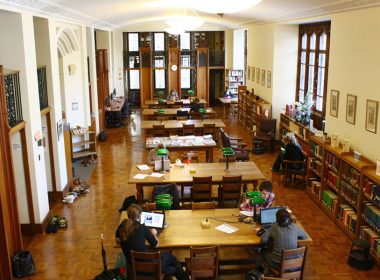
McGill’s downtown campus is home to no fewer than 13 libraries, but students commonly limit their study space to one or two—often simply out of habit or convenience. In honour of the abundance of midterms and papers this week, this is the first in a series of spotlights on McGill libraries to help you branch out and learn to appreciate each library for its individual character.


McLennan-Redpath Library Complex

Consisting of Redpath Hall, Cybertheque, Blackader, and McLennan, this library complex is the largest, oldest, and possibly the most notorious library on campus. Particularly during exams, the building tends to be over-run by stressed-out, sleep-deprived, caffeine-fueled zombies. The seven-story building houses the Humanities and Social Science library collections, which include books for the faculty of Arts, Management, Religious Studies, Social Work, and Education. Furthermore, the library holds a collection of government, government agency, and intergovernmental organization publications; the Blackader-Lauterman collection of architecture and art; and McGill’s collection of rare books.


History

Although the library collection dates back to 1855, it wasn’t until 1893 that Peter Redpath, a businessman and member of the McGill University Board of Governors at the time, donated the oldest part of the library complex, Redpath Hall. The Hall was the first building constructed to store the main university library collection.

In 1969 the reinforced concrete McLennan Building opened—named after Isabella McLennan, who helped fund the purchase of many of the school’s books. While some describe McLennan’s interior as stale, impersonal, and dull, the repeating concrete pattern was meant to elicit a calm and quiet atmosphere to facilitate focused studying.

Redpath and McLennan merged to form the Humanities and Social Sciences Library in 1988 and throughout the 1990s materials from other departments were incorporated into the collection.

Much to the chagrin of a majority of the student body, the building continues to face ongoing construction. The library grows and changes to fit the student body’s needs, and is now much more focused on serving the demand for study space and digital research tools, and less focused on books.


Capacity

With a staggering 2,000-plus seats for quiet study throughout the library complex, it’s shocking that they all manage to fill up around exam time. Included in this number are large group tables, and carrels conducive for efficient individual work. Graduate students and Honours undergraduates can reserve carrels by applying at the service desk on the main floor.

For more collaborative learning, meetings, or presentation practice, there are individual rooms that can be reserved online through the library website, including high-tech glass pods in Cybertheque with computer adaptable large flat-screens. There are also open group study areas in Cybertheque and Redpath where talking is permitted.


Food

The basement of Redpath has a cafeteria with staples like Tim Hortons, Pizza Pizza, and Bento Sushi. Snacks, beverages, and coffee can also be purchased from vending machines right outside the cafeteria. Signs indicate that food is not permitted upstairs, although that doesn’t seem to deter most people.


Resources

Besides stacks—on stacks, on stacks—of books, the library has much more to offer. They even have their own blog, the McLennan Post, which features posts written by librarians on topics pertinent to students and faculty who use the library. The library also has microform readers and scanners that are connected to the library’s network, allowing for printout retrieval from uPrint machines.  On top of that, the library runs workshops on topics such as research strategies and how to get your research published. Workshop schedules are posted on the McGill Library website.


Something special

One of the true treasures of McLennan is its Rare Books and Special Collections section on the fourth floor. The collection was started in the 1850s and contains books, memorabilia, maps, and other artifacts from a wide range of different disciplines. Due to the fragility and value of the collection, there are guidelines for accessing these resources. Visitors must register upon entering and personal belongings like bags, hats, and coats must be stored in special locations. Once this is done, you can carefully browse through the collection at your own will, although you must return all material to the Reading Room staff before you leave.


Hours of Operation 

*24-hour access only in the Redpath Library Building and on the main floor of the McLennan Library Building. The upper floors of McLennan (2- 6) are open for study until midnight.

Monday-Thursday: 8 am – Midnight

Friday: 8 am – 10 pm

Saturday: 10 am – 10 pm

Sunday: 10 am – Midnight

a, Science & Technology

Science from science fiction: Star Wars

From the moment it was first ignited in an old hermit’s home in the middle of Tatooine, the lightsaber captured the imagination of moviegoers. The steady humming of a blue blade of plasma bouncing off its scarlet counterpart has made generations of fans all over the world want one of their own. Made popular by the Star Wars Episode IV: A New Hope, the lighsaber has generated quite a legacy for itself.

Lightsabers have remained in the realm of fiction ever since they first appeared on screen. No known physics model could explain the ways the bars of light made contact with each other. However, this past September, recent findings by a team of scientists from Harvard and Massachusetts Institute of Technology (MIT) showed light behaving in a fashion reminiscent of the blade of the lightsaber.

Harvard Professor of Physics Mikhail Lukin and MIT Physics Professor Vladan Vuletic managed to bind photons—particles of light—together to form molecules. Using weak laser pulses, the scientists shone photons through a special medium—a cloud of rubidium atoms—in a chamber just a few degrees above absolute zero. Normally, photons are described as massless particles that do not interact with each other; when you shine two rays of light together, the beams simply pass through one another. However, when Lukin and Vuletic sent two photons through the special medium, the particles escaped the other end as a single molecule.

This phenomenon—where the photons clumped together as if they had mass and formed molecules—can be explained through the Rydberg Blockade concept. As the photons travel through the cloud, their energy excites the rubidium atoms in the medium along their path. This excitation causes the photons to interact in such a way that they slow down tremendously. The photons regain their normal behaviour once they leave the special medium, exactly like when light passes through water or a prism.

While Star Wars fans would love their own lightsabers, the motivation behind this particular research was instead its potential applications in quantum computing—a field introduced in the ’80s by mathematician Yuri Manin and theoretical physicist Richard Feynman.

Quantum computers are similar to current computers on the market, except that instead of using bits as a storage basis, they use qubits. A bit represents a 1 or 0 in classical computers, and is simply an electrical switch, which can be either on or off. A qubit, on the other hand, relies on the quantum mechanical notion that something can exist in all its states at once.

As computers progress, the size of their processors continue to get smaller. There is a limit to this, however, and manufacturers are rapidly approaching the smallest sizes possible. Theoretically, quantum computing would help increase computers’ processing power.

Lukin and Vuletic’s findings provide a clue in the direction of the storage of quantum information and on the process of inducing photon interaction—two important concepts for designing a quantum computer.

With the discovery of a new state of matter comes a veritable flurry of new applications. In an interview with the Harvard Gazette, Lukin suggested that by utilizing this phenomenon crystal structures could one day be made entirely out of light. The day we all own our own lightsabers might not be so far off.

Despite the fact that these “blades of light” do not radiate heat, generate energy, nor can they be contained in a single hilt at the moment, these findings just go to show that science will go to the greatest of lengths to realize the impossible.

Read the latest issue

Read the latest issue