


Latest News

a, Arts & Entertainment

Jenn Grant sets off into the wild

It takes a lot to ruffle Jenn Grant’s feathers. The singer-songwriter from Nova Scotia seems to take everything in stride, whether it is her upcoming show in Montreal or her future collaboration with Ron Sexsmith. Despite being a longtime fan of Sexsmith’s, Grant speaks nonchalantly about being approached by the Juno award-winner to perform together on tour this October.

“I don’t know what it’ll be like yet,” she says of taking the stage with Sexsmith, but feels that the new songs she will be performing on their tour will “lend themselves well to his audience.”

The closest she comes to gushing was on the topic of Sexsmith accepting her offer to sing on a previous record in 2007. “I felt like I was having an out-of-body experience,” she laughs.

Grant’s apparently unshakable confidence didn’t develop overnight, however.

“I was born to do music,” Grant says. “But it took me 10 years to be comfortable enough to start singing in front of people. It was scary at first.”

Never one to sit idly by, Grant put those years to good use pursuing other artistic aims. A woman of multifaceted talent, she studied painting, drawing, and sculpture at the Nova Scotia College of Art and Design (NSCAD) while building confidence as a musician. Indeed, her eye for visual art has made her mindful of all aspects of the concert experience. On her tour this fall, installation-based pieces by fellow Nova Scotian artist Charley Young will serve as a backdrop to Grant’s haunting voice. “I think they’ll enhance our performance and make the show more beautiful for the audience.”

Grant is entering an exciting new era in her career, a time of both independence and collaboration. She is breaking off amicably from the team she has worked with for the past seven years to make a fresh start and forge her own creative path.

“I’m working independently for the first time now. It was a challenge making that decision, but it’s been a positive move for me. I get bored, I like a little [variety].” She hasn’t left teamwork entirely in the past, however. One of her recent collaborations is a side project with Canadian musicians Charles Austin and Graeme Campbell, called AquaAlta.

“I’m part of something, rather than leading it, and it’s expanding my writing abilities,” she remarks. Grant’s latest album, The Beautiful Wild, is looser and more eclectic than her previous work, with a layered, Canadian indie tone. “There are a lot of organic sounds in it,” Grant says, also pointing out her experimentation with new instruments such as the sitar: “That was totally new for me.” The lyrics on the album follow a similar vein. “I was using a new writing technique. It was a much more sporadic writing experience. I was writing songs really quickly and every day; it was a rush.” Her advice for aspiring musicians? “Go see a lot of live music, support your community, collaborate with people, and don’t be afraid to take risks.”

Jenn Grant performs in Montreal Sept. 14 at 9 p.m. at Quai des Brumes (4481 St. Denis). Admission is $15.

a, News

New Deputy Provost outlines his objectives for five-year term

On Sept. 1, Ollivier Dyens officially began his five-year term as McGill’s second Deputy Provost (Student Life and Learning) (DP (SLL)). Created in 2005, the DP (SLL) position aims to improve student life at McGill and to act as a liaison between the senior administration and students. Last week, the Tribune sat down with Dyens to discuss his goals for the year and his approach to the portfolio.


McGill Tribune (MT): What kind of challenges does McGill present in contrast to your previous position as Vice Provost (Teaching and Learning) at Concordia?

Ollivier Dyens (OD): A different culture, different mission. The perception of McGill within the community is extremely strong. In all the universities I’ve attended and seen and worked in, I’ve never seen a place where there’s so much faith in the institution as there is here. I’m not saying there are no problems, I’m just saying people have a sense of the McGill community as a strong community, and people believe in that community. This is why we probably have issues once in a while—because everyone cares about McGill.


MT: What are your goals for your five-year term?

OD: I really want to put the emphasis on making the campus an interesting and stimulating learning environment, where you can apply some of your knowledge and where we can also do community outreach programs. The first thing we need to do is to really clearly establish the narrative of “student life and learning,” because I don’t think it’s really clear. What exactly do we offer students? That would be the first goal for the year—principles, sort of a strategic plan, and then the following year we can start building these things. I want SLL to provide a very supportive environment so you can focus on the classroom, but I also want this environment to be an extension of what happens in the classroom. So some of the theoretical knowledge you get in the classroom, you can apply some of it through projects on campus that might have an outreach aspect to them.


MT: Could you give an example? 

OD: There are some websites out there where people host problems or issues—usually they’re related to engineering problems or issues—[and] the community says ‘ok, we’ll try to figure this out’ and they post a solution. I can imagine something [at McGill] where the community could post some of the issues they’re having. Students could get together from different faculties and try to tackle that issue. The way I see it, the ultimate goal of an institution such as ours is to improve the community. The rest is all a means to that.


MT: This position has received some negative attention in the past. Do you have any plans for turning around that perception?

OD: I’m not going to talk about the past because I wasn’t present. All I can say is that my goal for this year and the following years is to create intellectual partnerships with students. Moving forward, all I can say is that I’ve promised two things to the student unions—respect and transparency. Once in a while we’ll probably not agree on things, but they’ll get my full respect and we’ll explain to them clearly why our position is the current one. My experience is that when you’re transparent about what your own constraints are, negotiations are much easier because people understand that you’re not trying to do anything negative, you’re just working with what you have. Those constraints can be financial [or] legal in nature, government restrictions, or budget cuts, but we have to deal with what we’re getting.


MT: Is there anything you plan on changing about the way that this position is run?

OD: It’s a complex institution, so it’s too early for me to tell. The objective for me is to develop a coherent narrative including all the community, so the dialogue needs to be constant. I will be present at as many events as possible. Katie [Larson, Students’ Society of McGill University president] and I have decided we would try to do the rounds of all the residences at lunch or at breakfast and meet with the students, because in my position I need to know what the student body is thinking. The students who are just focusing on their classroom experience, they’re not going to talk to their student union because they don’t have time for that. I’ll try to be there as often as possible for them to tell me what those issues are.


—This interview has been conducted, condensed, and edited by Erica Friesen.

a, Sports

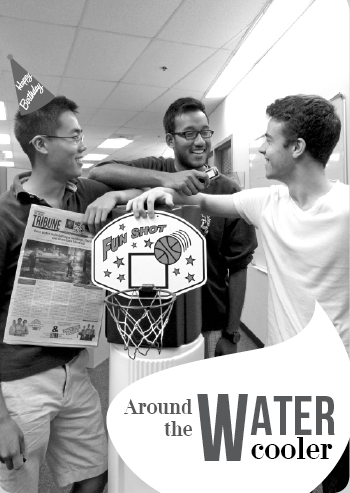
Around the water cooler

In case you were too busy waiting in line for beer at OAP to notice that a new semester has started, here’s what you missed this past week in the world of sports …

Major League Baseball – In only his third start of the season, Giants’ starting pitcher Yusmeiro Petit went 26 outs without surrendering a baserunner. Sporting a Bond villain moustache and cackling maniacally  as he stepped up to bat, pinch-hitter Eric Chavez finally looped a single off of Petit with the count full and two outs in the ninth inning to ruin the 28-year-old right-hander’s dream performance. Chavez, now San Francisco’s public enemy No. 1, seemed to be channeling some deep resentment, since his long-time ball-club, the Oakland Athletics, are suddenly relevant after his departure. Petit will now have to salvage a career that has otherwise been reminiscent of watching paint dry. It also cannot be confirmed whether Petit’s Wikipedia page existed prior to his near-perfect outing.


NCAA Football – Powerhouse programs USC, Texas, Florida, and Notre Dame all lost on the same weekend for the first time in over 35 years. Coincidentally, the quartet represent four of the most hated football teams in the United States. For USC and Texas, the losses against lowly Washington State and BYU, respectively, will certainly renew calls for both head coaches to be fired. Florida’s loss represents the second straight week in which a Top 15 Southeastern Conference (SEC) lost to a program in the Atlantic Coast Conference (ACC). Riots are sure to break out across the football-crazed South if a non–SEC team becomes the team of destiny and hoists the BCS National Championship. Lastly, Notre Dame fans are wishing that the calamitous past eight months would disappear, much  like Manti Teo’s girlfriend.


U.S. Open – This weekend played host to an outstanding weekend of men’s and women’s single tennis. Highlight games included the men’s semi-final, on Saturday which pitted ninth-seed Stanislas Wawrinka against the world’s No. 1 seed, Novak Djokovic. The surprise Wawrinka, who defeated UK deity Andy Murray, pushed Djokovic all the way before finally conceding the match to him after three gruelling hours. Rafael Nadal had less trouble against Richard Gasquet despite a surprise second-set effort by Rafa’s seasonal training fodder. Women’s tennis witnessed Serena Williams attempt to become the oldest woman to win the U.S. Open. The mainstream tennis media had a field day discussing Victoria Azarenka’s record as the only woman to beat Williams in her last 17 WTA finals. Alas, the media could not protect against Williams’ old-school game as she won her 17th Grand Slam title.


NASCAR – The lively, diverse, and  international NASCAR community…the NASCAR community…ahem, a collection of rich corporate Home Depot and Gilette clients, witnessed a disastrous and controversial Saturday night at the Richmond International Raceway. Ryan Newman lost out to the 12th and last berth to Martin Truex Jr. after his teammate, Clint Bowyer, spun out with seven laps left while Newman was leading. Speculation erupted as to whether Bowyer intentionally sabotaged Newman’s chances at the last spot, given that Newman and Truex finished with a tiebreaker at the end of the regular season. Gentleman Newman took the high road, blaming his pit crew for the loss, despite the back-room high fives that were sure to have happened in the Truex mansion over new Shick razors. Oh, and Carl Edwards won the race.

a, News

What Happened Last Week in Canada?

Saint Mary’s University faces outrage over frosh chants

Controversy arose at Saint Mary’s University in Halifax this past weekend after a video emerged featuring student leaders singing a frosh week chant about non-consensual and under-aged sex. Although the video was removed from Instagram where it was originally posted, it has since been made available on other websites.

Jared Perry, president of St. Mary’s University’s student union and one of the orientation leaders who performed the chant, resigned from his position following the incident. Perry apologized for the video, calling it inappropriate. He told the CBC that the incident “was simply a moment with a lack of judgement.” 

The student union apologised for the actions of the orientation leaders, many of whom were remorseful, according to Perry. While some students have remarked that they were not personally offended by the cheer, the Avalon Sexual Assault Centre, which is based in Halifax, said it has received calls from distressed survivors of sexual violence who have viewed the video. The centre’s executive director Irene Smith told CBC that Nova Scotia has the highest rate of sexual assault per capita in Canada, and that the chant “reinforces rape culture in our society.” 

Officials from the university have stated that they will conduct a review of the incident that will include recommendations for future precautionary measures.

Third birth control pill recall of the year in Canada

Mylan Pharmaceuticals has announced the recall of another one of the company’s contraceptive medications, Esme-28. Last week, the company stated that it would be recalling Freya-28, a separate type of birth control pills, as one package was discovered to have contained a placebo instead of functional medication.

According to Health Canada, the recall of Esme-28 was a cautionary measure, as it was impossible for Mylan to determine whether Esme-28 had been affected by the same placebo switch as Freya-28. 

This is the third recall of birth control pills in Canada this year, following last April’s recall of Alysena-28, produced by Apotex. Both the public and the medical community have voiced growing concerns about the quality control procedures used in manufacturing these drugs. 

Quebec corruption suspects linked to federal party donations

Last Thursday, the Canadian Press released a report stating that, out of the 102 people charged by Quebec’s anti-corruption police, the Unité permanente anticorruption (UPAC), 45 have also made donations to federal political parties. According to the report, the suspects donated over two million dollars to federal parties between 1993 and 2011.

Findings from the inquiry conducted by UPAC suggest that members of companies made donations in order to gain political influence. However, UPAC cannot legally investigate federal donations made by corrupt officials within Quebec, as it only has provincial jurisdiction.

Legislation capping corporate and personal donations was introduced by Jean Chrétien in 2003 and Stephen Harper in 2006 to curb the number of illegal donations to political parties. 

Federal government funds initiative to prevent honour crimes

On Thursday Sept. 5, the federal government announced that it would fund a project aimed at decreasing the number of honour crimes committed in Canada. $306,040 will go towards the Canadian Council of Muslim Women (CCMW)’s two-year project aimed at providing women and men across Canada with the training and tools to help Muslim women in their local community who are most at risk for these crimes. 

The project, called Violence Against Women: Health and Justice for Canadian Muslim Women, is a response to the highly publicised honour crimes that have taken place in Canada in recent years. Of the 19 honour killings on record in Canada, 13 have occurred since 2002.

As part of this project, CCMW executive director Alia Hogben is attempting to replace the term “honour killing” with “femicide,” since she said there is no honour in killing women, as the former term suggests.

Tensions at the G20 summit regarding the Syrian crisis

Last Thursday, the G20 summit launched in St. Petersburg, Russia. Regarding the Syrian Civil War, Prime Minister Stephen Harper maintained that Canadian research had indicated that the Assad government used chemical weapons on its people and that backing a United States-led strike against the Assad government is necessary to send a “clear message” that the use of chemical weapons will be punished. 

Foreign Affairs Minister John Baird also condemned the Syrian government’s use of chemical weapons, but appeared doubtful that an agreement would be reached on a plan of action, stating that the G20 is foremost an economic forum. 

Dmitry Peskov, press secretary to the Russian president, was critical of investigations led by the United States and told reporters that the evidence used to implicate Assad was “far from convincing.”

a, Sports

Sports briefs

Redmen Lacrosse

Vs. Trent:

McGill Lacrosse (2-0) kicked off its season on Saturday, facing off against the Trent Excalibur (0-1) in the season opener for both teams. The Excalibur were put in a tough position from the opening whistle, given that they were facing down the defending champions of the Bagattaway Cup.

Trent’s relatively young roster was no match for the Redmen as the visitors began the game with their signature aggressiveness. McGill got on the scoreboard first despite physical play from the Excaliburs, and managed to maintain the lead for the entirety of the game to finish on top, 13-8. However, Trent stayed resilient, keeping the match close for the entirety of the clock.

Credit for the win goes primarily to McGill’s spectacular depth at midfield and outstanding net-minder Riley McGillis, who lived up to his status as 2011 Goalie of the Year.

Vs. Queen’s:

The Redmen followed up their win against Trent with a trip to Kingston, Ontario to face the Queen’s Gaels (1-1). Holding a .500 record last year, the Gaels looked to start off the season on a strong note after rebooting the roster with a number of new faces.

However, the defending champion Redmen would not make that an easy task as they jumped to a lopsided lead over Queen’s, scoring eight consecutive points before the Gaels mounted a surprising 5-0 run in the third quarter. However, McGill managed to hold onto the lead and surge back, regaining their composure in the final quarter to close out the game 14-6.

The Redmen will play their home opener against the Carleton Ravens this Saturday, Sept. 14 at Molson Stadium.


Rugby

Martlets, Redmen topple Sherbrooke to open RSEQ Regular Season 

The McGill Martlets (1-0-0) travelled east to Sherbrooke (0-0-1) and dominated an overmatched Vert et Or squad to the tune of a 41- 12 victory. The blowout was a complete reversal of the Martlets’ previous game against St. Francis Xavier (1-0-1) in which the red-and-white were shut out 29-0. Junior, Emily Barber was chosen as McGill’s Game MVP after tallying two tries to lead the Martlets in scoring. Reigning RSEQ Player of the Year, Brianna Miller had three conversions while five others scored tries to round out the scoring.

The Martlets look to continue their attempt to top the RSEQ on Sept. 15 with a tilt against the Montreal Carabins(1-0-1).

On the same day the men’s squad eked out a victory against the hosts to begin their quest for an eighth straight RSEQ Championship, it was a homecoming for rookie Jordan Nimat, who provided McGill’s lone try in the outing. Last season’s team MVP, Cameron Perrin converted the kick after Nimat’s try, providing the difference in an otherwise tight affair.

The shaky performance sends a message that there are weaknesses to be exploited when playing against the Redmen. The aura of invincibility that once surrounded the program is fading as the rest of the province appears to be catching up.  McGill has the chance to regain its dominance as they face the Montreal Carabins (0-0-1) on Sept. 15.

a, Opinion

The academic decline and (other) decline of McGill University

For the three years that I’ve been at McGill, the academic decline of our school has been a constant topic of discussion around campus. A semester hasn’t passed in which budget cuts, professor and teaching assistant (TA) contracts, student experience, declining global reputation, or general financial woes are not at the forefront of campus discussion.

These concerns are not unfounded. It’s likely obvious to every student at McGill that the school has financial problems. In turn, there have been concerns about maintaining the university’s reputation and fostering a positive student experience. However, our perspective on these issues is often inconsistent.

All students are concerned about the fact that 200-level courses that previously had TAs and conferences are now taught with neither. It is clear that the combination of having fewer courses available, and larger class sizes, even with more TAs, will all negatively impact the student experience. We all recognize that these changes are harmful, and undergraduate students—particularly those in their first two years, whose courses are most affected—are right to worry about the changing face of the classroom experience.

What we need to realize, however, is that receiving a good educational experience and attending a ‘prestigious’ university are not the same thing. While closely linked, the ‘academic’ decline of McGill (i.e. its placement in world rankings) and the classroom decline of McGill (limited course selection, expanded classes) are not the same issue. The global QS University and Times Higher Education rankings that we all pore over are largely derived from aggregating academic citations, peer reviews, and employer perceptions. These factors can have very little to do with what one actually learns or experiences as an undergrad. Take, for example, University of Toronto; a high ranking, in this case, goes hand in hand with a dispiriting, Kafkaesque undergraduate experience of cavernous lecture halls and minimal interaction with faculty. McGill and UofT may be the highest ranked, but we also have higher rates of student dissatisfaction. Likewise, universities that boast the highest student satisfaction, such as Guelph, are not necessarily the most prestigious.

“What we need to realize, however, is that receiving a good educational experience and attending a ‘prestigious’ university are not the same thing.”

The point is that with limited resources available, we need to decide what kind of institution we want to be. At some point there comes a compromise between hiring prestigious researchers and building a global reputation and fostering a positive undergraduate student experience. Those of you in your first year at McGill are surely proud (and rightfully so) of the fact that you attend one of the best universities in the world. The administration has made clear to you and your

extended family that you will receive a world-class education. Keep that in mind as you step into Leacock 132 to attend the course in which you have only passing interest but are required to take because first year options are so limited. Keep that in mind as you notice the course is lacking in TAs, and is clearly over-enrolled.

I love McGill, and I believe that having world-class research and prestigious faculty has benefited my education substantially. Nonetheless, there have been times when I have been forced to confront the fact that a prestigious education is not always the same thing as a good one. Still, I feel like I’ve been lucky. I’ve had TAs and essays in the same Arts courses that now have only a professor—or, increasingly, just a PhD student—and a multiple choice exam. So to those of you who are new undergrads at McGill, especially Arts students, I welcome you to one of the best schools in the world; but I do not envy you. You will receive a respected diploma, but not necessarily a good education.

a, Student Life

Variety is the spice of lunch

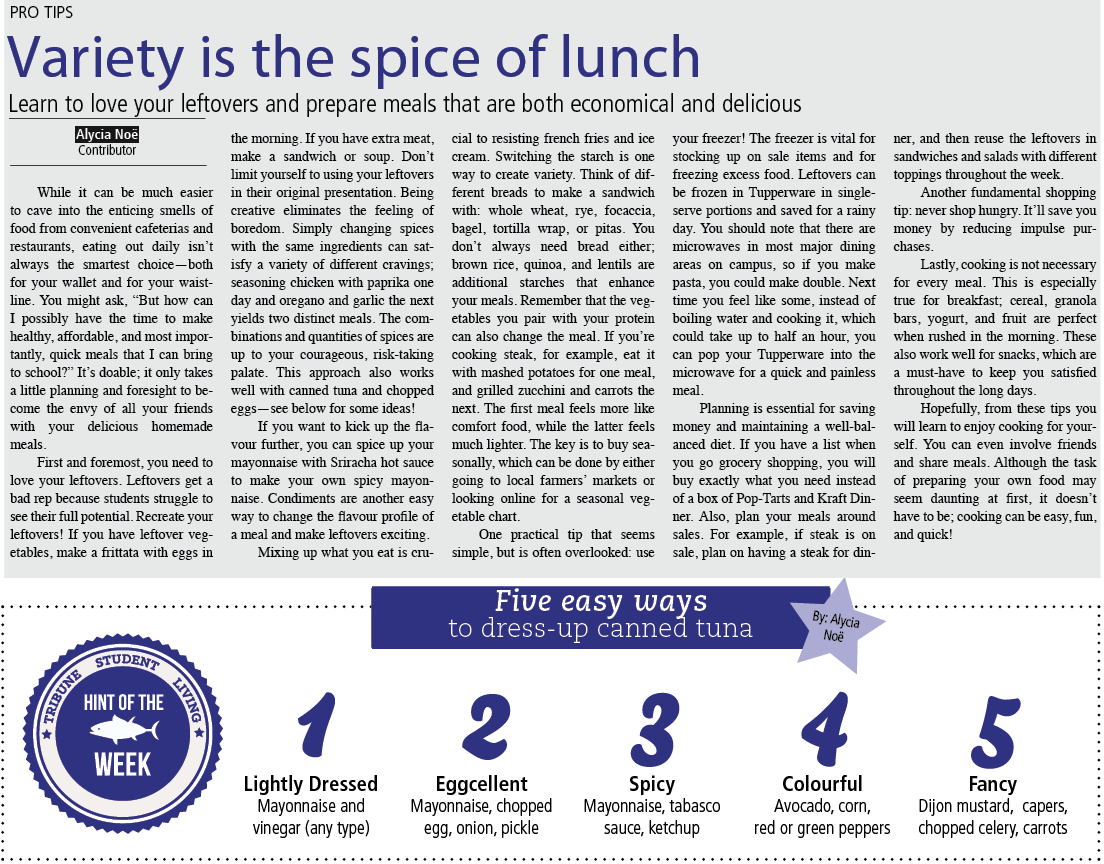
While it can be much easier to cave into the enticing smells of food from convenient cafeterias and restaurants, eating out daily isn’t always the smartest choice—both for your wallet and for your waistline. You might ask, “But how can I possibly have the time to make healthy, affordable, and most importantly, quick meals that I can bring to school?” It’s doable; it only takes a little planning and foresight to become the envy of all your friends with your delicious homemade meals.

First and foremost, you need to love your leftovers. Leftovers get a bad rep because students struggle to see their full potential. Recreate your leftovers! If you have leftover vegetables, make a frittata with eggs in the morning. If you have extra meat, make a sandwich or soup. Don’t limit yourself to using your leftovers in their original presentation. Being creative eliminates the feeling of boredom. Simply changing spices with the same ingredients can satisfy a variety of different cravings; seasoning chicken with paprika one day and oregano and garlic the next yields two distinct meals. The combinations and quantities of spices are up to your courageous, risk-taking palate. This approach also works well with canned tuna and chopped eggs—see below for some ideas!

If you want to kick up the flavour further, you can spice up your mayonnaise with Sriracha hot sauce to make your own spicy mayonnaise. Condiments are another easy way to change the flavour profile of a meal and make leftovers exciting.

Mixing up what you eat is crucial to resisting french fries and ice cream. Switching the starch is one way to create variety. Think of different breads to make a sandwich with: whole wheat, rye, focaccia, bagel, tortilla wrap, or pitas. You don’t always need bread either; brown rice, quinoa, and lentils are additional starches that enhance your meals. Remember that the vegetables you pair with your protein can also change the meal. If you’re cooking steak, for example, eat it with mashed potatoes for one meal, and grilled zucchini and carrots the next. The first meal feels more like comfort food, while the latter feels much lighter. The key is to buy seasonally, which can be done by either going to local farmers’ markets or looking online for a seasonal vegetable chart.

One practical tip that seems simple, but is often overlooked: use your freezer! The freezer is vital for stocking up on sale items and for freezing excess food. Leftovers can be frozen in Tupperware in single-serve portions and saved for a rainy day. You should note that there are microwaves in most major dining areas on campus, so if you make pasta, you could make double. Next time you feel like some, instead of boiling water and cooking it, which could take up to half an hour, you can pop your Tupperware into the microwave for a quick and painless meal.

Planning is essential for saving money and maintaining a well-balanced diet. If you have a list when you go grocery shopping, you will buy exactly what you need instead of a box of Pop-Tarts and Kraft Dinner. Also, plan your meals around sales. For example, if steak is on sale, plan on having a steak for dinner, and then reuse the leftovers in sandwiches and salads with different toppings throughout the week.

Another fundamental shopping tip: never shop hungry. It’ll save you money by reducing impulse purchases.

Lastly, cooking is not necessary for every meal. This is especially true for breakfast; cereal, granola bars, yogurt, and fruit are perfect when rushed in the morning. These also work well for snacks, which are a must-have to keep you satisfied throughout the long days.

Hopefully, from these tips you will learn to enjoy cooking for yourself. You can even involve friends and share meals. Although the task of preparing your own food may seem daunting at first, it doesn’t have to be; cooking can be easy, fun, and quick!


a, News

‘How’s My Froshing’ rings in McGill’s Orientation Week

Last week, McGill University’s annual Orientation Week included a new addition to the traditional festivities—a phone hotline initiative called ‘How’s My Froshing.’

‘How’s My Froshing’ is an automated phone and text service that allowed participants, leaders, staff, and coordinators of frosh to communicate in an efficient manner. The service immediately connectd callers to services such as Nightline, WalkSafe, DriveSafe, and the Sexual Assault Centre of the McGill Students’ Society (SACOMMS).

Phone numbers of every frosh participant, coordinator, and orientation leader were registered to the system before Orientation Week. The system automatically gave relevant information to callers, such as the events that were currently taking place on their calendars.

“The goal is to centralize our communication,” Brian Farnan, Students’ Society of McGill University (SSMU) VP Internal, said. “Any frosh leader, operation staff, coordinator, or executive member of respective faculties [is able] to text or call any frosh participant at any given time.”

“After having worked closely with frosh for many years, I saw that communication was crucial and could use a bit of extra support,” said Josh Redel, former-SSMU president and the programmer behind the hotline system.

Campus Life and Engagement’s Student Life Coordinator Mitchell Miller called the program a “customer service for frosh” and said the hotline served as a way to improve the inclusivity of Orientation Week.

“We’re trying to change the culture and come up with new initiatives,” Miller said. “We have a new project of inclusivity, sustainability, and community building.  So there is a cultural change in that froshes are more focused on how can every student—whatever they like to do for fun—find something welcoming and exciting about frosh and Orientation Week as a whole.”

According to Redel, the service is also a response to feedback that has been gathered from previous Orientation Weeks, and also provided instant feedback from participants in this year’s events.

“I think something like this empowers the community to be part of improving frosh,” Redel said. “The problem we have always faced in the past is the time between the actual event taking place and feedback being received [….] Our desire with this system is to be able to get feedback on-the-fly so as to more quickly incorporate changes as needed, and to be able to better assess comments in the moment as opposed to weeks or even months later.”

By the end of Orientation Week, a total of 5,365 calls to the How’s My Froshing hotline had been completed, for a total of 6,260 minutes of service. Of all calls, 1,048 were inbound calls; 4,942 were mass voice messages sent to leaders, operation staff, or participants; and 84 were connection calls, in which the hotline transferred to services such as McGill Security Services, DriveSafe, and WalkSafe.

In addition, 8419 SMS messages were sent or received. The majority of those were mass texts sent to leaders, operation staff, or participants.

Farnan expressed hope that the success of the program during its introduction this year demonstrates its potential for the future.

“We have both real time and long-term capabilities,” Farnan said. “We can respond to situations. If someone leaves a message, we can immediately act on it.  Also, we take the long-term into account, just adding another layer of surveying.”

Despite the numbers, however, not all students considered the service to be particularly useful during their frosh experience.

“I am not sure how many people would actually [use the] option,”  a first-year A=rts student who could not be identified said. “They told us about the number, but I haven’t even thought about it since to be honest.”

Miller, however, said he was optimistic for the future of the service.

“We had never done something like this before for Orientation Week, and there’s little precedence of anything like this at other campuses,” Miller said. “Looking at the data, I can only be excited by the numbers we got and more excited by how the system’s use can only expand and increase.”

a, Behind the Bench, Sports

Third man in: Reality checks in sport journalism

Thursday, April 25, 2013; the moment remains clear in my mind. The Los Angeles Clippers, led by my hero, Chris Paul, squared off against the Memphis Grizzlies in Game 3 of the first round of the NBA playoffs.

I had a vested interest in the Clippers taking it all the way, and the result seemed inevitable as Los Angeles held a two-game lead over their conference rivals. This was a big game, as 3-0 series advantages have an unsurprising historical precedent of yielding to the leader.

It didn’t hit me until midway through the fourth quarter that I was not actually watching the game. Rather than yelling at my team for falling into a nine-point hole, I stared blankly at the TV while pondering the implications of some sports article I had just read. The sacrilege of my actions didn’t hit me until later that evening as a grim-faced Paul addressed the media about the loss.

Click; scroll; scan.

Click; scroll; scan.

This is the daily rhythm of the sports journalist. The constant pursuit of knowledge through story lines is necessary for success in today’s 24/7, information-obsessed society. There is not a moment that goes by without Adrian Wojnarowski breaking news about the latest J.R. Smith mishap, or James Walker tweeting pointless Miami Dolphins quotes. We have turned the trivial into gold as we dig ourselves deeper into a stimulation-driven prison.

Analyzing sports has changed me. I can’t watch an NHL game without picking apart San Jose’s offensive spacing. Andrew Luck’s inability to step into the pocket no longer escapes my notice. I subconsciously analyze Chicago’s pick-and-roll defence every time they step on the floor.

I can’t see the game for the game plan, if you will. Diving deep into the world of analytical athletics has broken down the beauty of the game into binary X’s and O’s. The loss of the wonder and unadulterated joy that I used to feel while watching sports is a painful reminder of the hidden cost of sports journalism.

And yet, there are still those rare, transcendent games that you catch on TV which erase any mutinous thoughts. The Leafs and Bruins in Game 7. Novak Djokovic, one-seed, pushed to his limits by ninth-seeded Stanislas Wawrinka. The Miami Heat battling the San Antonio Spurs in one of the greatest finals in NBA history. These are the sporting events that break the shackles of media scrutiny. They remind you that sports will never be truly overshadowed by the media; sports transcend a 140 character limit or an expert’s analysis.

As with anything else in life, I think that reality checks are necessary when writing about sports. It is easy to get caught up in the analysis of professional athletes and forget about the love that drew us to sport in the first place. There is a fine balance between analyst and fan, and sports journalists must find it to maintain perspective.

That spring night when the Clippers fell to the Grizzlies was a crucial turning point for me. Los Angeles went on to lose the series eight days later, yielding to a dominant four-game run by Memphis. Perhaps it was because Zach Randolph found his rhythm. Perhaps Memphis realized that the Clippers were offensively inept beyond Paul. Perhaps I should have let my budding identity as a sports analyst continue to impartially analyze story lines for the collapse.

Or perhaps, I should just sit back and enjoy the game.

a, News

Quartier de l’Innovation projects aim to engage students

Plans for the Quartier de l’Innovation (QI) continue to progress since its official launch last May. A collaborative initiative of the Griffintown neighborhood, the project is designed to involve McGill and École de technologie supérieure (ETS), NGOs, and corporations, in a centre that drives research and innovation.

One development this summer was the creation of the QI Student Working Group (SWG) action plan, which will be presented at the end of September.

“At McGill, students are considered to be an integral part of the QI initiative and developing this district as a ‘playground’ where students can learn, experiment, research, work, and play is of utmost importance,” QI Project Director Isabelle Péan said. “That is why it was considered essential to develop a strategic communication-marketing action plan specifically targeted at increasing student involvement at McGill University within the QI and its vast variety of offered projects.”

Further opportunities for student interaction with development of the QI will arise throughout the year, according to Péan.

One such opportunity will be on Oct. 4, when McGill’s Social Equity and Diversity Education Office (SEDE) will host its annual Community Engagement Day—an event where students have the opportunity to volunteer in the Montreal community. This year, students will have the opportunity to work within the QI district.

“Specific activities will be organized in the QI district with the Horse Palace, Bâtiment 7, the Darling Foundery, and many others NGOs,” Péan said. “In addition, a walking tour concentrating on arts and history, as well as an open discussion on the main social issues in the district will be available for students to participate in.”

The QI consists of four pillars—categories under which various projects fall—of innovation: industrial, social and cultural, urban, and education and research. According to the QI Project Booklet, investments of around six billion dollars over the course of the decade combined with projects led by professors from both schools aim to develop the area into a modern district of learning and technology. Some planned events include CLUMEQ, “a research consortium for high-performance computing,” and C2-MTL, “an annual global conference exploring commerce and creativity.”

On the QI’s website, connections are drawn between the project and similar initiatives in other cities, such as 22@Barcelona and the Innovation District in Boston. Despite the similarities, Péan said there are fundamental differences that separate the QI from its international counterparts.

“Boston is a little bit younger [than Barcelona] and, for instance, their main focus is the industrial pillar,” Péan said. “QI is really a unique model. That’s also why we have so many challenges in bringing different projects related to our four pillars.”

Will Straw, a professor in the Department of Art History and Communications Studies at McGill, is leading the development of the Laboratory of Urban Culture. The project aims to set up space for collaborative research and art within the community. Straw said the project still faces a number of financial challenges.

“It would be great if funds could be found to rent or buy a cultural space [for the laboratory] for McGill in the Quartier d’Innovation, and we are exploring various alternatives, but we all know about the fiscal constraints facing McGill,” Straw said. “If we found and financed a space, McGill people would come, and that cultural activity could balance whatever high-tech and entrepreneurial activities might be part of the QI.”

Some members of the development team cite a lack of student support for their projects as another obstacle. Anita Nowak, a professor in the Faculty of Management, is leading the Social Economy Initiative, which “builds social entrepreneurship and social innovation into teaching, research and community activities.”

“I presented at a meeting last year to all the student union groups,” Nowak said. “I was surprised by the suspicion that the community of students had towards the QI project. It was considered quite top-down. That was just my reading of it.”

Nowak says students may be reassured to know that the QI is developing in a socially responsible manner.

“I know the players who’ve been involved and I know the intent is coming from a really sensitive place to honour the Quartier itself as it goes through a process of gentrification, to honour the history, to honour the community, [and] to be responsive to the community,” Nowak said. “Montreal is an absolutely amazing ecosystem to see this fluorish. I would invite students to look at the QI as an opportunity.”

Read the latest issue

Read the latest issue