Latest News

a, Opinion

Six ways to get involved in sustainability efforts next year

With the term winding down, thoughts turn to summer, the fall semester, and all the things that we didn’t get around to this academic year. Having been around McGill for way too long, I get to see a lot of what comes up and fades away from year to year. Here’s a list of meaningful ways to engage in sustainability around campus, all of which can provide tangible experiences and connections with interesting people around the community. McGill’s students pay me to work full-time for you so I’m 100 per cent willing to collaborate on any of these.

1. Curriculum—The time is ripe for a renewed conversation about sustainability in the content and delivery of undergraduate learning. We can actively challenge what we are learning about, and what skills and values we are acquiring here at McGill. For example, energy is an area of interest for many undergrad students, but learning opportunities are often scarce. Tweaking course evaluations, evaluating sustainability content in programs, and challenging professors, departments, and faculties to do better are all realistic activities that can be taken on.

2. New Principal —We often hear how the arrival of a new principal is one of the biggest opportunities for organizational change at a university. Students can help sculpt the principal’s entrance strategy. A community-signed letter to McGill’s incoming Principal, Suzanne Fortier, could be a powerful statement. Vision 2020, which is setting McGill’s sustainability strategy, has highlighted what many people in the community are saying and could make a decent template, but that doesn’t preclude any other issues from being brought forward as potential priorities.

3. Services—SSMU and other student governments house student-run services that do amazing work. There are too many to list, but getting involved at the Flat Bike Collective, the Sexual Assault Centre of the McGill Students’ Society (SACOMSS), Midnight Kitchen, or a media service can help maintain the foundations of this community.

4. Applied Student Research (ASR)—McGill is an academic institution, so take an academic approach to solving campus issues. It can get you course credit, and produce real changes on our campus. The McGill Food Systems Project (MFSP), a systematic multi-year ASR effort started in 2009 has studied where food on campus comes from, and works with McGill to bring better options to campus. The similarly-styled McGill Energy Project and McGill Waste Project, both formed in the last year, will tackle these on-campus issues through a combination of internships and coursework, and are a great way to get involved.

5. Investments—Here are five ideas that could be pursued: discussing with the McGill Investments Office about divestment and diversification (they’re really open to student involvement); setting up a McGill-specific carbon tax or cap system; brainstorming with peers and professors about how McGill could effect change through shareholder engagement; looking into a revolving loan fund for money and energy saving at McGill as an investment; and setting up a fund for greenhouse gas reduction research drawn from revenues from McGill’s tar sand investments.

6. Events—We don’t all have enough time to take on massive multi-year projects, but an event on a pertinent topic can begin a critical conversation around campus. There’s the Sustainability Research Symposium, Desautels Business Conference on Sustainability, the Green Groups Forum for student groups, the Sustainability Fair, workshops exploring equity and sustainability, SUS Green Week, Business Beyond Tomorrow Conference, and lots of other recurring events that need help with direction and organizing.

As you can see, there is a lot to get involved with, you just have to take the initiative. ASR is often the biggest win-win for getting involved as a student; extra-curricular activities become core curriculum. I’m around in the summer and fall to help make it happen.


David Gray-Donald

SSMU Sustainability Coordinator

BA&Sc 2010, Environment, Biology

[email protected]

Yuqing Song
a, Opinion

Making a mockery of a beautiful language, province

Scandal has arisen in Quebec with recently implemented and newly enforced language laws, making the province—as The Globe and Mail put it—an “international laughingstock.” The incidents were minor but absurd, such as forcing an Italian restaurant to change “pasta” on its menu to its French equivalent. To someone who is not from Quebec, the government’s enforcement appears radical and perplexing to say the least, as it tenaciously holds onto laws that do more harm than good. However, with Bill 14, the fourth piece of legislation of its kind aimed at restricting the use of non-French languages, the situation is no longer a laughing matter.

Quebec’s long-held obsession with language restrictions stems from its staunch interest in the protection of the French language. This pursuit, however, has come at the cost of other aspects of its culture, and arguably, the province’s own reputation. So what do outsiders think when they see Quebec portrayed through the “if it bleeds, it leads” apparatus we call mass media? Unfortunately, it is typically hardline separatist rhetoric, the “language police,” and radical protests.

The province doesn’t seem to understand that while utility is one reason why people learn new languages, interest in that language is also important. What it has been trying to do with Bills 22, 68, 101, and now, 14, is to make French vital for survival, so that people have no choice but to study it. The government can’t seem to grasp that North America is a mobile society.  Quebec is a French island—people can leave in nearly any direction. Montreal, once the top economy in Canada, has long ago ceded that title to Toronto. Quebec has lost, and is still losing, its businesses and top-notch people to the rest of Canada on top of an ongoing brain-drain to the U.S.

The current situation in Quebec is, sadly, that little good publicity is coming out, and little talent is flowing in. Culturally too, the province suffers, trapped in a paradox where making its culture more accessible to the rest of the continent, and making any attempt at cultural export would mean relaxing its language regulations, which it considers imperative to protecting its culture.

It seems at times that Quebec is trying so hard to distinguish itself from the rest of Canada, that its behaviour tends towards the irrational. The new Bill 14 is only making things worse, creating a real “language police” that had existed only in mockery during the time of its predecessor, Bill 101. With this new legislation that would “require the production of any book, account, record, file or other document,” and allow a language inspector access to anything that “may prove the commission of an offence,” these measures aimed at protecting the French language seem to be quickly getting out of control.

(Remi Lu / McGill Tribune)
a, Arts & Entertainment

McGill’s English department brings Shakespeare to life

With endless exams and essays currently stretching out before us, nothing feels farther away than summer. Fortunately, the McGill English Department’s production of Shakespeare’s A Midsummer Night’s Dream provides a glimpse of the warmer months to come.

The show sparkles with youthful enthusiasm, and features a cast comprised of the Acting Lab, a class taught by Sean Carney, associate professor in the English department. The acting is the best part of this production, closely followed by its stunning set design.

Carney switches the genders of three of the four lovers in this production, giving it a refreshingly contemporary flavour: Lysander is Lysandra, Hermea is Hermeus, and Demetrius is Demetria.

As a result, the love affairs cross all boundaries with the introduction of a lesbian relationship between Helena and Demetria. For those who know the play, this gender reversal can be confusing at times; but it also creates an excellent contemporary layer.

Accordingly, the cast also revolves; many of the actors switch roles on alternative performance nights.

The costume team—helmed by Catherine Bradley and the students of the Costuming II course—should be commended for its use of textures and contrasting colours, which highlight the two worlds of the play: the Athenians and ‘Mechanicals’, and the fairies.

Although the pacing of the production lags a little at the beginning, once the lovers and Puck (vibrantly played by Stevie Pemberton) enter the forest, it picks up.

The set in the forest scenes has multiple levels, allowing the actors to directly interact with the tree onstage, often clambering over and through it. At times, however, these movements can appear clumsy and unrehearsed.

Lighting transitions aid in the deft switches between Athens and the forest. The production’s sound effects also enhance the audience’s understanding that many of the main characters are spellbound at some point or another.

Jillian Cameron gives an intriguing performance as star-crossed lover Helena. She portrays Helena’s jealousy and confusion skilfully, and gives the character a sassy twist that is relatable for a modern audience.

(Remi Lu / McGill Tribune)

However, Stephanie Zidel’s hilarious portrayal of Nick Bottom is the standout performance in the show. She uses a mixture of physical comedy and clever acting to provoke laughter from the audience. The ‘Mechanicals’ (Elizabeth Brennan, Julien Dinerstein, Hannah Kirby, and Eléonore Buchet-Déak) are also entertaining; and their surprise, deadpan dance at the end of the play lifts the dwindling plot into a redeeming realm.

All in all, this production of A Midsummer Night’s Dream injects newfound enthusiasm into a popular play. Professor Carney, your students all deserve As for their enthusiastic, vibrant performances.


A Midsummer Night’s Dream runs from Apr. 11 to 13, 7:30 p.m., at Moyse Hall. Tickets $10.

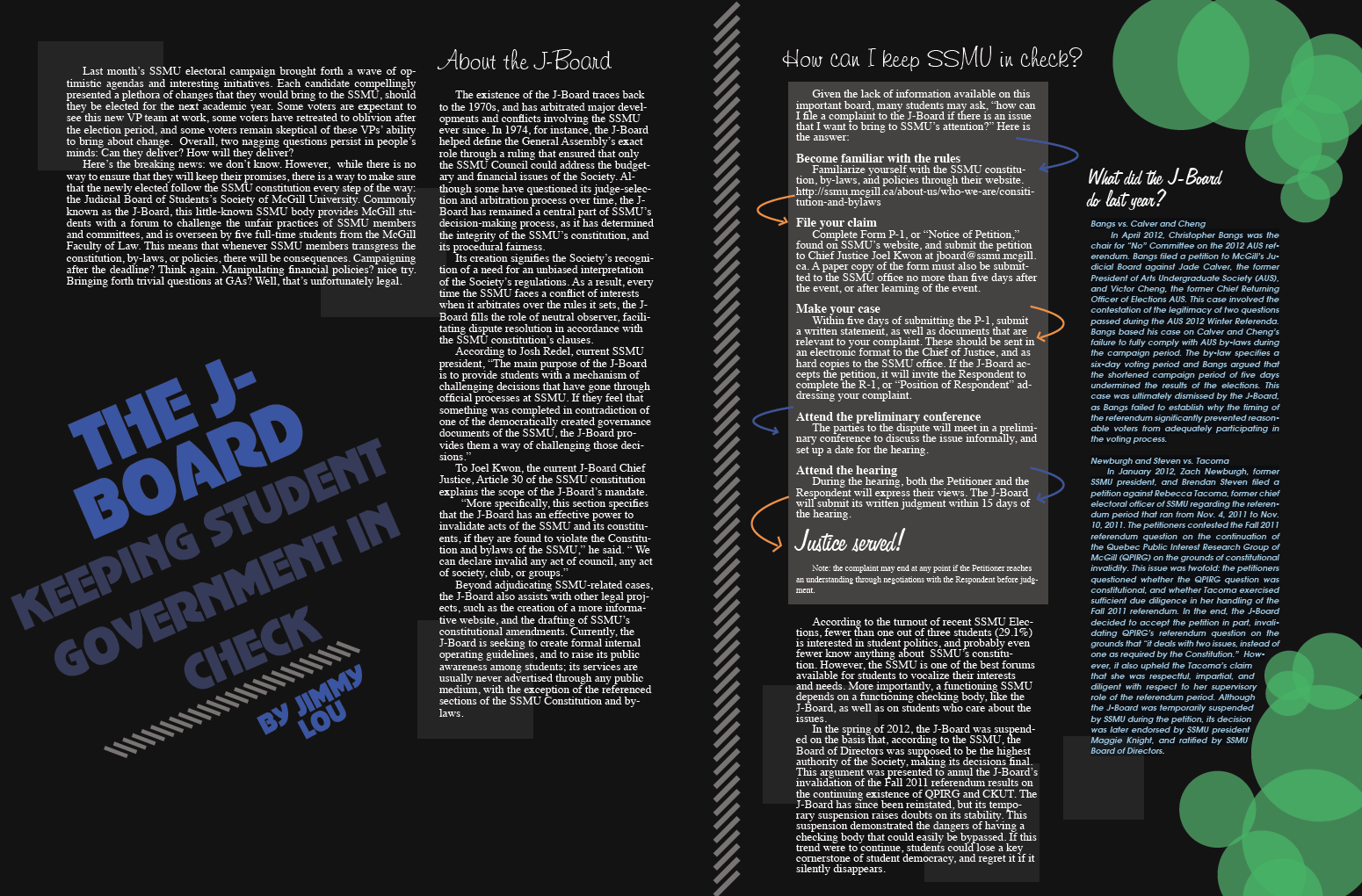
Check out our full Feature spread! (Click to enlarge)
a, Features

The J-Board: keeping student government in check

Last month’s SSMU electoral campaign brought forth a wave of optimistic agendas and interesting initiatives. Each candidate compellingly presented a plethora of changes that they would bring to the SSMU, should they be elected for the next academic year. Some voters are expectant to see this new VP team at work, some voters have retreated to oblivion after the election period, and some voters remain skeptical of these VPs’ ability to bring about change.  Overall, two nagging questions persist in people’s minds: Can they deliver? How will they deliver?

Here’s the breaking news: we don’t know. However,  while there is no way to ensure that they will keep their promises, there is a way to make sure that the newly elected follow the SSMU constitution every step of the way: the Judicial Board of Students’s Society of McGill University. Commonly known as the J-Board, this little-known SSMU body provides McGill students with a forum to challenge the unfair practices of SSMU members and committees, and is overseen by five full-time students from the McGill Faculty of Law. This means that whenever SSMU members transgress the constitution, by-laws, or policies, there will be consequences. Campaigning after the deadline? Think again. Manipulating financial policies? nice try. Bringing forth trivial questions at GAs? Well, that’s unfortunately legal.


About the J-Board

The existence of the J-Board traces back to the 1970s, and has arbitrated major developments and conflicts involving the SSMU ever since. In 1974, for instance, the J-Board helped define the General Assembly’s exact role through a ruling that ensured that only the SSMU Council could address the budgetary and financial issues of the Society. Although some have questioned its judge-selection and arbitration process over time, the J-Board has remained a central part of SSMU’s decision-making process, as it has determined the integrity of the SSMU’s constitution, and its procedural fairness.

Its creation signifies the Society’s recognition of a need for an unbiased interpretation of the Society’s regulations. As a result, every time the SSMU faces a conflict of interests when it arbitrates over the rules it sets, the J-Board fills the role of neutral observer, facilitating dispute resolution in accordance with the SSMU constitution’s clauses.

According to Josh Redel, current SSMU president, “The main purpose of the J-Board is to provide students with a mechanism of challenging decisions that have gone through official processes at SSMU. If they feel that something was completed in contradiction of one of the democratically created governance documents of the SSMU, the J-Board provides them a way of challenging those decisions.”

To Joel Kwon, the current J-Board Chief Justice, Article 30 of the SSMU constitution explains the scope of the J-Board’s mandate.

“More specifically, this section specifies that the J-Board has an effective power to invalidate acts of the SSMU and its constituents, if they are found to violate the Constitution and bylaws of the SSMU,” he said. “ We can declare invalid any act of council, any act of society, club, or groups.”

Beyond adjudicating SSMU-related cases, the J-Board also assists with other legal projects, such as the creation of a more informative website, and the drafting of SSMU’s constitutional amendments. Currently, the J-Board is seeking to create formal internal operating guidelines, and to raise its public awareness among students; its services are usually never advertised through any public medium, with the exception of the referenced sections of the SSMU Constitution and by-laws.

According to the turnout of recent SSMU Elections, fewer than one out of three students (29.1%) is interested in student politics, and probably even fewer know anything about  SSMU’s constitution. However, the SSMU is one of the best forums available for students to vocalize their interests and needs. More importantly, a functioning SSMU depends on a functioning checking body, like the J-Board, as well as on students who care about the issues.

In the spring of 2012, the J-Board was suspended on the basis that, according to the SSMU, the Board of Directors was supposed to be the highest authority of the Society, making its decisions final. This argument was presented to annul the J-Board’s invalidation of the Fall 2011 referendum results on the continuing existence of QPIRG and CKUT. The J-Board has since been reinstated, but its temporary suspension raises doubts on its stability. This suspension demonstrated the dangers of having a checking body that could easily be bypassed. If this trend were to continue, students could lose a key cornerstone of student democracy, and regret it if it silently disappears.


How can I keep SSMU in check?

Given the lack of information available on this important board, many students may ask, “how can I file a complaint to the J-Board if there is an issue that I want to bring to SSMU’s attention?” Here is the answer:


Become familiar with the rules

Familiarize yourself with the SSMU constitution, by-laws, and policies through their website. http://ssmu.mcgill.ca/about-us/who-we-are/consititution-and-bylaws


File your claim

Complete Form P-1, or “Notice of Petition,” found on SSMU’s website, and submit the petition to Chief Justice Joel Kwon at [email protected]. A paper copy of the form must also be submitted to the SSMU office no more than five days after the event, or after learning of the event.


Make your case

Within five days of submitting the P-1, submit a written statement, as well as documents that are relevant to your complaint. These should be sent in an electronic format to the Chief of Justice, and as hard copies to the SSMU office. If the J-Board accepts the petition, it will invite the Respondent to complete the R-1, or “Position of Respondent” addressing your complaint.


Attend the preliminary conference

The parties to the dispute will meet in a preliminary conference to discuss the issue informally, and set up a date for the hearing.


Attend the hearing

During the hearing, both the Petitioner and the Respondent will express their views. The J-Board will submit its written judgment within 15 days of the hearing.


Justice served!


What did the J-Board do last year?

Bangs vs. Calver and Cheng

In April 2012, Christopher Bangs was the chair for “No” Committee on the 2012 AUS referendum. Bangs filed a petition to McGill’s Judicial  Board against Jade Calver, the former President of Arts Undergraduate Society (AUS), and Victor Cheng, the former Chief Returning Officer of Elections AUS. This case involved the contestation of the legitimacy of two questions passed during the AUS 2012 Winter Referenda. Bangs based his case on Calver and Cheng’s failure to fully comply with AUS by-laws during the campaign period. The by-law specifies a six-day voting period and Bangs argued that the shortened campaign period of five days undermined the results of the elections. This case was ultimately dismissed by the J-Board, as Bangs failed to establish why the timing of the referendum significantly prevented reasonable voters from adequately participating in the voting process.


Newburgh and Steven vs. Tacoma

In January 2012, Zach Newburgh, former SSMU president, and Brendan Steven filed a petition against Rebecca Tacoma, former chief electoral officer of SSMU regarding the referendum period that ran from Nov. 4, 2011 to Nov. 10, 2011. The petitioners contested the Fall 2011 referendum question on the continuation of the Quebec Public Interest Research Group of McGill (QPIRG) on the grounds of constitutional invalidity. This issue was twofold: the petitioners questioned whether the QPIRG question was constitutional, and whether Tacoma exercised sufficient due diligence in her handling of the Fall 2011 referendum. In the end, the J-Board decided to accept the petition in part, invalidating QPIRG’s referendum question on the grounds that “it deals with two issues, instead of one as required by the Constitution.” However, it also upheld the Tacoma’s claim that she was respectful, impartial, and diligent with respect to her supervisory role of the referendum period. Although the J-Board was temporarily suspended by SSMU during the petition, its decision was later endorsed by SSMU president Maggie Knight, and ratified by SSMU Board of Directors


(Cassandra Rogers / McGill Tribune)
a, Science & Technology

Looking ahead

One of the most highly sought-after experiences for undergraduate science students is the elusive ‘lab job.’ There is no doubt within McGill’s Science student body that a lab research position is one of the most essential additions to your CV and med school application. Although working in a lab is just one of many factors that could help one receive admittance into graduate school, it is definitely a valuable experience.

The range of research at McGill today covers a broad range of exciting new domains, such as genomics and proteomics, and nanotechnologies, as indicated on McGill’s Research and International Relations webpage.

Despite the multitude of labs and the variety of research conducted at McGill, undergraduate students still find it increasingly difficult to obtain a research position. This experience is not surprising. Undergraduate students, particularly U0 and U1 students, are competing with upper level undergraduates, as well as graduate and PhD students—many of whom have previous lab experience, and are more specialized in the field. Not to mention, many find the process intimidating, as students must often contact professors who they have never met before, and ask them about job availabilities.

While there is no foolproof formula that will secure a research position—the process varies for every student—there are definitely some critical steps to becoming more involved in a lab.


Make Contact

While some professors prefer students to contact them in person about research opportunities, email is a useful tool in presenting yourself to researchers and inquiring about opportunities. The email is one of the trickiest parts in the process, because you have to juggle showing interest in someone’s research while presenting yourself and your qualities­—all without writing a novel. While every professor has his or her own preference, those I spoke with indicated that showing a genuine interest in someone’s research, as opposed to simply asking about job availability, makes you stand out. This means do your homework, and spend some time looking into someone’s research before you inquire about becoming involved in their lab.

Victor Chisholm, undergraduate research officer, acknowledges there are benefits to applying in pereson as well.

“Talk with a professor in person, either after class or during office hours, try to do so; this will be a much richer exchange than by email.”

“Whether you make contact by email or in person, show the professor why he or she should be interested in you,” Chisholm continued. “Show interest in and familiarity with his or her research, and also your relevant skills and courses. Non-academic skills count too; for example, if you had a summer job fixing cars, your mechanical aptitude could be an asset in an experimental physics lab.


When to Apply

Although there is no designated time to apply for a lab position, certain points in the year have higher hiring rates. According to Chisholm, professors should be contacted about one semester in advance, and a little earlier than that for the Summer. In the Summer there are research awards, such as NSERC, USRA/FRSQ, and USRA/SURA, which have deadlines in February and March, so many students begin contacting professors in November and onwards.

Chisholm also mentions that an advantage of starting too early is that if professors say, “it’s too early,” or you speak with a professor that says no, you can follow up with questions like:  ‘When is a good time to ask again? What do you look for in a student? Are there specific courses I should take or skills that I should develop?’

“That way, you can turn what seems like a failed inquiry into something useful,” said Chisholm.


When someone says “No”

There are very few undergraduate students that I have encountered who are working for the first professor that they contacted. Every professor has a different skill set that they are looking for, and there is no guarantee that their lab will even have an opening, or the funding to take on another student. Even if the professor is looking for an addition to his or her lab, it might just not be the right fit.

Researcher and associate professor Dr. Andrew Hendry suggested to contact as many professors as possible, and most importantly, to be persistent. What separates the students who are successful in acquiring lab jobs from those who are not is the fact that many of those students working in labs had to email ten, twenty, thirty different professors before they found their positions. While it will be hard to receive many “No’s,” continuing to pursue such a position will pay off in the long run.


Some Last Words of Advice 

Chisholm acknowledges that finding a lab position is a different experience for every student, so keep in mind there is no universal way to proceed. He adds,

“Keep talking! Do not rely solely on lists of specific research opportunities you might find; they represent only the low-hanging fruit, and everyone else is also chasing after them. Many professors do not advertise; they do not have to, because enough talented students come spontaneously to them. Soup and Science, held at the start of the Fall and Winter terms, is a great way to learn more about science research at McGill, and to meet cool profs.”


Why do it? 

Though lab research serves as an asset to your CV, research is not an easy job. It takes patience, diligence, and, perseverance. Professors at McGill are highly dedicated to their work, and want lab members who are also invested.

That being said, working in a lab provides an incredibly unique and worthwhile experience. Tribune contributor and U1 science student Kieran Steer noted that it gives him the opportunity to perform a lot of the procedures he is studying in school, which makes school a lot easier.

“It also gives me career insight about ups and downs for research as a career. The job in the lab really helped shape my career objectives,” added Steer.“Overall, it’s pretty cool to put into practice what we learn in school. It can get really boring writing about ‘DNA strands separating upon heating and then annealing to a complementary probe.’ With a lab job, mundane notes like that turn into insightful, active learning like, ‘that makes sense, that’s how the machine works when we run PCR!’ I can see the applications of what I’m learning, which makes university fascinating both in the lab and in the lecture hall.”


(Wendy Chen / McGill Tribune)
a, Arts & Entertainment

Neither a lender nor a borrower be: Financing McGill theatre

McGill dramatists are, by necessity and by definition, a passionate group. Unpaid as student artists, unrecognized in a frequently desolate and fine arts-free environment, passion is often all they have. Despite these conditions, they have thrived. Productions that fly under the radar still sell out. Shows rivaling those on professional Montreal stages grace McGill’s spaces. Underneath the academic, adamantine exterior of this university lies lively and talented artistry.

Although they soar high, student theatre companies nevertheless carry earthly burdens. Theatres must plan and manage their finances to ensure their group’s continued success. To create the fictional universes they present on stage, groups such as Players’ Theatre and the Arts Undergraduate Theatre Society (AUTS) endure an annual ritual of bean-counting and penny-pinching. Their experiences may not be wholly representative of every student theatre group on campus, but the challenges that one company endures, and the success enjoyed by the other, exemplify the difficulties—and rewards—that McGill theatre faces.


Shared challenges

Each company puts on productions in the hopes of tugging at heartstrings, but also at wallets. While actors nervously recite lines and rehearse scenes before opening night, the executives in charge of financing shows anxiously cross their fingers in the hopes of a good turnout.

“We depend on ticket sales as our largest and most consistent source of revenue,” says Hannah Wood, AUTS producer. The same holds true for Players’ Theatre.

“Our audiences are mostly students,” says Fiona Penny, executive director of Players’ Theatre. “Maybe 10 or 15 per cent are … people outside McGill.”

Players’ Theatre makes efforts to expand their reach to the community beyond McGill through radio shows, and cultivating ties with charities and other theatres. But they never forget students as their most important base of support.

“This year, our publicity director got one of the English professors to make it part of the syllabus that their whole Shakespeare class had to come see Macbeth,” says Penny, referencing their last production this year. The arrangement makes the productions by students, for students, even if attendance isn’t exactly voluntary.

“Some of them [attend] willingly, some of them not so willingly,” she laughs.

However, dependence on ticket revenue leaves theatres vulnerable early on.

“Most expenses in theatre are paid up front before the show, and ticket revenue only comes in afterwards,” says Wood. “Students in our production are expected to front money out of their own pocket. It’s unfortunate, but it was absolutely necessary with the state of our funding.”

This leads to what Wood diagnoses as the biggest problem AUTS faced this year.

“It is ludicrous to expect students to throw thousands of dollars of their own money into a production with no set guarantee of being reimbursed,” she says, referencing the unpredictable nature of ticket revenues.


Differing circumstances

Players’ Theatre faces the same problem. Because the company is registered as a SSMU student service, its financial situation is significantly more secure than AUTS’.

“It’s kind of a weird system,” Penny admits. “Our budget is outlined at the start of the year. However [much] we spend, we get reimbursed from SSMU; and all the money we make, we give back to SSMU. So we draw from the common pot of SSMU, and we put back that money.”

The upside to financial symbiosis with SSMU is peace of mind. Asked whether she is concerned about securing future revenue, Penny responds, “In certain ways, no.”

“In terms of the money we spend, it gets refunded through SSMU,” she continues. “If we don’t do well on a show—obviously you want to keep the books balanced—but it’s not like we only get to spend as much money as we make.”

Players’ financial comfort makes for a stark contrast with AUTS’ uncertainty. For the latter, accounting is a hair-pulling, nerve-shattering experience.

“Every year is a guessing game,” laments Wood. “We always start the year concerned about revenue, as nothing is guaranteed.”

The varying structure of each theatre company’s finances also results in widely different experiences for their directors. For Players’ Theatre, the directors are expected to fundraise on their own, and front the money for productions out of their own pockets; but they have an extra blanket of security in the form of SSMU reimbursements. They also have a clear line drawn in terms of limits to their financing.

“We have a standard budget for each show, which is $500, with the option of extending that upwards of $100 if [directors] need it,” says Penny.

“What [directors] do is they submit receipts, and then they justify them … and then what we do is we submit them to SSMU,” adds Samantha Leriger, Players’ finance director.

For AUTS however, directors are left hanging if their production doesn’t succeed.

“The main source of our revenue, ticket sales, only comes after everything has been paid for,” notes Wood. “Having funds to start out our year would certainly help with this problem.”

This concern resulted in a referendum question levying a $1.00 fee for every full-time and $0.50 fee for every part-time student enrolled in a BA program, which passed with 72.1 per cent support on March 22.

According to McGill Enrolment Services, there were a total of 6,993 full- and part-time students enrolled in a BA in Fall 2012.


An indeterminate future

Despite AUTS’ success at the ballot box, its finances nevertheless remain under pressure.

“This new source of funding does not guarantee our financial stability,” says Nora Fleury, VP External for AUTS, “The goal of the levy was to eliminate the private donations portion of our budget.” She emphasizes that AUTS will still remain dependent on uncertain and fluctuating revenues from grants and ticket sales.

Furthermore, the money to be generated by the levy pales in comparison to AUTS’ expenditures.

“The cost to rent [Moyse Hall] takes up over half of our budget,” admits Fleury.

Wood estimates this amount to be approximately $20,000.

In aiming to replace, rather than supplement private donations with a student fee, AUTS is trying to secure current levels of funding, rather than to increase  revenue. This leaves deeper questions about AUTS’ finances up in the air.

According to Wood, AUTS is able to carry “a few thousand dollars” over from previous years, which, she admits, “is a small amount.”

However, though Fleury mentions “moments where it seemed like we would not make enough money to put on the show,” she concedes that “ticket sales covered all our costs.”

Players’ comparative success and financial security raises perplexities of a different sort.

“As a SSMU service … we don’t want to make a profit,” says Leriger. “Players’ Theatre often makes a profit, usually, but SSMU kind of encourages us not to, to be honest.”

“I worry sometimes because I don’t know where our surplus goes in SSMU,” she adds.

SSMU Vice-President Clubs and Services Allison Cooper suggests a somewhat different relationship.

“The main SSMU operating budget would never dip into a service’s own department; any profits they make stay within the Players’ budget, and would not be allocated elsewhere,” she says.

SSMU Vice-President Finance and Operations JP Briggs confirms this, saying, “[Players’ Theatre] operate[s] from their own revenues…. All services keep their money on an annual basis except in the case of a year end deficit.”

Confusions aside, all involved would agree that Players’  Theatre is pulling its own weight in the ecosystem of SSMU clubs. Players’ profitability may eventually serve to fuel its continued growth—perhaps in either the number or size of their productions—but for now, they seem content to rest on their laurels.

“SSMU asked us this year, recently, if we wanted to apply a student fee directly for our theatre,” says Penny.

“We declined,” interjects Leriger.

“I think right now, the system is working for us,” concludes Penny.

Both companies seem optimistic about their future—Players’ bolstered by a successful season, and AUTS celebrating their recent referendum win. Both are also excited to see what a host of new executives will bring to the stage. Only time will tell if financial drama—whether misgivings about profit allocation, or more serious budget crises—will interfere with their companies’ efforts to put on shows.


a, Arts & Entertainment

Interview with Armin van Buuren

What’s it like to be the world’s number one DJ? One could look for the answer in Dutch trance producer Armin van Buuren’s latest single “This Is What It Feels Like,” which was released on his fifth studio album, Intense, on Apr. 3. The song features Vancouver singer Trevor Guthrie over a steady progression of melodic synths.  Although its lyrics speak of a breakup, it’s an upbeat track, and feels celebratory in the wake of van Buuren’s achievements. These include gaining the no. 1 spot in DJ Mag’s top 100 poll a record five times, including last year; and hosting one of the world’s most widely listened-to radio shows,  A State of Trance.

Van Buuren’s specialty is trance music, which is characterized by sweeping melodic layers and emotional buildup, and often mixed into longer sets, hence the popularity of his two-hour radio show.

“I do like my set to have a certain flow, so I’m trying to give my set a feeling that it doesn’t stop, that it’s one continuous thing,” he says, after headlining the Easter weekend’s Bal en Blanc show. The concert is an all-night, all-white celebration of electronic music, and one of this year’s largest so far, attracting 15,000 attendees.

“Bal en Blanc is almost a religious thing for people in Montreal; it’s such an important event,” says van Buuren. “It’s one of the remainders of the great times here in Montreal when I played a lot here; 2003, 2004, 2005…. Bal en Blanc still proves that Montreal is one of the great cities to play for.”

Just don’t call it a ‘rave.’

“I don’t think the term ‘raves’ even applies anymore to these kinds of events, because ‘rave’ has a bad taste about it,” says van Buuren. “A lot of people associate the word ‘rave’ with drug use and all those kinds of things, and I don’t use any drugs myself. I drink a glass of champagne—that’s what I did last night.”

Even though van Buuren loves playing in Montreal, he was still excited about being the first Dutch performer to play at New York City’s Madison Square Garden, where he appeared the night before Bal en Blanc as part of his A State of Trance tour. He is also the second electronic dance music (EDM) act to ever sell out the venue.

Over the years, Buuren has built a wide international audience.

“I’m sort of making it my thing to go to new cities every year,” he says. “Why do I do this? I do this because I believe in the love for music … and I’m in a position to break new territory with A State of Trance; with the sound.”

With committed fans worldwide, trance as a genre is still going strong 20 years after originating in Germany in the ’90s. But its surging popularity also dovetails with its umbrella genre of EDM, which has emerged as a major force in mainstream top 40 charts. French DJ David Guetta, who snatched the 2011 no. 1 title in DJ Mag, breaking van Buuren’s four-year winning streak, has released songs such as “Titanium” and “Turn Me On,” which topped international charts last year. Can trance music, especially poppier tracks such as van Buuren’s “This Is What It Feels Like,” ride the EDM wave to the top?

“I’m not gonna lie, I would be happy if the track does well on the charts, but it wasn’t made for that—that’s a big, big difference,” van Buuren says. “And I want to stress the rest of the album, Intense, is not like that. The whole album is a pretty varied album with instrumental tracks, a lot of influence from classical music and different kinds of electronic music. But the main sound is trance, for sure.”

There certainly seems to be a hardcore group of trance purists that keep the genre distinct. At Bal en Blanc, there were two rooms: a main room, and a trance room. Guetta’s remix of “This is What It Feels Like” has a 1:3 ratio of likes to dislikes on YouTube, with van Buuren fans deriding the poppy electro mix in the comments. But perhaps van Buuren’s success lies in balancing the widespread appeal of his music with his loyalty to his favourite genre.

“I know that the trance family’s a pretty tight community, and you’re not really allowed to step beyond those borders—at least that’s how some people view it,” he says. “I don’t like to limit myself to one style, to one genre, to one particular thing. I want to have the creative freedom to do whatever I want to do.”

a, Arts & Entertainment

Banging one’s head against the wall: a documentary

While Bill Stone’s directorial debut Triumph of the Wall is a testament to the hard work and passion of its subjects, the documentary ultimately does not translate into a cohesive and thought-provoking film. Stone’s first foray into the world of documentary filmmaking is more of a scatterbrained connection of poetic thoughts than a streamlined and insightful film. While there is a definitely a duality between Stone and the subject of his film—the mysterious Chris Overing—it is unfortunately not enough to save the documentary from serious detractions such as its monotonous pace and its enigmatic subject.

Triumph of the Wall is the story of two men who each embark on labours of love; for Stone it is his documentary, and for Overing, it is a dry stone wall that is planned to span 1,000 feet over a vast property in rural Quebec. Brought together by pure chance, these two men, both novices in their fields, originally reason that their ventures will take eight months. However, Stone’s documentary takes place over the course of eight years, highlighting moments of utter weakness and insecurity, as well as moments of creative brilliance. Although the film suffers from a few deficiencies, the passion evident in the work of Stone and Overing is undeniable.

Right off the bat, the film establishes a slow pace that remains for its duration, effectively taking away from the impassioned work of Stone and Overing. Additionally, this monotony does not help the relatively dull subject matter of constructing a dry stone wall in rural Quebec. Overing, the film’s subject, is correctly described as “a mental explosion,” and his frenetic nature, while amusing at times, ultimately distracts the audience from the bigger picture.

The editing in Stone’s debut documentary appears sloppy at times. There are instances where voiceovers fade out too quickly, or there is an excess amount of background noise in a shot. However, this may be because it is Stone’s first time in the director’s chair. To be fair, Stone acknowledges his own shortcomings in a scene where he chronicles the first interviews with Overing and his inability to ask the “right” questions.

While the film attempts to appeal to the fervent artist in all of us, its excessive running time, monotonous pace, and overwrought subject disable this intended purpose. Described as a “manifestation of Generation Y,” the film tries to connect Stone and Overing’s indecisive journeys to an entire generation. Granted, while the film’s purpose is relatable, the execution nevertheless reduces the impact. Upon completion of the documentary, Overing’s wall is not finished, and Stone is left with an aimless film. Where the purpose of a documentary is to shed light on a certain subject and provide significant exposition, Stone fails. Instead, he provides us with an insight into his adrift mind and evokes feelings of pity rather than awe. Suffice to say, this film is not a triumph.


Triumph of the Wall opens Apr. 12 at Cinèma Excentris (3536 Boul. St-Laurent). Student tickets $9.25.

Wavves: Afraid of Heights (Warner Music)
a, Arts & Entertainment, Music

Wavves: Afraid of Heights

From their name, to their aesthetic, to their music and lyrics, San Diego-based Wavves exemplifies surf rock. But where can one go, after naming their third album King of the Beach (2010)? Their fourth release Afraid of Heights answers that question with a series of tracks that infuse their typical surf rock style with contemplative lyrics and some experimental instrumentation.

Don’t be fooled by the first minute of album opener “Sail to the Sun,” which starts off sounding like the band decided to trade in their surfboards for cheery glockenspiels. This fake-out introduction quickly gives way to Wavves’ signature surf-rock sound, complete with crashing guitar riffs, thumping drums, and songwriter/vocalist Nathan Williams’ loud, punchy vocals.

While Wavves is a surf rock band, Afraid of Heights is not merely a collection of fast, catchy songs. Like the tide, the album has moments of high-speed intensity interspersed with slower, more textured tracks, including the cello-tinged “Dog” and album closer “I Can’t Dream,” which crescendos from a lo-fi guitar ballad into a full-bodied conclusion. The album’s biggest shortcoming is its inclusion of shorter tracks, such as “Mystic” and “Beat Me Up,” which end before they have a chance to go anywhere, and occasionally come off as filler.

Afraid of Heights is a step—or is it a paddle?—in the right direction for Wavves,  experimenting with the band’s typical catchy surf rock sound to demonstrate a potential for something more layered and complex.

Akron/Family: Sub Verses (Secretly Canadian)
a, Arts & Entertainment, Music

Akron/Family: Sub Verses

Ranging from creepy, melancholic songs, to energizing anthems and droning ballads, the experimental rock band Akron/Family’s seventh album Sub Verses intrigues the listener with layers of repetitive sound, rewarding them with each additional listen.

The album starts off alarmingly loud and captivating, surrounding the listener with many sounds that together, become a mesmerizing syrup that captures and directs attention. Each individual track is long and repetitive, yet altogether intriguing, as elements fade in and out. Each track possesses individual energy, which elicits unique responses.

Akron/Family started out as a folk band, but over the years, their sound moved away from this identity when they tried out different genres and searched for what fit them best. This album marks a large step in the rock and electronic direction, but still retains folk elements, such as vocal melodies.

The track “Sometimes I” stands out from the other tracks with its intense eeriness. It emphasizes chilling vocals, a slow, shrill violin, and echoing bass for five minutes, as it slowly transports you to a foggy graveyard at midnight with a full moon. Thankfully, the other songs are not nearly as terrifying, but they still possess a bit of lingering, intangible gloominess that darkens the album in all the right ways. However, the album is in no way depressing; the noisy guitar keeps most tracks upbeat.

With isolating headphones and a calm place to lie down, this album can capture the listener’s entire consciousness, and take them on an entertaining journey.

Read the latest issue

Read the latest issue