

Latest News

Players’ MDF runs Apr. 10 to 13. (Wendy Chen / McGill Tribune)
a, Arts & Entertainment

All McGill’s a stage for Players’

The onset of April is a time where many McGill students find themselves buckling down and pushing through final assignments and exam prep. Those involved with the McGill Drama Festival (MDF), however, are a rare exception—their fun is just getting started.

Organized by the Players’ Theatre, the MDF is a 10 day spectacle that features seven one-act plays—a fitting way to close out another busy year for the theatre company that has put on shows such as Macbeth,  Inherit the Wind, and Waiting for Godot.

So what sets MDF apart from the rest of the year’s shows?

“It features student-written plays, and then those plays are directed by other students,” explains Stephen Reimer, director of Risky Business, one of the plays being shown. “Of course the actors are students as well—lighting and design, everything is students. So it’s a completely student-run performance, and in that way it’s great.”

Every year, students write and submit one-act plays to the company, hoping to have them featured in the festival. The MDF coordinator reads the scripts with a selection team, which then designates the seven that will be performed.

The open submission process results in a diverse collection of plays. I attended two on Friday night that humorously explore some of society’s more unfortunate realities: kidnapping, and dealing with cell phone service providers.

Customer Service tells the story of a man’s plight to overcome the infuriation of dealing with cell phone service employees as he works to receive the free phone upgrade that he was promised, according to one of their ever-changing policies. As the frustration mounts and his level of desperation increases, so, too, does his neglect of the people in his own life—friends who are dealing with much more serious issues than he, and who he has rejected in his consuming quest.

A different sort of desperation is at work in Risky Business. An indebted married couple must somehow get their hands on thousands of dollars before midnight to avoid being killed by the man from whom they borrowed money. Posing as a prostitute, the wife lures an unsuspecting businessman into a hotel room, hoping to eventually kidnap and blackmail him in order to pay the debt. Things, however, do not go according to plan for the kidnappers, whose scheme is put in jeopardy when the businessman has an unexpected existential revelation.

If these plays are any indication, the rest of the festival will be well worth the price of admission. Both plays are well crafted and thought-provoking, featuring witty dialogue and outlandish situations that has the audience howling with laughter at times.

Putting on plays is no easy feat, and Reimer speaks glowingly about the support that was available.

“It was a great way to dip my feet into the pool of directing,” says Reimer. “They’re one-act plays, they’re shorter, and there’s also support from Players’ Theatre themselves. I had great help from my stage manager, and the rest of my cast and crew helped out a lot, too, so you’re definitely not doing it by yourself when you direct for MDF or Players’ Theatre.”

The highlight of MDF is this Saturday’s Round Robin.

“[It] features every single play in the McGill Drama Festival, and in between those shows are bits from other bits from McGill theatre that happened this year,” says Reimer. “It’s a great way of representing McGill theatre and what McGill has offered this year.”

“Come out to support your friends, if you have friends in [the plays], and also, just come and see these plays because they’re student written, and you probably know someone who’s written one, or is a friend of a friend who has…. It’s great to support people in the McGill theatre community, and it’s all McGill, it’s all organic,” says Reimer.

If you can spare the time this week, give yourself a break from the final thrust of the year’s schoolwork, and check out the festival. It’s a once a year opportunity to see 100 per cent authentic McGill student drama in full force.


The McGill Drama Festival runs April 10 to 13, Players’ Theatre (third floor SSMU Building.) Student tickets $5; festival pass $12.
 

(LunarEx Robotics)
a, Science & Technology, Student Research

McGill engineers compete to design lunabot

Busy beneath the McConnell cafeteria is McGill’s LunarEx robotics team’s lab, where the team has been working hard for the past year to construct a robot to compete in an international competition sponsored by NASA. Through this ‘lunabotics’ (moon-related robots) mining competition, NASA aims to increase interest in robotics and engineering science, by giving engineers a goal around which they can construct a robot.

The premise of LunarEx is to determine a method for mining substances on the moon, which could then be used as building material through 3D printing. This concept is futuristic, but it is based on the possibility of scientists building a space station on the moon. In order to create the space station, you need building materials; and this is where lunabotics comes in.

The engineers are responsible for designing a robot that can compete against others in an obstacle course to mine lunar ‘regolith’—a reproduction of the rock that is supposed to be found on the moon. The robots must start in a random position in a lunapit, navigate across obstacles found on the moon, and mine as much lunar regolith as possible on the other side, before dumping it into a bucket. The robots must do all of this within a time limit.

Despite having a team for the past four years, McGill will show by far its strongest—and largest—team this May at the weeklong competition in Orlando, Florida at the Kennedy Space Center, after facing challenges in previous years.

With better project management, the team has acquired around 40 highly committed members. (LunarEx Robotics)
With better project management, the team has acquired around 40 highly committed members.
(LunarEx Robotics)

“The first couple years, it was really small, maybe 10 people, and they made it to the competition those years; but one year they shipped the robot and it didn’t make it. Another year they didn’t finish [the robot] in time,” mechanical engineering student and lead of a LunarEx mechanical subteam Mike King explained. “This year, we tried to turn it around. We did a lot of recruiting to increase interest in [the team]. We have 50 people that officially signed up, and right now, there are about 40 very committed members—that’s pretty big for a team. And so, we have much better organization, as well as a team leader who does project management, organizes meetings, and pushes everyone to do their work.”

The engineers are responsible for designing a robot that meets an extensive list of requirements, many of which are related to the fact that this robot will hypothetically be mining on the moon.

“There is a crazy long list of constraints [in terms of] what you can use,” King said. “[The Kennedy Space Center] is obviously not the moon, but you want to design it as if it were. You can’t use sound, or air, or anything for cooling, for example, because there is no atmosphere.”

Although the robot cannot be designed for zero gravity or temperature changes, there is still a heavy set of restrictions placed on the engineers in terms of the design, such as weight and data transmission limits. The engineers are also responsible for social outreach.

(LunarEx Robotics)
(LunarEx Robotics)

“There is a whole point system. If you are overweight, you lose points; if you transmit less data, you get more points. Outside of the design of the robot, there are social media points, and outreach points. So if you go talk to schools about your project, you get points. Having a website, a Facebook, a Twitter … they want advertising because they are trying to spread interest in robotics,” King explained.

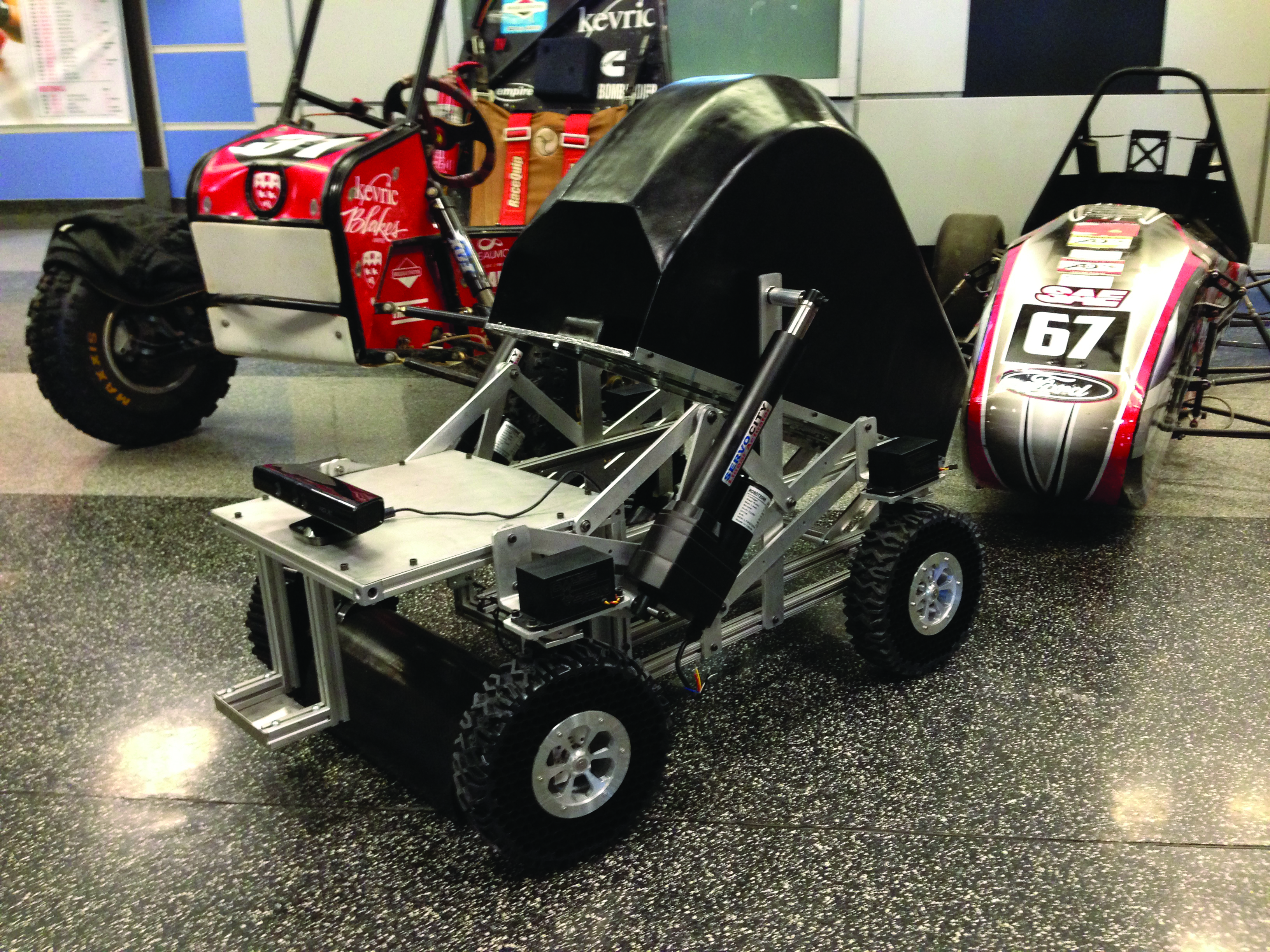
To best handle this point system, McGill’s team is focusing on collecting the most lunar regolith. It’s robot’s design is essentially a small digging mechanism (like a small screw) on the front with a giant bucket behind it. The bucket is horizontal when it’s digging, but when backed up to the bin where it empties, it dumps its contents more like a dump truck. The team is currently testing their machine at the Canadian Space Agency in their rover pit, which is where the Curiosity Mars Rover was tested.

For most of the engineers, this competition provides an opportunity to apply their learning in a more practical setting. As most engineering courses at McGill are heavily theory-based, students rarely get the chance to bring a machine to life by designing it on a computer, and then putting it together.

“I realized that McGill’s engineering program is very analytical, so doing something like this is very important for an engineer who wants to go into the field, and do more hands on stuff,” said King. “It’s basically as good as an internship, where you are actually learning about the team structure, doing everything—from design to ordering materials and assembly. I realized that this was so important, and that I had to do something like this.”

The outreach aspect of the competition has also provided some surprising experiences. The team got in touch with St. Georges School to teach the kids more about their designs and the opportunities in robotics. However, they were astounded at the wealth of knowledge these children had.

“[We spoke with] seventh and eighth graders [who] were building their own go-carts from scratch. It was really cool to see how interested they were, and how much they knew. We expected to teach them, but they ended up teaching us,” King said.

The parts were first designed on the computer, followed by 3D printing. (LunarEx Robotics)

LunarEx takes up as much or more than a normal course would for an average student, but King encourages other engineering students to take advantage of this amazing opportunity at McGill.

“Any engineer who hasn’t done an internship yet or even to get just a more hands on experience [should get involved], because your classes wont give you this experience.”

Unlike biologists, the Inuit have not observed a decline in polar bear populations recently (www.furtrimisatrap.com)
a, Science & Technology

No longer a poster child for climate change

The majestic great white bear of the north is threatened by its inability to adequately acquire food resources, as a result of melting sea ice caused by climate change. Or is it?

Many now believe that the polar bear, poster child for climate change, is not actually facing the declining populations that popular culture have become familiar with.

The Inuit constantly monitor their environment as part of their daily lives. Through generations of collective observation, they recognize patterns and changes, including those associated with climate change. In the arctic, the sea ice is now noticeably thinner; the ice breaks up earlier and freezes later, and there are fewer icebergs. What has not been observed, however, is an equivalent decline in the number of polar bears. Not all of the 19 polar bear populations are faring as well as others, but Inuit elders living in Nunavut are now encountering polar bears in greater numbers and in areas they never did while growing up. They insist that the bear is resilient, and, as sea mammals, will survive just fine despite the loss of sea ice.

“Those who put the polar bear on the endangered species list, they don’t understand … bears are part of the sea,” Inuit elder Jamesie Mike said.

The other side of the debate has its own evidence.

“In the last two decades, [the Churchill, Manitoba polar bear] population has gone down 22 per cent, due to the earlier ice melt and later ice freeze,” polar bear programme director for the WWF Global Arctic Programme Geoff York said, in a call to action video. The WWF is one of many organizations that strongly advertise the detrimental effects of climate change on the polar bear, having recently teamed up with Coca Cola in the Arctic Home initiative.

Biologists attempt to reconcile these differences by attributing the apparent increase in polar bear population to changes in behaviour, and distribution caused by climate change. Others agree with the Inuit that polar bear populations have increased in the past several decades. One explanation given for the increase is any ban on polar bear hunting. In the early ’70’s, Canada implemented its ban on polar bear hunting with the exception of some native hunting. Furthermore, regulation of commercial seal hunting has led to seal population explosions, providing ample food for the polar bears.

Polar bear hunting is regulated in an attempt to protect it as an endangered species. The United States proposed a change to the status of polar bears at the Convention on International Trade in Endangered Species (CITES), but was defeated this past March. Had this change gone through, polar bears would be banned in cross-border trade. This was a major victory for Inuit. The hunting quota in place regulates Inuit harvesting of wildlife, while allowing continued access to the resources that are integral to their lives. Polar bears provide sustenance as both a source of food and income, and the Inuit seek to protect the wildlife like a future investment. Efforts to ‘save the polar bears’ would reduce their freedom to hunt, limiting them culturally and economically.

A new face for climate change is needed. The emphasis on polar bears when advocating climate change may cause climate change deniers to use the conflicting data on polar bear population sizes to prove that there is no problem. It would be far more effective to pick one of the many other species of animals that climate change endangers. Warmer beach temperatures cause dramatic imbalances in the sex ratios of leatherback turtle hatchlings, and the clownfish is threatened by both climate change and oceanic acidification, which affects their senses of smell. If Marlin loses his olfactory abilities, how will he find Dory in the Finding Nemo sequel?

It comes down to the fact that the common aim is to protect our wildlife and protect our planet. Observational interpretations of the natural world give a more holistic view of the environment and allow for a deeper understanding of systems at work. Instead of finger pointing and labeling as right or wrong, greater collaboration between conventional science and other forms of knowledge may be better suited to tackle today’s complex problems.

a, Science & Technology

Sci-Tech Summer Reads

As the summer months draw near, visions of sandy beaches and cool breezes take over our minds, filling us with warmth—and promises of lots of free time. Whether looking out at the sea or the back of the seat in front of you on a flight, nothing can transport you to another reality like a good read. Here’s a list of some popular books in science and technology to pull out during your summer travels:

  • Science

    Whether new or familiar to science, it’s always interesting to take a look into its history—the failures and achievements of great minds—in the words of accomplished scientists.

    carl sagan the demon haunted worldThe Demon-Haunted World is a collection of 25 essays by astronomer, astrophysicist, and cosmologist Carl Sagan, including several written with his wife, Ann Druyan. These essays examine and debunk some of the most celebrated scientific myths of the past, such as witchcraft, faith healing, demons, and UFOs. Surprisingly, pseudo-science is still growing strong with stories of astrology, channelling past lives, and homeopathic cures—all of which have grown in interest and support. In light of today’s pseudo-science craze, Sagan praises the virtues of scepticism, controlled studies, and empirical evidence with intelligence and wit.

    1allthingshealing.comThis is your Brain on Music is written by one of our very own at McGill, Professor of Psychology and Behavioural Neuroscience Dr. Daniel Levitin. The novel explores various questions such as why music evokes such a powerful mood, and if musical pleasure is different from other kinds of pleasure.  These answers are becoming clearer through the lens of neuroscience and psychology. This is your Brain on Music also explores many different areas of research to investigate the relationship between our brain and music. These include an explanation of why two people may not have the same definition of pitch, to patients with rare disorders that prevent them from making sense of music.


  • Technology

    Technology often teaches us to forget the past. Advancements from before this year seem irrelevant when comparing it to today’s technology—remember those things we called floppy discs? There was even a time when there was no such thing as Google or Apple, and, while they grew in the shadow of our childhood, it’s worth taking a look at the lives of the people who changed our world, as well as what future technology has in store for us.

    1goodreads.comThe Search: How Google and Its Rivals Rewrote the Rules of Business and Transformed Our Culture by John Battelle describes how Google rose to new heights as one of the most used search browsers in history. Through over 350 interviews, Battelle plots the rough road Larry Page and Sergey Brin, the founders of Google, faced, along with the challenges they had to overcome to top the likes of Yahoo, Vista, Lycos, and others.

    1npr.orgThe Physics of the Future: How Science will Shape Human Destiny and Our Daily Lives by the Year 2100 is a flash forward look at the year 2100 through the eyes of physicist and author Michio Kaku. Kaku’s views are built upon interviews with more than 300 of today’s top scientists, many of which are working on future innovations. From regenerative medicine and artificial intelligence to vehicles flying on a cushion of air, Kaku makes and explains his predictions in a logical extension through today’s technology that might even have you convinced


a, Science & Technology

Little known programs

In a day or two, U0 students will be required to choose their majors and minors for next year. Many other students also have the opportunity to change their program, if their current one is not the right fit. The Faculty of Science has a wide range of programs, many of which are not well known by students. With course selection underway, consider if these alternatives to Anatomy & Cell Biology, and Physiology are interesting to you.


Physiology and Physics

The program provides a firm foundation in physics, mathematics, and physiology. It’s designed for students who want to apply methods of physical sciences to problems in physiology. If you have a love for biology and physics, this major may be of interest. Some courses you will be taking include experimental methods (U1), nonlinear dynamics and chaos (U2), blood, gastrointestinal, and cardiovascular physiology (U2), and biomedical signals and systems (U3).


Quantitative biology

This program combines biology with mathematics and computing. It is designed for students with a strong interest in biology, with the opportunity to also gain a strong understanding of the physical sciences and their application to biological questions. There are two streams: ecology and evolutionary biology (more like biology with mathematics), and physical biology (more like biology with chemistry, and physics). Some courses in the program include an independent research project (U3), a quantitative biology seminar (U3), an introductory computer scence, and one physics course (Dynamics of Simple Systems).

Music, like drum circles, is suspected to have healing qualities. (gogobot.com)
a, Science & Technology

The health benefits of “taking five”


Three weeks ago when I volunteered to play music for patients at the Royal Victoria Hospital (RVH), I was given a special request to play in the psychiatric care centre. The managers who made this request noted that researchers recently released evidence that music can counter the ‘sundowning effect,’ an increased anxiety and restlessness in patients with dementia. Although I had seen that my music could entertain people, I was a bit sceptical at this point about its ability to counter the effects of  mental illness.

As I entered the psychiatric care centre, I noticed a dementia patient­­­—as I was told by the staff—walking around the hall, while weeping about something nobody could really understand or help her with.

I sat down in the hallway and began to play my guitar; and after half an hour I noticed that her tears had stopped. After a full hour, she returned to her room in the best mood I’d seen her since I arrived at the hospital. I thought, “Maybe music has an impact on the sundowning effect after all.”

McGill researchers Dr. Daniel Levitin, associate professor of psychology, and Dr. Mona Lisa Chanda, post-doctoral fellow, have recently consolidated quantitative research and experiments showing music’s effect on neurochemical changes on “reward, motivation and pleasure; stress and arousal; immunity; and social affiliation,” according to Chanda’s paper.

“We came up with 400 articles that dealt with music and neurochemistry,” said Chanda, “which was a topic that had never … been covered in a review. It [gave] the question of what we should make of all this and how it can, in turn, guide us in seeing the overall picture and knowing where to go from here in terms of research directions.”

Through consolidating the results of the study, the research team uncovered numerous conclusions. They saw that “several brain imaging studies found musical pleasure associated with activation of brain regions for the mesolimbic system, [which is] also involved in processing other types of awards, such as food or sex.”

According to Chanda, in addition to uncovering a strong sense of award, music—especially relaxing pieces with slow tempo—reduces stress hormone cortisol. This could explain the soothing effect music has on some patients at the RVH.

A further study conducted by the team compared the effects of anti-anxiety medication benzodiazepine, versus musical therapy on reducing post-traumatic stress. Again, the experiment showed a marked stress reduction after musical therapy—even more than prescribed benzodiazepine medication gave.

However, although there is a large amount of research that provides strong evidence of music’s calming, and even healing effects, Chanda notes that in almost all of the studies the confounding variables were not strongly controlled.

For example, one experiment showed the effects of a drum circle, where people from all musical backgrounds learn and play simple percussive melodies in a group environment, and its ability to increase participants’ immune systems. Evidence showed the anticipated increase in the immunity of subjects who played in the drum circle; however, the circle was also a social activity involving storytelling, laughter, social gathering, and other features apart from just music.

“The aspects to it, other than just the musical component, could’ve contributed to the effects on the [drum circle] community,” explained Chanda.

People throughout history have witnessed the effects of music on personal and community health, but quantitative evidence is just beginning to emerge that scientifically explains these phenomena.

“Studies of the neurochemistry of music may be the next great frontier, particularly as researchers try to investigate claims about the effects of music on health outcomes… scientific inquiry into the neurochemical effects of music is still in its infancy.”

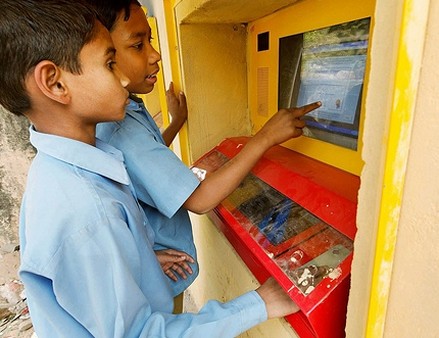
Mitra was surprised that with encouragement, the children self-taught themselves. (openideo.com)
a, Science & Technology

School in clouds, a new face to education

Albert Einstein once said, “The true sign of intelligence is not knowledge, but imagination.”

TED 2013 Prize Winner Sugata Mitra’s idea of building a school in the clouds epitomizes the way in which the human imagination can push boundaries to solve global issues.

Mitra, a professor of educational technology at Newcastle University, describes his idea as the future of learning. In a world driven by ideas and imagination, he understands the importance of looking foward in the field of education. Ken Robinson, international advisor on education in the arts, believes that schools are in some ways killing creativity, and he urges everyone to re-imagine what role schools should play in educating the citizens of tomorrow.

Mitra’s project, known as self-organized learning environments (SOLE), encourages students to learn from each other using resources and mentoring from “the cloud.”

The cloud is a relatively new concept that enables easy collaboration between teachers and students across the planet. The National Institute of Standards and Technology characterizes the cloud as on-demand self-service, broad network access, and resource pooling.

SOLE was the result of a creative and unusual experiment performed by Mitra. As a professor of technology, Mitra was responsible for teaching people how to write computer programs. He observed that young children quickly picked up how to use the computer, just by playing around on it. He wondered if children in the slums close to New Delhi, India would also be able to learn in the same manner.

He made a hole in the wall, close to a bank ATM in New Delhi, and stuck a computer through it, which was programmed in English. He then let the children play around with the computer. Eight hours later, the children had taught themselves how to browse the internet, despite knowing little English and nothing about the world wide web.

Inspired by this discovery, Mitra decided to carry out this experiment 300 miles away from Delhi in a remote village. By removing his experiment from the city, he eradicated the chances of a software engineer passing by, and teaching the children about the internet while they played with the computer.

Surprisingly, when Mitra returned several months later he found children playing games on the computer. When he pointed out that it only worked in English, Mitra was shocked to hear that the children had taught themselves English in order to use it. They also mentioned that they wanted a faster processor and a better mouse. Mitra carried out the experiment in several parts of India, and consistently found the same astonishing results.

Intrigued, Mitra conducted further research. He concluded that in a period of just nine months, children left alone with a computer in any language reached the same level of competency as an office clerk in the West.

This finding has enormous implications in the way today’s technology can be used to create educational opportunities for people in parts of the world which might not have sufficient infrastructure and human resources to obtain a good education. With the declining costs of computing technology juxtaposed with the increasing permeation of internet accessibility, learning from the cloud has never been easier.

Nicholas Negroponte, founder of the OLPC Project (One Laptop Per Child) posed an important question: “Is knowing obsolete?” In times where the ability to multiply numbers in your head doesn’t account for much, because we have computers everywhere to do that for us, the pertinent skills to have are the ability to think critically and read discerningly. It is these skills that Mitra hopes the children will acquire by using technology to teach themselves.

Mitra talks about how learning should emerge as product of educational self-organization. He envisions a future of learning where the teacher sets the process in motion, stands back, and watches in awe as learning emerges. Ultimately, SOLE stands as a pillar of light, illuminating the minds of children who would otherwise have never received the chance to indulge in learning and education.

a, Student Life

The ultimate guide to finding a summer job: McGill edition

For many students, the task of just updating their resume can be daunting. Here’s some tips, based on advice from friends, CaPS, and an interview with Ron Ben-Joseph, motvational speaker, communication champion and creative rabble rouser.


Start now:

It’s too late for you to start early, but it’s not too late to start at all! Some organizations will stop taking applications in January, but positions are constantly opening up, and some have yet to even be posted. Start looking now, before you miss another opportunity.


Know what you want:

The first thing you should do is figure out what you hope to get out of the summer. Do you want experience, money, or both? Even if you don’t know what you want to do with your life, or after graduation, you probably have some idea of what you want to do in the next two months.

“Create the opportunities for what you want to do next,” advises Ben-Joseph.


Finding a job:

Luckily, McGill has a number of resources to set students on the path to securing a job for the summer.

Listservs, albeit long and irrelevant on occasion, can be a fantastic resource for you. They advertise jobs, internships, and research opportunities in your area of study that you may not have heard of otherwise. Make sure to follow up with anything that interests you in a timely manner, because there are many other students who will be inquiring, as well.

CaPS (Career and Planning Services) is a gold mine. You can stop by during drop-in hours, book an advising appointment and find an extensive list of other services. MyFuture is a tool that can help you search for jobs and apply directly online. The CaPS website contains links to job postings, and if you’re seeking an internship, check out the workshop handout “Where to Find Internships.”


Networking:

Ben-Joseph explained the importance of networking in this way: in the original Star Wars movie, when Leia uploads a message to R2-D2 saying “Help me Obi-Wan Kenobi, you’re my only hope”—that’s networking. If you don’t understand the reference, suffice it to say that finding a job is often more about who you know than what you know. Making use of LinkedIn means you can network from your couch. Professors are conducting research constantly, and always need assistants. They can connect you to experts in the field, or a relevant organization.  On campus, wine and cheese events and academic conferences are great places to connect with people and get free food.


CV:

The purpose of a CV is to identify what makes you a good candidate; it is not just a list of your experiences. When stating past experiences, your CV should showcase desirable skills that are transferable to other jobs. Tailor your CV to they type of job you want. CaPS offers drop in hours where an advisor will provide feedback on your CV. Hours are posted online, and they ask that you bring a hard copy of your CV.


Interviewing:

During an interview, employers judge your personality and skills and determine if you’ll fit well with their team. Ben-Joseph suggests framing your past experience in a way that indicates, “everything in your history, you’ve done to help this company out.” To do this effectively, research the industry, employer, and position in advance. Ask a friend, or see an advisor to help you prepare with a mock interview.


Have confidence:

Don’t let the fear of failure or picking the wrong jobs get in the way of applying. Who wouldn’t want to hire you? As back up, apply for a couple positions in case the one you want doesn’t work out. Even if you don’t end up with your dream job, any new experience is more than you already have. Who knows, maybe you’ll discover a new passion.


a, Student Life

Overheard at McGill

Countless McGill-themed Facebook pages have emerged over the past year; McGill Compliments, Umentioned McGill, McGill Chirps, and Spotted: McGill Library—there are also individual ‘Spotted’ pages for each McGill residence—all make for excellent procrastination material. With over 4700 friends at last count, Overheard at McGill might just be the most entertaining, but it also might just turn our student body into a mass of paranoid whisperers. Then again, that’s one way to keep it quiet in the libraries. One of the co-creators of the Overheard at McGill Facebook profile shared a little bit about what it’s like being the fly on the campus wall. 


McGill Tribune: So how many people run Overheard at McGill?

Overheard at McGill: Just two of us. We’re roommates.


MT: How does posting work—how do you guys divide it up?

OaM: We don’t really have any set schedules or anything. I mean, whenever either of us gets a free second, we’ll just go on, and sometimes we’re on at the same time. We don’t really communicate when we go on and check things.


MT: How much time do you typically spend working on the profile in a day?

OaM: That’s kind of hard to answer. We’ll just go on sporadically, maybe for two to 10 minutes each time, depending on how many posts there are to put up and whatnot.


MT: Do you have any idea of how many posts you get in an average day?

OaM: It ranges a lot. Some days we’ll only have four or five, other days we’ll have around 20. Some don’t go up, based on if they were things that were actually overheard, or if people are trying to advertise through us.


MT: What kind of advertisements do you get?

OaM: There were a lot of people trying to submit their platforms when they were running for different positions on different councils…. They would send us their platform for like VP internal for some sort of faculty, and try and get us to post it so everyone would see, you know, try to campaign for themselves over our page.


MT: What kind of screening process do the posts go through? Do you receive any submissions you deem inappropriate to post or that just aren’t that funny?

OaM: We usually let most things through. A lot of the stuff is pretty vulgar, but I mean, everyone’s over 18, so I think the R rated material’s alright. Aside from that, there are things that are obviously made up, [but] you can kind of tell when things are made up. Or, if neither of us find [the post] funny, then we just agree to not post it.


MT: Have you ever had to take a post down after it’s been published due to complaints? 

OaM: Yeah, we’ve had a couple of people send us messages saying that their friend got mad at them for posting what they said, even though everything’s anonymous, and we never quote anyone. People have also gotten upset at a few of the more vulgar posts, so we’ve just gone back and taken them down.


MT: Where did the idea for the Facebook profile come from? Are you guys at all affiliated with the little-used Twitter account of the same name?

OaM: I didn’t know about the Twitter account. I know that there used to be a website called “Overheard at McGill,” and I had seen it last year. At the start of second semester, we just thought it would be a cool idea to get this going, and it looked like a lot of people enjoy it, so we just kept it going, and it’s gotten bigger and bigger.


MT: Do you see yourselves bringing in more help to run the profile?

OaM: We had a third person working on it, but they weren’t really pulling their weight. They would never really go on and check or anything, so we changed the password and just kept it to the two of us.


MT: Have you guys run into any of the problems McGill Compliments has, in terms of Facebook designating you as spammers?

OaM: Just at the beginning, when we were trying to get the [profile] up and running. We were adding lots of people at the beginning, so we actually got banned from adding friends for about a month. But at this point we don’t add any more people, and we seem to get about 20 or 25 friend requests per day.


MT: What’s the best part of running Overheard at McGill?

OaM: I was actually telling my friend yesterday that my favourite part of running Overheard is sitting in the library and watching the guy next to me on the computer reading, these posts and kind of chuckling to himself. It’s sort of funny because I was posting that stuff about five minutes prior.


MT: Do you ever worry you’ll get caught posting on Overheard at McGill in public?

OaM: Yeah, there’ve been times where we’ve been at the library posting things, and someone will be walking by, and we’ll switch to a new window just in time.

Clément-Heydra broke out this season with 45 points. (versants.com)
a, Sports

Dynamic duo poised to return to national stage

Leslie Oles and Katia Clément-Heydra formed a dynamic duo on the McGill Martlets hockey team this past season. After the team went undefeated in regular season play, Clément-Heydra finished with 45 points, second only to teammate Mélodie Daoust in the country, while Oles tallied 36 points—good for sixth highest in the nation. The Tribune had the opportunity to sit down with these two bright, young talents to discuss hockey, school, and the disappointingly early exit from the RSEQ playoffs.


McGill Tribune: How long have you been playing hockey? Tell us about the state of women’s hockey at a youth level.

Leslie Oles: I’ve played since I was four. I played other sports, but when I got to 15 or 16 years old, hockey just took up too much time, so I needed to make a decision. [As for] women’s hockey, it’s definitely getting bigger. Growing up, I played with the men up to two years after they were allowed to stop hitting, at about 14 or 15. That’s probably why I have the most penalty minutes in the league.

Katia Clément-Heydra: Same for me. Growing up, I was the only girl playing hockey in my city [St. Bruno, Quebec]. I stopped playing with the men when they started hitting. But today, more [women] are playing, and we are starting to see totally devoted leagues.


MT: Obviously, this season didn’t end the you hoped it would. How did it feel to lose  only two games all year—when they were the two most important?

KCH: Worst feeling ever. Deception, sadness … it was bad. It will always be with us, until next year. But now, we’re even more pumped up for next year. It’s hard being on top for so long.

LO: Yeah, we’re just going to use it to our advantage. We’re not going to sit at home and cry about it all summer. We lost a lot of key players after the past two years—[Cathy] Chartrand, and Charline [Labonte]. We had a really young team, and I don’t think people expected us to have an undefeated season. Looking at that, it is a big accomplishment.


MT: Did the fact that the Montreal Carabins went on to win the National Championships change your outlook?

KCH: It’s bittersweet. Yes, the team we lost to is the best. Yet, at the same time, we knew that if we had beaten them, we would have won. So it definitely makes it bittersweet.

LO: It’s also good for our league too. I watched a couple of the CIS games, and it just kind of felt that the announcers were saying things that made the [RSEQ] sound weak, and then Montreal went on to win.


MT: Last year, the team won bronze; and two years ago, you won Nationals. Did pressure play a role at all in not getting there this time?

KCH: It was the first time in 12 years that we didn’t make it. The last two games were different from any other in the league. There was a big crowd, and they were all [supporting the Carabins]. In our own rink, Montreal had three times the number of fans. It was a big draw for them.

LO: I think we should have won Game 2 though. We came out and were winning 2-0, and we just started missing empty nets. I don’t know; that was ours to win. Then, they gained momentum and that was it.


MT: Individually, you both dominated this year. How does that factor in when you look back on the year?

KCH: It was fun, but we’re more focused on the results as a team. The end product wasn’t where we wanted it to be; so when I look back, I don’t think of how many points I had. I just really focus on what I need to do even better next year to get to where we want to be.

LO: Of course you don’t look back and think, ‘I got how many ever points,’ or ‘I won this award,’ because in the end, you’re not going to look back and say, ‘In 2013 I made the all-star team.’ No; you look back and say, ‘We won a national championship.’ You always see where you were at as a team.


MT: Does Head Coach Peter Smith demand a lot from you?

KCH: He’s like a father figure. He can be very strict, but at the same time, he is so nice and generous to us. He expects the best, both as a player and as a person.

LO: He does demand a lot, on the ice, off the ice, and in school. But he really just wants to maximize the potential of all his athletes. Even in school, he cares about everything. You find some coaches that all they care about is hockey; but he wants to make you a better person.


Oles tallied 36 points this season. (doylehockeydev.com)

MT: How do you go about balancing being an athlete, while still maintaining a full course load?

KCH: My first year was tough; being French speaking was tough. But now I find that when hockey is done, I have so much time. When hockey is on, you just have to make time to study.

LO: Sometimes, it’s almost easier during hockey season, because you build a routine and make sacrifices. They’re not true sacrifices because we’re doing something we love. But you really have to manage your time, and do things you don’t necessarily want to do.


MT: I know some of the Martlets after graduation have gone on to play in the professional women’s league, often for the Montreal Stars. Is that something you see yourself doing after your McGill days are done?

LO: I will definitely be involved in hockey for the rest of my life, and I would love to continue playing. It’s small right now—[the league has] just five teams—but definitely growing. It will be hard for them next year, because all of the players will be going to the Olympics, but the year after that I don’t see why they wouldn’t expand.

KCH: Same for me. Whether it is coaching or playing, I will still be around hockey. The women’s league is starting to generate more and more attention now, even within the media. NHL teams are starting to budget them, like Calgary and Edmonton. But we’re still waiting for the Habs to get in with the Stars.


MT: What’s your favourite NHL team? And is there a certain professional player whose playing style you associate with?

LO: The Canadiens. And I like [Brendan] Gallagher. He kind of reminds me of myself. He goes hard to [the] net, wins his battles and is fearless, never backs down.

KCH: The Habs. I would say Jonathan Toews. Good all-around.


MT: Former Martlets Cathy Chartrand and Ann-Sophie Bettez made a video to try-out for Amazing Race Canada. Did you see the video? How would they fare?

LO: Yeah, it was awesome. They should make it; they’d win for sure. They’re the most competitive people I know.

KCH: I really hope they’re chosen. They’d be good on that show. So competitive, and really funny too.

Read the latest issue

Read the latest issue