

Latest News

a, News

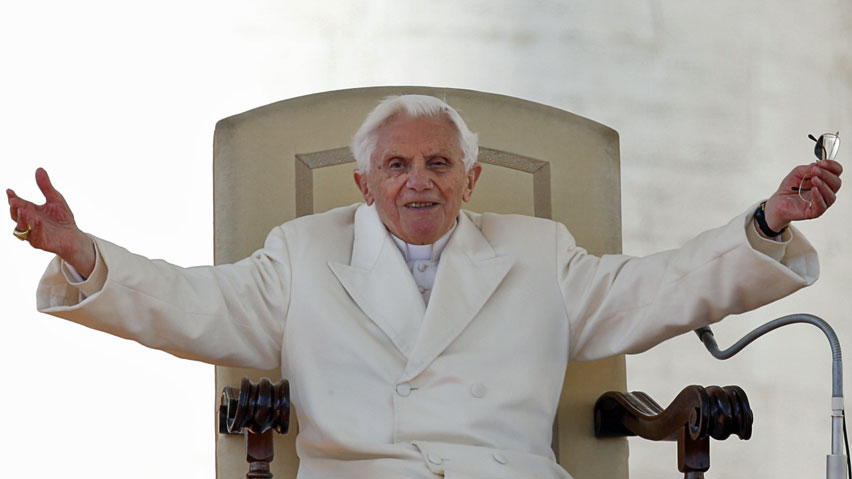
Tracey Rowland, Pope biographer, on Benedict’s resignation

On Feb. 28, Pope Benedict XVI retired from his position as the leader of the Catholic Church, becoming the first pontiff since 1294 to resign from the papacy. As the Catholic Church prepares for the conclave that will elect the next pope, the Tribune sat down with leading theologian Professor Tracey Rowland, Dean of the John Paul II Institute for Marriage and Family in Melbourne, Australia, and author of the 2008 biography of Benedict XVI, “ Ratzinger’s Faith: The Theology of Pope Benedict XVI,” to discuss Benedict’s legacy, the challenges facing the next pope, and candidates for the position, including Quebec’s own Cardinal Marc Ouellet.

MT: What was Pope Benedict’s contribution to the papacy?

TR: I think he’s [made] a number of contributions. The ones that stand out, I suppose, his work for Christian unity. He has a deep understanding of the Orthodox churches, and that’s because he has such a great knowledge of church history, and knowledge of what are called the Greek fathers…. He was all the time sending messages to the Orthodox leaders that he was trying to include … as part of the great patrimony of Christianity. And he did [an] enormous amount of diplomatic work with the leaders of the Russian Orthodox Church and the Greek Orthodox Church. He established the Anglican Ordinariate, and I think that in the future that will be seen as a watershed moment in the history of the return of Anglicans to full communion with the Catholic Church.… He’s also worked on bringing the Lefebvrists back, the people who went into schism in 1988 over interpretations of the Second Vatican Council…. I think in the future, one of his major legacies will be his writing, both as pope and as Cardinal Ratzinger. He’s published over 60 books, and I don’t know how many articles and how many homilies. I think people will be reading him for a very long time.

MT: It’s clear that one of the bigger legacies is his effort for Christian unity. How would you say he has handled some of the scandals that have come up during his papacy?

TR: I think he’s done the only thing he can do, and that is look humble, and say he feels so deeply sad about these things. The pope has a lot of authority, but the Church is a huge structure, and if people are making imprudent decisions at other levels, even if you have an enormous amount of authority, you can’t, on a day-to-day basis, be on [top of] everything that’s happening in every diocese in the world. That’s not humanly possible…. When terrible things happen, a reaction in the contemporary world is to think, well, what bureaucratic protocols should have been in place to stop this? And in some ways it’s valid to think about it like that. But there are much deeper issues. There’s no number of protocols or procedures that can stop evil. We’ve had evil in the world since the Fall [of Adam and Eve]. It’s like this problem is on a much deeper spiritual level. And I think he understands that. I think that with the resignation, he is saying, “Whoever has to deal with all of this needs to be a very strong person. And I don’t have the physical strength to deal with this and everything else the pope has to do. We need a younger man, a stronger man, but I’m not going to go into a room and watch television. I’m going to go and spend whatever days I have remaining in my life doing penance and praying.” And so it’s like he’s saying, “when things are this bad, we’re in an intense spiritual battle, and we know from the scripture that there’s some evil that’s so bad that the only thing that can get rid of it is prayer and fasting,” and that’s what he’s going to do.

… Sometimes lay people say, “Well, we don’t think we should be doing prayer and penance because we haven’t created these problems, we’ve been the victims, our families have been the victims, our children have been the victims. We shouldn’t be doing the penance, the bishops should be doing the prayer and penance.” And I think Pope Benedict is leading by example by saying, “Well, I am the chief bishop, and I’m going to do prayer and penance.” I think that’s the spiritual witness that he’s giving.

MT: What does the resignation mean to the Catholic Church?

TR: I think it could be something very providential. Imagine if the young pope finds himself in a position where he can go and talk to Pope Benedict like a son to a father. And to have the consolation that while he’s dealing with all the things he has to deal with, that there’s another man who has shouldered these responsibilities, who is living in the same precinct, praying, to whom he can go and share what is ever troubling him. I think that could be something really wonderful that, for 600 years, no pope has had.

… [Pope Benedict is] also admitting, “Well, my ability to deal with the problems of the church as an ecclesial administrator is severely limited by my age.” One bishop said to me that he has been told that Pope Benedict is only capable of doing four hours of work a day. His doctors have said, “If you do more than four hours of work a day, you’ll be dead within a couple of weeks.” That’s hearsay, but he’s an 85- year-old man, it’s probably true.

What are the main challenges facing the next pope?

He’s following two great popes, blessed John Paul II, who was just loved by so many people [due to] the incredible depth of his humanity. And [he] was followed by this brilliant theologian. It’s an extraordinary job description, but I think ideally we would like to have someone who has the theological gifts of Pope Benedict, the personal charisma of blessed John Paul II, and quite a strong skill for administration. Because we know that in the final years of the papacy of John Paul II, he was so unwell that the administration was starting to break down and become chaotic—and that doesn’t seem to have been fixed under the papacy of Benedict. So we’ve had pretty much a decade of poor ecclesial governance. The next pope will need to be able to get on top of the administration.

Would you comment on the candidates for the papacy?

Well, one of the most interesting things in terms of the frontrunner is that a lot of people think that the number one frontrunner is Cardinal Marc Ouellet. Cardinal Ouellet has had experience working in Latin America, he’s highly regarded by North Americans, he’s also had experience working in Rome in the Curia, [and] so he has some understanding of how the bureaucracy operates. He [knows] a number of languages. Some people think that after a Pole and a German, it’s about time that someone with a francophone background was pope, but mostly I think it’s because he’s seen to be someone who has had a very broad range of experiences in a number of different areas of the world. He’s also a very strong theologian.

You wrote two books on Benedict. What did you learn through the process of writing about him?

One of the things people say about Ratzinger is that he is so easy to understand, that when he writes about theological topics, one doesn’t need to have a degree in theology in order to follow what he’s saying. I think that has made him immensely popular with a lot of people. One also discovers that he has an incredible knowledge of Church history and the writings of the early Church fathers.

… Another thing I like about him, which is of no great theological significance, is he likes cats. I think that’s lovely. One of the stories about him is that when he was a cardinal, at lunch time he would often go to one of the parks in Rome. He liked to go for a stroll in the park near his office, and he always would take scraps to give the stray cats. I think that shows something of the emotional side of him. Apparently he does, or did [own a cat]. The cat was called Chico … a really good question is, will he get a cat now that he’s no longer pope? I think he should.
a, News

SSMU Winter GA features clickers

For the first time in McGill history, students used clickers at the General Assembly (GA) held by the Students’ Society of McGill University (SSMU) on Feb. 27. Although the GA did not reach quorum of 100 students, the gathering was a consultative forum that passed motions to support the Social Equity and Diversity Office, to support Indigenous peoples and allies, and to oppose the mining of conflict minerals.

GA reform

A major change in the Winter GA was the use of clickers for voting. SSMU President Josh Redel had aimed to include clickers in the Fall GA, but the order fell through before the date of the event. Redel said he was satisfied with the use of clickers in the assembly on Feb. 27.

“It did what it’s supposed to do—it’s supposed to [help the process] move fast so that people [can] spend more time talking and debating, and less time getting frustrated over the length of counting votes,” he said.

Some students, such as Sam Baker, president of the Economic Students’ Association, noted that anonymity was an additional advantage of using clickers instead of placards.

“Sometimes you can tell people want to be anonymous, especially if they’re voting against a motion,” Baker said. “Anonymity is a good thing to guarantee to people.”

The GA included several other additional new features, including a live stream application through AdobeConnect, which incorporated live minutes in English and French, as well as a chat room. According to Redel, the number of people using the application ranged from 25 to 35, or almost half of the attendants.

Redel also noted that SSMU led a significant advertising campaign before the GA, including 85 Facebook announcements, 55 classroom announcements, eight and a half hours of posting flyers in buildings, and nine hours of distributing flyers outdoors on lower campus.

Debate lacking

Following reports by the SSMU executives and a vote to approve SSMU’s auditor, attendants debated the motions. The first motion on the floor was a motion to support the Social Equity and Diversity Office (SEDE) and to call upon McGill to maintain funding for this office.

“In the current context where budgets are being cut, it is easy to cut out certain offices if you do not have quantitative impacts, which it is hard to have with SEDE,” SSMU Vice-President University Affairs Haley Dinel explained.

She added that the continuation of funding for SEDE was unclear even before McGill announced its upcoming budget cuts of $19 million by April 2013.

Without debate, the motion passed with 55 votes in favour, seven against, and two abstentions.

Students then passed a motion calling on SSMU to support the Idle No More movement. The motion passed with 51 in favour, four against, and three abstentions.

Members of STAND McGill presented a motion mandating that SSMU’s Financial Ethics Research Committee “consider the role of conflict minerals in current and future investments.”

Conflict minerals are minerals obtained in conflict regions, and whose sale and export contributes to violence by funding rebel groups. The motion passed with 54 in favour, three opposed, and three abstentions.

“We’ve been thinking about how we could get the student union behind us and have more of a symbolic statement so we could eventually target the administration,” Jessica Newfield, U3 arts and member of STAND McGill, said following the assembly.

Chris Bangs, U3 arts, was the mover of the final motion of the evening. Alluding to a recent review by the University of Toronto, which found that the institution was charging students additional illegal fees, the motion calls for SSMU to review McGill’s tuition and fees to “ensure that all charges comply with regulations internal to the University and with the laws and regulations of Quebec and Canada.”

Music Councilor Katie Larson and Dinel proposed an amendment calling for the SSMU Vice-President University Affairs and student representatives to Senate to lobby McGill to review their fees if deemed necessary. The amendment passed, and the motion subsequently passed, with a vote of 29 in favour, six against, and six abstentions.

As all the motions were passed by a consultative forum, they will be discussed and brought to a vote at the upcoming SSMU Legislative Council meeting on Mar. 14.

a, News

Highlights from the Feb 22nd SSMU Council

McGill clinic considers cutting services

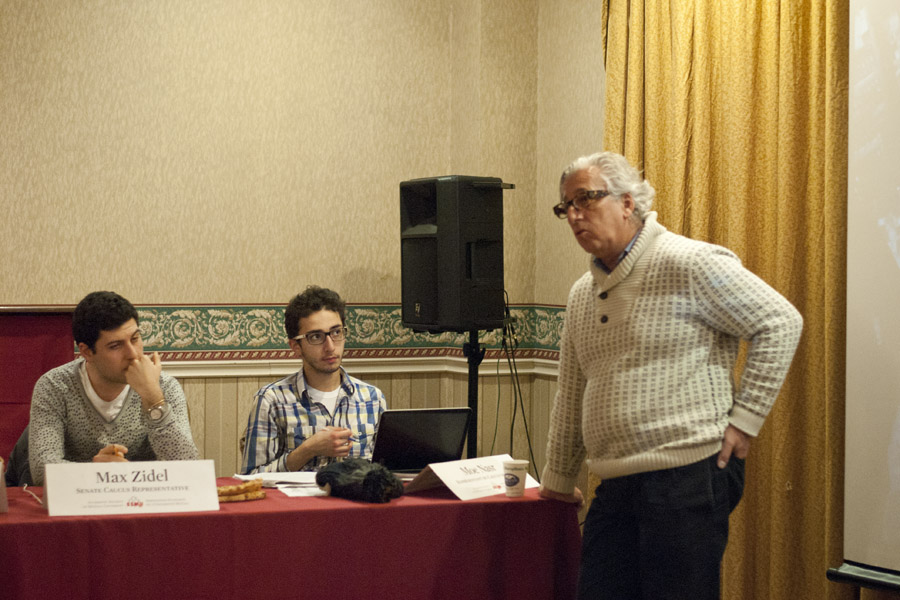
Director of Student Health Services, Dr. Pierre-Paul Tellier, was a guest speaker at the Students’ Society of McGill University (SSMU) Legislative Council held on February 22nd.
Tellier explained that McGill’s health clinic currently offers services to members of the university who pay the university services fee, as well as to spouses of McGill students who are not from Quebec. As Tellier explained, it can be difficult for non-Quebecers to access family doctors, and they are often charged a fee to open a file with a local physician.
To alleviate current strains on Student Health Services, including long lines and lengthy waiting periods, the clinic is considering discontinuing service to those who are not registered as graduates or undergraduates.
Tellier explained that the consideration is not due to financial constraints or the recent budget cuts, especially since the clinic currently enjoys a surplus generated by the clinic’s lab. Instead, it’s intended to more efficiently provide a service to those students who pay for it.
Clubs and Services Representative Geneva Nam asked Tellier what percentage of those serviced by the student clinic includes spouses. Tellier said that the clinic’s current databases do not gather such information.
“I don’t think it’s a large number,” Tellier said. “The flip side to that question is that it’s not only about the numbers, but the time that it requires from us. [Spouses] are typically older and have more complicated problems that would demand more time and more follow-up.”

Tellier began the consultation process in the Spring of 2012 and aims to continue the process for about two months before finalizing a decision.  If Student Health Services determines to cut services, the clinic will continue to provide service for a full academic year before the cuts become effective.

Following the meeting, SSMU President Josh Redel told the Tribune that it’s currently unclear if Council will revisit this issue later in the year.

TaCEQ representatives
SSMU Vice-President External Robin Reid-Fraser introduced the candidates who will represent SSMU at the Table de concertation étudiante du Québec (TaCEQ)—the student association to which SSMU belongs—for the rest of the year. Council will vote on the candidacy of arts student Alexandra Landry-Gravel and law student Patrick Martin-Ménard at their next meeting.
Following their introduction, Paul-Émile Auger, the secretary general of TaCEQ, spoke to councillors about the association’s goals for the Quebec summit on higher education.
“We hope to secure reinvestment from the government [into universities], and to fight the indexation of two or three per cent that will be announced during the summit,” Auger said.

Motion for a Greener McGill passes

Councillors revisited a motion regarding a Greener McGill that had been tabled at Council’s Feb. 7 meeting. The motion calls for SSMU to send letters to McGill’s Secretariat expressing the student society’s official stance against investment in tar sands, fossil fuels, or companies that do business on territories of First Nations peoples without their consent. The motion also calls for the SSMU Vice-President External to promote discussion on these issues through town halls and an informative website.

The motion passed with 16 votes in favour, two opposed, and six abstentions.

SACOMSS fee up for renewal
Councillors also approved a question for the Winter Referendum period that will allow the Sexual Assault Centre of the McGill Students’ Society (SACOMSS) to renew its fee. SACOMSS’ annual fee of $0.75 will be up for renewal for a period spanning the fall of 2013 to the fall of 2015.
Founded in 1991, SACOMSS is a student-run service that aims to empower survivors of sexual assault through direct support, advocacy, and outreach.

a, News

What happened last week in Canada?

Quebec Gov’t Tables Motion for Provincial Gun Registry

In response to the federal government’s recent vote to scrap the national long-gun registry, the Quebec government has unanimously voted to create its own provincial gun registry.

Provincial Minister of Public Security Stéphane Bergeron is prepared to table the bill at the National Assembly, noting that the cost to run a gun registry may be too high.

The provincial government is currently involved in a court battle with Ottawa. The Quebec government wants to save the federal government’s database on Quebec gun owners, which is otherwise set to be destroyed. Should Quebec win in court, the new bill will allow the government to use the data to set up its provincial gun registry.

“The Quebec government is stepping in to protect its citizens where the federal government is failing,” Wendy Curkier, president of the National Coalition for Gun Control, said to The Globe and Mail.

Canada appoints first ambassador of new Office of Religious Freedom

On Feb. 19, Stephen Harper named Andrew Bennett the first ambassador of the newly created Office of Religious Freedom. Bennett is the Dean of Augustine College, a small, private Christian arts college in Ottawa.

The Conservative government has promised the creation of this office since it formed a majority government in 2011. Its stated mandates include advocating for minority groups, opposing religion-based hatred, and promoting tolerance internationally.

According to the CBC, the Conservatives decided to take concrete action in creating this office after Shahbaz Bhatti, a Catholic man and the minister of minorities in the Pakistan government, was assassinated in Pakistan in March 2011.

Critics are accusing the Conservatives of creating the office in order to win the vote of minority groups. Other groups, including Humanist Canada, have expressed concern that the office will not defend the rights of non-religious people.

Police raid Montreal City Hall in corruption investigation

Approximately 120 police anti-corruption investigators arrived at Montreal City Hall armed with search warrants on Feb. 19. Anne-Frédérick Laurence, spokeswoman for the Unité Permanent Anti-Corruption (UPAC), told the CBC that the raid was part of a continued investigation into suspected fraud and the creation of falsified documents.

The investigation is believed to be looking into the illegal spending of public money that occurred in 2000 under former Montreal Mayor Gérald Tremblay and the Union Montréal party.

Although police did enter his office, current Mayor Michael Applebaum has stated that the raid was not targeted at him, but that he could not disclose details of the investigation.

“It’s a stain on the city of Montreal, but at the same time, this is work that has to be done, and I’m glad that UPAC is doing [it],” Applebaum told The Globe and Mail.

Nova Scotia community losing hope in search for five missing fishermen

Five Nova Scotia fishermen are missing at sea after a recent storm, which the RCMP is now handling as a missing persons case. The formal search for the five men was called off the night of Feb. 19, after officials concluded there was little chance the fishermen have survived the rough seas and cold water.

In response to family members’ pleas, the Department of National Defence (DND) has agreed to send an aircraft to locate the wreck of the 13.5 metre boat before it sinks. Family members of the missing fishermen believe that the men may have been trapped in the wheelhouse of the boat.

Members of the community had already hired a diving team, in case officials did not respond, and are hoping the DND aircraft will tell the divers the location of the capsized boat.

“We need closure now,” George Hopkins, the father of one of the missing men, told the CBC. “We need it looked at to know that there’s no one inside that boat.”

Four wounded in Whitby apartment building Shooting

Police are searching for suspects in a shooting that left four young men wounded in a Whitby, Ontario apartment building on Feb. 21. All four men were taken away from the scene in ambulances, and one of the victims, a 19-year-old male, was transported by helicopter to a Toronto hospital. He remains in critical condition.

Neighbours who heard gunshots and screaming in the building called the police, who arrived on the scene at around 12:30 p.m. The police have set up a perimeter around the twenty-storey building as they search for suspects.

On the same afternoon, another gunshot victim walked into a Scarborough hospital. Police have yet to determine if there is a connection to the incident in Whitby. These shootings come in the wake of a year of extreme violence in Toronto, with 33 shooting deaths and 54 total homicides in 2012.

a, News

Justin Trudeau reaches out to McGill student voters


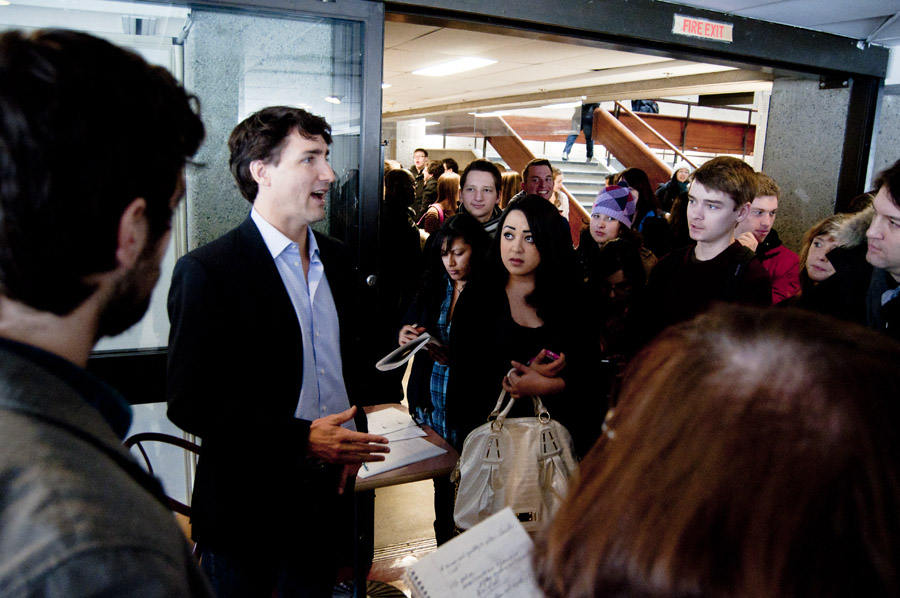
Justin Trudeau—a hopeful for the leadership of the Liberal Party of Canada—spoke to McGill students and staff on Feb. 19 about the supposed political apathy of younger generations, the importance of engaging in politics, and the difference he believes a Trudeau government would bring.

Since October, Trudeau has been making his way across the country, meeting supporters, taking questions, and listening to concerns of Canadians.

“This is the most engaged generation,” Trudeau said to an the over-crowded audience in the SSMU Building’s Lev Bukhman room. “This is a generation that is deeply aware it is our responsibility to shape the world around us with our actions. The fact that we are not connecting with politics is a reflection of the politicians, not the citizens.”

“Politics has become increasingly about scoring points, about voting against something,” he continued. “The idea of voting for something is something that seems very much removed from politics these days…. We need politics to be much more engaging, much more accessible.”

Trudeau also discussed his approach to creating a nationalist, unitary, Canadian vision.

“Canada is not a cynical country,” he said. “[We are Canadian] not despite our differences and perspectives, but because of our differences and perspectives.”

Trudeau spoke at Dawson College just before coming to McGill, where he addressed the question of language tensions in Quebec.

“People no longer see a tremendous conflict between the English and the French,” he said at Dawson.

However, Trudeau also highlighted at Dawson that he didn’t see any sense in strengthening Quebec language laws, according to Liberal McGill President Eric Hendry, who was in attendance.

During his presentation at McGill, Trudeau said that, if elected, his leadership would focus on strengthening the middle class and improving life for Canadians.

“The middle class is sliding downwards, and it’s not providing a ladder of opportunity,” he said. “We need to grow the economy, and share it.”

During the question and answer period, a McGill student asked Trudeau about his stance on education and if he would consider pursuing educational reform. Trudeau said that if he were to lead the federal government, it would play a more hands-on role in higher education.

“The fear of debt is preventing us and slowing us down in attaining post-secondary education,” he said. “We need to figure out how to be a knowledge-based economy and understand how to access our resources, which is all of you.”

Trudeau also briefly addressed the issue of his age, and said that he does not feel like it will serve as a limitation to political success.

“Age is less important than compassion and strength,” he said.

Adam Templer, U0 arts, said that he has high hopes for Trudeau’s future.

“[Trudeau] is definitely looking to change the future in Canadian politics,” Templar said. “Judging by how his father did, I think people already know his name. He’s a good bet to succeed. I think he is going to be a major player in Canadian politics.”

Hendry also expressed optimism about Trudeau’s presentation and the future of the Liberal Party, but expressed some reservations about Trudeau’s campaign.

“I think that the energy and enthusiasm that we saw at the event on Tuesday is a really encouraging sign,” he said. “I’m sensing a new optimism about the Liberal Party from university students, and I think a lot of that has to do with Justin’s campaign.”

“While I have concerns about the lack of a clear policy focus in his campaign so far, I think he’s managed to really connect with people and inspire them to get involved in politics, and to play a role in shaping Canada’s future,” Hendry continued.

Robert Selby
a, Creative

Putting a name to the face

Photos by Luke Orlando, Alexandra Allaire, Cassandra Rogers, Remi Lu & Simon Poitrimolt.

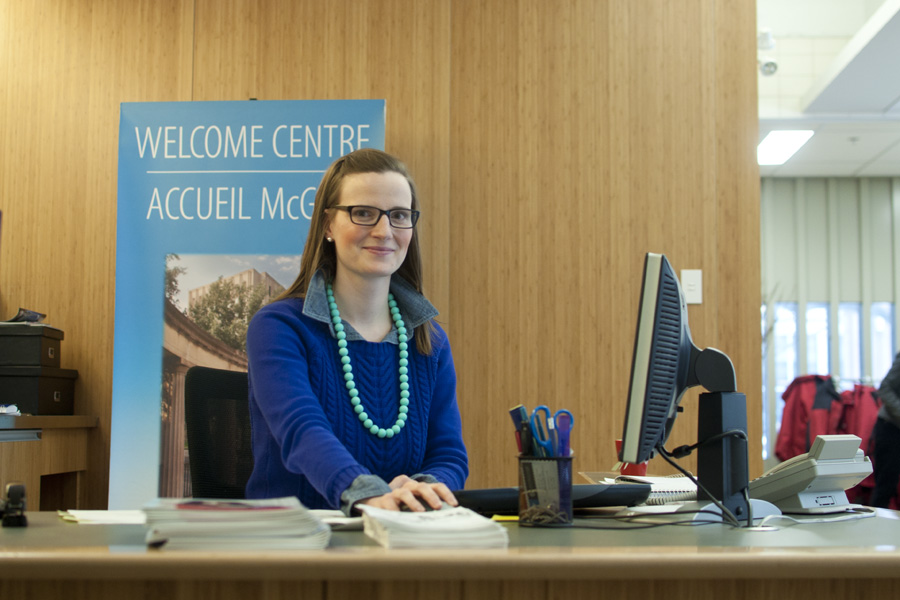
Adriana Rachubinski, Information Centre supervisor

Adriana Rachubinski is the first person many prospective students meet before enrolling at McGill. Her office, right next to Service Point, is essential to ensuring that they and their parents are well informed.

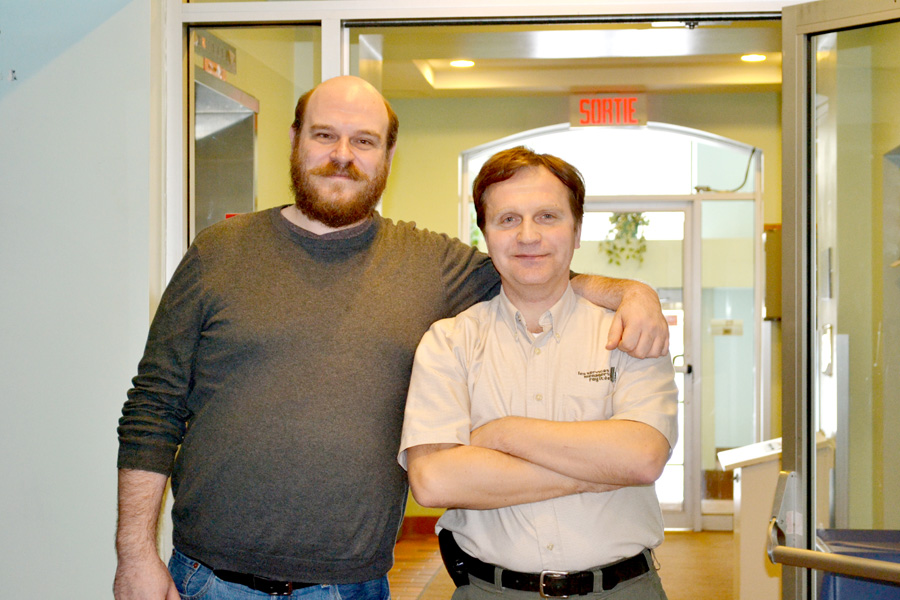
Howard Zinman (porter) and Vlad Pereplavtchenko (janitor), Solin Hall

Vlad has been working at Solin for ten years, but as he tells us, “It never gets old.” What is it about his work that is special? “Working here is not like working in just any other building: I work for a university, and not just any university. Not only do I get to interact with students every day, I get to work with students from around the world.”

Joe Suriano, buildings and grounds department

Joe Suriano works for the buildings and grounds department of McGill. He works tirelessly to maintain the campus in all conditions. Shown here in front of his John Deere gardener’s car, Suriano handles snow removal and spring landscaping.

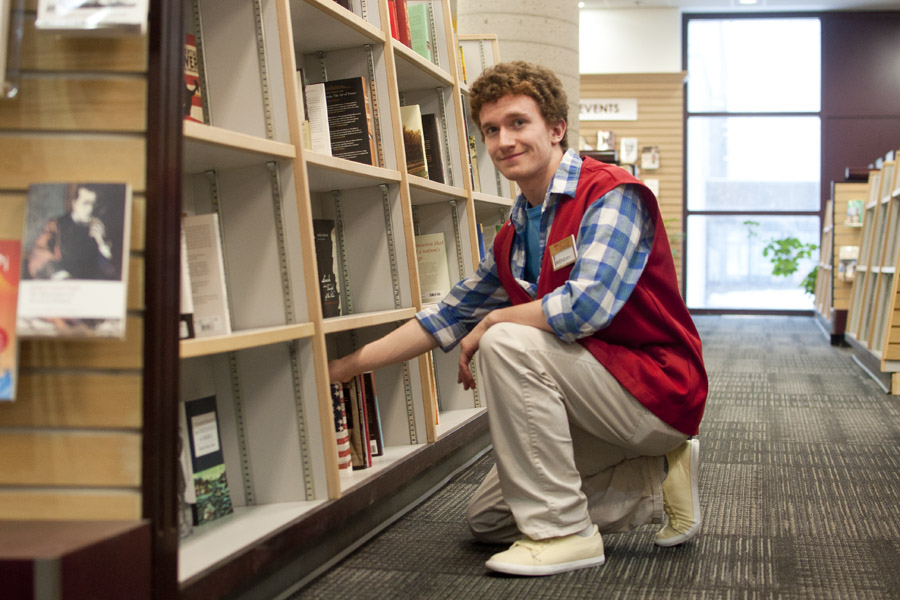
Brendan Edge, McGill bookstore

Brendan Edge, a Canadian studies’ student, is an employee in the McGill bookstore. Brendan spends the busy periods behind the cash register, and slower hours helping

Katy McLaughlin, Liquid Nutrition

Every Saturday Katy serves hungry students at SSMU with Liquid Nutrition’s “functional beverages,” as she calls them. Majoring in dietetics, Katy knows a thing or two about making healthy smoothies. Tell her if you’re feeling stressed or drained, and she’ll know exactly what to recommend.

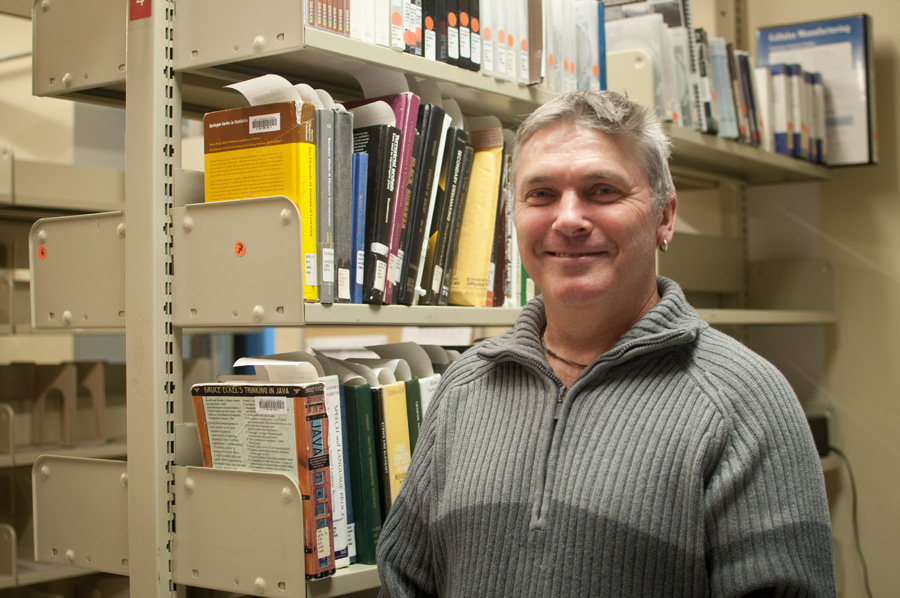
Robert Selby, Schulich Library supervisor

After 25 years at McGill, Robert became the supervisor of the Schulich Library in 2010. Facilitating library services is the core of his daily activities. From lost books to late returns, he helps students with all sorts of problems.

Benjamin Audet, Redpath Cafeteria night supervisor

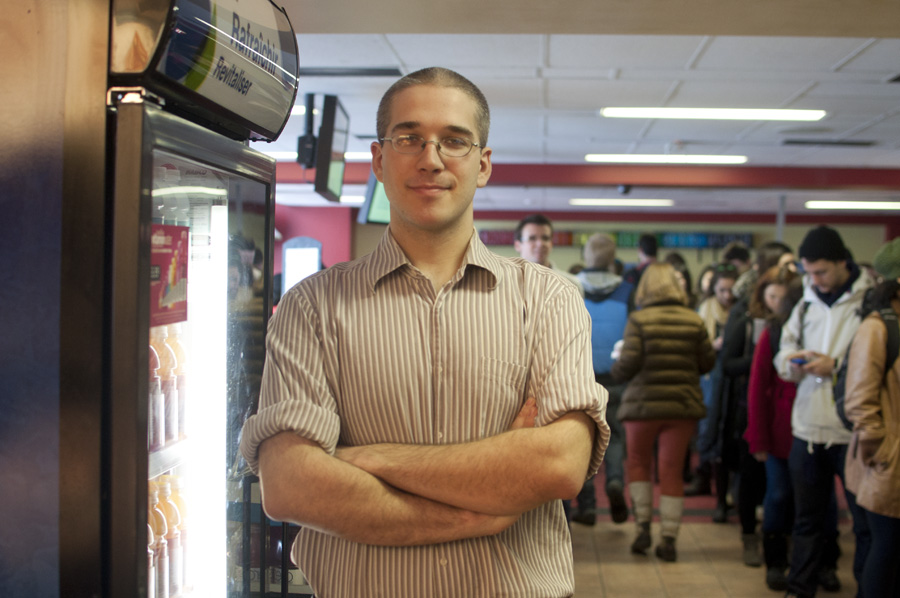
Benjamin Audet stands beside an endless trail of students in line for Tim Horton’s. Recently hired as the night supervisor of the Redpath cafeteria, Benjamin ensures that the cafe runs smoothly, from employee scheduling to quality control. He admits that keeping the Cafe running amidst the high demand from students is a constant challenge.

Alexandra Preimess, CaPS

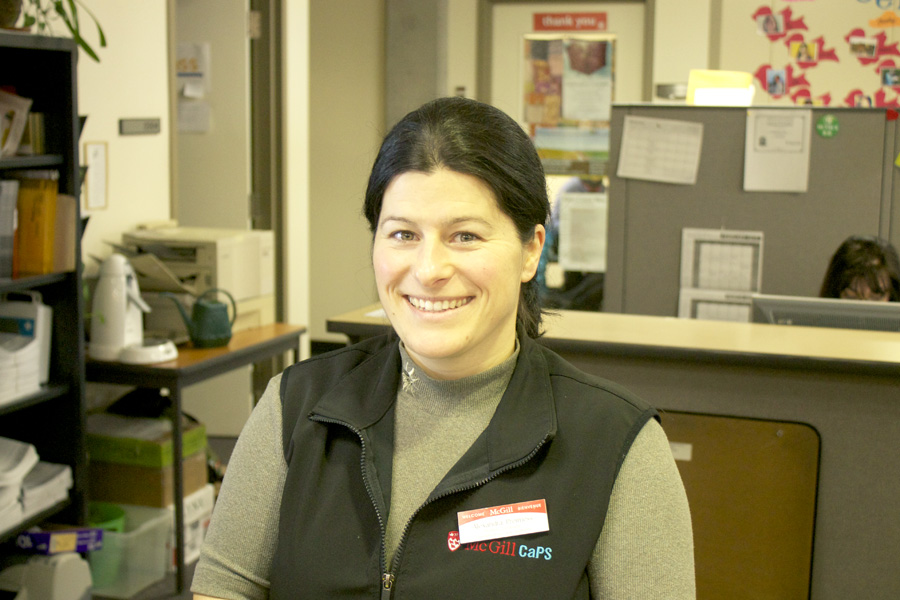
Working with CaPS since 2004, Alexandra creates a warm and welcoming environment for everyone in search of career advice. Her favourite part of the job? “My students. Helping them out with all their problems and inquiries,” she said. Drop in at any time and she’ll offer you a smile to alleviate any job-search nerves.

Fiona Penny, university tour guide

To Fiona, being a university tour guide is a unique opportunity to be an ambassador for McGill, sharing a wealth of information on academics and student life with prospective students and their parents. “It’s a very interesting time to be a university tour guide, especially with all the protests going on; but my main concern is to give people a true sense of life at the university.”

Tania Canales, SSMU receptionist

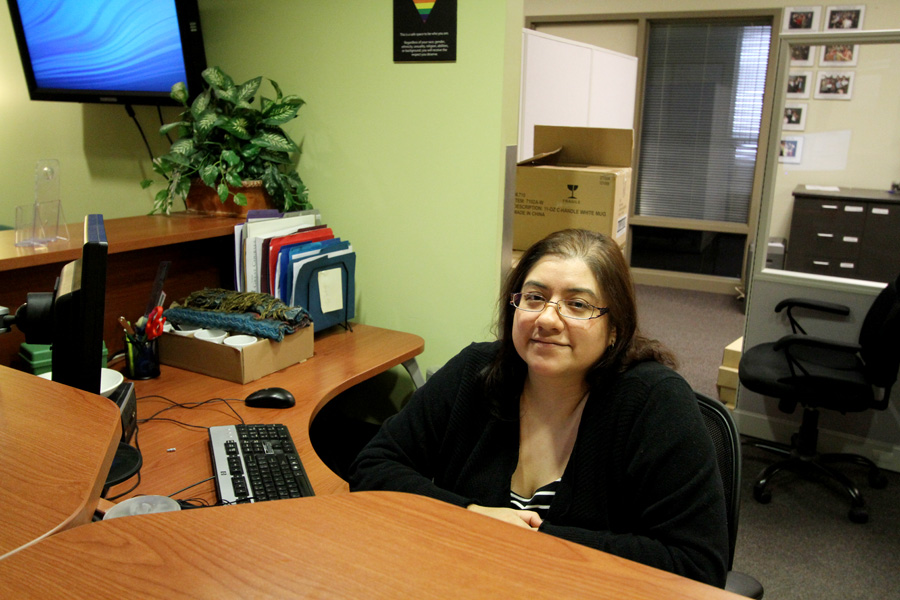
Tania Canales is the face of the SSMU office, greeting those who come to her desk with a smile, and answering a variety of concerns. From managing SSMU exec business to important requests from student services, Tania’s role at SSMU is definitely of utmost importance.


Simon Poitrimolt / McGill Tribune
a, Editorial, Features

The story behind the story

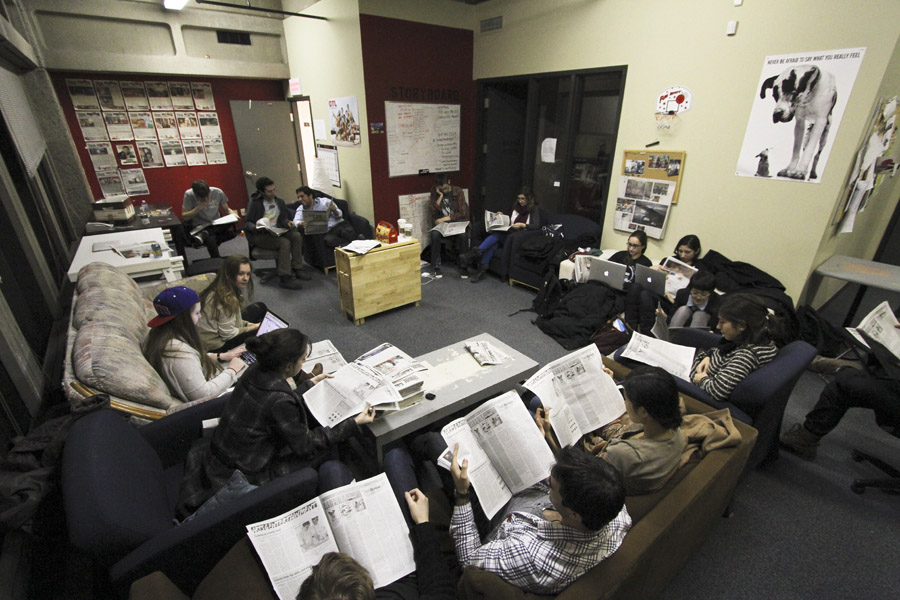
How do you measure a year? Maybe you do it in days, or maybe, like every other student at McGill, in the number of all-nighters left before the first day of summer vacation begins. The Tribune does it in words; 832,000 of them.

Each week, the 20 editors of the McGill Tribune come together to put out a newspaper. The very same paper that started off as an eight-page ode to student life now rounds out at over 20 pages a week, with eight sections that reflect the disparate interests of this school’s student body.

How do all of these different parts come together to tell a coherent story? Each piece begins with an idea, a vague goal, and a week later becomes part of the mosaic of stories that reflect the life of the McGill community. From concept to paper, each passes through many hands before you pick them up every Tuesday morning.

Monday: the pitch

The pitch is the most important part of the publishing process. How a story is planned dictates the article’s tone and direction. If it’s well-conceptualized, the logistics of writing, interviewing, and editing all fall into place. If the story’s intended contribution is unclear, the end result will sometimes be unpublishable. My first piece for the Tribune, a reflection on a speech by Angela Davis given in September 2009, suffered from this affliction. Unsure of what to emphasize, I provided a play-by-play of the night’s logistics, coloured by my own conceptual musings on the event. Oddly enough, this was not deemed worthy of publication.

It can be hard to come up with (roughly) 36 stories every week. Sometimes, they’re determined by routine—for example, every second Thursday, the News team covers the events of the SSMU Legislative Council and reports on what Councillors have been doing. Pitches also come in response to out of the ordinary events, like a special sports event, a renowned guest speaker on campus, an outstanding McGill production—or a flood on Rue McTavish.

The List

Once a story has been pitched, planned, and discussed, it makes its way into the week’s story list. Contributors come to weekly meetings in Shatner 110 to pick up a story that captures their attention, or to pitch their own. After negotiating deadlines, sources to interview, and events to attend, each story idea finds a writer, and each writer finds a mission for the week.

The Process

[pullquote]“The best sports stories aren’t those written about what happens on the field, but the stories that show the tenacity, the struggle, and the inspiration of the athletes themselves” —Sports Editor[/pullquote]

Contributors leave Room 110 with a story burning in their back pocket, or stuffed in their backpack with other worries and assignments. At home, waiting for them, is a follow-up email from the editors that shares an in-depth vision for the piece: who the contributor should talk to, and what reporters should keep in mind when writing. At the end of this email is always a friendly reminder that the story is due Friday at midnight.

Juggling this deadline with schoolwork and procrastination, the writer shoots off some emails to potential sources, hoping for a quick reply, or—hopefully—schedules in enough time to attend, cover, and reflect on an event. Once interviews are set up and a plan is made, the story sits quietly on top of the contributor’s agenda, waiting patiently among the rest of the week’s stresses.

The Research

Before writing, contributors do some background research on the topic or event, ideally steering clear of Wikipedia. Each writer outlines each of the key issues, identifying who’s involved, as well as the different sides to the story. If it’s a sports event, writers must look back over the team’s season and identify the issues that plague the squad. If it’s a speaker on campus, they must reflect on how this event will contribute to discussion at McGill.

With a close deadline looming, the writers work hastily to find the answers that piece all of these questions together. All the while, they hold the reader at the back of their minds: what will students get out of this story?

Putting the Pieces Together

Integral to this contextual process are the interviews, where contributors learn firsthand about the issues from direct sources. This is the most interesting part of writing for the Tribune. It is also the most important, as it offers the opportunity to explore subjects that they would not have the chance to know about otherwise. The questions asked determine how the interviewee responds, which in turn dictates how the story is written. Notepad in hand, writers jot down the quotes they find the most interesting or powerful and record the conversation to later on tease out all of the different elements in the story. Often, it turns out that the story is not what’s immediately evident, but is rather what’s not being said.

The Writing

[pullquote]“People often say ‘you had to be there’. Our job is to make you feel like you were” —A&E Editors[/pullquote]

Once the interviews have been collected and the framework has been sketched, the contributor works diligently to juxtapose a broad collage of information in order to present a story, making difficult choices along the way. Information can be contradictory. Interviewees’ quotes may be vague and hard to decipher. The final verdict to an event can be difficult to determine. Sentences must be crafted with the utmost attention to the smallest detail. And length constraints are hard to reconcile with the amount of information that a particular issue merits. Among the unavoidable confusion that defines the writing process, the author’s underlying vision must shine through, shedding light on what needs to be said. After hours of hard work, some intensive writing, and quite a few cups of coffee, a story finally surfaces.

The Weekend: section edits

Over the weekend, the piece goes through the section and managing editors. Each editor evaluates it from the reader’s perspective: what information is missing? What demands further explanation? The section editors exchange versions of the story’s draft, leaving each other notes in the margins. Once satisfied, stories are sent to a section’s managing editors for further review, and by Sunday night, the story is sent into the Tribune’s design editors, who create a clear and visually appealing layout for the story.

Monday: Production

[pullquote]“Week in and week out, we portray the life of the McGill community as best we can throughout both, its eventful and uneventful weeks.” —Photo Editors[/pullquote]

Every Monday, from 9:00 a.m. to 1:00 a.m., we work to make that week’s issue our best issue yet. Monday morning, a story is printed and read a total of six times: four times by other section editors for clarity, grammar, and general feedback; once by the copy editor, for grammar, punctuation, and style; and once by the Editor-in-Chief for final approval.

Alongside this editing process, the design editors collaborate with our photo editors to create the layout of each section, skillfully arranging up to 24 pages of colour, text, headlines, images, photo-spreads, infographics, text boxes, and advertisements. Stories are then designed, laid out, exported to PDF format, and sent to the publishing company. There, each issue is printed, cut, and folded overnight. And the following morning, the outcome of a week’s worth of hard work is distributed on campus by the Tribune’s publisher.

Friday: Post-mortem

After Monday’s intensive work, the Tribune wastes no time. By the time the week’s issue hits the stands on Tuesday, the planning of a new issue is already underway. The editorial board meets every Friday to digest the week’s work. If mistakes have slipped through the cracks of the editing process, they are generally dissected here. Each section says one thing they’re proud of, one thing they’d like to change, and then presents the next week’s story list, defending the story’s content, timeliness, and relevance to students. A significant part of the meeting revolves around the next editorial. Through hours of debate and consideration of every possible angle, a consensus is made on the content of this opinion piece. By this point, stories have already been assigned to contributors, and the wheels are set in motion. The process begins anew, and another 30,000 words are jotted down in preparation for the following Monday.

Photos by Simon Poitrimolt

Black Lake Mine (Laurence Butet Roch)
a, News

Asbestos at McGill: one year later

As a large research university, McGill is one of the world’s leading institutions when it comes to scientific breakthroughs. With this title, however, comes great responsibility and a stringent public eye. 

In the past few years, McGill has received internal and external criticism on some of the research projects conducted within the Roddick gates, including military and pharmceutical research. 

But what happens when research that was conducted 40 years ago comes into question? That is exactly what has happened with John Corbett McDonald— former McGill professor of oncology—and his research on chrysotile asbestos.  This month marks one year since the release of CBC reporter Terrence McKenna’s provocative documentary on asbestos research at McGill. The Tribune has set out to recapitulate the controversy surrounding this research over the past year, and to look forward to the year ahead.

A story 40 years in the making

Chrysotile asbestos is the most commonly used form of asbestos. It was popularly employed as insulation between the 1950s and 1970s in countries around the world, including Canada. Historically, Quebec has been one of the major exporters of asbestos, with the largest asbestos mine in the world residing in the namesake town of Asbestos, Quebec.

The mineral is now widely recognized as a cancer causing agent—it is most known to cause mesothelioma, a cancer that commonly develops in the lungs—prompting over 40 countries to ban its use.

The CBC reported that in the late 1960s, the asbestos industry hired McDonald, at the time a professor in the oncology department at McGill, to conduct research into the health effects of asbestos. This is according to David Egilman, a clinical professor in the department of family medicine at Brown University, and a long-time critic of the use of asbestos.

McDonald’s study focused on the health of 11,000 asbestos miners and mill workers in Quebec, and it took place over the course of approximately 30 years. As late as 1998, McDonald co-wrote a paper with F.D. Liddell—a professor of epidemiology and biostatistics—based on these studies, which concluded that, at face value, the data proved that asbestos had a protective effect on workers’ health at a certain level of exposure.

The Internal Investigation

McDonald’s studies and conclusions on asbestos have raised two important debates within McGill and the wider scientific community in the past year. The first debate began after McKenna released a documentary on the CBC show The National on Feb. 2, 2012. The documentary accused McDonald of tailoring his results to comply with what was in the best interest of the Quebec Asbestos Mining Association (QAMA)—an asbestos company that gave one million dollars to fund McDonald’s research.

Following the release of McKenna’s documentary, McGill authorized an internal investigation to conclude whether or not these allegations of research misconduct were founded.

David Eidelman, vice principal (health affairs) and dean of medicine, initially asked professor and chair of the department of epidemiology, biostatistics, and occupational health Rebecca Fuhrer to do a preliminary review of the research material to determine whether or not an internal investigation needed to be held. According to Eidelman, there was no obvious reason based on the preliminary review on which to conduct an official investigation. He said, though, that there was enough uncertainty that he felt compelled to formally commission  McGill’s Research Integrity Officer (RIO) Abraham Fuks to conduct the internal investigation on McDonald’s research in April 2012.

“I think our process is very strong,” Eidelman said. “We have to have an internal process that is reliable and robust because we don’t just react when something is on TV. We hear about things before, and we have to be able to deal with them. The research in this university would be worthless if we couldn’t be sure it was carefully overseen.”

On Oct. 17, 2012, Eidelman announced that McGill had cleared McDonald of all charges, after receiving a 17-page report written by Fuks, which found no evidence of research misconduct.

“After we [announced] this … and shared the report, the people on campus were largely supportive of the way we did things, and I got really positive comments,” Eidelman said.

No external review into McDonald’s research was conducted. Eidelman stated that an external review is not something McGill requires when the university has been accused of research misconduct. He also pointed to the high costs of holding an external review.

The anti-asbestos lobby, however, has criticized McGill’s choice to conduct an internal investigation. Critics maintain that the internal investigation was self-serving on the part of the university, and that McGill continues to cover-up what it sees as research misconduct.

“I think they have done it because [their number one priority is] to protect McGill, to do public relations for McGill, and to cover the whole issue up,” said Kathleen Ruff, a senior advisor to the Rideau Institute—a Canadian non-profit organization that focuses on research and advocacy. “You can indeed do that when you have power and privilege, but not forever.”

Support from McGill faculty for both McDonald’s research and the internal review became apparent when David Egilman came to speak to the McGill community this January. He continued to argue that McDonald conducted malpractice in his research.

All the McGill professors who attended and participated in Egilman’s discussion defended McDonald’s 1998 paper after Egilman accused McDonald of research misconduct and called for the paper to be retracted. One of these professors was Eduardo Franco, the interim chair of McGill’s department of oncology.

“It seems to me [that there is] a festival of misinterpretation out there by the activists,” Franco told the Tribune. “Nobody is saying, not even the authors of that paper, that chrysotile asbestos is not hazardous.”

Franco said, instead, that McDonald derived his conclusions by comparing people who were heavily exposed and those who were only moderately exposed.

“At the end, they are being accused of having published a paper that indicated a protective effect,” he continued. “It’s not protective. It’s just in relative terms. If you are extremely exposed to asbestos, you are going to have a higher risk value than someone who is moderately exposed, and that may just be the semantics of the game.”

Both Franco and Eidelman addressed the issue of investigating research that was conducted 30 or 40 years ago.

One of the accusations against McDonald’s papers was that he did not properly disclose the source of his his funding. Franco pointed to the changes that have occurred in policies about disclosing conflicts of interest in published papers. He maintains that this is a recent practice that has only developed in the last three or four years.

“If this paper were published today, it would have of course included a conflict of interest statement,” Franco said. “So what Dr. Egilman is wrong in doing is trying to use a collective witch hunt to use the objects of today to condemn a study from 1998. This is completely wrong and unfair.”

Eidelman, too, pointed out that the rules of the game have changed in general since McDonald carried out his research.

“One of the issues is, of course, with rules that were in place, let’s say, in 1975, [they] are much less clear than the rules that are in place now,” he said. “That’s one of the things that makes that [internal investigation] different.”

“In the case of Dr. McDonald … as far as we are concerned, we’ve looked into it from a research misconduct point of view, and that issue is closed,” Eidelman continued. “From the point of view of what Dr. McDonald may or may not have said or what things he promoted or didn’t promote … the record is there for people to read for themselves and draw their own conclusion.”

Current implications and the anti-asbestos lobby

McDonald’s research provoked a second debate, which is now occurring around what McGill should do with McDonald’s papers—particularly, the one he co-wrote with Liddell in 1998.

Members of the anti-asbestos lobby, including Egilman and Ruff, have called on McGill to retract McDonald and Liddell’s paper.

According to the anti-asbestos lobby, McDonald’s research is still used today by asbestos companies to advocate for the use of asbestos in developing countries like Brazil and India, where asbestos continues to be used in construction. It is the anti-asbestos lobby’s mission to discontinue the use of asbestos around the world.

“McGill’s research done by McDonald still is one of the most important weapons used by the asbestos industry around the world to defeat efforts by health professionals to ban asbestos,” Ruff said.

According to Egilman and Ruff, in order for this paper to no longer be used in the defense of asbestos, the paper needs to be retracted. Egilman said that when he went to Science—the journal that originally published the paper—to ask for a retraction, the editors directed him to McGill, claiming this was a decision to be made by the university where the research took place.

McGill has not retracted the paper or indicated that retraction has been officially considered at all.

Franco believes there are no grounds for retraction because  Fuks’ internal investigation found that there was no research misconduct.

In an interview with the Tribune, Eidelman did not address the issue of retraction directly, saying that he would not comment on what Egilman has said on the topic.

“But I will say this: sometimes people confuse the issue of research misconduct,” Eidelman said. [Research misconduct] is … not presenting data fairly, not admitting … you took money from a company and then pretending you didn’t,” Eidelman said, implying that McDonald hadn’t done this. “And then [there is] deriving conclusions from data … that maybe aren’t the best conclusions.”

What’s next? The Asbestos Conference

Following the presentation of Fuks’ report to Senate last October, McGill announced that it will hold a conference on asbestos research, now slated to happen next September, as a follow-up on the internal investigations and reports.

The Faculty of Medicine, which is sponsoring the symposium, has tasked Eidelman with assembling a committee of both faculty and students to plan this conference. This committee first met on Jan. 14.

Eidelman explained that the first meeting was delayed in order to make sure that representatives from four student associations could participate. The student associations represeted are the Students’ Society of McGill University (SSMU), the Post-Graduate Students’ Society (PGSS), the Engineering Undergraduate Society (EUS), and the Medical Students’ Society (MSS). He also noted that having the conference in the fall gives the committee a chance to invite international authorities on the topic of asbestos to attend and that these people need months of notice before traveling to Montreal.

Eidelman said that the conference will take place over the course of a single day.

“All we can really do is a one-day symposium,” he said. “A couple of professors complained that you couldn’t do a proper job unless you had, like, three days.”

Eidelman explained that while the issue of asbestos is complex, the conference will not exclusively focus on the science  behind asbestos. Therefore, the  topics the committee would like to see discussed only require one day, according to  Eidelman.

“We will concentrate on two major issues.,” he said. “The morning will be given over to discussing asbestos, with a focus on the science.  We hope to address issues like what exactly is ‘asbestos,’ which turns out to be more complicated than it seems at first.”

He said the afternoon’s discussions will examine the university’s relationship with industry in general.

He also noted that students and professors alike will co-lead the conference. He expressed hope that students will play a leading role in all sessions that take place that day.

“We are trying to be forward-looking and make things better,” he said.

Eidelman said that the conference will be open to the public, and that the committee would like to bring in people from all sides of the debate to present their views—including those from the anti-asbestos lobby.

“Our goal is not to prove whether or not Dr. Egilman and his friends are right or wrong,” he said. “They cannot only speak for themselves, they speak very well for themselves, and they can defend their point of view. My goal and our goal here is to make sure that at McGill, we are giving a full and open discussion of the material, so people can interpret the information for themselves and come to their own conclusions.”

Ruff expressed skepticism over the idea of an asbestos symposium at McGill.

“I have nothing against conferences, but I think [the conference] really avoids the issue … that McGill has carried out a whitewash, and that the report by the Research Integrity Officer is completely full of incorrect information,” Ruff said. “The whole process has been unethical and biased.”

She pointed to how the internal report notes that McDonald did not attempt to hide his connection to the asbestos industry. She disputes this. According to Ruff, McDonald did conceal this link. When testifying at hearings in the U.S. over the issue of raising standards to protect workers, McDonald said he had no connection to the industry.

“This is a mark on McGill that will not go away until they address it in a clean, honest way,” Ruff continued.

a, News

Students and admin discuss protest documents

On Feb. 20, the McGill administration hosted a Consultation Fair on the downtown campus concerning the recently released Statement of Values and Principles on Freedom of Expression and Freedom of Assembly and Operating Procedures. Participants at the Fair raised concerns with the language of the Statement of Values and the restrictions outlined in the Operating Procedures, as well as the relationship between the two documents.

The Statement of Values and the Operating Procedures will replace the provisional protocol that currently governs the university’s response to demonstrations and protests on campus. The provisional protocol has been in effect since Feb. 12, 2012, after a group of students occupied the sixth floor of the James Administration building for five days.

The Consultation Fair was the second of two fairs hosted to revise of the Statement of Values, before it is taken for approval to the McGill Senate on Mar. 20, and the Board of Governors on Apr. 26. The Operating Procedures, however, will not be ratified by either body. The first Consultation Fair was held at the Macdonald campus on Feb. 13.

(Alexandra Allaire / McGill Tribune

Senior administrators engaged in moderated discussion with a small turnout of six students about possible improvements to be made to the content or language of the two documents.

“This protocol, for me, is the administration saying, ‘This is when we’re going to intervene, under these conditions,’ and [then] trying to describe those conditions,” Andre Costopoulos, dean of students said. “I think what we have to focus on is: are the statements in there clear enough?”

Several students did not appear to think so, and raised the issue of the document’s “ambiguous wording” throughout the discussion. Some pointed out that terms like “intimidation” and “intentionality,” found in the Statement of Values, may have great variance in meaning from person to person, and may affect whether an assembly would be classified as peaceful or not. Students suggested that vague terms such as these should therefore be changed or removed.

“[With a demonstration], one can intend to disrupt and not disrupt,” Morton Mendelson, deputy provost (student life and learning), said in response. “The issue of intentionality only comes into play when you intend to disrupt.”

Participants at Wednesday’s fair also discussed how much interference caused by a demonstration or assembly should be permitted before the event is deemed disruptive. Some students argued that the wording in the Statement of Values—specifically, the “right of members of the University community to carry out their normal activities without undue interference”—scarcely allows for the disruptive nature of demonstrations, and suggested substituting “interference” with “obstruction.”

Other students even questioned the need for two documents, and what makes them different.

Joey Shea, U3 arts, said she believes that the Operating Procedures should be more closely tied with the Statement of Values.

“For me, there [is] a lot of ambiguity as to what is the relationship between these two documents,” she said. “I totally agree with the Statement of Values for the most part, but … there’s a huge discrepancy—for me at least—between the values and how they’re going to be implemented [into the Operating Procedures].”

Students also suggested adding a ‘fair warning clause’ to the Operating Procedures in order to counteract the unclear language of the Statement of Values. McGill Security or the administration would use such a clause to issue clear warnings to protestors when their demonstration has been deemed in need of intervention. Sam Gregory, U1 arts, expressed concern about the lack of such a clause in the Operating Procedures.

(Alexandra Allaire / McGill Tribune)

“[Will] fair warning be given [to students] when protest will be broken up, or [when] actions [will] be taken?” Gregory asked. “[The Procedures] should also make clear to students what the consequences are for violating the rules.”

Students also expressed confusion over the roles and limits of McGill Security and the administration in maintaining peace on campus.

“Security Services, disciplinary officers … they all have very different but very defined roles, and they all have very different powers,” Costopoulos said in response to students’ questions.

“We need to better educate, not only students but staff and faculty as well, about who is responsible for what in terms of campus order,” he continued. “By making clearer the division of powers within university governance, we can create a context that is much clearer for students to express themselves without intimidation.”

The McGill community may continue to submit their feedback on both documents on the Statement of Value’s open website
until Mar. 8.

SSMU Execs. At Home. (Simon Poitrimolt / McGill Tribune)
a, News

The people behind the portfolios

Every year, six McGill students invest vast amounts of time and energy into the events and operations of the Students’ Society of McGill University (SSMU). For this special ‘Behind the Scenes’ issue, the Tribune brings you the personalities behind the portfolios.

With elections for the 2013-2014 SSMU executive team just around the corner, the Tribune set out to learn more about the lives of the current SSMU team. 

As a full-time job, an exec position often requires these students to spend upwards of 12 hours in their office everyday, often seven days a week. For SSMU President Josh Redel, who has had a part-time job throughout his undergraduate degree, the almost $30,000 salary that comes with the job is only a small “relief” from the relentless demands of being an exec.

Every week is a busy week for SSMU clubs and services (Simon Poitrimolt / McGill Tribune)

“I can put … all of my time [into SSMU], [and] the salary goes towards my rent, paying off student debt, [and] tuition,” he said. “My budget’s pretty tight.”

Although they receive a salary, execs are also students, albeit in a less intensive manner than many others who study at McGill. Vice-President Internal Michael Szpejda, who hopes to graduate next December, is only enrolled in one full-year, one-credit course.

“Initially in first semester I was in a few more classes, [but] there was no way I could do 400-level neuroscience classes and [SSMU] at the same time,” he said. “People think it’s like any of the faculty [executive positions] where you can totally still do school, but it really is a full-time job.”

Like Szpejda, most execs only take one course per semester. Some, however, have already graduated. Vice-President Clubs and Services Allison Cooper said she followed the course of action taken by many previous execs by choosing to stay on at McGill for another year after graduation as a ‘special student.’

“For example, to graduate from anthropology at McGill, you don’t need to have taken statistics as part of your graduation requirement, but then if you realize you need statistics to go to grad school … you have a year after you graduate that you can still be enrolled as a ‘special student’ and take courses for grad school,” she said. “It’s cool because the classes I’m taking don’t affect my [degree], so I’m not so stressed out in that sense.”

While Cooper is the only exec this year to be enrolled as a ‘special student,’ many execs also said that they feel odd heading to class, and feel disconnected from the world of McGill students.

“Sometimes I worry that I’ve lost sight of what an average student’s perception is of the university,” Redel said. “I have the opportunity to sit [on] the Board of Governors, to sit at Senate, [and] to meet with the Principal … so [I] have the opportunity to have explained, face-to-face, what’s going on, when most people hear it through an email that they probably don’t even read.”

Executives are frequently reminded of students’ apathy or outright disdain towards SSMU. According to Redel, much of the criticism stems from students’ uncertainty of what the role of the organization should be.

“Students get upset when SSMU takes political stances [because they ask] ‘Does SSMU have a mandate to do that project?” he said. “Let’s look at that objectively: What GA motion passed 4Floors being an event every year? None. It’s an initiative we think is good. You’ve elected us as your student representatives, and we think [an event like this] is something that represents students, or the best interests of students.”

(Simon Poitrimolt / McGill Tribune)

Although they spend far less time in classrooms now, many SSMU execs feel that their experience in the office has affected the way they view themselves as students.

“If I can speak up to somebody in Senate, publically, in front of other students, in front of all the admin, then why can’t I tell my profs how I feel?” Vice-President University Affairs Haley Dinel said. “These kinds of positions empower you to take charge more of your degree [and] of your life.”

Vice-President External Robin Reid-Fraser said her position has also changed the way she thinks about other members of the McGill community.

“The staff people that we talk to, [I’ve] realized that most of them are very approachable, very committed, and a lot of them really do want to know what students think and really do appreciate the feedback that students have to give them,” she said. “Staff members don’t necessarily get enough credit for the work that they do and how open they are to dealing with students.”

Redel, however, said his advanced knowledge of the way the university works sometimes causes him to “fear” for McGill and the future of higher education.

“It costs $500 to install a plug at McGill, and one of the things students want more and more [of] are outlets in a classroom; but we don’t have enough money to [buy] even a single $50 chair,” he said. “How are we going to continue to grow and innovate in a time when we face austerity?”

Redel said he also finds members of the Board of Governors—McGill’s highest governing body, where he sits as one of two student representatives—to be “intimidating.”

“They do truly care about McGill, but the way in which they care about it might not align with how we think of a university … investments, portfolio, partnerships, alliances­—when they bring that to the university level, does that align with academia?” he said. “That’s where we see a lot of disagreements with Board of Governors. They really struggle to understand students sometimes, just because they’re so distant from [them].”

Speaking with members of the senior administration is also a key component of Dinel’s portfolio. She advised candidates for her position to focus on their communication skills and make sure they are knowledgeable about how the university functions.

“You need to make connections with people across the university, [and] you need to really understand the issues right off the bat,” she said. “The admin know there’s [going to be a] transition, but they’re not going to educate you. They’re not going to presume you know everything, but you have to come as well-versed as the person before you in your first meeting.”

When they’re not in meetings with the administration and other student bodies, the members of the exec team share much of their lives together in the SSMU Building.

“It’s kind of like when you have roommates—we all have to live together, but we’re all friends,” Dinel said. “If you’re not friends, you’re going to have problems.”

“We don’t want to let each other down,” she continued. “If we’re frustrated, we can at least say it or express it in a friendly way.”

Cooper agreed that the most important part of being on the SSMU exec is working as part of a team.

“You have to make decisions on an absurd diversity of things and learn each other’s portfolios,” she said. “You come into it and [say] you’re going to do clubs all the time, but you’re also a counsellor. No matter what your portfolio is … foremost, you’re on the exec team.”

Read the latest issue

Read the latest issue