

Latest News

worldofstock.com
a, News

Meet the main players at the Quebec Education Summit

On Feb. 25 and 26, the provincial government will hold a summit for  members of civil society and the higher education community to discuss the future of  the post-secondary education system in Quebec.

Before the summit commences, the Tribune set out to give students a look at some of the primary stakeholders, their views on prominent issues up for discussion, and their plans for the two days. 

Parti Québécois (PQ)

The PQ planned the summit in the wake of intense debate and frequent student protests regarding the former Liberal government’s proposed tuition annual increase of $325 for five years, which the PQ rescinded following their election last September. 

In January, Higher Education Minister Pierre Duchesne said free tuition is not an option for the Quebec government, and that the government is instead looking at indexing tuition fees to the cost of living.

“The good thing about this possibility is that there are different indexation models, some of which resemble a freeze, others which are indexed based on certain indicators,” Duchesne said in January.

However, the government has promised that discussion at the summit is not limited to tuition—quality of higher education, access to higher education, governance and university funding, and contribution of research to the province’s development will be the four main themes covered during the two-day event. Four preliminary workshops with the parties involved have taken place since the summit was officially announced last November. Premier Pauline Marois and Duchesne will discuss these issues with student organizations and post-secondary establishments.

“This is vital for Quebec society,” Marois said at a press conference last November. “Our prosperity rests on knowledge and education .… I hope this is a fruitful debate for all.”

Conférence des recteurs et des principaux des universités du Québec (CREPUQ) 

CREPUQ is a non-profit organization that was founded in 1963. It is composed of university administrators who work to improve the efficiency of Quebec’s higher education system. Representing all 19 Quebec universities, its main concerns are research, funding, and the university activities affected by government bills. It also serves as a coordinator between universities and a research centre for administration.

In anticipation of the summit, CREPUQ proposed last November to create an independent public council in charge of studying and counselling academic affairs.

“[The council] would report to the National Assembly and the people of Quebec on the situation of the university system in general and, more specifically, on … the quality of university programs and how well they are meeting society’s needs; Quebec’s competitive position with regard to research in all fields of knowledge; and how universities are contributing to social, cultural, scientific, technological, and economic development,” a CREPUQ statement from November reads.

According to its website, CREPUQ’s stance is that every Quebecker who desires to and is qualified to enter university should be able to, and that universities have the job of ensuring accessibility while maintaining a high quality of education.

The organization claims that, in comparison with their trans-Canadian counterparts, Quebec universities are underfunded by $850 million. For that reason, CREPUQ advocates stable funding as necessary to support research and development.

As a member of CREPUQ, McGill’s administration agrees that Quebec universities are underfunded. The administration recently posted on McGill’s website that, if given more funding, it would use these funds to invest in talent and infrastructure, as well as to work on reducing the university’s deficit.

The McGill website defines improving talent as lending “more support—financial and otherwise—for our students, including a commitment to spend 30 per cent of all new net tuition revenue on improving student aid and accessibility, competitive compensation, and improved academic support for professors.”

Fédération étudiante universitaire de Québec (FEUQ)

FEUQ was created in 1989 immediately following the government’s decision to end Quebec’s tuition freeze. Its 14 member associations represent more than 125,000 Quebec university students, making it the largest student group in the province.

According to its official website, FEUQ’s mission is to represent student associations across Quebec and to put their positions at the forefront of discourse on higher education. They also aim to promote unity in the recent student movement.

The FEUQ has historically opposed tuition increases, calling them problematic. Accessibility and student debt have remained central issues for the Federation. In 2011, it supported the PQ’s position to freeze tuition.

“We’re looking to actually make sure that people understand what it means to preserve accessibility in university and to propose two things: better financing and a better governance of universities, ” FEUQ President Martine Desjardins told the Tribune in November.

To increase accountability and promote universities’ efficiency, the FEUQ advocates for a commission to evaluate the universities in Quebec, promotes collaboration and accountability of universities, and aims to pursue this proposal in the upcoming summit.

“We do have this kind of commission for the CEGEP system—that’s how we want to actually propose this commission [at] the summit, ” Desjardins said. “We’re very hopeful that we’ll have a big consensus about this proposition. ”

While some student groups, like ASSÉ, have distanced themselves from the summit, the FEUQ will continue to put pressure on the PQ to opt for a tuition freeze.

FEUQ participated in four preliminary meetings leading up to the summit, posted a document explaining their positions on each theme online, and presented them to the government before each meeting.

Table de concertation étudiante du Québec (TaCEQ)

Founded in 2009 and representing 60,000 students, TaCEQ is one of the youngest and smallest student associations in Quebec. The Students’ Society of McGill University (SSMU) is one of the four member unions that constitute TaCEQ, alongside student societies from Université Laval and Université de Sherbrooke.

SSMU Vice-President External Robin Reid-Fraser will be one of TaCEQ’s representatives at the summit. She said TaCEQ wants to bring several ideas to the table.

“[We want there to be] a process in place that would have companies contribute to somebody’s education—not [as] in specific, targeted things that they get to choose, but for them to be funding … education that can go to everybody,” she said. “Another [idea] is that there be a charter for student researchers … because right now, student researchers fall through the cracks in terms of representation and their rights.”

SSMU will also promote policies at the Summit that TaCEQ doesn’t necessarily share. According to Reid-Fraser, the Society wants a better process to facilitate discussion about the education system across the province. Reid-Fraser noted that she has only just received the summit’s agenda—barely a week and a half before the event will take place.

“The concern I have now is that it is not very inclusive,” she said. “If we are talking about reshaping our universities, we need to be bringing people who are not in universities right now, and have them talk about their connection and how they view these institutions.”

Reid-Fraser also recognized the summit’s benefit, since the meetings leading up to the event allow her to hear the views of the main actors in the discussion .

“This summit could be the opportunity to realize that there are so many things that need to be worked on and that give a direction for a more thorough process to address some of those issues,” she said. “That being said, it is very unclear what the government wants.”

Association pour une solidarité syndicale étudiante (ASSÉ)

Founded in 2001, ASSÉ is a student organization with approximately 70,000 members from universities and colleges across Quebec. On Feb. 13, ASSÉ officially announced that it would not participate in the summit on higher education. The organization has unofficially expressed concerns about the summit since the PQ announced it in September. ASSÉ’s main goal is free education, which the PQ has said will not be seriously considered at the summit.

Jérémie Bédard-Wien, ASSÉ’s finance secretary, said the group is organizing a demonstration for the second day of the summit on Feb. 26, and that they are expecting thousands of people to attend.

“It is clear that free education is off the table—the decision has already been taken by the government,” Bédard-Wein said. “We should not give [the summit] credibility. We should make ourselves heard outside rather than inside.”

Before last week, none of McGill’s many student associations were members of ASSÉ. On Tuesday Feb. 12, the Art History and Communication Studies Graduates Student Association voted to join ASSÉ, making them the first student association at McGill to be  a part of the organization.

Last spring, a temporary coalition of ASSÉ known as CLASSE (Coalition large de l’ASSÉ) organized many of the protests against tuition hikes that occurred in downtown Montreal. While many McGill students were involved in the student movement last spring, only a few faculties and departments voted to go on strike. Bédard-Wien expressed hope that McGill students will mobilize more for the summit than they did in the spring.
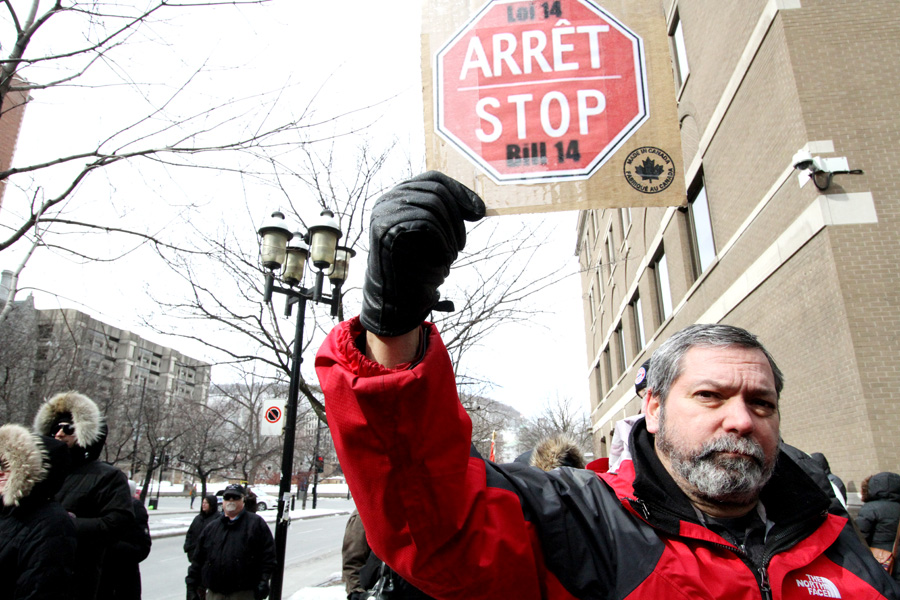
Montrealers gathered on Sunday to oppose new legislation aimed at amending Quebec’s language laws. (Alexandra Allaire / McGill Tribune)
a, News

Montrealers gather to say “no” to PQ’s Bill 14

More than 200 people gathered in the square opposite Quebec Premier Pauline Marois’ office on Sunday afternoon to protest the Parti Québécois’ (PQ) proposed changes to language laws with Bill 14. The rally featured several guest speakers who denounced the bill’s potential impacts on Quebec society, and was organized by two minority rights groups—the Unity Group and PutBackTheFlag.com.

(Alexandra Allaire / McGill Tribune)

Introduced by the provincial government on Dec. 5, Bill 14 focuses on amending Bill 101—Quebec’s Charter of the French Language. The bill seeks to further protect and promote the French language in Quebec in the realms of business, education, and municipalities.

Bill 14 would restrict the use of English in the workplace by mandating that businesses with 26 or more employees must make French their “normal and everyday language of work,” whereas currently this applies to businesses with 50 or more employees. The new legislation would also amend the bilingual status of certain municipalities. If the law were to pass, a community would only be considered bilingual if English were the mother tongue of at least 50 per cent of its population.

According to Jimmy Kalafatidis, chairman of the Unity Group, Sunday’s protest was an opportunity for both Anglophones and Francophones to demonstrate their discontent with Bill 14.

“Basically what we’re doing here is … trying to send a message to [the Coalition Avenir Québec] and the Liberals to vote down Bill 14,” he said. “[The bill] is detrimental to our economy … to education … to business in general .… It hurts everybody.”

Colin Standish, a law student at Université Laval, was one of four guest speakers who spoke at the rally. Standish expressed concern with the impact Bill 14 would have on the bilingual status of municipalities with both Francophone and Anglophone citizens.

“With [Bill 14], we would see 45 of 90 bilingual status municipalities lose [the] ability to communicate with citizens in the language of their choice,” he said. “In the Eastern Townships … we have 18 bilingual-status towns right now, and 15 of them would be taken away.”

Many of those present at the protest shared Standish’s opinion. Chris Durrant, a third-year law student at McGill said he was shocked by Bill 14’s new bilingual status requirements.

(Alexandra Allaire / McGill Tribune)

“Requiring 50 per cent Anglophones is ridiculous,” he said. “Certainly, no minorities in the rest of Canada, [like] Franco-Ontarians, would be subjected to such a high standard. I firmly support the right to protect the French language in Quebec, but this goes beyond that. This is persecution of the English-speaking community.”

In his speech, Standish further denounced Bill 14 for its proposed changes to the Quebec Charter of Human Rights and Freedoms.

“[In the bill], we see the term “ethnic minorities” changed to “cultural communities,” he said. “In international human rights tribunals, ethnic minorities do have rights, [but] cultural communities don’t. So if we see our rights infringed upon here in Quebec, and want to take it to the Supreme Court … we would actually have no rights here in this province.”

Attendees expressed concern with Bill 14’s impact on students’ ability to finish school, and to enroll in English CEGEPs.

“To graduate CEGEP and secondary school, even from an English system, you would have to pass a French exam,” Standish said. “It’s totally disconnected from any pedagogical goal, [and] also explicitly disconnected from merit-based acquisition of academic credentials.”

Kalafatidis also pointed to the difficulties Bill 14 would create for students to secure employment in the province after graduation.

“When I graduated [from Concordia] in 1994, everybody left [the province] because of the language laws,” Kalafatidis said. “We don’t want the best and the brightest [students] to leave. We want them to stay here, and help grow the economy, and help grow Quebec into a very strong multilingual society.”

Daniel Roy, who said he was not speaking on behalf of any group or organization, attended the rally to express his support for Bill 14.

“The French language is beginning to disappear in America, and it is beginning to disappear in Quebec, as well,” Roy said in French. “I support Bill 14 because it reinforces certain [aspects] of Bill 101 that have been diluted several times by the Supreme Court … and I don’t think [the bill] goes far enough. It’s important to preserve .…  French in Quebec.”

Throughout the duration of the event, several police vans lined the street, blocking traffic from accessing McGill College between Sherbrooke and President Kennedy. No arrests were made, and the protestors began to disperse after an hour.

According to The Montreal Gazette, a parliamentary committee will hold public hearings regarding Bill 14 in March.

Sébastien focuses on whipping up culinary magic, while enduring father Michel’s whithering gaze. (www.twi-ny.com)
a, Arts & Entertainment

Cooking up a family feud

The world of haute cuisine is a mystery: what happens in the kitchen is usually kept secret, and what comes out is invariably delicious, beautiful, and expensive. Every dish has a deliberate balance of textures, flavours, and colours. Similarly, every restaurant has a clearly defined balance of power that inevitably shapes the product.

In the documentary Step up to the Plate (Entre Les Bras), viewers finally receive access to the Bras family, owners of a 3-Michelin-star restaurant that is about to see one of the most closely-watched power transfers in the restaurant world. Situated deep in the beautiful Aubrac region of France, the restaurant sits atop a mountain both physically and symbolically—it is currently ranked among the top 50 restaurants in the world, and was as high as no. 6 in 2007. All eyes are on it as Michel Bras steps back, and hands control over to his son Sébastien, who was practically raised for the role.

Directed by Paul Lacoste, the film seeks to explore the family history and dynamics in order to predict the restaurant’s future. How will the dishes, and the fate of the restaurant change as a result of the new leadership? It is a question that not even the members of the Bras family can answer.

The movie itself is astonishingly simple and crisp; the audience is drawn to the food and the family more than anything else. The chefs are the true artists here, not the filmmakers, whose role is simply to capture food-as-art on camera. This is done flawlessly. A highlight of the narrative is Sébastien’s quest to create his own new masterpiece, which takes an enormous amount of time, technique, and artistry. There is no epic music or hectic distraction; instead viewers are forced to focus intensely, just as Sébastien does, as the dish comes together. Only when it is complete do we see what he saw all along—a brilliant combination of elements that only a master chef would have been able to envision. The preparation of this dish is unlike anything you can find on the Food Network or YouTube, and for this reason alone, the movie is a must-watch.

The father-son relationship is a classic dynamic, yet remains unique in the film—both clearly have enormous respect for one another, but the equilibrium of power is still very much teetering as the father relinquishes his responsibilities. Sébastien is eager to take over; he wants to maintain continuity but sees opportunity to show his own identity in the food. Meanwhile, Michel watches closely to make sure the integrity of the dishes remains intact, and the quality is as high as ever. As their family and friends agree, “It’s not a revolution; there is continuity.” Consequently, the world can expect the restaurant to remain one of the best—though under new leadership, it’s still in the family, and that in itself is a guarantee of excellence.

In this documentary, audiences get a clearly defined sense of how a delicate power transfer can be accomplished. Step up to the Plate offers a unique exploration of a family-owned, world-renowned haute cuisine restaurant, an opportunity that is not to be missed.

Step up to the Plate is showing until Feb. 21, 7:15 p.m. at Cinema du Parc (3575 Avenue du Parc). Student tickets $8.50.

Gene sequence analyses yield disappointing results for cancer research. (geneticawareness.org)
a, Science & Technology

Looking beyond mutation with cancer genetics

The media constantly bombards us with coverage of presumed cancer causing agents, jumping to the conclusions that we should ‘avoid this’ or ‘avoid that,’ only to contradict themselves the following week. Since the culmination of the Human Genome Project, which succeeded at sequencing the entire human genome, the media has placed a heavy focus on the identification of potential cancer genes. Articles concerning cancer causes, such as the recent news that the BRCA gene—a gene related to breast and ovarian cancer—places you at high risk for breast cancer, have taken over the newsstands. However, the bold headlines—which have succeeded in scaring many readers—are misleading.

The correlation between genes and cancer tends to be over-hyped. Media frequently labels them as deterministic factors, when in reality, the contribution of potential cancer genes remains unclear. These broad claims have led many otherwise healthy individuals to undergo drastic and premature procedures in an effort to reduce their risk of developing disease. For example, many women who have tested positive for the mutant BRCA1 and 2 alleles have elected for pre-cancerous mastectomies, even though the BRCA mutation only appears in two per cent of breast cancers.

As McGill professor Dr. Bruce Gottlieb points out, modern cancer therapeutics have yet to progress significantly beyond the scope of tumor excision—surgical removal of a tumor—introduced by the ancient Romans. Billions of dollars and datasets later, we are still no closer to a cure, nor identifying the cause of cancer.

So why the lack of progress? According to Gottlieb, our approach may be wrong. Since the advent of DNA sequencing, scientists have focused on uncovering and investigating oncogenes and tumor suppressor genes. This is called the two-hit hypothesis. Humans have 23 chromosomes, and each chromosome is composed of two copies of the same gene, also known as an allele. In the two-hit hypothesis, a mutated copy of one of the aforementioned genes is inherited from one parent, while the second normal copy eventually mutates due to carcinogenic exposure. Once both genes are mutated, the cell undergoes rapid proliferation, resulting in tumor formation.

“It was believed that uncovering these genes would be the magic bullet for cancer,” Gottlieb said. “[However], there were [only] two basic results from these studies. You get many mutations in many different genes being identified for no rhyme or reason. It just doesn’t make sense… A gene variant in one individual can be associated with a disease, yet in another individual with that same alteration there’s no phenotype [the disease is not present].”

Thanks to advances in biotechnology, genomes can now be easily sequenced for a fraction of the cost. This has created a stir in the field of cancer genetics—many believe that with this technology, a potential breakthrough is on the horizon. Gottlieb does not agree.

“People have started to look to see if every tumor in an individual has the same genetic sequence,” he explained. “What did they find? They don’t.”

Gottlieb conducted a recent experiment in which different regions of an individual’s prostate tumor were excised and analyzed. They found similar results: different genes are mutated in different parts of the same tumor. These results demonstrated that cancer genetics is much messier than expected—a reality the reigning two-hit hypothesis fails to explain.

“You need to understand the context of a mutation in order to grasp its significance,” Gottlieb stressed.

Gottlieb believes that each individual has their own DNA reference sequence; and to understand what’s happening you need to look at both the diseased and normal cells from a particular tissue. Mutations are not only specific to an individual, but also to a tumor, and regions within that tumor.

This manner of research may be a game changer for cancer. Based on these results, it appears that our methods of assigning risk to potentially cancer-causing genes are overly simplistic, and our therapeutics too crude. It is somewhat ironic that a disease considered largely universal—one that touches us all—can be highly individualistic at the same time.

a, News

BoG discusses need for communication on budget cuts

Last Tuesday’s Board of Governors (BoG) meeting included updates on the provincial government’s $19.1 million budget cuts. The Board also discussed the damages from the flooding of the downtown campus that occurred Jan. 28, and the administration’s intention to replace the provisional protocol on protests with two documents: a Statement of Values, and a set of Operating Procedures.

In December, the provincial government announced $124 million cuts to universities across Quebec, including the $19.1 million cuts to McGill’s operating budget. While no decisions have been made at this point as to how the university will face these cuts, Provost Anthony Masi led four Town Hall meetings on the topic last week.

“It’s very important that our community understand this is a government-manufactured crisis,” Principal Heather Munroe-Blum said on Tuesday. “[Town Halls] are an opportunity for [the McGill community] to hear about the circumstances and give input. These were very well attended .… [There is] great concern in the community.”

Associate Provost (Faculty Affairs and Resource Allocation) Jan Jorgensen said the recent cuts would require three to five per cent across-the-board cuts to faculties and administrative units.

“As we are still undertaking consultations with stakeholders through meetings and Town Halls on the alternatives for targeted cuts, and as the government’s budget pronouncements continue to evolve … we cannot decide or announce the specific targeted cuts [until] after the Education Summit at the end of February,” Jorgensen said.

Masi emphasized the importance of communication with the community as McGill moves forward with decisions.

“It’s not only about facts—it’s about the way people perceive them,” he said. “We’re anxious to get feedback from the community.”

Post-Graduate Students’ Society (PGSS) Secretary-General Jonathan Mooney told the Tribune that he thought last week’s Town Hall meetings were an “effective” means of communication, but consultation needs to continue as the administration considers different options for reducing the budget.

“These scenarios are guaranteed to be unpleasant, but I think it would be far healthier to see the different choices debated and discussed by everyone at the university before a decision is made, than to proceed with a decision that hasn’t been carefully explored by all relevant stakeholders,” Mooney said.

The Principal also informed the Board about the Statement of Values and Principles Concerning Freedom of Expression and Freedom of Peaceful Assembly and the Operating Procedures. These are the focus of two consultation sessions—one on Macdonald campus last Friday, and the other on the downtown campus scheduled for Feb. 20.

The Statement of Values and the Operating Procedures are the latest outcome in the administration’s search to create a document detailing the university’s response to forms of collective action on campus, such as protests and demonstrations.

Students’ Society of McGill University (SSMU) President Josh Redel told the Board he was “happy” to see the new drafts of the documents, which he thought took the community’s feedback into consideration.

“Hopefully there can be another big step forward if that’s what’s called for,” he said. “But why [are the] Operating Procedures [not] coming [to Senate and BoG] considering it is under the same umbrella [as the previous document]?”

Munroe-Blum said she could add discussion of the Statement of Values and the Operating Procedures to Senate’s and Board’s agendas, although both governing bodies will only vote on the Statement of Values.

The Principal also addressed the aftermath of the flood that affected the downtown campus on Jan. 28. Vice-Principal (Administration and Finance) Michael Di Grappa said the expected costs “keep going up every day.” Damages to McGill property are estimated at approximately $3 million as of last Tuesday, and  McGill will file an insurance claim.

The flood occurred after a 48-inch water main burst while construction workers were completing renovations to the McTavish Reservoir. Munroe-Blum said she has been talking with Montreal Mayor Michael Applebaum “to make sure that the infrastructure surrounding campus is taken care of effectively,” in order to prevent future incidents.

PGSS Council met Wednesday. (Simon Poitrimolt / McGill Tribune)
a, News

Universities underfunded, PGSS declares at Council

The Post-Graduate Students’ Society (PGSS) of McGill University has publically taken the stance that Quebec universities are under-funded. Last Wednesday, PGSS Council passed a motion calling for the Society to take this position in preparation for the upcoming Quebec Education Summit scheduled for Feb. 25 and 26.

According to the motion, PGSS  also supports the Fédération étudiante universitaire du Québec (FEUQ)’s call for further investigation into how university money is spent. It passed after a heated debate amongst Council members and representatives of the FEUQ who attended the meeting.

Participants who spoke on behalf of FEUQ said they do not believe there is enough evidence to prove that Quebec universities are underfunded, and that university administrations are responsible for mismanaging the money they receive from the provincial government. FEUQ speakers were concerned that the PGSS motion means the Society is complying with university administrations and their association, known as Conférence des recteurs et des principaux des universités du Québec (CREPUQ).

“I want to point out … that the underfunding that the CREPUQ talks about is a comparison between Quebec and the rest of Canada,” Marc-André Legault, president of the graduate student council at the FEUQ, said. “It doesn’t specify what are the needs of the university .… What we advocate at the FEUQ is that we have to know what are the needs of universities. We are not going to give blank checks to the rectors.”

The PGSS decided to hold its own investigation into university financing after receiving many requests from within and outside McGill to take the stance that universities in Quebec are underfunded, according to PGSS Secretary-General Jonathan Mooney. He named both the McGill administration—which is a member of CREPUQ—and FEUQ as groups that wanted PGSS to take an informed stance on the issue.

“Obviously, FEUQ lobbied us to stick with their position that the studies demonstrating underfunding are flawed and not to take the position that underfunding is a reality,” he said.

PGSS asked Conor Farrell, a researcher for the Society with a background in statistics, to look at the different reports from CREPUQ, FEUQ, and other post-secondary education organizations to determine whether or not Quebec universities are underfunded. Farrell produced a 24-page document that concluded that universities in Quebec need more money to function properly. After having received the report, the executive drafted the motion for Council.

“The first part of this motion is to say that, ‘yes, there is evidence that Quebec universities are underfunded,’” Mooney said. “But, that doesn’t mean you just give the money to the rectors or the principals to let them do whatever they want with it. There needs to be an accountability mechanism system in place, so we are supporting the FEUQ’s motion to create a [Commission for the Evaluation of Universities in Quebec] CEUQ.”

CEUQ would be an independent body that would hold rectors accountable for the spending of public money.

Mooney expressed concern when his colleagues showed scepticism over the report’s findings.

“It’s not just CREPUQ who is saying [that universities are underfunded],” Mooney said. “[When] the Council of Ontario Universities … [was] trying to make a case that Ontario universities are underfunded, they did [a] comparative analysis. Quebec came in dead last among operating grants given from the government.”

“This idea that we don’t need money is absurd,” he continued. “It’s all being done for political reasons.”

Leah Freeman, a graduate student in McGill’s School of Social Work and FEUQ vice-president of graduate student affairs, spoke out against the PGSS’s motion on behalf of FEUQ at Wednesday’s meeting.

“We will always advocate for more money to universities,” she said. “We are not asking you to give us permission to not ask for more. We are asking you to give us permission to get universities’ funding where it needs to go. Right now … we don’t know where the money is going.”

Freeman—along with the other FEUQ representatives, had no voting rights—as she is not a member of Council. Ultimately, the motion passed with an overwhelming majority in favour.

a, News

What happened in Canada this week?

COURT RULES PORTER MUST PAY MCGILL BACK

Last Wednesday, The Montreal Gazette reported that the Quebec Superior Court has ordered former Chief Executive Officer of the McGill University Health Centre (MUHC) Arthur Porter to pay over $252,000 back to McGill. The sum represents a loan Porter did not pay back in full to the university, as well as a salary overpayment. Porter, who claims he is undergoing treatment for lung cancer at his private clinic in the Bahamas, did not appear in court to defend himself.

Also last week, former Bloc Québécois leader Gilles Duceppe accused Philippe Couillard, the former Quebec Health Minister under the Liberal government, of negligence when appointing Porter as CEO of the MUHC in 2004. Duceppe pointed to Porter’s past as CEO of a hospital in Detroit, which he left deeply in debt, as an indication that Couillard either neglected to research Porter’s past, or willfully ignored it.

Duceppe has also criticized Prime Minister Stephen Harper for not conducting a proper security check on Porter before appointing him as Chair of the Security Intelligence Review Committee—an external review body that reports on the actions of the Canadian Security Intelligence Service. Porter stepped down from this position last November, after reports revealed his involvement with an international arms dealer in Montreal.

BILL C-30 SCRAPPED BY PARLIAMENT 

On Feb. 12, the federal government scrapped Bill C-30, the Protecting Children from Internet Predators Act. The bill was intended to protect children from online stalkers and sex-offenders, but was ruled to violate online privacy rights.

If the government had passed Bill C-30, police at both federal and provincial levels would have been allowed to intercept some communication services. Furthermore, companies would have been required to facilitate access to information transmitted through telecommunications, and to provide basic private information about their customers to the Royal Canadian Mounted Police (RCMP), the Canadian Security Intelligence Service (CSIS), the Commissioner of Competition, and provincial police.

The bill received opposition from both public and civil liberties groups—one of which, Open Media, drafted an online petition against the bill that received over 100,000 signatures.

Although Bill C-30 has been scrapped, other bills have been passed, or that await a vote, have also been criticized for potentially violating Canadians’ privacy rights. For example, Bill C-12, which remains before Parliament, would allow e-mail hosts, social media sites, and Internet Service Providers to voluntarily share personal information about their customers with the police.

CANADIAN CARDINAL COULD BE NEXT POPE

A Canadian Cardinal is considered to be a promising candidate for the papacy, following the announcement of Pope Benedict XVI’s resignation last Monday.

Cardinal Marc Ouellet, a former archbishop of Quebec City, has been speculated to be the frontrunner for the position, along with three other cardinals from Argentina, Nigeria, and Ghana. Ouellet is currently the Vatican’s top staff director, the same position that Pope Benedict XVI held when he succeeded Pope John Paul II in 2005.

Ouellet, 68, publically stated last year that he cannot see himself as Pope.

“I don’t see myself at this level, not at all … because I see how much it entails [in terms of] responsibility,” he said to Salt and Light Television, a Catholic news organization, last year.

Some Canadians have speculated that it would be very unlikely for Ouellet to become Pope, as Catholicism has been in decline in Canada for the last 40 to 50 years in comparison to Latin America, where more than half of the world’s Catholics reside. Ouellet has also faced criticism from Canadian politicians for calling abortion a “moral crime,” even in cases of rape.

NEW BRUNSWICK PUSHES FOR SHALE GAS DEVELOPMENT

On Feb. 15, the New Brunswick provincial government announced new regulations to allow the province to explore the use of shale gas—a natural gas that is formed when trapped between formations of shale rock. The plan has been proposed in order to create jobs and induce economic growth in a province that has recently faced financial difficulties.

The new government regulations have been designed to try to create a balance between environmental protection and economic development. Environmental concerns include the contamination of water sources with potentially dangerous chemicals used during the process of extracting shale gas. The Liberal party and environmental groups around the country have openly opposed the plan.

Conversely, several prominent politicians and businessmen have supported the exploration of shale gas in the province, including the former Liberal Premier of New Brunswick, as well as the current Deputy Chairman of TD Bank, who say that the province needs the economic growth.  Current Environment Minister Peter Kent has also supported the idea, saying that the environmental concerns are not as grave as stated in the media.

MOUNTIES ACCUSED OF ASSAULTING ABORIGINAL WOMEN IN B.C.

In a report released last Wednesday, Human Rights Watch—a non-governmental organization— accused officers of the Royal Canadian Mounted Police (RCMP) of physically and sexually abusing Aboriginal women and girls in rural British Columbia.

The human rights group published the report following a five-week investigation of neglected cases of missing and murdered women on the “Highway of Tears” in northern B.C., where several unsolved murders and disappearances have taken place. The allegations include the beating of teenage girls, the illegal strip search of women by male officers, and the rape of a homeless Aboriginal woman by four RCMP officers. In light of its findings, Human Rights Watch is pressuring the provincial and federal governments to perform a national inquiry.

The RCMP has stated that the allegations must be brought forward to the police for investigation before they can be dealt with. The federal Liberal and the NDP parties have both called on the Harper government to do more about the issue, although the government has yet to discuss the possibility of an investigation by another police force.

Students vote at the GA. (Simon Poitrimolt / McGill Tribune)
a, News

AUS GA discusses changes to VP Finance selection process

Reform to the nomination process for the position of the AUS Vice-President Finance, the fate of McGill’s Industrial Relations program, and students’ ability to decide whether McGill recognizes their advanced standing credits were among the topics discussed at Monday’s General Assembly (GA) of the Arts Undergraduate Society (AUS).

With between 20 and 45 students in attendance throughout the evening, the GA never met its quorum of 150 voters and, therefore, only passed motions as a consultative forum. Each motion passed by the GA as a consultative forum requires a 2/3 vote at AUS Council to become binding.

The most highly debated motion concerned reforming the requirements for the AUS’s vice-president finance position.

Currently, arts students elect a vice-president finance from a group of nominees in the AUS election. If this motion passed, AUS Council would determine through a vote whether nominees were qualified to run for the position after a short presentation from each candidate. Students would then elect the vice-president finance from among the approved candidates.

“This motion is valid because [the AUS] has had a history of losing money and embezzling,” AUS Vice-President Events Natasha Fenn said. “A solid [Vice-President] Finance would prevent that.”

Most students agreed that this motion addressed an important issue, but some expressed concern over its fairness.

“Do you think this is an unfair attempt to influence the outcome of the election?” Daniel Stysis, U3 arts, asked during the GA. “Do you believe that this is a decision best left to the voters who should, in fact, be choosing their own [executives]?”

Current AUS Vice-President Finance Saad Qazi, who brought the motion forward, argued that the measures would allow voters to make more informed choices about their executive.

“The 100-word blurb I wrote for the ballot [when I was campaigning] was nowhere near to conveying enough information about what my qualifications were,” Qazi said. “Something like this would just be adding [an] extra little bit of information on the ballot.”

The motion was tabled for further refinement, and will not affect this year’s election period, since the nomination period for next year’s executive positions begins this week.

Students also passed a motion that aims to protect McGill’s Industrial Relations program. The program is in danger of termination due to a lack of faculty advisors dedicated to continuing the program. AUS Vice-President Internal Justin Fletcher and Benjamin Kershman, president of the McGill Industrial Relations Association, submitted the motion.

“The issue of why the program is considering being retired has nothing to do with student enrollment,” Fletcher said.

Industrial Relations is an interdisciplinary academic program that allows students in the Faculty of Arts to study labour-management relations. Students in attendance wondered whether the program could exist independently from the Faculty of Arts.

“Will the program still continue to fully exist under [the Faculty of] Management if it doesn’t exist under arts?” Enbal Singer, U2 arts, said. “How hard would it be for students to just take it as a management program?”

The motion passed after participants discussed the fact that arts students would have to switch faculties in order to enroll in the program in the Faculty of Management.

Students also passed a motion calling for the AUS to lobby the Faculty of Arts to provide students with the opportunity to decide whether their advanced standing credits are recognized by McGill. Incoming students are currently unable to decline transfer credits from advanced standing credits, and, as a result, are unable choose whether they complete a three or four-year degree.

“I really … like the spirit of this [motion],” Ryan Mitton, U1 arts, said. “I’ve seen a lot of my friends suffering from trying to make decisions [over declaring a major] going into first year.”

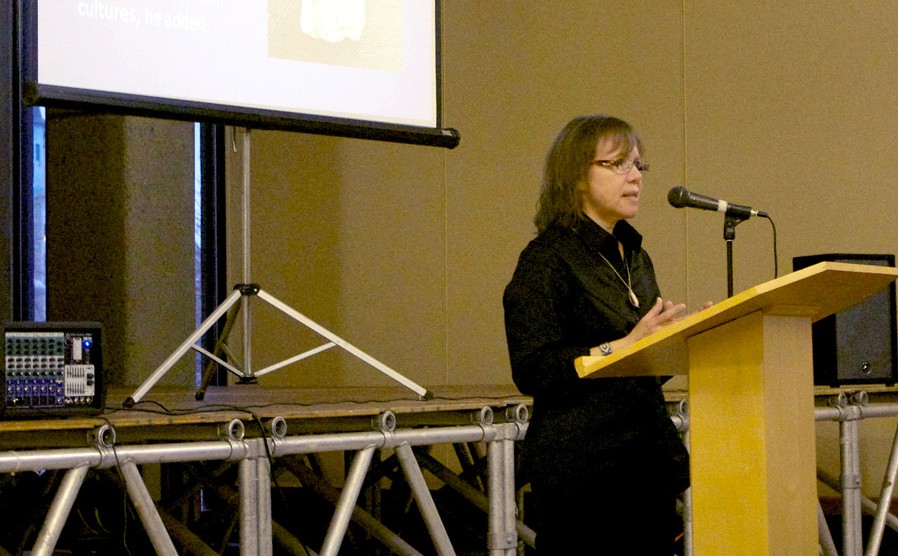
Ellen Gabriel talks equity. (Remi Lu / McGill Tribune)
a, News

Speakers conclude McGill has long way to go on equity

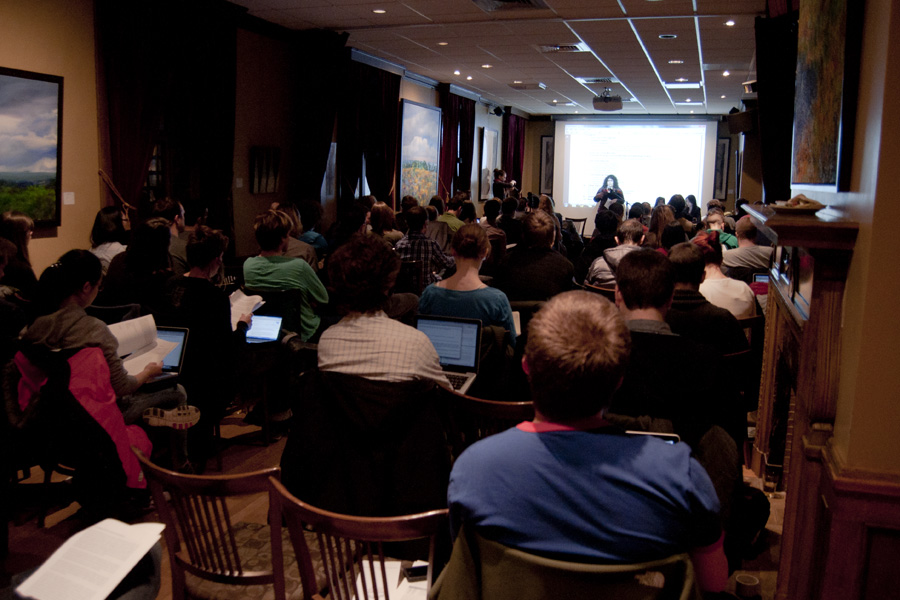
Last weekend, the Equity Committee of the Students’ Society of McGill University (SSMU) held its annual conference in the SSMU Ballroom for students to learn about issues of inequality and how to promote equity at McGill. Throughout the two-day conference, professors, guest speakers, and students shared their research on equity.

SSMU’s Equity Committee follows the SSMU Equity Policy to promote social justice at McGill, and offers services and channels for addressing equity complaints.

“We tend to think that since we’re at McGill, a university with much cultural diversity, everyone would love each other, but that is not the case,” SSMU Equity Commissioner Justin Koh said. “There are lots of situations in which students are not very comfortable if they are not of the dominant race, social, or ethnic background … this conference is an opportunity for students who have done research on this topic to share their knowledge.”

The first half of the conference, held on Friday night, featured five speakers who gave their perspectives on the definition of space and on the issues of inequality that might arise when people with different backgrounds and goals share a common learning space. The second half of the conference, held on Saturday morning, allowed undergraduate students to present their papers and findings regarding equity on campus.

Ellen Gabriel, an Aboriginal political activist from the community of Kanehsatà, spoke about historical injustices against Indigenous populations, contemporary debates on Indigenous affairs, and their relation to the McGill community. She suggested that attention to Indigenous welfare and heritage from the Canadian government is largely inadequate, and that Canadian public education should invest more effort into educating students on the history and issues concerning Indigenous minorities.

“We are marginalized within academia,” Gabriel said. “I think [because of] the fact that after 11 years of lobbying by students, there still isn’t an Indigenous program, definitely, McGill is not viewed by most Aboriginal students as very welcoming, because there is really nothing here.”

McGill currently offers courses in Aboriginal Studies under the Canadian Studies department, and is in the process of establishing an Indigenous Studies program.

The issue of racial inequality was also brought up during the conference. Mahtab Nazemi, a graduate student from McGill’s Faculty of Education, presented her Master’s thesis: “Beyond Racism: Mapping Ruling Relations in a Canadian University from the Standpoint of Racialized Women Student Activists.” Nazemi informed the audience about the experience of some racialized students at McGill.

“[McGill has] a good reputation of being equitable and diverse globally, but some of the ‘old boys’ club’ reputation is still there,” Nazemi said. “If [a McGill student] can live up to that experience [of being treated equitably] then great—you can feel represented by the institution. But if you can’t, then it is important for you to present your counter narrative.”

The topics of other presentations ranged from the effects of political representation on equality to the gendered landscape of urban spaces. Students engaged with speakers during short question and answer sessions after each presentation.

“[As] McGill is my community, I am very interested in how [equity] affects me,” Sarah MacArthur, U1 arts, said. “Even if we live in Canada, and we go to a very liberal university, [issues of inequality] are still present in my eyes.”

SSMU Equity Commissioners Justin Koh and Shaina Agbayani promised attendees that another conference would be hosted next year.

Social Justice Days at McGill. (Cassandra Rogers / McGill Tribune)
a, News

Workshop addresses challenges facing temporary workers

Over the course of last week, the Quebec Public Interest Research Group (QPIRG) McGill and the Students’ Society of McGill University (SSMU) presented a series of Social Justice Days designed to encourage dialogue regarding social issues in the Montreal community and around the world.

Now in its seventh year, Social Justice Days has become an annual tradition at McGill. Events this year included a wide range of workshops, film screenings, and lectures. One event, called “the Permanence of Temporary Work,” exposed attendees to Canada’s Temporary Foreign Worker Program (TFWP), the criticisms surrounding it, and the challenges it faces.

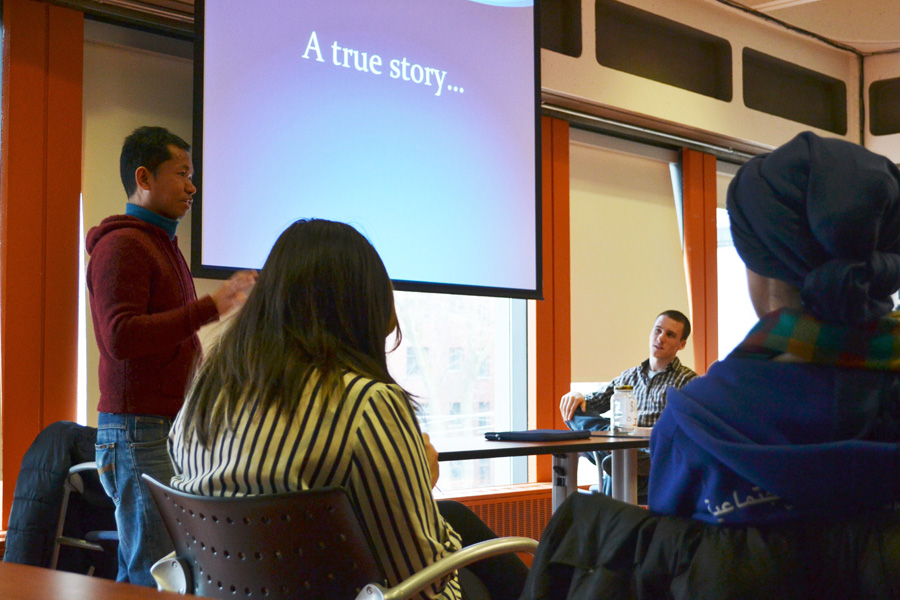
The workshop included a viewing of a scene from the film “The End of Immigration,” and a presentation from guest speaker Niel Ladote, who described his experiences as an open permit worker from Indonesia.

The Government of Canada introduced the TFWP as a measure to offset temporary labour shortages for sectors in which Canadian citizens and residents were unavailable for hire. However, temporary workers often face challenges such as cultural barriers, low standards of living, unsafe work conditions, and below-par wages. Due to their status and dependency on temporary work, they often find themselves without leverage when work-place issues arise.

Ladote came to Canada three years ago, and currently has an open work permit.

“I came here as a student, but I don’t feel as though there is any improvement [for foreign workers],” he said.

Ladote said challenges for temporary workers don’t stop at the Canadian border, as many workers find that their position puts a strain on their relationships with loved ones back home.

“I have two siblings back home, and we don’t have [a] really close [relationship anymore],” Ladote said. “I dreamt of the Canadian dream, but it’s not true.”

Students at the workshop were aware that while seemlingly unrelated to McGill, the TFWP plays a role in students’ lives because of temporary workers’ involvement in many aspects of daily life.

“Being a student at McGill, there’s a certain standard of living that we uphold, and I think being aware of how that standard of living is maintained is really important,” Susanna Millar, a U3 social work student who attended the event, said. “Where you buy your daily groceries, where those groceries were harvested, and who made your dinner if you go to a restaurant are important [things] to be aware of, because the standard of living that people enjoy would not necessarily be possible if the cost of production went up.”

Ladote stressed the importance of creating discussion and raising awareness about the challenges temporary workers face in Canada.

“I believe that working together in action is important and crucial—people telling their stories and speaking out, [saying] ‘yes, this is happening in this city and this country,’ ” he said.

Millar echoed Ladote’s call to raise awareness.

“Within the McGill community, we’re not isolated from government policies of immigration,” Millar said. “Just keeping your eyes open to these issues is important because it’s not just [happening] in some remote area, [it’s not just] some people working in a basement; it’s everywhere.”

Read the latest issue

Read the latest issue