


Latest News

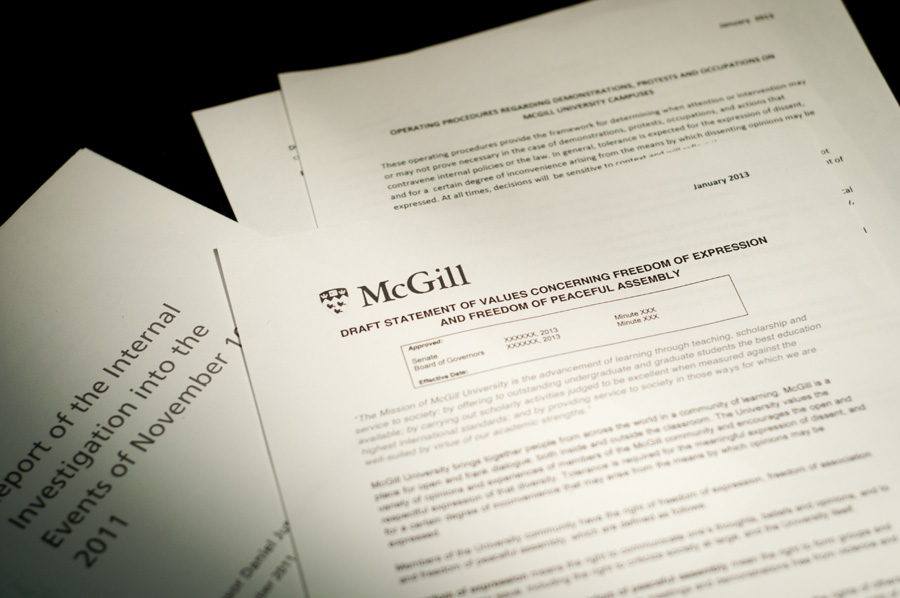
McGill will host two Consultation Fairs to discuss the new Statement of Values and Operating Procedures. (Simon Poitrimolt / McGill Tribune)
a, News

McGill releases new documents on how to deal with protests

McGill released the latest set of documents regarding protests and demonstrations on campus on Monday. Originally a draft protocol on demonstrations, these documents consist of a Statement of Values and Principles on freedom of expression and freedom of assembly, and a set of Operating Procedures regarding demonstrations, protests, and occupations on McGill University campuses.

Vice-Principal (Administration and Finance) Michael Di Grappa and Provost Anthony Masi first announced that the administration would take this course on Jan. 16, following consultation for the draft protocol in December and January. The documents are meant to eventually replace a provisional protocol that has been in effect since Feb. 12, 2012, since the five-day student occupation of the 6th floor of the James Administration building.

According to the second document, the Operating Procedures will serve as guidelines for determining “when attention or intervention may or may not prove necessary in the case of demonstrations, protests, occupations, and actions that contravene internal policies or the law.”

“In general, tolerance is expected for the expression of dissent, and for a certain degree of inconvenience arising from the means by which dissenting opinions may be expressed,” the document reads. “At all times, decisions will be sensitive to context and will reflect the exercise of sound judgment by those in charge.”

The document then outlines in what contexts demonstrations, assemblies, and protests are considered to be peaceful, which include the consideration of “intensity, intentionality, duration, and location.”

While both the Senate and the Board of Governors (BoG) were originally intended to vote on the draft protocol, the Operating Procedures will not face a vote in either body. Di Grappa has said that this is common procedure for university administration, because the Operating Procedures are an “administrative document,” rather than a matter of academic or fiscal policy.

Both the Senate and the BoG will vote on the Statement of Values and Principles on Mar. 20, and Apr. 26, respectively.

“The Statement of Values will be an over-arching statement that will influence how McGill responds to events on campus, including the implementation of the Operating Procedures,” Di Grappa said.

The email that announced the release of the documents on Monday notes that the administration created the Statement of Values to closely resemble the preamble to the draft protocol.

“Based on consultation on the draft of a revised protocol circulated to the community before the Holiday break, we concluded that the preamble of the proposed protocol was generally well received,” the email reads.

Students’ Society of McGill University (SSMU) President Josh Redel said he felt the new documents were “a step in the right direction” for McGill, although he questioned the administration’s decision to forego discussing the Operating Procedures at Senate or the BoG.

“Does it belong at Senate? Does it belong at Board?” he said. “I can see some Board members saying that ‘this is management and we usually deal with governance’ … but that doesn’t mean that it shouldn’t go there at least for discussion.”

Although Post Graduate Students’ Society (PGSS) Secretary-General Jonathan Mooney expressed that he saw improvement in the language of the latest draft of the Operating Procedures, he also shared Redel’s view of the administration’s decision.

“It is clearly stated that [the Operating Procedures] ‘do not replace policies such as the Charter of Student Rights, [nor] the Code of Student Conduct,’” Mooney said. “We think it is critical that no administrative document supersede any of the policy documents [that] are approved through the Board and Senate, which include student input.”

“Still, since these Operating Procedures clearly touch on matters related to the Student Code and the Charter of Student Rights, [PGSS thinks] it’s critical that these [Operating Procedures] come before democratic mechanisms in place—the [Board] and Senate—both of which include students’ voices and the ability for people to suggest changes [and] debate,” he continued.

Critics of the draft protocol, including students, campus unions, and the Canadian Civil Liberties Association (CCLA), described the document as being vague and open to interpretation. U3 arts student Eli Freedman filed a grievance with the university against the draft protocol in December 2012, asking that both the draft protocol and the provisional protocol be nullified. According to Freedman, the new documents “repackage the exact same document” into two.

“[The administration] certainly haven’t changed any of the sections that have been criticized [by the CCLA], so it seems like the Mc- Gill administration believes it can bully students, unions, and civil rights watchdogs,” he said. “The same types of concerns have been brought forth by so many parties at this point, that it seems like [the administration is] … ignoring any criticisms and pushing through the type of document that they wanted all along.”

Freedman said his grievance has been delayed by the administration’s decision to split the document, but that he should hear back from the Senate Committee on Student Grievances by mid-February.

Although the documents are separate from one another, they will receive feedback together at two Consultation Fairs in February— one at the Macdonald Campus and one at the downtown campus.

“Experience tells us [attendance] won’t be huge, [but] I think people will have ample opportunity to make their views known,” Doug Sweet, McGill’s director of internal communications, said.

The administration also created a comments section, where members of the McGill community may post comments and view other participants’ comments. According to Sweet, those interested in submitting a comment should do so by the beginning of the second week of March for the administration to consider their remarks.

According to Di Grappa, the provisional protocol will likely remain in effect until Apr. 26, when the BoG is expected to vote on the Statement of Values. Redel said he intends to encourage the administration to create an opportunity for Senate to discuss both documents.

“I hope people do get out and provide feedback,” he said. “Hopefully the university is truly willing to … consider splitting [the documents] again, combining [them], or reforming [them] significantly if the consultation feedback they get in the next phase is drastic enough to warrant another change.”

Joel Suriano from the Grounds Department. (Simon Poitrimolt / McGill Tribune)
a, News

McGill still recovering from flood

The cleanup of McGill’s downtown campus continues this week after severe flooding occurred on Jan. 28. Several buildings remain inaccessible to students and staff, and several hundred people have been relocated until building repairs are completed.

The flood occurred when a 48- inch water main at the McTavish Reservoir broke, releasing 40,000 cubic meters (just over 10.5 million gallons) of water. Last Thursday, the city of Montreal announced that the incident concluded that the burst may have been caused by construction workers shifting earth around the pipe. Financial responsibility for the incident has not yet been assigned.

According to McGill Vice- Principal (Administration and Finance) Michael Di Grappa, the flood caused the cancellation of 80 classes and the relocation of 12 laboratories on Monday. He said approximately 12 buildings were affected, including Service Point, the James Administration Building, and the Wong Building.

While most buildings have been reopened, the Wong Building remains closed, as well as basement spaces in Birks Building, Wilson Hall, and 3534 University—the building that houses the School of Environment. People in these spaces have been relocated to places like the Ferrier Building and the Stewart Biology building while repairs are conducted, which are predicted to take two to three months.

“The damage has been flooding in foundations, there’s a risk of mold, there’s damage to furniture, [and] damage to equipment,” Di Grappa said. “We don’t know what the dollar amount is, but believe it will be hundreds of thousands of dollars.”

Some of the most extensive damage has been to the James Annex— a small building by the James Administration building that houses McGill’s graphic design team– where water smashed a window and flooded the building. According to Director of Internal Communications for the Media Relations Office Doug Sweet, staff members who work in the Annex and the second floor of James Administration will not be able to return to their offices until repairs are complete, which could take several months. This further delays damage assessment.

“We don’t have a precise estimate of the costs, and in fact, some of them haven’t been incurred yet— for example, whatever it will cost us to relocate people from James Annex and from the second floor of the James Admin Building,” Sweet said. “[We] will be filing a claim with our insurers.”

A clean-up effort on campus has been underway for over a week to remove debris, before freezing temperatures complicate the process.

Alexandra Allaire / McGill Tribune

“There’s a very fine silt of mud that is very hard to remove when it freezes,” Angelo Tambasco, supervisor of McGill’s Grounds and Vehicle Services, said. “If all this mud freezes up, we’re going to have to wait for the next window of opportunity to be able to clear it up.”

Tambasco said his crew focused on freeing emergency exits, since a building must remain closed if its emergency exit is blocked. Tambasco also said that the flood may have caused more serious problems in places like McTavish Street, where entire areas were washed away by water, and cracks in the road have appeared.

“Right now, a lot of the earth underneath is still frozen, so you could have some voids underneath your roadways,” he said. “A lot of this is going to have to be looked at come spring, [because] at this particular point in time, we can’t really tell [if it’s dangerous].”

A student-run garden located behind McGill’s School of Environment on University Street was also severely damaged when floodwater washed soil away, dumped bricks and rocks in the area, and may have carried pieces of a nearby invasive plant into the garden. The garden is run by Campus Crops, a student-run collective that promotes urban agriculture.

“A lot of time, energy, and money has been lost for us, especially since the little good quality topsoil we managed to have accumulated so far seems to have been washed away,” Campus Crops Coordinator Carl Dion Laplante said. “We’ll have no choice but to remove as many rocks as possible and see what we can do with the soil that is left.… We might not be able to use it to grow vegetables next summer.”

a, News

Students vote to keep The McGill Daily and Le Délit alive

The Daily Publications Society (DPS) will continue to collect student fees for the next five years, after 18.8 per cent of graduates and undergraduates voted in favour of renewing the DPS’s Memorandum of Agreement (MoA) with McGill University. The referendum passed with 76.17 per cent of voters in favour of the DPS’s continued existence. The results were announced last Thursday.

An MoA is a contract between a student group and the university that specifies the details of their relationship, including fee collection, lease space, and distribution rights for the DPS’s two newspapers—The McGill Daily and Le Délit. McGill requires that independent student groups run a referendum every five years to ensure that students continue to support the organization’s existence.

DPS Chair Sheehan Moore, who was also the chair of the official ‘Yes’ committee for the campaign, said the DPS is happy with the result and the high voter turnout.

“We had over a hundred people sign up for our ‘Yes’ committee and they were extremely enthusiastic and helpful in helping us get out the vote,” he said. “I think attitudes towards voting on campus have also changed …. I think it marks a feeling of students wanting to get more involved in campus life.”

According to Elections DPS Chief Electoral Officer Faraz Alidina, this year’s election team worked to address challenges such as meeting quorum and involving graduate students in the election.

“The Elections DPS team worked very hard to create this electoral agency as one that was impartial and apolitical, and that the McGill student body would accept [it as such],” Alidina said. “The students could easily have not voted, we would have lost quorum, and this process would have been a complete disaster. In reality, the exact opposite happened—we raised the level of debate on campus and achieved a good turnout rate.”

According to Alidina, quorum was met within a few hours of the first day of polling. He also noted that the operations of both The Mc- Gill Daily and Le Délit continued as normal throughout the campaign period.

“We wanted to ensure that the regular operations of The McGill Daily [and] Le Délit were not consumed by the needs of the ‘Yes’ campaign,” Alidina said. “Both papers continued to publish and operate in their usual fashion, despite the pressures and stress of their existence being up for question.”

While 23.83 per cent of participants voted against the referendum, an official ‘No’ committee was never formed. Some students, however, were surprised by the results.

“I honestly didn’t expect The Daily to get de-funded, but I did expect [the results] to be closer, not 70 per cent [in favour], but in the fifties or even the sixties,” Graham Pinchin, U3 engineering, said. “I would have preferred that, just because I think it would have possibly made The Daily re-evaluate how they’re publishing. With [such a majority], I think that’s unlikely to happen.”

Despite their successful voter turnout, which exceeded the five per cent quorum, Moore said students and the administration should now start thinking about alternatives to existence referenda.

“The most turnout any [group] gets is 18 to 20 per cent of the student body,” he said. “We celebrate that, but it’s still fairly disheartening …. The motives behind [existence referenda] are extremely well-intentioned, but if you look at the student groups that [the administration] requires to have existence referenda, they all have their own internal structure of … checks and balances to make sure they are accountable to students.”

Moore said next year will provide a good opportunity to start working with the administration on this topic, since there will be a new incoming Deputy Provost (Student Life and Learning).

“This would be a good time for students to be more proactive in trying to work with the administration to think of different ways … we can ensure that student groups are accountable,” he said.

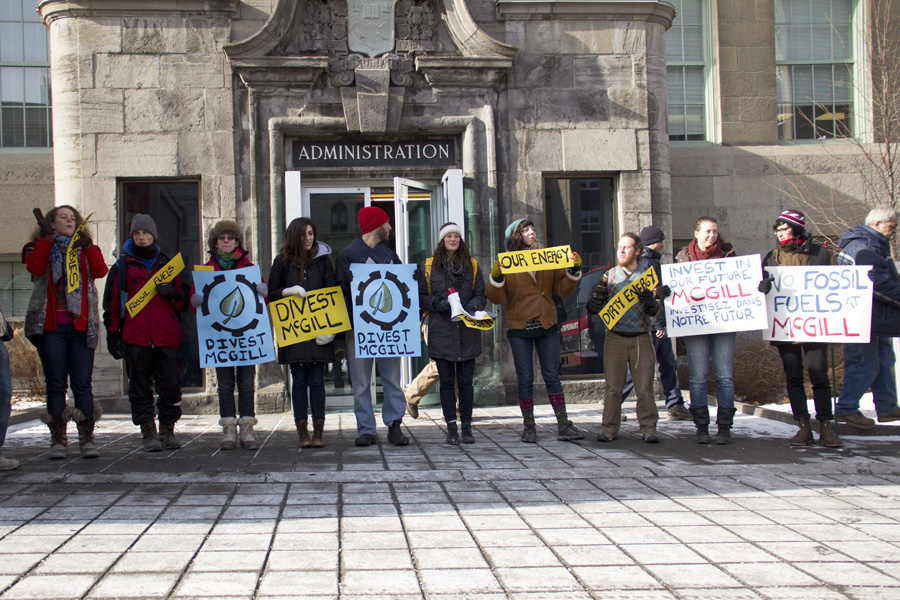
Divest McGill members chant in James Square. (Luke Orlando / McGill Tribune)
a, News

Petitions call for divestment from fossil fuels, Plan Nord

On Friday afternoon, Divest McGill delivered two petitions to the university’s Secretary-General, Stephen Strople, calling for McGill to divest from the Plan Nord, the oil sands, and fossil fuel industries.

According to administrative practice, the petitions will be passed on to the Committee to Advise on Matters of Social Responsibility (CAMSR)—an advisory body responsible to the Board of Governors (BoG)—where they will eventually be reviewed.

Launched in October 2012, Divest McGill is a student-led campaign concerned with environmental issues such as climate change and McGill’s investments in companies whose projects negatively affect the environment. It circulated the two petitions over the past three months, and garnered a total of 750 signatures from students, faculty, staff, and alumni.

The first petition calls for Mc- Gill’s Investment Committee to “dispose, in an orderly and responsible fashion in no longer than three years, of the University’s holdings in corporations which produce, refine, transport, or sell fossil fuels,” and to also divest from financial institutions that support fossil fuel companies within three years.

The second petition requests that the university divest from corporations linked to the Quebec government’s Plan Nord—a development project to extract natural resources in the north of the province. This petition also calls for McGill to cease its relationship with “corporations that do business on native land against the wishes of the native peoples of that land.”

“Tar sands and fossil fuels are already … buzzword[s] in Canada …. This is an issue that affects all of us personally in a variety of ways,” Lily Schwarzbaum, U3 arts, said. “At the same time that we independently … decided to make our own campaign, there were actually campaigns going on all over North America, organized by 350.org in the States, and the Canadian Youth Climate Coalition in Canada, to divest from the fossil fuel industry.”

“McGill University, as a top academic institution in Canada, has a major social role to play in … challenging the way that the fossil fuel industry has engrained itself in Canadian society,” Schwarzbaum continued.

Schwarzbaum and U3 arts student Christopher Bangs, who are both spokespersons for Divest Mc- Gill, expressed satisfaction with the amount of support that the campaign has received since its initiation.

“We’ve had endorsements from SSMU, endorsements from the AUS, and we’re bringing it forward to other student associations, labour unions, and faculty associations,” Bangs said. “It seems like everyone we talk to [and] everyone we try to collect signatures from is really, really into it.”

About 20 students gathered in front of the James Administration Building on Friday to watch Divest McGill members deliver the two petitions to Strople. The event included several chants, as well as speeches to the crowd.

“Climate change is one of the greatest threats of our generation,” Bronwen Tucker, U2 environment, said. “It is our obligation as a university and as a community to act and ensure a sustainable … future for our planet.”

“McGill is one of the only universities in North America to have a formal process for [expressing] concerns about the impact of university investments,” Tucker continued. “We commend McGill for this open channel. We believe it demonstrates a concrete commitment to ethics and the free exchange of ideas.”

Strople will be handing over the two petitions to CAMSR.

“We will proceed under the Terms of Reference of CAMSR [as outlined in the BoG Handbook] to review it and … move forward,” Strople said.

Bangs said he is optimistic about CAMSR’s review process, which includes analyzing the substance of—and concerns raised in— the two petitions.

“Secretary-General Strople informed us that we can probably expect a … response [within] two weeks,” he said.

Following its review, if CAMSR confirms whether “social injury”—as defined in Section 5 of CAMSR’s Terms of Reference—has occurred, the Committee will recommend to the BoG whether action is necessary, and what form such action should take, a process which is expected to take several months.

“We’re sort of expecting a decision by October,” Bangs said.

Bangs and Schwarzbaum were also pleased with the energy exhibited by participants during Friday’s presentation, and expressed enthusiasm for the expansion of the Divest McGill campaign.

“I see a lot of potential for the community at McGill to get involved because there [are] so many ways of looking at it—from an environmental standpoint, from an economic standpoint, from a community- building, academic mission standpoint,” Schwarzbaum said. “We’re very excited to be able … to use the resources that we have to work for our future.”

a, News

Meet members of the McGill community recently elected to the BoG

Edith Zorychta

Edith Zorychta was elected in November as a Senate Representative to the Board of Governors (BoG). Zorychta is an associate professor in the Department of Pharmacology and Therapeutics, and currently sits on the McGill Senate.

She decided to run for the position following her colleagues’ encouragement at McGill, especially those who sit with her on Senate. In the past, Zorychta served as president of the McGill Association of University Teachers (MAUT), and sat on committees dealing with equity issues, staff benefits, university governance, and academic regulations. Currently, she serves as Graduate Program Director for her department.

Zorychta pointed to her experience with both undergraduate and graduate students, and with her advocacy for Universal Design for Learning (UDL) as assets that will assist her throughout her time on the BoG. UDL is an educational tool that helps create flexible learning environments, and that considers individual learning differences.

Zorychta said she thinks Mc- Gill’s harsh financial reality is the BoG’s greatest concern right now.

“McGill is always having to do more with less, but there is a limit to our capacity, and difficult decisions may have to be made regarding priorities,” she said.

Zorychta also believes that restricted space on campus is another significant issue, yet she questions the feasibility of the McGill campus expanding into the Royal Victoria Hospital area—a tentative opportunity that was discussed at the Jan. 23 Senate meeting.

“We … have ongoing problems with space constraints,” she said. “There are relatively few large classrooms, which can restrict student enrollment in some courses and create problems in scheduling examinations .… McGill could possibly obtain much needed space in the [Royal Victoria Hospital], but could we finance the renovations necessary to create research laboratories, offices, classrooms, [and] residence rooms?”

Zorychta hopes to promote openness and communication within McGill during her time on the BoG.

“McGill rests on transparency and trust,” she said.

Bryan Haynes

Bryan Haynes has also been elected to the BoG for a five-year term, which began Jan. 1, 2013. He serves as one of three Alumni Association Representatives. Haynes graduated from McGill with a BA in 1990 and a law degree in 1993.

“McGill is an institution that I care deeply about,” he said. “It is where I earned two degrees … and the tools of my trade. It is where I became an independent person. I have very fond memories as a student at McGill. I will forever feel indebted to McGill for what it has provided to me, and allowed me to become.”

He is now a partner at Bennett Jones, an international law firm. He is based in Calgary, where he is co-head of the firm’s corporate practice group. He deals more specifically with private mergers and acquisitions, divestitures, and corporate reorganizations. Lexpert—a magazine that focuses on the business of law—named Haynes one of Canada’s top 40 lawyers under 40 in 2008.

“I have lived most of my life in Western Canada,” Haynes said. “This will allow me to offer another perspective on things—an ‘outside’ view of sorts.”

Haynes decided to run for the BoG after being nomiated by the McGill Alumni Assocation last spring.

“Being asked to stand for election to the Board of Governors is, in my view, the highest calling,” Haynes said. “It is an honour and a privilege bestowed on few and represents the ultimate opportunity to give back to one’s alma mater.

He said keeping McGill as one of the world’s top 20 universities is of great importance to the BoG.

“Maintaining and advancing McGill’s position and role as Canada’s top university and one of the world’s top 20 universities is a persistent challenge that must constantly be overcome,” he said.

a, News

What happened last week in Canada?

MUHC links to Kuwait questioned

The Montreal Gazette has raised questions about the transparency and resource management of the McGill University Health Centre (MUHC), after unearthing details about its role in a five-year agreement between Montreal Medical International Inc. (MMI) and the government of Kuwait. The agreement, which was signed in 2010 and is in effect for two more years, was designed to improve cardiovascular services in Kuwait through post-doctoral training provided by McGill University Health Centre (MUHC).

Prominent members of the MUHC and MMI, including MMI President Michael Churchill-Smith and former MUHC Executive Director Arthur Porter, signed the contract. However, Quebec Health Minister Réjean Hébert said he was unaware of the agreement. According to The Gazette, the MUHC, supposedly receives payment for the use of its staff in Kuwait, never detailed receipt of these funds on any public document.

The contract also states that no Kuwaiti citizens will be admitted or treated at the MUHC. However, La Presse reported last week that a Kuwaiti heart patient underwent an operation at the Royal Victoria Hospital on Dec. 16, 2011. While MUHC spokesman Ian Popple emphasized that the patient was treated on “compassionate grounds,” this event has been criticized because many Quebec heart patients wait for several months to receive cardiac surgery.

Senate reform act goes to the Supreme Court The federal government has asked the Supreme Court to clarify whether the Senate Reform Act is constitutional, according to a statement last Friday by Tim Uppal, the Minister of State for Democratic Reform.

The Conservative government introduced the act to the legislative agenda in 2011. If passed, the legislation would allow provinces to elect senators and also limit senators’ terms to nine years. Senators are currently appointed by the Governor General on the advice of the Prime Minister, and may serve until they reach the age of 75. However, the legislation has not been debated in parliament for almost a year, and faces certain challenges, including how to determine the number of senators who should come from each province.

Opposition has criticized the decision to send the legislation to the Supreme Court, saying that it could take as long as two years to release a decision. However, the Conservatives claim they are attempting to speed up the legislation. NDP House Leader Nathan Cullen has alleged that the Conservatives are trying to delay the legislation in order to continue appointing as many senators who support their party as possible before the Act passes.

UBC fills pay gap

The University of British Columbia (UBC) announced last week that it will give its tenure-track female faculty members a two per cent pay raise by the end of February. The pay raise, which will affect 880 female professors, is also retroactive to July 1, 2010.

The decision, which will cost UBC about $2 million this year alone, was made after the university’s Equity Office held a series of internal equity studies. These studies discovered that female professors were paid approximately two per cent less than their male counterparts, which averages to about $3,000 per year.

According to The Globe and Mail, McGill and Western University have been filling gender pay gaps for the past two decades, but UBC’s approach is different than the route taken by most other Canadian schools. While most other universities focus on raising the pay of female faculty members deemed to be under-paid, UBC plans to raise the salaries of women at all ends of the pay scale.

UBC has said that it wants to implement the changes immediately, so as to avoid potential human rights complaints that could follow the Equity Office’s findings.

Landslide in l’Épiphanie leaves two workers dead

A landslide last Tuesday left two truck drivers dead in a quarry in L’Épiphanie, a city just northeast of Montreal. The two drivers were operating heavy machinery in the quarry when sliding gravel caused their vehicles to fall approximately 100 metres into the pit and become trapped under mounds of gravel and mud.

Rescue crews recovered their bodies on Saturday after a four-day search, which was put on hold several times due to poor weather conditions and fears of another landslide. Another worker, whose backhoe was similarly trapped in the quarry, was rescued on Tuesday. He was airlifted out of the quarry and taken to the hospital in Terrebonne, where he is recovering from the shock of the incident.

One geologist has speculated that the landslide may have been caused by a several factors, including the way the site was being excavated, and the composition of the pit, which has a layer of clay soil between layers of excavated gravel. Authorities are currently conducting an investigation to determine the cause.

Ikea monkey won’t return home yet

Yasmin Nakhuda—owner of Darwin, the Ikea monkey—lost a third bid to have her monkey returned to her after an Oshawa court decision on Friday.

Toronto Animal Services took Darwin to the Story Brook Farm Primate Sanctuary in Sunderland, Ontario, after he was found wandering around an Ikea parking lot wearing a shearling coat. He remains at the sanctuary today, and will stay there at least until a trial is held this spring.

Nakhuda filed a civil action against the sanctuary after claiming that by-law officers from animal services tricked her into giving up Darwin. She filed a motion with the provincial courts to allow her to take Darwin back until the trial begins, but this request was denied. A judge reminded those in attendance on Friday that this was not a custody battle, but rather a matter over personal property. The sanctuary maintains that they believe Nakhuda is an unfit caregiver for Darwin—claiming that she strangled the monkey and neglected to change his diaper for a number of days—and that he is thriving in his new environment.

a, Opinion

Plus ça change: New protest documents are more of the same

Nearly a year after McGill released its proposed Protocol Regarding Demonstrations, Protests, and Occupations, the administration has drafted its latest incarnation. The new version comes in the form of two concurrent documents: a Statement of Values regarding freedom of expression, and a set of Operating Procedures intended to act as a guideline for disciplinary action in the event of protests and demonstrations. Although these replace the latest protocol on the pretense of the administration reacting to student opposition, the new documents are still open to most of the previouslylevelled criticisms. These include charges of ambiguous language, and of the university overstepping its bounds by infringing on human rights. This latest response from the university leaves us with no sense that these concerns have been taken into account.

As was the case with the previous draft protocol, these two documents are being released with the promise of a consultation process. This comes in the form of two “Consultation Fairs” (one downtown and one at Macdonald Campus), as well as an online discussion forum on the announcement page. We have numerous concerns about the effectiveness of these strategies. Will the university publicize its efforts in a way that will garner interest? If so, will the fairs be able to accomodate high attendance? More importantly, we have come to feel that the administration’s professed commitment to the consultation process amounts to nothing more than lip service. For over a year, students have been lobbied for their input on the protocol, and despite a vocal response from the McGill community and elsewhere— including an open letter of concern from the Canadian Civil Liberties Association (CCLA)—we have yet to see any major deviation from the initial protocols. Changes have been limited to the removal of a definition of non-peaceful demonstrations, and a more descriptive definition of “disruptive.” After a year of criticisms and concerns being pushed aside, our confidence in any consultation process has been severely shaken.

The university’s claim that its procedures are in line with those of other institutions also leave us unconvinced. The situations of different institutions are rarely perfectly analogous, especially considering Quebec’s unique history of protests. To assume that another school’s policies can be used as a valid comparison point, or are a fair standard in defining what is appropriate, is a highly misguided notion. We will accomplish nothing by merely adoping another university’s values, especially while disregarding ongoing input from the McGill community.

We also take issue with the approval process as it has been proposed. Splitting the Protocol into two documents means that while the Statement of Values will be put before the Senate and the Board of Governors (BoG) in the spring, the Operating Procedures are being considered an “operational or administrative matter,” and will not be subject to any ratification process. Seeing as how it is this latter document that inherited the controversial and widely opposed aspects of the protocol, we find the administration’s conduct to be deceptive and underhanded. This further weakens our faith in the consultation process. Additionally, this effectively unilateral declaration on the administration’s behalf will undoubtedly harm the document’s perceived legitimacy; there is no evidence that these Operating Procedures reflect the values of the student body or those of the greater community. While following this course of action is within the administration’s rights, we feel that the mere ability to do so does not mean that they should.

The same applies when it comes to the actual contents of the Operating Procedures. The statement that was sent out with the documents cites article 9.1 of the Quebec Charter of Rights and Freedoms, which outlines acceptable limits to the rights of the individual. Again it is clear that the school is not overstepping its legal boundaries, but by no means does this suggest that that its actions are appropriate. Drafting its Operating Procedures without any real regard for the community’s input has allowed the administration to set its own definitions of free expression, and outline its own parameters for legality. When there are such decisions to be made elsewhere in society, they are entrusted to judges, who are expected to be neutral and unbiased. McGill can make no such claim to impartiality. Regardless, even the parameters that the administration does identify are, as in previous iterations of the protocol, excessively vague, and fail to effectively identify the limits of a peaceful and acceptable protest. As a result, the document leaves far too much arbitrary and retroactive power of interpretation in the hands of the administration. It defines the four parameters: intensity, intentionality, duration, and location, by which it evaluates a protest, but it fails to quantify them in any meaningful way. Dean of Arts Christopher Manfredi’s Report of the Open Forum on Free Expression and Peaceful Assembly states that “It is only when a protest or demonstration takes a disruptive form previously defined as unacceptable by authorities that it becomes civil disobedience.” A major issue with the new Operating Procedures and the preceding protocol is that it is never clear what is being “defined as unacceptable.” Such ambiguous terms inevitably leave protesters vulnerable to attacks on their freedom of expression.

Throughout this increasingly protracted consultation process, the administration has obliquely refused to make any significant changes in its proposals. Under the guise of a dialogue, the repeated, ineffective consultations have served to do nothing more than frustrate and exhaust opposition to McGill’s restrictive vision of expression on campus. With no official channel beyond an increasingly suspect consultation process for students to express their dissatisfaction with the documents, it is becoming ever more clear that McGill has no respect for those whom its policies impact. We are dismayed to see that so little has changed in a year.

a, Opinion

Re: “Cuts and an inconsequential conversation” (Jan 29)

Abraham Moussako’s latest article “Cuts and an inconsequential conversation” is an example of the tired and monotonous intellectual sludge which has come to define his contributions to the McGill Tribune.

In his article, Moussako claims he hoped this year would be free of past turmoil. He then goes on to state that these hopes have not been fulfilled, seemingly ignorant of the fact that this year has been extremely quiet in relation to the 2011-2012 academic term.

Even the Daily Publications Society (DPS) referendum has been nearly unanimous, without an official “No” campaign to even put up a fight. It seems like right-wingers on campus are asleep, so perhaps this is why Moussako has chosen to write the same article about “campus radicals” numerous times this semester.

Yet, Moussako constantly misrepresents the “campus radicals” he seems fascinated by. For example, he attempts to portray strike supporters as naïve pawns of the Parti Québécois (PQ), when in fact many did not support the PQ, and had no illusions as to what they would pursue while in power. Moussako may not trust my observations on the “campus radicals,” but he should, as he’s thrown me in with this mysterious group in a previous article of his.

Moussako goes on to poke fun at the reaction of the “campus radicals” to the PQ’s cuts to university budgets, though he admits that their protest calling on administration to go on strike was largely “satirical” and “ironic.” He claims that “formal student and campus organizations thankfully responded with more coherent expressions of dismay,” but fails to mention exactly what these expressions were. Due to this, he leaves it up to the reader’s imagination, and I cannot regard joining ModPAC as any sort of example of coherency.

Additionally, Moussako focuses on Arts Senator Jimmy Gutman’s response to the news that one hundred arts classes will be cut, portraying it as one which represents the entire group of “campus radicals.” Moussako would do well to actually speak to these individuals as opposed to assuming Gutman accurately represents them in any way.

Finally, Moussako calls the response of the “campus Left” to the cuts in classes “predictably nonconstructive.” Maybe so, but has there been a response from anyone else? Is Moussako an art critic who has never painted before?

a, Opinion

Security must be prioritized in Dawson expulsion

Dawson College student Ahmed Al-Khabaz caught nationwide attention last month after his expulsion for hacking into the school’s security system. Al-Khabaz claimed that he did so to check on a security flaw that he had reported weeks earlier, that he had no malicious intent, and had made no attempt to cover his tracks. Debates around Dawson’s decision to issue an expulsion circulated throughout the media and the 20-year-old almost-graduate became something of an icon. He has since received numerous job offers, including one from the company that designed the Dawson system, in a twist not unlike the story of how notorious jailbreaker Nicolas Allegra was hired

While the media covered his story and explored the fairness of his punishment in great detail, one serious problem was overlooked: If a talented college student could easily navigate in and out of the school’s online security system, can students trust the school with their important information? Despite any breach of policy on his part, Al-Khabaz had reported the fault weeks earlier only to find that the vulnerability was not fixed. Al-Khabaz is not the real issue here, and expelling him doesn’t make Dawson better at securing information. To solve the problem we must address it at its core. Institutions must prioritize security, and not react to these situations as Dawson did, leaving a faulty program unfixed for weeks and then expelling the student who tried to help. Substantial delays seem to be a characteristic of bureaucratic structures in Canada and elsewhere, but when it comes to information security, we shouldn’t let habit get the best of us.

The emergence of social media has taught us that there isn’t any real privacy when it comes to the internet. However, that knowledge did not dampen the shock when the world learned of Project Hellfire, a leak of 120,000 records from 100 of the world’s top universities carried out in 2012 by a hacking group called Team Ghostshell. The University of Mumbai’s students were certainly surprised when some had to take re-examinations because the original exam had leaked out. The school must have known that the exam was accessible through the web, and that the web holds no privacy. They took this risk, however, because while privacy may not be a guarantee, security is there to make up the the difference.

The money in a bank account isn’t “private money.” It is money shared between the bank and the account owner, and with whomever else the bank might have interactions. Yet people, fully aware of this, still decide to put money in banks; although the money is not private, it is secure. Security and privacy are two different entities and should be understood as such. Having no guarantee of privacy should serve as a reason for more security, and not an excuse for less. This applies to a bank, a school, or any other institution where peoples’ personal information is at stake.

Some say that what Al-Khabaz did was wrong and that deserved punishment. After all, ‘rules are rules’ and if they can be broken without consequence, then why have them in the first place? An increased focus on security, not the expulsion of a student, is the only way for Dawson to protect its students’ privacy.

a, Opinion

When good enough is not good enough

More than a decade after the first suspicions arose and categorical denials began, Lance Armstrong has finally come clean. Armstrong’s televised confession sheds light on more than just a sportsman with a tainted legacy. He claims that the win-at-all-costs attitude that helped him overcome cancer was what turned him into a doping machine.

At first, this sounded like a poor, empty excuse. But similar motivations exist in all spheres and sections. Cutting through a cross-section of events in the past year alone reveals the alarming rate at which this same trend has been prevalent in academic circles. Over 100 students were caught cheating at Harvard. Respected journalists such as Fareed Zakaria and Margaret Wente were found plagiarizing. Dongqing Li, a professor at the University of Waterloo, is facing suspension for lifting sections of text from other papers for his own publication. While all of these incidents signal a lack of ethics in the way research is conducted, it also sends out some telling signs about the mindset and attitudes that underpin these actions.

A lesser known, and even lesser documented activit,y among this string of misdeeds is the use of neuro-enhancing drugs to boost academic performance, the subject of the Tribune’s Nov. 26 feature. In the absence of a policing mechanism in academic circles, is it alright to use drugs such as Ritalin or Provigil when an important exam or a scholarship is at stake? The final choice rests with the user. However, it’s imprudent to ignore the fact that such decisions are also heavily influenced by peer and societal pressure.

The Tribune story included an interesting observation from an athlete who claimed that, in competitive sports, players “are paid to be unnatural.” The Armstrong story makes me wonder whether, if someone is too good to be true, perhaps he or she isn’t true at all in the first place. It also demonstrates our overwhelming need to push human boundaries by any means. At a time when the question of doping was obviously doing rounds, I wonder why the Tour organizers continued running the event year after year with so much aplomb! Just winning a grueling race one time isn’t enough. After all, would we have noticed Lance Armstrong, cancer survivor and one time wonder? The truth is his story it would lkely not have been the fairytale we all witnessed. But at the same time, it would have never had cause to devolve into a horror show either.

In academia, however, the lines of right and wrong apparently blur. There is no explicit rule that forbids students from taking these drugs. Yet, the thought of academic performance becoming contingent on drug use is simply unacceptable. The mind is the most potent part of a human and developing intellectual capacity has to be on one’s own effort. Piggybacking on a pill may not be illegal, but it definitely creates an unsustainable atmosphere by artificially raising the stakes. Can anyone performing well on these drugs ever rid themselves of self-doubt or be sure of their own potential?

Competition at some of the most prominent universities is indeed cut-throat. Developing strategies that typically suit one’s natural pattern of learning and recollection are techniques that help. Succumbing to peer pressure and adopting such unhealthy practices can produce great results in the short term, but life extends beyond the realms of academia. The purpose of true education is to act as a scaffold and a guide in the world beyond the walls of the university. It is precisely for this reason that within these walls, we must stick to walking on our own two feet.

Read the latest issue

Read the latest issue