Latest News

a, Opinion

A defence of the arts

Last week, the Arts Undergraduate Society (AUS) held “Work your BA Week” to orient soon-to-be graduates on their prospects after graduation. In contrast with other majors such as education, engineering or nursing which are occupation-based, the notion of being an “arts” student is often overcast with ambiguity, since there is no specific occupation associated with each field of study.

There are many indicators that the arts at McGill are valued less than other academic disciplines. In the admissions process, the faculty of arts has a lower cutoff grade than most. Faculty stereotypes established as early as frosh week stipulate that the management students be nicknamed “cubicles,” engineers “virgins for life,” and arts students “unemployed.”

What is the value of a BA then? Does a degree that teaches us, as the McGill website claims, how to “think critically, communicate effectively and be able to think and work across cultural and social contexts” actually help our chances in the real world? I would say “Yes,” for a few substantial reasons. A Bachelor of Arts at McGill follows a multi-track system, allowing each student to have considerable room for electives after fulfilling the requirements for their major. This prompts students to explore a wider range of academic disciplines, allowing them to be more well-rounded in multiple areas of social science.

Though some may say the labour market is becoming increasingly specialized, there are many indicators that society—at least in the North American context—is progressively more “right-brain” oriented. The surge of creative industries requires personnel who can draw links between a variety of academic fields to create products and services that meet the needs of the 21st century consumer. Have a look at the companies that make Fortune’s top lists of anything (top employers, most admired companies) such as Apple, Google, Procter & Gamble, Walt Disney, Nike, etc. All of these companies put an explicit internal emphasis on “thinking outside the box” and seeing connections that other people do not.

The arts approach to education is also notably different from other faculties. The degree does not focus so much on the ‘ends’ of your education, but rather the ‘means’ and the learning process. Students who enter medical school almost unanimously want to be doctors, but people who major in history do not necessarily want to be historians. The idea is that you start with an academic discipline that suits your passion, and see where your passion can take you. The degree is not another obstacle that stands between you and your desired profession. You pursue a degree in a field because you like it.

Finally, a BA is not as worthless in the labour market as some make it out to be. A report published by the Georgetown Center on Education and the Workforce in January 2012 entitled Not All College Degrees Are Created Equal revealed statistics on university majors in relation to unemployment rates. According to the report, all recent university graduates (except for those in Education and Health services) hover around seven per cent unemployment, with arts-related majors at 9.4 per cent, science majors at 7.7 per cent and business at 7.4 per cent. Though arts students do lag behind in job placements, the problem of widespread unemployment is nowhere near as drastic as people make it out to be. Moreover, across the board, graduate school, work experience, and comprehensive networking are factors in improving career prospects for people in all majors.

As an English Cultural Studies student, I share the common experience of telling a new acquaintance about my major, only to be asked the million-dollar question: “What can you do with that?” As innocent as the question may seem, I find it somewhat humiliating, knowing that someone cannot see the value in my education. I would suggest reframing the question.

Ask these questions instead: “Why did you choose this major? Where do you hope your interest in this field will take you?” Regardless of your undergraduate major, as long as you have a clear sense of where your passion is and start from

a, Science & Technology

Chicken Noodle Soup: Fact or Fiction?

After the debauchery that is Winter Carnival and the exhausting weekends of Igloofest, many of McGill’s finest have begun to suffer from the effects of the common cold. Although cures like sage extract, licorice tea, and kissing a mule’s muzzle—a bit of creative flare on the part of the Romans— fluctuate in popularity, the most established remedies call for rest, hydration, and chicken soup. While we’ve heard plenty of anecdotal evidence for chicken soup’s efficacy, what does the science behind the broth have to say?

There are a number of ways chicken soup may alleviate a cold. Dr. Stephen Rennard of the University of Nebraska, found that his wife’s family recipe for chicken noodle soup—handed down from her Lithuanian grandmother—inhibited the action of neutrophils, the white blood cells of one’s immune system that defend against infection. Neutrophils, when they attack bacteria, cause inflammation. While these white blood cells are necessary to fight infection, too much inflammation can cause many uncomfortable symptoms. Dr. Renner postulated that by suppressing some activity of these white blood cells, chicken noodle soup may reduce cold symptoms, such as sore throats.

Chicken soup’s palliative properties may also come from the chicken itself. The flavor of chicken meat comes from the amino acid cysteine; and a chemically similar substance, N-acetylcysteine, is frequently used in cold medication to thin out mucus in the bronchial tract. A team of researchers at Miami’s Mount Sinai Hospital investigated the possibility of cysteine possessing similar properties to N-acetylcysteine by measuring the speed of cold patients’ nasal mucous flow (i.e., snot-speed) after drinking cold water, hot water, or chicken soup. Those drinking chicken soup had substantially runnier noses than patients drinking cold water, and slightly runnier noses than those who had hot water. These results—not particularly impressive in the first place—lasted a whole half hour before nasal drip speed returned to baseline, resuming congestion.

While chicken soup may not cure a cold, it’s likely to help by replenishing the electrolytes we lose while sick. Vegetables, and parsnips in particular, contain the necessary potassium to sodium ratio that cells require; think of it as hot, hearty Gatorade. Additionally, components such as peppercorns and chili peppers contain substances resembling guaifenesin, frequently present in medication which increases the production of mucous and lubricates the irritated respiratory tract.

The placebo effect is also likely to be involved in the healing properties of chicken soup. Since it’s often touted as an appropriate remedy by both clinicians and the public at large, it’s probable that we hold strong expectations about chicken soup’s benefits. These preconceptions help us feel better after consuming a hot bowl of soup.

While the above findings may seem somewhat compelling, all of the available evidence is indirect. To date, no amount of research has conclusively linked chicken soup to shorter colds. But while it may not cure your cold, it certainly beats a mule’s muzzle.

a, Science & Technology

App Reviews

Better Me

For those who have trouble making their 8:30 a.m. classes, ‘BetterMe’ provides a fun and ingenious way to wake up in the morning. The app is based on a simple idea—post a status update on your Facebook profile each time you hit that dreaded snooze button. Essentially, ‘BetterMe’ is a productivity app which uses public humiliation as a motivator to overcome grogginess in the morning. Available on the iPhone for free, it is a highly effective wake up tool that will publicly shame you into getting up.

Zombies, run!

Add motivation to your workout by jogging through a zombie apocalypse with ‘Zombies, Run!’ Available on the iPhone, Windows phone, and Android for $7.99, this app turns a boring jog in the park into an exciting game of survival. Co-created with British awardwinning novelist Naomi Alderman, ‘Zombies, Run!’ acts as an immersive running game and audio adventure that connects 33 different storytelling missions to your workout.

The app delivers constant instructions to your headphones through voice recordings. It tells you to run to different locations in order to collect supplies, such as medicine, batteries, and ammunition, in a post-apocalyptic world infested with zombies. Upon successful completion of each task, you can assign these resources to your colony and watch it grow. Failure to go for a run and complete your mission will result in the death of your colony from a lack of supplies. ‘Zombies, Run!’ channels the excitement of a zombie game into a fitness app, providing a completely original (and frightening) workout experience.

Fitsby

‘Fitsby,’ a free Android app, makes not going to the gym serious. In order to provide motivation to work out, it allows users to earn money for going to the gym, paid for by friends who didn’t make it there. The app works by turning exercise into a game of gym check-ins, in which you compete with your friends for the number of times you “check in” to the gym using GPS. For further motivation, Fitsby allows users to up the stakes by wagering money on their exercise goals. Once the game has started, users must exercise for 30 minutes before the “check-out” option becomes available. By the end of the game, gym goers who have met their goals are rewarded money from their friends who did not do it, based on the wagers set at the beginning of the game.

a, Science & Technology

Up close and personal with the human brain

Not many students can say they have touched a human brain, but thanks to the Neuroscience Undergraduates of McGill (NUM), I— along with around 130 other McGill students—can attest to holding not one, but six.

On Jan 30, NUM hosted the first event of its kind at McGill: Touching Human Brains . Held at the Strathcona Anatomy and Dentistry Building Histology Lab, students from all faculties at McGill were invited to see, touch, and learn about bonafide human brains. Entrance to the event was by donation (a recommended five dollars), and all proceeds were donated to AmiQuebec, a non-profit organization focused on helping families manage the effects of mental illness through support groups, education, and counselling.

According to NUM’s VP External, Maria Zamfir, most undergraduate students in the neuroscience program rarely have the opportunity to handle human brains, despite dedicating most of their time at McGill to understanding the nervous system.

“To be fair, we study the brain, its development, [and] its function and malfunction in disease in such detail, that simply looking at a brain with your own eyes won’t help you learn the underlying molecular mechanism,” says Zamfir. “However, having this opportunity after learning for three years about the central and peripheral nervous system is a really rewarding, beautiful, and quite humbling experience.”

Touching Human Brains was organized to provide students with the opportunity to examine one of the most complex organs in the universe. The room was set up to include several stations, including a pre-brain-touching area, which included slides of brain sections to observe, and computers set up with presentations to provide more information about the six brains featured at the event.

In addition to the incredible opportunity to observe and handle human brains, students were also able to talk with several professors and TAs who specialize in areas of neuroscience about the brains they were holding and any other questions regarding the nervous system. These included Dr. Naguib Mechawar, who works at the Douglas Brain Bank and studies depression; Melanie Segado, TA for ANAT 321 (Circuitry of the Human Brain); and Jean-Sebastian Provost, head TA for the laboratory portion of ANAT 321. All three stayed for the entire event to help students with general brain questions.

Dr. Mechawar, in particular, played a critical role in organizing the event. Through the Douglas Brain Bank, he lent NUM two brains—one from a person who suffered from major depression and committed suicide, and another from someone who suffered from Alzheimer’s disease. Students were able to observe, and handle these organs, allowing them to compare the differences between healthy and diseased brains.

I was surprised to discover that while the Alzheimer’s brain had clear indications of disease—it weighed half the amount of a regular brain—I could not see, nor feel any noticeable differences between the brain of someone with depression and that of someone without.

Dr. Brawer, professor of ANAT 321, was also incredibly supportive of the event.

“[Brawer] is aware of the fact that students don’t usually get the opportunity to hold a real human brain,” says Zamfir.

Along with providing the histology lab where Touching Human Brains was held, Brawer organized the donation of four other brains from McGill’s anatomy wet lab. Dr. Keith Murai, associate professor and researcher, donated the gloves worn by students.

Wearing my borrowed lab coat and goggles, I was amazed at the weight of a human brain. It was much heavier than I expected— though the formaldehyde in which brains are preserved adds some additional weight. In addition, the brain was smooth to touch and larger than I imagined. Other students, many of whom came from neuroscience and psychology, also marvelled at the experience.

Touching Human Brains provided a highly unique and exciting opportunity for students from all faculties to learn about the nervous system, talk to experienced professors and TAs from the field of neuroscience, and cross “touch a human brain” off from their bucket lists.

“When you get to hold a brain in your hands—a complex computing machine that functions more efficiently and in a more complicated manner than any computer made by man—that’s something. It’s what defines human life!” Says Zamfir.

As a result of its success— during the three hours of Touching Human Brains, the Neuroscience Undergraduates of McGill raised $570.81—NUM plans to make Touching Human Brains an annual event. Look for it next year, because this opportunity is not one you want to pass up.

a, Science & Technology

Quantum teleportation: science straight from Star Trek

The words “quantum teleportation” bring forth the image of transporting a person from one location to another. Although it is applied very differently than its portrayal in science fiction movies, teleportation is possible, and has been carried out in laboratories around the world. In 2012, a team of scientists in Austria set a new world record distance of 143 km for successful teleportation.

Like something out of Star Trek, quantum teleportation has earned a sensational name because it allows all the information about an object to be scanned and reproduced in a new location. ‘Quantum’ refers to a theory in physics based on the principle that matter and energy have properties of both waves and particles. Also known as ‘entanglement- assisted teleportation,’ quantum teleportation involves the transmission of a qubit—the basic unit of quantum information—from one point to another without visibly moving through the intervening space.

Before 1993, researchers believed that in order to achieve teleportation, the position and momentum of each particle in an object must be measured, and sent to a receiving end in order to re-build the object. This process can be likened to taking a photograph of an object, and using the image to build a model of the original object.

However, there was a fundamental problem to this approach, known as Heisenberg’s Uncertainty Principle. In 1927, German physicist Werner Heisenberg determined that the position and momentum of any particle could never be measured at the same time—a necessary requirement for this method of teleportation. If position and momentum could not be measured simultaneously, no photograph of the object could be taken nor used to recreate it in another location; thus, scientists were forced to abandon this classical approach to teleportation.

Fortunately, in 1993, researchers successfully demonstrated that this problem could be overcome, if the original object was destroyed during teleportation, based on a theory known as quantum entanglement. Quantum entanglement is a complicated phenomenon; but what is important about this process is that it allows information to be relayed from one location to another. Essentially, it makes teleportation possible, because the particles share an inextricable bond—whatever happens to one particle happens to the other, regardless of how far apart they are. Think of it like a fax, but where the original is destroyed the moment the copy is received.

“Once you disembody the state of the particle, you can then recreate the particle in a remote copy,” said physicist and computer scientist Charles Bennett of IBM, who coauthored the first paper on quantum teleportation in 1993.

As explained by the research page from the IBM website, quantum teleportation follows this process:

Two objects B and C are brought into contact and separated. This process creates an inextricable bond between the two objects.

Object B is taken to the sending station, while object C is taken to the receiving station.

The item to be teleported, object A, is scanned together with B. Since B and C are inextricably linked, the scanned information is sent to the receiving station, and will transform object C into object A, thereby teleporting A from one location to another.

Quantum teleportation, however, is not only a cool scientific experiment—it allows scientists to instantly send information from the sender to the receiver, without the possibility of interception. As a result, physicists around the world have begun to envision a quantum Internet, which would be based on communications between the Earth and satellites to create an incredibly secure global communications network. Other potential applications of quantum teleportation involve unbreakable encryption, as well as more efficient computers.

While it might be disappointing to science fiction fans that scientists cannot zap humans from work back to home, there is still a chance in the future that this concept could become a reality. Last November, a group of Chinese scientists succeeding in transporting a macro object—100 million atoms of the chemical element Rubidium—with an accuracy of about 90 percent. Although more research needs to be conducted before the human body— which has close to 10^29 atoms—can be transported with 100 per cent accuracy, there are no theoretical reasons as to why this cannot be done.

a, Features

Black History Month in Montreal

High school textbooks of Canadian history have told, generation after generation, the tale of a settler colony besieged by territorial struggles between French pioneers and British conquerors— with a brief mention in between of the Indigenous peoples who had inhabited the vast territory for millennia before them. Canada’s popular culture has a space reserved for proud leaders of the nation such as Wilfrid Laurier, John A. Mc- Donald, William Lyon Mackenzie King Jr., and Robert Borden, all of whom now grace the Canadian banknotes. Yet, little recognition has been given to the hundreds of thousands of people of African and Caribbean descent who have contributed to the wealth and progress of their country for centuries. This community has seldom been given due credit for their immeasurable contribution to Canada.

However, unlike other urban centres across the country, Montreal’s black community has always been, despite its small size, a visible part of the city’s cultural landscape. For more than 300 years, successive generations of black Quebeckers have enriched Montreal with their savoir-faire and talents in all sectors of society, contributing greatly to its development and vitality, and adding to its multiculturalism. Black-Canadians of varied descent have helped to make Montreal a world-class city—from being the driving force behind its vital transportation system, to making Montreal a worldrenowned jazz centre, to leading the development of crucial social and scientific breakthroughs.

For the past 19 years, Quebec’s Black History Month’s Round Table has organized activities enabling Quebeckers to discover the cultural richness of black communities in the province and honour those who have thrived in different domains. This tradition followed its American counterpart, which began in 1926 in the United States.

Negro History Week was celebrated by the country’s African- American community in honour of great slavery abolitionists Frederick Douglas and Abraham Lincoln. The month of February was chosen, as it was these freedom fighters’ birth month. Negro History Week later gave way to Black History Month in 1976, during the United States’ bicentennial festivities.

While official recognition in Canada was slow to come, the National Assembly of Quebec passed a law in 2006 that dedicated February as Black History Month throughout the province, with the aim of recognizing the vital contribution of the black community in Quebec’s growth.

A Chance to Learn About Montreal’s Black Community

Now in its 22nd year, Black History Month maintains a tradition of celebrating the black community’s culture and achievements, through a series of events open to the public that range from workshops and conferences, to art exhibits, plays, storytelling, dance shows, and musical performances. Its program promises to present over 100 events for people of all tastes and interests.

The Espace Georges-Emile- Lapalme de la Place des Arts will host an emotive display of talent on Feb.6 with its I Have a Dream exhibit. Six artists will revisit and reinterpret Martin Luther King’s famous I Have a Dream speech from the viewpoint of today’s issues, through various means of expression, including acting, sculpture, photography, and painting. On Feb. 9, SSMU will participate in this month-long celebration with its Black History Month Banquet, an event for students, professors, and other community members to spend an evening of dining with speakers, local performers, and a silent auction. And on Feb. 26, the school of Mapou Ginen invites the public to discover Haitian folkloric dance at the Place-des-Arts station.

For Angelo Cadet, spokesperson for Black History Month, the celebration is an opportunity for Montrealers of all cultural and social backgrounds to experience the richness and diversity of a community that is seldom recognized.

“So many black people in Montreal have talent in music, dancing, acting. [But] we don’t see them on TV. We don’t hear them on the radio. We don’t see them on stage. This is a way to discover them,” he said. “TV and [media] should reflect our society. If we don’t see each other, [how can we] be a part of this society? … That’s why I say ‘Thank God that Black History Month exists.’”

Cadet also sees this celebration as an opportunity to build bridges between Montrealers of diverse cultural backgrounds, and bring about a sense of wider community to the city.

“To me it’s like saying ‘Come home, come visit us. Spend some time with me and with my people and you will see.’ … It’s about getting to know more about each other. … You’re going to meet great people, and you’re going to learn about things that you don’t normally see.”

The month is also a way for Montreal’s black community to go back to its own origins, learn about them, and be proud.

“I grew up in Ontario in a white community. I went to school with white kids. We were the only black family, so I have not had the opportunity to connect as much with the black community in Quebec,” said Dawn Tyler Watson, also a spokesperson for Black History month. “[Black History Month] gives me the opportunity to reconnect with such a rich and multicultural community and educate myself about it.”

Cadet agrees. According to him, “the more you know about your history, the more you know about yourself. And so, you can look at your community in a different way. You can look at your mother in a different way. You can look back at the history that they teach us in high school and say, ‘Well, maybe I should learn more.’”

A Chance to Honour Great People

In addition to being an impressive display of talent and cultural richness, Black History Month is also a movement that calls for social change. As Michael P. Farkas, president of the Round Table on Black History Month declared during his speech, “We should take guidance from the ones that have walked through the valley of prejudice and discrimination, and have risen to take the opportunity to grow, and to show the world our better side.”

In the words of Farkas, “Now is the time … to rediscover Black History Month 2013, by celebrating the memory of Martin Luther King and of I Have a Dream. For any who are skeptical about the road we travel today, I can only say: ‘As long as you an I have a dream, our actions will set the scene.’”

That is why the celebration is also a recognition of illustrious members of the black community, who have made a difference. Among this year’s laureates is McGill alumnus Denburk Reid, who graduated with a major in economics and a minor in management. One of Reid’s most recent contributions has been the foundation of Montreal Community Cares Foundation, a non-profit with the aim of giving back to the community, by mentoring its youth and recognizing all the unsung heroes that must be looked up to by future generations.

Though Reid’s organization was recognized officially as a foundation less than a year ago, his community programs for youth have helped kids for over six years. His programs help bring together underprivileged children from various schools and communities through sports.

“We introduce basketball to the kids. But it’s not just about basketball. We teach them interpersonal skills. We teach them about communication. We teach them about accepting difference, accepting someone who’s not from the same culture. We use the basketball, but it’s really more about mentoring,” said Reid. His foundation is a reflection of his own experiences as a young man, and the support and mentoring that he received from people in his own community.

“My inspiration was the way I was brought up. I grew up in Little Burgundy, and basketball was somewhat of an escape from the madness of my community, my surroundings. It was not a safe place to grow up but it was all that I knew,” he said.

In the face of challenge, he turned to his mentor Trevor Williams. Also from Little Burgundy, Williams founded a community project to help the youth of this inner-city Montreal neighbourhood through basketball. His influence made a decisive impact on Reid’s life.

“[He] was someone who saw something in me … [who] really guided me. Because of him, I was really able to get out of high school, and get out of CEGEP, all though university. If it wasn’t for him, and an organization, a community-type entity to help me achieve those things, I’d probably end up like the rest of my friends, in jail, or dead, or something like that,” Reid said. Following William’s steps, Reid worked to give back to his community by helping and empowering its youth.

“Because of what he did, I thought it was a natural thing to continue, seeing that he told me to do it that way, I always thought that I could help someone …. The way Trevor helped me …. It was just a natural progression to go ahead and help in my way.”

It is now left to us as Montrealers to take advantage and experience Black History Month the way it is meant to be experienced. To discover and celebrate the unsung cultural wealth of Montreal’s black community, and to honour the leaders who have worked hard to help future generations rise above challenge, and create a better Montreal for all of us to live in. As Reid said, Black History Month, “is not ‘a black thing.’ It is not ‘an English thing,’ nor [is it] ‘a French thing.’ It is a community thing … to bring the [Montreal community] together.”

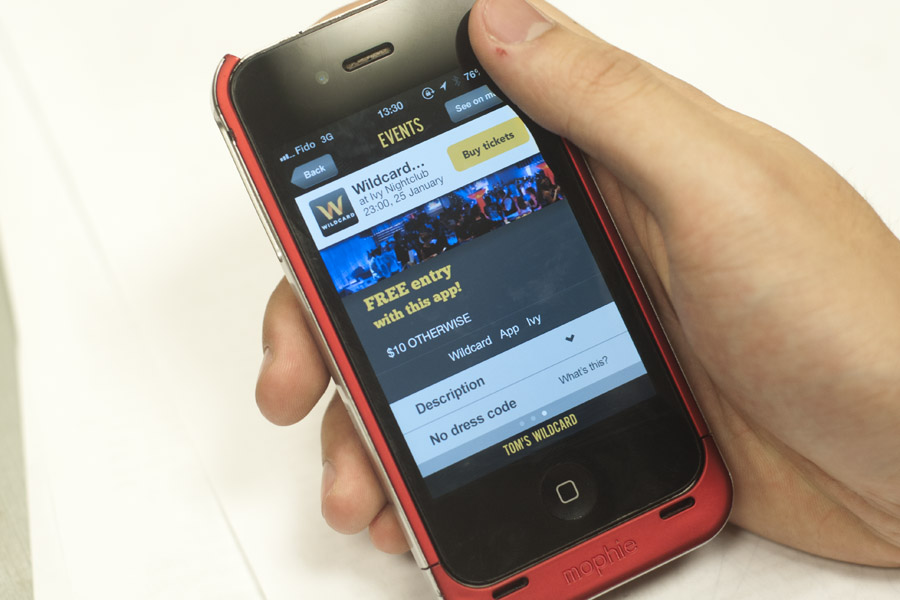
The easy-to-use Wildcard app. (Simon Poitrimolt / McGill Tribune)
a, Student Life

Student project graduates to the big leagues

McGill Tribune: What exactly is Wildcard?

Tom Zheng: Wildcard is a membership platform [that works as] an app and a card, and with it you are able to receive benefits at our partner clubs, restaurants, and bars. So, for example, you don’t pay cover, you get complementary drinks and appetizers, and you also claim rewards points every time you use it.

MT: How did the idea for Wildcard come about? Who was involved from the beginning, and who has gotten involved over the course of the process?

TZ: Three years ago a good friend of mine named Adam Hirsch—who is now in Malaysia—[came up with the] concept of a card that gets you into clubs. Last summer, my business partner, Randeep Singh—a third year materials engineering student—and I came together [to expand the business]. Nightlife is not just about clubbing, it can involve eating out, it can involve going to bars, even watching movies for that matter. So we wanted to create a platform for nightlife. We don’t want to concentrate on one specific niche. We want to really have something that everybody can use for whatever purpose they [want].

MT: What kind of learning curve have you faced since you first took over the company?

TZ: People think you tell [developers] what to do, they make it. Boom, done. But it’s a constant form of management that we learned how to do from scratch. Wildcard is different than a student club, we have to run it like a corporation. The process of turning this from a glorified student project into a legitimate corporation was by far, the hardest thing we had to do.

MT: How do you find the dynamic of working with people who have been at it, so much longer than you have?

TZ: I think the important thing is to listen and learn. We can only see so far; we see something with a great potential, but we don’t know how to get there. How do you get more users, how do you set meetings, how do you have a structured way in which you attack a problem? It took us a while to adjust to that, as well as [developing] a very strong sense of self-discipline; because both Randeep and I are still full time students, and I’m VP Academic for the AUS. You have to be focused on what you do—that was the hardest part, and we still have to work on that every day.

MT: I know that you were supposed to launch the app in mid- October, but the official event was held on Friday, January 25th. How has the timing been over the past year or so, in terms of expansion?

TZ: With something like this, you always want to reach your deadline, but things constantly come up. This entire product … was pretty much made by two students from Waterloo. You talk to them, and they build something, and that process kept going and going. So it took us a while, because both Randeep and I are perfectionists. It was very, very hard from September to December— the going back and forth. And because we’re a legally registered corporation….we have investors, we have people who we need to be responsible to, so [there] was a lot of pressure.

MT: So did the two Waterloo students get it done in the end, or did you end up having to switch to other developers?

TZ: They got it done. That was a relief, because literally an hour before the launch event, we were still working on it. With something like tech, it’s not like you draw a picture and you’re done; you make something, and you test it; something goes wrong; you fix it; something else goes wrong. And with any software, the front end is what you see, and the back end is how it operates…

MT: Do you have any other plans to expand in the future?

TZ: Definitely. At this point we’re still proving the idea in Montreal. There are some adjustments we want to make in terms of user interaction. Once we have something set, then we plan to go to every single major city in Canada. We’re already in talks with a company in Portugal who are interested in licensing the idea, and franchising the system. Because not only are we a front end product, but we have a back end system of analytics that we are able to implement with other companies.

MT: What do you hope to see happening with Wildcard in five years?

TZ: It will be in every major city in North America. The norm [for nightlife]. Because the concept is universal, we want to make it universal.

a, Student Life

Pintxos offers tasty tapas with a Basque flair

Three weeks after Christmas, I still had not gotten my girlfriend a gift. In a last-ditch effort, I decided to plan her a romantic night out to an expensive restaurant. As a student, my knowledge of Montreal’s fine dining was limited to O. Noir, ‘that crazy blind place’ I’d been told about in first year. Wanting to actually see my girlfriend of three years during dinner, I perused online restaurant reviews for better options.

A trail of Gazette, Urbanspoon, and OpenTable reviews ultimately led me to Pintxos (pronounced ‘peencho’). Pintxos specializes in pintxos, a Basque take on Spanish tapas. Originally a simple snack, tapas are now known as a menu of small, elaborate plates, on which chefs can display their inventiveness with Spanish and global flavours. The restaurant’s executive chef, Alonso Ortiz, designs food that we, as financial dependents, usually only get to see on Iron Chef.

We went on a Tuesday night after a day of classes, and sat down to a table with a heater and window view. The ambience was dim—romantic, and quiet—not loud enough to mask our vehement sniffling. In a French accent, the waiter recommended to my girlfriend a wine “which the women love.” I, on the other hand, ordered from a disappointing selection of beers.

Pintxos’ menu is an incredible two-page list of dishes with ingredients that you probably have never heard of but that all sound delicious. Every plate had something I’d never tried before. I ended up going with the chef’s choice, which includes three pintxos tasters, one full pinxtos, and one plato—or entrée—for $38. My girlfriend ordered four pinxtos.

Round one of our food arrived quickly. My first dish was the taster plate. On it were smaller portions of the ‘foie gras torchon with onion confit,’ the ‘yellow beet tartar with smoked salmon and feta cheese,’ and the ‘avocado soup with Serrano ham.’ It was exciting to try so many new flavours, but I had to restrain myself from finishing the whole plate in less than 10 seconds.

Next, the waiter brought my full pintxos, the ‘stuffed fig with Serrano ham and mahon cheese.’ The fig was so beautifully arranged with the ham and the cheese that I felt bad eating it so quickly. Despite the portion sizes at Pintxos, and the speed at which you could consume each dish, the food really makes you take the time to think about the textures and the combinations of flavours you are experiencing.

Thankfully, the platos was something more substantial: ‘filet mignon with roasted asparagus and goat cheese.’ Again, the plate was aesthetically breathtaking. The steak was served on top of mashed potatoes, asparagus, and basil, and the goat cheese was slightly melted on top of the steak, gravy dripped around the plate. The filet mignon was perfectly rare, and tasted rich and juicy with the cheese and gravy.

By the end of my platos, I was full, but I couldn’t resist dessert. I ordered clafoutis, a soft, spongy cake with black cherries and powdered sugar. The cake was sweet and creamy, while the cherries provided a sour tinge and thicker texture.

Once the euphoria of dessert was over, I remembered that I was paying for all of this, and the bill was not pretty. The dinner, with drinks and dessert for two people, was well over a hundred dollars.

While certainly expensive, Pintxos was a special occasion, and I recommend it for anyone who has to entertain a date, parents, or classy friends. Order from the wine list and make sure to get a platos, or you might leave hungry. More importantly, eat slowly, and enjoy the food! Otherwise, it’s going to be a quick meal.

Alexandra Allaire / McGill Tribune
a, Student Life, Student of the Week

Student of the Week

 Q: You were nominated for your success on the McGill chess team during the recent CUCC, can you talk about that?

A: A bunch of schools [like] McMaster, University of Toronto, Waterloo, Queen’s, and a [few others] all came together to compete. There are four boards, and they’re ranked, so the first board plays against the first board, second against the second, et cetera. Whoever ends up with the most points wins, and whoever has the most team match [victories] wins the tournament. Fortunately, we were able to pull it off [this year].

Q: Does McGill usually host the CCUC, or does it rotate through different Canadian universities?

A: It rotates, and there’s also an interesting trend. The school that’s hosted [the tournament each year has] won it. It’s been [going] for four years in a row, and we’ve managed to keep that [trend] up.

Q: How big is the chess team?

A: We had three teams this year, and each team consists of four players.

Q: Do you have weekly meetings? How do you practice?

A: There’s a club that meets [and we play each other]. [There’s] a national ranking system, and as you play tournaments, you accumulate points. There [aren’t] really any tryouts or anything.

Q: What are the best and worst parts about chess?

A: [The best part is] meeting so many different people from so many different backgrounds who all come together just to play. You can immediately have something in common with them, and that’s pretty neat. Probably the worst part [is] losing. It’s pretty painful, takes some time to recover from.

Q: If you were a chess piece, which piece would you be and why?

A: I’d probably be the knight. You know, it can hop over other pieces, it can do a lot.

Q: What’s your least favourite sound in the world?

A: Probably the sound of chalk on a chalk board; really makes me cringe.

Q: If you could change one thing about McGill, what would it be and why?

A: I’d make the [cafeteria] have longer hours. There are always times, like at ten o’clock, when I’m starving, and I have to go to Provigo or Tims. I never plan ahead to get food from the [cafeteria], which is the logical thing to do.

Q: Your apartment is flooding and you only have time to save three things; what are they?

A: My computer because I basically live on it. My iPad—that’s similar to my computer, I spend 99.9 per cent of my time on it. And probably my radio; whenever I’m in my room or doing anything I always like to have some constant sound going.

Q: Who’s your hero?

A: I guess it’s kind of cliché, but I’d say Terry Fox, just because he was able to accomplish so much with such a big handicap. It’s always inspiring when you see somebody who had so many disadvantages, and was able to do so much. It’s motivating.

Q: What’s your lucky charm?

A: When I play chess, I always [go] with the same pen. If I win a game I keep the same one, and if I lose, I pick a new one.

Q: If you could trade lives with anyone for a day, who would it be, and what would you do?

A: Maybe Kobe Bryant. That seems like a fun lifestyle; and [it would be funny] to see how he would fit in in a McGill environment.

Q: Describe the McTavish flood in three words.

A: What the hell?

Considerate yet passionate, Innocence Lost questions whether our judicial system prizes efficacy over justice. (Liam Maclure / McGill Tribune)
a, Arts & Entertainment

A long and torturous path to justice

Minute misfortunes, cringing incompetence, and wanton, inexplicable malevolence—that’s all one needs to hang a boy.

Steven Truscott’s case is a black stain on Canadian history. In response to the violent rape and murder of a child—12-year-old Lynne Harper—our neighbours, our courts, and our society took the life of another. Just 14-years old at the time, Truscott became in 1959 the youngest Canadian sentenced to death. That this was commuted to life imprisonment, and the executioner’s noose stayed, is hardly comforting. Truscott would have to wait until 2007—when the errors of the initial case could be brought to light—to be acquitted of the charges.

The Centaur Theatre/National Arts Centre co-production of Innocence Lost: A Play About Steven Truscott, written by Beverley Cooper and directed by Roy Surette, is an accomplished telling of the events surrounding Harper’s murder and Truscott’s trial. Cooper’s script rightly reflects the pain experienced not just by Truscott, but also the Harper family and the small, tightknit community of Clinton, Ontario in which the tragedy took place. This attentiveness, coupled with Surette’s even-handed and empathetic direction, makes for a production that is provoking without moralizing, inquisitive rather than inquisitorial, and very, very much alive.

This care is evident in the meticulous construction of an idyllic community, a space that is pristine, protected, perfect—a space without evil. The same care can be seen in the slow fragmentation of this safety, as Harper’s disappearance becomes a morbid, unimaginable discovery in the bushes, and as the community slowly turns to chew out and digest one of their own. The innocence that is lost is not merely Truscott’s—the story is very much about the suffering of a town and country.

Cooper merits praise for her dexterity in navigating such a horrible event, one in which various parties have incalculable emotional stakes. Many of the lines are narrations, breathlessly relaying facts to keep the audience informed of all relevant detail, but the cast handles the task, which could easily sink into tediousness, with livid yet restrained passion. The rest of the script dives deep into intersubjective experiences, whether it’s the gossipy neighbour, the traumatized classmate, or the cop that’s out for blood. Here, we see glimpses of what a clinical court document or aseptic news clipping could never reveal. The best moments of the production capture a back and forth of this dualism, a fusion of cool facts and heated humanity.

Technical elements also complement the respect and restraint which characterizes this production. James Lavoie’s tiered set design, replete with miniature houses, exhibits the power of subtlety. The same can be said for Luc Prairie’s lighting, though it is appropriately dramatic at select points, such as during Truscott’s appearance at the Supreme Court of Canada. The video projection which accompanies several scenes may easily have slid into uncomfortable sentimentality in less accomplished hands, but George Allister and Patrick Andrew Boivin’s design is compelling and effective without being self-indulgent.

Liam Maclure / McGill Tribune

Distinguishing themselves among a versatile and accomplished cast, most of whom play multiple roles, are Fiona Reid and Allan Morgan. Both veteran actors in Canadian theatre, Reid and Morgan’s talent is evinced by the range and depth of nuance in their characterizations. Each role inhabited is made unique, and even the briefest cameo, in the hands of Morgan, could become the most memorable performance of the night. As the guiding spirit for the audience, Sarah (Jenny Young) is a formidable presence. Young invests the role with both vulnerability and strength, making for an imminently relatable character that helps the audience through the wrenching story. The tightly-wound and immaculate production nevertheless saw a number of minor line mishaps on opening night—such things are, however, unlikely to mar future performances.

The subtle movement from ‘innocent until proven guilty’ to its terrifying inverse speaks to the injustice of Truscott’s case. Lines like “He’s got to be guilty! There’s too much at stake!” exhibit just why the conviction became one of the most infamous ‘miscarriages of justice’ in Canadian history. Yet there’s no condemnation or accusation in this production, no single ‘ah-ha!’ moment that the viewer can point to as the source of all wrong. There’s no target for one to strike with the red-hot poker of vengeance, nothing that can be used to console oneself with the thought that ‘if we stop that, we can prevent it from happening again.’ Instead, Truscott’s story is one overflowing with sadness, helplessness, and frustration. Though we may not answer this question, the fact that Innocence Lost asks it at all is important: What made us, governors and participants in our cherished democracy, turn so eagerly to condemn this boy?

Innocence Lost runs until Feb. 24 at the Centaur (453 Saint-François- Xavier). Student admission $26.

Read the latest issue

Read the latest issue