

Latest News

a, Sports

10 questions with Vincent Dufort

MT: When did you start playing basketball?

VD: I started when I was probably four or five years old. I’ve been playing my entire life; I played club ball in high school and elementary school—I’ve always played with my older brother too, so that helped a lot. I’ve just always loved it for my whole life.

MT: Why did you want to play basketball at McGill?

VD: Coach DeAveiro recruited me my whole last year. He came to all of my games; he showed me the campus and everything about the school, and I really liked it a lot. I met some of the guys on the team, and he explained to me that it would be the best balance for basketball and school, so I really bought into that. Obviously, basketball is really important, but so is education, and I got into the program that I wanted to here. I got recruited from a lot of schools in the OUA like Carleton, Queens— those were my other two main schools, but I was recruited all over the place. I just figured that McGill was the best balance for me [in terms of] basketball and academics.

MT: How do you feel about the team at this point in the season?

VD: I feel really good about it, actually. I think we’re starting to really gel, and the chemistry is really good. Obviously, we lost our starting point guard, which hurt a lot, but Simon Bibeau is stepping up as our point guard now. We’re really coming together as a unit and playing well, so I feel good about our team now.

MT: Tell me a bit more about the team chemistry and dynamic on and off the court.

VD: Well, there’s definitely a huge connection between the two, because we’re all such a tight group. On the court, we’re not afraid to maybe tell each other if we screwed up somewhere; we won’t take it to heart or anything like that. We’re so close and we’ve played together so much now, that you know where some guy’s gonna cut, you know where he’s going to be; so that helps a lot, and that’s just a huge part of basketball. I think—having good chemistry on and off the court is necessary to be successful.

MT: You guys have five games left in the regular season, what are the goals for the end of the season?

VD: Well we’d like to win all five, obviously and finish first in the league, because we want to improve every single year. We just went through a rough stretch playing the second and third place teams, and now we’ve got the forth and fifth placed teams to play for the rest of the season. We should come up with some wins if we play well together— and that’s what we’re expecting to do.

MT: How does this season compare to last season personally and as a team?

VD: Personally, I’ve learned a ton. Obviously, experience helps a lot. Just little stuff, mistakes. Coach really taught me to play hard for 40 minutes, and not take plays off here and there, so that definitely helps me a lot. As a team, we’ve all come up just, like I have. I’ve grown as a player; we’ve grown as a team, with everyone together. The chemistry comes into play again, where we all just know each other that much better now—one year makes a huge difference. Everyone worked really hard this summer, and we’ve taken a really big step forward.

MT: Looking forwa rd pas t McGill, where do you see your basketball career going?

VD: I would like to play pro in Europe if I would have that opportunity. I’m going to keep working hard over the next three years, and hopefully I’ll get that chance. But if not, it’s not the end of the world. I’ll start my career as a teacher, which I’m looking forward to as well, and hopefully get to coach some high school teams or something like that—I really enjoy that stuff too.

MT: Do you have a specific routine on game days, or are you superstitious at all?

VD: A little bit. As a team, we always go out for a team meal; then, we go back to the gym, hang out, and watch the girls’ game. At the start of the year, I always had shin splints; so I always got calf massages before the game and we won 11 straight games. Even though I don’t have shin splints any more, I still get the calf massage; so that’s my superstition.

MT: Who is your all-time favourite basketball player?

VD: Well, this might be contradicting to my favorite team, but I’ve gotta go with Vince Carter. I grew up watching the Raptors when he was on them, and I’ve just always loved him. Even though he kind of backstabbed us, I’ve always been a big Vince Carter fan.

MT: Do you play Fantasy Basketball?

MT: I’m actually in two different leagues; I’ll tell you the team that’s doing well. I’ve got Kyrie Irving, Andre Iguodala, Rudy Gay actually—I’ve got Chris Bosh, JaVale McGee, George Hill, Luis Scola. Iguodala is doing a little better now, but he’s been struggling abit. JaVale is frustrating too.

Marie-Christine Lapointe volleys it up. (Anna Katycheva / McGill Tribune)
a, Sports

Tears flow as season ends for Martlets

Tears flooded the court at the conclusion of the McGill Martlets’ last volleyball match of the season on Saturday evening. Although the Martlets fell in straight sets, the loss was not the main source of this outpouring of emotion. As with the end of any season, the Martlets had to say goodbye to their graduating seniors—and this year’s crop was a particularly talented and motivated group.

Setter and perennial All-Star Marcela Mansure will certainly be moving on next season, as she has used all of her five years of CIS eligibility. Joining her is Rebecca Canam, and potentially, captain and star power hitter, Geneviève Plante. Plante is graduating this year from a three-year program, but hopes to continue with the team in upcoming years, during a graduate degree.

Already eliminated from the playoffs, the Martlets still sought to finish the season on a positive note. First up were the Montreal Carabins on Thursday night, who rode the explosive talent of Sophie Bergeron- Leblanc and Marie-Sophie Nadeau, en route to a 26-24, 25-19, 25-15 victory. The Carabins closed out the last half of the season on fire, winning nine of their last 11 games to climb to seventh in the national CIS rankings.

Anna Katycheva / McGill Tribune

To finish off the season on Saturday, the Laval Rouge-et-Or visited McGill. However, the result was much of the same for the Martlets. McGill looked a little taken aback by the power and ferocity of their opponent—as they have for much of the season—and had to play catchup from the beginning.

The first two sets finished an uninspired 25-21, 25-20. The lone bright spot arose in the third, when McGill took it to Laval on the backs of Plante and rookies Catherine Amyot, and Ashley Norfleet. It was the first time in the match that the Martlets did not seem intimidated by the size of their opponents. The Martlets built a lead, but a few unforced hitting errors gave the Rougeet- Or enough momentum to tie the game at 24 and ultimately come out victorious 27-25.

With no chance to replicate last year’s stunning bronze medal at Nationals last year, this season was undoubtedly a rebuilding year for the Martlets. Several starters from last year’s squad were lost to graduation, while 2012 Libero-of-the-Year, and Team Canada member, Daphnée André-Morin was absent the whole season with a knee injury. Morin’s absence left a gaping hole in the Martlet defence—one they failed to fill all year.

To add to this, while McGill was battered and inexperienced, the three other members of the league were really hitting their strides, each ranking in the CIS top 10, and making the RSEQ arguably the most competitive league in the country.

The Martlets battled with the weapons they had, and Head Coach Rachèle Béliveau did well in fostering the development of the freshmen, who were adjusting from the slower CEGEP—or high school— game to the more physical and powerful CIS volleyball level.

Development will be crucial next year as André-Morin returns, and the team looks to be competitive once again. The one question mark looming on the horizon is the loss of Mansure, who has been the lone setter for the last four years of Martlet volleyball. Converted right-side hitter Marie-Christine Lapointe has played setter in the past, but never consistently at the CIS level, and listed sophomore setter Yasmeen Dawoodjee has failed to make her mark in the CIS game. This void will need to be addressed as the team moves forward to next season.

Although the CIS sanctioned competition is over for the year, Mc- Gill still has a series of upcoming exhibition tournaments, giving them an even greater opportunity to gel. Those tournaments compose the illustrious “Coupe du Québec,” which starts in March and runs through April.

Luke Orlando / McGill Tribune
a, Sports

Redmen slam rivals in full-house thriller

After a difficult loss to Bishop’s on Wednesday, the McGill Redmen were hungry to bounce back. The team battled the No. 10 Concordia Stingers on Friday night at Love Competition Hall. McGill Athletics chose the right contest for its annual “Pack the House” game, and the capacity crowd experienced a thriller.

McGill edged out their opponents 63-61 after Concordia guard Kyle Desmarais missed a last second shot that would have pushed the contest into overtime.

Luke Orlando / McGill Tribune

The matchup got off to a fastpaced start, with both teams’ raw athleticism on display. McGill dictated the flow of play early on, clearly inspired—while the Stingers appeared sluggish. The Redmen really took off after McGill third-year guard Simon Bibeau launched the offence with a three pointer. They continued to make most of their shots, while Concordia’s typically dynamic offence struggled to penetrate McGill’s defensive interior.

The crowd propelled the Redmen in the second quarter, as the team built a 13-point lead by the midway point. Concordia picked up their play by the end, but the Redmen held a 34-25 lead heading into the half. Bibeau, Vincent Dufort, and Aleks Mitrovic were all key to McGill’s dominant start.

The final half, however, played out very differently for the Redmen, as the Stingers slowly clawed their way back into the game. Despite McGill’s consistent defensive stands for McGill, the Stingers shots started to fall, and the crowd was taken out of the game for a stretch. Concordia second-year point guard Jerome Blake and fifth-year forward Evens Laroche led the Stingers comeback, which seemed to light a fire under the rest of the team.

Luke Orlando / McGill Tribune

The game’s turning point was in part, thanks to Concordia coach John Dore, who implemented a full-court press. As the game grew closer, the animosity between the two sides became apparent, and the contest grew more physical.

Redmen shooting guard Te’Jour Riley—by far the most effective player on the court in the second half—took his game to another level when the Stingers started their run. He was everywhere—diving on loose balls, stymieing Concordia’s offence in the paint, and contributing to the Redmen offence. Without his effort, the Stingers would have sealed the victory. Riley spoke after the game about what inspired his performance.

“It was all the crowd. It really lights a fire under the whole team when the fans get into the game like they did,” Riley said. “Especially because I am an emotional player, I really feed off of that energy.”

As the game went down to the wire, there was frantic play at both ends of the court, with McGill attempting to hold onto their twopoint lead. On the last possession, Riley got just enough of his hand in Desmarais’ face as he put up the game-tying shot, which clanked off the rim, ensuring a Redmen victory.

Other than a Concordia blowout in January, just five total points in their other three meetings this season have separated the two teams. Second-year guard Ave Bross, who has been increasingly reliable this year, commented on the great rivalry between the two up-and-coming programs.

“The dynamic of McGill [versus] Concordia games has changed this year. We used to feel like we needed to play above ourselves to win. We still respect them, but now we go in knowing we can, and should, win these games,” Bross said. “I think our team has really grown this year and our play on the court, especially against Concordia, shows it.”

The win puts the Redmen back into uncontested first place in the RSEQ, but they have a lot of work ahead of them, with a busy second half of the season looming. The Redmen will need to put together some similar performances if they hope to win the RSEQ, and make an underdog push at the CIS Championship in March.

a, Behind the Bench, Sports

Chris Bosh: the ultimate ‘third-wheel’

My Toronto Raptors fandom was born when Vince Carter and Tracy McGrady first flew through the newly opened Air Canada Centre, leading what was arguably the most exciting young team in the NBA. Admittedly though, my clearest Raptor memories are rooted in the Chris Bosh era, when mediocrity was the norm and yelling ‘onions’ after three pointers was acceptable.

As a result, most avid Raptors fans of my generation have a strong opinion about Bosh— whether we regard him as the leader of the team’s transition from the Carter years, or the backstabber that left the organization out to dry when he departed for South Beach in 2010. In any case, the NBA community—particularly Raptor fans—were shocked by and mocked Bosh’s response to a question about his Hall of Fame chances on Jan. 25:

“I [was] a Hall-of-Famer like four years ago; and I say that very seriously, though. I’ve talked about it before with my friends.”

While Bosh seems quite sure of himself—“four years ago” seems a bit extreme—is he out of line in his prediction? Looking at the crude numbers and past trends, he might not be too far off. He is one of only 35 players to amass over 13,000 points, 6,000 rebounds, 700 blocks, and 500 steals. Of this group, 20 are either in the Hall of Fame, or are considered locks to make it once eligible. At just 29 years old, Bosh is the youngest in this group and his numbers will continue to rise, barring any injuries. Bosh also has eight All-Star selections to his name—only one eligible player in NBA history with eight All-Star appearances has yet to make the Hall (Larry Foust). Bosh, in all likelihood, will be selected to a few more All-Star games before his career is over. Finally, he has a great chance to add a few more championship rings (“not three, not four …”) to his hand, assuming Miami can keep the ‘Big Three’ together.

However, as Kelly Dwyer of Yahoo! Sports noted, basketball— unlike sports like baseball—does not have the type of significant numerical benchmarks that all but guarantee a player’s spot in the Hall. So while Bosh is on pace to reach all of these numbers, do they actually matter? It’s fair, then, to question whether Bosh will leave a legacy in the NBA. Upon discussion with anyone who follows the league, the initial consensus answer is ‘No.’ When he was the leader in Toronto, his teams were never serious contenders. Currently in Miami, the perception is that Bosh is playing ‘third fiddle’ to LeBron and Wade’s duet.

However, it can be argued that Bosh did, in fact, play an instrumental role in their championship run last season. When he was hurt, the team faltered and looked as if ‘LeBron wasn’t clutch.’ His return sparked the Heat’s dominance (LeBron may have helped, too.) Perhaps Bosh will follow the path of Hall-of- Famer James Worthy—who won three championships with the Los Angeles Lakers in the ‘80s, playing ‘third-wheel’ behind Magic Johnson and Kareem Abdul-Jabbar— and cement his legacy as the ‘ultimate third-wheel.’ That probably wouldn’t look so good on his plaque, though.

For those still skeptical, it is possible that Bosh can find his legacy outside of the championships he wins in Miami. As more teams try to emulate the Heat’s brand of “small-ball,” organizations will seek out centres likes Bosh—athletic big men, who can rebound and run the floor. If the NBA continues in this direction, Bosh may eventually be perceived as the prototype centre for this new era of basketball.

Although Bosh’s legacy with the Raptors isn’t particularly impressive when taking into account the team’s lack of success, Toronto fans should come to terms with the fact that he will likely be inducted to Springfield one day. He is deserving, after all; even if it kills us that his time in Toronto didn’t play the largest part.

Dean Manfredi speaks to students about course reductions planned by the faculty. (Simon Poitrimolt / McGill Tribune)
a, News

Dean of Arts addresses student concerns over course cuts

Last Tuesday, Dean of Arts Christopher Manfredi listened to students’ concerns about cuts to arts courses, during a Town Hall hosted by the Arts Undergraduate Society (AUS). AUS Vice-President Academic Tom Zheng invited Manfredi to speak about the faculty’s decision to cut up to 100 courses and reduce the number of temporary lecturers teaching in the faculty for the 2013-2014 academic year.

Manfredi said he would pass students’ concerns along to department chairs during the next step in the process, where individual departments will decide which courses they can cut without affecting students’ ability to complete their programs. He announced the reductions to professors and students at a faculty meeting on Jan. 15.

According to Manfredi, the restructuring is intended to increase the proportion of courses taught by permanent teaching staff, and to get rid of classes that are typically under-enrolled. With the remaining funds, the faculty intends to hire more teaching assistants (TAs). The goal is to hire one TA for every 60 students, rather than the current ratio—one TA per 80 students.

Some students, however, expressed frustration at the implication that full-time faculty members provide a better educational experience than part-time lecturers.

“A lot of course lecturers are better at teaching courses than fulltime professors,” Arts Senator James Gutman said. “I know a lot of full-time professors who are great at research but aren’t so good at talking to a crowd of 200 people. Course lecturers are great at that, so why, I ask, are we cutting them?”

Manfredi said consultation on the subject took place with teachers and students in 2008, and a dean’s working group on academic program delivery was held in 2010-2011. He expressed surprise at recent student criticism of the decision, saying that he had already discussed the upcoming course reductions at faculty meetings in September and November, although he and the AUS were unable to plan a Town Hall until last week due to exams.

“There’s nothing secret about it,” Manfredi said. “We did these consultations, and we learned that students were dissatisfied with the level of teaching assistant support, [and that] students were concerned that there was a disconnect between research and teaching in the faculty.”

Although the cuts will target courses with fewer than 20 students, Manfredi emphasized that the intention is to cut courses that are under-enrolled, and not simply small.

“If a course is small by necessity … [or] because pedagogically it has to be small, no problem,” he said. “However, some courses are small by design because the professor doesn’t want to teach more students … and some courses are small because their topics are so esoteric and uninteresting to students that they don’t enroll in those courses.”

Associate Dean of Arts Gillian Lane-Mercier, who also attended and spoke at the Town Hall, emphasized that relatively few courses will be “retired.” Options include offering courses every two or three years, and creating new courses that combine the topics of several smaller courses.

Manfredi said funds from courses that are no longer offered would be reallocated towards teaching assistantships, internships, and advising. However, some students expressed skepticism that the additional funds created by reducing courses will lead to an improved learning experience.

“We’ve been told to get less with a very whispering promise of ‘more,’ ” Gutman said. “What we do know is that course lecturers [and] small courses are going to be cut.”

Manfredi responded to the claim that students may not see “more.” He estimated that the faculty will be able to reallocate $500,000 towards teaching assistantships and $200,000 towards advising and internships.

Students also questioned TAs’ ability to compensate for smaller classes taught by temporary instructors.

“I’ve heard from TAs that they feel ill-equipped when they go into conferences because they’ve never facilitated conversations before or they’ve never really learned how to teach,” Talitha Calder, president of the Political Science Students’ Association, said. “If there are more resources that are being put into the number of TAs … will they also receive the adequate training that is needed to fulfil that position?”

Manfredi encouraged students  like Calder to submit their general feedback about the quality of teaching at McGill by completing course evaluations, and by reaching out to the undergraduate representatives of their department.

“We don’t want to offer a low quality educational experience,” Manfredi said. “We’re trying to deliver the best programs we can deliver with the resources we have, and none of us benefit from doing that poorly.”

Zheng said the AUS is committed to preserving the diversity of courses offered by the faculty of arts, and will try their best to ensure that student consultation continues to be part of the process.

“There were a lot of questions that were answered [at the Town Hall] … and there was some good rationale on his side of the story,” Zheng said. “But the changes are going to occur, and people still aren’t going to be happy about it.”

Flood takes on McGill campus. (Luke Orlando / McGill Tribune)
a, News

Burst water main damages buildings

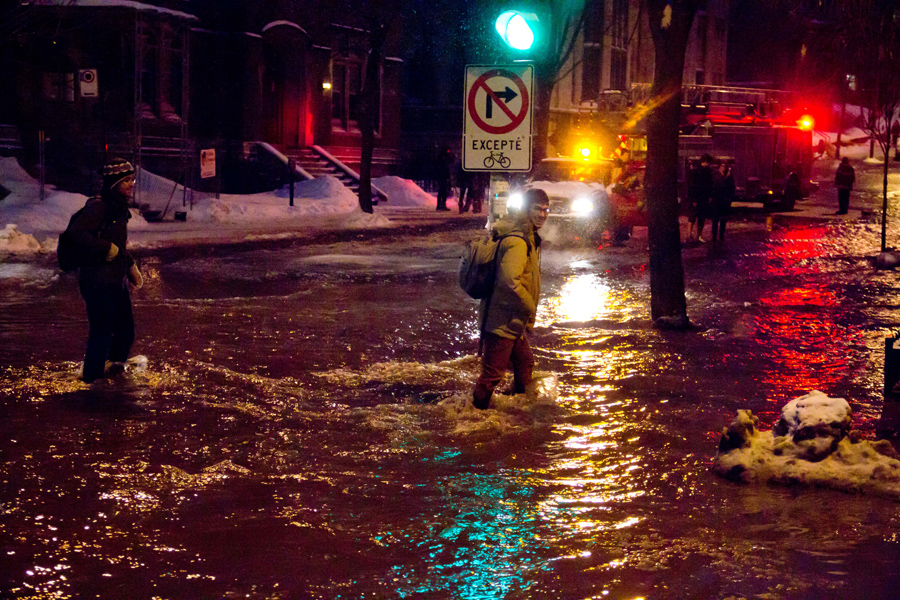
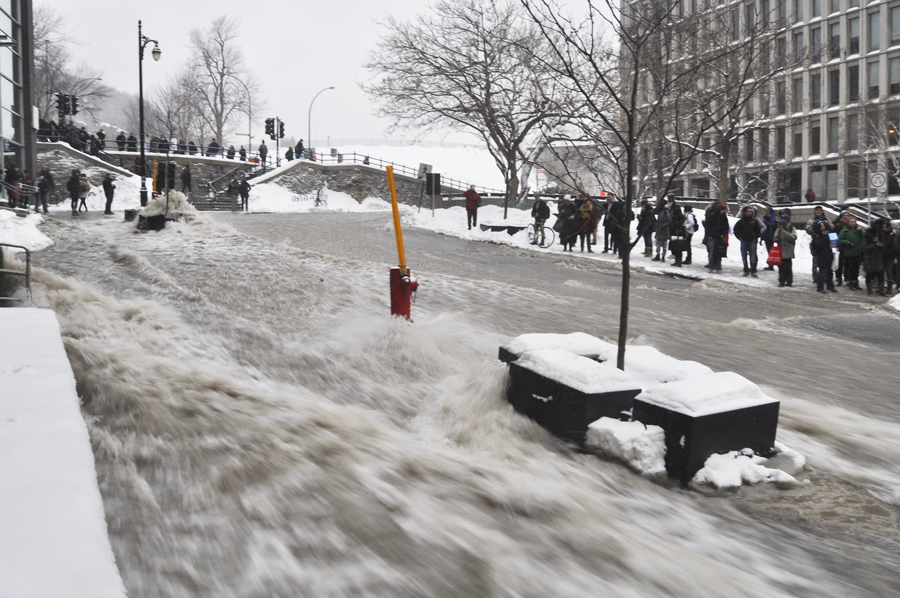
Severe flooding from a 48-inch water main break Monday evening caused widespread damage to buildings on campus, confirmed Doug Sweet, Director of Internal Communications of McGill’s Media Relations Office (MRO).

“[The damage is] very extensive to James Annex, where water broke windows in the back of the building and rushed through the main floor,” Sweet said. “That building requires significant repairs.”

According to Sweet, McGill staff and a cleaning firm worked through the night to clean up debris and complete repairs.  Water continues to flow near the Wong and James Administration Buildings, but according to a message from the MRO, the water does not pose a threat to the buildings and is being diverted into the sewer system.

Classes reopened on Tuesday in most buildings following the cleanup operation.  Classes in Wilson Hall and Birks Hall were cancelled, and those at the Wong Building were relocated. Additionally, Service Point and the James Administration Building were closed.  Sweet noted that Wong will likely be closed for a few more days and that administrators are trying to determine when other buildings may be reopened.

The flood began at 4 p.m. when a water main burst under Doctor Penfield Ave. in front of the McTavish Reservoir. Campus buildings were evacuated and all evening classes were cancelled.

The flooded area stretched from Dr. Penfield Ave. to Ste. Catherine Street, and from Union Street to Peel Street, causing pedestrians and traffic to be re-routed in downtown Montreal. At about 9 p.m., the MRO announced that the City of Montreal had shut off the water from the burst main.

The Reservoir is in the middle of the second phase of renovations, which aim to replace the surrounding tank and water mains. The repairs, conducted by the City of Montreal and estimated to cost $16.4 million, began in October 2012 and are expected to be completed in August 2013. Built in 1852, the Reservoir provides drinking water to 500,000 Montrealers in seven boroughs of the city.

A McGill Fire Prevention Crew worker who chose to remain anonymous said that, despite the harsh weather conditions of the past week, the cold was probably not the reason for the break.

“[The construction workers] were working with the big machinery,” he said. “They hit the seal, it broke, and they thought there was no pressure in that pipe, but there was pressure in the water.”

The Students’ Society of McGill University (SSMU) Vice-President Clubs and Services Allison Cooper said the flooding was a great inconvenience for SSMUfest, the Winter semester’s Activities Night. The event was planned for the evening, but had to be rescheduled for Tuesday night, the day after.

“It’s the worst possible timing,” she said. “We told the club leaders to get here at 3:30 p.m., and now they are trapped with no people to greet.”

The MRO sent out a series of emergency emails throughout the evening. One message referred to the flooding as “a serious situation,” and mentioned that “a number of buildings” on the downtown campus had been flooded.

“We are trying to assess damage as best we can, but it will be extensive,” read an MRO message from Monday at 4:55 p.m. “We will provide more information as it becomes available.”

Following the evacuation of the SSMU Building, SSMU President Josh Redel said that there were no signs of flooding in the building.

“We’ve been checking the basement, and everything’s good to go,” Redel said. “We haven’t seen any leaks in areas where we’ve noticed them before.”

In Sept. 2011, a leak in a 16-inch water main at the entrance of the pumping station of the Reservoir

flooded Service Point, McLennan Library, and Wilson Hall. In 2009, a burst in a 42-inch pipe at the top of Dr. Penfield Ave. flooded many of the same buildings.

“We continue to assess damage and costs and will work as hard as we can to get our teaching and research spaces reopened,” Sweet said. “Our prime consideration, of course, is the safety of the members of our community.”

a, News

Water main break in McTavish Reservoir floods campus and downtown Montreal

McGill’s downtown campus suffered severe flooding after a 48-inch water main burst under Doctor Penfield Ave. in front of the McTavish Reservoir on Monday. Campus buildings were evacuated and all evening classes were cancelled.

The flooded area stretched from Dr. Penfield Ave. to Ste. Catherine Street, and from Union Street to Peel Street, causing pedestrians and traffic to be re-routed in downtown Montreal.

The Reservoir is in the middle of the second phase of renovations, which aim to replace the surrounding tank and water mains. The repairs, conducted by the City of Montreal and estimated to cost $16.4 million, began in October 2012 and are expected to be completed in August 2013. Built in 1852, the Reservoir provides drinking water to 500,000 Montrealers in seven boroughs of the city.(Luke Orlando / McGill Tribune)

A McGill Fire Prevention Crew worker who chose to remain anonymous said that, despite the harsh weather conditions of the past week, the cold was probably not the reason for the break.

“[The construction workers] were working with the big machinery,” he said. “They hit the seal, it broke, and they thought there was no pressure in that pipe, but there was pressure in the water.”

The Students’ Society of McGill University (SSMU) Vice-President Clubs and Services Allison Cooper said the flooding was a great inconvenience for SSMUfest, the Winter semester’s Activities Night. The event was planned for the evening, but had to be rescheduled for Tuesday night, the day after.

“It’s the worst possible timing,” she said. “We told the club leaders to get here at 3:30 p.m., and now they are trapped with no people to greet.”

(Alexandra Allaire / McGill Tribune)


McGill’s Media Relations Office (MRO) sent out a series of emergency emails throughout the evening. One message referred to the flooding as “a serious situation,” and mentioned that “a number of buildings” on the downtown campus had been flooded.

“We are trying to assess damage as best we can, but it will be extensive,” read an MRO message from 4:55 p.m. “We will provide more information as it becomes available.”

Following the evacuation of the SSMU Building, SSMU President Josh Redel said that there were no signs of flooding in the building.

“We’ve been checking the basement, and everything’s good to go,” Redel said. “We haven’t seen any leaks in areas where we’ve noticed them before.”

In Sept. 2011, a leak in a 16-inch water main at the entrance of the pumping station of the Reservoir flooded Service Point, McLennan Library, and Wilson Hall. In 2009, a burst in a 42-inch pipe at the top of Dr. Penfield Ave. flooded many of the same buildings.

McGill could not be reached for comment.

a, Editorial, Opinion

Accountability must come first in Access to Information debate

A fundamental pillar for the success of a publicly funded institution is the public’s right to know and understand where its money goes, and what is being done with it. McGill’s recent motion to the Commission d’accès à l’information seeking the authority to ignore Access To Information (ATI) requests threatens this right, and risks severely compromising the school’s accountability to students and staff, and to taxpayers in general. As a media outlet, the Tribune firmly believes in the importance of a fair and functional ATI process. We feel that were the university’s motion to be approved outright, it would set a dangerous precedent and concentrate excessive power in the hands of the administration.

While we disagree with the broad implications of McGill’s request, various aspects of this issue stirred much debate amongst members of our editorial board. We felt that certain grievances brought forward by the administration are legitimate, but the school’s response has been equally problematic. The claims brought forward in the university’s motion do not justify the severity of the course of action being pursued.

McGill claims that its recent backlog of ATI requests is the product of a deliberate and coordinated attack on the school “as a retaliation measure against McGill in the aftermath of the 2011-2012 student protests.” If a conscious effort to hamstring the administration is really being undertaken, then this is also extremely worrisome. Money spent needlessly compiling thousands of pages of documents is money that will never reach a classroom, and such action benefits no one. However, these allegations on the part of the school amount to speculation at best, and the proposed solution could also put a stop to well-intentioned requests. We feel that when freedoms and liberties are at stake, people must be given the benefit of the doubt.

Another complaint put forward in McGill’s motion pertains to the nature of the requests, stating that they are frivolous, repetitive, or too broad in scope. Once again, there is a fair argument to be made to this effect; spending excessive amounts of time disclosing the contents of fridges prevents the administration from making more effective use of its resources. However, other topics outlined in the motion include corporate ties in fossil fuels and weapons research, as well as breaches of privacy. These are some of the issues that matter, and under this motion, it would be entirely within the university’s purview to avoid them altogether. Giving an institution the ability to decide what is and isn’t important to disclose directly enables it to dodge accountability in the future.

In addition to seeking to reject ATI requests based on their topics, the motion outlines a specific list of individuals whose requests it seeks to disregard. Moreover, its broad terms include student journalists, all McGill students, and anybody the administration feels “could reasonably be linked” to any of the above. The lack of clarity here and the resulting level of arbitrary power on the part of the school are both extremely troubling, and would further put McGill in a position to extensively limit what can or cannot be disclosed; in essence, the passage of this motion would allow McGill to become its own arbiter.

Rather than pursue such a dire course of action, we feel that the university should be willing to invest in  necessary infrastructure that would facilitate responses to such queries. The Government of Canada is currently in the process of implementing an online repository of previously disclosed files, to which duplicate queries can be referred. A similar system would also help to alleviate strain on the university. While this would be an investment on the part of the school, it is one which would serve to bolster the rights of the McGill community, and encourage institutional accountability.

Nevertheless, the motion has not yet moved beyond its submission state. It seems unlikely that McGill will be granted its desired level of freedom in this domain, but the request itself is clearly indicative of the administration’s attitude towards the issue. Although the pressure that an increased number of ATI requests puts on the administration may not be sustainable, it is important, as we move forward to ensure that our rights are valued above all else.

a, Sports

Records fall at biggest indoor track meet in Canada

Famous Canadian sprinters Bruny Surin, Nick Macrozonaris, and current Olympian pentathlete Jessica Zelinka hold all-time records in the Tomlinson Fieldhouse in their respective events. Over the past weekend, further history was made, as McGill played host to the 18th Annual McGill Team Challenge Meet—the largest indoor track meet in Canada.

The event saw 11 new meet records while three other Fieldhouse records were established. More impressively, 41 CIS standards (qualifications) were met, as the participants won the chance to compete at the National Championships, held in March in Edmonton. Most notable amongst them were Alex Brussieres from the Laval University Track Club, who ran to a new Canadian Junior Record in the 1000m (25:60), and Olympic Pole Vaulter Mélanie Blouin, who posted a new Fieldhouse best at an impressive 4.35m.

The results of the day were slightly more ambiguous for the McGillians, as the men’s and women’s squads finished 11th and eighth overall, respectively.

Nonetheless, there were a few standout performances. Chief amongst them were a pair of podium finishes for the men and women. Alana Battison dominated the competition en route to a personal-best, gold medal performance in the pentathlon, collecting 3492 points over the race’s five events.

However, the gold medal win comes with a slightly sour aftertaste, as Battison just missed out on qualifying for the CIS Championships. Her final score fell mercilessly only 23 points short of the required 3515 points.

Not all hope is lost, however, as there are still at least three opportunities left to qualify before the end of the season. On the men’s side, the sprinters were extremely successful, as the 4×400 metre team claimed silver in McGill record time. However, despite their 3:19:11 time, this too was just short of the CIS standard, outlined for the event at 3:18:11.

In the end, the day belonged to the nationally No.2 ranked Guelph Gryphons. The club bested the 27-team competition all weekend, and climbed to the top of the podium in several events, claiming the championship on both the men’s and women’s sides. The Gryphons dominated the distance events, as Guelph swept the Men’s 1000m and the Women’s 1500m, while amassing an additional three medals in events over 1000m distance.

Although the overall team results were slightly lower than desired and did not amount to many podium appearances, the outlook is still positive for McGill track, as the club will make the trek south of the border to attend a major NCAA competition at the Armoury in New York City next weekend. The meet is sure to be an exciting one, as it will expose the athletes to a strong level of talent.

Following this, the Redmen and Martlets will compete in one more home competition—the RSEQ Championships—at the Tomlinson Fieldhouse Feb. 23-24. It will serve as the final opportunity for athletes to qualify, before the successful parties travel to Alberta for Nationals on Mar. 6.

a, News

McGill Principal says universities will face more budget cuts

At the Jan. 23 McGill Senate meeting, Principal Heather Munroe-Blum spoke on the government-imposed university budget cuts that the Parti Québécois (PQ) announced in December. Vice-President (Finance and Administration) Michael Di Grappa also updated Senate on the progress of the Statement of Values and Principles concerning freedom of expression and freedom of peaceful assembly.

Munroe-Blum told senators that she has received “signals” from Minister of Higher Education Pierre Duchesne that more budget cuts will affect the budget for the 2014 fiscal year.

“While we are committed to accountability and working productively with the government in every way we can, we also must take the course of not taking these retroactive cuts in this academic year,” she told Senate. “It would be irresponsible.”

According to Munroe-Blum, the university would be in a better position to accept budget cuts this year if the government promised to reinvest back into the university system in the years to come. However, she said Quebec Premier Pauline Marois “refuses to commit” to reinvestment, or indicate when such an action may come.

Munroe-Blum also noted that she has been participating in pre-Education Summit meetings in Quebec City on behalf of the Conférence des recteurs et des principaux des universities du Québec (CREPUQ) and McGill. University leaders from Montreal intend to hold their own summit on Feb. 4.

“The goal of the summit is to set an agenda, and create Montreal as a centre of education … before the government summit begins,” Munroe-Blum said.
The principal also asked Di Grappa to provide an update on the statement of values and principles, which will be released this week. He announced that the statement will be accompanied by a separate document, detailing permanent “operational procedures.” These will serve as guidelines that campus security and disciplinary officers will follow when dealing with protests on campus.

Di Grappa confirmed that, while the statement of values and principles will be voted on by both Senate and the Board of Governors (BoG), the operational procedures will be implemented with no vote in either body.

“The operational procedures are an administrative document, not a matter of academic or fiscal policy. We have all kinds of operational procedures at McGill, in various units and departments,” Di Grappa said following Senate. “They are not approved by Senate or Board.”

Although they will be separate documents, the statement and operational procedures will face consultation together.

Consultation fairs over the statement of values and principles, as well as the operational procedures will occur at both campuses, and an open website is expected to launch this week, according to Di Grappa.

Arts Senator James Gutman expressed concern at Senate about how the last consultation period was handled, pointing to the fact that the administration only received 25 responses.

“One thing that upset me when you sent out the consultation email is that you sent it out during exams, and then had it end when students were coming back to McGill on Jan. 7,” he said. “I think that was really bad. … There is a reason only 25 people responded.”

Senate also discussed the possibility of expanding the McGill campus into the Royal Victoria Hospital area, as well as introducing the topic of Massive Open Online Courses (MOOCs).

Following updates from top administrators, Students’ Society of McGill University (SSMU) Vice-President University Affairs Haley Dinel asked Di Grappa if there were any plans to use Royal Victoria Hospital for university-related purposes like classes or research.

Di Grappa pointed out that the university does not own the hospital, but that before the PQ government was elected in September, there had been talks with the Charest government over the potential transfer of the property to McGill. The hospital will soon move to another site. According to Di Grappa, the government will have to decide what it does with the property once this move takes place.

“It is now unclear how Marois would deal with this,” he said. “McGill needs to expand its space. The hospital represents an important amount of space, in which the school could gradually expand over time.”

“The new government is undertaking a ‘reflection’ on what to do with this property, as well as Hotel Dieu,” he said following Senate. “We have met with representatives of the new government to make the case that McGill should acquire the site.”

Di Grappa also said it might not be the best time for the university to pursue plans to expand.

“It would appear that renovation costs would probably be too high,” he said. “We are examining this more to see if it is feasible. The university is also dealing with budget cuts … and a campus that has buildings that [already] need reparations.”

The majority of Wednesday’s Senate meeting was spent discussing MOOCs—online courses that universities like Massachusetts Institute of Technology (MIT) and Harvard University have begun to offer. The discussion outlined how various members of Senate feel about eventually implementing large online lectures into academic programs at McGill. Opinions on this topic varied widely.

Arts Senator Max Zidel said he supports the idea, but would like to see these programs as one option out of many that students could use when completing their programs.

“I would like to think of them as different [than] conferences and lectures,” he said.

Zidel suggested that high school students could be allowed to take MOOCs before coming to McGill to get certain prerequisite classes and program requirements out of the way.

Other senators showed concern about the idea of online courses.

“My gut feeling is that, at its root, this is ultimately a revenue generation exercise,” said Medicine Senator Daniel Bernard. “I know there might be a feeling that if we don’t get on this train, we might miss it, but I think we should consider that the train may be going nowhere or, worse, over a cliff.”

Dinel expressed hope that the courses would be open to a wider demographic, which could involve people in other countries.

“It could provide a great societal development,” she said. “It would provide access [to education] to students and people who can’t come [to McGill]. … It’s a great way to share our knowledge with everyone else.”

Read the latest issue

Read the latest issue