



When we think of what the physical world is made of, atoms come to mind—but it turns out the story is far more complex. In reality, atomic matter makes up only five per cent of the universe. The rest, however, is made of dark matter and dark energy, which have puzzled scientists for nearly a century. In hopes of better understanding these components, The Tribune attended a talk by McGill’s Trottier Space Institute (TSI) on March 26.
Katherine Freese, one of the first women admitted to Princeton University and now director of the Weinberg Institute for Theoretical Physics and the Jeff & Gail Endowed Chair of Physics at the University of Texas at Austin, led the discussion. She explored where current scientific research stands and what it reveals about the nature of dark matter and energy.
Before asking what dark matter is, one must understand how scientists discovered it. The first person to suggest such a thing could even exist was Fritz Zwicky, a Swiss scientist who, in 1933, studied the motion of hundreds of galaxies clustered together, known as the Coma Cluster. The laws of physics dictate that the closer a galaxy is to the centre of its cluster, the faster it should spin. However, Zwicky’s observations showed that galaxies further away from the centre travelled differently than expected.
“[Zwicky] saw some that were really whizzing, going really, really fast. If there’s not enough material inside there, then those galaxies should just escape. And based on the other galaxies that he was able to see, that’s what should have happened. There shouldn’t be these rapidly whizzing galaxies at larger distances from the centre,” Freese said. “A potential solution is [to] add more matter, more gravitational pull that would hold in those galaxies to keep them [closer to the center] even though they’re moving so fast.”
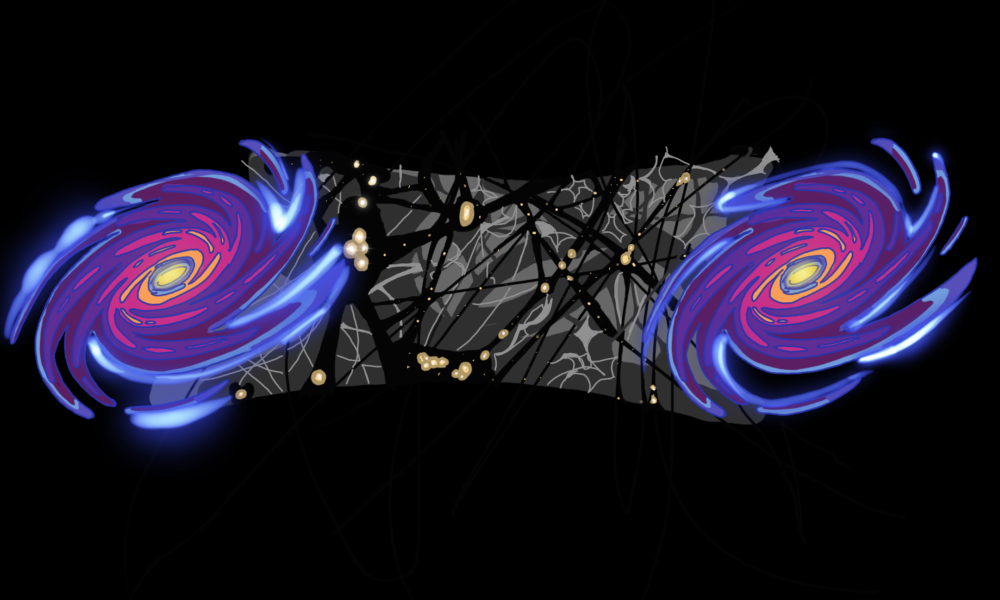
In the 1970s, American astronomer Vera Rubin definitively demonstrated that dark matter was the additional matter behind these strange observations. Additional support comes from Einstein’s theory of gravitational lensing—which describes how light and time bend around massive objects—and from recent observations such as the Bullet Cluster, where two galaxy clusters collide. These phenomena can both be attributed to the presence of dark matter.
So the real question remains: What is dark matter? The short answer is that scientists don’t know yet. There is a large experimental effort trying to determine the answer to this very question. As of 2026, two particles are thought to make up dark matter: Weakly Interacting Massive Particles (WIMPs) and axions.
Freese highlighted why WIMPs remain a favourable candidate, pointing to a concept referred to as the ‘WIMP Miracle.’ After the cooling of the universe—a consequence of the Big Bang—the density of WIMPs left over happens to be 26 per cent of the universe, matching the observed amount of dark matter. Axions, the other top contender, are proposed particles that are weakly interacting like WIMPS; however, they do not have a fixed mass.
While dark matter acts as a type of glue for the universe, dark energy, making up the other 69 per cent, behaves differently. From the theoretical and observational side of things, there isn’t a strong understanding of what exactly dark energy is. What we do know is the universe is not only expanding, but its expansion is accelerating—an acceleration best understood as some form of repulsion. The existence of dark energy would explain said repulsion, leading scientists to confidently believe in its existence, even if we can’t see it.
With these answers only come more questions. Talks like Freese’s remind us of the many great mysteries of our universe waiting to be unravelled.
To learn more about dark matter and energy, “The Cosmic Cocktail”by Katherine Freese expands on this topic.