
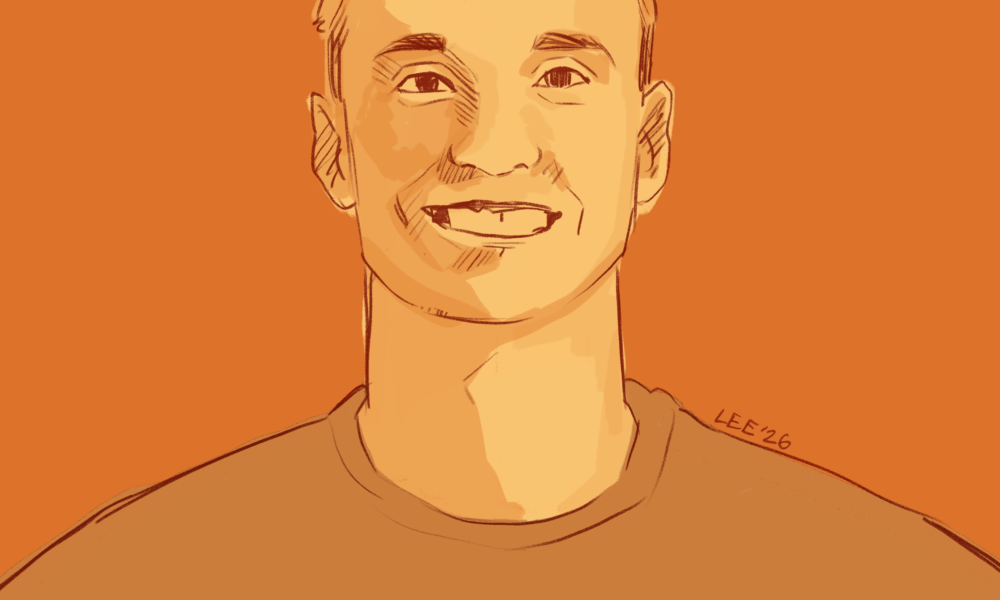

At the U SPORTS National Swimming Championships, held from March 12 through 14, Loïc Courville-Fortin, U2 Science, won one gold, one silver, and three bronze medals, rewriting his personal bests and breaking McGill and Réseau du sport étudiant du Québec (RSEQ) records. This is only the beginning. Courville-Fortin has his eyes set on the 2028 Los Angeles Olympics.
Courville-Fortin started swimming at the age of seven, partly due to his parents’ insistence. After training three times a week, mostly for fun, he soon realized how much he enjoyed spending time in the pool. In an interview with The Tribune, Courville-Fortin explained the journey that led him to join his current swimming club, CAMO NATATION.
“In the middle of high school, I decided to move to Montreal to train with bigger clubs and teams,” Courville-Fortin said. “I trained at the Olympic Stadium for two years while finishing high school. Then I joined CAMO, which is the club I am still training with right now.”
After graduating from Ahuntsic College, Courville-Fortin knew that he wanted to stay in Canada for university. For him, McGill had the best of both worlds: A fast swim team and a great STEM program. Courville-Fortin has been balancing his aquatics accomplishments with his academic commitments his entire life. Not only is he a professional athlete, but he is also an Honours Biochemistry student and an undergraduate researcher at the Luedtke Lab.
“I wanted to have research opportunities at [university], and I also wanted to have the best [swim] team,” Courville-Fortin said. “I love learning. Unfortunately, it’s true that my sport affects my grades. It’s really planning-wise, knowing when to pull off a bit on training. For me, I just need a lot of sleep, which is hard to achieve for student athletes sometimes because of studying and training, but I try to be really careful with that.”
To balance time in the pool with time in the lab, Courville-Fortin trains with an innovative regimen that prioritizes quality over quantity.
“[My regimen] is on the really low side in terms of the number of practices, but every practice I go to, I’m always going 100 per cent,” he said. “I would say that my result didn’t improve because of something I changed. It’s more of the constant work. Everything we’re seeing now is based on the past three years of work.”
In his first semester at McGill, Courville-Fortin trained with the rest of the McGill Swim team, which allowed him to bond with head coach Peter Carpenter and his teammates. He currently trains with CAMO NATATION under Coach Greg Arkhurst and represents McGill for university-level swim meets. He attributed his success to Coach Carpenter, Coach Arkhurst, his teammates, and athletic therapists Catherine Matthews and Romain Bouyer.
“My first year allowed me to get to know [Coach Carpenter] and actually be able to work with him properly right now,” Courville-Fortin said. “When I joined the university circuit, it was a premier bonus. My goal was to have an opportunity for me to race more often in the same events, which you don’t really get to do outside of university.”
Courville-Fortin also stressed the importance of having a team of students around him who also have to balance studying with competing. At CAMO NATATION, he trains with full-time athletes, including Olympians Mary-Sophie Harvey and Katerine Savard.
“They [don’t] really have anything else outside of training, which is understandable when you are at that level,” Courtinville-Fortin explained. “Right now, having the [McGill Swim] team allows me to get closer to people who have a similar reality in terms of school and training. I think it’s really helpful to have people encourage you. The team aspect goes beyond the pool.”
As for his future plans, Courtinville-Fortin hopes to qualify for the 2028 Los Angeles Olympics while continuing his education by applying to a Master’s program at McGill. Despite his ambitious outlook, Courville-Fortin emphasizes the importance of balance.
“Even if it’s a hard choice to step back for most athletes, [because] you want to do as much as possible to be the best, sometimes you need to be smart about it and take a step back. Maybe train a bit less, but take care of yourself a bit more.”