

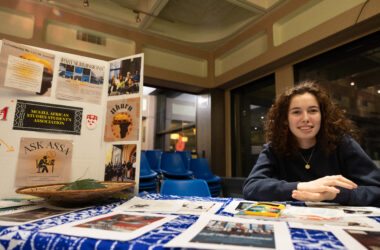

Zawadi Ombeni, U1 Science, is just like any other McGillian. She studies Software Engineering, jokes about her bi-weekly mad dash from Adams Auditorium to McIntyre Medical between back-to-back lectures, and wonders if we can truly call our exams “mid-terms” when they don’t end until finals have already begun.
Unlike most students, however, Zawadi arrived at McGill from a refugee camp in Malawi.
Zawadi is one of thousands of student-refugees that World University Services Canada (WUSC) has sponsored to re-settle in Canada and pursue higher education over the course of its century-long existence. In an interview with The Tribune, Zawadi reflected on what receiving such a sponsorship meant for her.
“I heard about WUSC when I was still at secondary school, and that it [provides] opportunities to help young refugees to be relocated to Canada and […] [pursue] an opportunity to study at university,” Ombeni said. “I was like, ‘Whoa! This is a very great opportunity for me to become the very first person ever in my family to go to university.’”
For hundreds of young refugees, WUSC provides a path to opportunities that would be otherwise unimaginable for students fleeing war, violence, persecution, and socio-political instability.
“It’s a beacon of hope for quite a lot of us young refugees, whereby you’re living in a place where opportunities are very limited. [WUSC] helps you to be relocated. It helps you navigate through the finances. It helps you navigate accommodation. Arriving here, at a new place, where you don’t know anybody, you don’t have [for instance] an uncle here that is going to help you, but WUSC and the local committees have always been there trying to help you.”
Despite the resources WUSC provides to students like Zawadi, young refugees still face a range of complex barriers when coming to study in Canada. McGill’s rigorous admissions process, for example, emphasizes high secondary-education grades but often does not fully consider the extreme extenuating circumstances many displaced students face when applying.
“[W]ith a refugee camp, it’s not like you’re assured every time [that] you’re going to have something to eat. It’s not like you’re assured there’s electricity, or [that] you [will] have other resources. No. It’s not like a person who has gone [to school] here in Canada who has resources, who has got WiFi, who has got […] electricity, because sometimes […] in the camp, you can even do one month without having electricity.”
Besides facing obstacles at the administrative level, Zawadi described the complicated social pressures that student-refugees must navigate upon arriving at university. Often, she said, such students must reconcile the struggle to adapt to a new culture with the need to put down roots, all the while striving to maintain relationships with the family and friends with whom they are now physically distanced.
“You have the pressure from the families upon arriving here, [who are still] living in the camp. Coming from there, you know the situation. You also have pressure […] to send money back to them, and then, [also in] trying to understand everything: ‘How does this new system work? How am I going to get registered for a new class? What do I do? How do I communicate?’” Ombeni said. “Now, this is another environment. It’s another cultural environment. I need to get adapted to that.”
Nevertheless, Ombeni is confident, eager to work hard, and endlessly grateful to have the opportunity to study at McGill. Thinking ahead to what she’d like to pursue post-graduation, she hopes to help other students from difficult situations receive excellent higher education.
“I’ve started becoming involved with different humanitarian organizations [around campus], although I’m still studying [….] [At these organizations], you try to advocate for girls in the community, [and] try to speak for somebody who cannot speak for themselves,” she said. “If I have the potential to speak for somebody who cannot speak for themselves, why can’t I do that?”
Students interested in getting involved with WUSC’s humanitarian work can join the organization’s McGill Local Committee, a SSMU club that organizes funds and assists student refugees in their transitions to McGill