
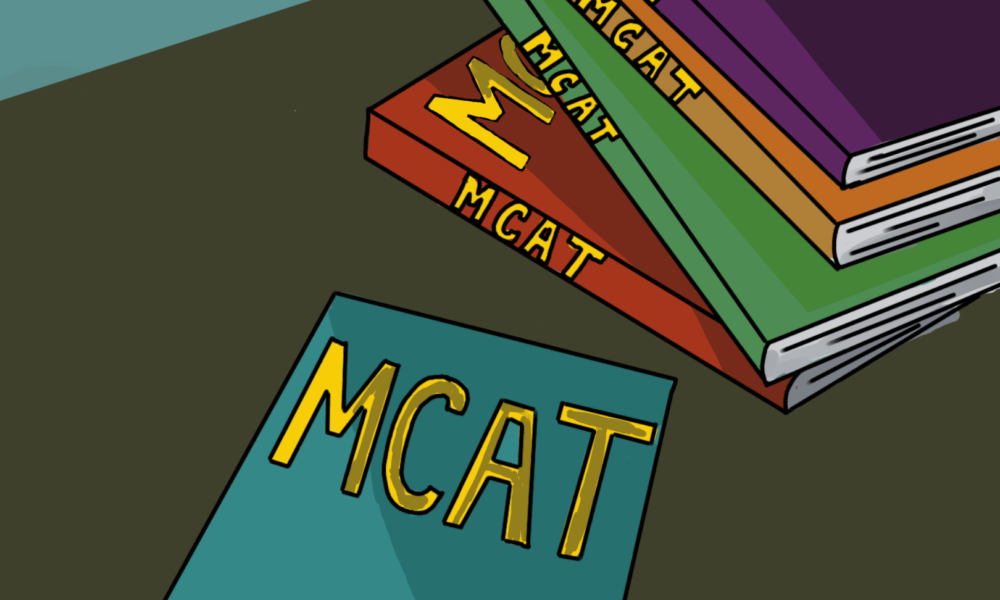


For many professions, undergraduate education is the final step before entering the job market. However, for the medical field, it is only the preface for an additional four to eight years of schooling. Prerequisites for dental and medical school include the Dental Aptitude Test (DAT) and Medical College Admission Test (MCAT), respectively. These exams have several cycles throughout the year and require an immense amount of preparation. Students study for hours a day, for months at a time—often while simultaneously being enrolled in university curriculum in hopes of being admitted to medical school in the future.
In interviews with The Tribune, Jane Hostetter, U2 Arts and Science, and Sofiya Turban, U2 Science, provided insights into their experiences this past summer studying for the DAT and MCAT.
Hostetter began studying for the DAT in May, leaving her four months to prepare before her exam date. She split up her days between content review and practice, all while working evening shifts at a local restaurant.
“Everything felt manageable up until the final month, where I started to feel guilty for doing other activities when I could have been studying,” Hostetter said. “Even though I knew I was well-prepared, the exam was really daunting, and I got nervous as I got closer to my testing date.”
There is a lot of pressure associated with the lead-up to the exam, and while many are dedicated to their study strategies, Hostetter and Turban both expressed a decrease in confidence as they got within a month of their exam dates.
While Hostetter favored half-day study sessions and working part-time, Turban gave herself roughly three months to study for the MCAT, and committed 10 to 12 hours per day instead, a schedule she has adapted to under McGill’s rigorous curriculum.
“This is extreme and not necessarily productive, but I prefer to sit down and get it done,” Turban said. “I followed the exact same day-to-day schedule as I do […] during finals here at McGill.”
In terms of the mental health impact of this strict and aggressive schedule, Turban described a similar trajectory to Hostetter. Both students reported decreasing social engagement and extracurricular activities as the exam dates approached in August.
“In the first one-to-two months [of studying] I was able to keep up with my daily activities,” Turban said. “But in the third month, I really felt the pressure of the exam […] and cut out other events.”
An additional source of students’ apprehension derives from family members and friends. Hostetter expressed that everyone knowing about her exam and asking for scores after the fact added another layer of stress and a stronger fear of underperforming to the testing experience. Similarly, Turban’s mother went to medical school, and while her parents were supportive, she did not want to disappoint anyone.
Another influence on the study process was McGill’s impact on the test takers.
“[Organic chemistry] was the most helpful for content preparation on my exam, and it was reflected in my Natural Sciences section score,” Hostetter said.
She also expressed the benefits of the first year science requirements, such as General Chemistry 1 and 2, reporting that her knowledge from these classes proved beneficial in building a strong base going into the exam study period.
On the contrary, Turban felt McGill’s foundational science curriculum was less helpful than she expected. While the courses’ content proved useful, MCAT questions are very specific, so she found it more effective to master the question style than to memorize information while studying.
Both Hostetter and Turban expressed that their exam preparation limited some activities this summer, and required intense self-discipline. However, as they return to university this fall semester, a huge step in their career paths has been completed.