

American artist and poet Theodore A. Harris is a genius of the political collage. Born in Manhattan, New York and raised in Philadelphia, Pennsylvania, Harris brings an autobiographical focus to the subversive, polysemous medium of the collage, one shaped by his upbringing, mentors, and personal experiences with anti-Black discrimination and American capitalism’s exploitative nature.
In an interview with The Tribune, Harris described his medium as uniquely capable of placing disparate images in dialogue with one another, so that these images transgress time and space in an instantaneous, profoundly political manner.
“Collage is like a novel that can go back and forth in time, just by the very fact that [it uses] existing images which you can appropriate,” Harris said. “Because those images are each from a different time period, you can talk about the past and the present at the same time […] [and] get multiple meanings.”
Yet for Harris, meaning does not just emerge from the clippings themselves and the way they interact; rather, the viewer’s own experiences mediate their individual interpretation of the work. Harris draws on James Baldwin’s concept of the “most disagreeable mirror” to explain this phenomenon: A theory where Baldwin argues that Black bodies reflect back to white Americans their unacknowledged histories of colonialism, racial prejudice, and complicity in oppressive economic systems. As such, viewers encountering Harris’s collages are forced to confront their own place within the political realities his work depicts.
“Collage is a great vehicle for […] dealing with the personal as political,” Harris said. “When the viewer is looking at the work, the experience that [they] bring to that artwork determines how [they] feel about it, what [they] think about it, how [they] see [themselves] in that artwork.”
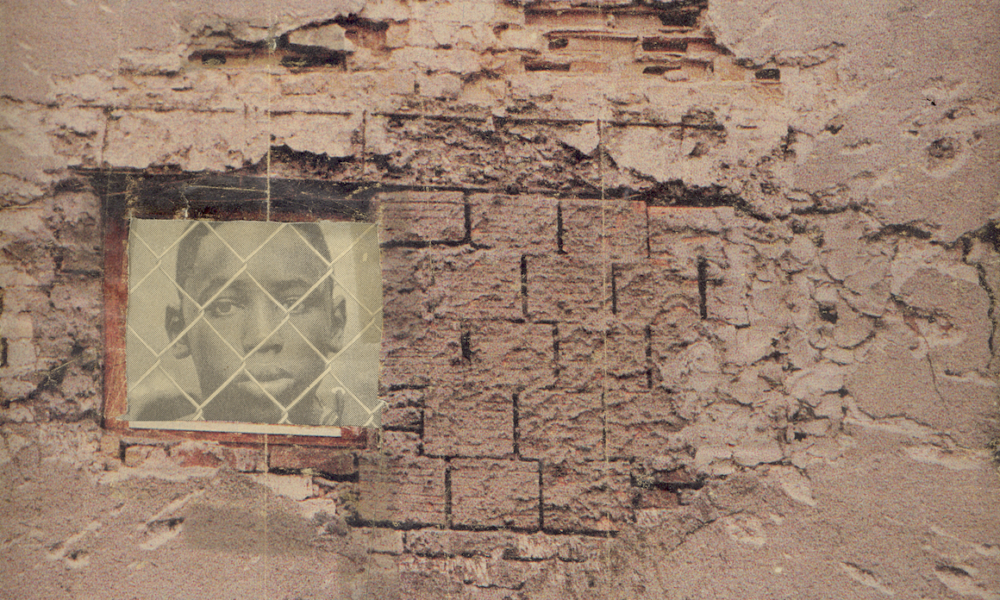
Harris’s 1995 piece, The Long Dream, After Richard Wright, is on display in the McGill Visual Arts Collection (VAC)’s Visible Storage Gallery, located on the fourth floor of McLennan Library. One of the VAC’s more than 3,500 works, the collage measures only 12 by 15.5 inches and is shown among dozens of far larger pieces. Yet, you can’t miss it. The collage is almost deceptively simple, combining only two images: One of a young boy looking through a fence, clipped from an advertisement for the 1994 film Fresh, and a photograph of a wall destroyed by an Israeli missile strike in Palestine. By layering the demolished wall over the movie poster, Harris creates a trompe l’oeil effect, making the boy appear trapped behind both the fence and the rubble.
“You get this mixture of push and pull of the form and content [in the collage],” Harris explained. “[It] is a reflection of a dystopian dream that is reality. That reality, for that [boy’s] innocent face, is […] trying to dodge the bullets of race, class, capitalism, and a country that is doing everything it can to stifle your growth.”
The collage’s title The Long Dream, After Richard Wright pays homage to American novelist Richard Wright’s 1958 novel The Long Dream, set in Jim Crow-era Mississippi. In the novel, Wright highlights how systemic racism perpetually defers the American Dream for Black individuals, turning it into a prolonged, agonizing fantasy that is never fully realized due to anti-Black discrimination. Harris reinterprets Wright’s thesis in a contemporary context through this collage, illustrating how systemic racism still renders the American Dream elusive.
The collage was anonymously donated to McGill by a friend of Harris’s in honour of Charmaine A. Nelson, provost professor of Art History at the University of Massachusetts Amherst, founding director of the Slavery North initiative, founder of the Nova Scotia College of Art and Design’s Institute for the Study of Canadian Slavery, and former professor of Art History at McGill. Nelson became the first Black person appointed as a tenure-track professor of Art History in Canada in 2001, and went on to teach at McGill for 17 years before leaving the university in 2020; she resigned after the Art History department refused to consider her for the department chair role and discriminatorily denied her full professorship. At the time of her departure, only 10 of McGill’s 1,700+ faculty members were Black.
By dedicating his piece to Nelson, Harris transforms McGill’s own gallery space into a platform through which to recognize the significance of Nelson’s scholarship, advocacy, and impact on the field of art history, something the university failed to do while she was working there. For Harris, the presence of this work is itself political, serving to facilitate discourse on anti-Black racism, capitalist exploitation, and American colonialist projects abroad.
“A lot of institutions do use art as a cover for their dirty deeds,” Harris stated. “It’s been going on forever. Politics have always been in art, and art has always been in politics. All I can do is make work that I hope will be in a conversation down through history. Just by that artwork being [displayed at McGill], it has a function of being in that space to raise consciousness.”
Institutions also possess a responsibility to go beyond merely showcasing conscious-raising works. In an interview with The Tribune, Assistant Curator of the VAC Michelle Macleod described how McGill’s Action Plan to Address Anti-Black Racism 2020-2025, introduced a few months after Nelson resigned in 2020, entails a responsibility that the VAC actively seek to acquire and curate a collection that is “as diverse as the McGill community.” According to Macleod, identifying and filling these gaps must be substantiated by active reflection.
“It’s tricky in the art world [….] [Inclusion] can quickly become tokenism. You can’t just install one artwork and be done,” she said. “The work is baked into everything you do, everything you put out there, and how you put it out there as well.”
Harris himself has worked to create institutional pathways for active, structural inclusion, most notably as the founding Artistic Director of the Institute for Advanced Study in Black Aesthetics—an educational project designed to spotlight the Black Arts Movement’s approach to art and aesthetics through events, written works, and exhibitions. The Movement was founded by poet and Harris’s close collaborator Amiri Baraka as a cultural counterpart to the Black Power Movement, emphasizing the need to create a Black cultural identity independent from Eurocentric artistic standards: A project Harris continues through the Institute.
Beyond The Long Dream, After Richard Wright, in the exhibitions he presently curates, Harris continues to foster unlikely conversations between disparate art forms, techniques, and genres, making each exhibition a collage in itself.“I [want] to see abstraction exhibited with figurative work, blatantly political artwork juxtaposed to more subtly political or minimalist work next to abstraction, all mixed up,” he said. “The only thing that’s important to me is the truth. It’s what makes [art] beautiful.”