
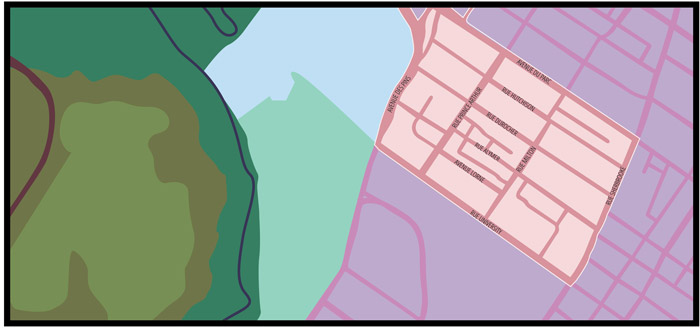

The Milton-Parc neighbourhood, colloquially known as the McGill ghetto, is home to many McGill students. It’s an area with a rich history: In the late 19th and early 20th centuries, it was the east end of the Golden Square Mile, an upscale residential community that was primarily home to Montreal’s anglophone elite. By the end of the Second World War, these houses had stood for almost a century, and families started moving out of the neighbourhood in pursuit of more modern accommodations.
Martin Croteau, manager of le Syndicat de la Copropriété (a union of Montreal building owners), and a resident of the Milton-Parc neighbourhood, spoke to the post-war history of the area.
“In the ’60’s, promoters bought a lot of buildings in the Milton-Parc [area] for Project Concordia, the towers on [Avenue du Parc],” Croteau said. “The citizens mobilized for a fight against this project.”
The most prominent of these property developers was a company known as Concordia Estates Ltd., who sought to rebuild the neighbourhood by constructing several high-rise apartment and commercial buildings. The residents of Milton-Parc—now a lower-middle class neighbourhood consisting of students and families—banded together to prevent the destruction of the historic buildings in the area.
Over the next few decades the activism of Milton-Parc Citizen’s committee and Quebec’s political climate—the [PQ] were a part of the provincial fabric—led to the property developers’ withdrawal.
“[After] the election of the [PQ] in ’76, the English financers feared the independence of Quebec and wouldn’t put [in the] money for building a big project,” Croteau said.
Today, the streets of Milton-Parc are mostly home to McGill students and working professionals. In fact, Croteau lives in the neighbourhood with his family.
“It’s a marvelous neighbourhood,” he said. “My girls go to school at [Fine Arts Core Education School] FACE, on University, and I work on Parc Avenue [….] We can walk every day—we choose [not to] have a car. My wife is a teacher [at a] CEGEP; she takes the metro and the bus. In the neighbourhood, we have the mountain, the Parc Jeanne-Mance, two supermarkets, which both close at midnight each day […] restaurants, [and] Place des Arts.”