
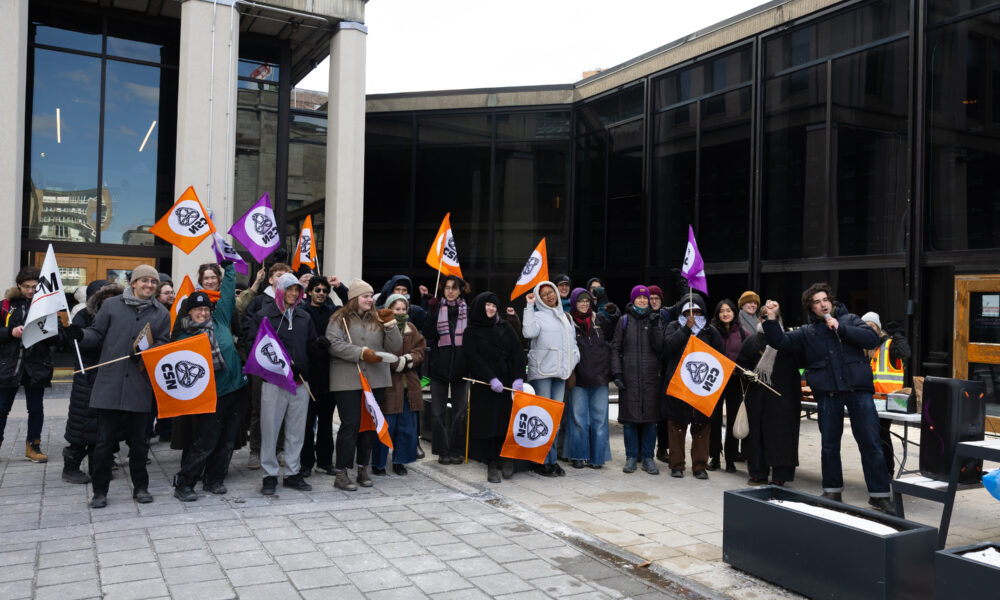


On March 18, approximately 40 McGill students, workers, and faculty members gathered outside the Leacock Building for the Association of Graduate Students Employed at McGill (AGSEM)’s rally. The rally, which advocated for a budget increase for the wages of graduate student workers, was timed to coincide with a McGill Senate meeting scheduled at 2:30 p.m. the same day.
Protesters gathered in support of AGSEM’s ongoing negotiations with McGill, as did speakers from the bargaining team. AGSEM’s negotiations occur through open bargaining, allowing all union members to participate.
In a speech to the crowd, Donald Morard III, a PhD candidate in History and Classical Studies and member of AGSEM’s Unit 3 bargaining team, explained the importance of putting pressure on the Senate to further AGSEM’s cause. Morard is also running for the role of Secretary General in the ongoing Post-Graduate Students’ Society elections.
“Student senators and allies up on the faculty were able to block the worst proposed changes to the code of student conduct and discipline,” Morard said. “Senators are able to push these upper administrators to directly answer for these [wages] cuts [….] Politics are zero replacement for student activism and organized labour. But these bodies can serve as useful tools for information and to put pressure on the powers that be.”
In August 2024, over 1,000 academic casual workers at McGill unionized and formed AGSEM’s Unit 3. Nikaela Lange, a Master’s student in Political Science at McGill who is also a mobilization officer at AGSEM and a teacher’s assistant, explained what’s at stake in an interview with The Tribune.
“We’re a union made up of around 4,000 workers at McGill,” Lange said. “We’re here today for our workers in Unit 3, which are course-based academic casuals. They are currently negotiating their first ever contract, and frankly, we did not like McGill’s monetary offer. We think they deserve better so we’re rallying today to try and get them that raise.”
Emma Moore, U3 Arts student and member of the bargaining team, then addressed the crowd to speak on the progress AGSEM hoped to make for Unit 3 workers, which consists of academic casuals such as graders, tutors, course assistants, and graduate teaching fellows.
“Workers told us they needed stronger health and safety protections so people can do their job in safe working conditions,” Moore said. “They told us they needed clear job expectations and protections against overwork so workers are not made to work more than what they’re paid for.”
Lange then highlighted the specifics of what Unit 3 workers want included in their new contracts.
“Better working conditions for these workers, protections against harassment and discrimination. But a raise seems to be one of the biggest issues for our workers. Some of them are making minimum wage,” Lange said.
AGSEM’s negotiations with McGill began in September 2023 following the expiration of the organization’s collective agreement with McGill in July of that year, after which they came to a new agreement that expired on Dec. 1, 2025. Since then, AGSEM’s efforts have focused on improvements for Unit 2 and 3 workers, Unit 2 comprising McGill’s invigilators.
Moore informed the crowd of McGill’s response to the suggested pay increase at the March 11 bargaining session.
“Last week we tabled our wage proposal, moving us into the monetary phase of bargaining. Today McGill came back with an offer that was offensive,” Moore said. “McGill made it clear to us today that they do not care to pay you enough to live on.”
At this bargaining session, McGill recommended a pay scale structure, offering a range of wages for each position. The starting wage offered was $18.67 CAD per hour. Comparatively, at Concordia University, workers in a similar position are paid $32.68 CAD per hour, increasing to $35.25 CAD per hour after May 31, 2026. At the University of Toronto, the pay is around $53.92 CAD per hour.
While AGSEM’s negotiations primarily focus on wage increases for workers at McGill, better treatment of workers and students is part of their fight as well, such as in the case of McGill’s new proposed identification (ID) policy. This policy will require anyone with a McGill ID to carry their card while on university property. Authorized personnel—including McGill faculty and staff, invigilators, and campus security—may request an ID for the alleged purpose of upholding the campus’s integrity, university policies, and cases of physical safety.
Morard elaborated on AGSEM’s opposition to the proposed identification policy when addressing the crowd.
“Today there will be a push by pro-democracy senators to fight against the upper administration’s proposed ID policy,” Morard said. “We’re into fighting the ID policy. Tell [the Senate], support the fight against it.”
In the Feb. 4 bargaining session, AGSEM focused on Unit 3 workers. The union successfully tabled workload forms to help reduce excessive workloads for employed students, outline clear job expectations, and better explain how hours are allocated. AGSEM also tabled to negotiate Article 8, which addresses workplace grievances. However, little progress was made for Article 6, which addresses harassment, discrimination, and sexual violence. AGSEM proposed specific language against deadnaming, but McGill rejected their proposal.
On Feb. 9, AGSEM began negotiations for a new invigilator contract. AGSEM proposed a salary raise to $26 CAD per hour for invigilators, a minimum number of shifts, and a minimum invigilator-to-student ratio. McGill’s initial proposal included a requirement for a 48-hour notice for shift cancellations and mandatory supervisor approval for overtime.
Following this negotiation session, AGSEM released an update stating their stance on McGill’s proposals.
“While last-minute absences and no-shows can create additional stress for other invigilators, we believe the real solution is addressing the root causes. Fair wages and improved working conditions are the best way to reduce no-shows and increase reliability,” AGSEM wrote. “McGill has also proposed language aimed at preventing overtime that is not pre-approved in writing by a supervisor. We are determined to fight McGill on this proposal and win contract language that does not restrict the ability of invigilators to work.”
On Feb. 18, the final bargaining session before the tabling of monetary clauses occurred. The session again began with the trading of proposals. McGill’s workload proposal, when compared to AGSEM’s, was limited in specifications and lacked development, according to AGSEM’s report following the session. AGSEM reintroduced their proposal to amend Article 6 to include more explicit language against deadnaming and pronoun misuse. McGill’s position remained unchanged.
On Feb. 27, negotiations focused on contracts during which McGill opened the floor to longer-term contracts, according to AGSEM representatives in their negotiation coverage report.
“McGill indicated that they are open to discussing the possibility of contracts that last longer than a single semester. They acknowledged that there may be mutual benefit in exploring longer-term arrangements,” AGSEM wrote. “However, they expressed concerns about guaranteeing minimum numbers of shifts or hours beyond a single semester.”
Their most recent session on March 9 focused on shift distribution. The next negotiation session on March 27 will focus on contract length and sexual violence policies.
With the negotiations ongoing, Moore emphasized the importance of AGSEM’s fight for their workers and called on members to participate in future bargaining sessions.
“Our union took the time to understand the lived reality of our members. Through conversations with workers, general assemblies, and organizing across campus, we heard clearly what people needed in a first contract,” Moore said. “AGSEM cares for your Unit 3 bargaining team. We will fight for you and we need you in this pivotal time. Sign up for open bargaining. Come to the next session and watch McGill sweat.”