
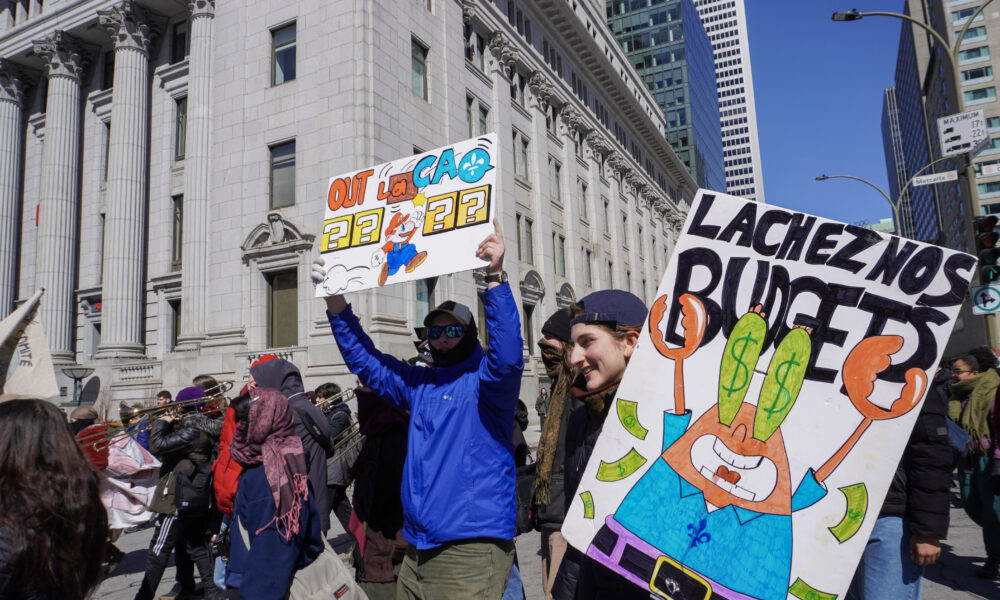




From March 23 to March 27, over 65,000 post-secondary and Collège d’enseignement général et professionnel (CEGEP) students participated in a week-long strike against austerity in education. The strikes were organized by the Coalition de résistance pour l’unité étudiante syndicale (CRUES), a union of 30,000 students in local and regional levels in Quebec. The strike called for a higher education budget in the province in response to Minister of Finance Eric Girard’s budget for the 2026-27 fiscal year.
The 2026-27 budget attempts to balance funding for public services with economic stimulation. While the budget established a 2.4 per cent increase in education spending, it is insufficient to cover the increasing costs of public education, which would require a 3.8 per cent increase. In all categories other than education and health, where a 2.3 per cent increase is required to keep up with growing costs, spending will decrease by 1.2 per cent.
In a written exchange with The Tribune, Elki Mercier, a coordinating officer at CRUES, highlighted the government’s failure to invest in education.
“Despite last fall’s student mobilization and the struggles of community groups and workers against austerity and budget cuts, the government continues to turn a deaf ear to our demands,” Mercier wrote. “This is very clear in the new budget, in which the government is failing to invest sufficiently in education.”
Over 20 student groups participated in the week of action through organized strikes, with the majority coming from the Université du Québec à Montréal. 10 CEGEPs and universities participated in the week of action, organizing students across Quebec.
The Association étudiante du cégep de Saint-Laurent (AECSL), a student group with 4,900 members participating in the week-long strike, emphasized their commitment to creating change in a written response to The Tribune.
“This movement shows that students of Quebec are getting tired of governments that cut in public services to the advantage of the elite,” AECSL wrote. “For now, we have not seen actual change from the government, only a weak budget that does not cancel past budget cuts and that does not properly refinance education. We demand clear change, not half measures. Until then, the strike and protest situation is only going to escalate.”
Simone Bélanger, a spokesperson at l’Université du Québec à Rimouski (UQAR)’s strike movement Population Unie Contre l’Austérité et la Précarité, spoke on the changes the Quebec government needs to make for students.
“Students hope for a massive reinvestment in post-secondary education. We are asking for a serious reform of the [Student Financial Assistance] program, paid internships for all students, the lowering and indexation of international students’ tuition fees, which have been instrumentalized by the government for years to narrow its deficit, as well as the preservation of our social safety net.”
To close the week of action, CRUES organized a protest on March 27 at Dorchester Square. While not on an official strike, the McGill contingent joined the protest. McGill students, in addition to protesting austerity in the Quebec budget, also rallied against McGill’s investments in weapons manufacturers and previously in fossil fuel companies.
As the week of action came to an end, Mercier emphasized the importance of student involvement beyond the March strikes and how students can further fight against the budget changes.
“There are other concrete ways to get involved in the fight against austerity: Participate in general assemblies, join or start mobilization committees, stay informed about ongoing struggles through student newspapers, associations, or CRUES’s social media, and organize direct actions,” Mercier wrote. “CRUES also encourages student associations to ally with workers’ unions on their campuses, since austerity affects us all.”