
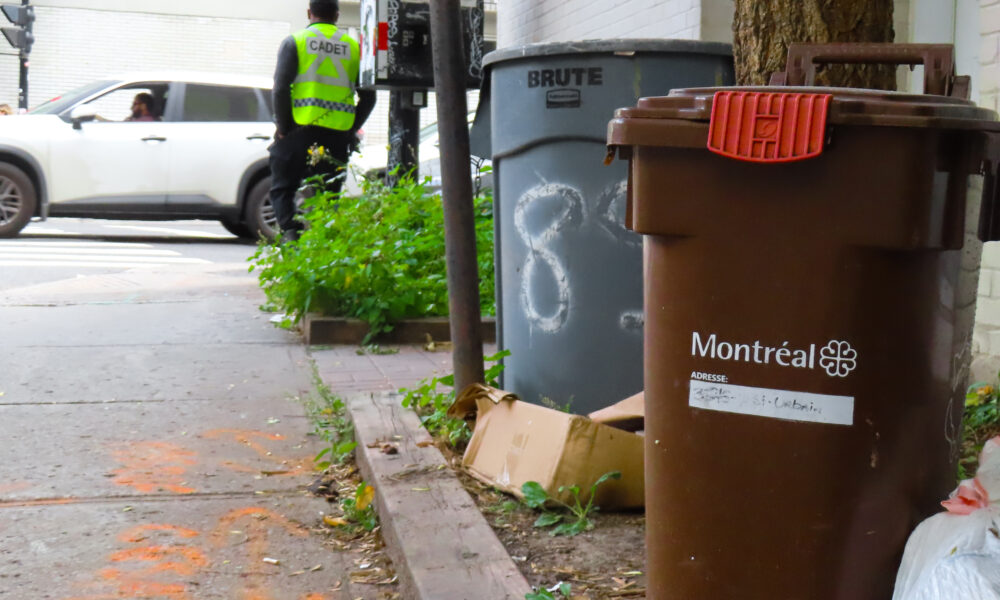




In her most recent annual report, Montreal’s Auditor General Andrée Cossette found that the city is far behind its composting target. Right now, about 55 per cent of the waste Montrealers send to the landfill is organic material that could have been composted instead; the city aims to bring that proportion down to 15 per cent by 2030, as part of its zero-waste target.
Disposing properly of organic waste is undeniably more onerous—and more odorous—than sending waste indiscriminately to the landfill. Thus, a successful municipal composting system requires particularly strong accountability infrastructure. Simple and effective means of accountability have been implemented elsewhere in Canada—Montreal just needs to follow suit. In Montreal, a clear-bag requirement for trash would make fast accountability possible for improper organic waste disposal, establishing the foundational incentive necessary for Montrealers to properly sort their waste and lead the city to its zero-waste goal.
It must be noted that improper compost disposal is anything but innocuous. When organic waste is deposited into landfills between layers of non-organic material, it decomposes without proper oxidation, releasing methane into the atmosphere—a greenhouse gas with a heating potential 80 times more potent than carbon dioxide. In fact, Canada’s 2023 greenhouse gas inventory reported that landfills accounted for 17 per cent of the country’s national methane emissions—further accelerating short-term warming that causes severe flooding, stronger storms, worsening wildfires, and prolonged droughts.
Seeing as composting holds immense power over decreasing Montreal’s greenhouse gas emissions, the city must find a way to close the gap between the amount of compost Montrealers currently send to the landfill and the much-lesser amount necessary to meet the fast-approaching 2030 zero-waste deadline.
A simple solution can be found on Prince Edward Island (PEI), where, for years, residents have consistently created less garbage and kept significantly more organic waste out of landfills than anywhere else in Canada. Among a number of successful initiatives under its Waste Watch program, PEI implements a clear bag policy for garbage. This way, trash collectors can efficiently ensure that residents are not sending organic waste to the landfill on a case-by-case basis: When collection drivers encounter bags containing organic waste, they simply refuse to collect them.
In Montreal, regulations and penalties do exist regarding proper compost disposal, but unlike PEI—and other compost-forward Canadian cities like Vancouver and Calgary—these regulations are not backed up by substantial incentives to follow them. For example, Montreal does threaten a $300 to $1,000 CAD fine for improperly sorted waste, but it is difficult to enforce when trash is collected in opaque bags, and thus cannot be assessed upon collection for poorly separated waste. In the case of successful composting, transparency is literally the key.
Clear trash bags’ track record is consistently successful far beyond just PEI. In Orilla, Ontario, the clear trash bag policy led to a 40 per cent reduction in organic waste sent to landfills and a 20 per cent increase in the amount of captured organics. In Muskoka, clear trash bags reduced landfill waste by 37 per cent and increased proper organic waste disposal by 80 per cent in just one year.
This is not to say that clear bags will solve all of Montreal’s composting problems, nor should this tactic replace the other initiatives the city is taking to close the waste gap by 2030. The city is pursuing a number of promising strategies to improve its composting system, such as the new Saint-Laurent compost processing facility, the city’s recent move from weekly to bi-weekly trash collection in some boroughs, and the distribution of almost half a million brown bins for organic waste.
These efforts should persist, but there is no reason that they should not be accompanied by the baseline level of oversight ensured by clear bags; it is, really, a no-brainer.
Montreal should look to PEI’s clear bag policy as an economical and straightforward model that would establish a system-wide foundation of accountability for residents to adhere to proper compost disposal practices—for the sake of the city, the country, and the ozone layer.