

Latest News

Features

Shame must switch sides

How survivors are reclaiming power

Content warning: Mentions of rape, sexual assault, and violence.

Survivors of sexual assault and rape often have to grapple silently with feelings of shame. 72-year-old Gisèle Pelicot is flipping the script: Placing the shame on the perpetrators of sexual assault and rape.

In November 2020, Pelicot’s husband Dominique was found to be taking photos of women’s skirts at a supermarket in southeastern France. When police subsequently searched his laptop, they found that Dominique had taken over 20,000 videos and photos of his decade-long sexual abuse of his wife. For nearly 10 years, Dominique drugged his wife unconscious and invited dozens of men to rape her51 of the 83 men identified in Dominique’s videos—aged 26-74—are standing trial: firefighters, journalists, students, truck drivers, prison guards, nurses, retirees, and city councillors. These were men who were going home to their wives, tucking their kids into bed, typing at their work desk the next day, treating patients, and more, all after raping Pelicot.

Pelicot waived her legal right to anonymity in the trial, which prevents the media from identifying survivors of sexual abuse. She wants the world to know her name, and to expose the identities of those who assaulted her. Revolutionarily, she has allowed videos of the rapes to be made public, forcing the rapists to have their faces known for their crimes.

Katherine Zien, an associate professor dually appointed in the Department of English’s Drama & Theatre and Cultural Studies streams, spoke to why theatre’s live format might make it especially effective at engaging audiences with political and social issues. While reading a book, watching a movie, or looking at a painting whose content is political can certainly prompt reflection, it is far easier for the viewer to disengage with these forms of media if they have a dissenting opinion, feel discomfort, or even react with disinterest; all they have to do is put down the book, turn off the screen, or walk away from the artwork. By contrast, the tacit social contract of the theatre—the societal norm present in most traditional theatrical spaces that the audience sit quietly, watch the show, and only make noise when it’s finished—dissuades audience members from disengaging with a piece of theatre, even when it explores difficult subject matter.

“I’ve decided not to be ashamed. I’ve done nothing wrong [….] They are the ones who must be ashamed,” Pelicot told the court on Oct. 23.

Pelicot’s courageous decision stands against the guilt and shame that is generally propelled onto survivors of sexual assault and rape. Stigma and ongoing failings of the justice system for survivors of sexual abuse lead to drastic underreporting: Only six out of every 100 cases are reported to the police, but one in four North American women will be sexually assaulted during their lifetime.

80 per cent of assailants are friends and family of the victim, making a large portion of these cases a matter of intimate partner violence (IPV). 44 per cent of Canadian women who had ever been in an intimate partner relationship reported experiencing some kind of psychological, physical, or sexual abuse in the context of an intimate relationship in their lifetime.

Claudine Thibaudeau works as a social worker in clinical support and training atSOS violence conjugale, a non-profit Quebec organization that works to ensure the safety of survivors of IPV.

She explained to The Tribune that the goal of IPV for perpetrators is coercive control—using violent behaviours to gain power over the other in the relationship, taking away their partner’s ability to make their own choices. Thibaudeau argued that there is sexual violence in almost every instance of IPV. Sexual violence in relationships goes beyond isolated incidents of forced sexual intercourse, such as considering involvement in a relationship as a guarantee of consent, demanding a minimum number of instances of intercourse per week, and creating discomfort for the victim if they do not consent to sexual activity.

Thibaudeau also detailed psychological and emotional sexual violence, which includes denigrating the victim’s physical appearance, or otherwise ridiculing the victim sexually, using sexuality to control or degrade the victim, making sexual comments to humiliate the victim in front of others, comparing their sexual prowess to that of previous partners, or threatening to cheat. There’s also sexual gaslighting, which entails making the victim believe that they had previously consented to sexual activity when they had not.

“It can take a very wide array of behaviours. It’s not reported as much because it’s very intimate. A lot of [survivors] feel a lot of shame around sexual violence. It’s hard to talk about because it’s very private, but most victims of partner violence have been through one or the other or many of those [forms of IPV violence] in their relationship. So it’s a very big problem. It affects hundreds of thousands of women and youth in Quebec,” Thibaudeau said.

Thibaudeau explained that IPV can also include instances where a partner crosses a boundary and does not seek to repair the harm they caused.

“Let’s say someone crosses a boundary once—maybe because they weren’t paying enough attention to realize that the other person wasn’t enjoying what was going on. But the second they find out they should be working so hard to fix things, you know, crossing boundaries happens, but the second you’re made aware of it, you stop,” Thibaudeau said.

She also touched on the shame that many survivors of IPV face, often because they did not see the signs of violence earlier in their relationship.

“Violence can be so subtle. There’s no way that anybody can see the violence,” Thibaudeau said. “So victims often feel ashamed, because when they look back, they can see the violence when it started. They can see the subtle behaviour [….] It’s easier to see afterwards, but when you’re in it at the beginning, there’s no way anybody can see it.”

As a result of this shame, it can often be hard for survivors of IPV to leave their situation, or entirely stop seeing their romantic partner after IPV has occurred.

“Of course, leaving a situation and violence is very hard, because very often, when enough fog has been blown away, and you realize what you’re confronted with, and you see the violence,” Thibaudeau said. “The first reason [IPV survivors don’t leave is it] being dangerous. There’s always a potential for danger, and the moment of separation is the most dangerous.”

Furthermore, the effects of violence are reflected in the survivor’s self-confidence.

“[They’ve] been suffering from violence for months, maybe years. [They’re] exhausted. [Their] self-confidence is low. [They] might be confused about [their] rights, about the situation. [They] might have stress-related health issues. [They] may be scared. [….] It makes it even harder to imagine being able to deal with everything that leaving the violent partner means.”

IPV occurrences are even more frequent in spaces where victims and perpetrators experience violence in other areas of their lives. Orsola Torrisi, assistant professor of Social Demography in McGill’s Department of Sociology, researches demographic factors for conflict and violence, family dynamics, gender-based violence, intimate partner violence, and structural determinants in contexts of armed conflict. In her research on determinants of violence in places of active military conflict, she found that violence became normalized in all areas of life, including the domestic arena.

“Especially on the side of the perpetrator, violence becomes the main way in which people think about how they can resolve problems, especially when they are socialized at a very young age in violent settings,” Torrisi explained in an interview with //The Tribune//. “What I was finding especially in this context was that women that were exposed to violence, particularly between the ages of zero and 15 […] were way, way more likely to experience pretty much all types of abuse, but particularly [those considered] more actually visible forms of violence, that is sexual abuse and severe physical abuse from their partners.”

Torrisi also explained that men in military conflict zones justified beating a woman for a variety of reasons.

“In general, a lot of the research that really looks at violence against women, especially in the home in conflict settings, is related and sort of speaks to these more macro-phenomena that occur and that lead people, and particularly the perpetrators, to kind of acquire those attitudes that are much more masculine and much more prone to violence,” Torrisi explained.

IPV is not the only form of sexual violence that young girls and women face. For women like Lexi Good, sexual violence can occur outside the confines of a romantic relationship, leaving lasting impacts. Good shared how she navigated the mental health challenges that followed her assault, particularly in her interactions with men.

“I was diagnosed with PTSD [….] Anytime there was a man walking on the street, I would be convinced they were gonna kill me. I would completely cross the street anytime I saw a man coming my way. I couldn’t really have relationships,” she explained. “I would say I just wasn’t myself in general, and that was the bigger thing. So I was like, ‘Wait, I’m not just crazy. This is a situation that I’m having right now.’

Good also referred to the lack of control that survivors of sexual assault often feel. While she recalls having called friends and family during her assault to attempt to get out of the situation, she later realized that she did not have as much control over that situation as she thought she did.

“You don’t realize how much your life has changed after. This might sound crazy, but the actual experience itself was not nearly as hard as getting out of it or having issues with mental health,” Good said. “I think people want to feel like they’re in control. That’s why they say, ‘I could’ve done this better. I could’ve done that. But it’s my fault.’ Because if it’s your fault, then you have control. And not having control is actually more scary than being at fault.”

Good also remembers realizing that her healing process had begun to impact her closest friends and family. She felt that she wasn’t treating her friends justly, seeing that “people she loved were hurting by watching her hurt.” Especially after moving from the United States to Montreal for school and making all new friends, she wanted to be a responsible friend, who was kind and helpful to others. After a conversation with her then-roommate, she realized she wanted to actively work through her response to the experience, rather than have its issues resurface years later. She recalls talking to other women who had survived sexual assault and rape and realized that they had felt the same mental health pressures that she had.

“I started having a lot of bouts of mental issues that I didn’t know were related to that [experience],” she said. “Then I talked to other women who were just like, ‘Yeah and then I had this kind of manic-like episode.’ And I was like, ‘Wait, that exactly happened to me.’”

Good shared that eye movement desensitization and reprocessing (EMDR) therapy is what helps her continue to process and heal from her trauma. EMDR therapy involves moving one’s eyes in a certain way while recounting/reliving traumatic memories, allowing survivors to process the original event without the fight, flight, or freeze response being activated.

“It’s really great, because you can be like, ‘Oh, now I know it’s not my fault.’ Logically, I understand it’s not my fault, but now that I’m back in a reprocessing state, I can actually go back in time almost, and make that click better,” Good said.

Good encourages all survivors to speak up and reminds them that they are not alone. However, she recognizes that as women especially speak up, men will attempt to silence them.

“I think it’s good for some women to know they’re not alone, but be wary that as women get more of a voice, more men will attempt to say terrible things to shut them down. The strategy of someone commenting ‘She’s not even hot anyway’ […] is strategically meant to prevent women from speaking out about it,” she said. “Look on the bright side—men are saying these things because they know we’re getting ahead. They know they’re getting left behind. As they see women rise in society, they want to push us down because they’re afraid that we’re going forward. If men weren’t afraid of us, they wouldn’t be making comments like this.”

Following Pelicot’s and Good’s examples, more and more survivors are finding ways to free themselves from shame. Shame is an internalizing emotion—it can make us shrink inwards and hide away from the world. Survivors often feel vulnerable, and disappear to protect themselves from further violence. While all of these are valid responses, the actions of women like Pelicot and Good can work to alleviate some of the additional burden on survivors. Regaining a sense of control—through therapy, freedom from violence, and finding community—can lighten the load for survivors, and change the environment for all women around them. Every time a survivor shares their story, the world becomes a better place.

Shame must switch sides, leaving survivors free to heal and placing the blame squarely where it belongs: On the perpetrators.

McGill, Montreal, News

Protests erupt in response to NATO Parliamentary Assembly in Montreal

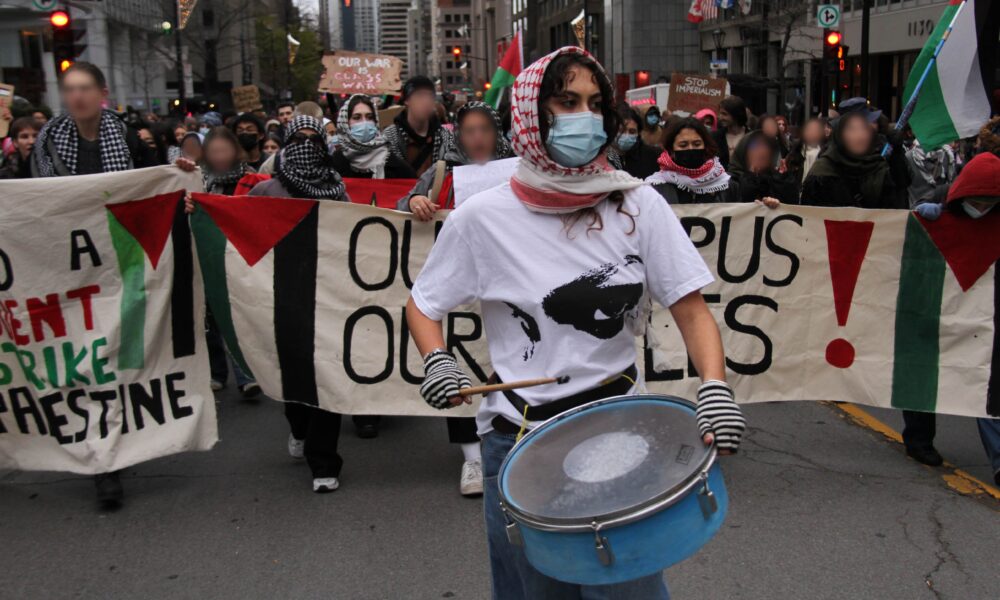
From Nov. 22-25, representatives from 32 Western countries met in Montreal to take part in the 70th Parliamentary Assembly of the North Atlantic Treaty Organization (NATO). On the first day of the assembly, protestors made demands to dissolve NATO due to the alliance’s perceived complicity in the genocide in Gaza, and to reduce Canadian defence spending. On the evening of Nov. 22, protestors smashed shop windows on Rue St-Urbain and René-Lévesque Blvd,  and set cars on fire—actions which drew condemnation from Canadian politicians including Prime Minister Justin Trudeau and Montreal Mayor Valérie Plante. 

NATO is a defensive alliance initially formed in 1949 to provide collective defence against the Soviet Union. Today, the alliance is known for Article 5, which guarantees that an attack on one member country will trigger a response from all member countries.

The agenda for the assembly focused on providing support for Ukraine, which relies on NATO to slow the ongoing Russian invasion. Canada is also under pressure to increase its annual defence expenditure from 1.29 per cent of its GDP, to the NATO benchmark of 2 per cent.

Greg Baune is Vice President of Le Mouvement Québécois pour la Paix, an organization that opposes Canada’s membership in NATO, and was involved in organizing the Nov. 22 protests. He argues that NATO’s self-description as a defensive alliance is misleading.

“[NATO describes itself] as purely a defensive organization, and many people just buy it, hook, line, and tackle,” Baune told The Tribune. “In the end, the very existence of the organization allows its members to coordinate the help they give to whichever client state they wish to advance Western imperial interests in [….] We think that as working-class Canadian students, our first and primary task is to dedicate ourselves to fighting against our own imperialism.”

Sasha Robson,* U2 Arts, was starkly opposed to the NATO assembly being hosted in Montreal, as they believe that NATO is complicit in Israel’s siege on Palestine. They called for NATO countries who provide weapons to Israel to stop, and for the alliance to enforce an arms embargo on Israel to avoid the risk of being collectively responsible for a genocide.

“NATO is a cornerstone of imperial power worldwide that is responsible for endless death and killing, including in the ongoing genocide in Palestine and Lebanon,” Robson told The Tribune. “This set of wars is to perpetuate violence for the sake of perpetuating violence, for the sake of profit […] NATO has been responsible for colonial violence worldwide for decades, since its inception in places like Afghanistan and Libya.”

Robson also argued that Canada should not increase its defence expenditure to support Eastern European countries, but should rather reinvest tax revenues in social services domestically.

“I don’t think Canadian tax money should go anywhere other than Canada. Frankly, I don’t think [arming Ukraine] is a responsibility,” Robson told The Tribune. “While I can obviously say that Russian aggression […] is horrible, I don’t think the solution [is to be] found through funneling more money through the US government.” 

Lorenz Lüthi, Professor of History of International Relations at McGill, clarified that NATO is not directly involved in the conflict in Palestine. 

“NATO is not involved in the current war of the Israel government/military against the Palestinians in Gaza. Individual NATO countries provide weapons to the Israeli government, but not all—and some are quite critical about Israeli policies in the region,” Lüthi wrote.

However, Lüthi emphasized that the dissolution of NATO would have devastating effects on Eastern European nations facing Russian expansionism. 

“[The dissolution of NATO would] have a major impact on Eastern Europe, however. The Baltic States, Poland, and Romania have a long history of Tsarist Russian, Soviet, and post-Soviet Russian interference and domination,” Lüthi wrote to The Tribune. “Under Putin, this has become a major issue again.”

Mihails,* U2 Engineering, claims that Canada has a responsibility to protect Eastern European countries from Russian expansionism, and believes in the importance of the country’s continued involvement in NATO. 

“[Russia] wants to expand its influence towards Eastern Europe, and I think it would be an awful thing for some democratically elected governments to fall if NATO were to be disbanded,” Mihails told The Tribune. “I think [participation in NATO is] a very beneficial investment that we’re making in defending weaker countries and maintaining their stability.”

Despite mounting pressure, the US, Germany, and Italy—all NATO members—continue to provide arms to Israel, which are used against the Palestinian population. 

*Robson and Mihails’ names were changed to preserve their anonymity.

McGill, News, Recap

Recap: McGill student societies hold General Assemblies to strike in solidarity with Palestine

During the week of Nov. 18, several McGill student associations held General Assemblies (GAs) to vote on a motion to strike in solidarity with Palestine following a national call for action from Students for Justice in Palestine. Thhe McGill Students’ Geography Society (MUGS), Philosophy Students’ Association (PSA), and Anthropology Students’ Association (ASA) successfully passed the motion and picketed classes on Nov. 21 and 22.

In order to vote on the motion, each GA had to meet its quorum requirements. Tris*, a student organizer involved in the picketing explained to The Tribune that for some associations, meeting quorum was more challenging than for others. 

“The strike votes were conducted democratically through general assemblies, reflecting the collective voice of students rather than decisions made solely by committee executives,” Tris said. “Quorum requirements varied by department: For example, Anthropology required only a majority vote, while MUGS, MESS [McGill Environment Students’ Society], and [PSA] required 25 per cent, 50 per cent, and 10 per cent, respectively.”

Student associations that could not meet their quorum were unable to formally participate in the strike, although some student association executives still urged general members to strike regardless of the outcome.

In an email to The Tribune, the McGill Media Relations Office (MRO) explained its rationale for not cancelling classes during the strike.

“Though we respect the right of students to express their views, we saw no basis to cancel classes [on Nov. 21 and 22]. In fact, the vast majority of students attended class that day,” the MRO wrote to The Tribune. “McGill will always support the right to free expression and peaceful assembly within the boundaries set by policies and legislation. However, the University’s primary responsibility is to deliver on its academic mission.”

Throughout the week, organizers held teach-ins and visited various GAs to talk to general members about students’ right to strike. 

“Students worldwide heeded the call, and it took Quebec’s colleges and universities by force,” Tris commented. “At McGill, the focus was on making the strike approachable for students unfamiliar with such actions, aiming to create manageable, targeted efforts.”

*Tris’s name was changed to preserve their identity.

Editorial, Opinion

The Tribune’s SSMU by-election endorsements

The Tribune’s editorial board presents its endorsements of the candidates for the Fall 2024 Students’ Society of McGill University (SSMU) by-election for the Vice-President (VP) Student Life and VP Sustainability and Operations positions. Editors researched and communicated with each candidate before leading an editorial board discussion on the candidate’s qualifications and vision for their prospective role. Editors with conflicts of interest abstained from discussing, writing, and editing relevant reviews.

VP Student Life

Justice Bongiovanni

Bongiovanni, who worked in student government at his Cégep, plans to bolster student food security initiatives on campus. His campaign has included goals to re-open student-run cafes (namely, Gerts), employ students on campus, support student-run food cooperatives, fund affordable courses for students to gain practical skills, and make dietary-restricted and culturally appropriate food more readily available on campus. Bongiovanni has also run his campaign on the goal of investing $10,000 CAD to address food insecurity at McGill. While lacking experience working within SSMU or its clubs and services, Bongiovanni consulted various student groups to form his campaign. Bongiovanni told The Tribune that he believes that students are frustrated with SSMU, but that through collaboration with the other executives, he can ensure that student fees are reflected in their experiences on campus. 

Alice Postovskiy

As the administrative coordinator for the Union for Gender Empowerment (UGE) and treasurer for the Mafia Club, Postovskiy has spent multiple years working within SSMU clubs and services. Her campaign centres on objectives to streamline club finances, ensure timely operations so that services can run smoothly, recognize the autonomy of clubs and services, facilitate collaboration between student groups, and simplify regulatory processes to eliminate what she sees as unnecessary administrative work. Postovskiy has also claimed she will work to protect student groups from “overreach by administration.” She told The Tribune that if elected, she plans to recognize the community that student groups foster and the power they hold as well as increase communication between groups and herself to ensure that student groups are appropriately advocated for at the executive level. Postovskiy believes that SSMU ought to competently provide essential administrative work while also granting student groups more autonomy. She emphasized that clubs and services often know what is best for their communities, citing the fact that many services tend to have stronger institutional memory than SSMU due to less frequent staff and volunteer turnover.

Endorsement: Yes to Alice Postovskiy

With years of experience working with clubs, services, and SSMU, Postovskiy would bring a grounded understanding of the responsibilities of the role of VP Student Life and the unique needs of student groups. Postovskiy demonstrates a clear desire to enhance the working relationship between SSMU and its student groups—something The Tribune believes is necessary in order to realize a well-functioning student union. The Tribune also supports Postovskiy’s vision to bolster student group autonomy as opposed to strict top-down management as student groups are the lifeblood of SSMU. While The Tribune applauds Bongiovanni’s commitment to food security initiatives, Postovskiy’s platform provides clear and actionable goals, plus a broader vision that is directly in line with the portfolio of VP Student Life. 

Vp Sustainability and Operations

Kareem El Hosini

El Hosini’s platform is based on efficiency, transparency, and enrichment. He believes that SSMU should maximize the value provided to students with the resources at hand, quickly and correctly. El Hosini believes that transparency is key, as students have the right to know the important decisions being made by SSMU. This will work in two ways: First, by letting the students be heard before making decisions through the implementation of a feedback system; second, by putting out regular messages with information pertinent to the students. “We hear you, you hear us,” he says. El Hosini plans to begin by working with student services that already receive funding to assist in directing their resources more efficiently, as well as partnering with local businesses. He aims to close the gap between students and the administration, ensuring that students are not only heard but are also empowered to communicate directly with McGill without relying on intermediaries. He believes that “having direct access to those whose job is to serve students is a right, not a privilege.” His message is: Vote Kareem, free Palestine.

Arya Cheuk

Cheuk’s platform is based on simplicity, community, and sustainability. She wants to address students’ concerns about the gravity of the climate crisis, as well as the guilt they may feel for their lack of use of climate-conscious alternatives. Cheuk has experience being the McGill Undergraduate Geography Society (MUGS) Sustainability Officer, through monthly roundtable meetings for the Science Undergraduate Society and as a member in large of the Environmental Committee of SSMU. She will work toward transparency for students by being aware of the inventory of services available on campus and keeping up to date with SSMU environmental social media. One of her main initiatives is increasing compost accessibility at McGill, through installing independent student waste collective bins in collaboration with building directors and increasing labelling of composting sites on campus. When it comes to student calls for Palestinian mobilization, she believes individual executives may hold certain biases and SSMU needs to ensure that they are adequately representing their faculties, and thus recommends holding General Assemblies instead. 

Endorsement: Yes to Kareem El Hosini

El Hosini’s years of experience working at McGill’s clubs would prepare him to facilitate transparency, administration, and communication with students. He plans to be a representative voice of the student body, heeding their calls for pro-Palestinian solidarity. The Tribune commends his planned initiatives toward quick and efficient solutions to increasing communication and collaboration with students. El Hosini recognizes the impact a representative student executive team has on the student body, and plans to approach this position as a privilege. The Tribune encourages El Hosini to ensure that he is able to make the time commitment to the position, given his vast involvement in other student groups at McGill. 

Commentary, Opinion

Grindr is not about sex

Throughout much of the latter half of the 20th century, queer and transgender folks fought hard and brave to guarantee their basic human rights. From the Stonewall Uprising to the AIDS epidemic, 2SLGBTQIA+ people were united by a common goal. Furthermore, because homosexuality was so condemned at the time, queer communities gathered in particular parts of town in which they were accepted: The East Village in NYC, the Castro District in San Francisco, or even our own Gay Village here in Montreal. These used to be places in which queer dating took place—and for some people, it still does—but Gen Z rarely frequents these places now. 

More and more, 2SLGBTQIA+ youth do not need to rely on these places to be their authentic self. Evidently, this is a good thing; yet, it also comes at a high cost. Given that younger queer people do not frequent these spaces anymore, they resort to the digital world to meet other queer people and date. For better or worse, dating apps are the easiest way of meeting potential romantic partners in the 21st century. However, while for straight people these are more of a choice, many LGBTQ folks, particularly gay men, use them out of necessity to meet other queer people. It is due to the lack of vibrant queer spaces in the real world that queer people resort to dating apps, some of which can have detrimental effects on mental and physical health.

The use of dating apps such as Grindr severely impacts users’ mental health, because it’s designed to feed upon gay men’s insecurities and vulnerabilities. Grindr is a dating app that caters primarily to cisgender gay men and is centred around hookup culture. Since it is not particularly easy to meet other gay guys in real life, Gen Z gay men often feel lonely and alienated from their community. Grindr promises a quick, 21st-century solution to this problem. It makes finding sex and potential romantic partners incredibly easy, just like gay clubs back in their heyday. However, unlike gay bars, apps like Grindr have the potential to become severely addictive. This is because such apps pair neutral, quick actions in the brain, such as simply scrolling on the app, with pleasurable reactions such as sexual gratification, which in turn teach the human brain to repeat those actions consistently.

However, what I think most gay men on Grindr are really seeking is not purely sex, but connection and community. The app offers an escape from the isolation that many gay men might experience. Men log into the app with the intention of finding a connection, and while they often do find a match, that pleasure is short-lived and ephemeral. It is a mere illusion, because most of the interactions in such apps are one-night stands, in which no meaningful connection develops, leaving men more anxious and lonely than before. Nonetheless, it seems they remain on these apps because finding gay men in the real world proves extremely difficult

This problem has no easy solution. Gay clubs and bars are still highly sexualized spaces, and it is difficult to make them attractive to younger generations. However, a step in the right direction would entail investing in such communities to foster a sense of queer belonging. Montreal’s gay village has visibly decayed in the past few years. This place decades ago was a beam of hope for the 2SLGBTQIA+ community; now, it is a shadow. Rebuilding it will not fix the problem of dating apps,  but it can at least empower queer individuals by providing them with the option to meet other gay people in real life, giving them more choice in how they connect with others.

Commentary, Opinion

Could pedestrianizing Rue Sainte-Catherine ease our seasonal blues?

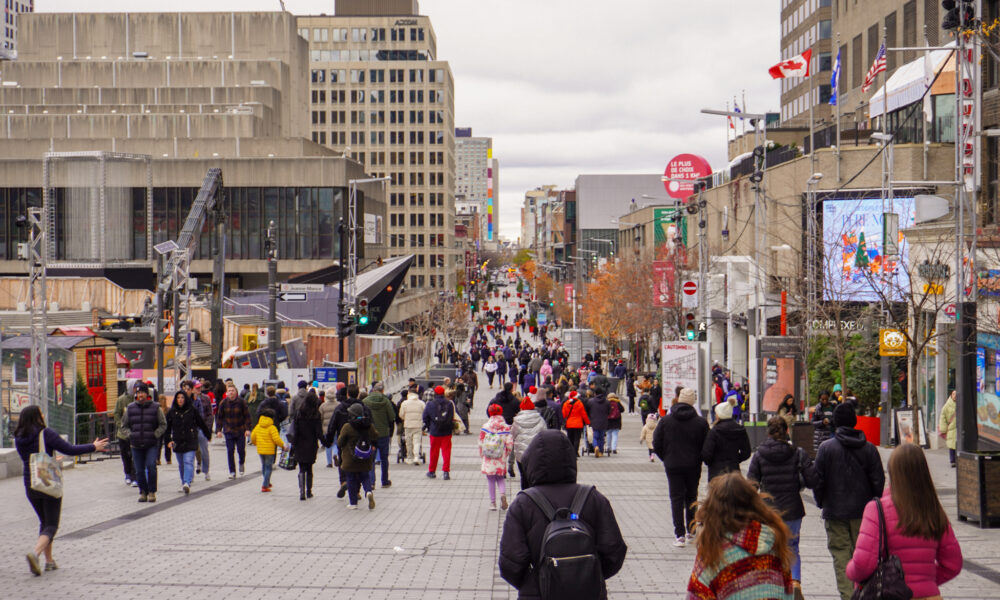
A last-minute battery replacement for your beloved laptop that’s well past its prime. A new top for a first date when you have nothing to wear. A warm pair of gloves because, yes, Montreal really is as cold as your mom warned it would be. A trip to the Eaton Centre’s Time Out Market when dining hall food just isn’t cutting it. Rue Sainte-Catherine has it all. 

McGill students and Montrealers alike faithfully flock to Sainte-Catherine’s urban thoroughfare in astounding numbers: Half a million pedestrians are estimated to walk the street every day. Its unique popularity lies in the fact that—beyond the usual shopping outlets, cultural centres, and public squares—Sainte-Catherine takes on a unique form during the summer, one that it should arguably occupy all year round. 

Transforming into a pedestrian-only street between the months of May and October, Rue Sainte-Catherine is home to a high volume of festivals and cultural activities, including the Montreal Pride Parade, the annual Rue Sainte-Catherine Sidewalk Sale, and the Montreal International Jazz Festival. On a more basic level, the pedestrianized street is also opened to street-vending by local retailers, used by businesses to expand outdoor seating arrangements, and even made available for temporary art installations.

Rue Sainte-Catherine is not alone in this practice of seasonal pedestrianization. In fact, Montreal has been strategically pedestrianizing its streets for years post-pandemic, with many significant thoroughfares like Mont-Royal Avenue ceasing to admit car traffic during the summer and fall months. Clearly, the city’s Urban Planning and Development department is gradually adopting a broader practice of pro-pedestrian modifications to the city’s landscape.

However, the opportunity for increased community activity and walkability is not convincing enough for every Montrealer to embrace year-long car-free legislation. Business owners and residents alike have expressed concerns about the full-time pedestrianization project. They fear that economic activity will be slowed and general aesthetics hindered without deliveries and trash collection services being taken on by vehicles. Montreal residents have also theorized that converting Rue Sainte-Catherine to pedestrian-only will force congestion out to neighbouring streets.

These concerns—while completely understandable—overlook the proven benefits of the pedestrianization policy. Such a car-free policy would not occur in isolation; pedestrianization legislation is coupled with improvements in public transportation and developments in pedestrian and bike infrastructure. The vacuum created by a lack of cars on Rue Sainte-Catherine would thus be quickly filled, presenting a transformative opportunity for the city to turn what was once a street into a vibrant urban zone.

With the street no longer being plagued by vehicular air pollution, the sound of irritable honks from drivers, and a general inefficiency in space usage, Sainte-Catherine could become home to a green community space. Such a shift in the street’s presentation bears additional relevance when considering that, once a street becomes increasingly designed around the well-being of its pedestrians, foot traffic has been shown to increase

When pedestrian presence increases, it’s not just the vibe of the city that’s bolstered; local economies are too. For example, when Toronto’s Public Works and Infrastructure Committee implemented a 2016 resolution to replace on-street parking with bike lanes on the major thoroughfare Bloor Street, both monthly spending by customers and the number of customers themselves increased. The alleged decline in consumer activity that has been causing anxiety among Sainte-Catherine merchants is, truly, a myth, and the data shows this. Business—particularly restaurant—owners tend to overrepresent the significance of cars to economic activity due to the dominance of services like Uber Eats and GrubHub. In reality, the real spenders are the pedestrians walking by and peering into storefronts.

The pedestrianization of Rue Sainte-Catherine is a crucial step towards promoting Montreal’s cultural life, improving the city’s environmental health and boosting small business finances. While disruption to the car-oriented status quo may be intimidating for long-time residents, this change is necessary to set an urban landscape standard for generations to come.

Besides, Rue Sainte-Catherine is perpetually under construction anyway. Montrealers might be more used to the idea of a car-free future than they realize.

Soccer, Sports

Glaring double standards as Israel continues Nations League campaign

Israel’s participation in major sporting events, like the Union of European Football Associations (UEFA) Nations League soccer tournament or the Olympic Games, has raised controversy among fans and activists alike. The double standard of sports governing bodies allowing Israel to compete has been particularly noticeable in the wake of FIFA and UEFA extending Russia’s international soccer suspension on Nov. 18. Russia was originally suspended just four days after its invasion of Ukraine in 2022 for violating international law. However, Israel continues to participate in the UEFA Nations League, despite ongoing violations of international law through its continuous human rights abuses in Palestine

FIFA justifies its ban against Russia as part of its human rights policy, where it claims to stand by its commitment to take any measures necessary to avoid contributing to human rights abuses. FIFA banned South Africa from the World Cup from 1961 to 1992 because of the oppressive apartheid regime. Yet, this standard does not seem to apply to Israel. Article 76 (3) of FIFA’s statutes states that “member associations and their clubs may not play on the territory of another member association without the latter’s approval.” Despite this, the Israel Football Association (IFA) has at least eight clubs that play on occupied Palestinian territory in the West Bank. 

FIFA has been aware of this breach since 2013, but Israel has faced no repercussions. The Palestinian national football team, on the other hand, faces a deteriorating security situation as a result of Israel’s occupation. Israeli forces have killed around 350 professional Palestinian athletes since Oct. 7, 2023, and Israel’s bombing campaigns have destroyed almost all the sporting facilities available in Gaza and the West Bank. The Human Rights Watch and the Palestinian Football Association argue that, by allowing Israel to compete, FIFA and UEFA are supporting and legitimizing the occupation. 

While not a European country, Israel has been a part of UEFA since 1994. Originally, the IFA was a founding member of the Asian Football Confederation (AFC) in 1954. However, some AFC members, such as Kuwait and all of the Arab League nations, boycotted matches against Israel due to the occupation and treatment of Palestinians. Eventually, the AFC expelled Israel in a motion led by Kuwait in 1974. UEFA invited Israel to participate in European competitions starting in 1992 and permanently accepted it in 1994, despite Israel’s geographic location.

There was similar controversy over Israel’s ability to participate in the Paris Olympic Games this summer, while Russian athletes had to compete as Individual Neutral Athletes (AIN). At least 30 of the 88 Israeli Olympians publicly supported Israel’s actions. Palestine’s Olympic Committee called this out, pointing to the contradictory attitude the athletics community appears to have toward the treatment of Russian and Israeli athletes

During the opening ceremonies, spectators booed the Israeli national anthem, but France maintained its commitment to protecting Israeli athletes. Russia, on the other hand, was banned on the grounds of violating the ancient Greek tradition of Olympic Truce. Palestine’s Olympic Committee accused Israel of violating that same truce by continuing its violence in Gaza. Some athletes also disagreed with Israel’s presence, such as Tajikistan’s judoka Nurali Emomali, who refused to shake hands with his Israeli opponent.  

In July 2024, the International Court of Justice (ICJ) found Israel guilty of a long list of human rights abuses and violations of international law. The ICJ deemed the Israeli occupation illegal and set out the standards of reparations that Israeli authorities owed Palestinian civilians. Similarly, on Nov. 21, 2024, the International Criminal Court issued a warrant for the arrest of Israeli Prime Minister Benjamin Netanyahu for the war crimes Israel has committed since Oct. 7, 2023. The warrant also included Israel’s Defence Minister, Yoav Gallant and a senior Hamas official, Mohammed Deif (although Israel states he was killed in a targeted July airstrike).

How can Israel, a country convicted of so many violations of international law, human rights, and sporting regulations still be allowed to compete? FIFA and UEFA seem to apply scrutiny over human rights selectively. As people continue to demonstrate against Israel’s participation, it seems unlikely that the country will face any restrictions on its ability to compete in the future. If FIFA and UEFA want to promote unity, diplomacy, and peace through sport, they must apply pressure to all countries committing human rights violations.    

Local Stories, Student Life

My mom ran for Congress. This is what I learned

For the last four years, my mom has been running for Congress in Tucson, Arizona. She started her political journey in the state legislature when I was 11. When she first ran for Congress, she lost by such a narrow margin that many asked her to run again; so she did. Her race this time was one of the closest and most high-profile in the country, as it could have been one of the four seats needed by Democrats to gain a majority in the House of Representatives.

I came to McGill a year and a half ago, far from where American politics run both my parents’ lives. While most people know about the presidential elections, few know the nitty-gritty of the campaigns behind them.

My biggest takeaways from watching a congressional campaign behind the scenes are how gruelling the work is, how constrained candidates are in what they can say or do to appeal to voters, please their own party, and prevent an avalanche of spending against them, and most importantly, how almost everything in American politics is about money—a whopping $36 million USD was spent in my mom’s race by both sides. 

Every time I accompanied my mom to an event, people were excited to meet the candidate’s daughter. They recognized me from her TV ads, asking “Aren’t you proud of your mom? Isn’t she cool? Are you going to run for office like her?” 

But I just see her as my mom. At home, she is loving, caring, and quirky. She doesn’t understand technology or pop culture, she hates scary movies, laughs easily, sings or hums when she walks around the house, and loves to accumulate a ridiculous number of houseplants. She’s smart, and very opinionated, having worked as an environmental lawyer before politics. 

But this isn’t who she is during the campaign. Her fiery candidate persona is like a superhero alter ego, albeit one constrained by her consultants and the “D-triple-C” (Democratic Congressional Campaign Committee). They told her reproductive rights were her strongest issue—crucial because abortion care in Arizona is abysmal—despite water and climate issues being her professional strength. In the state legislature, she championed bipartisan progressive criminal justice reform, which she was discouraged from mentioning in the campaign because her opponent was accusing her of wanting to defund the police. I noticed she was also overly cautious when speaking on controversial topics, like Israel’s siege on Gaza. This was a point of contention in our household: I wanted her to speak out more strongly against it.

The conservative district also played a role. She was asked in an interview once, “Is there a crisis on the border?” She answered “No,” and followed it with a thorough answer about the need for more officers to process asylum-seeking migrants, and the need to secure the border from drug and human trafficking. But her opponent clipped her saying “No,” and ran it in a TV ad, making his whole campaign against her about that one word. The political system is so inflated with money—which mostly goes to TV hit ads—that it pushes candidates to be centrist and robotic. 

I flew home to Arizona for her (and the presidential) election night. Initially, energy was high, but as the night wore on, the ambiance took a plunge. First North Carolina went for Trump, and then the rest of the swing states, one by one. We were all in shock, but my mom’s race took a week to finish being counted. She was ahead on election night, but little by little, her opponent surpassed her, winning the election in the Trump wave that swept the nation. 

It’s incredibly disappointing. Her campaign was exciting and important, and she could have done so much as a congresswoman. Looking back, I feel she was squeezed into a mold that the party had for her, one which flattened her into something much less nuanced and certainly less interesting than she is.

McGill, Montreal, News

Tens of thousands of students walk out in support of Palestine across Montreal

On Nov. 21, over 80,000 Cégep, college, and university students across Montreal walked out of their classrooms to call out their institutions’s complicity in the ongoing genocide in Palestine. At McGill, students walked out of classes at 1 p.m., organized by Students for Palestine’s Honour and Resistance (SPHR) at McGill in collaboration with Law Students For Palestine at McGill, Divest McGill, Independent Jewish Voices (IJV) McGill, Profs4Palestine, and the Association of Graduate Students Employed at McGill. Protestors gathered outside of the University Centre before heading to Concordia University. There, groups from McGill, Concordia, and other adjacent Montreal institutions and communities filed into the Henry F. Hall Building, going from one floor to the next. Afterward, the protest once again filled the streets of downtown Montreal before dispersing at around 3:45 p.m. 

The protest began in front of the University Centre, which houses the offices of the Students’ Society of McGill University (SSMU). In a statement to The Tribune, a representative from SPHR at McGill who wished to remain anonymous explained that along with walking out of campuses in support of Palestine, the McGill contingent was also walking out for what they believed to be inaction from SSMU. 

SPHR submitted a motion through SSMU channels for the entire body to join departmental strikes across McGill in support of Palestine, which would have brought together roughly 24,000 students. The SSMU-wide Strike General Assembly (GA) would have required a 500-person quorum. While 12 GAs were hosted across various departments in the days leading up to Nov. 21, the facilitation of a SSMU-wide strike GA was denied.

“They deflected to obscure legal ‘constraints’ which they had extrapolated so ridiculously and conveniently as to not allow the SSMU to make any public statement in relation to Palestine. After confronting them for over two weeks, we learned that this pretense was clearly a ridiculous and misconstrued interpretation of their legal limitations regarding the injunction,” the SPHR representative wrote.

In a statement to The Tribune, SSMU President Dymetri Taylor shared that the SSMU Steering Committee denied SPHR’s first motion for a strike GA because it had actionables taken verbatim from the Policy Against Genocide in Palestine (PAGIP), which a present court injunction has forbidden SSMU from enacting in any part. 

“We communicated as much that, due to the ongoing case and injunction against the SSMU, we cannot do anything that the Courts would perceive as us enacting the [PAGIP]. If we did, we would be in contempt of the Court, leading to further sanctions against the SSMU, potential fines, or worse,” Taylor wrote. 

Taylor also shared that SPHR then worked on another draft of the strike motion, which called for a strike general assembly and a referendum to vote on the strike scheduled for Nov. 28-29. 

“This time, it was not as clear as to whether or not we would be in violation of the injunction, thus, we sent it to our Legal Counsel. Another issue before that, however, is the fact that more than 50% of the students who signed the petition were from a single Faculty, which is not permissible under our internal regulations,” Taylor wrote. “We have been waiting for a legal opinion since November 14th, and they take time to procure.” 

However, the SPHR representative expressed frustration toward SSMU for its “colossal failures” in representing the student body over the past year. 

“We see a clear pattern of this within the SSMU where last year they failed to contest the injunction on the historic PAGIP. This year, when we’ve seen them revoke SPHR’s status [as a] club […], fail to adequately address the current condition on campus, and fail to adequately take a stand in solidarity with the student body as they’ve been disciplined, arrested and criminalized,” they wrote. “And now finally, we see their inaction in the face of this strike [….] We have honestly let the SSMU get away with not being a representative force for way too long.”

A representative from IJV McGill who wished to remain anonymous encouraged students to join in on the national protest for Palestine. 
“It’s been over a year of genocide. It’s been over 76 years of occupation. There are chances for you to get involved. There [is] rally after rally. Make your voice heard,” they said in an interview with The Tribune. “I understand that it’s scary on campus right now with our administration placing literal surveillance on us. But you have a voice, and you can use that.”

Montreal, News

Trans Day of Remembrance protest honours the past and looks toward the future

Over a hundred people gathered on the evening of Nov. 20 to mark Transgender Day of Remembrance, an annual observance that serves to honour and remember transgender people who have lost their lives due to transphobia and discrimination. The event, organized by a group of Montreal activists, began with a vigil and series of speeches at Dorchester Square, followed by a march that weaved through downtown Montreal and the Village and ended in front of the Radio Canada headquarters on Avenue Papineau. 

“Trans Day of Remembrance is an especially important event for the trans community because it faces a higher mortality rate – simply put, trans people tend to often have community members to grieve, and it is deeply meaningful to do it as a community,” Quebec Public Interest Research Group (QPIRG) wrote in an email to The Tribune.

Following the election of Donald Trump, whose campaign focused heavily on anti-trans policies and transphobic rhetoric, anxiety about increasing American and Canadian legislation against trans rights was palpable. 

“It’s devastating news for trans people who live in the US,” added Celeste Trianon, a jurist and activist for trans rights in Montreal, in an interview with The Tribune. “Trump has fully gone down the rabbit hole of attacking trans people as much as he can, especially trans women.”

The organizers also recognized the ties between trans rights activism and Palestinian human rights. 

“We, as queer and trans people, have been able to work within the pro-Palestinian movement to fight for liberation and an end to genocide,” a representative from the Divest for Palestine Collective said, addressing the crowd. “Not only that, but also to knit a larger web of solidarity between our struggles, which all converge together.” 

While many of the speeches reiterated the need for continued solidarity and activism, they also emphasized Trans Day of Remembrance as an opportunity to make space for mourning, rest, and community support. 

“I’m thankful for each and every one of you who’s here today to remember and honour the siblings who have lost due to transphobia,” said Montreal-based activist Alice Winterland, addressing the crowd. “Let us mourn those we’ve lost today. Let us celebrate their lives, and finally, let us find solidarity amongst each other and other queer people in the community.”

Recognizing the difficulty of a day for mourning, several volunteers were designated as active listeners for anyone who needed to discuss feelings brought up by the day or the event. They additionally provided free food, encouraged attendees to wear masks, and supplied wheelchairs for those who needed them during the march. 

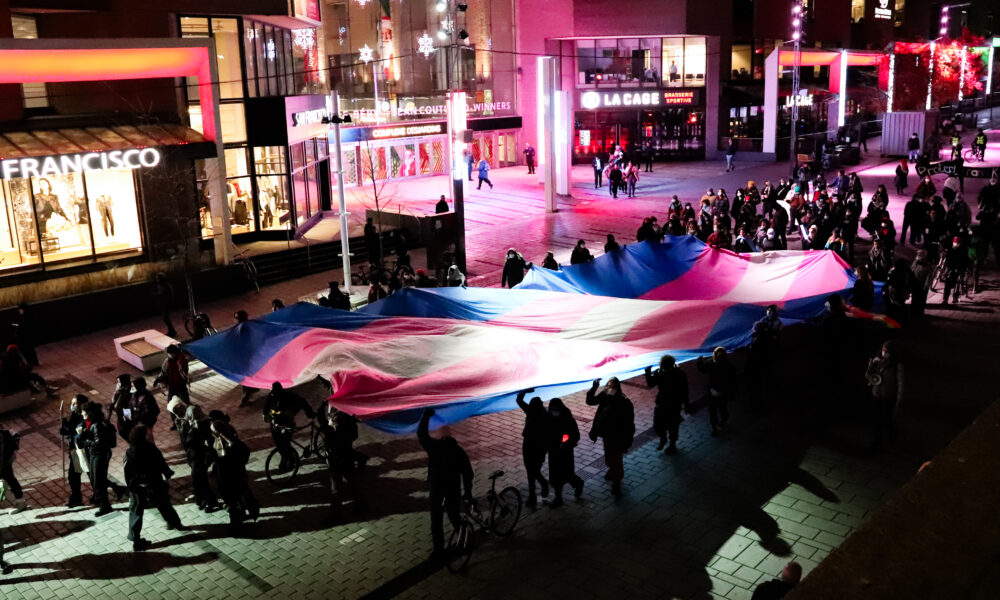
After the speeches and food, protestors unfolded a large trans flag, which spread from one side of the street to the other. They marched along Sainte Catherine Street through downtown Montreal. As the protest moved through the Gay Village, people spilled out of clubs and restaurants to join in with the chanting, joining in for refrains like “We’re here, we’re queer! We’re fabulous, don’t fuck with us!” and “Fight for Black trans women!”

Finally, the protestors arrived at the Radio-Canada headquarters on Avenue Papineau, where they called on the organization to increase their support for trans-Canadians and report more actively on trans issues, with chants like “Every time the media lies, another trans kid dies!” Celeste noted that there were no mainstream media organizations covering the protest. 

“It shows how trans rights are represented in the media as an issue that is not worthy of reporting, that trans lives are not worth reporting on,” she told The Tribune

A representative from the Union for Gender Empowerment also spoke about the importance of events like this to break the silence surrounding the mistreatment of trans individuals. 

“The amount of violence that occurs in our lives, whether it’s social violence, whether it’s what sociologists call deaths of despair, whether it’s interpersonal violence, […] all of these things occur very quietly, to the ears of the outside world,” they shared in a voice memo to The Tribune. “Trans Day of Remembrance is about claiming that, it’s about saying these things actually do occur. They’re occurring to us. And they deserve to be remembered, right here, right now.”

Read the latest issue

Read the latest issue