Latest News

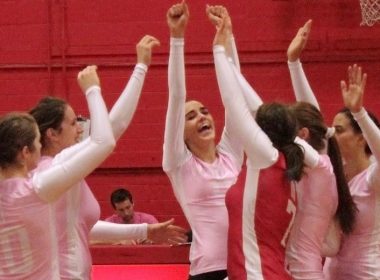
Mélodie Daoust celebrates with her teammates after scoring a goal. (Luke Orlando / McGill Tribune)
a, Sports

Defending their No.1 ranking: Martlets stay perfect

The Martlets entered McConnell Arena Saturday afternoon looking to defend their No.1 ranking in Canada and their conference-best 6-0 start to the season. In the end, the Concordia Stingers proved to be no contest for McGill, as the Martlets prevailed 3-1.

McGill jumped out to a quick 1-0 start, thanks to a goal by Leslie Oles only a minute into the game. The Martlets continued the aggression on the offensive end, which resulted in a lopsided 16-1 shots on goal differential at the end of the first period.

This assertive Martlet play continued into the second frame. McGill relentlessly challenged the Concordia defence. After a number of narrowly missed opportunities, the Martlets once again converted. Mélodie Daoust fired a shot past Stingers’ goaltender, Carolanne Lavoie-Pilon—who faced 41 shots in the contest—with three minutes left in the period. Head Coach Peter Smith expressed satisfaction with his team’s offensive attack in the game.

“We wanted to move the puck, and we wanted to get lots of pucks toward the net. I thought we did a good job in doing that,” Smith said. “Their goaltender made some good saves … but we generated a lot of scoring chances, which is the most important thing.”

Just a minute into the third period, Concordia’s Alyssa Sherrard capitalized on a powerplay that carried over from a roughing penalty in the second frame. The Stingers continued to trade blows with McGill, but the Martlets sealed the game on their own powerplay, thanks to a goal from first-year standout Gabrielle Davidson. She scored her seventh goal of the year with less than eight minutes left to play. The Martlets applied further pressure after some careless Concordia turnovers, and preserved the 3-1 lead.

Throughout the contest, McGill appeared to be a cohesive unit on both sides of the puck, executing clean passes on offence and playing strong defence on the other end. Coach Smith lauded his team’s effort after the game, highlighting the play by fourth-year goalie Andrea Weckman, and forward Kim Ton-That.

“Andrea Weckman didn’t get a ton of shots, but when she did, she made some real good saves. She brought a lot of confidence to the team,” Smith said. “I [also] thought Kim Ton-That was terrific … she was involved in the play in all three zones … [she] did a real good job. I thought we got a real good effort by everybody out there.”

Second-year defender Brittney Fouracres also stressed the importance of McGill’s team-oriented approach to the game.

“I think that it was a strong game for everybody. Having that support, and the forwards and goalie behind you, makes it easier to play well and strong, and helps towards the victory,” she said.

The Martlets improved to 7-0 on the season, and solidified their spot atop the RSEQ leaderboard. Ton-That was adamant that her team would stay focused despite dominating the competition in the early season.

“[Coach Smith has] always really focused on the fact that we should take it one game at a time, so that’s [our] focus,” Ton-That said. “Obviously we want to have a long-term approach to things, but in order to have a really good long-term approach you have to take it day by day. So that’s what we’re really focused on.”

The Martlets extended their undefeated streak again on Sunday afternoon, taking down Ottawa 8-3. They look to continue their hot streak against the Montreal Carabins at McConnell Arena on Nov. 17.

a, Behind the Bench, Sports

Beers, cheers, and tears: that’s politics

‘Happy Hour’ on a Tuesday night—not exactly the time you would expect to pay $3 cover at Gert’s. But our thirst had to be quenched, and we couldn’t walk much further. My friend and I were in search of a simple study break and an escape from the ‘McLennan Madness.’ As we ordered our first pints, it became very clear that we had stumbled into something much bigger.

It was election night in the United States. Though we knew the circumstances, the abundance of Uncle Sam top hats did serve as an ever-constant reminder. The scene was reminiscent of any Montreal bar on the night of a Canadiens-Leafs game. Only this time, the blue jerseys far outnumbered the red.

I got the sense that everyone was there for the same reason. Everyone wanted to celebrate something. The parallels between ‘Election Night in America’ and ‘Hockey Night in Canada’ were uncanny. Attendees were rocking their team colours, decking themselves out in face paint, and waving their banners with pride.

The bar was decidedly in favour of the Barack Obama, erupting as though a goal were scored every time CNN projected Electoral College votes for the incumbent. Mitt Romney supporters were not shy either, and they huddled together like fans of the visiting team, and tried to make their voices heard in the left-leaning crowd.

Soon, the line to get into Gert’s stretched out the basement doors of the SSMU building onto McTavish. It may have been my imagination, but as Obama’s lead grew, you could faintly hear someone starting the ‘Olé, Olé, Olé’ chant. In fact, the event started to seem incomplete without a tailgate party and the Goodyear blimp.

While the sports parallels continued to mount, one stark contrast began to emerge: politics is drastically more consequential than sports. In both cases, roughly 50 per cent of the audience goes home happy. However, the result of an election can present serious ramifications in peoples’ lives. For the 50 per cent who go home defeated—or 47.9 per cent in this case—there are no more games left on the schedule. This is not a best-of-seven series. There is no rematch. This is of quantifiable importance.

It is because of its profound impact that politics can be so divisive. Our differences of opinion over the Red Sox and Yankees, the Lakers and Celtics, or the Leafs and Canadiens don’t ultimately decide who we are as human beings. How we take care of the poor and the elderly, wage war on other nations, or utilize natural resources—these choices are far more telling of our identity than whether our favourite teams win or lose.  Just don’t remind me of that during the fourth quarter of the Super Bowl.

In the end, that is why people love sports so much. Sport allows us to pour our blood, sweat, and tears into something so trivial, yet seemingly so significant. We can despise the logo on someone’s sweater without holding any disdain for the man or woman wearing it. We can laugh, cry, fight, and make up, all in two-and-a-half hours—then do it all over again the next night. Unfortunately, the same cannot be said of politics—but it was nice to see us try.

a, Sports

Sports Briefs

Swimming — RSEQ CUP 3: Bielby, Renaud, Benoit, De Broux win: four medals each

Steven Bielby and Valerie De Broux swam past the competition on Saturday afternoon, as the Redmen and Martlets competed in the third RSEQ Cup at the Université de Montreal’s CEPSUM pool.

The Redmen placed third out of six teams, finishing with 110 points. Bielby’s four medals (three gold, one silver) earned him Swimmer-of-the-Meet honours. The Redmen had a few other standout performances in Pierre-Alexandre Renaud (three gold, one bronze) and Marc-Andre Benoit (two gold, one silver, one bronze), who continue their strong campaigns.

For the third meet in a row, the Martlets finished behind the Montreal Carabins with 107.5 points. Five other Martlets joined De Broux with multiple medals, including freshman Kathleen Caldwell (two silver, one bronze).

The swim teams head to Halifax this weekend to compete in the AUS Invitational at Dalhousie University.

Basketball — Redmen 80, Laval 58: Redmen open season with dominating performance

After a wildly successful preseason, the Redmen continued their success in the regular season opener. McGill blew out the Laval Rouge-et-Or 80-58 in their first RSEQ contest of the year. Sophomore shooting guard Vincent Dufort led way for the Redmen, registering a double-double with 16 points and 10 rebounds. Adrian Hynes-Guerny also hit double digits, with 15 points in his McGill debut. The Redmen dominated the glass on defence, amassing 11 more boards than the Rouge-et-Or could muster. This statistic might have been inflated due to Laval’s spotty shooting. The team only hit 37.9 per cent, while McGill made nearly 50 per cent. The Redmen also found success from downtown, going nine for 21 from beyond the arc. McGill will travel across the city to clash against UQAM and Concordia, before opening up the home schedule against Bishop’s on Nov. 28.

Basketball — Martlets 52, Laval 49: Sylla scores 17 pts., grabs 14 REB. in debut; Martlets win close opener

Five fourth quarter points were just enough for the Martlets on Saturday night, as they opened their RSEQ schedule with a close 52-49 victory over Laval. Freshman Mariam Sylla was the star for McGill, racking up 17 points and 14 rebounds in the winning effort. Helene Bibeau joined her in double figures with 11 points, while Gabriela Hebert contributed nine off the bench. The Martlets never trailed in the game. Laval gradually chipped away in the fourth, but failed to make it all the way back. Combining with the Redmen win, McGill achieved its first weekend sweep at Laval in 15 years.

Rugby – Redmen 76, Bishop’s 15: McGill advances to RSEQ final

The McGill Redmen look poised to add to their trophy collection after advancing the RSEQ finals. They advanced with a resounding 76-15 victory over Bishop’s University on Sunday afternoon. Second-year winger Robert Ashe led the way, scoring five tries for a total of 25 points. Third-year Cameron Perrin was right behind him, scoring 16 points on eight converts. Seven other Redmen scored a try in the win.

McGill is on a five-game winning streak after forfeiting their first four contests due to an ineligible player sanction. The visiting Redmen will battle the Concordia Stingers for the RSEQ crown on Nov. 18.

Georges St. Pierre regained his title in Montreal in 2008. (media.ufc.tv)
a, Sports

Montreal set to welcome hometown hero

The NHL lockout has left a huge void in the lives of Montreal sports fans: we walk the streets on Saturday nights, expecting to see hockey on bar televisions, but all we find is college football. Luckily, there’s an opportunity coming up this Saturday night that will rival the atmosphere of even the tensest Canadiens playoff games.

Georges St. Pierre (GSP), Montreal’s MMA golden boy, is coming back for his first fight in 18 months to defend his UFC Welterweight title at the Bell Centre. Since he regained his title in Montreal in 2008, GSP has dominated the division, winning six straight title defences. Unfortunately, GSP has not fought since he tore his ACL in 2011 during a bout with Jake Shields. In his absence, the UFC created an interim Welterweight belt—won by Carlos Condit, who will fight GSP this Saturday in a title unification match.

Given Quebec’s pacifistic reputation, it may surprise many to hear that this city goes absolutely wild during GSP fights—whether it takes place in Montreal or elsewhere. I caught his UFC 111 bout with Dan Hardy at Bar Bifteck, and it was the rowdiest bar atmosphere I had ever seen. The place was packed shoulder to shoulder with screaming fans, despite the $10 cover charge. Because it was so packed, fans were ordering pizza to be delivered at the bar. The place erupted when GSP came out on top—you couldn’t hear your own screams.

I had another opportunity to watch GSP fight—this time in the Bell Centre against Josh Koschek. Again, the atmosphere was incredible. During GSP’s entrance, the fans in the stadium were so loud that bottles were visibly jumping up and down near ringside. Once again, GSP dominated the fight, and the fans went home happy.

With the next GSP fight scheduled for this Saturday, here are some tips for enjoying a good night out—even if you don’t enjoy MMA and it’s just for the fun times.

Make sure you get to the bar early. The main card starts at 10:00 p.m., and GSP fights at around 11:45. However, you should arrive at the bar no later than 9:30 p.m., because it will get full. Champ’s and Bifteck on St. Laurent, or Peel Pub and McLean’s on Peel offer great experiences for fights. Barring a late arrival, you can walk up and down St. Laurent, hoping that some bars will let you in. Note that most bars will charge cover, as owners see this as a great opportunity to make some extra money. If the desire really strikes you, you can even head down to the Bell Centre to pick up the few tickets left unsold, or try your luck with scalpers.

The amazing atmosphere of these fights can only truly be appreciated in person. So head on down to local bars with the rest of Montreal as it admirably cheers on the hometown athlete. I’ll be at the Bell Centre, and I hope to see some fellow McGillians there.

Snickerdoodles done right. (http://yourmomcallsyouwhat.blogspot.ca/)
a, Student Life

Snickerdoodle

Prep time: 20 minutes

Cook time: 8-10 minutes

Makes two dozen cookies

Ingredients:

¼ cup butter, softened

¼ cup shortening

¾ cup white sugar

1 egg

1 tsp. vanilla extract

1 ¼ cups all-purpose flour

1 tsp. cream of tartar

½ tsp. baking soda

Pinch of salt

1 tbsp. white sugar

1 tbsp. cinnamon

Directions:

Preheat oven to 400 degrees Fahrenheit.

Cream together butter, shortening, and ¾ cup white sugar in a large bowl. Once the mixture is smooth, stir in the egg and vanilla extract.

In a smaller bowl, stir together flour, cream of tartar, baking soda, and salt.

Add the dry mixture to the wet mixture in thirds, stirring until the two are completely combined. Add more flour to make the dough firmer, if necessary.

Shape spoonfuls of dough into balls, and place on an un-lined baking sheet.

Mix the tablespoon of sugar and cinnamon into a shallow dish. Roll balls of dough in the dish until they are completely coated. Place back on baking sheets, two inches apart.

Bake 8 to 10 minutes, until edges begin to turn golden-brown. Remove immediately from baking sheets and leave to cool.

If you’re looking for a twist on the classic, use the back of a teaspoon to make a small depression in each ball of dough before baking, and remove cookies from oven after 6 minutes. Put a bit of Nutella in each depression, and return to oven for an additional four minutes of baking. Remove and let cool completely.

a, Student Life

McGill soars to top; no magic needed at Queen’s

Despite what you might think about Quidditch from the fantasy world of Harry Potter, it’s real, and it’s full-contact. The McGill Tribune catches up with McGill Quidditch President Jon Cohen, and first-year chaser Robyn Fortune, fresh off their championship win at Queen’s University this past Sunday.

McGill Tribune: How did McGill fare this weekend?

Robyn Fortune: There were 12 teams there, and we played Algonquin, University of Toronto, Carleton, and U of Ottawa. Our game against Carleton went into overtime; that was the semi-final. We were up by 30, but then they caught the snitch, and then we were tied. [During overtime, the winner is] the first team to 30 points—so either score three goals, or catch the snitch. If that hasn’t happened after five minutes, [the winner is] just who has the most points. Our [game with] Carleton was really tight; they’re a really strong team and that game was neck-and-neck. We were glad to win that one; it was probably our most exciting game all year.

MT: What made you want to get involved with the Quidditch team?

RF: I heard about it during orientation week, and it sounded really cool, so I just wanted to try it. It was actually way more fun and more intense than I imagined.

MT: How far back does Quidditch go at McGill? How did it get started here?

Jon Cohen: It started in 2008, the year before I came to McGill. It was started by Reid Robinson, who’s a legend in his own right. It started out pretty small: [McGill’s] was the first Canadian team, [the] first international team outside of the United States, and was at the second World Cup. [This year, the World Cup] is in Florida. You have to vie for spots, and by winning the national championship, we now have one.

MT: So the team will be going to Florida later this year?

JC: Well it’s awkwardly right before finals in April, so the answer is ‘hopefully.’

MT: Is this strictly a university sport?

JC: There is high school Quidditch now, and there’s actually also ‘Kidditch,’ which is for kids. But the International Quidditch Association is doing a really good job of promoting the sport, and setting up this organizational structure to allow for new teams to grow and succeed, which is great for the sport’s future.

MT: How did Quiditch get started as a university sport?

JC: I think it started as a whim almost. Some kids at [Middlebury College invited Vassar] to come play … but USA Today also came with them, and that was that. Now [schools] like McGill have B teams, and it’s come beyond the imagination of the first people involved, certainly.

MT: So what exactly are the rules of Quidditch, the way you play it at McGill?

JC: It’s actually exactly like the books and the movies, except it’s running around and tackling instead of flying. Sort of takes a lot of know-how, and [there are] a lot of finer points about legal tackling. So, there’s a quaffle that you try to score with, and then bludgers [which are dodgeballs], which is kind of a separate game … and then there’s a snitch, which is [someone] in yellow running around, and you’re trying to snatch a sock from the guy. There’s a tennis ball in it, it’s worth thirty points, and it ends the game.

MT: With this version of the game, are there limits to where the snitch can go?

JC: They’ll start off the field, for about ten minutes, and when they’re back on the field, it’s just chaos. There’s basically three games going on at the same time, and to the untrained eye it’s very difficult to watch, to say the least.

MT: In other sports, there are certain body types and skills that make a person suited to them. Can you speak to that in terms of Quidditch?

JC: Athleticism is number one. Number two is the ability to play a really complicated sport with one hand, because you’re holding a broom between your legs the entire time. [That] obviously gives the whole game its flair. But, really: speed, tackling ability. We know a lot of people who played frisbee, who played soccer especially. Rugby is a big one, basketball, but I would definitely compare it, at least in terms of sports knowledge, [more closely] to soccer or hockey.

MT: So this is a full contact game, but you’re all on brooms?

JC: They want to keep the game safe and accessible. There’s no tackling from behind, there’s no tackling certain areas, like above the neck or shoulders. [The International Quidditch Association] recognizes the danger, but they account for it in their rule book.

MT: How would you like to see the team progress next year?

RF: Well, this is my first year on the team, but I think we just want to keep up the Quidditch program because we had a lot of rookies come in this year. We were able to have two full teams represented at this tournament, and I think we just want to keep that up.

a, Student Life

10 must-haves to complete your winter wardrobe

As the temperatures plummet  heading into winter, the number of outfit options begins to soar.  Colder temperatures call for a flurry of sweaters, parkas, and scarves. With so many choices, how do you go from simply ‘ready for winter’ to completely ‘wintachic?’ Never fear, the Tribune is here to help.

The chunky knit scarf:

Whether it’s a plain wrap-around or an infinity, a scarf is not only a chic accessory, but a necessity. Choose a chunky knit scarf to lend structure to your getup, or add texture to your parka. Use neutral colours to complement, and brighter colours for a pop. If you want optimum warmth, go for a blend that’s over 40 per cent wool.

Keep those ears warm:

Protect your ears from the harsh Montreal cold with a stylish winter headband or a pair of earmuffs. You can find a wide array of choices throughout the city, in stores like Little Burgundy, H&M, and Zara. We love a headband adorned with a bow to the side, or faux fur earmuffs that make a statement. Très belle!

The oversized coat:

For coats, big is beautiful this season. Own the streets with an androgynous, double breasted coat, or go feminine with a flowy, gown-esque choice. Topshop is a great haven for oversized coats, so head over to the Bay on Ste. Catherine’s to have a look at their selection. With chunky knit tights and black boots underneath, even visiting Parisians will envy your style.

A velvet love affair:

Velvet was a huge hit on the runways this season. Start your velvet experience off right with a simple pair of black or burgundy skinny pants and you’ll set your tights apart from the typical plain legging. Match with a polished top, and you’re ready for class—both kinds.

Perfect plaids:

Winter is never complete without a healthy dose of plaid. Take your red, black, and white plaid out of the log cabin and onto the street for a festive feel.  Dress it down with a boyfriend-fit button up shirt over a white tank and leggings for a comfy-chic way to relax on a lazy Sunday!

The sneaker wedge:

Athletic meets fashionable in this latest fashion innovation. The sneaker wedge offers the versatility of a sneaker with the stylish flair of a wedge. This glammed-up version looks fabulous with navy skinny-jeans and a warm biker jacket. Our favourite? Jeffrey Campbell’s black sneaker wedge—the patent accents are to die for.

Haute in houndstooth:

Always classy, houndstooth is inarguably one of the most fashion-forward patterns this winter. Channel your inner Coco Chanel or Alexander McQueen with a sweater, scarf, or purse, and incorporate a touch of houndstooth into your outfit for an extra dash of drama.

Fair Isle sweaters:

Despite perks like fresh snow, Starbucks specialty drinks, and vacation time, what we love most about the holiday season are definitely Fair Isle sweaters. The knits, the patterns, the textures… what’s not to adore? A baggy sweater ensemble with tight leggings is a sure-fire way to cozy up to winter and show off your holiday spirit.

The faux fur vest:

Take a bold risk and invest in a faux fur vest for your winter wardrobe. They look great with any dark, solid-colour top and a pair of jeans for bottoms. Accessorize with a long-chained silver necklace as a finishing touch. Club Monaco’s fur vest this season is catching our eye, as well as ones from Urban Outfitters and H&M, so head down to the shopping district if you want to investigate this trend.

Thigh high socks:

Shy away from the typical leggings-jeggings-jeans getup this season and try something a little different. Black tights with thigh high socks are a very fashion-forward spinoff to the typical bottom. Go subtle with muted shades, or go bold with louder colours to add some flavour to your outfit. Wear them underneath a dark skater dress, and you’ll be sure to turn heads!


a, Student Life, Student of the Week

Student of the Week

Q: If you could be anywhere else in the world right now, where would it be?

A: My cabin in the Alberta Foothills.

Q: What’s the one quality you admire most in others?

A: Being assertive.

Q: What’s your good luck charm?

A: Well, I did my undergrad at McGill, and [for] every single midterm or exam that I’ve ever written, I’ve worn the same either t-shirt or sweater. It’s mostly worked out.

Q: What’s the best piece of advice you’ve ever received?

A: It’s a rhyme and I can’t remember—but I remember the notion behind it….It says something about ‘you can never have everything, but you just got to enjoy what you have in the moment.’

Q: What’s one piece of advice you’d give McGill students?

A: Balance your life. Don’t just do school, don’t just not do school.

Q: If you were a course at McGill, which course would you be and why?

A: POLI 450, Peacebuilding. I’m in law school in part to look into dispute resolution and things like that. I think we need more of that.

Q: What reality TV show would you be perfect for?

A: Not because I’m actually a good chef, but Chopped is really cool. Sometimes, getting random ingredients in my kitchen is how I have to cook, because I never really plan things out, so I’m kind of forced to cook weird things…. [On the show,] they give you random ingredients, there’s four people, and then you have to make whatever you can out of them – it has to taste good – and there’s a starter, a main course, and a dessert. And at each round, someone gets chopped; but they’re actual cooks, whereas I’m scraping by and microwaving most nights.

Q: What’s your go-to stress-buster?

A: Going for a walk.

Q: Which historical figure would you most want to get a drink with?

A: Well I guess it’s sad to say, but I guess Jack Layton is [now] kind of a historical figure. People said, in the last campaign, that he was the only Canadian politician that people wanted to go have a beer with. I think regardless of politics, that was really true. So I’d have a drink with Jack.

Q: What’s your favourite Leonardo di Caprio movie?

A: I really wanted to see Titanic 3D when it was re-released, but no one wanted to see it with me. But I’m still going to say Titanic.

Q: Rank the Spice Girls from favourite to least favourite.

A: Can I phone a friend on that one? Can we just name them and I can make sure I’ve got them all?

Q: Can you name all five of them? 

A: Baby spice, Sporty spice, Posh spice, Scary spice… Red head… Ginger spice. In rank order? Whichever order they drove around the Olympic stadium in, I can’t tell you on that one.

Q: Name one book you think everyone should read.

A: A Short History of Progress by Ronald Wright. I read it a few years ago and it just always left an impression on me. It’s a quick read, so if you’re in [school] and you can’t take on a novel, take on this instead.

Q: What Guinness World Record would you have the best shot at breaking?

A: One of those ones where it’s just will power, where it’s not a skill like balancing things on your head.

Q: Like doing something for the longest amount of time?

A: Yeah. Well, no, because even holding your hand in the air—people do it for like twenty years, so I would not… I guess one of the group ones, like McGill hosted. I could cut some fruit and make a fruit salad for a while.

Q: Describe the McGill law school in three words.

A: Challenging, welcoming, and trans-systemic. I feel like that’s a bit of a cop out, but that’s what they pride themselves on. I actually debated between U of T and McGill, but I’ve just found everyone [at McGill] is really up to meet new people, and you know the faculty are very approachable. It feels like a small sort of family; the upper years are nice. I’ve enjoyed McGill a lot.

Q: Who would star in the story of your life?

A: Is it bad that I have a rehearsed answer for this one because I’ve said it before? Jake Gyllenhall, just because I want him to. Some people say actually John Krasinski, but I would say Jake Gyllenhaal.

Q: What’s the first thing you think of when I say Movember?

A: Men’s health stigmas. Because now everybody has a moustache, so it gives you a reason to talk about things you wouldn’t otherwise talk about.

Q: If you could say one thing to Taylor Swift, what would it be?

A: Please don’t ever write a song about me.

Q: Name a stand-up comedian you consider completely over-rated.

A: Dane Cook. He was funny. When you’re 13 it’s funny, but I just don’t see who he actually appeals to. It’s humour that’s supposed to be for like 20-year-olds but it’s just… I don’t know.

Q: What’s your biggest pet peeve?

A: Slow walkers. If I’m in a fast-walking mood.

Q: Why are you an asset to McGill?

A: Being nominated for [my role in organizing a team for] Movember I guess is one thing, but I think it’s just important, whatever it is, to get people together on things. In this case, being new at law, it was just fun to get my friends to join the team but then also people I hadn’t met before. And now we’re a whole team, 30 people in the faculty, and so, you know, to have something outside of class to get together for, and it’s a good cause.

Q: How has captaining the Mo’tion to Dismiss Movember team been so far?

A: We got an anonymous thousand dollar donation… and we’ve raised almost three thousand dollars so far. We’re trying to be the top-raising university team in Canada, or at least at McGill.

Q: Do you know if there are a lot of teams at McGill?

A: I’ve seen a number. The med team is right behind us. I don’t know exactly, across Canada they’ve raised four hundred thousand dollars already, and there’s probably hundreds of teams. At McGill there might be 15 or something.

Sylvie-Ann Paré
a, News

Summit on innovative districts takes close look at Griffintown

On Oct. 30, the second Montreal Summit on Innovation, provided an opportunity for McGill and the École de Technologie Supérieure (ÉTS) to present the Quartier de l’Innovation (QI) project to experts on innovative districts.

The QI is a joint venture between McGill and ÉTS, an engineering school in Montreal that plans to spearhead development in Montreal’s Griffintown district. According to Vice-Principal (External Relations) Olivier Marcil, the project aims to merge “social and technological innovation with entrepreneurship” in an environment that promotes interaction and innovation between McGill and ÉTS researchers, private businesses, and artists.

The QI

Vice-Principal (Research and International Relations) Rose Goldstein first announced the QI initiative to the McGill community during the February session of Senate, the highest academic body at the university. According to Marcil, McGill and ÉTS hope to launch the project in early 2013.

“A massive restructuring is already under way, with $2.5 billion already invested and commitment of up to $6 billion over the next 10 years,” Marcil said. “Our aim for the QI is to build on this momentum, together with the stakeholders, to create a district that celebrates social innovation, as well as diversity in the arts, culture, and ideas.”

Marcil noted that the QI is a long-term project. It will be fully operational in about 10 years.

To date, the project has received support from all three levels of government, which together contributed up to $1 million to research the feasibility of the project. McGill and ÉTS also received an additional federal grant of $25 million that will go towards research on second generation biofuels—fuels that do not compete with agricultural commodities such as corn.

“Our goal is to develop the knowledge, tools, and programs so that in the next 10 to 20 years, 25 per cent of fuels in the country are composed of biofuels,” he said.

Role of the City of Montreal

The City of Montreal is playing a major role in the development of infrastructure in Griffintown. On Oct. 18, the City of Montreal launched a special urban planning program (PPU) for the district, including a pledge to spend $93 million in infrastructure over the next four years. The urban plan also includes the creation of six new public green spaces and a “Cultural Corridor” on Ottawa Street.

Though the announcement comes months after the QI idea was proposed, François Goneau, director of communications for the City of Montreal, told the Tribune that the City’s plan to invest in the area was not directly related to the QI project.

“Planned investments in the sector are above all related to obligations of the City to establish in Griffintown the conditions that will make the environment one of high quality,” Goneau said in French. “It must be remembered that the urban plan adopted in 2004 identified the area of Griffintown as a detailed planning area—the mixed use of urban spaces and the importance of residential use as an engine of revitalization were clearly announced.”

Consultation and criticisms

As Griffintown is a low-income neighbourhood, one of the major concerns surrounding the project is that the real estate development will lead to gentrification in the district of the South-West borough.

Marcil explained that McGill and ÉTS created a liaison group that aims to mitigate the effects of real estate development in the area. The 20-person group is composed of citizen representatives, real estate developers, and members of McGill, ÉTS, the City of Montreal, and the borough.

“In addition to consultation with community members, the QI plan currently aims to have at least 15 to 20 per cent of low-income apartments to avoid gentrification,” Yves Beauchamp, CEO of ÉTS, said.

“Already in that area, there is a population of artists, and we don’t want them to leave the area,” he continued. “We want to create a place where a creative community will [be] established and, with the presence of university [and] enterprise, we will come up and [interact with] the creative community in a way that will be [conducive] to the development of innovation.”

Andy Pratt, a professor at King’s College London who attended the summit, criticized the summit’s emphasis on investment in infrastructure, and advised that the organizers focus on the creative aspect of the innovative district.

“It’s not the real estate that makes this work… the real estate is a part, but not the most important part,” Pratt said. “It’s very important to go beyond simply the physical design of these places and to think much more carefully about how to construct an ecology of creative and innovative firms.”

President Josh Redel, councillors, and Vice-President External Robin Reid-Fraser discuss M-SERT and Radio CKUT’s referendum questions. (Michael Paolucci / McGill Tribune)
a, News

SSMU Council endorses one of two fall referendum questions

Last Thursday, SSMU Legislative Council passed a motion to endorse a referendum question that would increase the fee levy for the McGill Student Emergency Response Team (M-SERT), but did not endorse a question on Radio CKUT’s fee increase.

Councillors also discussed the four nonbinding motions passed by the Oct. 15 SSMU General Assembly (GA) after losing quorum.

The vote to endorse CKUT’s question—which asks for a $1 increase in its opt-outable fee—fell short of the required majority, with 11 councillors for, 11 against, and four abstentions.

CKUT is a non-profit campus-community radio station based on the McGill campus. According to SSMU Vice-President Clubs and Services Allison Cooper, an endorsement of CKUT’s referendum question could help raise student awareness of the radio station’s status as a student group.

Michael Paolucci / McGill Tribune

“I think it’s an important way for Council to help students navigate these confusing bureaucratic channels by lending legitimacy to questions that many students may not understand SSMU’s relevance to,” Cooper later told the Tribune.

Other councillors expressed concern over endorsing CKUT, even though a ‘No’ committee has yet to be formed for the question.

“Clearly some students feel one way and some feel the other way,” SSMU Vice-President Internal Michael Szpejda said. “So if we are picking one way, I don’t see how we are representing all of our constituents.”

Council decided to pass M-SERT’s motion after many councillors expressed their support. M-SERT is a student-run first aid service that provides emergency response in residences and on campus. M-SERT’s referendum question asks for a $0.50 increase in its fee.

“M-SERT is super important on this campus,” SSMU Clubs and Services Representative Zachary Rosentzveig said. “[The service] literally saves lives … they do amazing work with very little money.”

President Josh Redel pointed to the fact that M-SERT, unlike CKUT, is a SSMU service rather than an independent student group, and reminded Council that SSMU has a policy stating that clubs and services are the society’s highest priority.

Council also passed two out of four nonbinding GA motions, which were tabled at the last Council meeting due to a lack of clarity in SSMU’s by-laws. The by-laws in question dealt with the online ratification process for GA motions, which SSMU introduced this semester.

While the two motions passed when the GA had quorum went automatically to an online vote, the by-laws were not clear as to whether Council should treat the four nonbinding motions as GA motions—which are subject to online ratification—or  as Council motions.

Michael Paolucci / McGill Tribune

Redel explained that the Steering Committee decided that the GA motions should be treated as Council motions, with the results deemed binding following a Council vote. Ratification of motions voted on by Council violate SSMU’s governing documents because Council would then assume the role of the GA.

Discussing the GA motions as Council motions allowed the vote to be binding, while including time for debate and amendments if necessary.

“[The] Steering Committee does recommend that Council operate under the direction that the consultative forum took on each motion … but we do welcome and encourage debate on the motions to help make them stronger, more powerful motions from Council,” Redel said.

Council passed the motion regarding SSMU’s support for accessible education and its opposition to the further development of the Canadian oil sands.

Council then tabled a motion regarding its opposition to Canadian military involvement in Iran, and a motion regarding opposition to Plan Nord. Some councillors suggested that a lack of knowledge made them more hesitant to take a stance on issues external to SSMU.

“I find it kind of bizarre that we are not provided with external information that is supposed to support these motions,” Arts Representative Nicole Georges said. “The point of our responsibility is to vote on motions that affect the student body as a whole, and yet we are being asked to do this with a tiny bit of knowledge. This seems to be very irresponsible and reckless.”

However, Arts Representative Claire Stewart-Kanigan disagreed with Georges’ concerns.

“There is no reason why you cannot go out and do this research yourself,” Stewart-Kanigan said. “We get these motions ahead of time … That’s your responsibility as a councillor.”

Council also passed a motion about creating a trial run for the Student Advocacy Resource Committee until March 2013. This committee, based on a group formerly known as the Independent Student Advocacy Service, is designed to help SSMU members access information and support to help effect change on campus through advocacy campaigns, research, and co-ordination with elected representatives.

Additionally, Council passed a motion regarding work on the upcoming McGill education summit. The motion mandates that SSMU will produce a document by the end of the semester after broad consultation with students and faculty student associations on the subject of education.

Read the latest issue

Read the latest issue