Latest News

Georges St. Pierre regained his title in Montreal in 2008. (media.ufc.tv)
a, Sports

Montreal set to welcome hometown hero

The NHL lockout has left a huge void in the lives of Montreal sports fans: we walk the streets on Saturday nights, expecting to see hockey on bar televisions, but all we find is college football. Luckily, there’s an opportunity coming up this Saturday night that will rival the atmosphere of even the tensest Canadiens playoff games.

Georges St. Pierre (GSP), Montreal’s MMA golden boy, is coming back for his first fight in 18 months to defend his UFC Welterweight title at the Bell Centre. Since he regained his title in Montreal in 2008, GSP has dominated the division, winning six straight title defences. Unfortunately, GSP has not fought since he tore his ACL in 2011 during a bout with Jake Shields. In his absence, the UFC created an interim Welterweight belt—won by Carlos Condit, who will fight GSP this Saturday in a title unification match.

Given Quebec’s pacifistic reputation, it may surprise many to hear that this city goes absolutely wild during GSP fights—whether it takes place in Montreal or elsewhere. I caught his UFC 111 bout with Dan Hardy at Bar Bifteck, and it was the rowdiest bar atmosphere I had ever seen. The place was packed shoulder to shoulder with screaming fans, despite the $10 cover charge. Because it was so packed, fans were ordering pizza to be delivered at the bar. The place erupted when GSP came out on top—you couldn’t hear your own screams.

I had another opportunity to watch GSP fight—this time in the Bell Centre against Josh Koschek. Again, the atmosphere was incredible. During GSP’s entrance, the fans in the stadium were so loud that bottles were visibly jumping up and down near ringside. Once again, GSP dominated the fight, and the fans went home happy.

With the next GSP fight scheduled for this Saturday, here are some tips for enjoying a good night out—even if you don’t enjoy MMA and it’s just for the fun times.

Make sure you get to the bar early. The main card starts at 10:00 p.m., and GSP fights at around 11:45. However, you should arrive at the bar no later than 9:30 p.m., because it will get full. Champ’s and Bifteck on St. Laurent, or Peel Pub and McLean’s on Peel offer great experiences for fights. Barring a late arrival, you can walk up and down St. Laurent, hoping that some bars will let you in. Note that most bars will charge cover, as owners see this as a great opportunity to make some extra money. If the desire really strikes you, you can even head down to the Bell Centre to pick up the few tickets left unsold, or try your luck with scalpers.

The amazing atmosphere of these fights can only truly be appreciated in person. So head on down to local bars with the rest of Montreal as it admirably cheers on the hometown athlete. I’ll be at the Bell Centre, and I hope to see some fellow McGillians there.

Snickerdoodles done right. (http://yourmomcallsyouwhat.blogspot.ca/)
a, Student Life

Snickerdoodle

Prep time: 20 minutes

Cook time: 8-10 minutes

Makes two dozen cookies

Ingredients:

¼ cup butter, softened

¼ cup shortening

¾ cup white sugar

1 egg

1 tsp. vanilla extract

1 ¼ cups all-purpose flour

1 tsp. cream of tartar

½ tsp. baking soda

Pinch of salt

1 tbsp. white sugar

1 tbsp. cinnamon

Directions:

Preheat oven to 400 degrees Fahrenheit.

Cream together butter, shortening, and ¾ cup white sugar in a large bowl. Once the mixture is smooth, stir in the egg and vanilla extract.

In a smaller bowl, stir together flour, cream of tartar, baking soda, and salt.

Add the dry mixture to the wet mixture in thirds, stirring until the two are completely combined. Add more flour to make the dough firmer, if necessary.

Shape spoonfuls of dough into balls, and place on an un-lined baking sheet.

Mix the tablespoon of sugar and cinnamon into a shallow dish. Roll balls of dough in the dish until they are completely coated. Place back on baking sheets, two inches apart.

Bake 8 to 10 minutes, until edges begin to turn golden-brown. Remove immediately from baking sheets and leave to cool.

If you’re looking for a twist on the classic, use the back of a teaspoon to make a small depression in each ball of dough before baking, and remove cookies from oven after 6 minutes. Put a bit of Nutella in each depression, and return to oven for an additional four minutes of baking. Remove and let cool completely.

a, Student Life

McGill soars to top; no magic needed at Queen’s

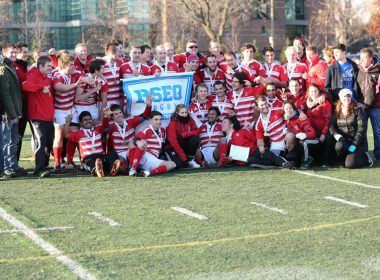
Despite what you might think about Quidditch from the fantasy world of Harry Potter, it’s real, and it’s full-contact. The McGill Tribune catches up with McGill Quidditch President Jon Cohen, and first-year chaser Robyn Fortune, fresh off their championship win at Queen’s University this past Sunday.

McGill Tribune: How did McGill fare this weekend?

Robyn Fortune: There were 12 teams there, and we played Algonquin, University of Toronto, Carleton, and U of Ottawa. Our game against Carleton went into overtime; that was the semi-final. We were up by 30, but then they caught the snitch, and then we were tied. [During overtime, the winner is] the first team to 30 points—so either score three goals, or catch the snitch. If that hasn’t happened after five minutes, [the winner is] just who has the most points. Our [game with] Carleton was really tight; they’re a really strong team and that game was neck-and-neck. We were glad to win that one; it was probably our most exciting game all year.

MT: What made you want to get involved with the Quidditch team?

RF: I heard about it during orientation week, and it sounded really cool, so I just wanted to try it. It was actually way more fun and more intense than I imagined.

MT: How far back does Quidditch go at McGill? How did it get started here?

Jon Cohen: It started in 2008, the year before I came to McGill. It was started by Reid Robinson, who’s a legend in his own right. It started out pretty small: [McGill’s] was the first Canadian team, [the] first international team outside of the United States, and was at the second World Cup. [This year, the World Cup] is in Florida. You have to vie for spots, and by winning the national championship, we now have one.

MT: So the team will be going to Florida later this year?

JC: Well it’s awkwardly right before finals in April, so the answer is ‘hopefully.’

MT: Is this strictly a university sport?

JC: There is high school Quidditch now, and there’s actually also ‘Kidditch,’ which is for kids. But the International Quidditch Association is doing a really good job of promoting the sport, and setting up this organizational structure to allow for new teams to grow and succeed, which is great for the sport’s future.

MT: How did Quiditch get started as a university sport?

JC: I think it started as a whim almost. Some kids at [Middlebury College invited Vassar] to come play … but USA Today also came with them, and that was that. Now [schools] like McGill have B teams, and it’s come beyond the imagination of the first people involved, certainly.

MT: So what exactly are the rules of Quidditch, the way you play it at McGill?

JC: It’s actually exactly like the books and the movies, except it’s running around and tackling instead of flying. Sort of takes a lot of know-how, and [there are] a lot of finer points about legal tackling. So, there’s a quaffle that you try to score with, and then bludgers [which are dodgeballs], which is kind of a separate game … and then there’s a snitch, which is [someone] in yellow running around, and you’re trying to snatch a sock from the guy. There’s a tennis ball in it, it’s worth thirty points, and it ends the game.

MT: With this version of the game, are there limits to where the snitch can go?

JC: They’ll start off the field, for about ten minutes, and when they’re back on the field, it’s just chaos. There’s basically three games going on at the same time, and to the untrained eye it’s very difficult to watch, to say the least.

MT: In other sports, there are certain body types and skills that make a person suited to them. Can you speak to that in terms of Quidditch?

JC: Athleticism is number one. Number two is the ability to play a really complicated sport with one hand, because you’re holding a broom between your legs the entire time. [That] obviously gives the whole game its flair. But, really: speed, tackling ability. We know a lot of people who played frisbee, who played soccer especially. Rugby is a big one, basketball, but I would definitely compare it, at least in terms of sports knowledge, [more closely] to soccer or hockey.

MT: So this is a full contact game, but you’re all on brooms?

JC: They want to keep the game safe and accessible. There’s no tackling from behind, there’s no tackling certain areas, like above the neck or shoulders. [The International Quidditch Association] recognizes the danger, but they account for it in their rule book.

MT: How would you like to see the team progress next year?

RF: Well, this is my first year on the team, but I think we just want to keep up the Quidditch program because we had a lot of rookies come in this year. We were able to have two full teams represented at this tournament, and I think we just want to keep that up.

a, Student Life

10 must-haves to complete your winter wardrobe

As the temperatures plummet  heading into winter, the number of outfit options begins to soar.  Colder temperatures call for a flurry of sweaters, parkas, and scarves. With so many choices, how do you go from simply ‘ready for winter’ to completely ‘wintachic?’ Never fear, the Tribune is here to help.

The chunky knit scarf:

Whether it’s a plain wrap-around or an infinity, a scarf is not only a chic accessory, but a necessity. Choose a chunky knit scarf to lend structure to your getup, or add texture to your parka. Use neutral colours to complement, and brighter colours for a pop. If you want optimum warmth, go for a blend that’s over 40 per cent wool.

Keep those ears warm:

Protect your ears from the harsh Montreal cold with a stylish winter headband or a pair of earmuffs. You can find a wide array of choices throughout the city, in stores like Little Burgundy, H&M, and Zara. We love a headband adorned with a bow to the side, or faux fur earmuffs that make a statement. Très belle!

The oversized coat:

For coats, big is beautiful this season. Own the streets with an androgynous, double breasted coat, or go feminine with a flowy, gown-esque choice. Topshop is a great haven for oversized coats, so head over to the Bay on Ste. Catherine’s to have a look at their selection. With chunky knit tights and black boots underneath, even visiting Parisians will envy your style.

A velvet love affair:

Velvet was a huge hit on the runways this season. Start your velvet experience off right with a simple pair of black or burgundy skinny pants and you’ll set your tights apart from the typical plain legging. Match with a polished top, and you’re ready for class—both kinds.

Perfect plaids:

Winter is never complete without a healthy dose of plaid. Take your red, black, and white plaid out of the log cabin and onto the street for a festive feel.  Dress it down with a boyfriend-fit button up shirt over a white tank and leggings for a comfy-chic way to relax on a lazy Sunday!

The sneaker wedge:

Athletic meets fashionable in this latest fashion innovation. The sneaker wedge offers the versatility of a sneaker with the stylish flair of a wedge. This glammed-up version looks fabulous with navy skinny-jeans and a warm biker jacket. Our favourite? Jeffrey Campbell’s black sneaker wedge—the patent accents are to die for.

Haute in houndstooth:

Always classy, houndstooth is inarguably one of the most fashion-forward patterns this winter. Channel your inner Coco Chanel or Alexander McQueen with a sweater, scarf, or purse, and incorporate a touch of houndstooth into your outfit for an extra dash of drama.

Fair Isle sweaters:

Despite perks like fresh snow, Starbucks specialty drinks, and vacation time, what we love most about the holiday season are definitely Fair Isle sweaters. The knits, the patterns, the textures… what’s not to adore? A baggy sweater ensemble with tight leggings is a sure-fire way to cozy up to winter and show off your holiday spirit.

The faux fur vest:

Take a bold risk and invest in a faux fur vest for your winter wardrobe. They look great with any dark, solid-colour top and a pair of jeans for bottoms. Accessorize with a long-chained silver necklace as a finishing touch. Club Monaco’s fur vest this season is catching our eye, as well as ones from Urban Outfitters and H&M, so head down to the shopping district if you want to investigate this trend.

Thigh high socks:

Shy away from the typical leggings-jeggings-jeans getup this season and try something a little different. Black tights with thigh high socks are a very fashion-forward spinoff to the typical bottom. Go subtle with muted shades, or go bold with louder colours to add some flavour to your outfit. Wear them underneath a dark skater dress, and you’ll be sure to turn heads!


a, Student Life, Student of the Week

Student of the Week

Q: If you could be anywhere else in the world right now, where would it be?

A: My cabin in the Alberta Foothills.

Q: What’s the one quality you admire most in others?

A: Being assertive.

Q: What’s your good luck charm?

A: Well, I did my undergrad at McGill, and [for] every single midterm or exam that I’ve ever written, I’ve worn the same either t-shirt or sweater. It’s mostly worked out.

Q: What’s the best piece of advice you’ve ever received?

A: It’s a rhyme and I can’t remember—but I remember the notion behind it….It says something about ‘you can never have everything, but you just got to enjoy what you have in the moment.’

Q: What’s one piece of advice you’d give McGill students?

A: Balance your life. Don’t just do school, don’t just not do school.

Q: If you were a course at McGill, which course would you be and why?

A: POLI 450, Peacebuilding. I’m in law school in part to look into dispute resolution and things like that. I think we need more of that.

Q: What reality TV show would you be perfect for?

A: Not because I’m actually a good chef, but Chopped is really cool. Sometimes, getting random ingredients in my kitchen is how I have to cook, because I never really plan things out, so I’m kind of forced to cook weird things…. [On the show,] they give you random ingredients, there’s four people, and then you have to make whatever you can out of them – it has to taste good – and there’s a starter, a main course, and a dessert. And at each round, someone gets chopped; but they’re actual cooks, whereas I’m scraping by and microwaving most nights.

Q: What’s your go-to stress-buster?

A: Going for a walk.

Q: Which historical figure would you most want to get a drink with?

A: Well I guess it’s sad to say, but I guess Jack Layton is [now] kind of a historical figure. People said, in the last campaign, that he was the only Canadian politician that people wanted to go have a beer with. I think regardless of politics, that was really true. So I’d have a drink with Jack.

Q: What’s your favourite Leonardo di Caprio movie?

A: I really wanted to see Titanic 3D when it was re-released, but no one wanted to see it with me. But I’m still going to say Titanic.

Q: Rank the Spice Girls from favourite to least favourite.

A: Can I phone a friend on that one? Can we just name them and I can make sure I’ve got them all?

Q: Can you name all five of them? 

A: Baby spice, Sporty spice, Posh spice, Scary spice… Red head… Ginger spice. In rank order? Whichever order they drove around the Olympic stadium in, I can’t tell you on that one.

Q: Name one book you think everyone should read.

A: A Short History of Progress by Ronald Wright. I read it a few years ago and it just always left an impression on me. It’s a quick read, so if you’re in [school] and you can’t take on a novel, take on this instead.

Q: What Guinness World Record would you have the best shot at breaking?

A: One of those ones where it’s just will power, where it’s not a skill like balancing things on your head.

Q: Like doing something for the longest amount of time?

A: Yeah. Well, no, because even holding your hand in the air—people do it for like twenty years, so I would not… I guess one of the group ones, like McGill hosted. I could cut some fruit and make a fruit salad for a while.

Q: Describe the McGill law school in three words.

A: Challenging, welcoming, and trans-systemic. I feel like that’s a bit of a cop out, but that’s what they pride themselves on. I actually debated between U of T and McGill, but I’ve just found everyone [at McGill] is really up to meet new people, and you know the faculty are very approachable. It feels like a small sort of family; the upper years are nice. I’ve enjoyed McGill a lot.

Q: Who would star in the story of your life?

A: Is it bad that I have a rehearsed answer for this one because I’ve said it before? Jake Gyllenhall, just because I want him to. Some people say actually John Krasinski, but I would say Jake Gyllenhaal.

Q: What’s the first thing you think of when I say Movember?

A: Men’s health stigmas. Because now everybody has a moustache, so it gives you a reason to talk about things you wouldn’t otherwise talk about.

Q: If you could say one thing to Taylor Swift, what would it be?

A: Please don’t ever write a song about me.

Q: Name a stand-up comedian you consider completely over-rated.

A: Dane Cook. He was funny. When you’re 13 it’s funny, but I just don’t see who he actually appeals to. It’s humour that’s supposed to be for like 20-year-olds but it’s just… I don’t know.

Q: What’s your biggest pet peeve?

A: Slow walkers. If I’m in a fast-walking mood.

Q: Why are you an asset to McGill?

A: Being nominated for [my role in organizing a team for] Movember I guess is one thing, but I think it’s just important, whatever it is, to get people together on things. In this case, being new at law, it was just fun to get my friends to join the team but then also people I hadn’t met before. And now we’re a whole team, 30 people in the faculty, and so, you know, to have something outside of class to get together for, and it’s a good cause.

Q: How has captaining the Mo’tion to Dismiss Movember team been so far?

A: We got an anonymous thousand dollar donation… and we’ve raised almost three thousand dollars so far. We’re trying to be the top-raising university team in Canada, or at least at McGill.

Q: Do you know if there are a lot of teams at McGill?

A: I’ve seen a number. The med team is right behind us. I don’t know exactly, across Canada they’ve raised four hundred thousand dollars already, and there’s probably hundreds of teams. At McGill there might be 15 or something.

Sylvie-Ann Paré
a, News

Summit on innovative districts takes close look at Griffintown

On Oct. 30, the second Montreal Summit on Innovation, provided an opportunity for McGill and the École de Technologie Supérieure (ÉTS) to present the Quartier de l’Innovation (QI) project to experts on innovative districts.

The QI is a joint venture between McGill and ÉTS, an engineering school in Montreal that plans to spearhead development in Montreal’s Griffintown district. According to Vice-Principal (External Relations) Olivier Marcil, the project aims to merge “social and technological innovation with entrepreneurship” in an environment that promotes interaction and innovation between McGill and ÉTS researchers, private businesses, and artists.

The QI

Vice-Principal (Research and International Relations) Rose Goldstein first announced the QI initiative to the McGill community during the February session of Senate, the highest academic body at the university. According to Marcil, McGill and ÉTS hope to launch the project in early 2013.

“A massive restructuring is already under way, with $2.5 billion already invested and commitment of up to $6 billion over the next 10 years,” Marcil said. “Our aim for the QI is to build on this momentum, together with the stakeholders, to create a district that celebrates social innovation, as well as diversity in the arts, culture, and ideas.”

Marcil noted that the QI is a long-term project. It will be fully operational in about 10 years.

To date, the project has received support from all three levels of government, which together contributed up to $1 million to research the feasibility of the project. McGill and ÉTS also received an additional federal grant of $25 million that will go towards research on second generation biofuels—fuels that do not compete with agricultural commodities such as corn.

“Our goal is to develop the knowledge, tools, and programs so that in the next 10 to 20 years, 25 per cent of fuels in the country are composed of biofuels,” he said.

Role of the City of Montreal

The City of Montreal is playing a major role in the development of infrastructure in Griffintown. On Oct. 18, the City of Montreal launched a special urban planning program (PPU) for the district, including a pledge to spend $93 million in infrastructure over the next four years. The urban plan also includes the creation of six new public green spaces and a “Cultural Corridor” on Ottawa Street.

Though the announcement comes months after the QI idea was proposed, François Goneau, director of communications for the City of Montreal, told the Tribune that the City’s plan to invest in the area was not directly related to the QI project.

“Planned investments in the sector are above all related to obligations of the City to establish in Griffintown the conditions that will make the environment one of high quality,” Goneau said in French. “It must be remembered that the urban plan adopted in 2004 identified the area of Griffintown as a detailed planning area—the mixed use of urban spaces and the importance of residential use as an engine of revitalization were clearly announced.”

Consultation and criticisms

As Griffintown is a low-income neighbourhood, one of the major concerns surrounding the project is that the real estate development will lead to gentrification in the district of the South-West borough.

Marcil explained that McGill and ÉTS created a liaison group that aims to mitigate the effects of real estate development in the area. The 20-person group is composed of citizen representatives, real estate developers, and members of McGill, ÉTS, the City of Montreal, and the borough.

“In addition to consultation with community members, the QI plan currently aims to have at least 15 to 20 per cent of low-income apartments to avoid gentrification,” Yves Beauchamp, CEO of ÉTS, said.

“Already in that area, there is a population of artists, and we don’t want them to leave the area,” he continued. “We want to create a place where a creative community will [be] established and, with the presence of university [and] enterprise, we will come up and [interact with] the creative community in a way that will be [conducive] to the development of innovation.”

Andy Pratt, a professor at King’s College London who attended the summit, criticized the summit’s emphasis on investment in infrastructure, and advised that the organizers focus on the creative aspect of the innovative district.

“It’s not the real estate that makes this work… the real estate is a part, but not the most important part,” Pratt said. “It’s very important to go beyond simply the physical design of these places and to think much more carefully about how to construct an ecology of creative and innovative firms.”

President Josh Redel, councillors, and Vice-President External Robin Reid-Fraser discuss M-SERT and Radio CKUT’s referendum questions. (Michael Paolucci / McGill Tribune)
a, News

SSMU Council endorses one of two fall referendum questions

Last Thursday, SSMU Legislative Council passed a motion to endorse a referendum question that would increase the fee levy for the McGill Student Emergency Response Team (M-SERT), but did not endorse a question on Radio CKUT’s fee increase.

Councillors also discussed the four nonbinding motions passed by the Oct. 15 SSMU General Assembly (GA) after losing quorum.

The vote to endorse CKUT’s question—which asks for a $1 increase in its opt-outable fee—fell short of the required majority, with 11 councillors for, 11 against, and four abstentions.

CKUT is a non-profit campus-community radio station based on the McGill campus. According to SSMU Vice-President Clubs and Services Allison Cooper, an endorsement of CKUT’s referendum question could help raise student awareness of the radio station’s status as a student group.

Michael Paolucci / McGill Tribune

“I think it’s an important way for Council to help students navigate these confusing bureaucratic channels by lending legitimacy to questions that many students may not understand SSMU’s relevance to,” Cooper later told the Tribune.

Other councillors expressed concern over endorsing CKUT, even though a ‘No’ committee has yet to be formed for the question.

“Clearly some students feel one way and some feel the other way,” SSMU Vice-President Internal Michael Szpejda said. “So if we are picking one way, I don’t see how we are representing all of our constituents.”

Council decided to pass M-SERT’s motion after many councillors expressed their support. M-SERT is a student-run first aid service that provides emergency response in residences and on campus. M-SERT’s referendum question asks for a $0.50 increase in its fee.

“M-SERT is super important on this campus,” SSMU Clubs and Services Representative Zachary Rosentzveig said. “[The service] literally saves lives … they do amazing work with very little money.”

President Josh Redel pointed to the fact that M-SERT, unlike CKUT, is a SSMU service rather than an independent student group, and reminded Council that SSMU has a policy stating that clubs and services are the society’s highest priority.

Council also passed two out of four nonbinding GA motions, which were tabled at the last Council meeting due to a lack of clarity in SSMU’s by-laws. The by-laws in question dealt with the online ratification process for GA motions, which SSMU introduced this semester.

While the two motions passed when the GA had quorum went automatically to an online vote, the by-laws were not clear as to whether Council should treat the four nonbinding motions as GA motions—which are subject to online ratification—or  as Council motions.

Michael Paolucci / McGill Tribune

Redel explained that the Steering Committee decided that the GA motions should be treated as Council motions, with the results deemed binding following a Council vote. Ratification of motions voted on by Council violate SSMU’s governing documents because Council would then assume the role of the GA.

Discussing the GA motions as Council motions allowed the vote to be binding, while including time for debate and amendments if necessary.

“[The] Steering Committee does recommend that Council operate under the direction that the consultative forum took on each motion … but we do welcome and encourage debate on the motions to help make them stronger, more powerful motions from Council,” Redel said.

Council passed the motion regarding SSMU’s support for accessible education and its opposition to the further development of the Canadian oil sands.

Council then tabled a motion regarding its opposition to Canadian military involvement in Iran, and a motion regarding opposition to Plan Nord. Some councillors suggested that a lack of knowledge made them more hesitant to take a stance on issues external to SSMU.

“I find it kind of bizarre that we are not provided with external information that is supposed to support these motions,” Arts Representative Nicole Georges said. “The point of our responsibility is to vote on motions that affect the student body as a whole, and yet we are being asked to do this with a tiny bit of knowledge. This seems to be very irresponsible and reckless.”

However, Arts Representative Claire Stewart-Kanigan disagreed with Georges’ concerns.

“There is no reason why you cannot go out and do this research yourself,” Stewart-Kanigan said. “We get these motions ahead of time … That’s your responsibility as a councillor.”

Council also passed a motion about creating a trial run for the Student Advocacy Resource Committee until March 2013. This committee, based on a group formerly known as the Independent Student Advocacy Service, is designed to help SSMU members access information and support to help effect change on campus through advocacy campaigns, research, and co-ordination with elected representatives.

Additionally, Council passed a motion regarding work on the upcoming McGill education summit. The motion mandates that SSMU will produce a document by the end of the semester after broad consultation with students and faculty student associations on the subject of education.

a, Features

Survival of the Fittest?

For decades, a flurry of academic, institutional, and governmental activity has openly embraced the concept of women standing shoulder-to-shoulder in their effort to open new doors in a male-dominated world.

From the memorable Persons Case in 1939, to the recognition of illustrious Olympic gold medalists, award-winning scientists, bestselling authors, and national leaders, women have praised the hard work of ambitious female pioneers who paved the way for greater gender equality in Canada.

In that light, and with the number of women in the labour force at record numbers, it would be expected to also see mutual appraisal and recognition abound among successful women in all fields and professions.

However, recent studies reveal that the reality quite another. Contrary to common perception, when it comes to career-advanceent, women are sometimes their own worst enemies.

Discrimination and harassment towards women in the workplace has been widely documented as a growing concern. A recent Leger Marketing poll, commissioned by the Queen’s School of Business, reveals that workplace harassment, especially towards women, is very much a part of the modern day office environment. The survey, completed last March using a sample of 1505 participants, revealed that 57 per cent of Canadians have experienced or witnessed harassment in the workplace. Of that percentage, an astounding 87 per cent of victims are women.

However, an additional fact that often escapes the estimates is that, although men in a position of power continue to personify the typical face of workplace harassment, women are twice as likely to report that this abuse came from another woman rather than a man. In addition, not only female bullies tend to disproportionately choose other female colleagues as targets, but they also tend to prey on above-average female workers.

In an interview for The Financial Post, Jana Raver, organizational behaviour expert and associate professor at the Queen’s School of Business, pointed to a clear contradiction in regards to this alarming statistic. “This is somewhat surprising,” Raver said. “In some ways it goes along with what you hear colloquially, but on the other hand people are saying, ‘shouldn’t women be supporting each other?’”

While current research has not delved into the reasons why women tend to single out other women for harassment, part of the cause of this puzzling behaviour relates to their reduced opportunities in the labour market.

It would only be fair to expect that, after decades of social transformation, women would have joined by now their male counterparts in the upper echelons of Canadian corporations. Yet, according to research conducted by Catalyst, a non-profit organization that studies women in the workplace, while women constitute 47.7 per cent of the Canadian workforce, they hold only 17.7 per cent of senior office positions, and fewer than six per cent of these companies’ CEO positions. In addition, more than 30 per cent of companies in the study have no women senior officers.

Constantly worried about losing their place in an increasingly competitive “work race”— or maybe even about getting into the race at all—female professionals have sometimes grown fearful, suspicious, or envious of equally competent same-sex colleagues, especially as they climb to senior positions.As youthful colleagues begin their onerous ascent up the corporate ladder, senior professionals, guarding their hard-earned jobs, use their honed in skills and years of experience to pull down the ladder right behind them.

According to Dr. Gary Namie, co-founder of the Workplace Bullying Institute, this behaviour is intensified in industries and professions that remain largely dominated by men, as “women feel the need to be hyper-aggressive to get ahead in a male-dominated environment.” Buying into the widespread perception of men as traditionally powerful and assertive in the workplace, which make them difficult targets, women are perceived as vulnerable and easier to bully.  According to Phyllis Chesler, author of the book Woman’s Inhumanity to Woman, like men, they are also exposed to the misogynistic and sexist messages that permeate society, and unconsciously buy into gender-based stereotypes. This can elicit abuse and mistreatment of other women.

Why hasn’t this behaviour been properly documented? Workplace harassment in Canada takes a more covert and tacit form when inflicted by a woman than by a man. Often, incidents of harassment between women go unreported as they encompass more latent forms of aggression, including upsetting and unwelcome comments, secrecy and gossip, badmouthing colleagues,  creating favouritisms, or simply choosing not to help a co-worker advance within a company. According to Dr. Namie, female bullies sabotage the careers of other women by being unsupportive. While some tactically avoid helping other women in their careers, others can resort to passive-aggressive behaviour to protect their own interests.

This is not to say that there is no way out of such an inhealthy trend. The answer lies with the upcoming generations. For over 100 years, McGill University has educated outstanding women professionals. Joining the ranks of the most illustrious Canadians, these McGillians have inspired succeeding generations to live up to their example in just about every field imaginable. In every department, McGill’s female students have joined their male counterparts in the pursuit of higher education, oftentimes outnumbering them. As these women venture out into the labour force, taking their first steps in pursuit of their professional ambitions, they must not forget that it was through mutual support that women came to break insurmountable barriers to their advancement in the past. It is through mutual support as well that they will be able to overcome obstacles in the future.


Marc-Olivier Vachon led McGill with three points in the victory. (Luke Orlando / McGill Tribune)
a, Sports

Fast start key in battle; Redmen defeat Waterloo

In the wake of a thrilling victory over the York Lions on Friday, the Redmen were back in action on Saturday evening to take on the Waterloo Warriors at McConnell Arena. From the drop of the puck it was clear that the men in red carried the momentum they had established a day earlier, as they defeated the Warriors 5-2.

McGill (5-3) came out flying, and remarkably capitalized twice in the first three minutes of the game. Patrick Delisle-Houde scored the fastest goal in Redmen history—only 16 seconds in—while Mathieu Pompei followed up with his first of the year, just two minutes later. The initial tally materialized when the puck was dumped into the attacking zone off the opening face-off. Delisle-Houde pounced on a juicy rebound and stuffed it into the open cage. The goal invigorated the team as well as the large crowd. The Redmen outshot Waterloo (5-3) 13-6 in the first period, en-route to a strong 3-0 lead.

In the second frame, McGill found itself in a bit of penalty trouble, but Redmen goaltender Hubert Morin was able to weather the storm for his teammates. He carried them through to the end of the period with a total of 11 saves, allowing just one goal. In particular, he answered the call on several occasions when the Warriors had the Redmen defencemen on their heels, deep in the zone. After the game, he talked about his performance and applauded his teammates’ effort on the penalty kill.

“The goalie has to step up when there is a [penalty kill],” Morin said. “[My teammates were] blocking shots, cutting the line, and doing a great job in front of me.”

Luke Orlando / McGill Tribune

Waterloo made things interesting in the third period as defenceman Steve Whitely cut McGill’s lead to 3-2. However, the Redmen persevered during the gut-wrenching moments of play as the Warriors pressed for the tying goal. The Redmen exemplified this determination by scoring two insurance goals in the final two minutes of the game. Marc-Olivier Vachon assisted both of these goals to cap off a three-point night, holding onto his status as McGill’s leading scorer. Vachon was named the first star of the game, but complemented his teammates’ abilities to finish plays.

“I have to give credit to my teammates, because they’re the guys that put it in the goal,” Vachon said.

Redmen Head Coach Kelly Nobes was pleased with his team’s effort and mentioned that McGill’s quick start helped pave the way to the victory.

“We wanted to get on [the Warriors] early,” he said. “They played Trois-Rivières into overtime last night and had a three hour bus ride afterwards, so we wanted to get off to a quick start.”

Nobes also noted that the team’s fatigue helped Waterloo generate some chances midway through the game. Fortunately, Morin was on his game.

“We stopped moving our feet a bit in second period but got back in it in the third,” he said. “Hubert [Morin] had another solid night tonight, in particular in the second period.”

The Redmen now have an opportunity to rest and recuperate for a few days before they hit the road to take on the Western Mustangs in a national championship rematch on Nov. 9 in London, Ontario.

a, Sports

Point Counterpoint

The NBA has recently seen an emergence of ‘superteams’ that feature small groups of incredibly talented players. As larger markets, such as Los Angeles and Miami, continue to attract these stars, the league loses parity. This begs the question of whether or not this strategy is necessary to win an NBA title. Two Tribune contributors weigh in…

FOR Superteams

It’s simple. The numbers don’t lie. In this day and age, if you want to win an NBA championship, you need a star-studded lineup.

Many fans want to hang on to the notion that a championship can still be won with hard work, determination, and a solid foundation backed by a great coach. This idea worked as recently as the early 2000s, as evidenced by the Detroit Pistons. But in today’s NBA, talent surpasses everything else.

When the Miami Heat first assembled their trio of superstars, critics quickly jumped to the conclusion that the collection of egos and lack of team chemistry would prevent them from advancing deep into the playoffs. Despite all the criticism, the Heat managed to put together an impressive season and  reached game seven of the NBA finals. The more impressive feat was that they accomplished all of this in their first season as a team and with an inexperienced head coach.

The point is, even though the Heat lacked the coaching and team chemistry everyone said they needed to succeed, they still managed to be an NBA finalist by relying solely on talent. Then, last season (the second year of the big three), the Heat developed the little chemistry they needed and hoisted the Larry O’Brien trophy.

Many fans wonder how the league got to this point. How can just a few individuals dictate the outcome of a team sport? The truth is that there are a few ‘elite’ players in the league, and any of them can dominate a game and carry their respective teams. Unfortunately, for the majority of the league’s teams, it’s these players who have sent the NBA along this ‘superteams’ course.

Take a look at what happened with Dwight Howard and the Orlando Magic last season. In less than a year, Howard managed not only to get his coach fired, but also his general manager, all while toying with Magic fans about whether he would stay or leave in the off-season—Quite frankly, he never planned on staying.

Once the offseason arrived, Howard had complete control over his future destination (the Los Angeles Lakers), should he become a free agent the year after. This put teams at risk for trading for him for one season, before seeing him leave in free agency. This is why teams need to build such stacked lineups. With stars controlling the dynamics of free agency and trading, it has become more important than ever to create enough cap space and to assemble other top talents to attract these athletes.  Players like Howard and James want to play with their friends and play for contenders. Their desires can be turned into realities because they control the deck.

It wouldn’t be surprising to see the top 15 players in the league play for four teams by the end of the decade. If you’re a basketball fan, you had better hope that your team gets in on that action. Otherwise, the chances of your team winning a championship diminish to nil.

— Michael Ghofrani

AGAINST Superteams

‘Superteams’ have become part of the NBA culture. Over the past couple of seasons, a number of teams have acquired some of the league’s best talent to play together. We all remember LeBron James’ infamous decision to join Dwyane Wade and Chris Bosh in Miami. More recently, we watched the Los Angeles Lakers acquire both Dwight Howard and Steve Nash to complement Kobe Bryant.

Yet, history has indicated that amassing talent is not a guaranteed path to the Larry O’Brien trophy. Regardless of the big names, it has been demonstrated countless times that, to succeed, a team must have the perfect alignment of team chemistry, a strong head coach, and players who fill certain roles.

The 1996-1997 Houston Rockets led by Hakeem Olajuwon, Clyde Drexler, and Charles Barkley were a favourite to win the championship. The 2003-2004 Los Angeles Lakers were basically a shoe-in for the title, led by Shaquille O’Neal and Kobe Bryant, along with stars Karl Malone and Gary Payton. The 2010-2011 Miami Heat had the highest expectations placed upon them after signing both James and Bosh to join Wade. However, despite the teams’ superstar-heavy lineups, they all failed to hoist the trophy at the end of the season.

Furthermore, concentrating the NBA’s elite talent amongst a few teams is not in the league’s best interest. The NFL famously sports the “any given Sunday” approach, in which small market teams are in the mix for the title just as much as larger market teams. In the NFL, there is more parity, which is something that the NBA needs. Nobody enjoys watching the Miami Heat absolutely beat down the Charlotte Bobcats. Teams like Charlotte, Milwaukee, and Sacramento cannot compete with the likes of L.A., Miami, and Boston. The league becomes predictable and these smaller markets lose out on meaningful basketball.

Spreading the best talent between many teams, and having team-grown stars such as Bryant, Tim Duncan (of the San Antonio Spurs), Paul Pierce (from Boston), Kevin Durant (of the Oklahoma City Thunder), and Derrick Rose (with the Chicago Bulls), makes for a more interesting and competitive league, thus creating fiercer rivalries, and more loyal fan bases. The satisfaction of watching Michael Jordan lead the city of Chicago to a championship after seven tough years, of Hakeem Olajuwon finally breaking through for Houston, or Dirk Nowitzki carrying his team to the top after toiling for 12 years in Dallas, are the truly inspirational stories and are etched into basketball legend. Taking a shortcut and being disloyal to fans by forming a ‘superteam’ appears pathetic and dishonours the game of basketball.

Ultimately, while the big names may fill seats and garner television viewers, winning a championship still boils down to the basics of basketball: great team chemistry and the right conditions. History has shown that meshing talent together to form a ‘superteam’ does not necessarily guarantee a championship. It’s more important to play basketball the right way.

— Remi Lu

Winner: FOR Superteams

It’s becoming clear that teams without a small collection of superstars cannot compete for an NBA championship. After winning a title last season, the Miami Heat are a model from which large market teams wil strive towards in the future. Unfortunately for smaller markets that can’t attract as many big name stars, years of mediocrity await, while only a select few teams compete for championships year after year.

Read the latest issue

Read the latest issue