Latest News

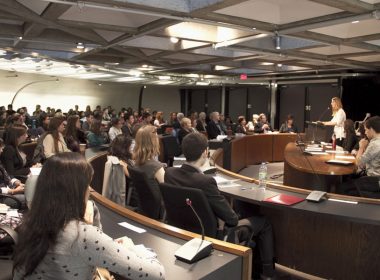
CLASSE Spokesperson Bédard-Wien spoke with students about tuition. (Alexandra Allaire / McGill Tribune)
a, News, SSMU

SSMU hosts session on future of Quebec student movement

On Sept. 18, students gathered in the Student Society of McGill University’s (SSMU) Clubs Lounge for an informal discussion about the recent student strikes in Quebec. The discussion was led by Jérémie Bédard-Wien, finance secretary of the Coalition large de l’Association pour une solidarité syndicale étudiante (CLASSE). CLASSE is one of Québec’s largest student union coalitions, and has played an active role in the student movement against the tuition increases planned by Jean Charest’s liberal government last year.

The 2011-2012 academic year was marked by months of large-scale student protests and strikes in response to the proposed tuition increase of $1,625 over a period of five years. Tuition for out-of-province and international students was also raised, as these tuition rates are based on the Quebec fee.

However, a minority Parti Québécois (PQ) government ousted Charest’s liberals in the Sept. 4 provincial election. On Sept. 20, the new government officially cancelled the tuition increase, and PQ leader Pauline Marois announced her intention to hold a summit on education in the upcoming months.

Last Tuesday’s discussion focused on how the student movement can continue to fight for free education and promote the interests of students, now that the general strikes have ended.

“I think that it’s very important for people to come and be part of this kind of conversation, because there are people who were affected in very different ways by the things that [happened] last semester,” SSMU Vice-President External Robin Reid-Fraser said.

Bédard-Wien stressed the importance of maintaining the atmosphere of student activism that grew during the months of demonstrations against the tuition increases. He also praised the “democratic union culture” that has appeared on anglophone campuses—an atmosphere in which students are able to participate through smaller student unions, like departmental associations.

Many of the attendees at Tuesday’s round-table were skeptical about the promises made by the newly elected government.

“The PQ has a long history of making promises they don’t keep, and [they] are certainly no friend of any progressive social struggle,” Bédard-Wien said. “We must still be prepared to face [a] hike.”

Discussion also focused on the proposed summit regarding Quebec education. It is currently unknown how students will be represented at the summit, and to what extent the interests and values of students will be taken into account.

“We want the summit to be something that involves [the] university community, rather than outside interests; [that] has proper representation for students; [and] that allows us to address governance and privatization,” Bédard-Wien said. “Of course, these demands are not likely to be met.”

Students expressed concern about the merits of the summit, and suggested possible plans of action, such as a refusal to take part or the possible creation of an alternate, student-organized summit.

“I think that those discussions about what we want the summit to look like shouldn’t start from the assumption that we are actually going to be at the summit,” Kevin Paul, first-year law student, said. “The forum will lose legitimacy if a large part of students don’t participate, and we can use that to demand certain things.”

Other topics of discussion included the importance of strengthening communications between student groups, workers’ unions, and other movements, as well as ways in which student groups can ensure the inclusion of out-of-province and international students.

According to Reid-Fraser, SSMU will likely hold similar events in the future to encourage continued awareness of current events amongst the McGill student body.

Bédard-Wien emphasized how the events of the past year show the power that students have to connect with and aid other political movements.

“This is the first time in many years that a mass movement organized on a union basis has managedto reach across to other movements, and to really engage with other sectors of society,” he said. “We must see strikes as a platform for other kinds of political action and debate to take place.”

a, News

Student-run Wildcard Montreal expands beyond McGill

Wildcard Montreal Beta, a nightlife membership platform that is free to acquire and activate, made its return to the McGill and Montreal scene this fall. A revamped student-run business, Wildcard is managed by co-founders Tom Zheng, U2 arts, and Randeep Singh, U2 engineering.

Established two years ago by former McGill student Adam Hirsch, Wildcard began as a member card that allowed subscribers into nightclubs at a reduced rate, or for free. Hirsch passed the company off to Zheng and Singh during the summer of 2010.

Prior to taking over Wildcard, Singh and Zheng had independently  worked on a smartphone application that would inform students of local nightlife events and discounts. According to both directors, the combination of that vision with the original Wildcard was an ideal project.

“[The fusion means] no complications and easy access,” Singh said. “It [also] simplifies night-life [by letting you] know where your friends are going.”

Singh and Zheng got the new Wildcard off the ground with the help of Singh’s father, Parminder Singh—former managing director of Microsoft Canada. Along with providing baseline financial support, Mr. Singh became Wildcard Beta’s Business Advisor; he offers mostly technical strategies, while Singh and Zheng manage large company decisions.

During his experience working with Singh and Zheng, Mr. Singh stressed the importance of discipline and control when building a company.

“As newcomers to [the business world], they’re not exactly sure how it all works and how all the pieces fit … It’s about forcing [them] into discipline,” Mr. Singh said. “You [can’t get] emotional in business… too many entrepreneurs become emotionally attached and fail to make good logical judgments.”

In addition to achieving and maintaining disciplined practices, the entrepreneurial industry offers many other challenges to business hopefuls. Mr. Singh predicts that one of the greatest challenges facing Wildcard will be the young age of its co-founders.

“Having to become entrepreneurs is a challenge unto itself,” Mr. Singh said. “They’re going to make mistakes, and [the real test will be] just how fast they recover from those mistakes.”

Zheng echoed Mr. Singh’s sentiments.

“[It’s hard] to get people to take you seriously,” Zheng said. “When you meet someone who’s twice your age … they see someone who’s passionate, but they wonder if you don’t know what you’re doing.”

In order to fulfill their vision of Wildcard, Singh and Zheng sought sponsorship from many popular nightclubs and venues in Montreal, as well as local businesses that attract student clientele. To date, Wildcard has secured sponsorship from Club Entourage, La Mouche, Stereo, and Yeh! Yogurt, among many others.

Yeh! Yogurt CEO Jean-Daniel Nadeau spoke positively of Yeh!’s partnership with Wildcard, and even encouraged other local businesses to team up with Wildcard for mutual benefit.

“[For] any company with an audience of teenagers to 35-year-olds, [Wildcard] is a great marketing tool,” Nadeau said. “[Partnering with Wildcard] is better than advertising in any magazine since it [goes] straight to the students.”

Nadeau was also surprised when he learned both Singh and Zheng were students.

“I never [saw] them as students … I saw them as entrepreneurs,” Nadeau said. “They’re really motivated and passionate about their product.”

Wildcard has already attracted much student attention in Montreal over the past month. The company sponsored the faculty of arts frosh at McGill, with every first-year student receiving a Wildcard in their frosh bag. They were also involved with froshes at Concordia, Université de Montréal, HEC Montréal, and École Polytechnique de Montréal.

U0 arts student Kareem Ibrahim, although new to Montreal, is already thrilled with the product.

“I love the Wildcard program, no doubt,” Ibrahim said. “It’s cost-efficient, and a great way to both encourage people to go out and have a good time while saving money.”

Though Wildcard is already fully functional, it will officially launch in mid-October. The Wildcard smartphone application will be released in two weeks.

a, News

Montreal-based website reveals new form of plagiarism

Academic personnel and services are reacting to the recent surfacing of www.unemployedprofessors.com, a Montreal-based website through which students can pay unemployed professors to write their essays. Students use the website to post their essay on a bidding forum, and the lowest bidding ghostwriter wins the project.

Established in the fall of 2011, unemployedprofessors.com currently involves approximately 30 professors. The website helps potential plagiarizers avoid the challenges posed by anti-plagiarism websites, such as turnitin.com, by offering high quality, original papers—although A’s are not guaranteed.

“This business is a result of the overproduction of PhDs, as cheap labour, by the contemporary university system,” a public relations representative for the website, who asked to remain anonymous, said in an email to the Tribune. “Unemployed Professors fills a void in the market for custom private sector research solutions.”

“Given the overproduction of doctorates, specifically in the Humanities and Social Sciences, there is a glut in the number of reasonable research and teaching jobs available to well qualified individuals holding PhDs,” the representative continued. “As such, in response to a university system that shunned them, [unemployed professors] have begun doing this.”

Websites such as unemployedprofessors.com underscore the growing problem of academic integrity in colleges and universities today.

According to Associate Dean of Arts (Student Affairs) André Costopoulos, McGill confirmed approximately 136 cases of cheating last year. This pales in comparison to cases in other universities. For example, Concordia University had 400 reported cases of cheating last year, while at Harvard University, 125 students are currently under investigation for collaborating on a take-home exam written this past spring, as reported in the Montreal Gazette.

“Students are here to learn,” Costopoulos said. “I don’t mean to sound preachy, but professors design courses with the students in mind, and ultimately, [the students] are only hurting themselves.”

McGill has several policies and services in place to help students avoid plagiarism and to learn to cite material properly, such as the McGill Writing Centre. Located on the first floor of Redpath Library, staff at the centre work to review students’ papers to ensure ideas are cited correctly and structured appropriately.

Furthermore, professors are required to remind students of McGill’s policies and procedures by including them on every class syllabus.  The McGill Library website also offers access to online citation managing software, such as EndNote and RefWorks—programs that allow students to store citations while conducting research.

Professors can also invite McGill librarians to come to classes and conduct workshops for students on how to cite, paraphrase, and conduct research properly.

“There are two types of plagiarism—accidental and purposeful,” Megan Fitzgibbons, liaison librarian at the Humanities and Social Sciences Library, said. “The intent is different with accidental plagiarism and that is where a librarian can help.”

Despite widespread criticism from the Montreal academic community, the spokesperson for unemployedprofessors.com insisted that their business is perfectly ethical.

“We do not engage in plagiarism,” the public relations representative said. “We provide custom research to any individual willing to and capable of paying for it … the ethical burden lies squarely on the shoulders of the student.”

The website also offers essay-writing tips for students experiencing difficulties writing their own papers.

A U3 McGill arts student, who wished to remain anonymous, feels the issue was trivial, because users of unemployedprofessors.com ultimately lost out on their educational experience.

“It seems to me that the students who write their own papers have the advantage because they can [use] that skill [in the future], whereas an essay purchaser may not.”


Stephen Clarkson delivered a lecture about the issues North America is currently facing. (Karla Stasiak / McGill Tribune)
a, News

Lecture explores relations between Canada, U.S., and Mexico

Last Thursday, the McGill Institute for the Study of Canada hosted renowned political economist Stephen Clarkson in a guest lecture titled “Why has North America Failed?” Clarkson, who has spoken at McGill in the past, answered the question by analyzing the United States and its economic relationship with Canada and Mexico, as well as the North American economy and its position on the global stage.

The event, which took place in the ballroom of the Faculty Club, was attended by both McGill faculty and students. William Straw, director of the Institute, provided context for the lecture.

“In [Clarkson’s] view, Canada and Mexico sustain and support American power, and the United States really depends on [those] two countries for their power and place in the world,” he said.

Clarkson’s main thesis was that North America has failed to meet certain standards.

“I don’t think it’s highly contested, but let me lay out what I think is normal criteria of success of a region in three dimensions: economic, political, [and] security issues,” Clarkson said.

He described the areas in which North America has moved toward meeting those standards, but mainly focused on its shortfalls, such as security. For example, the United States makes it extremely difficult for people from Mexico to migrate north, despite Mexico’s membership in the North American Free Trade Agreement (NAFTA).

In recent years, economic and political changes in the United States, Canada, and Mexico have affected their relationships with one another. Mexico is seeking to form better relationships with countries to its south, and Canada is looking across the Atlantic Ocean. Both countries are attempting to form alternate free-trade agreements to cope with the slowly declining U.S., on whom they have been so dependent in the past.

This brings up the question of what North America is—and what it ought to be—economically and politically.

“For many years now, we’ve lived in the context of NAFTA, but does that mean anything to us anymore?” Straw said. “There are great dreams of North American integration, but … people might say that a lot of those dreams have been blocked, disappointed and so on, so I’m very interested in anyone who addresses the question of ‘what does North America mean?’ ”

Following the lecture, wine was served in another room, where the audience socialized amongst themselves and posed questions to Clarkson.

Audience members were impressed by Clarkson’s extensive knowledge on the subject of North American politics and economics, and were grateful for the opportunity to hear him speak.

“I expected a renowned member of the academic community to give a thrilling talk about economics, [and] it was quite impressive,” Ben Palevski, U2 engineering, said. “Including the fact that it was accessible to pretty much anyone who wanted to go, the speaker seemed very well-versed in his material. It didn’t even look like he had prepared—[it appeared as if] he just got up and started talking about his research.”

a, Opinion

Aboriginal Studies Program at McGill long overdue

Last Friday’s fantastic Pow Wow brought an explosion of native culture to McGill’s campus. The events of Aboriginal Awareness Week bring the discussion of First Nations issues to the forefront, and though the week has only just begun, it has already rekindled calls from students and faculty for McGill to institute an undergraduate program in Aboriginal Studies.

Aboriginal issues continue to be a major concern for Canada. Few internal Canadian affairs receive as much international scrutiny as the record of our country’s dealings with First Nations peoples. Last February, a United Nations committee condemned the existing health and education gap between First Nations communities and the rest of Canada. The panel pointedly asked why more progress had not been made.

Data from Aboriginal communities over the past decade hardly show improvement. Aboriginal students are four to six times more likely to drop out of high school than non-Aboriginal Canadians. Compared to the general population, five to six times as many Aboriginal people live in overcrowded conditions on reserves and in northern communities. Recurring reports of the lack of access to the most essential of needs—such as clean drinking water and basic medical care on reserves and in the North—put Canada to shame.

Such neglect reflects how removed these issues remain from the Canadian political sphere. Canadians need to be more aware of the state of some of their country’s most marginalized citizens. If McGill hopes to develop the future leaders of Canada, the challenges faced by Aboriginal communities cannot go unaddressed in its curricula.

The Tribune urges the faculty of arts to develop a major—or at the very least, an interdisciplinary minor—in Aboriginal Studies. Such a program is feasible in part because it would not necessarily require the development of new courses. Rather, it would involve piecing together relevant, existing classes from disciplines like Canadian studies, anthropology, history, social studies of medicine, and political science. Such a program would give interested students tools to make informed decisions about the future of Canada—and the role this continent’s first people must play in shaping that future.

An Aboriginal Studies program has both a symbolic and practical role. On one hand, investment in such a program would re-affirm McGill’s commitment to Aboriginal affairs and heritage, and would broaden the scope of its involvement in improving the livelihood of First Nations people. On a more pragmatic level, such a program would provide interested students with a comprehensive survey of Aboriginal history, culture, and politics, as well as a holistic understanding of how Canada can best serve that growing population. Only from there can true activism, outreach, and political change begin to take place.

With clear student interest—and a pressing need to educate a new generation about the mistakes of an earlier one—there is no longer an excuse for McGill to let yet another year, and another Aboriginal Awareness Week, pass without a structured academic program in Aboriginal Studies.

a, Opinion

Cheering for Israel in the World Baseball Classic? It’s not just my imagination

Benedict Anderson, political scientist and scholar of nationalism, defines a nation as an “imagined community”; a group of people too large to have all met but with bonds—including any or all of blood, language, a common history, specific territory, and so on—that allows them to believe that they are travelling through history together. Coincidentally, in a week in which I have studied Anderson’s theory in two courses, I have confronted my own questions about which nation, or nations, I belong to.

On Wednesday, the Israeli baseball team played its first game in the qualifying round for the World Baseball Classic in 2013. While Israel has, in the past, patched together national teams to compete in small tournaments like the European Championships, nothing compares to the money, prestige, and media attention of baseball’s marquee international event. Qualifying meant a chance to compete with teams from the United States, Japan, and the Dominican Republic, as well as an opportunity to be crowned World Champions.

But this Israeli team was special. International baseball rules require not that a player be a citizen of a country, but that he have the ability to become a citizen of the nation he wishes to represent. Israel’s immigration laws, recognizing the fundamental Jewish character of the state, allow anyone with at least one Jewish grandparent to immigrate and become a citizen. This stands as a legacy of the brutal Nuremberg Laws of Nazi Germany, which used that criteria as an answer to the question, “Who is a Jew?”

Israel’s laws, therefore, mean that any Jew in the world can represent it in baseball on the international stage. Although the team does boast three Israeli-born players— pitcher Shlomo Lipetz made it into the ninth inning of the team’s first game—it is essentially a collection of the best Jewish baseball talent not playing in the Major Leagues. If Israel had qualified for the Classic (they lost an extra-inning thriller in the final game against Spain),  these players would likely have been replaced by household names like Ryan Braun, Ian Kinsler, and Kevin Youkilis, who are all Jewish. This has led to a rallying effect from significant parts of American Jewry to get behind the Israeli team in its efforts to qualify.

As a sports fan, a political science student, and a Jew, this essentially consumed my life all week.

By Anderson’s definition, the Jewish people are a nation. Though these are baseball players I have never met and likely will never meet—Lipetz did accept my Facebook friend request (creepy or legitimate expression of pride? You decide)—I feel a historic connection to them and to their quest for baseball glory. This is not merely a religious connection. Orthodox Judaism—which recognizes only those with a Jewish mother as being “legally” Jewish—would not consider many of these players as “members of the tribe.” However, the fact that they have chosen to wear the Star of David on their hat is enough for me. They are representing me on that field because we are members of the same nation, connected by language, blood, a shared history, and a love of the game of baseball.

What I’ve learned, however, is that one person can have more than one nation. Whenever I go back home, my bed is covered with news clippings on the exploits of both Jewish and Canadian athletes my father feels I should know about. As fervent as I was in my support of the Israeli team, I closely followed the story of the Canadian squad as it successfully qualified from the Regensburg, Germany bracket. I share something with those players as well: two languages, a common history, and a love of baseball (and hockey).

Much has been made of the connections between sports and politics, and particularly nationalism. This week, my geography professor asked how many students supported their countries at the Olympics this summer and nearly everyone raised their hand. While Anderson might argue that nationalism is an “imagined” social construct, the responses of the students in that class and the thousands of American Jews following the Israeli baseball team confirm that the feelings associated with it are real, and that they can be positive. In an interview with the Palm Beach Post, Lipetz said that hopefully the efforts of this team will lead to “one less tank and one more baseball.” In our lifetime Shlomo, in our lifetime.

This time of year on the Jewish calendar, the High Holidays of Rosh Hashanah and Yom Kippur, calls for one to reflect on her or his life and to take stock of how we can grow in the upcoming New Year. While I experienced this in synagogue, atoning for my sins and determining how to become a better person, one of my greatest revelations may have come in front of my television: I am a member of both a Jewish and a Canadian nation … and I love the game of baseball. And that is good.

a, Opinion

Where’s representation when you need it? In defence of a student-run café on campus

Last year, the Students’ Society of McGill University (SSMU) hurried to finalize plans for a student-run café project, both in response to the closure of the Architecture Café and due to high student interest.

The Student-Run Café (SRC) has been highly discussed and anticipated in recent years. It first gained widespread support, then was temporarily put on hold—in response to concerns raised at an internal level—without adequate student consultation.  In 2007, SSMU Council decided to sub-lease a space to Café Supreme, rather than selecting one of the student-run alternatives.  Following this decision, 2008-2009 SSMU President, Kay Turner, invested substantial time in trying to revive the project, only to be  faced with the resignation of the VP Finance and Operations.  Since Turner’s tenure, subsequent SSMU executives have discussed the concept, but it never got off the ground.  That all changed when last year’s team ended the hiatus by striking a Working Group and establishing a case competition to realize the project.

Through my own experience with SSMU, I realized, and now admittedly confess, that discontinuity between the society and the student body is characterized by hurdles of red tape and unnecessary bureaucracy.  The SRC would help cut away some of that red tape by creating a sense of community and collectivism. It would also empower students to be a part of the decision-making process without having to deal with bureaucracy.  This is something the SRC Working Group, established to create a business plan and conduct research before the 2013 launch, strongly believed to be lacking at the student union level.

To move forward with this project, I really believe that the endeavour should not solely focus on product differentiation, but instead, should set itself apart in the services it offers.  The space must go beyond coffee and tea; it can be used to facilitate fundraisers for student groups, create meeting spaces, serve as a forum to display art, and establish working opportunities.  The café needs to be branded from a community perspective, and it helps that there has already been an outcry for SSMU to move forward with the SRC.

What are we so scared of, then?  Probably the finances.  SSMU has an investment portfolio of $2.3 million.  As a not-for-profit, SSMU established a long-term financial plan last year with a list of projects to be covered through this fund.  This includes initial costs of the university’s decision to offset utilities costs to the SSMU and an SRC.  The most consistent argument against the SRC that I’ve heard is heavily related to funding, and this worry is understandable.  However, students have proven that they can manage budgets and work proactively to tackle fiscal concerns.  Furthermore, it’s interesting to consider that the SSMU has put a halt to the SRC project due to monetary issues, after the 2010-2011 team granted the Gerts Renovations project about $450,000 in funding, fully aware of the SSMU’s lease issues (SSMU has entered its fourth consecutive year of lease negotiations with the university). It baffles me how money is found for so many projects, while the SRC just takes a back seat every time.

Learning from the past is indispensible.  It seems that anyone who opposes the SRC always takes it back to Haven Books—the student-run bookstore that went under in early 2010, after running a near $200,000 deficit.  I admit Haven Books was the epitome of a poor operation; however, its downfall was central to location and mismanagement.  SSMU should learn from its mistakes and finally adopt an SRC concept over sub-leasing spaces to commercial tenants; especially since rent from tenants is not the main source of SSMU’s revenue stream.  Mini Courses is SSMU’s only fully student-run operation, and it has managed to perform quite well. I think this result can be replicated by the SRC.  Furthermore, other student unions in Quebec, such as Université Laval and Université du Québec à Montréal (UQAM), have established successful models for their SRCs.

It’s a real shame that SSMU has been unable to respond to one of the most reverberating student demands.  I think we need to stop stalling and move forward with this development.  You’d hope that five years of student demand and effort is more than enough justification.

Shyam is the former SSMU VP Finance and Operations. He spearheaded the Student-Run Café initiative last year in this capacity.

a, Opinion

Moral Superiority and Student Politics: on the sanctimoniousness of student radicalism

As this term progresses, many of the usual routines of the year are fast returning to focus. Due dates are beginning their slow, inexorable evolution from abstractions printed on syllabi to concrete time commitments and nights of lost sleep. Libraries are, again, beginning to fill with students, and class schedules are now set in the stone of the Minerva menu.

One of the things that has not come back with such speed is student politics, and for this we should be thankful. Sure, we’ve once again been subjected to the tiresome debate over whether frosh is an incubator of racist, patriarchal rape culture, but in general, the mood around campus is pretty calm compared to this time last year, when the MUNACA strike was giving campus opinion pages more than enough fiery rhetoric to work with.

And so, in this time of calm, I thought it would be useful to examine one of the main streams of thought that runs through the ranks of the more politically-minded on campus. There’s a prevailing view that involvement in student politics—and only on one ideological side—is not simply one of many perfectly legitimate and fulfilling uses of time, but an action that is on a higher moral plane than any other.

Before we look closely at this phenomenon, let me unequivocally announce that there is no moral virtue to campus politics. The stakes of most political debates on campus  are astonishingly small; a student café here, a symbolic condemnation there, and even in the cases where they are not—as in the cases I will discuss—the issues are complex, morally ambiguous matters of economics and politics that students have a perfect right not to care about. Simply paying tuition at this institution does not obligate one to attend a General Assembly, and the low turnout at most of these events is a very democratic demonstration of people voting with their feet, and with their time.

We start our look back with the MUNACA strike.  Anyone reading campus media immediately after the strike began would have been  besieged with exhortations to join a labour action that “ideologically parallels students’ struggles against tuition hikes and austerity measures.” (McGill Daily, Sept 8., 2011) Such language made clear a moral implication. To not support MUNACA wasn’t simply a decision to ignore or reach a different conclusion on the merits of a labour dispute. Rather, it was a decision to turn one’s back on a critical front in some sort of social justice struggle.

The turn to winter and the spectre of the provincial student strike merely served to raise the volume of such moralizing. A group attempting to put forth a strike vote in the Faculty of Science argued, in an open letter, that “being politically neutral does not mean withdrawing from a situation, but, rather, being inactive when injustices are committed.” The writers went on to proclaim that university students have a “duty” to engage in their politics, which in their case, meant voting for the strike.

And engage in politics students did, packing the AUS to vote on the strike, just as they were exhorted to—again, as a moral obligation—by activist forces on campus. There,  the script took an unexpected turn, and students narrowly rejected the strike motion. Suddenly, the rhetoric changed. Participating in campus politics was not a sign of an advanced political consciousness or a deeper understanding of global injustice. Instead, the decision was seen as merely a temper tantrum of a privileged majority at McGill. A student columnist in the days afterward went as far to argue that a minimum quorum passage of the strike vote would have been better than “McGill students being unusually politicized for six hours.”

This reveals the contradiction at work. It would be bad enough if these ideologues viewed any participation in campus politics as morally superior to doing other things, but it seems only participation on a particular side is virtuous. Those who would organize from somewhere closer to the political mainstream are “destructive,” as was said of last year’s QPIRG opt-out campaign.

On some level, this is unsurprising. When you approach the world from the sort of stark, good vs. evil viewpoint that would make Rumsfeld and company proud, it’s pretty easy to see anything less than strident advocacy in your favor as a grievous moral lapse. As the political skirmishes of this year begin to shape up, it would be instructive to see if we will again be subjected to these sanctimonious appeals.

a, Opinion

Letter to the Editor: Eliyahu Freedman

As a former SSMU Councillor, two-time meal plan holder, and frequent visitor of the Shatner Building, I was extremely disappointed to read of the current SSMU executives’ plan to delay the creation of a Student-Run Café in the Shatner building. A Student-Run Café is about social and environmental sustainability; it’s about equity, and offering cheap, healthy, vegetarian-friendly food to hungry students; it’s about further entrenching McGill students’ efforts in supporting local and sustainable food systems; it’s about creating a culture of students doing it ourselves and building community as opposed to being reliant on others. It is about mason jars, cheap coffee, rice and beans, food co-ops, local farmers, comfy couches, and good vibes. It would be nice if we turned a profit, but it would be even better if we refused to pay increased utility fees or otherwise found a way to make the project viable.

I am confident McGill students will continue to push for the development of this project, as seen through the tremendous enthusiasm the Sustainable Case Competition had last year, the anger around the Architecture Café’s closure, and general awesomeness of cheap, vegetarian food cooked by students in the Shatner building. I very much hope the SSMU Executives reverses their decision, turning our stumbling blocks into stepping-stones. I hope students play an active role in pushing their elected representatives to fight for this delicious, worthy cause!

Eliyahu Freedman, U3 Arts, Former SSMU Councillor 2010-2011

Laurin Liu at the Science and Policy Exchange (Cassandra Rogers / McGill Tribune)
a, Science & Technology

Third annual Science and Policy Exchange

On Friday, Sept. 14, a group of graduate students, professors, policy-makers, and entrepreneurs gathered in the McGill Faculty Club ballroom to attend the third annual Science  and Policy Exchange.

The conference featured panel speakers from government, industry, and academia. The sessions covered three topics: sustainable policymaking, the 2014 health care reform, and science literacy in Quebec.

According to Janet Prince, director of the Science and Policy Exchange organization and PhD candidate in neurology and neurosurgery at McGill, the mission of the conference was “to give students an opportunity to discuss [science and policy issues] with decision-makers in Quebec and at a federal level.”

“You can have people at a government and industry level that never hear the voice of students, and vice versa,” she said.

Vasanth Ramamurthy, a PhD student in his final year in experimental medicine at McGill, attended the conference hoping to learn how his research could be used on a larger scale, and how businesses and policy-makers look at the work being done by PhD students.

“Events like these are a great way for students to learn how they can apply their talents to the bigger picture,” Ramamurthy said.

The Science Policy Exchange is an annual event. The organization is run by a team of volunteers, graduate, and postdoctoral students from McGill University, Université de Montréal, and Polytechnique Montréal. The board of directors has members from both McGill and Concordia.

(Cassandra Rogers / McGill Tribune)

Sustainable Policy-Making

Accoring to a recent report by the World Economic Forum, Canada placed 14th  out of 17 developed countries in innovation.

Federally-appointed panelists at the Science and Policy Exchange focused on the disconnect between sustainable technology breakthroughs and commercially available products, as well as their impact on Canadian innovation.

“Despite strong research, breakthroughs are not leading to commercialization and investment because Canada lacks an innovation policy,” CEO of Polytechnics Canada and member of the Jenkins panel Nobina Robinson said. The Jenkins panel was charged with leading a review of federal support to research and development.

In 2011, the Jenkins panel published a report, calling for changes in tax policy and trade, in addition to stronger government focus on developing the research it funds into commercial products.

According to Laurin Liu, NDP member of parliament and McGill aluminus, the problem stems from a lack of support for research-oriented companies.

“Cutting science funding is a debt we are leaving for future generations,” she said of federal programs like Canada’s Major Resources Support.

Health Care Reform

Despite a common assumption that Quebec’s aging population is the largest financial burden on the health care system, panelists agreed that other factors, such as improper management, costly novel technologies, and the privatization of certain aspects of health care account for the burgeoning costs.

The health care reform, slated for 2014, will be based on 18 reports generated over the last 15 years, outlining problems facing the system. Louis Theriault, director of health economics at the Conference Board of Canada, says half of the 432 recommendations in these reports called for improved health care system management.

Theriault believes students will play an important role in ensuring adequate implementation of these policy changes in the future.

“Students are the future policy makers, future politicians and future business leaders—this is the demographic group that should be most concerned about the future,” he said.

Science Literacy

In general, students are showing less interest in science, according to Johanne Patry, an expert in education and chair of Science on Stage Canada. She partly attributes this lack of interest to a failure by teachers to impart  a passion for science to students.

“Rather than reaching [out to] students, we should reach teachers, since that reaches a thousand students,” Patry said.

Quebec’s first Chief Scientist Remi Quirion, was the panel’s keynote speaker. Quirion chairs the board of directors for the three Fonds de Recherche du Quebec (FRQ), which work to ensure that Quebec retains its best researchers and students.

Quirion said that Quebec is working to create an environment to attract the best students with challenging programs and by making sure that the research is well-funded.

According to Quirion, schools in Quebec can “give the best minds an edge—in Quebec, given our culture, bilingualism, or maybe speaking three languages, can give you an edge.”

Read the latest issue

Read the latest issue