

Latest News

McGill Tribune / Alexandra Allaire & Simon Poitrimolt
a, News, SSMU

Michael Szpejda: VP Internal

What have you accomplished this summer?

Organizing frosh. We took a step forward significantly toward the integrated orientation model, in the sense that it was the first year it was truly a cooperative working relationship, not only between all the faculties and SSMU, but also with the First Year Office and Student Services. The first month or so, we spent a lot of time renegotiating our beer contract. That took a long time, but now we have Sleeman on campus.

We’re also looking into making the Listserv more integrative. We’re looking to use Mail Chimp, which is currently used by the Management Undergraduate Society — it’s great because you get diagnostics, so you can see how many people actually read it and whether or not it’s a total waste of time. So, we’ll do a test run and see how people respond to that, and if that doesn’t work, we can find other ways, maybe even having a video news update or something like that.

We’re really trying to make the social media more interactive this year, integrating the Facebook and Twitter accounts so that it’s something we can pre-manage, and is more of something that people actually want to follow because we’ll have constant updates. So that should really start to become apparent around mid-September.

What are your long-term goals for the year?

I want to make my portfolio about more than the usual events. For example, for the end-of-year concert, we’re looking to do a two to three day SSMU music festival, and have one or two larger acts, but also showcase a lot of McGill and Montreal talent.

I also want to do a lot of smaller things that build McGill as a community. Next week I’m starting some movies in the park, since the one we had during Frosh week was really well received. It’s not something that takes an outstanding amount of effort, but it’s something people really appreciate. And then hopefully trying to bring back a couple of smaller things like the apple picking, and a trip to Mac Campus, so that there’s something to do almost every week.

What lessons from frosh planning will impact the way you run other events this year?

Definitely the new openness towards having an all-age event every single night of frosh. The numbers for the beer tent this year show a record low in consumption, which I think shows that having all these alternative activities is a good thing. Frosh also really established a lot of camaraderie between the faculties and with SSMU. This year, there was a lot more cooperation, and that’s going to help everyone move forward a lot. Hopefully everyone keeps working together because all of the faculties have something unique that they do, and to have other faculties participate in that would be great.

McGill Tribune / Alexandra Allaire & Simon Poitrimolt
a, News, SSMU

Robin Reid-Fraser: VP External

What have you accomplished this summer?

Over the summer, it’s been a lot of gathering information and putting out information and keeping track of what’s been going on, particularly around the student movement. We also put a letter together in regards to a potential change in federal policy regarding student immigration. They asked for comments from student unions; so along with my political attaché and some of the other execs, we put together a letter and sent that in.

I’ve also been organizing street teams during frosh. We had groups of people out in the Milton-Parc neighbourhood giving out water and food and making sure that Froshies were safe. I’ve been talking about having people living in apartments in the Milton-Parc neighbourhood serve as resource people for students who are just moving into their own apartments for the first time. There’s a lot we could do to try and improve the relations between students and the other members there.

What are your long-term goals for the year?

One of my personal goals is to continue to make political issues relevant and accessible to people who aren’t already super knowledgeable and involved. There are a lot of issues that I would like there to at least be more conversations around—like what’s happening with the economy or the environment. There are specific issues like the tuition hike that can really divide people, but there are also a lot of issues that we need to realize are going to affect all of us one way or another. We should try to make that information accessible for people ,and then find ways for people to get involved in whatever capacity they’re most comfortable with.

How do you see your role as the VP External with regards to the student movement this year?

A lot of it depends on what the other students decide to do. Whatever happens, I will relay that information as those things continue to take place. Students who are already active here can find ways to organize themselves, but I think another big part of my position is having very basic intro-level information available, especially for first-years. If the PQ ends up having their big summit about education, then I think that’ll be a really interesting opportunity, because education and access to education don’t just involve the price of tuition. As an English school with many international students, it would be a very interesting debate to have on campus. One way or another, I want to be a source of information but also be as receptive as possible to the different opinions that there are on this campus.

2013 St-Laurent - (Alexandra Allaire / McGill Tribune)
a, Arts & Entertainment

Eva B

South of Sherbrooke, where Saint-Laurent assumes a dingy, morose air, is the home of vintage boutique Eva B. Don’t let its ghastly facade repel you— upon entering the shop’s cozy interior, you’re likely to be welcomed with a cup of warm tea.

Embellished with a wall covered with 25 cent books, hand-made jewelry, and antiques from typewriters to giraffe statuettes, there are few wares that this “Queen of Thrift Stores” lacks.Then, there are the vintage finds—main floor racks are bulging with enough chunky turtlenecks and fuzzy plaid pants to outfit the cast of Fresh Prince. The basement, meanwhile, seats a selection of unique Halloween costumes available to rent for the night.

Eva B’s true highlight however is in its back room: “The Pile.” The Pile is analogous to a child’s bedroom: filled to the brim with clothes, onto which the shopper jumps in (shoeless, of course) from a wooden ladder. The real beauty of the Pile lies neither in the fun of the infinite dig nor in the occasional amusing bikini top. The true joy is the price—any item in the heap can be yours in exchange for a single loonie. You can leave your house with three dollars and return with a sweater, a scarf, and any other treasure you may have unearthed.

With regards to finding the store, abandon any hopes of seeing “Eva B” written anywhere near eye-level. Instead, watch for the colourful, Victorian exterior with a huge sign.

Enjoy the plunge!

—Eva B is located at 2013 Saint-Laurent. 

4873 St Laurent - (youareyourmedia.wordpress.com)
a, Arts & Entertainment

Casa del Popolo

The ‘House of the People,’ or Casa del Popolo as it’s known, is a Montreal community staple you can’t miss. For almost 13 years, it’s been fulfilling a particular set of desires common to the Montreal citizenry: good vegetarian food, good coffee, good liquor, good tunes, and great local art.

High ceilings give you air to think and breathe while you’re sipping your fair trade. Sink into one of Popolo’s unpretentiously eclectic couches or chairs, and lose yourself in thought. Make sure you enjoy the art on the walls; it might change before your next visit.

A giant blackboard to the right of the door lists upcoming shows (some held at sister venue La Sala Rossa across the street). The big bartop to the left and the friendly folk behind it will get you hooked up with vegetarian wraps, sandwiches, and more (try the spicy tofu sandwich with a pint of St. Ambroise Apricot).

Don’t overlook the Distrobo, a machine tucked to the left of the bar that dispenses an ever-changing assortment of ‘zines, buttons, and tapes for $2. Take advantage of the $4 pint special from 5-7 p.m.

—Casa del Popolo is located at 4873 St. Laurent. For further information about their free events and more, check out casadelpopolo.com. 

5490 St Laurent - (www.nightlifemagazine.ca)
a, Arts & Entertainment

Le Cagibi

Locals will proudly inform you (in addition to boldly asserting that Harvard is America’s McGill) that Montreal is Canada’s worthy answer to New York. While the general sentiment is somewhat bucolic, Montreal does hold a few gems that would fit snugly on the ground floor of a refurbished textile factory in Williamsburg. In the realm of coffee shops, few exude the redolence of hipster grunge quite as pungently as Le Cagibi.

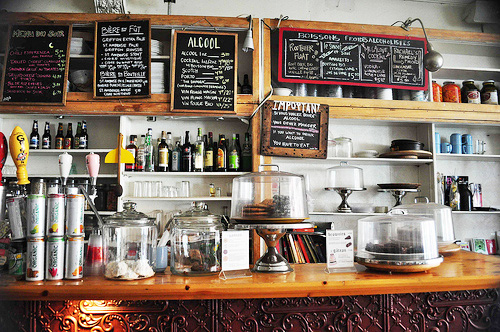
A vegetarian eatery, music venue, and café rolled into one, Le Cagibi occupies prime real estate in the Mecca of nonchalance commonly known as the Mile End. Decorated with a hodgepodge of old furniture, ramshackle chairs, and tables placed ad-hoc on the wooden floors, Le Cagibi consists of two homey, dimly illuminated rooms.  On occasional evenings, small acts remove the table from a low-lying stage and set up musical shop. If you’re fortunate, you’ll catch a low-key performance on a winter evening while drinking a big bowl of coffee ($4). Otherwise, if your habits tend towards the matinal, start a day of study with the Morning Rumble.

 —Le Cagibi sits on the corner of Saint Viateur and Saint Laurent. If you’re in the mood to catch a show, check out the calendar at www.lecagibi.ca

Dennis (Kim Kold) and Toi (Lamaiporn Hougaard) share a tender embrace. (www.filmmovementcanada.com)
a, Arts & Entertainment

Bodybuilders have feelings too

Teddy Bear is a study in contrasts. The dissonance between a tattooed, muscle-bound hulk of a man and his utter domination by those thin and frail is a wonder to behold. This is the state in which Dennis, the titular character of Teddy Bear, is introduced: so nervous on his date that he mindlessly copies her order and ends up with food to which he is allergic. “Why did you order it?” “I didn’t think it had shrimp.” A look. “In a shrimp cocktail?”

Though clad in Schwarzenegger-esque musculature, Dennis (Kim Kold) is more reminiscent of a painfully awkward adolescent. Many aspects of Dennis’ life suggests a man in stasis: from the fact that he’s still living with his mother at age 38, to his computer, which runs Windows 98.

Many lacking Dennis’ physique manage to get the better of him—in one memorable scene, he is emasculated at a urinal by a prostitute. One individual who does this with unfaltering persistency is Dennis’ own mother, played with a convincing mix of infirmity and callousness by Elsebeth Steentoft. Manifesting physical frailty and an indomitable will, she is Dennis’ very antithesis. Her tactics are formidable: a Molotov cocktail of shame and pity.  The size disadvantage is more than compensated by her adroit grasp of psychological manipulation. Some may find her almost sympathetic, but I disagree; if anything, the character is not and Steentoft makes her so.

The cinematography masterfully accentuates this atmosphere, shooting a bedside conversation at a diagonal angle to emphasize Dennis’ mass, or pulling back to a well-edited reveal of the pair’s relative heights (for the record, she is below Dennis’ shoulder). The hand-held camera conveys intimacy to the point where I felt awkward prying. A proliferation of medium shots, as opposed to tight close-ups, has the effect of hitting home Dennis’ loneliness. Even in group gatherings, the camera manages to frame him alone.

Much of the film takes place in Thailand, where Dennis travels in search of love. The filmmakers should be commended for their breakaway from stereotypes; the audience’s first look at the “exotic East” is composed of spacious highways and English billboards, projecting the very core of modernization and globalization.

The film is very modest in its general arc. Writer-director Mads Matthiesen valorizes a love that is old-fashioned. A throwback, the kind based on chance and hard knocks. Individual scenes pulse with warmth, yet the plot unfolds in a predictable fashion. Teddy Bear personifies the unfortunate instance in which the whole is less than the sum of its parts. However, this drawback neither diminishes the pleasure obtained from watching Dennis’ personal growth, nor the frustration felt when the solution, so simple to the audience, remains just out of reach.

One can see the film’s “moment of truth” coming from a mile away – the imminent collision of Dennis’ two worlds, the promise of a train wreck – unfolding with awkward timidity. This is not quite so. The climax is skipped over for the denouement. There’s no yelling, no triumphant catharsis — just an acknowledgement that love is a complicated, messy, beautiful thing.

—Teddy Bear opens Friday, September 7th at Cinema du Parc, 3575 avenue du Parc.

a, Arts & Entertainment

Roman Holiday

Despite a longstanding love of film, I’ve never been drawn to Woody Allen’s neurotic charm.

My review of To Rome With Love, therefore, should have been nothing more than another addition to the burgeoning disappointment of the majority of film critics. In fact, I was so taken aback by its simple charm and unaffectedly playful honesty that I followed To Rome With Love with three more of Allen’s films.

Having proclaimed his love for New York, Barcelona, and Paris, Allen has finally turned towards this clever homage to Rome. The film follows four concurrent stories: a young architect (Jesse Eisenberg) falling in love with his girlfriend’s affected best friend (Ellen Page); a white-collar nobody (Roberto Benigni) who gains brusque, illustrious fame; a retired record company executive (Woody Allen) who attempts to recapture his glory days, and a provincial couple who have just moved to Rome. Apart from disappointingly flat performances surrounding Page and Eisenberg (excluding a brief appearance by Alec Baldwin), and Allen’s on-screen wife (Judy Davis) appearing somewhat forced, the cast is largely attuned to Allen’s vision.

The film’s impact, however, is much greater than the individual performances. While a number of critics hectored To Rome With Love for its absence of cohesion, this charge speaks more to a cerebral indolence on the part of the authors than to the quality of their subject. Allen’s object of study in these stories is allure: the siren call of fame, the desire to taste spurious grandeur. Such is Allen’s Rome –  deceptively glamorous; and in spite of its somewhat aggrandized romantic nature, simply another city filled with indelibly joyous bubbling life.

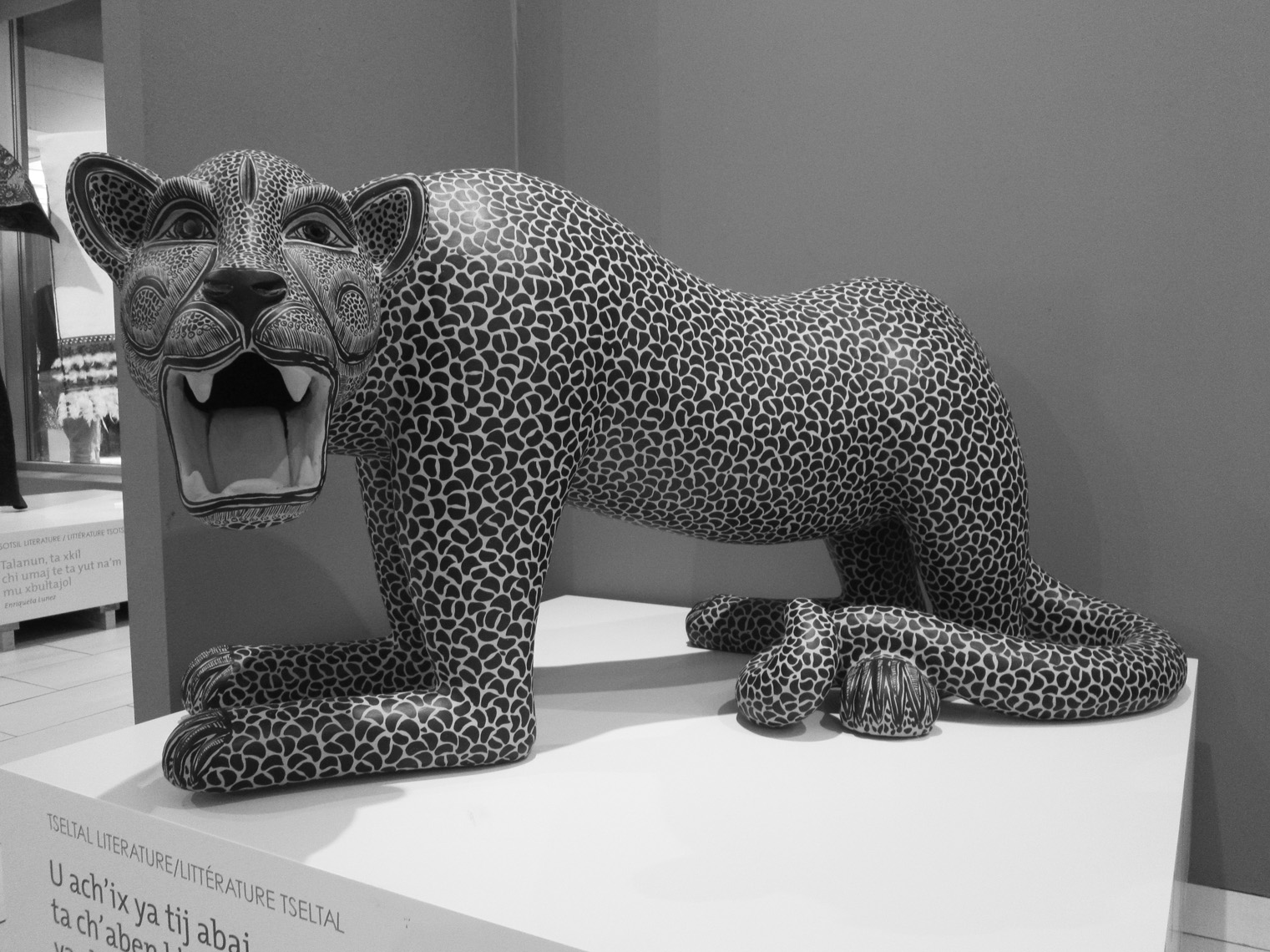
A Tseltal wood-carved jaguar greets visitors. (Carolina Millán Ronchetti / McGill Tribune)
a, Arts & Entertainment

Life and death meet the quotidien

This September, the aesthetic of mortality is on display in Montreal for Life and Death, Expressions of Daily Activities in the Worldview of the Contemporary Indigenous Peoples, an exhibit at the Espacio Mexico exploring the spaces between the funeral and the festive.

The intimate venue, showcasing roughly 40 arts and crafts pieces from 14 of the 68 surviving indigenous groups in Mexico, is the country’s first state-supported exhibition of indigenous art at an international location. The majority of the pieces were created by young artists who blend ancient techniques learned in their close communities with avant-garde approaches.  By including works that represent traditional approaches and juxtaposing them with modern interpretations of indigenous art, the exhibit traces the cultural evolution of these communities while celebrating the survival of ancient techniques.

Phil Price, a member of the public relations department of the Mexican Contemporary Indigenous Art Museum (MAIC), explains that the exhibit aims to shape the contemporary portrayal of indigenous groups.

“[We seek …] a flip in the mentality with which indigenous groups are seen and more importantly how they see themselves,” Price said. “Indigenous groups are labelled in a rather general manner as ‘poor,’ referring specifically to an economic context. Widely ignored, however, is their incredibly rich culture, traditions, language and artistic knowledge.”

This richness of the groups’ culture and tradition is immediately apparent upon entering the exhibit. Organized geographically, the display guides viewers through the indigenous groups from the north, centre, and south of Mexico, showcasing arts and crafts in different media.

The central theme surrounding this panoply is the close relationship between life and death. From the northern desert areas of the nation, the exhibit explores pottery made with different types of clay and dyed with pastes consisting of crushed insects. String and percussion musical instruments, as well as traditional decorations used in ritual dances are also present.

The portrayal of indigenous groups belonging to Central Mexico is remarkably varied, forming an amalgam of the native and the European. Some of the more memorable displays included colourfully painted celebrations of nature and agriculture, mixing Christian imagery with indigenous Nahua symbols and mud skulls clad in nun attire, inspired by the national “Day of the Dead” celebration.

In the South, rainforest imagery permeates the artwork. These include an imposing carving of a jaguar, peyote-inspired art employing beads representing a creation myth, and traditional textiles.

Additionally, the exhibit showcases music samples from each region and traditional poetry, displayed in the original languages as well as in English and French.

Ulimately, the exhibition succeeds at showcasing the breadth and diversity of Mexican indigenous traditions. The striking differences in texture, media, and imagery vary starkly—from the austere neutral colours and rustic wooden shapes of the north, to the eclectic and intricate bead designs of the south.  Although the display depicts Mexico as a nation with remarkably vivid indigenous culture, the lack of focus hinders the overall effect of the exhibit. The various media employed make it much more difficult to connect to the character of each indigenous group. This leaves the exhibit toeing the treacherous line of tokenizing each indigenous group by reducing them to a single salient characteristic. A narrowing of scope would lead to a more true appreciation of the complexities characterizing each community.

Despite the loose connection between some of the selections, this artistic sampler accomplishes its aim of highlighting the resilience of indigenous culture in Mexico. While the display takes into account how different groups’ techniques often adapted to include European motifs and approaches, it also celebrates the survival of indigenous culture and traditional art forms despite centuries of colonization.

“[Our proposition is for] this expansive ancestral wisdom to be something not just consigned to history books,” Price said. “Instead, from this living and breathing diversity, contemporary society can learn as we ponder our own existence and look towards constructing a sustainable future for human beings and the planet.”

Life and Death, Expressions of Daily Activities in the Worldview of the Contemporary Indigenous Peoples, brought by the Mexican Contemporary Indigenous Art Museum (MAIC) and organized by the NGO Espacios de Arte Nomada (EAN),  is on display until Sept. 14 at Espacio Mexico (2055 Peel St.) Admission is free of charge.

Last Gang Records
a, Arts & Entertainment, Music

Purity Ring: Shrines

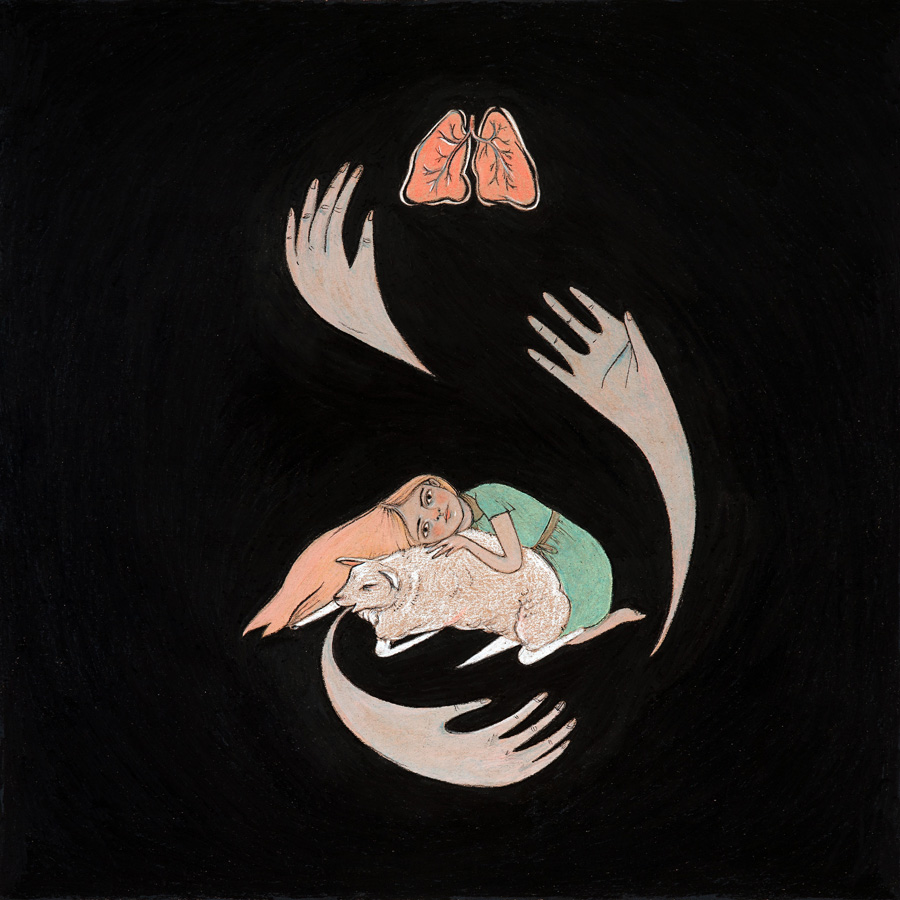
The debut album from Montreal duo Purity Ring defies definability. Airy, synth-pop, electro: each label is only a piece of the puzzle. The picture only becomes clear once one listens to their tracks.

“Obedear” is a subdued single full of the swirling, jangling pop  that Purity Ring is known for. Lead singer Megan James has a pristine nymph-like voice, yet sings lyrics like “tear our skin up out from the bottom.” Such contrast gives Purity Ring an eerie, unexpected presence. With each listen, new notes, beats, sounds, and feelings are discovered.

A surprising strength of this album is that it simply doesn’t make much sense. While the lyrics may be clear to the duo, listeners are faced with abstract verses filled with word associations unlikely to be endorsed by Webster’s Dictionary. The line in “Amenamy,” “plug up your wormholes and give them/to feeders and spirits be freer” is just one of the many examples of Purity Ring’s avant-garde lyricism.

While the songs share similarities—which could also be a point of criticism— the album altogether is nothing short of breathtaking. Best listened to with a beer, comfy clothes, and preferably outside with a couple of friends, the wildfire word-of-mouth spread of Shrines has happened for good reason.

—Haley Kemp

a, Arts & Entertainment, Music

Mother Mother: The Sticks

Ever since the release of their debut album Touch Up in 2007, BC’s indie rock darlings Mother Mother have been know for their catchy rhythms and haunting harmonies. Three albums and a whirlwind global tour later, they have returned with The Sticks.

The Sticks aims for a cohesive theme, a feature absent from the group’s previous albums; both lyrically and structurally, the tracks attempt to distill the modern world. The general arc of the album aims at the contemporary lifestyle, beseeching man to “take off your cage, and go back to the wild.” The artists’ efforts, however, are mixed. While some songs create beautiful juxtapositions, others fall flat — relying on rhythmic sequences self-plagiarized from their previous work. The album’s lyrics are dark: songs like “Little Pistols” contrast soft violins and acoustic guitar with phrases like, “I want brimstone in my garden/I want roses set on fire.”

“Bit by Bit” is arguably one of the album’s strongest tracks. “Bit by bit I’m going to get my bricks back in the sticks”) skillfully ties in their motifs. It is one of the few non-acoustic songs that does not emerge as overbearing.

Mother Mother should, however, give more consideration to their thematic goals. Tracks are fattened with diagetic noise; the crooning children and cawing gulls do nothing except add bulk. The hypocrisy of an album that lyrically preaches natural simplicity but musically practices self-indulgent excess is difficult to miss.

Without a doubt, Mother Mother knows the formula for catchy songs. Their harmonies are strong and the band uses an assortment of instruments with noticeable adroitness.  Still, this formula is not groundbreaking. While The Sticks is palatable and conceptually interesting, it offers nothing we haven’t heard before.

—Hilary Dyck

Read the latest issue

Read the latest issue