

Latest News

Opinion

The library stampede

McGill Tribune

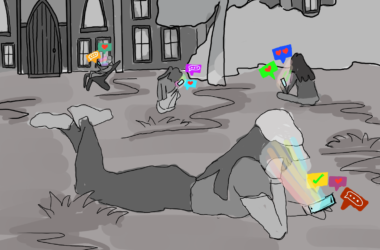
The Library Stampede kicks off when you wake up. After slamming your alarm clock you stumble groggily from bed, glaring around the room, daring anything or anyone to mention something about good sleep leading to good grades. The glorious image of an open, spacious library spot—plug-in included—begins to form. Interlocking, pulsing neurons, teeming with memorized information, mould the picture of oneself strolling through those library doors after a peaceful night’s rest. A librarian nods smilingly on the left as the elevator doors open on the right. Step into it, and you’re carried to a floor where your clean desk awaits. Open windows frame your work with leafy views of campus while the surrounding books stand like encouraging guardians of your intake of knowledge.

Oh, if only. Before this picture can become solidified in your mind, the smart, calculating side of you—the side that got you here in the first place—starts to take control. It takes the montage of tranquil study time and screws with it, unapologetically inserting the realities of what this library spot will actually look like. Pages are strewn everywhere. Cold War-era grey walls encircle windows through which you have to squint to glimpse a square foot of green grass. And every five seconds some punk is trying to move the electronically controlled book stack, leading to a sharp, high-pitched, gonna-kill-something-if-I-hear-it-again beep.

Halfway to school, you realize you left your laptop charger at home. Consciously trying to suppress profanity as you run, you hear the clock slowly clicking down. If you’re lucky enough to reach the library before the doors open, then you’re unlucky enough to sit in sheer academic tension till they do. Students line the walls awaiting the rush. A foot taps anxiously here, a pen is clicked constantly there. And then it happens. The security guard mutters something into a wireless radio, eyes scan the area, and the doors are opened.  

The next moment is key: as students fly by, swinging bags, fists or both, do you take the elevator up to the best spots or do you book it up the stairs? There is no right answer. It all depends on the collective psyche, wind pressure, humidity, subject of study, and many other incalculable factors that change with the day. You’ll have to take it as it comes. However, to avoid the small-but-horrific risk of being stuck in the elevator, I suggest you duck your head, clutch your belongings to your chest, and sprint up the stairs, voicing a constant Braveheart-esque war cry all the way.

In my time here, I have found my fellow McGill students to be mostly friendly in conversation and selfless in deeds. Not in the library. The best spots are fair game. And so be it—few things promote studying as much as sitting comfortably in a spot you arduously fought for. If you have an issue with this, be vocal about it. There are political voices galore on campus that would be ecstatic to take up the “A LIBRARY SPOT IS A RIGHT, NOT A PRIVILEGE” cause. Until then, get up early, get up strong, and get on top of those library doors before the break of dawn.

Opinion

The enjoyment ethic

You are familiar with the words usually attributed to Bob Marley: “In every life we have some trouble/ But when you worry, you make it double/  Don’t worry, be happy.” This famous line—adopted as a mantra by stoners everywhere—was actually written by an early 20th century Indian mystic named Meher Baba, who spent the last 40 years of his life in total silence, communicating with his followers via alphabet board. “Don’t worry, be happy,” has virtually become the modern enjoyment ethic. This consists of roughly two principles: 1) Pursue happiness. 2) Don’t interfere with others’ pursuit of happiness

The idea of the pursuit of happiness has a long philosophic tradition, from Epicurus to Jeremy Bentham, who believed that happiness was the only intrinsically good quality, that it was the best common denominator in the context of liberal values like equality, liberty and tolerance. The beauty of Bentham’s idea is that the more we embrace a simple ideal like enjoyment, the more we encounter others who share our ideal, which in turn produces more enjoyment.

But taken to an extreme, this doctrine makes us passive and apathetic, distorting the traditional ideal of tolerance. For instance, suppose you meet someone at a party who you consider not only bigoted and ignorant, but aggressively so, and you say: “Hey, if that’s what makes you happy, great!” Bentham’s position creates a passive social space, where there is no longer any reason for internal conflict if the ethics of enjoyment are followed.

An ethic is an internal dialogue, in which we repeatedly ask ourselves, “Am I doing what I think is right?” The enjoyment ethic puts the cart before the horse; before we jump to the creation of an ethic, we should determine what it stands for.

A useful ethic should be like a good sports coach. A good coach will tell you to do more than just “score a goal,” unless he wants you to run around the field aimlessly muttering, “How do I score a goal?” A good coach will tell you how to score and his explanation will involve an appraisal of how your abilities can be used effectively toward that end. Similarly, ethics aren’t about constantly asking ourselves, “How can I enjoy myself?” A person becomes ethical when they can play the whole game.

The blind pursuit of enjoyment or happiness demands something inherently unnatural from its surroundings: it requires total control of a situation which is generated from involvement and investment of desire in the outside world. Real enjoyment is a by-product of the creative process, rather than the pursuit of a Zen-like state of pure consciousness and bliss.

Seeking enjoyment has become a cultural imperative. Although enjoyment is great, it doesn’t ask us to care, to direct our energy outwards, to form opinions, to disagree, or to fight for a cause. It leads us to prioritize “how” we are doing over “what.” It bypasses the need to ask why we are pursuing happiness, because that answer is already part of the question. An ethic is a dominating force in our lives, a standard by which we measure our self-worth; it is a terrible thing to waste.

Opinion

Freeing Demasduit

McGill Tribune

Demasduit was 23 when she saw her husband die. In 1819, Newfoundland colonists raided her village and took her captive. They shot her husband before her eyes, leaving her newborn child to die.  Eventually the colonists tried to return Demasduit to her people, but could not find them. She died a captive.

This story doesn’t sound like the Canada we know. We know only of a Canada that is supposedly awesome: a premium version of the United States that mixes northeastern liberalism with southern friendliness and a pseudo-European multicultural twist. But when it comes to the issue of aboriginal rights, Canada is far from awesome.

Canada has screwed aboriginals royally. First we stole their land, and then tried to kill them. Next, we gave them blankets with smallpox. Eventually we decided not to kill them, and tried to forcibly assimilate them. We outlawed their customs and forced them into residential schools, where they were physically and sexually abused.

Why should you care about all this? You didn’t steal their land or crush their culture. How are you responsible for the misdeeds of the past? You aren’t. But the point is that their plight is not only in the past.

We are responsible for the fact that the average aboriginal gets 2.5 times less funds from the government than other Canadians. We receive services from three levels of government. They receive services from only the federal government.

We are responsible for the fact that they get less resources for healthcare and less for education. We are responsible for the staggering levels of disease, poverty and social ills on reserves and among urbanized Native communities. We are responsible for the fact that Canadian aboriginals live in Third World conditions in a First World country.

But we can stop screwing them over. We can correct a great historical injustice. Canada needs to reconstitute aboriginal sovereignty within the federalist structure. Give them jurisdiction over relevant policies: health, education, and wildlife, among others. Canadian aboriginals I’ve spoken to reject the idea of a paternalistic state trying to solve their problems. They want the freedom to address their own issues, which can only happen through the reconstitution of Aboriginal sovereignty.

Social ills like suicide, alcoholism, and  endemic school dropout rates are inextricably linked to national self-esteem. Sovereignty is the only way to boost aboriginals’ collective self-worth.

Many would tell you that it can’t be done or that it’s too complicated. Not only can it be done, but such solutions have already been designed. The Royal Commission on Aboriginal Peoples advocated creating a third order of government, that gives Aboriginals powers similar to those of the provinces.

As a large federalist country, we already include competing sovereignties in one system. We can successfully add one more without damaging our national fabric.  

None of this should make any Canadianss gloomy about our country. As I said, Canada is great. We have the chance to be even greater.

Let’s embolden the Canadian values of justice and federalism. Let’s reconstitute aboriginal sovereignty. Let’s free Demasduit from her endless captivity

Michael Morgenthau is a U1 Political Science student. He can be reached at [email protected].

Opinion

Source confidentiality must be protected

McGill Tribune

Last Friday, the Supreme Court of Canada outlined certain principles for assessing cases in which journalists in Quebec are asked to reveal the identities of anonymous sources they use in gathering sensitive information. The Tribune feels it is vital to the public interest that reporters are able to plausibly assure sources that their identities will never be made known to the public or to those interests that might be angered by the dissemination of whatever information is being shared. To that end, we feel the court’s decision is a step in the right direction, but does not go far enough. The National Assembly of Quebec now needs to follow the court’s recommendation and enact a closely worded shield law, which, while not absolutely protecting journalists from ever having to reveal their sources, would make it clear that the onus is not on the journalist to prove she is concealing the identity in the public interest, but on the litigator to claim that they would be acting in the public interest by revealing the identity of that source.

Any proposed solution needs to address this issue’s complexity.An absolute shield law would mean an absence of journalistic accountability, and would too often prevent the courts from fairly judging certain civil and criminal cases. However, rules which make it too easy for journalists to be prosecuted for not revealing their sources would inevitably lead to greater governmental corruption and a less-informed citizenry, because individuals privy to vital information might be less willing to share it with the media. The court is right to say decisions should continue to be made on a case-by-case basis.

There must be specific principles to guide such judgments. According to the Globe and Mail, this decision makes two specific recommendations: “Journalists should be forced to reveal their sources only when there is no other alternative to get the information and when disclosure of sources’ identities is vital to the administration of justice.”

The first of these principles evades the issue entirely. The problem arises when there is no other way to get the information. Stating that in the case of an impasse the journalists will always have to yield means no longer judging things on a case-by-case basis. It is to say that the public interest is always served by using the coercive power of the state to force a reporter to betray a solemn promise to someone revealing information we might not have otherwise known, and which we are better off for knowing. This is a massive loophole in the court’s decision, a tiny asterisk next to the freedom of the press, and should not be preserved in any future legislation.

The second principle—that journalists should have to reveal their sources if concealing them would prevent “the administration of justice”—is also too heavily weighted against the journalist’s right to conceal and the source’s right to remain anonymous. By virtue of their profession, judges are more likely to think about judicial issues and not about the importance of protecting sources for the public interest.

While we agree that cases should be judged according to which outcome would further the public interest, the court is wrong to place the burden of proof on the journalist rather than on the person trying to reveal the anonymous source. Such an onus might prevent journalists from securing the confidence from their sources that is necessary to gain access to sensitive information. The Quebec government should reverse this formula, through robust legislation that gives journalists the power to do their jobs, and gives sources the incentives they need to keep us all in the know.

News, SSMU

All motions pass at sparsely attended GA

Last Thursday, the student body passed all six resolutions proposed at a sparsely attended Fall General Assembly.

The resolutions regarding the Students’ Society liquor licence, gender parity, and liability were passed with few or no amendments. The resolutions regarding the volume in Gert’s, the Arts Undergraduate Society fundraiser, and the student-run printing service also passed, but with major amendments.

After a heated debate on the resolution regarding the volume in Gert’s, an amendment raised the proposed volume limit from 60 decibels to 140 decibels. This amended resolution was eventually discarded, and the final resolution stated “that Gert’s Bar Managers abide by the requests of the majority of patrons.”

Allan Cyril, Engineering Undergraduate Society VP Internal and the mover of the resolution, said he was neutral about the outcome of this resolution but was glad that the bartenders are now mandated to listen to the students.

“I was kind of upset that the Gert’s bartending staff were the ones who didn’t really recognize that there was a problem, even though a lot of students have said there is a problem,” Cyril said.

Gert’s night manager Stephanie Gossage argued that the motion probably won’t seriously affect the way Gert’s operates.

“In the end, what came of it was a nondescript clause that doesn’t really mean anything at all,” she said. “It seemed like a big waste of time. I don’t think we’re actually going to see anything come of this, to be honest.”

The resolution regarding liability was passed after Eli Freedman, the motion’s mover and a Management representative to council, gave an impassioned speech calling for students to show the administration that they should be allowed to use the “McGill” name in the titles of clubs and services. The motion resolved SSMU refer to itself as the “Students’ Society of The Educational Institute Roughly Bounded by Peel, Penfield, University, Sherbrooke, and Mac Campus,” or by the acronym “SSTEIRBBPPUSAMC.”

“This is a huge joke, it’s ridiculous, it’s absurd. But it’s a joke with a very serious punch line,” Freedman said at the GA. “That serious punch line is the administration’s liability concerns.”

The motion, which expires at the end of the semester, will not force SSMU to make changes that would incur any costs, such as redesigning the logo.

The motion mandating SSMU to hold a bake sale to raise money for the AUS, which has recently suffered large financial losses, also passed, but was amended so that the money raised be donated to a not-for-profit organization of the AUS’ choosing instead of the AUS.

The gender parity motion, which proposed to do away with the alternating male, non-male speaking order at GAs and council, was passed near the end of the night with little debate or discussion. Some expressed concern that a question with so many implications didn’t receive more student consideration.

“I was surprised that the discussion on gender parity was not more thoughtful,” said SSMU President Zach Newburgh. “This is a very important issue.”

Arts Senator Amara Possian agreed.

“What I was watching in there was a bunch of white males drowning out a bunch of other people’s voices and abolishing gender parity with absolutely no debate on an issue that has implications for equity, implications for people feeling safe on this campus,” she said. “It’s not so much the fact that it passed that bothered me, it’s the way that it happened.”

But William Farrell, the resolution’s mover, said that if students at the GA had had serious objections to the motion, they would not have passed it so quickly.

“I guess maybe that just goes to show how many people realize … that [gender parity]’s pretty silly in perspective,” he said.

The resolution regarding Gert’s renovations, which would have included a “stripper pole” in the upcoming Gert’s renovations and made every Thursday night “Amateur Night” at the bar, was ruled out of order earlier in the week. The motion, Speaker of Council Raymond Xing said, violated article six of SSMU’s constitution, which mandate that SSMU protect “human dignity and bodily sovereignty.”

SSMU VP Finance and Operations Nick Drew added that there were other concerns with adopting such a motion.

“[A stripper pole] is simply a dangerous thing to have in the bar. The last thing we want is to have a drunk student try their hand at pole dancing and then injuring themselves,” he said. “I’ve seen enough YouTube videos of sober people falling flat on their face.”

Another major concern was the fact that the assembly had a difficult time maintaining the 100-student quorum. This led some students to question what had been done to promote the event and whether the GA was a valuable legislative process.

Students, Newburgh said, attend the GA when they’re interested in the motions on the agenda.

“It has been shown in the last number of years that [the GA] has taken a lot of time from the executives to plan and execute, and perhaps instead of using [that] time and the effort and the resources that SSMU has to put toward a legislative body that only every off-time gets quorum,” he said.

Others, however, were more blunt.

“[The GA is] a joke, right?” Cyril said. “I think it should be abolished.”

McGill, News

Bookworms in paradise at 40th annual McGill Book Fair

Sophie Silkes

Redpath Hall was filled with book lovers searching for rubies in the dust at the 40th annual McGill Book Fair held late last week.

Founded by the Women’s Association of McGill in 1971, the Book Fair is now run by an independent group of volunteers, mostly elderly women who self-identify as the “Book Fairies.” It’s the culmination of a yearlong process, beginning in February, when the Fairies receive and sort through thousands of donated books.

“They come flooding in, you have no idea,” said Victoria Lees, the co-ordinator of the Book Fair since 2008, and former secretary-general of the university. “Some smell like tomcat, some are mildewed, some are wet.”

The unsold volumes are later distributed to various charities in places ranging from Verdun to Ghana. Lees predicts that for each book that ends up on the tables, at least 150 others have passed through her hands.

The acceptable books are then sorted into categories and priced by volunteers with some background knowledge of their respective subjects. The Fairies stock the books in boxes in a small corner of what Lees calls “beautiful subterranean Redpath Hall,” despite the basement’s musky stench and clear evidence of recent floods.

One browser in the political science section said she continues to go to the Book Fair “to get cheap books that interest me.” The books at the fair are of remarkably good quality, and are sold to students and other shoppers at reasonable prices.

Last year the fair raised $86,021. While McGill permits the Fairies to use Redpath Hall at no charge, the fair has to pay for tables, security, and various other expenses associated with running a special event.

After all expenses, last year the Fairies voted to give a $75,000 cheque to the Faculty of Music. “There’s a very strong feeling among the Book Fairies that it should go toward [need-based] bursaries, rather than [merit-based] scholarships,” Lees said.

According to Lees, book collectors from as far as Nova Scotia and New England line up at 7 a.m. on the first day of the fair, waiting for it to open at 9 a.m. The most expensive book sold this year was an original edition of Samuel Johnson’s 1755 Dictionary of the English Language, which went for $1,800. A signed copy of Leonard Cohen’s first novel, The Favourite Game, sold for $750.

“There are treasures here to be bought,” says Frances Groen, former director of McGill Libraries, and the Fairy responsible for pricing the history section.

Ilea Tant, the Book Fairy in charge of the special collection of rare and fragile books, said she would often spot a book and ask herself who would possibly want to buy it.

“Then I see someone going through the books,” she said, “and they say, ‘My God, I’ve been looking for that book for 20 years.'”

Lees, who completed her PhD in English literature at McGill, says that one benefit of the Book Fair is that “old ladies who still want to contribute to the university have a place to do so.”

Another Fairy, Betty, a volunteer since 1971, has a simpler reason for working the Book Fair. “I like the books,” she said with a bashful smile.

The Book Fair also offers jobs to students to help out as cashiers and as informal security staff. A cultural studies student, seemingly a Book-Fairy-in-training, who has worked the fair both of her two years at McGill, said, “There’s a lot of really nice people that work here, and a lot of interesting people who come here. People come from all over the place.”

Since 1971, the McGill Book Fair has raised more than $1.5 million dollars for student bursaries and scholarships.

Lees dismissed any suggestion that books or book fairs might be declining as e-readers rise in popularity.

“My theory is that God loves book fairs,” she said adamantly.

News

After Obamania, McGill’s Americans mail ballots once more

As a heated U.S. midterm election campaign enters its final week, American students at McGill appear to be voting in fairly large numbers, despite the hassle of requesting absentee ballots and the lack of a presidential contest.

When Barack Obama squared off against John McCain for the presidency two years ago, students on campus got involved in droves. McGill Students for Obama, a campus club started by law student Kevin Grumberg, held voter registration drives and organized trips to battleground states where McGill students went knocking on doors. On election day, hundreds of students packed Gert’s to watch the returns.

Though the atmosphere is more subdued this year, most of the students interviewed for this article said they were still planning to vote, the majority for Democrats.

According to Marc Seltzer, the Montreal chapter chairman of Democrats Abroad Canada, about half a dozen McGill students have approached him regarding volunteering to man phones and register voters, including Cassandra Zawilski, a U2 Psychology student from the San Francisco Bay Area.

“Most of my work has been within my own group of friends, trying to get them registered and make sure they’ve requested their absentee ballots,” she said.

Estimates vary for how many Americans live in Canada and are eligible to vote. According to Kenneth Sherman, the nation chairman of Democrats Abroad Canada, the number is between 500,000 and 750,000, though two years ago the Obama campaign estimated that up to a million Americans may live in the country.

Approximately 2,000 Americans are enrolled at McGill, making it one of the largest concentrations of Americans in Canada. Although the administration does not keep figures for where students are registered to vote, many hail from Democratic-leaning states.

“A lot of McGill students come from the Northeast, in places that aren’t nearly as contested as the rest of the U.S.,” said Cathal Rooney-Cespedes, U3 Economics and Political Science.

Rooney-Cespedes votes in Massachusetts 10th Congressional District, where longtime Democratic Congressman Bill Delahunt’s decision not to seek re-election has ignited a tight race to fill the seat. Rooney-Cespedes said he plans to vote mostly for Democrats, but he’s not against the Republicans retaking the House of Representatives.

“I think there needs to be an ideological check,” he added. “I’m all for reform, but it needs to be done fiscally.”

Despite the general enthusiasm for Democratic candidates on Tuesday, several students interviewed said they were planning on splitting the ballott for at least one candidate.

Yaakov Stern, a U2 Biochemistry student from Florida who has volunteered for the Democrats since  the age of 16, said he plans on voting for Charlie Crist, the Republican governor who decided to run for Senate as an independent after losing to Marco Rubio, a Tea Party-backed candidate, in the GOP primary. But he’s supporting the Democratic challenger in Florida’s Seventh Congressional District, where John L. Mica, who Stern called a “conservative gun-nut of a Congressman,” is running for re-election.

Not all American students are voting, of course.

Manisha Aggarwal-Schifellite, a U2 History student who grew up in Canada but is registered to vote in Connecticut, said she had not requested a ballot, despite voting two years ago. Her actions reflect a broader trend—just 25 per cent of Americans voted in the 2006 midterms, compared to 52 per cent in the 2008 presidential elections.

But Zawilski is voting, she said, to combat the perception that youth are not politically aware.

“I don’t want our generation to be seen as this monolithic, apathetic group,” she said, “because I don’t think that’s true.”

News

Quebec’s Bill 115 eases access to Anglophone schools

Thousands gathered outside Premier Jean Charest’s Montreal office to protest the recently approved Bill 115 on October 18. The legislation grants students access to the English public school system after spending three years in a private non-subsidized English school and after having followed a so-called “genuine educational pathway,” which protesters feel is a threat to Francophone culture.

After a nightlong debate in the Quebec national assembly, the bill was passed early Tuesday morning, by a vote of 61 to 54.

The law passed only days before the end of the Supreme Court’s yearlong deadline to find an alternative to the previously approved Bill 104, which was found to be in violation of the Charter of Rights and Freedoms.

The bill also replaces Bill 103, which was proposed earlier in the year and contained essentially the same elements.

“[Bill 115] allows the purchase of a right, and in a democracy that should not exist. Attending an English private school now legalizes the access to an English public school, public meaning paid by our taxes,” said Gilles Lefebre, a protester at the rally. “We are conscious that we are a Francophone minority in North America, so if we want to survive, there has to be a legislation that protects our language.”

The so-called “bridging schools,” English private and unsubsidized schools, have been considered to be a “loophole” in Quebec’s Charter of the French Language (Bill 101), which limits access to the English public system to children whose parents attended English-language schools in Canada.

“When we established Bill 101, we collectively decided that public schools would function in French for everyone, with minor exceptions for First Nations and for the historically Anglophone minority,” said Mario Beaulieu, the president of St-Jean-Baptiste Society of Montreal, in his opening speech at the rally. “The only solution is to apply Bill 101 to English non-subsidized private schools. That’s what we want and that’s what we will have.”

As the protesters chanted “Montreal in French” on a packed  McGill College Avenue holding signs reading “Vive le Quebec Français” and “No to Bill 103”, Beaulieu expressed his discontent with Charest’s Liberal government claiming that it is abandoning the defence of the French language.

“Mr. Charest and all of you who find it radical to ensure the future of French, we are here to tell you that you will no longer let you move us backwards, we are done feeling guilty of existing, enough is enough, from now on it is forward that we are moving, forward in French,” said Beaulieu.

According to Beaulieu, education should be provided in the majority’s language. He said Bill 101 needs to be reinforced.

“At this point, Bill 101 has suffered over a dozen modifications that weaken it in all of its aspects. English in Montreal has now a power of attraction five times greater than that of French,” he said. “French is what makes us a nation. If we want to include all of our citizens, no exceptions, it will take a law that applies to all of us equally.”

Several organizations including Imperative French and the Commission of National Syndicates (CSN) were among the groups present at the rally.

M. Fernand, a member of Imperative Montreal, supported Beaulieu’s solution of incorporating “bridging schools” to the Charter of the French Language.

“All we want is that everyone who arrives in Quebec and whose first language is neither English nor French, to be integrated in the French school system, whether it’s public or private,” she said. “Anglophones have the right to attend English school and I agree with that. We simply want immigrants to be obliged to go to school in French because we really are a small minority.”

Jonathan Goldbloom, a spokeperson for the Quebec Association of Independent Schools was satisfied with the outcome.

“We are pleased that it will provide us with access to certain students who were not eligilble to attend our schools [under the previous legislation].”

However, Goldbloom argued  for more precision.

“We feel that the regulations that they put forward are a little too complicated and unclear in terms of helping parents as well as schools plan, but Bill 115 is definitely a step in the right direction.”

At the national assembly, Premier Jean Charest ignored opposition from both Francophone and Anglophone groups and referred to Bill 115 as “pragmatic.”

Arts & Entertainment, Music

Femme fatale

“Caution: there will be loud noises during this performance,” warns the door to Medea. The meaning of this sign came to light during the most explosive part of the play.  A murder is revealed, and BAM! The back wall of the set falls down, revealing charred fabric and streams of blood.

Medea is Euripides’ classical Greek tragedy about Mithia, scorned ex-wife, and her one day of fiery revenge. Though written over two millennia ago, the story is accessible to a modern audience. Euripides is hailed as the most contemporary of the Greek playwrights—his psychological works feature empowered women, and heroes who fail to live up to their reputations.

In this case the satirized hero is Jason, captain of the Argonauts, who left his wife Mithia for a king’s daughter even though she’d killed and betrayed her country for him. The ridiculous figure (played by co-director and co-translator Andreas Apergis) seems to think the marriage will benefit Mithia and her children, but doesn’t judge the woman too harshly at first. After all, as he says, “Women get angry when their husbands remarry.”

“Angry” doesn’t suffice. Mithia, portrayed in an outstanding performance by France Rolland, begins as a dejected bundle of tears and transforms into a raging, murderous, madwoman. “You’re not a woman,” notes Jason near the end, “you’re a lioness.” Rolland manages to balance the softness of a grieving wife and mother with the frenzied actions of a woman pushed over the edge.

Beautiful, focused lighting along with an imaginative minimal set (designed by David Perrault Ninacs and Amy Keith, respectively) allow the audience to focus on the players in Euripides’ work. Granted, it takes five or 10 minutes to adjust to the heightened drama of it all. The opening monologue may seem like overacting, but it’s not. In a world where the gods rule all and revenge is best served very hot, high-strung emotion is just a fact of life.

A good deal of Medea’s impact can be attributed to its music. which was composed by Brian Lipson and directed by David Oppenheim. Live string instruments and a chorus of singers evoke the mood and meaning of each scene. The music is rembetiko—an underground Greek style, which blends folk and blues. The five women of the chorus interact with Mithia as her friends and conscious, highlighting her plight with beautiful, haunting voices.

Medea is a wonderful (and inexpensive) way to experience theatre. Parts of the production feel like Shakespeare, Mithia plotting like an ancient Lady Macbeth—but the language is much easier to understand. The production is a well-rounded, memorable, tour-de-force. I’d recommend a trip to Medea—as long as you’re comfortable with loud noises.


Medea is playing at the Centaur Theatre until Oct. 30th. More information at centaurtheatre.com

Arts & Entertainment, Music

All in the family

The music of Angus and Julia Stone has a strange effect on some people. After listening to them, many begin to think of the Sydney-based brother-sister duo as “their” band.

When their music was playing at a recent party, I mentioned to the guy manning the iPod how much I liked them. The stranger’s unsmiling response? “Well, I’m sure I like them more than you do.”

Admittedly, I am not immune to the possessive instincts their music can sometimes instill and selfishly tried to keep this band to myself after hearing them on a trip to Australia in 2007. But, two albums later and with an appearance on the Grey’s Anatomy soundtrack, the secret is officially out.

Their new album, Down the Way, has given fans much to be possessive about. In “And the Boys,” Julia’s warbling voice croons about “the gold falling from the ceiling of this world/ falling from the heartbeat of this girl/ falling from the things we should have learned.” Listeners everywhere fall in love with Angus on the album’s single “Big Jet Plane,” as he implores you, in a smoky voice, to, “Be my lover, my lady river/ but can I take ya, take ya higher”.

Their simple acoustic ballads about love, lust, and loss seem to typify the twentysomething romantic experience to the point that it often feels the songs were personally written to accompany the feelings of infatuation, relationships, and heartbreak.

Speaking from New York, the current stop on their North American tour, the charming Julia Stone described her difficult relationship with the English language. Though their poetic lyrics may hold a lot of resonance for their fans, Julia does not find satisfaction in the spoken word.

“I’ve always felt a little bit unfulfilled expressing things through words,” says Stone. “I never feel like I can fully connect the intention between what I want to say and the actual sound of it.”

Fans seem to think otherwise, and the band’s ability to connect to their listeners has won them legions of loyal followers on the festival circuit from Australia to Canada to Britain, where they currently live.

The siblings, who have been collaborating since 2006, have a fairly unconventional working relationship. The two write their songs separately, split the album between their different songs and work together in the studio on the musical arrangements and harmonies.

Though their lives are now very much intertwined, Julia said it wasn’t always that way, and growing up, the two didn’t exactly get along—something Stone attributes to their troubled childhood.

“Family relationships are so extreme because usually your parents’ dynamic comes into your sibling relationship,” she says. “You grow up watching dysfunctional behaviour between two adults and then you become adults and you’re playing the same roles.”

A love of music eventually brought the siblings together and allowed them to “use this very strange set of circumstances where we’re living together and working together to try and let this stuff go.”


Angus and Julia Stone play Le National on Friday at 8 p.m. Tickets are $18-20.

Read the latest issue

Read the latest issue