
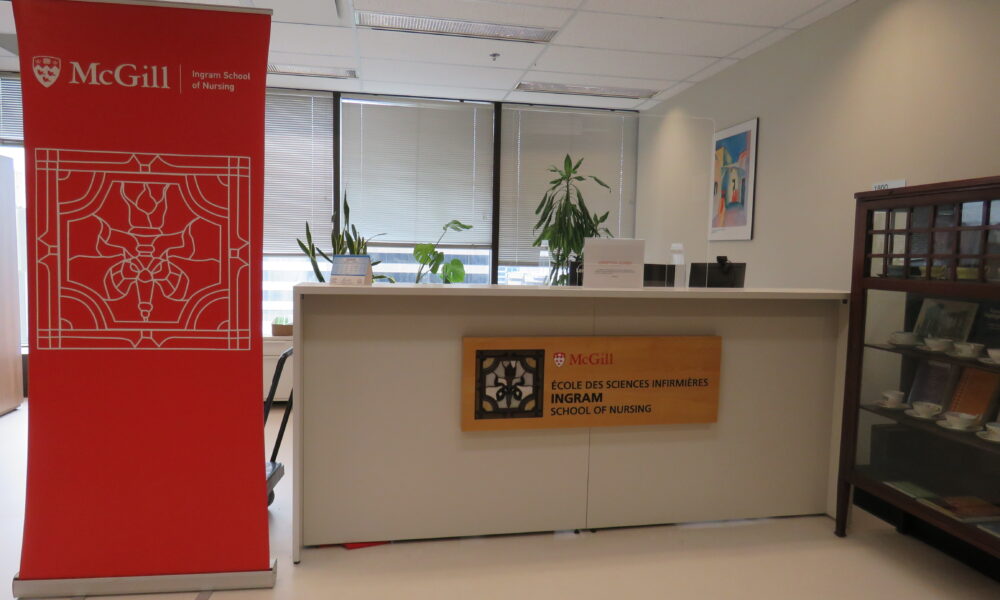




On Aug. 28, the Association of McGill Nursing Academic Staff (AMNAS) and McGill attended a hearing at the Tribunal administratif du travail. AMNAS represents academic staff in the Ingram School of Nursing, one of six schools that fall under McGill’s Faculty of Medicine and Health Sciences (FMHS). Represented by Sibel Ataogul, AMNAS disputed McGill’s contestation of AMNAS’ union certification. The union first filed for certification before the Tribunal on June 29, representing McGill’s seventh academic union to file for accreditation.
Shortly after, McGill contested AMNAS’ certification, stating that AMNAS should be unionized under its broader faculty rather than by the school itself. Currently, there are 19 unions and 2 non-unionized associations at McGill. This includes the McGill Association of University Teachers (MAUT)—an existing organization that aims to include faculty in university governance in order to advance the working conditions of McGill’s academic staff and librarians.
AMNAS has already obtained a membership of over 75 per cent nursing academic staff—exceeding the 50 per cent threshold in Quebec for union certification. If McGill’s nursing academic staff accepts McGill’s proposal to unionize under the FMHS, the union membership rate would drop significantly, effectively restarting the unionization process.
In an interview with The Tribune, William Archambault, assistant professor of nursing and AMNAS interim president, highlighted the unfair working conditions that nursing academic staff experience, underscoring the urgency to unionize amid McGill’s budget cuts.
“Over the past year and a half, we were asked on multiple occasions to take on more work without more pay and other compensations,” Archambault said. “Workload increases for the same conditions, which is one thing when you’re told it’s just going to be for one semester, while [McGill] gets the [financial] situation under control. But no, whatever was added, we’re being told that it’s the new normal now, and it looks like it might keep happening for a bit [….] It was not a discussion. We were basically informed of decisions that were made without consulting us, and that’s the biggest source of frustration among faculty.”
In a written statement to The Tribune, Norma Ponzoni, assistant professor of nursing, mirrored the same sentiment, citing the disproportionate workload as a major challenge the Nursing faculty faces.
“The number of students in some Nursing courses has increased substantially, while at the same time faculty are being allocated fewer teaching credits for essentially the same work,” Ponzoni wrote. “We’re facing a difficult combination: more students and greater teaching demands, but less recognition of that work through teaching credits. That is simply not sustainable over the long term.”
Ponzoni also expressed that AMNAS allows the faculty to hold collective bargaining power, providing a more effective avenue to improving working conditions.
“Under the existing collegial and administrative model, faculty can raise concerns, participate in committees, and seek support from organizations such as MAUT,” Ponzoni wrote. “Collective bargaining changes that dynamic. It gives faculty a formal seat at the table when decisions about our employment conditions are being made. Instead of simply raising concerns or making recommendations, we can negotiate those conditions with the employer. And once an agreement is reached, its provisions aren’t just recommendations—they’re contractual commitments [….] That creates a different level of accountability.”
In a written statement to The Tribune, McGill’s Media Relations Office (MRO) maintained that McGill respects the Nursing faculty’s right to unionize, arguing that the university’s decision to contest the accreditation stemmed from concerns over the union’s fit rather than opposition to unionization itself.
“We have never opposed unionization as a matter of principle, and we remain committed to bargaining in good faith with our certified unions and to reaching collective agreements that are fair and sustainable for everyone involved,” the MRO wrote. “The question currently before the Tribunal administratif du travail is not whether nursing academic staff can unionize; it’s about which bargaining unit is the right fit for certification. That’s a legitimate legal question, and the Tribunal is the appropriate place to resolve it. McGill will present its position there, as any party to a certification process is entitled to do.”
According to Assistant Professor of Nursing Caroline Marchionni, the School of Nursing has the highest concentration of Contract Academic Staff (CAS)—representing 17 per cent of all CAS faculty at McGill, and 47 per cent of CAS in the FMHS. While CAS faculty are still expected to work full-time, much like Tenure Track Academic Staff, they do not receive the equivalent hiring benefits, pay, and contract length as their tenured colleagues do.
In an interview with The Tribune, Marchionni emphasized that the need for the School of Nursing to unionize independently stems from its large proportion of CAS faculty.
“Our needs are different, and our primary job is to teach. My job is to educate nurse clinicians and nurse practitioners […] for the Quebec health system and advance nursing education,” Marchionni said. “[Other schools in the faculty] have different mandates, some more focused on research [….] Given the varied missions and methods of renumeration across the six schools, it would never work [….] We’re so different in the way we function on a daily basis that it’s just [McGill’s] way to make [our own union] not happen.”
Archambault shared a similar perspective, illustrating the difference between the School of Nursing and the rest of FMHS.
“What we’re arguing is that [FMHS] is different from others in the sense that it’s made of a bunch of professional schools who are very distinct, and that we don’t really talk to each other,” Archambault noted. “I don’t know many people in medicine or in physiotherapy [….] I wouldn’t feel comfortable being represented by one of them, just like how I wouldn’t feel comfortable representing those schools because we don’t know [each others’] realities.”
Both Marchionni and Archambault also pointed to a Nursing pharmacology course that originally had two sections—one conducted completely in-person, and the other entirely remote. However, McGill fused the two sections into one in 2025, so that all students now must attend both in-person and online instruction. Marchionni explained how professors were forced to then take on extra work to fulfill the credit requirements.
“Now [the professor] is getting three credits for the whole [course], so then he has a spot in his credit load because we have to teach 18 credits,” Marchionni said. “But 300 students mean 300 emails. He wasn’t compensated for more work.”
Archambault commented that the repercussions of McGill’s decisions are felt most acutely by the course’s professors and instructors, as well as students—rather than the administration itself.
“Pretty much all the students were unhappy,” Archambault said. “Because it happened so quickly and [the course] wasn’t designed for that, the quality of the course definitely went down. And who got blamed for that? The professors. But it wasn’t our decision. We were told basically two months ahead of September [2025], in July, that this was going to happen. So those are examples of decisions that were made top-down without consultation that directly impacted the student experience and learning.”
According to Archambault, when McGill does not renew some CAS faculty contracts, extra work will be piled on to those who stay, or the university will opt to hire more course lecturers.
“No matter how good [a new] course lecturer is, there’s a lot more rotation. They don’t tend to stick around for many years, which may leave a gap in the curriculum,” Archambault said. “On average, it takes about three to four years minimum to build a good course and to have it running. If that [course lecturer] doesn’t stick around, then everything has to be started over.”