
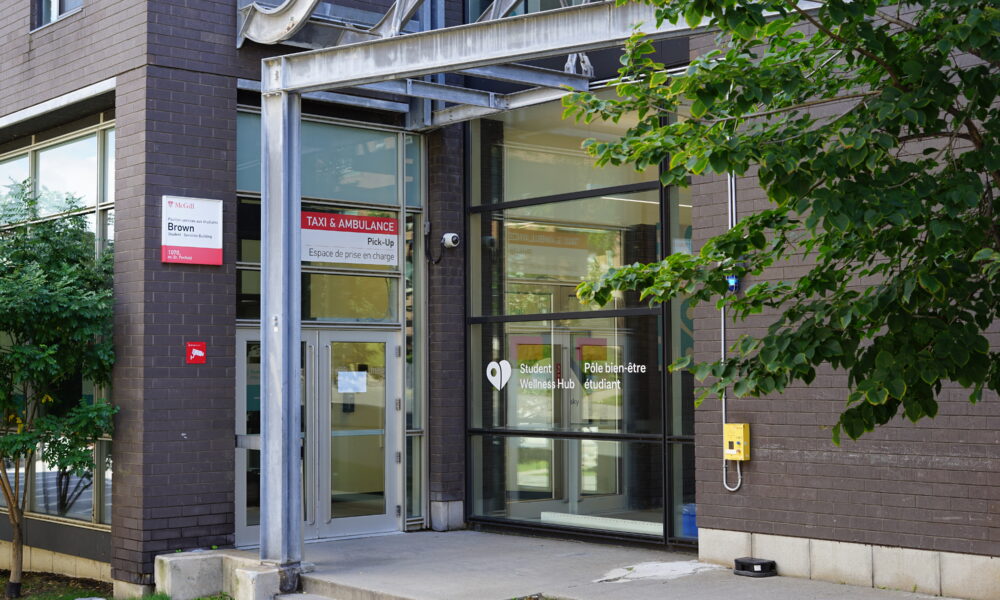




The Montreal Trans Patient Union (TPU)—a collective advocating for healthcare for trans and nonbinary people—announced on July 12 that McGill’s Student Wellness Hub will once again provide gender-affirming care (GAC) services to trans American students under the age of 19. This reversal followed months of negotiations between the Wellness Hub and the TPU, after the Wellness Hub decided in March to suspend GAC access to this demographic.
The Wellness Hub halted certain American students’ access to GAC in light of United States President Donald Trump’s executive order in January 2025, which banned young Americans from accessing this essential care. Following this ban, the Trump administration released a form in April of the same year, allowing people to whistleblow on American and Canadian doctors who provide GAC.
The Wellness Hub cited related liability concerns about potential American legal repercussions for McGill doctors performing GAC as the reason behind the suspension. However, the TPU and other advocates for GAC argued that precedent shows American executive orders have no legal force in Canada, rendering the Wellness Hub’s decision to suspend this care unnecessary.
In an interview with The Tribune, Emma Gimbert, a U2 McGill student and member of the TPU, shed light on how the process of reinstating GAC at the Wellness Hub unfolded.
“After some discussions with the [Wellness] Hub, and after [the TPU] had a couple interviews with some local newspapers, [and made] some social media posts, [there was] pressure towards the [Wellness] Hub,” she stated. “[After] internal discussions [between the Wellness Hub and the TPU], we eventually came to the agreement [in May 2026] that it would be up to the doctor’s individual discretion of whether they wanted to provide HRT to 19-year-olds based on their personal assessment of the legal risks involved with the situation […] and we know that there’s at least one doctor [at] the [Wellness] Hub who [is currently] willing to prescribe that care.”
Eike*, co-administrator of the TPU and recent McGill graduate, explained in an interview with The Tribune how the Wellness Hub’s initial GAC suspension demonstrates greater concern over doctors’ hypothetical safety than the immediate safety risks caused by limiting students’ GAC access.
“It is incredibly unlikely for a doctor from Canada to actually face action over [Trump’s executive order],” they said. “[An adult patient’s] parents [would] have to get access to their medical records, [and] then have to report [them via the whistleblowing] form [….] Then, the Trump government [has] to decide [to] give this list of doctors to every border station [between Canada and the United States] and [have the] police ‘do something’ [….] I do think that the concerns by doctors have been somewhat exaggerated, [seeing as] it really is a very specific sequence of events that cause things to go wrong.”
Eike then noted that for some trans students, McGill campus services may be the only avenue for receiving the medical support they need.
“In theory, students can go to another [Montreal] clinic and get [GAC],” they explained. “But being a new international student in Quebec, […] if you’re getting care through the public system, you don’t have [RAMQ] and [must rely] on your international student [health] insurance, [so] you really don’t have other options than the [Wellness] Hub [unless] you have hundreds or thousands of dollars to go private.”
McGill’s Media Relations Office did not comment to The Tribune on the Wellness Hub’s recent GAC provision guidelines.
In an interview with The Tribune, Celeste Trianon, Montreal trans rights advocate and reporter, reiterated TPU members’ assertions that the Wellness Hub’s GAC offerings are essential for international students who struggle to navigate the francophone public healthcare system or come from countries where GAC is not legally available.
“The [Wellness Hub’s decision] to implement a ban on [GAC for] U.S. international students […] is confusing,” she said. “Why [is GAC then] allowed for someone fleeing from Russia or Saudi Arabia or all these other countries where trans healthcare is banned [or restricted], even for adults?”
Trianon also echoed Eike’s perspective, stating that the Wellness Hub’s GAC interruption posed a much greater risk to trans students than doctors, considering Quebec’s broader anti-trans climate.
“In Quebec, there are several anti-trans policies which are currently active,” Trianon said. “In the public sector, the word ‘iel’, the equivalent of ‘they/them’ in English, is prohibited by force of government policy, and there’s also current policy throwing trans women into men’s prisons, […] which can […] expose [them] to increased risks of sexual assault.”
Chloe*, a collective member of The Union for Gender Empowerment—a trans-positive and feminist McGill service—expressed the importance of sustained, collective action to protect trans rights amid growing uncertainty. In an interview with The Tribune, she highlighted the insecurity of trans healthcare in Canada and the backslides to trans rights in the U.S. as reasons for demanding stronger institutional accountability and support.
“The consistent crux of trans healthcare is that it’s always very precarious, and we always have to fight for every inch,” she stated. “So it’s always kind of a consistent combat with organizations like [universities] who […] without outside pressure, will just kind of revert to underfunding and neglecting trans healthcare [….] We need to just keep the pressure up [and] keep fighting for more because […] any step back, especially given the context in the U.S., is very risky to a lot of trans students.”
Gimbert similarly discussed how, considering some American students may be attending McGill in large part to avoid anti-trans legislation at home, GAC must be assured by the university.
“[GAC] is a necessary thing that trans people often need to improve their mental health and to feel more comfortable in themselves, and recognizing [through GAC provision] that it’s [a form of] healthcare same as anyone else would receive, and not some special, discrete category, helps to affirm that [GAC] is something that should be supported across the board,” she said.
Eike further emphasized that GAC must not be “medically gatekept.”
“An issue in the whole Quebec healthcare system […] is that providing [GAC such as hormone replacement therapy (HRT)] is viewed [as] specialty trans care,” Eike stated. “Oftentimes, doctors will refer you to an endocrinologist, [though] any family doctor in Quebec is able to provide HRT. A lot of doctors assume [this care] is out of their professional bounds, but it very much is not.”
Eike then called out the Quebec medical system’s undue treatment of GAC procedures as exceptional.
“If you were going to a doctor who had gone to [medical] school decades ago, and they [said], ‘I never learned about that new cholesterol medication, so I just don’t prescribe it,’ you’d say, ‘No. You’re a doctor. It’s your job to stay up to date on the current care that you can provide your patients.’ And HRT is just not held to the same standard,” Eike said. “The bar is on the floor for all of this.”
Beyond the Wellness Hub’s reversed decision, Eike also spoke to the TPU’s wider fight against barriers to GAC in Montreal.
“[Limited GAC access] is partly downstream of transphobia and not necessarily caring about trans people,” they stated. “And it is partly just down to a lack of resources. The [Quebec] medical system in general, and family doctors especially, are very overburdened, and so we [at the TPU] are starting to run into more systemic problems in addition to these smaller ones. And so that’s what we’re working to address more broadly.”
*Eike and Chloe’s last names have been omitted for the sake of their privacy.
To learn more about GAC, visit transpatientunion.org, where you can also sign an open letter stating your support for the TPU’s current advocacy for shorter GAC wait times in Quebec.