Latest News

News

At Green Drinks, Mehdi discusses climate change’s effects

Jessica Batalitzky

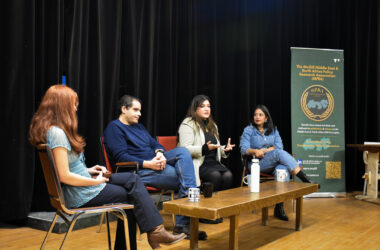
Last Tuesday night, another Green Drinks Montreal Chapter  event took place at Thomson House. Bano Mehdi, a PhD candidate in the department of geography, presented a talk titled “Climate Change Impacts on Agriculture in Canada.”

Mehdi addressed the small but attentive crowd and attempted to dispell the common belief that climate change is negative. Instead, she argued that “climate change vis-à-vis agriculture is seen as good.”

Focusing on three main points—how the climate has changed in Canada over the past century,  future climate predictions for the country, and the possible impacts of climate change on Canadian agriculture—Mehdi presented statistics that revealed clear evidence of temperature changes, but also possibilities for adaptation.

According to her presentation, there was  an overall increase in temperature of 0.9 degrees C across Canada over the past century. The change came with variation, though, and the temperature decreased at times.

Mehdi also said that Canada has had a 12 per cent increase in precipitation over the past eight years.

“Expect Canada to be warmer and wetter with occasional variations,” she said. “This changing climate will be more welcoming to high-value crops, such as grapes, which need specific temperatures at which to grow.”

Along the mid-latitude regions of the northern hemisphere, where Canada is located, there is the most potential for longer planting and harvesting seasons and new crop types. In the coming century, Mehsi said, most of these areas will be able to maintain a climate that will allow for optimal planting and harvesting.

The same cannot be said for mid-latitude southern regions. Only a minority of the world’s climatic regions, Mehdi said, will experience changes in their climates that will give them beneficial conditions.

But even for countries like Canada, the changes in temperature and precipitation have variability and cannot be predicted accurately enough to prevent natural disasters. Mehdi warned that no systems are currently in place to deal with such events, which could destroy crops.

Mehdi argued that it is up to farmers to adapt their methods to the climate. “They must have good soil and a ready water supply,” she said.

She also said that to ensure food security, the government will have to step in to help farmers with these burdens through access to knowledge, technology, and funds.

 “The agriculture sector is very adaptable” Mehdi said. “But if not enough attention is paid to these changes, Canada would not be able to keep up and therefore have a very difficult time feeding itself.”

Chris Wrobel, a Master’s student in plant science, is a member of the Post Graduate Students’ Society Environment Committee and a co-founder of Green Drinks Montreal, an informal organization that seeks to promote discussion on environmental issues. He explained that issues like the one addressed in this talk are what Green Drinks tries to promote.

“[The organization aims to] provide a forum for environmentalists with different views,” he said, asserting that “sustainability is a binding force” and that through them common projects amongst many groups can be undertaken.

News

McGill grad wins Emmy with UBC documentary team

Blake Sifton, a McGill graduate, along with nine other University of British Columbia journalism students,  became the first group of students ever to win an Emmy Award last week.

The group produced the documentary: Ghana: Digital Dumping Ground as part of an international reporting class at UBC’s Graduate School of Journalism. The film picked up two nominations at this year’s news and documentary Emmys, and won the award for Outstanding Investigative Journalism.

Ghana: Digital Dumping Ground aired on PBS’ Frontline/World, where it was described as “A global investigation into the dirty secret of the digital age—the dumping and dangerous recycling of hundreds of millions of pounds of electronic waste across the developing world.” It documents poor workers–often children–burning the European and American computers that recyclers ship to developing countries, and sifting through the toxic residue to salvage and sell tiny pieces of precious metals.

The film also documents another problem: functioning hard drives that contain Westerners’ personal documents and sensitive information. In a particularly memorable scene, one of the teams purchased a hard drive containing sensitive details about U.S. government contracts with one of the country’s largest military contractors, Northrop Grumman. Ghana is adjacent to Nigeria, which Sifton describes as “the epicentre of cyber-crime.”

But the real story is “that we’re poisoning the Third World, not that some African is going to steal your family photos,” said Sifton.

Socially conscious journalism is nothing new for Sifton, who first “got into journalism from activism” during his years at McGill.

Sifton, who graduated from McGill in 2007 with a joint honours degree in political science and international development studies, was involved with a group called Students Taking Action in Chiapas during his time at university, which “raised awareness of and money for the plight of indigenous population in southern Mexico.” He travelled with the group to Chiapas in 2004 and 2006 with donations and to volunteer in communities there.  

On his second trip, Mexico was caught in the middle of an election crisis, and Sifton eventually turned the trip into a feature for the McGill Daily. He managed to take a picture of one of the electoral candidates in the midst of an enormous throng of people, which the BBC later published on their website.  

“[That] was this really incredible experience that taught me that I could do that, that I wanted to watch history unfold like that and be a foreign correspondent,” Sifton said.

He later used the feature in his UBC application.  

This may be the first student-driven documentary to win anything as prestigious as an Emmy, but for project leader and multiple-Emmy-winner Professor Peter Klein, student involvement can add an important dimension to this kind of project.

Students, Klein said, bring a lot of fresh ideas and smart questions to such projects.

“Working journalists kind of get into certain patterns and certain ways of doing things, and you kind of just accept those norms,” he said. “Students question things in ways that experienced journalists don’t. And in that respect I think it actually improves the project. It improves the ethical approaches and the quality of the reporting.”  

Klein helps his students by bringing expertise and connections to the media world. For the students, many of whom are employed at major news organizations, winning an Emmy at such a young age is a promising career start. In a few weeks, Sifton will be joining Al-Jazeera as a deputy news editor in Doha, Qatar.  

As for Ghana and other e-waste recipients, Klein said the situation has not changed significantly since the program aired last year. Regarding what students can do, Sifton advises researching the recyclers you use to dispose of your computer products to ensure they are being as responsible as they claim so that they don’t “destroy your hard drive.”

News

History faculty members address BP Gulf oil spill at forum

McGill history professors Jason Opal, Thomas Jundt, and Daviken Studnicki-Gizbert spoke at a public forum on Wednesday to address last April’s oil spill in the Gulf of Mexico.

The aim, according to Opal, was to tackle “the legal, cultural and political dimensions of deep-water drilling in and near American waters and relate it to the American sphere.”

The speakers took a historical, rather than strictly environmental, approach to the subject. The idea for the forum, Studnicki-Gizbert said, began by discussing how the Deepwater Horizon disaster could be a turning point in the environmental and political consciousness of the United Sates.

“We said, ‘If we did some history on this, we could look at how environmental crises feed into environmental consciousness, environmental politics, and in particular issues of regulation,'” he said.

History Students Association VP Internal Marni Isaacson coordinated the forum and reached out to the professors.

“They were all very enthusiastic about coming together with the McGill community to both share their insight on the topic and hear what the public had to say,” she said.

The forum, though long after the initial oil well blowout, took place just 10 days after the U.S. government announced that the spill was officially over.  

The forum and discussion were  pertinent to the summer-long fiasco, and allowed academics, students, and the public to reflect on, as Opal said, “what we find to be most troubling, what we find to be most compelling, and above all perhaps where we are now and where we are going to head in terms of environmental disasters and the political response to them.”

On April 20, a fire erupted early in the morning on the drilling rig Deepwater Horizon.  The failure of a “blowout preventer” resulted in a massive explosion, the death of eleven workers, and the release of a continuous stream of crude oil into the Gulf of Mexico.

Each professor approached the disaster differently. Opal, who studies early American history, compared aspects of the disaster to the 19th century American frontier.  

“British Petroleum had a reputation as ‘cowboys.’ The terminology of the frontier suffused this disaster and is everywhere if you look carefully,” he said. “A frontier, or horizon, relates to or describes a specific relation of peoples to the environment and the people living there.”

The notion of untouched tracts of wilderness, Opal said, gave people the sense that anything they conquered would be theirs, and the frontier was the future. Now, he said, we see the consequences of similar attitudes regarding oil, and “a sense of being impotent in the face of crisis.”

Studnicki-Gizbert, on the other hand, who researches mineral and resource extraction in Latin America and the involvement of Canadian mining companies in these activities, discussed the spill in the context of other environmental disasters. He linked the spill to similar ones in the last century, like the spills of the Exxon Valdez or the Newtown Creek in Brooklyn.  

“It was a highly mediagenic event, because of the kind of historical resonances with other disasters and other events,” he said. “We inherently relate images of today’s crises to those for which we already have an understanding. This in turn dictates our reactions to current disasters.”

Jundt, an environmental historian, took the most straightforward approach to the disaster.

“In the case of the BP spill, it speaks quite loudly in terms of being representative of issues that characterize 20th century United States history,” he said. “It reflects a long-standing tension between protecting the environment and promoting the economy.”

Jundt discussed the issue of responsibility, and where the blame should lie. While all of the presenters agreed there was no clear-cut answer, Jundt explored the complex relationship between excessive corporate power and governmental involvement.  

“The U.S. government, through tax exemptions and lackadaisical egulation, has helped big companies get a foothold in this deep-water drilling,” he said.

Over five months after the enviromental disaster took place, McGill faculty and students were able to analize the issue from a historical perspective rather than the traditional environmental view, by relating and comparing the oil spill to previous events of the same nature.

News, SSMU

SSMU will support campus food boycott

In an effort to pressure the McGill administration to reopen the Architecture Café, the McGill Students’ Society Council voted to support a student boycott of McGill Food and Dining Services at its meeting on Thursday, despite the vocal opposition of several councillors.

The motion, brought to council by Arts Senator Tyler Lawson and Arts Representative Kallee Lins, represents the most direct attempt to engage students in SSMU’s efforts to convince administrators to reconsider McGill’s summertime decision to close the popular student-managed café.

Erin Hale, a former McGill Daily editor, first proposed the idea for a campus-wide boycott of Food and Dining Services shortly after the September 21 rally outside the Leacok Building, where of hundreds of students gathered in support of reopening the café. Hale started a Facebook event urging students to boycott all McGill Food Services, which had more than 3,000 members at press time.

Lawson and Lins proposed the motion after seeing the groundswell of student support for the boycott. According to Lawson, the motion commits SSMU to supporting the boycott until McGill releases the financial data showing that the café was losing money—a major point of contention for Architecture students, who have claimed that the café was in the black—and agree to discuss reopening the café. The motion exempts students with prepaid meal plans, however, as well as first-year students in residence.

“The point is to try and get some consultation on the issue,” Lawson said.

However, several councillors declined to support the motion on Thursday, with four dissenting and five abstaining, with the latter group including SSMU President Zach Newburgh. One of the most vocal councillors who opposed the motion was Lauren Hudak, a Science representative to SSMU and an occasional Tribune contributor.

“I felt that we could do something more constructive, more positive, in trying to get the administration to listen to the demands of students,” Hudak said.

Along with other councillors, Hudak argued that passing a motion supporting the boycott did not address students’ frustrations with the administration, which contracts out the management of food outlets on campus to Aramark, an outside company.

“I think by placing the pressure on McGill Food and Dining Services, we’re moving away from the original reasons students were upset that the Architecture Café closed,” she said.

Other student associations on campus have echoed Hudak’s concerns. The Management Undergraduate Society discussed passing a motion in support of the boycott at a meeting on September 26, but ultimately decided against it.

The MUS, said Eli Freedman, Management representative to SSMU, decided to not to take a stance in the fight over the Architecture Café, which few Management students patronized. In addition, the MUS feared damaging its relationship with Sinfully Asian, the popular eatery in the Bronfman Building.

“To be honest, I don’t know how many people in Management are that concerned and are participating in the boycott,” Freedman said, though he added he was personally supporting the boycott.

The Engineering Undergraduate Society also decided against endorsing the boycott at a meeting on September 29, instead leaving the decision of whether or not to boycott up to its members.

“We wanted the debate to stay centred on the lack of support for student initiatives, the lack of consultation with students,” said EUS President Daniel Keresteci.

Though the boycott will not affect the McGill administration directly, Newburgh said he hopes the indirect pressure on the university will convince administrators to reopen the café.

“Because this will affect Aramark’s sales,” he said, “which are unrelated to any kind of profit that would be received by the university, Aramark will then have some kind of incentive to approach the university and say, ‘Listen, it’s time to reconsider the closure of the Architecture Café.'”

SSMU is currently exploring several options for promoting the boycott, Newburgh said, including Facebook and the listserv emails. All six SSMU executives have been boycotting Food and Dining Services since the motion passed.

Along with representatives from other campus groups, including the EUS and the Architecture Students Association, Newburgh said SSMU has been planning additional events to protest the Architecture Café’s closure. A potluck outside the Macdonald-Harrington Building, which housed the café, is planned for the near future. Newburgh also intends to bring up the issue at the next senate meeting.

“I am confident that the university will hear us,” Newburgh added, “and that they will respond positively and constructively.”

News

David Suzuki discusses his legacy in lecture at McGill

Anna Bock

David Suzuki, the famed Canadian author and environmentalist, was welcomed by the McGill Bookstore last Tuesday. With the release of his newest book The Legacy: An Elder’s Vision for our Sustainable Future, the author addressed an eager McGill audience in a full Pollack Hall, presenting what he referred to as “a lifetime of thought distilled into a one-hour lecture.”

“It’s his legacy project, and it’s probably one of his final projects,” said Anna Stein, events administrator of the McGill Bookstore. “He is getting older and he is recognizing that and so it’s his big push to pass it on to the youth.”

To set the right mood, Suzuki began his lecture by taking the audience on an imaginary journey to four billion years ago, when the Earth was unsuitable for life. He stressed that the human race today has a large ecological footprint, due to the vast amount of resources needed to sustain an exponentially growing population, as well as our increased appetite for “stuff,” which has led to an ever increasing consumer culture.

“We have become cut off from the world that keeps us alive,” Suzuki said. “We forget that the word economics comes from the same group word as the word ecology … which means home.”

This way of thinking, Suzuki said, has led to value economy over ecology, an unsustainable idea in a world constrained by the laws of nature.

“We depend for our very survival on ecosystem services, but economists are so smart they figure we don’t need that,” he said. “They’re not even in the economic equation. They refer to them as an externality.”

Suzuki argued that the 2008 economic recession was a wasted opportunity to change the direction of the economy. Instead, trillions of dollars were injected back into the system that led to the recession in the first place.

“The definition of insanity is doing the same thing over and over again expecting a different result,” said Suzuki.

As the night proceeded, Suzuki moved on to climate change and the federal government’s inaction on the issue.

Stephen Harper’s government, Suzuki said, has decided to focus on the economy, and has failed to act on climate change. He used the example of Sweden, a country that has managed to reduce greenhouse gas emissions to 8 per cent below 1990 levels and at the same time achieve an economic growth of 44 per cent over the same period of time, to demonstrate that the two targets are not mutually exclusive.

“Our prime minister for more than four years has said there’s no way we are going to act on climate change […] because it will ruin the economy,” Suzuki said, “How dare you tell us that? It’s time to put the ecology back into the economics.”

As the talk progressed, Suzuki said that the exponential growth of the human population, coupled with the ever-present desire for growth in a fixed biosphere, is leading humanity on a “suicidal path.”

“The only two systems that think they can grow forever are cancer cells and economists,” he said, adding a little humour to his lecture.

Suzuki, 74, also took the lecture as an opportunity to reflect on his legacy.

“We’ve gone off on this weird tangent to think that stuff is what makes us happy, [but] the most important things in life have to do with people and the things that we share and do together,” he said.

“At this stage in my life, whatever governments, corporations do or do not do will have very little impact on my life,” he continued. “But what corporations and governments and society does or does not do will reverberate through the entire life of our children and grandchildren.”

After the talk, a question-and-answer period followed. Befitting Suzuki’s desire to pass on his knowledge, a 12-year-old boy asked the final question.

“It’s amazing to see he’s doing this decades after and still going strong, and it’s an inspiration more than anything, that you can’t let anything let you down,” said Ana Vadeanu, a U3 Environment student who attended the talk.

“We’ve partied as if there’s no tomorrow, and we’ve forgotten to think about future generations,” Suzuki said. “Well, the party is over, it’s time to silver up, and clean up our mess and work towards a future that we can imagine into being. We’ve done it in the past, we can do it in the future, all it takes is the vision and the will to do it.”

News

Engineers ban QPIRG from booking tables for one year

The Engineering Undergraduate Society Council banned the Quebec Public Interest Research Group from using its resources for up to one year at their meeting last Tuesday.

The ban will prevent QPIRG from booking table space in any engineering building on campus.

The ruling followed last week’s incident between members of QPIRG and the QPIRG Opt-Out Campaign, a campus group that encourages undergraduates to opt-out of paying QPIRG’s $3.75-per-semester fee. According to the QPIRG Opt-Out campaign, QPIRG supporters allegedly attempted to prevent Opt-Out Campaign members from distributing their fliers, which resulted in Opt-Out members calling McGill Security.

But Rae Dooley, a member of the QPIRG Board of Directors, said the situation wasn’t enitrely one-sided. Members of QPIRG alleged that Jess Wieser, leader of the Opt-Out Campaign grabbed Maddie Ritts a QPIRG board member.

“We weren’t the only people being confrontational in that environment,” Dooley said. “Our students could have just as much called security.”

Allan Cyril, vice president internal of the EUS, said that although QPIRG could have also acted in formal avenues at the time of the incident, they did not.

“QPIRG didn’t call security and didn’t make a complaint to us at the time,” he said.

The EUS Council responded by passing the ban last Wednesday, citing concerns about how the incident reflects on their ability to manage table bookings in Engineering buildings.

“We have to show we are responsibly administering [our resources], or there’s a risk we might lose those privileges in the future,” Cyril said.

Dooley lamented that QPIRG was banned because of last week’s event but said that “[QPIRG is] in an open dialogue with EUS and we are interested in working with them, reaching out to more Engineering students, and hopefully over the next year we will gain that ability back.”

QPIRG and the EUS met on September 27 to discuss scheduling a moderated discussion between QPIRG and the Opt-Out Campaign. However, QPIRG requested that the EUS wait at least a week before holding the session in order  to allow tempers to cool. The EUS has also considered bringing in an outside mediator.

The proposed session between QPIRG and the Opt-Out Campaign would facilitate discussion on the proper handling of issues between conflicting interest groups, especially in the context of using EUS facilities.

 “We are trying to speak to QPIRG Opt-Out,” Dooley said. “We are trying to make sure events like that don’t happen in the future.”

Dooley also expressed concern regarding how the incident is being “sensationalized.” She said QPIRG is trying to move on and that their “major concerns are running QPIRG right now and challenging the entire opt-out system.”

According to its website, QPIRG is an organization that “conducts research, education, and action on environmental and social justice issues at McGill University and in the Montreal community.” According to a press release, QPIRG Opt-Out argues that QPIRG has “grossly violated their mandate, funding organizations whose basic principles are opposed to those of McGill students” and therefore informs students how to opt out of the organization.

Sports

MLB heats up as weather cools

Leaves are changing colours, the air is crisp, and the days are getting shorter—it must be time for the MLB playoffs. Only fools would bet on baseball in October, but we’ll take a stab at predicting it.

A.L. Divisional Series

Rays vs. Rangers­­—The Texas Rangers (90-72) are one of only three teams tthat have never made it to the World Series. Cliff Lee leads a strong pitching rotation of C.J Wilson, Tommy Hunter and Colby Lewis, but he’s the only one with significant playoff experience. The Rays’ David Price, Matt Garza, James Shields, Wade Davis and Jeff Niemann form arguably the deepest pitching staff in the post-season. Rangers MVP candidate Josh Hamilton looks to return to a potent lineup that includes Vladimir Guerrero and Michael Young. Evan Longoria is looking to return and help a struggling Rays batting lineup that is led by Carl Crawford. Ultimately, whoever is healthier should win this matchup. While the Rangers are excited to return to the playoffs, the Rays’ great pitching depth, excellent defence and ability to manufacture runs will result in a hard fought win. Tampa Bay in 5.

Yankees vs. Twins—The Minnesota Twins had an incredible stretch in August and September but will be missing Canadian slugger Justin Morneau for this series. The injury leaves the Minnesota offence with little depth behind last year’s MVP Joe Mauer. Delmon Young, Jim Thome, and Michael Cuddyer need to step up if the Twins are to compete with the Bronx Bombers. Twins ace, Francisco Liriano, leads an unproven rotation of Carl Pavano, Kevin Slowey, and Scott Baker. They might have trouble against New York’s lineup, which is easily the best in baseball. Though the Yankees’ pitching rotation looks very shaky behind Cy Young frontrunner C.C. Sabathia (21-7, 3.18 ERA), the Mariano Rivera-led bullpen should be able to hold enough leads to beat the Twins despite not having home field advantage. New York in 4.

—Walker Kitchens

N.L. Divisional Series

Phillies vs. Reds—The Phillies are absolutely the team to beat. Roy Halladay’s finally pitching in the playoffs, but he’s already logged 250 innings this season. Can his arm hold up? The whole team could get tired; no regular is under 30 years old. With a suspect bullpen after Brad Lidge, and the wicked Cincinnati lineup featuring the terrifying duo of Jay Bruce and Joey Votto, late-inning drama is guaranteed in this classic pitching-hitting matchup. Cincy has the best offence in the N.L., and if anyone can get to the Phillies aces, it’s them. Plus, their playoff rotation of Edinson Volquez-Bronson Arroyo-Johnny Cueto finished the season strong, and could keep them in every game. Still, Phillies in 4.

 Braves vs. Giants—The Braves won’t go down easily in Bobby Cox’s last season, although they limped into the playoffs, going 14-16 over their final 30 games. Against playoff pitching their hitting might not be consistent enough to win. Unfortunately for the Braves, the Giants have two legit aces at the front of their rotation. If pitching wins championships, Tim Lincecum and Matt Cain could take the Giants far. But which Giants will hit Tommy Hanson and Tim Hudson? Their best hitter is a rookie catcher who’s never played this far into a season. Don’t forget about the Hinske effect: utility man Eric Hinske is in the playoffs for the fourth straight year with a fourth different team. The past three won the pennant. Braves in 5.

—Gabe Pulver

The Big Picture

   The Yankees and Rays should hook up in the ALCS. The series will be tight but Joe Maddon’s rotation will be enough to get the Rays to their second World Series.

 On the Senior Circuit, the Phillies and Braves will lock horns in the NLCS. Roy Halladay, Cole Hamels and Roy Oswalt should neutralize Jason Heyward and the upstart Braves to secure the Phillies’ third straight pennant.

 In a rematch of the 2008 World Series, the Phillies and Rays will give us a duel for the ages. Two outstanding pitching staffs will go up against two high-powered offences. Something’s got to give. Look for these more mature Rays to avenge their loss from two years ago and win their first-ever World Series.

—Adam Sadinsky

Joke

Honest application answers

Application to the Future of:

Steve Smythe

Please answer the following questions truthfully. Provide verifiers for specific activities.

Describe a situation when your actions had a positive influence on others.

I’m sorry, people who will decide my future, but I did not find a cure for malaria, nor have I traveled to Africa and saved a village from starvation. I did not go to Machu Picchu to help excavate it, nor did I teach English or the general values of life to impoverished children in India. I am not the Dalai Lama’s North American youth ambassador, nor have I raised millions of dollars for Leonardo DiCaprio’s tree-saving charity. I did, however, give a girl the best lay of her life last night. By the sounds of it, I influenced her very, very positively that evening.

Verifier: Suzie? No, Sam … Serena?

Are you a “big picture person” or are you more prone to detail? Give an example that illustrates your orientation.

This is one of those questions where there is no right answer, right? Asking me whether I see the big picture or scrutinize over minute details is like asking whether I’d prefer walking on the right or the left side of the street. You’re just looking for a skillfully bullshitted answer. On the left side, I may benefit from some cool shade on a bright day and might even avoid a pothole or two. Conversely, taking the right hand route would definitely save me some time, and time is money, right? No. You know what? Maybe I am gifted with a broad perspective and at the same time have a knack for precision. So I should walk down the middle of the street? No. I get it now! I have been brought up to avoid generalizations and not be fussy over what’s on my plate, so I won’t walk at all.

Verifier: My friend Hans Leutermann who, if you call, will tell you that I will be an amazing doctor/lawyer/whatever position this application is for.

Describe a situation in which you were in “over your head” and how you dealt with it.

NO.


Describe a situation when you went above and beyond and gave 110 per cent. Reflect on your reasons for doing so.

My incredible stamina and solid work ethic shone like a laser beam the night my Science Carnival team fought for the winning title against the arch nemesis team Pocahump-us. Earlier that night, tired and hung-over, I thought I wouldn’t be able to make the final event as I was temporarily impeded, projectile vomiting in an alley near Brutopia. My teammates suggested I go home and rest, as unfortunately I was clearly physically incapable of performing any kind of action which didn’t involve puking Chicken McNuggets. However, the final event was a lightning round of bros icing bros and without my lack of gag reflex, I knew that my team would suffer. After an hour of belligerent crawling, I arrived at the event like a phoenix out of the ashes, except covered in its own urine. I secured our gold-medal status, and we celebrated like kings before I had to be hospitalized due to alcohol poisoning. This is a clear indication of my resilience, and how I will go above and beyond to fulfill my destiny.

Verifier: Hobo up  the street from Brutopia, Crescent Street.

Student Life

Living with boys

collegecandy.com

Until recently, I’ve always lived with girls. If I decided to play Miley Cyrus on repeat for weeks on end, or buy a vanilla scented candle, it was never a problem. But things change when you live with a member of the opposite sex, which I’ve discovered by acquiring a well-dressed, well-groomed European boy as my roommate this semester. The most important thing to say about my new roommate is that he has really, really good-looking friends. He also, for whatever reason, rarely leaves the house, leaving me with very little time in my natural habitat. He spends his days relaxing, and his nights congregating with his gorgeous posse in shared territory, which turns my apartment into a Eurotrash Esquire magazine headquarters. Two months of living with him has thoroughly modified the looks and content of my apartment, room by room.

The bathroom

What used to be a washroom facility is now a stronghold of objects masterfully hidden from the male gender. Age-old feminine secrets like the fact that girls poop, use tampons, and occasionally have weird facial hair can’t be tastefully tucked aside, and are instead now iron-bolted in an opaque container underneath a floorboard.

The kitchen

Boys eat at least twice as much as girls. It’s infuriating. Having a boy in your kitchen is a constant reminder of all the things girls can’t do in fear of morbid obesity, like eat a pizza as a snack or drink Gatorade instead of water. Suddenly my fridge—which previously contained a carrot, cheap white wine, and a tub of margarine—is filled to the brim with meat products and beer that’s at least 85 cents more expensive than the type I usually buy. Jerk.

Moreover, for reasons I can’t really explain, I am too ashamed to eat my feelings in front of my new roommate. When I have the urge, I now have to go to my neighbour’s house to eat a tub of peanut butter with a spoon.

The bedroom

Our apartment is configured so that people have to walk through my room to get to the kitchen. It’s unfortunate, but it’s cheap. However, this means that my bedroom is public domain to French and German bros who spend more money on their jeans than I do on my rent. The sacrifices I’ve made are probably for my own benefit, but embarrassing nonetheless. Long gone are the days of hanging around in the flowery sweaters my mom made for me when I was a fat fifth grader. I’ve even had to purchase a fair amount of lace underwear just to surface-cover my good old Fruit of the Looms while doing laundry.

As you can see, my current living situation has caused a fair amount of trouble in my day-to-day life. But let’s be honest, when my roommate brings his friends over to pre-drink and walk around shirtless (because that’s what hot people do), and when they insist on kissing both cheeks instead greeting me with a hug or a hand shake (because that’s what hot European people do), I know all the trouble is worth it.

Student Life

Living with girls

Last year a girl I didn’t know moved in with me and my two other male roommates. It was weird. But during that semester, no matter how much I fought it, my living style changed, sometimes for the better, but mostly to the lamer. But, besides certain aspects of my life changing, I noticed a few things that surprised me about living with a member of the fairer sex.

The bathroom

No matter what anyone tells you, girls are definitely messier in the bathroom than guys. This really shouldn’t come as any surprise after seeing how long it takes girls to get ready for class or, God forbid, a night out. I guess I had originally assumed that girls take 30 seconds to apply makeup and then stand in the bathroom, not doing anything for the other 59 minutes and 30 seconds. I finally figured out that girls take so long to get ready because of all the products they apply everywhere on their bodies. Lotions, perfumes, potions, soaps, pads, dabs, appliances, colours, and unidentifiable containers with Chinese writing were always abundant in our bathroom.

The living room

There were a few big changes in our living room when the girl moved in. First, I felt extra nerdy playing video games for three hours at a time. When it’s just me and mes chiens, I had no qualms pwning noobs. But with a girl around, it became slightly embarrassing. Also, my television watching had to change. Either I felt compelled to watch more manly things, or when I did watch Say Yes to The Dress, I had to act like I didn’t love it (but come on, it’s a great show). Our pre-drinking situation also became way less manly because it turns out that hanging out without my shirt on while pounding PBRs before going out is not very attractive.

The kitchen

Maybe it was just my personal experience, but I have found that girls cook differently than guys. Girls are very into heating things up or cooking one small thing, and then leaving the dirty dishes next to the sink for five days. On the other hand, when I cook, I am using the whole kitchen and usually at least two or three burners. It can get messy, but I will clean up after dinner. Again, this could just be my experience, but every girl’s kitchen I’ve seen has almost been messy, and the leftovers are gross. Sorry, ladies.


Obviously, there are differences when living with a lover rather than just some girl you know, but I can tell you this: although chicks are awesome, living with dudes is sometimes just a lot easier.

Read the latest issue

Read the latest issue