

Latest News

McGill, News

CAMPUS: Library service desk in jeopardy

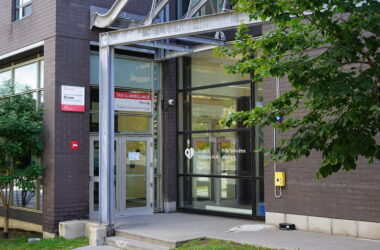
A proposed reorganization of the Blackader-Lauterman Library of Architecture and Art is in the works and may end up closing the service desk permanently.

Janine Schmidt, the Trenholme Director of Libraries, issued a document in May 2006 to McGill librarians that presented a plan to “close the service point of the library and leave the collection part unattended,” according to Marilyn Berger, the head librarian at Blackader-Lauterman. “She’s not clear on whether the study section will stay open or not,” she said.

The fate of the book collection is also unclear.

Blackader sits two floors above Redpath and serves students in Architecture, Art History and Communication Studies and Urban Planning. According to the library’s website, the staff answers roughly 10,000 reference questions every year. It goes on to note that over the years “the library staff [have] authored or collaborated on a number of specialized publications designed to improve access to material in the library and the architectural archives.”

Berger explained that Schmidt’s reorganization proposal was put on hold until the fall semester since many key parties would not be present during the summer.

“At the urging of Julie Cumming, the Chair of the Special Libraries Advisory Committee, the proper procedure [including student representation] had to be followed by bringing this to the Special Libraries Advisory Committee and the Senate Committee on Libraries,” she said. “So when this was presented at the end of May there was no way that any action could be taken, because of summer with faculty away and students not in attendance.”

Schmidt emphasized that no decisions had been finalized yet.

“It is difficult to summarize what is a complex proposal in a couple of sentences,” she said. “We are really looking to provide improved services to our users.”

However, the proposal has met resistance at many levels.

“Why she’s doing this we don’t know,” Berger said. “A task force has been appointed with representation from all three faculties that are served, because opposition was made known and we hope that they can change things. We’re supposed to meet regularly over the next 6 months and hopefully will come up with an alternative.”

Jennifer Bartoli, editor of the Art History Students’ Association journal, Canvas, said she favours the search for alternatives to closing the service portion of the library.

“AHSA is fighting to keep the Blackader library alive,” she said.

AHSA’s graduate student counterpart, the Art History and Communication Studies Graduate Students’ Association, is also involved in the library issue.

“The position of [AHCS-GSA] corresponds with the Department of Art History and Communication Studies position,” said Jessica Santone, an Art History PhD student and AHCS-GSA’s vice-president. “We are, on the whole, discontent with the current plans to close or decrease the availability of staff services in Blackader-Lauterman library.”

Santone said that AHCS-GSA had surveyed art history graduate students on the issue. She acknowledged the small sample size, but said that students were more interested in “improvements to the study space, resources and staffing than a cessation of these services.”

Pressed on the specifics of the plan, Schmidt said the printed materials would not be moved from their present location. However, she said that in the digital age the McGill library system would have to adapt.

“The kinds of library services we provide in an online era with a huge array of online information resources are dramatically different and we need to organize our services accordingly,” she said. “What is being proposed is really a change in the reporting lines and organization structure. There is much to discuss and the process of discussion has only just begun.”

Berger was hopeful that student concerns would be considered throughout the process.

“Students’ needs are important,” she said. “You’re paying for these libraries and for the access to information. Libraries are very much a part of students’ quality of life. And students here support their library, like no other generation has. I’ve been at McGill a long time, and this generation of students is amazing because of their involvement.”


News

Gross talks physics and the history of the universe

Can you construct a machine with free will? Will the universe accelerate forever? And how will the universe end? These were the questions that David Gross, winner of the 2004 Nobel Prize in Physics, addressed during his lecture at McGill on Thursday.

Born in Washington, D.C., Gross completed his undergraduate and master’s degrees at Hebrew University in Jerusalem before earning his PhD at the University of California, Berkeley in 1966. Gross received his Nobel Prize for his discovery of asymptotic freedom, a key contribution to quantum field theory. He is currently the director of the Institute for Theoretical Physics at the University of California, Santa Barbara.

In his lecture on Thursday, Gross briefly summarized what physics has accomplished over the last 50 years, highlighting physicists’ attempts to map out the history of the universe.

“The most important product of knowledge is ignorance,” said Gross, setting the stage for his discussion of current inquiries in theoretical physics and its related fields.

The question of what precisely happened in the moments after the Big Bang is a subject of particular interest to Gross, though he admitted that “nobody has the vaguest idea” of the answer.

“It is not just an interesting question of why, of curiosity, although that is enough motivation,” said Gross, who acknowledged that all previous attempts to answer the question have been either religious or philosophical. “But it’s a question that I, as a particle or string theorist, would like to know to tell my friends, the cosmologists, what happened at the Big Bang. They need to know in order to explain those variations in temperature that occurred a few hundred thousand years later that led to all of these galaxies that form a billion years later.”

In his lecture, Gross leaped between issues surrounding vacuums, quantum mechanics, string theory, space, time, and gravity, among various other topics, before segueing into an extended discussion of consciousness and biology.

“Is there a theory of biology?” Gross asked. “And even if there is a theory of biology, can theoretical physics have one? The answer to that is probably yes.”

For Gross, a theory of biology would only be a first step from which scientists could approach other questions, such as, “What are the mechanism and the principles that underline consciousness or memory?”

Those in attendance seemed to find Gross’s references to biology – specifically regarding scientists’ ability to measure the onset of consciousness in an infant, particularly – intriguing.

“His connection with biology was very interesting,” said Mahammed Myi, a PhD candidate in physics at McGill. “The notion that you can ask questions about consciousness the way you ask questions about physics is an extremely curious topic by itself.”

Martin Grant, dean of the Faculty of Science, who also specializes in theoretical physics, echoed Myi’s comments on the lecture.

“I thought it was great the way he played up the importance of interdisciplinary study, and the idea of biology and physics working together,” Grant said. “The tricks that we have in physics for understanding theories and developing models may be applicable to other areas as far as how the brain works, how evolution takes place, or how consciousness takes place.

After the lecture, Gross reflected on the issues he had brought up, saying that choosing his favourite question was like “choosing your favourite kid.”

“What I hope is that there were young people in the audience who think that physics is still interesting, that physics is alive and well,” Gross said. “I think the questions we ask today are interesting – more interesting than when I started out.”

News

McGill study finds Montreal still a long way from racial equality

Montreal is still a long way from racial equality, according to a recent study conducted by several professors at McGill’s School of Social Work. The comprehensive survey of the city’s black demographics found that black Montrealers make less money and are less likely to be employed than non-blacks.

On average, the unemployment rate for black Montrealers is 10.9 per cent, as opposed to 4 per cent for non-blacks. The poverty rate for blacks, at 39.2 per cent, is nearly twice as high as the rate for non-blacks, at 20.2 per cent.

The study also found that black Montrealers who have earned graduate degrees earn significantly less than non-blacks with similar qualifications. The average income for all black Montrealers is one-third less that the city’s average.

Though the study doesn’t draw explicit connections between inequality and racism, James Torczyner, a McGill professor of social work who is the study’s lead author, said that it was possible to read such links into the data.

“The census data doesn’t ask questions about attitudes, so I can’t say it’s because of racism in Canada,” Torczyner said. “But members of the black community are saying that.  They’re the ones who have experienced the data in their daily lives.”

Clarence Bayne, a professor of business at Concordia University who has also conducted research on the subject, said that both Torczyner’s numbers and those of other researchers tell a story of “clear, persistent, and almost brutal discrimination by the market against blacks and visible minorities.”

Other factors may contribute to the city’s racial inequality, however. About 60 per cent of black Montrealers are immigrants. In addition, the black community is more fragmented in Montreal, because members often have different heritages or speak different languages. 

“Because of the way Montreal is, you live in a neighbourhood where your language is spoken,” Torczyner said. “You’ll find French-speaking blacks in the east end and English-speaking blacks on the west end, so it divides it by geography as well as by language.”

According to Torczyner, this fragmentation may prevent the black community from addressing its pressing unemployment and income problems. 

“You take [the fragmentation], and you take a community that is growing so rapidly and the resources aren’t, [and] you end up with a proliferation of community groups in the black community with diminished funds,” Torczyner said.

In the short term, Torczyner said that he hopes he can help keep the city focussed on the issue.

“I would be very pleased if we could create a small organization led by members of the black community to be able to do what I’ve done now, and to be able to bring data to the community and to galvanize an agenda and to organize a strategy,” he said.

Tolu Adeniyi, one of Torczyner’s master’s students, called the study’s findings “shocking.” Although she might face an uphill battle as a black person with a graduate degree, Adeniyi said she remains optimistic. 

“It is discouraging, but at the same time, I’m not going to let it stop me,” she said.

News

Daily Publications Society narrowly passes $1 fee increase

The Daily Publications Society, which publishes The McGill Daily and Le Délit, passed its $1 fee increase on Thursday, with 51.3 per cent of students voting to increase the DPS’s non-opt-outable fee to $6 per semester.

Approximately 2,500 students, or 12.8 per cent of the undergraduate student body, voted in the election. According to Mike Vallo, the chief electoral officer of Elections McGill, the turnout was higher than that of the general elections in Fall 2008.

“Both [the Yes and the No] committees were really passionate,” Vallo said. “Everyone who voted was clearly on one side or the other, so I’m not surprised it was that close.”

Though the fee hike passed, the DPS’s slim margin of victory has focussed attention on students’ attitudes toward the Daily.

“I’m happy that the DPS is going to be financially sustainable for the future,” said Stephen Davis, the Daily’s coordinating editor. “But, at the same time, this brought to our attention a lot of work that needs to be done, and a lot of things we need to address in our coverage.”

Stéphanie Dufresne, the coordinating editor of Le Délit, echoed Davis’s comments on the DPS’s future.

“Of course, the DPS will have to take [the narrow margin] into consideration and find ways to address the criticisms that were voiced by the No committee,” Dufresne said. “[Now], we’re going to be able to use these resources to make the Daily and Le Délit more responsive to students, more open, and also to develop our web component.”

Allan Cyril, the No committee chairman, said that the committee raised several issues that the Daily needs to address, such as the lack of engineering- and science-related stories in the paper.

“I think we did inform people about what going on,” said Cyril, who was recently elected as next year’s vice-president internal of the Engineering Undergraduate Society. “I hope that the Daily takes this as a sign that some stuff that they’re doing doesn’t make the campus happy, and we’d like to see them reform.”

Max Halparin, the chairman of the DPS’s Board of Directors, expressed concern with the narrow margin of victory and the issues raised by the No committee. He argued that the No committee had inflamed an intolerant “anti-Daily sentiment” on campus.

“I think the No committee raised a lot of legitimate concerns, and then, unfortunately, raised a lot of offensive sentiment that was anti-Daily for not the greatest reasons,” Halparin said.

During the campaign, slogans such as “Say NO to Daily propaganda” appeared scrawled in chalk across campus walkways. Cyril maintained, however, that the No committee harboured no “anti-Daily” feelings.

“We aren’t trying to be oppositional to the Daily; we’re stakeholders in it as well,” Cyril said. “We’re part owners of the DPS. We just want to see a good campus newspaper. [But] for any type of fee increase, I think there should always be a No committee formed.”

For his part, Davis said that the Daily is already taking steps to address the concerns of the 48.5 per cent of students who voted against the fee increase.

“Truthfully, I don’t think we cover enough stories relating to engineers or science students,” he said. “We’ve already got four or five pitches that are going out on some of our listservs for writers to pick up that are stories specifically related to the Faculty of Engineering and the Faculty of Science.”

Off the Board, Opinion

OFF THE BOARD: The self-shot revolution

The bastard son of the 17th century’s commissioned works and the late 19th century’s photographic revolution, portraits are here to stay. We’ve all had one taken. Graduations. Weddings. Family Reunions. Selfies in the park. Sunday night webcam sessions. Blue Dog Friday night Canon-fests. And the elementary school photo. Throughout primary school, once a year, we were shuffled into the gym or library, one by one, to sit in front of the cameraman. And then with a flash bright enough to make our cheeks and forehead glow, we were immortalized in a wallet print you took home to your parents while they hemmed and hawed over purchasing photo package A or photo package B.

Photographic portraiture seems a strange practice of the 21st century when compared to its lofty origins. Portraits used to be elitist, available only to the wealthy. Depending on your level of affluence, you’d hire a traveling artist or a famous painter to visit your family and freeze you in time with canvas and oil paint. There was always room for artistic interpretation. Of course, a likeness was necessary, but a shadow here and a highlight there were the tools of the trade, drawing attention away from less-flattering aspects of the subject. Portraits got their first big break during the Renaissance, when Leonardo da Vinci painted “Mona Lisa” and Diego Velázquez painted “Las Meninas.” But it was really Vincent van Gogh and Paul Gauguin who paved the way for the ubiquitous self portrait.

The 19th-century invention of the daguerreotype, and later the wet collodion process – both revolutionary steps forward in photography – overhauled the lower echelons of portraiture. Portraits were soon available en masse to the general public through photographic prints. The industry ballooned outward, exponentially expanding with the introduction of the “Brownie,” one of the first inexpensive personal cameras. Portraits became the new hot topic in the artistic world. Black-and-white photography invaded the fashion world and Richard Avedon’s stylistic prints changed our perception of capturing the essence of a person through film.

The invention of the digital camera has changed portraiture and photography forever. Besides the fact that the digital single-lens reflex camera is the hottest new spring accessory, our online world had spurred the reinvention of the portrait. Those school photographers no longer toil in a dark room to develop images of cherubic, infantile cheeks, but spend their afternoons in front of their computer touching up acne spots and shiny foreheads with Photoshop. The price of a respectable digital camera has been cut in half in the last couple years, flooding the market with affordable choices for budding photographers. Today, we take a picture, manipulate it, and then post it for the world to see – perhaps as our Facebook or MySpace profile picture. Technology has given us the ability to choose how we depict ourselves. Our photographic histories are written instantaneously.

In the end, portraits have come full circle. Photography may have replaced painting as the choice method of remembrance for society’s upper tier, but professional work still comes with a weighty price tag. Martin Schoeller has made a name for himself through his portraiture work. His subjects spend 10 minutes in a white box-like structure with thousands of watts of light beaming onto them. With a click, Schoeller captures a signature white-light reflection on his subject’s iris. He has worked with everyone from Jack Nicholson to Heidi and Spencer (“Speidi”) Pratt.

It’s difficult to have a night out without it being captured on someone’s memory stick. Those who love to capture people on film are competing against every artistically inclined camera owner. Sure, your mom tells you they’re good, but when your index finger plunges down on the shutter button or your laptop-embedded webcam snaps a shot, what are you really thinking about? Do you really need another picture of yourself? Maybe you’re just projecting yet another interpretation of yourself – a little different from the one before – into the digital universe.

News

BASiC hosts Lander and Huh at annual Ampersand Conference

The Bachelor of Arts & Science Integrative Council hosted the second annual Ampersand Conference last week, which focussed on creativity in the digital age.

The four-day event featured addresses by Christian Lander, the founder of the popular blog Stuff White People Like, and Ben Huh, the internet entrepreneur who popularized Lolcats, as well as workshops on digitial innovation.

“We felt the theme of creativity in the digital age was relevant and interesting to students,” said Metz, who helped to organize the conference and also serves as the president of BASiC. “You just need to go a class in Leacock 132 and see people on their laptops to see how much digital media affects us.”

Lander, a McGill alumnus and former Tribune editor, opened the conference by speaking about the surprising success of Stuff White People Like. He started the humour blog using WordPress, an open-source publishing site, after he and a friend spent a night discussing how they didn’t trust any white people who didn’t watch HBO’s critically acclaimed crime drama The Wire.

“I was going after these upper-middle-class boomers, trying so desperately to believe they’re progressive,” Lander said. “I really wanted to make fun of that. I wanted to go after the pretentiousness of it.”

Some of his blog posts were inspired from his time at McGill, such as white people’s love of “Arts Degrees” and being able to “Study Abroad.” Other posts deal with issues of multiculturalism, including “Having Black Friends”.

“White people were trying to collect ethnic friends like they were Pokémon – unfortunately you couldn’t trade them,” Lander joked.

Since he started the blog in January 2008, Lander has published two books and has been a featured guest on The Early Show and Late Night with Conan O’Brien. Lander attributed the blog’s popularity to the accessibility of applications like WordPress.

“Most of the traffic hits were due to people sharing the blog through their own blog links, Facebook statuses, and IM away messages,” Lander said. “It was really interesting to see the blog grow without having to go through a journalism gatekeeper, such as needing a plug from a show or magazine. If you do something that really connects with people, all of this can happen really quickly because the barriers are gone.”

Huh closed the conference by discussing his experiences as the CEO of the Cheezburger Network, a group of 45 meme humour websites, some of which Huh purchased from their original owners. He stressed the importance of simplicity when running websites that centre on user interaction.

“Too often businesses try to make things more complicated,” Huh said. “You need to connect with your fan base. Apple released a phone that was five years behind in terms of features, but 10 years ahead in terms of usability.”

Two of the most famous Cheezburger Network sites are failblog.org, which features embarrassing “epic fail” moments, and icanhascheezburger.com, which combines captions with awkward photos and videos of cats – a concept known as Lolcats.

Huh acknowledged that purchasing a humour website that revolved around cats and fast food was an unprecedented move that carried financial risks.

“I had a well-paying job in Seattle I didn’t like, so I was looking to start up a company,” Huh said. “I realized this could be career suicide, but I wanted to do consumer related things. Our goal is to make people happy for five minutes a day.”

The Cheezburger Network depends on user interaction to make Huh’s goal a success. The sites depends on users who upload their own comedy pieces, re-caption others’ uploads, and provide immediate feedback. Huh believes that today’s internet celebrities benefit greatly from the rapid growth of the online humour industry.

“It’s almost like the business found us,” he said. “WordPress wasn’t available five years ago. But today, internet humour as a vehicle for cultural change is inevitable. One thing’s clear: there’s more untapped potential in the internet user base than in the professional writers, and we need to tap into this user base.”

Sports

MEN’S SOCCER: Redmen stutter to victory

With Sherbrooke having prevented the Redmen from reaching the playoffs in each of the last two seasons, it’s not difficult to imagine why this meeting was such a scrappy affair. And while it won’t erase the memories of post-season dreams dashed, McGill managed to exact a little revenge by edging out a 2-1 victory at Molson Stadium.

Despite sloppy play which resulted in a slew of giveaways and four yellow cards, the Redmen managed to eke out a narrow victory on Friday night. McGill dominated play throughout but struggled to bury its chances, needing an own goal by Sherbrooke defender Charles-David Racine to earn the win.

“I know, and the players know, that we can do a lot better than that,” said Head Coach Philippe Eullaffroy. “In terms of quality, it was a little bit disappointing-but we won, and that’s the most important thing. It’s very promising because we won while not playing very well.”

McGill opened the scoring in the 43rd minute when midfielder Alec Milne tapped in a deflection from inside the six yard box. The setup came off a corner which was flicked on by midfielder Olivier Brett through a crowd of defenders to a wide open Milne.

Vert et Or goaltender Elie Saint-Laurent was kept busy all night stopping six shots en route to earning himself player of the match honours. Despite being peppered early and often, Saint-Laurent managed to keep his team alive with big first half stops, especially off the foot of Shawn Amarasekera who found himself frustrated on two golden opportunities.

The Redmen would finally break through again in the 56th minute as striker James Scholefield took a throw-in and banked a low pass off Vert & Or defender Charles-David Racine into the net for a 2-0 lead.

Redmen take foot off the gas too earlyFrom there, McGill seemed to let up a bit, and almost allowed Sherbrooke to get back into the match. Despite rarely threatening the Redmen net, the Vert et Or almost scored a lucky goal in the 59th minute after McGill carelessly gave away possession in their own third. Defender Dominik Desbois was forced to clear the goal line with an impressive header.

Sherbrooke also took advantage of some complacent defending, playing a few solid through balls and using their speed in the latter part of the second half. Most notably in the 72nd minute, when substitute Guilhelm Couderc sprinted past the Redmen backline, forcing keeper Olivier Boulva to race out of the penalty area to save a loose ball.

Sherbrooke would finally get on the board in injury time on a goal from Adrien Durand but it would be too little too late.

“Our focus is an area we need to work on,” captain Daniel Jones said. “We need to maintain our focus for 90 minutes.”

In spite of fielding a very defensive 4-6-0 formation, the Redmen struggled in their own end, as poor positioning opened up gaps for Sherbrooke. McGill will need to work on playing in their own end if they hope to be competitive in tough upcoming fixtures against Concordia and Laval.

News

Barghouti postpones Canadian tour due to visa complications

A speaking tour of Canada by Mustafa Barghouti, a well-known peace activist and member of the Palestinian Legislative Council, was cancelled last week due to delays in the Canadian visa application process.

Barghouti, who finished second to Mahmoud Abbas in the 2005 Palestinian presidential election, had been set to visit Toronto, Ottawa, and Montreal – where he was scheduled to speak at the University of Montreal on March 21 – in a tour organized by Canadians for Justice and Peace in the Middle East. In Ottawa, Barghouti was scheduled to meet with members of the three Canadian opposition parties, some of whom called the offices of the foreign minister and the Department of Citizenship and Immigration in an effort to expedite the visa process.

According to a press release, CJPME attributed the delays to “a broader strategy to muzzle or obstruct any voice critical of the policies of the Israeli government.”

According to Grace Batchoun, a spokesperson for CJPME, the trip to Canada from Barghouti’s residence in Ramallah in the West Bank required that he cross into Jordan before flying overseas, as Palestinians cannot enter Tel Aviv to depart from Israel. When the visa was issued Friday, the night before Barghouti was scheduled to speak at the University of Toronto, Batchoun said, the Jordanian border and the Canadian mission were both closed for Shabbat.

“They decided to sort of trash our plan,” Batchoun said. “They didn’t want his message to come out.”

While Melanie Carkner, a spokesperson for the Department of Citizenship and Immigration, would not comment on this specific case, she explained some of the possible reasons for delays in visa application processes.

“Canadian officials do their utmost to complete visa applications in a timely manner when urgent situations arise, but in some cases, such as when information is incomplete or arrives at the last minute, this is not possible,” Carkner said. “A visa can be issued only when the complete application is received – and I’m giving you a hint here.”

Barghouti could not be reached for comment on the specifics of his case, but CJPME and the McGill University chapter of Solidarity for Palestinian Human Rights both noted that he had received prompt responses to visa applications in previous years, in one case receiving a visa less than 24 hours after applying to enter Canada from the United States. This year, however, he applied March 5 and was not granted a visa until two weeks later, on March 19. In a recent interview with The Toronto Star, Barghouti noted that this was odd, but refrained from blaming Prime Minister Stephen Harper’s government.

Jamal Daoud, a PhD candidate in biomedical engineering at McGill and a member of SPHR, which helped promote Barghouti’s visit to Montreal, said that while the reasons for the delay were unclear, he is worried about opportunities for open discussion in Canada.

“In the past year and a half, there has been a sort of limitation on free speech regarding the Middle East conflict,” Daoud said. “I’m worried. Canada has no problem bringing pro-conservative speakers like Ann Coulter.”

Bob Rae, a Liberal MP representing Toronto Centre who was scheduled to meet with Barghouti, confirmed that his office had made enquiries on Barghouti’s behalf.

“My understanding is that a visa was issued, but came too late to allow him to leave, which is unfortunate,” Rae wrote in an email to the Tribune.

Barghouti has now been issued a three-month visa, which will allow CJPME to reschedule Barghouti’s tour for sometime in May.

Sports

WOMEN’S SOCCER: Second half surge sinks Sherbrooke

The third ranked Martlets got off to a slow start in Friday night’s season opener at Molson Stadium. But a much stronger second half allowed them to escape with a 2-0 victory over the visiting Sherbrooke Vert et Or.

Neither side had been able to find any rhythm or assert itself during the first frame. But the second was a different story. Forward Magalie Kolker opened the scoring three minutes after the break, swinging the momentum in McGill’s favour. Defender Anna Gruending put the game away in the 68th minute with a fortuitous strike from long-range.

“I think we got off to a nervous start,” said Martlet captain Shari Fraser. “We were kicking the ball around and not really keeping it and playing our game.”

The best chance of the first half fell to McGill in the 22nd minute. A bouncing ball from a Martlet corner deflected straight to Fraser who, standing alone just outside the Sherbrooke six yard box, put her shot over the bar.

With McGill unable to capitalize, Sherbrooke grabbed the momentum and began to threaten the Martlet defence. Fraser more than made up for her earlier mistake in front of goal with a number of key defensive interventions that kept the Vert et Or attackers frustrated.

At the break, Head Coach Marc Mounicot knew that his Martlets were not playing up to their capabilities.

“It’s always a question for them to stay a little more composed,” Mounicot said. “I think they were a little bit nervous during the first half. We were not able to keep the ball and play our normal soccer”.

Cooler heads prevailThe Martlets opened the second half much more composed and they were quickly rewarded with a beautiful goal which more than made up for the drab performance up to that point. Midfielder Carolyne Pelletier managed to shake off a defender before whipping in an inch-perfect cross for Magalie Kolker who expertly headed the ball into the top left-hand corner of the net to put McGill ahead 1-0.

McGill doubled its lead on 68 minutes when a long ball pumped into the Sherbrooke area by Anna Gruending was misplayed by Sherbrooke keeper Marie-Michelle Coulomb. Coulomb allowed the ball to bounce over her head and into the net. While clearly not as pretty as the opener, the fact that McGill had controlled play throughout the half meant it was nonetheless deserved. McGill continued to dominate the rest of the way, maintaining possession and dictating play.

Lofty goalsThe game demonstrated that the Martlets have some areas which they need to work on if they hope to achieve their lofty goals for the season. Coach Mounicot singled out the relations between the midfield and the strikers as being one that needed improvement. Nevertheless, the team recognized the importance of opening with a win.

“It was really important,” Kolker said. “We’ve had a lot of goals right from the preseason: We want to win every game in the league and come out first to go to Nationals being one of the top teams. We also wanted no goals against so it was nice we had that outcome. It’s good momentum.”

Momentum which these Martlets hope to continue to build on all the way to the CIS Championships in Victoria.

News

Glazer discusses segregation, immigration, and education

Nathan Glazer, the prominent sociologist and professor emeritus at Harvard, delivered two lectures at McGill last week. Glazer is perhaps best known for Beyond the Melting Pot, a pioneering study of different ethnic groups in New York City that he co-authored with Daniel Patrick Moynihan in 1963. His first lecture last week dealt with the state of American race relations during Barack Obama’s presidency, while the second focussed on the role of public intellectuals in the modern era. The Tribune caught up with Glazer between his lectures to discuss America’s contemporary urban dilemmas.You were born to immigrant parents and grew up in working-class neighbourhoods in East Harlem and the Bronx. How did that experience shaped your academic views?I suppose it’s shaped my academic outlook in one respect. I do believe that the ordinary public schools, which I attended, provided opportunities for upward mobility and still do. In fact, they do so more than they used to because there are many more foundation-supported programs. I do feel that America provides opportunities, and in some ways, one needs the sort of reform within the black community that would make it possible to take more advantage of opportunities.

Can you tell me a bit about your experiences at City College in New York in the 1940s?City College was almost entirely populated by immigrant children. It had many virtues – one virtue was that it was free. Another virtue was that it was not a residential institution, so one could live at home. It was a ferment of political activity on the one hand with perfectly adequate academic standards on the other. It was a unique moment.

One of the interesting things you mentioned in your lecture was that, in many ways, the position of young black males in the U.S. has declined since the 1970s. Can you elaborate on that?Well, that’s what the figures seem to show. We’re talking about the non-college-going group, which is by far the large majority – particularly those who have not even gotten high school degrees, which may be one half of the young black male population. Their situation has declined and it has declined in particular, because the kind of jobs that were once available are just not there. The manufacturing jobs, which those without particular education or skills can take, [are being] replaced by service jobs.The figures do show that for blacks without high school diplomas, and even with high school diplomas, the percentage working is relatively small. It used to be close to two thirds with a job, and now it’s more like one third. In other words, certain elements of the black population are worse off than they were.

Is there a clear role for public policy in turning this around?It is clear what could help: better schooling and better outcomes in schooling for blacks. But despite many, many efforts at improving educational outcomes for blacks, overall progress has been very slow. We do have various kinds of small programs like charter schools and foundation-supported efforts. Intensive efforts have been made to bring blacks, and particularly black males, up to the level where they can go to college, and these programs have worked well. But they do require a lot of money, a lot of effort, [and]dedicated individuals, and we have not really found ways of multiplying them sufficiently [vis-à-vis the] public school, which for urban blacks has just not been successful.There’s also the remarkably high rate at which these young black males fall afoul of the law and serve prison terms or are put on probation. The percentages are phenomenal. Now, one answer is that we need alternatives to standard punishments in the form of imprisonment. There are alternatives, particularly for those who get involved in drug dealing in the inner cities … maybe the reform of American drug policy. On the whole, I think American drug policy has been unenlightened and overly punitive.

Much of your career has been devoted, in one form or another, to the study of American cities. What’s the greatest challenge facing American cities today?The greatest challenge is the problem of concentrated inner-city poverty and areas of mixed problems – primarily minority, and more significantly black than even Latino – that have been with us for a long time. We can do more to improve the American city by making progress in that area, difficult as it is, than by any other means.

– Compiled by Theo Meyer

Read the latest issue

Read the latest issue