

Latest News

Sports

To all the sports I’ve loved before: McGill athletes and sports fans share love letters to the sports they love most

Tillie Burlock, Managing Editor 

Dear baseball,

My bat mitzvah was a week away. As my soft spoken tutor, Aaron, desperately tried to get me to focus on my D’var Torah, the speech I would be delivering before an audience of family members and bored preteens, Jose Bautista stepped up to the plate. I convinced Aaron that I could multitask; writing the speech while watching Game 5 of the American League Division Series between the Blue Jays and the Texas Rangers. I lied. As Aaron tried to draw me back to the kitchen table, I stood in the living room, riveted to the TV, watching as Bautista sent the Skydome into pure and utter chaos with the infamous bat-flip that would hook me on baseball for years to come. 

In the eight years that followed, I struggled to find my way playing on all-boys teams, attempting to figure out exactly how I fit in. The seasons from eighth to 10th grade were marred by constant teasing, being left out of the team group chat, and the snide whispers of parents who couldn’t figure out why I was taking away playing time from their son, obviously destined to play professionally. But thirteen- and fourteen-year-old me didn’t care. No amount of being called a bitch to my face or behind my back diminished my love for the smell of wet grass at an early morning practice or the strange satisfaction of seeing the seams come up on a bruise from blocking a ball in the dirt. 

Attending a high-performance school for sport when I was 16, I found myself in a situation where a coach twice my age pushed me out of a training facility that had once been my happy place. I suppose my flirty teenage personality led this coach to believe I was interested in him not as a coach, but as something more. The motivations of the coaches I had worked with quickly became blurred. When I turned 18, I was fair game, as they say, and coaches who I hadn’t heard from in years reached out, trying to connect in a way that felt so wrong, distorting my perception of what all those years of hard work had truly meant. As I matured, baseball quickly became a place of discomfort. I love you baseball, but not like that.

In 2022, my relationship to baseball changed again. That summer, I worked as a scout—a scouting intern as it were—and re-asserted myself in the very spaces that I felt alienated from when I was a younger girl. Occasionally, an older scout would ask my co-workers which one of them was sleeping with me, never letting me forget that my acceptance in baseball was conditional. I watched with jealousy as 16-year-old boys unselfconsciously fielded ground balls, free from the assumption that their presence on the field had anything to do with their gender or sexuality. My male co-workers looked on beside me, shielding me from the comments made just out of earshot, yet, watching from the place of comfort I longed to be part of. 

Now, four years removed from my playing days, I wonder what my life may have been like if I had never fallen in love with you, baseball. Would I have made my way in a sport better equipped to accept women? Maybe one that does not employ an abundance of domestic abusers at its highest level? Maybe one that would have been easier to love. 

I still love you, baseball. In spite of the complexity, the diamond will always feel like home. 

      Yours, 

      Tillie

Peter James Cocks, Contributor 

Dear my darling football,

You have been by my side my entire life. I have known you since my first steps, darting through the kitchen whilst my mother tried marking me from threatening corners. You introduced me to my first friends with the evergreen pickup line “What team do you support?” followed by hours of kickabouts, pointless nattering and a lifetime of friendship. Even now, there are few friends I can point to who didn’t come my way via football. And no, America, the bludgeoned sport you play with an egg is not ‘football’.

Even your cold concrete terraces have kept me comfortable through all these years, standing shoulder-to-shoulder with the legions watching loss after loss. There’s a warmth in them, a fiery hope that one day we can return to the pub for a pint of lager to break the streak of consolation bitters. Even the deadened discussion over whether playing three at the back is outdated in today’s game gifts me an embracing escape from the monotony of life. 

People say you’re unpredictable; I disagree. 

I don’t know if I’ll go to my lectures; I don’t know when I’ll get around to doing my week’s shopping. But I sure as hell know when Chelsea is playing. Battling to find a video stream, to summon the energy for hope, to pray my mood is better in 90 minutes. To this day I can identify key moments of my life—anniversaries, hospital visits and deaths—by the football calendar encased in my brain. Call me a sad-case or obsessed, I simply do not care. You have been the one constant of my life, and I know I am not alone.

What other sport can entrance more than half the world for its finals, capture the audience of the UN General Assembly, command an army of die-hard lovers across every continent? 

Football can, and always will be, the world’s sport. All you need is two jumpers and a ball.

      Love forever more,

      Peter James Cocks.

Suzanna Graham, Arts and Entertainment Editor

Dear Cross Country,

I miss you. I remember the first time we met—I was a naive girl in a dress running toward a chalk line in the dirt a half mile away. My legs held no muscle then (and my arms still don’t). I remember feeling the wind floating through what was left of my thin ponytail and I knew: You were the one, my one.

It’s been 16 years since that first meeting. We don’t talk every day anymore. I still love you. Maybe the timing wasn’t right, or maybe I got lost in my head, seeing you as a punishment rather than a gift. Sometimes I think we should talk more. But I still see your influence. I see you when I look at myself in the mirror. The strength in my thighs and calves. The way I fix my gaze at an obstacle, and beat it. The drive to win—if only to impress myself. 

We haven’t always been exclusive. I’ve flirted with basketball, frisbee, and skiing. But during every other sport, I thought of you. Playing basketball, I thought of your shin splints, and iced my shins and knees after every game. In frisbee, I used your finishing kick to score the winning point. While skiing, I channeled your endurance that I’d finally earned, to push myself across kilometeres of vast snow. I’m not sure I always wanted you to be my forever. At this point, I don’t think I have a choice. It’s always been you.

I was five when I ran that first race in my dress, thinking I’d die after a cool half mile. I was fourteen when I competed at the state championship—and had qualified all on my own. I was seventeen when I left competitive cross country. Two days ago I was 21, running amid ice and snow for the sole purpose of fulfilling my own drive. I imagine myself at 60, with grey hair and new runners, running alongside a dog and hoping to avoid my family’s hereditary bad knees. You’re always there––always.

Maybe our love isn’t a quick, fiery burn. Maybe our time isn’t up. Maybe they were right when they said love is a marathon not a sprint. Maybe I’m not sure who //they// are, but I know you. And I know that in the marathon of life, I’m still running. And you’ll be at the finish line, cheering me on. 

      All my love,

      Suzanna

Megan Belrose, Contributor 

Dear Basketball, 

When I was three years old, my parents bought my brothers and me a Little Tikes basketball net. The rest was history. You were the first sport I knew and loved. My dad is a huge fan—really, I think he has the largest collection of Golden State Warrior shirts on the planet—and he instilled a passion for the sport in me. Basketball became a way for me to spend time with my family, whether that be playing pickup in the back lane or just sitting down to watch an NBA game. 

In high school, basketball was a welcome escape from the monotony of the classroom. Nothing quite compares to the atmosphere on the court when my team was fighting for a win. The feeling of community, the exhilaration when a basket falls, and the endless hours spent practicing in gyms are aspects of the game I’ll remember forever. 

I helped coach intermediate girls teams at my high school, and despite the hard work, I never wanted to stop. I loved seeing the elation on a player’s face after they made their first basket of the season. It reminded me of how it felt to play when I was their age, when every degree of improvement made me feel like I was walking on clouds.

The professional sport is another level entirely. I’ve been lucky enough to go to NBA games, and the physicality, drama, and passion are unmatched. There are moments of the game where you can’t help but hold your breath, knowing the fate of your team hinges on which way the basketball bounces. I love those moments more than anything.

Basketball is fun. I love every part of it, and the game has been and will continue to be an important part of my life. 

      Yours, 

      Megan

Campus Spotlight, Student Life

Word on the Y: Awkward, sad, and cute romantic moments at McGill

With chocolate boxes at every store, roses lining the windows of florists, and people blushing as their crushes awkwardly ask if they’re free on the 14th, Valentine’s Day is right around the corner. To all those happy couples or new Valentines, I wish you a lovey-dovey day, but for those who are dreading this Wednesday or waiting for the discount chocolate boxes, maybe you’ll appreciate this mix of awkward, sad, and cute romantic moments at McGill. With the former two being the most popular responses I received, I have to ask: McGill, where is the love?

The Happy Couple

“I played a gig here in Montreal, actually, my first gig in that band, and my girlfriend brought me flowers and hid them until the end. It was one of the sweetest things someone’s ever done for me—of course, we met at McGill.” — Wes Norton, U2 Arts

A Foiled Confession of Love

“One of my best friends one day suggested I should study with her twin brother because he’s in the same program as me. It wasn’t a setup or anything. I mean I wasn’t looking for love. Before I knew it, I had a crush on him, which I proceeded to ignore. The thing is, finals season came and I couldn’t take it anymore! Keeping the feelings in was adding too much to my stress, and this boy was making me unfocused. I needed to tell him and get over it, so I made a plan to tell him after class. My heart was racing and I had all this adrenaline and then right as I was about to tell him, my friend—his sister—came walking up to us, having finished a test early. Just like that all my mental psyching myself up and my plan went out the window. I was disappointed. I mean, I said it eventually, but I think it’s funny how the timing played out.” — Anonymous

A Short and Sweet Horror Story

“One man was involved with both me and my best friend at the same time and neither of us knew.” — Anonymous

A Failed Case of Friends to Lovers

“There was this guy I had been friends with for a while, since res, and this semester he started leaving hints, and his friends made it clear he was down. I didn’t know if I wanted to do anything about it, but after a month, I realized maybe I did feel that way and I should give it a chance. We started hanging out, and it was cute. We studied in the library a couple of times and got food together. A couple of weeks in when things didn’t progress, I expressed that I wasn’t looking for casual, and if that’s not what he wanted, we should end things. He spent the next 45 minutes convincing me he didn’t want casual but just wanted to take it slow. Sounds kind of romantic, right? 

Yeah, until after a week of hanging out, he texts me, ‘Can we go for a walk?’ and proceeds to tell me on this walk that he doesn’t know what he wants so he can’t continue seeing me. As you can expect I didn’t take this well. I mean I tried to break up with him a week before, but, no, he had convinced me he wanted more! I’m just upset he compromised a friendship, and now when we see each other at every friend event it’s awkward. The most annoying part is that he’s a nice guy who was simply confused. UGH—basically, don’t waste people’s time!” — Anonymous

Romantic Holidays

“There was a guy I had been seeing casually, and I was texting him one day, and it came up that it was International Women’s Day. Later he asked to meet up and when I arrived, there he was with a bunch of flowers. I have to admit, it was sweet.”  — Anonymous

This piece was updated at 12:28 p.m. on Feb 14th.

Arts & Entertainment, Music

At the Grammys, Black artists continue to go unrewarded in the major categories

Every year, the Grammy Awards accompany the periodic discussion around their failure to celebrate Black artists, and this year is no exception. Jay-Z’s acceptance speech for the Dr. Dre Global Impact Award called out this disappointing pattern in the Grammys. He noted how, despite Beyoncé being the most awarded artist in the Grammys’ history with 32 awards, she has consistently been snubbed for what is arguably the most prestigious and coveted award: Album of the Year (AOTY).  

Throughout Beyoncé’s solo career, she has been nominated for AOTY four times. Most recently, she was nominated for Renaissance at last year’s awards, which lost to Harry StylesHarry’s House. Renaissance was by far the most deserving album, and arguably one of Beyoncé’s best albums to date. It served as a stunning homage to club culture that Black women and queer, trans-Black, Latinx people created as a safe place. In 2016, Beyoncé was also snubbed in this category when Lemonade lost to Adele’s 25. Adele spent most of her acceptance speech saying how she felt that Beyoncé deserved to win and remarking on the album’s important message of empowering Black women. Lemonade was more than just great music—it uplifted a marginalized and oppressed community. 

However, the message of Jay-Z’s speech extends beyond Beyoncé. It highlights how the Grammys have continuously refused to celebrate Black excellence in the major categories: Song, Record, and AOTY. Altogether, only 11 Black artists have won AOTY, with only four of those awarded in the past 20 years. It has been 25 years since a Black woman won the award, with Lauryn Hill for The Miseducation of Lauryn Hill in 1999, which is only the third instance of AOTY being awarded to a Black woman. This lack of recognition emphasizes a systemic issue in the award process and its voting body.

While the Grammys have made some changes regarding this situation, such as renaming the Urban Contemporary category to Progressive R&B due to the racist history and connotations with the word “urban,” they have been unsuccessful at addressing the root of the issue. SZA’s wins at this year’s awards stress how the Grammys still have a long way to go in properly addressing these problems. 

SZA’s win in Best Progressive R&B Album highlights that the deeper problem with the category is its existence. In 2020, Tyler, the Creator described the issue perfectly when he said, “Why can’t we just be in pop?” This category pushes Black artists outside of the pop category and perpetuates the racist falsity that pop music is a white genre. Rather, pop music—like so many genres—is indebted to the work of Black artists. 

SZA’s win with Phoebe Bridgers for Best Pop Duo/Group Performance for “Ghost in the Machine” shows that the Grammys will only recognize SZA’s music as “pop” when it is attached to whiteness. This treatment of Black artists in pop music is ingrained in the genre’s history, in which white artists co-opted and then popularized sounds that Black artists pioneered. We see this today with other predominantly white genres like country, exemplified by the success of Luke Combs’ cover of Tracy Chapman’s “Fast Car.” 

Despite this disappointing trend, this year’s Grammys still had great moments that celebrated the contribution of Black artists to the music industry. For instance, Best African Music Performance, a new category awarded to South African coloured artist Tyla, showcases the international impact of African music alongside Nigerian artist Burna Boy’s performance. Performances by SZA, Tracy Chapman, Stevie Wonder, Jon Batiste, Travis Scott, and Fantasia Barrino’s tribute to Tina Turner were all great displays of Black artists’ exceptional talents. If the Grammys want to provide meaningful change to their treatment of Black artists, they must celebrate their excellence by awarding them for their work in the major categories, not just the genre categories.

McGill, News

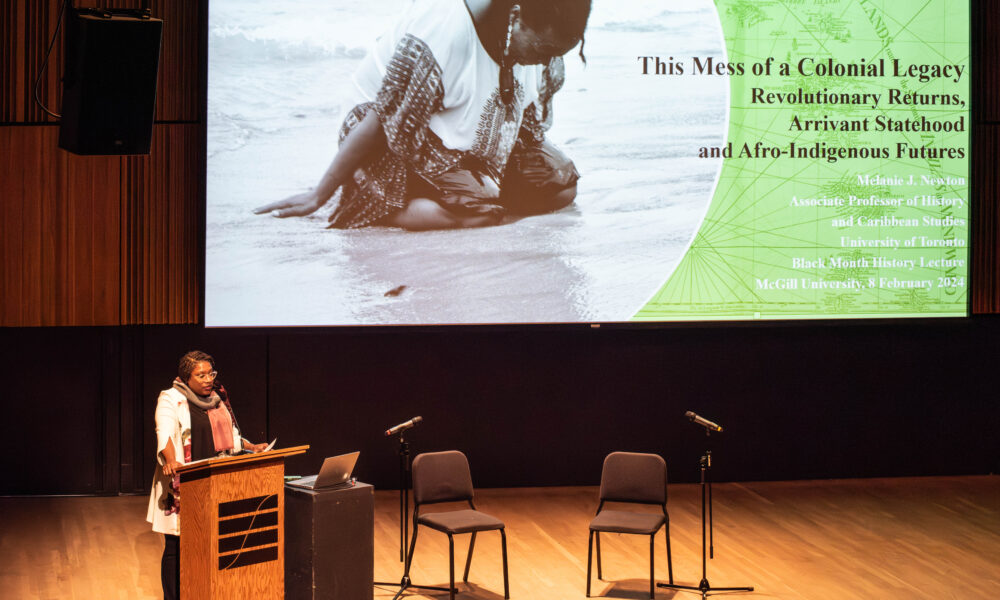
Melanie J. Newton delivers annual Black History Month Keynote Lecture on reparative justice and Afro-Indigenous histories

Students, alumni, staff, and Montrealers congregated in the Elizabeth Wirth Music Building on Feb. 8 to attend McGill’s eighth annual Black History Month Keynote Lecture, featuring Melanie J. Newton, Associate Professor in the Department of History and Graduate Associate Chair at University of Toronto. The McGill alumna, Rhodes Scholar, and former Coordinating Editor of The McGill Daily delivered her speech titled “This Mess of a Colonial Legacy: Revolutionary Returns, Arrivant Statehood, and Afro-Indigenous Futures,” inspiring the audience to build a more equitable future by reinvigorating the possibilities of Afro-Indigenous solidarity denied by colonial rule. 

Newton’s presentation centred around the Garifuna—an Afro-Indigenous people from the Lesser Antilles—and their experience of European colonialism, in which imperial systems of power intertwined their histories with those of the Black enslaved people violently relocated to their land. Newton explained that Afro-Indigenous communities experienced “colonial shatter,” where the management of identity obfuscates claims to land, enables genocide, and places Indigeneity and Blackness as diametrically opposed to one another. Newton stressed that, to this day, Black nationalism within the Antilles continues to mobilize on the understanding that the people native to the land are extinct, just as they petition for direct recognition of their right to land in Belize with the Indigenous Maya people. 

“In Suriname, Trinidad and Tobago, Jamaica, Guyana, St. Vincent, and Belize, Indigenous and Afro-Indigenous communities have all fought, are engaged with legal battles against their national governments, who often do not have any constitutional or legislative recognition of Indigenous peoples within their jurisdictions,” Newton said.

However, Newton also affirmed that Caribbean states can act against this injustice through Caricom’s 10-point plan for reparatory justice—a plan that compels former colonial powers to apologize to African nations and provide them with sustainable development support and reparations. The plan seeks to create a future where Indigenous peoples like the Garifuna can return to their land through systems of reparative justice and coexist alongside their Black neighbours, a society that colonialism denied. Newton referred to this future structure as an “arrivant statehood,” through which Caribbean states must take decisive action for success. 

During the question and answer portion of the event, Newton also spoke to how, as a student of German and British imperial history and eventually as a teacher, erasure so often operates through the classroom.

“I remember there was this one class I’ll never forget, this it was 2004, and there was this […] Mohawk student, she always sat in the front, she was so keeen she was so interested,” Newton said. “But I had also learned all of those narratives about you know sort of Indigenous people having all been killed and so on. When I first started teaching here in Canada, I’d see my students writing using the word ‘natives’ in their papers and I would circle it and say ‘who’s native to the Caribbean, who’s Indigenous in the Caribbean?’ Then I’m like ‘where the hell are they getting this stuff from?’ and I’m realizing, it’s coming from the stuff I’m teaching. I want to think about this differently.”

Inaara Ismail, a first-year master’s student in Science and Public Health, was intrigued by an opportunity to reflect on her knowledge of colonialism from an Indigenous perspective. 

“Hearing that from a different perspective and seeing what can be done to address barriers that still exist [….] Part of it was also in support of solidarity, being from an ethnic minority myself, wanting to support other people of colour,” Ismail said.

For other attendees, like Donalee, a McGill alum practicing social work who preferred to be referred to by only their first name, Newton’s speech was an awaited moment of reprieve. Donalee emphasized that Black History Month at McGill serves as an opportunity for community building in a fashion that work and academic environments do not offer. 

“I like being around other Black community members […] [to] see people that I know [….] It does bring something to me that I can’t always get outside of the nine-to-five, and other commitments, to even just be in this space where you can feel comfortable,” Donalee said. 

Newton ended her speech on a note recognizing adversity, but also possibility, saying, “There is a different future coming. What it looks like, I cannot say.”

Behind the Bench, Sports

A costly renovation of the Olympic Stadium benefits nobody

If Quebecers thought a $7 million handout for the Los Angeles Kings to play some preseason games in Quebec City was insulting, here comes the latest public sports subsidy fiasco. In an announcement on Feb. 5, Quebec tourism minister Caroline Proulx handed taxpayers an $870 million bill for the replacement of the Olympic Stadium’s roof and technical ring. This decision surely made the organizers of the next MonsterTruck Spectacular show breathe a sigh of relief. The costly renovation is deemed necessary, given that the Big O’s current roof has 20,000 holes and that three-centimetres worth of snow accumulation on the roof presents a safety concern so large that events must be cancelled. According to Proulx, the stadium could be forced to close permanently if action is not taken swiftly. An $870 million question remains: Who benefits from the renovation?

It will not be the Alouettes, Montreal’s Canadian Football League (CFL) team. The Big O has clipped the Alouettes’ wings more than once. During the Olympic Stadium’s time as the Alouettes’ home, the stadium’s high capacity made attendance seem sparse, creating a poor environment for players and fans alike. Attendance declined and the Alouettes eventually folded in 1987. When the CFL returned to the Olympic Stadium in 1996, attendance issues continued to plague the team. As fate would have it, a U2 concert in 1997 forced the Alouettes to move a home game to Percival Molson Stadium. The team decided to move to McGill’s campus permanently starting in 1998, at which point attendance numbers and interest in the team grew.  

CF Montréal, the local Major League Soccer team, will not benefit from this decision either. In 2008, CF Montréal, then named the Montreal Impact, christened Stade Saputo, an intimate, outdoor, soccer-specific stadium just steps away from the Big O. The club is quite fond of its stadium; ownership is currently planning to winterize the venue, allowing for games to be played there during colder months à la Commonwealth Stadium and BMO Field. It would be reasonable to expect that they would not be looking to renovate their facilities if they had any plans of playing in the concrete monstrosity within spitting distance of their current home. 

This will also not help Montreal get a Major League Baseball (MLB) team back in town. That, however, was always a pipedream. The stadium was never suited for baseball, despite the architects’ best efforts in the original design process. There is, however, a sad irony on the baseball front: In 1998, former Quebec Premier Lucien Bouchard refused to provide government funding for a proposed downtown ballpark for the Expos. He argued that it would be unwise to commit public funds to the construction of a stadium when the healthcare system was stretched thin and he was being forced to close hospitals. This time around, the provincial government has decided to subsidize the overhaul of a stadium that does not have a primary tenant. At least the situation in hospitals has gotten better, right?

When public subsidies are discussed for professional sports teams, there seems to always be a shouting match about whether governments should contribute to billionaire owners’ dreams for a shiny new facility. After all, when these owners have the means to build these venues on their own, why should taxpayers foot the bill? Then, the owner’s response is usually to threaten to relocate the team if local governments refuse to play ball. It’s a decades-old extortion tale. Of course, in the aforementioned scam, taxpayers at least get to catch a game after their government gets ripped off by the local team owner. In this case, Montrealers will have the unique privilege of being able to attend the Electric Vehicle Trade Show or the MonsterTruck Spectacular; events that could easily take place at Palais des congrès or the Bell Centre. It would be difficult to put a price tag on that, but Caroline Proulx just did: It’s $870 million. 

There is, of course, the possibility that the Olympic Stadium, once renovated, will be an appealing venue to our local sports teams. It’s possible that big-ticket acts such as Taylor Swift will want to perform there once a new roof is installed and the faulty acoustics are fixed. And it’s even possible that this new roof will be able to safely support more than three centimetres of snow. For the sake of the public’s tax money and our collective civic pride, let’s all cross our fingers for that sequence of events to unfold. In the meantime, please mind the falling concrete chunks in the parking lot.

All figures mentioned are in CAD.

Arts & Entertainment, Music

GQ magazine’s absorption of Pitchfork is devastating for diversity in music journalism

Gentlemen’s Quarterly (GQ), the men’s fashion and lifestyle magazine, has absorbed one of music’s most influential journalism outlets, Pitchfork. Condé Nast, the parent company of both GQ and Pitchfork, is the driving force behind this move. Publicly announced on Jan. 17, this move came as a shock to the publication’s staff. With massive layoffs and concerns of music as a hobby primarily for men, as a result of GQ’s label as a men’s magazine, this change will undoubtedly have far-reaching consequences for the music journalism industry.

Pitchfork, which covers almost everything music-related, started as a small blog focused on reviewing, interviewing, and covering mostly alternative and indie artists. After the mass media conglomerate Condé Nast acquired Pitchfork back in 2015, they expanded their coverage to include a much wider range of music genres. They also began focusing more on investigative journalism in the music community, which paved the way for their breaking coverage of sexual assault allegations against Arcade Fire’s lead singer Win Butler in 2022. 

Their fame, however, can be partially accredited to their blunt review style and hyper-specific ratings; rather than using the typical five-star scale, the outlet scores albums on a decimal scale from 0.0 to 10.0. Getting a perfect 10 on a Pitchfork review—which is almost impossible, unless you’re Radiohead—could absolutely change an artist’s life through an album’s success thanks to Pitchfork’s platform and recognizability. 

With GQ being a magazine mostly focused on kitschy style ideas for men, the absorption of Pitchfork raises fears that the music publication will lose its authenticity and edge. Part of Pitchfork’s charm is its unyielding honesty. No Pitchfork article shies away from its author’s opinions, even when its publication could be a detriment to an artist’s career. Could GQ’s cookie-cutter image force Pitchfork to abandon its blunt style? Will Pitchfork start being overly forgiving of the cheesy mall music that they usually trash? 

The absorption also presents a major blow to the diversity Pitchfork previously brought to music journalism. Over the years, a large number of mostly women and non-binary editors at Pitchfork have worked hard to create a gender-inclusive magazine. This extends to both what they write about and within their staff, mirroring the broader music industry, which is far from homogenous. Additionally, they have made considerable efforts to hire people of colour, especially as the industry of both music and music journalism has been dominated by white men for years. With Puja Patel being Pitchfork’s first female Editor-in-Chief, she paved the way not just for women in the industry, but especially for women of colour. Patel is the most notable of Pitchfork’s staffers to be laid off during this current move; though we may not be seeing it yet, the industry will feel the consequences of her layoff in the years to come. 

The idea of Pitchfork becoming a magazine under the wing of a men’s lifestyle magazine reinforces the boys’ club mentality present in much of music and music journalism alike. Not only does this ignore that music is a universally appreciated art form, but it is also a major step backward for both the industry. This absorption reinforces antiquated ideas that music should only be for men. Former Pitchfork Features Editor Jill Mapes, who was also laid off with the announcement of GQ’s absorption, posted a tweet on X, formerly Twitter, expressing her frustration with these exact issues: “After nearly 8 yrs, mass layoffs got me. glad we could spend that time trying to make it a less dude-ish place just for GQ to end up at the helm.” With Condé Nast laying off some of Pitchfork’s most prominent women editors, this is further proving that the move to GQ will remove the diverse interests of Pitchfork and transform it into a new variation of the men’s magazine. 

McGill, Montreal, News

McGill holds roundtable to discuss the sustainability and design of New Vic Project

On Feb. 9, McGill held a virtual roundtable discussion on its New Vic Project, hosted by Provost and Executive Vice President (Academic) Christopher Manfredi. The New Vic Project is the subject of an ongoing investigation prompted by a lawsuit that the Kanien’kehá:ka Kahnistensera (Mohawk Mothers) filed against McGill, the Société québécoise des infrastructures (SQI), the Royal Victoria Hospital (RVH), the City of Montreal, and the Attorney General of Canada over concerns about potential unmarked Indigenous graves on the project site. Members of Settler Solidarity—a group formed to support the Mohawk Mothers—held a simultaneous virtual screening of the university’s roundtable, with the Mothers present. After McGill’s event, the Mothers engaged in a discussion with the students and various stakeholders present at the Settler Solidarity screening, pointing out that McGill had cherrypicked the questions they answered. 

McGill Director of Institutional Communications Michel Proulx moderated McGill’s presentation, which began with a brief land acknowledgment followed by an introduction to the speakers of the event: President Deep Saini; Christopher Buddle, Associate Provost, Teaching and Academic Planning and Academic Lead for the New Vic Project; Pierre Major, Executive Director of the New Vic Project; Bruce Lennox, Dean of the Faculty of Science and New Vic Academic Design Lead; and Viviane Yargeau, Dean of the Faculty of Engineering. 

Saini welcomed the over 200 audience members, after which Major presented the project’s footprint and design. He shared that the building is both a historical meeting site for Indigenous peoples and an opportunity to tackle the space deficit problem at McGill. Major touched on the design of the project, saying that it is in line with McGill’s commitment to reconciliation with Indigenous communities. According to Major, there have been over 50 meetings with Indigenous stakeholders, several co-creation workshops, and roundtable sessions with Indigenous elders. These meetings resulted in several ideas for physical representations of Indigeneity in and around the buildings, such as highlighting the idea of basket-weaving through the ceilings and incorporating Indigenous-designed sculptures. He then spoke about the concerns over the university’s handling of the ongoing investigation into the former Royal Victoria Hospital site. 

 “We have endeavoured to keep our community apprised of our methods and outcomes of this work and have maintained a comprehensive FAQs page on the New Vic project website and have provided regular updates via email,” Major said. 

Major asserted that the court was right to hear McGill’s appeal of Justice Gregory Moore’s Nov. 20 decision to reinstate the court-appointed archaeological panel that oversaw the investigation. He believes the panel’s mandate was carried out and, thus, the panel rightfully dissolved. McGill and SQI both appealed the Nov. decision because, in their view, the judgement had contained legal and palpable errors. He concluded by urging people to read their FAQs page for more information.

As the presentation concluded, the meeting entered a question and answer period, during which the speakers answered questions that audience members had submitted in advance. The questions pertained to pedestrian traffic, specific sustainability initiatives, consultations with Indigenous faculty, and accessibility. 

After the discussion wrapped up, the Mothers shared their thoughts about the roundtable in the virtual meeting they had screened the roundtable. Mohawk Mother Kwetiio expressed that she found that there was no care given to the possibility of there being graves on the site. Additionally, Kwetiio pointed out that not all submitted questions had been answered, and that the administration had cherry-picked the questions they answered. 

“They’re just talking about [the] Quebec restoration of that building. That’s what’s important to them,” Kwetiio said. “So nothing there was talked about. So they’re not taking it seriously. There’s total denialism going on.” 

Kwetiio additionally stressed the importance of the Mothers having an open forum discussion with students in order to present them with the facts of the case. Mohawk Mother Kahentinetha echoed this sentiment and pointed to the challenge students must take on to educate themselves on the realities of the case. 

“We’re in court […] but we would like you to stand with us. Stand with us by knowing the history, knowing what’s going on right now [….] And what is your reaction to what you’re finding out?,” Kahentientha said. “It is up to you to start looking around and finding out the truth.”

All Things Academic, Student Life

Brilliance on display: TEDxMcGill

Peering into Le National on Feb. 4, one entered a world of spinning red and blue lights, mixing as they bounced off celebratory balloons. The audience in the antique theatre hushed as the TEDxMcGill event began. The one-day conference, dubbed “Kaleidoscope,” was the latest showcase of the annual TEDx event initiated in 2009.

“With Kaleidoscope, we tried to put in really unique, personal perspectives to open the door for all kinds of interests. It’s meant to encourage a kaleidoscope of ideas, identities, and people,” Chelsea Wang, U3 Arts and TEDxMcGill Chair, said in an interview with The Tribune.

The stories ranged from the importance of mental health to limiting greenhouse gas emissions, highlighting personal, global, and social issues. Each of the eight presenters connected their topic to the McGill community, empowering the audience to make small differences in their own lives. 

“We have a really strong speaker batch this year. You can tell that they are incredibly passionate about what they are talking about. Even if it’s topics that I wouldn’t even think were interesting, [after hearing them], I’m interested now,” Hanna Eik, U3 Arts and TEDxMcGill Memberships Coordinator, said in an interview with The Tribune before the event.

Many talks highlighted challenges that were particularly relevant to students. Elaine Xiao, U2 Science and the first speaker of the day, shared her story about the consequences of burnout and emphasized how vital it is for students and young professionals to reevaluate their expense of time and energy. 

Xiao noted that we all have spoons of energy to give, and if you “give away all your spoons, you will have none left for yourself.” 

On another side of academia, McGill philosophy professor Oran Magal advocated for expanding the philosophical canon to recognize more Eastern philosophies, so we can teach diverse ideas and philosophies—like the TEDx event does.

Some speakers at the event focused on combating gender norms. Nicholas Chomsky, U0 Arts and Science, opened up about how traditional masculinity has negatively impacted his mental health and often prevents men from reaching out for help. He advocated for redefining masculinity to include the value of discussing emotions openly. Chomsky also expressed the importance of creating safe spaces with friends and family to help break down those barriers. 

Nithya Mahasenan, U1 Management, discussed the pressure placed on women in the workplace to compete not only against their male colleagues but especially against other women. She broke down the perception that women must hide or amplify their femininity for work and advocated for a “gender-neutral workplace” to allow women an equitable way to advance professionally. 

Ramiro Almeida and Ryan Chen, CEO and COO of TRAM Global Inc., a Miami-based technology company dedicated to reducing carbon emissions, spoke about reducing our environmental impact. Walking and taking the metro, they say, are some of the best ways to lower our carbon footprint. While not affiliated with McGill, they came to inspire the McGill community to take action against the changing climate.

Bradley Crocker, PhD student and lecturer in Kinesiology, described using eye-tracking technology to measure how people consume health information. 

“[Crocker is] using his own research to explain how two people can be looking at the same website and interpret it very differently,” Eik noted.

The event also featured two performances from local artists: Kreation Montreal lit up the stage with an upbeat K-pop dance cover, and McGill students Desola Ogunlade and Lily Mason, both U3 Arts, delivered a heart-melting vocal performance.

According to Wang, applications to become a TEDxMcGill speaker for the 2025 conference will open next fall. 

“There isn’t really a profile that you have to fit,” Wang explained. “It’s really just about the ideas you have and your ability to relate it to a popular audience. That’s another thing that I think is really wonderful about TEDx: Everyone that has something to say is equal on the stage.”

Lily Mason is an editor at The Tribune. She was not involved in the writing or editing of this piece.

McGill, News

Board of Governors discusses Saini’s meeting with Legault, EDI at McGill, and divestment from fossil fuels

On Thursday, Feb. 8 the McGill Board of Governors (BoG) convened for one of its five regular meetings of the 2023-2024 academic year. The Board’s 27 members heard remarks from McGill President Deep Saini; a report from the McGill Senate; a report from the Equity, Diversity, and Inclusion Committee (EDIC); a report from the Committee on Sustainability and Social Responsibility (CSSR); and a presentation from the Dean of the Schulich School of Music.

During his remarks on university affairs, Saini explained that he had met with Quebec Premier François Legault earlier in the week. 

“We had a frank discussion [….] A number of issues related to the tuition policy were discussed, including francisation, a lot of time was spent on francisation,” Saini said. “I would not say we made any significant progress […] [but] the meeting was held in a very civilized manner. And that we’re talking at least, that’s progress. Anytime you talk to the government, it’s a good thing. And we will continue to use any opportunity to get through, to engage with government, because [at] the end of the day, McGill’s focus is on serving Quebec as well as we can.”

The President also touched on the federal government’s recent announcement that study permits for international students will be capped, but assured the Board that he thinks McGill will be largely unaffected.

After concluding his remarks, Saini then briefly presented the report from the Senate, which included a report from the Academic Policy Committee, a proposal for revisions to the Regulation on Conflict of Interest, a proposal for revisions to the Policy on the Ethical Conduct of Research Involving Human Participants, and six points of information. Both proposals were quickly approved by the Board without discussion.

Next, Inez Jabalpurwala, an Alumni Association representative on the Board and Co-Chair of the EDIC, shared updates from a Feb. 5 EDIC meeting. One of the updates concerned the development of an educational module on anti-Black racism. Jabalpurwala explained that while “there was some concern that it may counter the premier’s statements about not having systemic racism,” in the end the team “landed on […] a very principled decision that we need to go forward.”

Alan Desnoyers, Vice-Chair of the CSSR, then presented several updates related to the committee’s work. Desnoyers explained that the Office of Investments had made a calculation error when reviewing the university’s investments in fossil fuels prior to the Board of Governors’ decision to divest from top fossil fuel holdings in December 2023. The Office had calculated that, as of December 2022, direct investment in fossil fuels made up 0.5 per cent of the McGill Investment Portfolio (MIP) and indirect investments made up 0.4 per cent, which would total around $17 million. In reality, however, direct investments made up 1.0 per cent of the MIP and indirect investments made up 0.7 per cent as of Dec. 2022, approximately $31 million. 

“The calculation error, to be clear, does not compromise the viability of the university’s goal to divest completely from all direct investments in the [Carbon Underground] 200 by the year 2025,” Desnoyers said.

Finally, Sean Ferguson, the Dean of the Schulich School of Music, presented an overview of the School’s global standing, local impact, research, and initiatives. 

“Forty-eight per cent of the members of the Montreal Symphony Orchestra are our former students or our teachers, and 51 per cent of the Orchestre Métropolitain,” Ferguson said.

After Ferguson’s presentation, many of the meeting’s participants shared their own experiences attending performances put on by the School of Music and expressed their appreciation for the school’s work.

Moment of the meeting:

Ferguson stressed that the Schulich School of Music is both unique and world-renowned throughout his presentation. Near the end, he played a minute-long recording of a student performance from last fall to replicate the experience of sitting in Schulich Hall for the members of the Board. 

Soundbite:

“Accessibility remains one of the more difficult issues to address on campus, we’ve had some challenges with making progress in this area. And I think that with this strategy […] we have a path forward. One of the discussion items that came up during our conversation was the whole area of neurodiversity and accessibility [….] And that does raise even more challenges, but it’s clearly tied to the idea of how they feel that they’re part of the McGill community, being included, and […] access.” — Jabalpurwala on the McGill Accessibility Strategy.

Off the Board, Opinion

Slowing down with your Sims™

The Sims™, a life-simulation video game series created by EA games in 2000, has content aplenty for dedicated players, whether you envision yourself roleplaying different lives or creating your architectural dreams (or nightmares, if that’s your vibe).

But while many of the game’s various traits, hobbies, and interests reflect real life, other aspects set The Sims™ apart. Unlike the game, we can never pause time to stop, think, and plan; we can never reset our choices if an unfortunate, random event occurs. And tragically, there aren’t really any cheat codes to get rich in the real world. 

All these concepts provide the Sims™ video game with the our-lives-but-infinitely-better quality. Who wouldn’t want to pretend they live in a world where they can create their dream home on a whim, easily upgrade any skill, or try any career path? For this reason, many find the game relaxing, a brief respite from our busy lives. I, on the other hand, feel incredibly stressed while playing. But why? The game has limited consequences, infinite retries and replays, and all the money and resources in the Sims™ world. It should be the epitome of carefree gameplay.

However, with such limited days with your poor Sim™, the stress to level up begins the day they’re created. Sims™’ lifespans are typically around 130 days from birth to death, but since they are typically adults when you start a new world––and every real second is one in-game minute––this means you only spend about 71 in-game days with your Sim™. Additionally, many great tragedies could befall them and further shorten their lifespans: Cooking fires and electrocutions are but a few of the possible ways your Sim™ could randomly encounter death itself (enter Grim Reaper). Not to mention, maintaining their needs is exhausting when it’s your responsibility to keep all your Sims™ alive (and preferably happy), but this eventually becomes habitual. 

When food, housing, money, and basic needs are taken care of, much like in real life, skills and careers become the new focus. With so much money and ability, there should be no excuse not to make your Sim™ the most talented, multifaceted individual they can be. If you had the opportunity to master every skill, experience any job, and attempt any interaction without the worry of anything needing to be permanent, maximizing your game-play efficiency and perfecting your Sim™ feels like the logical thing to do.

But then when you have too many hobbies, unfinished projects get ignored for job promotions. Your Sim™’s artwork on the walls reminds you that they haven’t painted in a week (which, in their case, is three months). A half-written manuscript appears every time you click a Sim™’s computer, and when they play the dusty piano in the corner, their off-beat notes and clumsy playing make it painfully obvious that you’ve neglected this skill (among many others) in exchange for something you deemed more “useful”—perhaps it was a higher handiness level to upgrade any house appliance or a better cooking skill so they stop setting the stove on fire (understandable, honestly). 

While this game began as a distraction from everyday life, these aspects start to hit close to home. Your once-captivating hobbies, like art and photography, are now pushed to the side for “more important” things, like your schoolwork or career; unfinished artwork on the floor makes your hands feel like they’ve forgotten how to hold a paintbrush, and they’re too afraid to try. And suddenly, even through the lens of a game where time, money, and resources are supposedly infinite, you’re reminded that even make-believe is limited by the passage of time.

My enthrallment with becoming the best version of my Sim™-self—without the constraints of money, time, and resources—takes away from the main focus of the game: Having the freedom to try anything, and finding happiness while doing so. I, for one, believe that instead of just turning off aging, a natural process in both realities, we should collectively ask EA to make each in-game minute last longer, and allow our Sims™ (and ourselves) to live a little more freely.

Read the latest issue

Read the latest issue