


Latest News

Know Your Athlete, Sports

Know Your Athlete: Charlene Robitaille

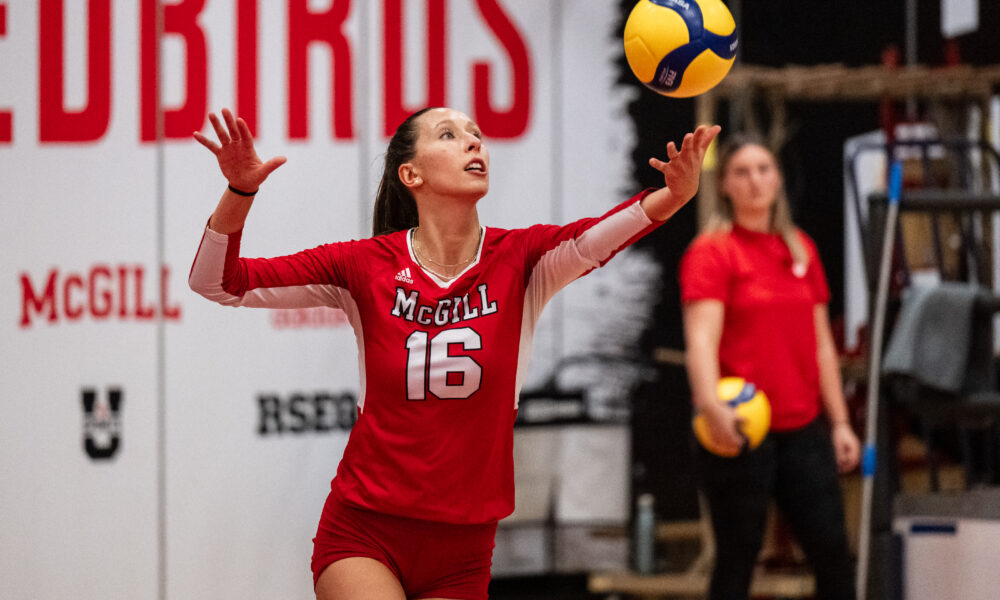
Charlene Robitaille is renowned for her volleyball prowess. Martlet fans are familiar with her skill on the court as well as her history of awards from the Réseau du sport étudiant du Québec (RSEQ), which includes best middle blocker two years in a row and most valuable player. But despite her volleyball success, Robitaille’s athletic career did not begin on the court. It began on the soccer field when she was just five years old.

Robitaille tried volleyball in her first year of high school after a friend on the team suggested she switch sports. Her career took off after a coach saw her potential in secondary four. This led her to change schools so that she could be trained by an experienced coach on a competitive team. From there, she committed to CEGEP Édouard-Montpetit where she led her team to a fifth place finish in the Canadian championship and carried them to victory at the 2014 Jeux du Québec

The transition to university volleyball went hand in hand with a welcome shift in coaching style.  While just a rookie at McGill, she felt extremely lucky that the graduation of two middle blockers allowed her to secure a place on the court. Robitaille felt supported by a coach who trusted her and was confident in her team’s ability to succeed. 

Amid MVP awards and All-Star team nominations, Robitaille found an unexpected takeaway in her personal growth. 

“You’re not always going to agree with your teammates, and you have to deal with that,” Robitaille explained to The Tribune. “It’s relationships that you have to deal with to continue even if you’re exhausted. You need to go to practice and do your best.”

Robitaille feels the lessons she’s learned in volleyball are preparing her for the rest of her life. 

“I think that [volleyball makes you think] outside of yourself. What are your openings, what are your options? Everything like leadership, self-growth, not panicking in rough moments—it’s organization.” 

Robitaille says developing her game day mindset has taken a lot of work. Her anxiety began as a rookie before the pandemic and continued to manifest after.

“I’m the kind of perfectionist that doesn’t want to make any mistakes,” Robitaille said.  “Volleyball is a sport of mistake[s]. If there’s no mistakes from any person, there’s no points. I hate making mistakes in general. I had to learn to accept them, because they will happen for sure,” she explained. 

One of her biggest challenges presented itself the year after the COVID-19 restrictions loosened in 2021-22. Robitaille described moments where mental health struggles took over, causing her to question whether she wanted to continue playing.

“Sometimes I was literally like, can I just quit? Why do I stress like that? Why put that stress on myself? It’s not fun,” Robitaille reflected. “On a game day, I couldn’t do anything else. I was not able to concentrate on work, on anything [….] I was so disconnected.”

She began journaling, meditating, and listening to podcasts to alleviate the pressure she put on herself. Robitaille also credits her coach, Rachèle Béliveau, as a major part of her support system. 

Robitaille recalled a moment two weeks ago where she was unfocused during an important match. 

“If [this had happened] two years ago, I would have told myself, ‘Okay, that’s not my day and that’s it,’” Robitaille explained. “But I was able to refocus and play my best. I was really, really proud of myself.”

As she heads into the final three games of the Martlets’ season before playoffs, Robitaille focuses on her appreciation of the game.

“I really want to enjoy it. I know I have the skills, I know I can bump, I know I can hit, so now it’s just about having fun.” 

Regarding achieving her goal of enjoying herself, she believes it is a process, as every game demands different things. When points flow easily, Robitaille thoroughly enjoys herself, but when a tough game occurs it requires a reminder for her to be kinder to herself.  
The Martlets will play next on Feb. 9 against the UQTR Rouge et Or (2–15).

Arts & Entertainment, Books

Childhood through the ages

Aesop’s Fables (1571) is the oldest book in McGill’s Rare Children’s Book Collection. Written in Latin, with interpretive notes in Greek, it’s now housed in a collection of children’s literature—despite predating the Victorian conception of childhood itself.

But this story also begins later, in the 1930s, with Sheila R. Bourke. As a child, Bourke had polio, which kept her bedridden for three years. She spent her days with children’s books, and she fell in love. 

Bourke—who celebrated her 97th birthday last year—went on to graduate from McGill with a BA in 1949. She maintained her love of children’s books and went on to collect thousands of them. In 2011, she donated 2300 works to McGill’s Rare Books and Special Collections (ROAAr).

On the shelves of the fourth floor of McLennan, a world at once lost and intimately familiar materializes: A world where Kate Greenaway’s garden is always in full bloom and lavender is always blue; but also the bloody world of Bluebeard and the sea where The Little Mermaid dissolves into foam. 

Bourke’s collection ranges from miniature books, the size of a palm, to majestic volumes, hundreds of pages thick—in English, German, French. Included in the collection are the secret world of fairies, the Firebird, foolish foxes, Cinderella, Schippeitaro, Snegurochka; authors from Aesop to Pullman; and illustrators and engravers from Edmund Dulac to Edmund Evans. 

Some titles have stood the test of time—Puss in Boots, The Three Little Pigs. Others, such as Valentine and Orson—a publishing plum of the 19th century—were not so lucky.

Children’s literature, often underestimated and challenged, occupies a strange place in literary history. Deceptively playful, it reflects changing social conventions, global politics, the imagined “other,” what childhood is supposed to look like, and what happens when children grow out of it. 

A 1916 Edmund Dulac work entitled Fairy Tales of the Allied Nations features a compilation of tales from countries that emerged victorious from the First World War. It’s written in English. The Great War also changed how children’s books were produced: Prior to the war, many children’s books had been printed in Germany.

“​​[Germany was] really key in the development of colour [Chromolithography] […] If something is beautifully colour printed, odds are, before the First World War, it was printed in Germany,” Jacquelyn Sundberg, an Outreach Librarian with ROAAr, told The Tribune. “They were leaders in the field up until politics cut off trade relations between Germany and the rest of Europe. And then everybody else had to start printing their own things.”

Contemporary debates surrounding banned books have generated frenzy both online and offline. But these debates return to the same question that children’s literature has been grappling with from the beginning—who is children’s literature for, and what is its purpose?

“I don’t think that denying access to a book is going to stop its ideas from spreading,” Sundberg said. “Because for every book, there’s a person who needs to read it, either to be exposed to an opinion that’s not their own, and to learn from it, or possibly to have their opinion shifted by it.”

Books contain ideas. Within their pages and illustration, between the words, in the ridges of engravings. But they also reflect ideas back. Reading children’s literature—and indeed literature more broadly—allows us to know ourselves and our societies better in the figures and ideas we see living inside the work. 

The preservation of children’s literature is intimately intertwined with the despondent truth that for much of human history, children died as children—many still do today. The stories in the Sheila R. Bourke Collection have survived centuries of oral storytelling, moved across various kinds of borders, and undergone translations into and out of numerous languages. 

It can also be said that these books survived because Sheila R. Bourke survived polio. Many works of children’s literature have been lost. But the stories we have—physically, or in memory—allow us to glimpse back into not only a beautiful, messy historical past—but also our own personal ones. 

An exhibition of the Sheila R. Bourke Collection is viewable online. Individual works from the Collection can also be viewed in person by request through Worldcat.

Out on the Town, Student Life

Igloofest: A must-do for every Montrealer

A brooding night sky hangs above you, and a couple of stars wink lazily in the frigid Montreal air. In the momentary silence, we all hold our breath—nearly ten thousand of us, from university students to parents, travellers to locals. I can imagine the quiet lap of the icy water against the pier beyond the stage. We wait, our excitement tangible and our presence heating the air around us by at least ten degrees, until all of a sudden a synthetic bass beat electrifies the crowd. Immediately, people start to move, jumping to the beat, waving their arms with the strobe lights, letting the erratic sounds and timbre take control. 

Since 2007, electronic dance music (EDM) has energized Montreal’s Old Port in the dead of winter, persuading thousands of people to leave their cozy beds and brave the city’s negative temperatures for several hours. 

Max Gross, U1 Science, described the festival’s unique ambiance in an interview with The Tribune.

“The atmosphere is really unlike anything there, however, and Igloofest is chilly in line but sweaty as hell when inside the main stage area,” Gross explained. “I went more for the crazy atmosphere than the music and I think a lot of people can relate to that.” 

With two stages—one massive and the other more cozy—several interactive tents, and food and beverage vendors, the festival has more than enough to keep anyone entertained for the night. 

Depending on your desires, there are many ways to approach a night at Igloofest. If you are coming from afar or have a distaste for lines, I suggest going early. Getting to the festival around 7:30 p.m. will have you inside the gates in about 15 minutes when everything is only just starting to fill up. Take your time to visit the beverage stands, where you can get a multitude of drinks that come with a festive reusable cup. Maybe mosey around to the sponsor tents and follow a live choreographer to gain the upper hand on all the dancing that’s bound to come, or grab some free samples (this year it was Cadbury chocolate, yum!). 

If you start to get hungry, visit one of the food trucks that promise to supply a variety of spins on poutine. I suggest hurrying to the enclosed room beyond the second stage to keep your food warm and let your fingers defrost before the night’s finale. Being early also gives you the advantage of casually picking your spot for the concert and finding fun neighbours in the crowd. 

But if you’re not interested in spending that many hours outside, pregame at home with friends before heading to the festival, and save some money by eating beforehand. After all, as Gross put it,“The pre is always more fun than the post.”

For Karthikeya Gautam, B.A ‘23, Igloofest’s negative temperatures push the boundaries of outdoor music festivals.

“We have a general perception about the winter—once Christmas is done, that’s it,” Gautam said.  “No enjoyment for the next four months. But Igloofest challenges that very idea, that it doesn’t matter if the sun is setting at 4 p.m. every day: You can still get together with a bunch of people, head outside, and dance to your hearts content.”

Spanning four weekends, Igloofest showcases countless incredible artists—I can personally vouch for Diplo and Armin Van Buuren, who gave unforgettable performances. 

Another lover of Armin Van Buuren’s performance, Léna Ginesta, U2 Arts, confirmed the festival’s allure in an interview with The Tribune

“Igloofest was definitely one of the craziest things that I have experienced in Montreal. It is a must-do for anyone who’s in the city while it’s taking place,” she said.

Whether you’re an EDM fan or not, bundle up and get yourself down to Old Port. The atmosphere, musicians, and the beauty of falling snow glowing in neon light promise a surely magical night. After all, can you really say you had the Montreal experience without going to the world’s coldest music festival?

Arts & Entertainment, Books, Film and TV

‘American Fiction’: A movie about movies about books

Spoilers for American Fiction

“Nuance doesn’t put asses in theater seats.”

At least, that’s what fictional movie director Wiley Valdespino (Adam Brody) says in the final scene of Cord Jefferson’s American Fiction. In the Cineplex that I trekked out to on a Tuesday after class, the audience let out a collective laugh. I looked around suspiciously. Then why are there so many asses in these seats?

There is no denying that American Fiction is a nuanced movie filled with meta-cinematic moments and witty dialogue. But when protagonist Thelonious “Monk” Ellison (Jeffrey Wright) adapts his life into a screenplay, Wiley points out that a story with an ambiguous ending won’t work for a movie. As they cycle through potential endings for the film—letting them play out on screen—the film self-consciously sheds light on the difficulties of adaptation. 

American Fiction is, itself, a literary adaptation of Percival Everett’s 2001 novel Erasure. When I first read Erasure, I hadn’t met anyone outside of my English class who had even heard of it, but somehow I found myself attending a packed screening of American Fiction almost a month after the film’s theatrical premiere. How has the process of adaptation given this story new meaning?

Erasure is a book about books. It follows Monk, a professor and writer who is repeatedly told his work isn’t “Black enough.” In response, Monk writes a satirical, intentionally offensive novel called “My Pafology,” giving his publishers what they seem to want. He publishes it under a pseudonym, only to find that the novel becomes an unironic bestseller. Erasure identifies the limited literary space that publishers give to Black authors, where depictions of poverty and dysfunction are lauded over the multiplicity of Black experiences. 

Erasure is sprawling and multifaceted, with digressions that encourage close reading. By contrast, American Fiction strips away the more ambiguous details, instead emphasizing the plot-driven family drama and comedic moments. The novel chooses to print Monk’s book in its entirety, filling 60 pages with over-exaggerated dialect, blatantly offensive stereotypes, and violence. This works as part of the novel’s complex patchwork-like structure, allowing readers to experience exactly the kind of exploitative book Erasure is critiquing. By contrast, inserting such a huge tonal shift into American Fiction would complicate its genre-signaling. Instead, Monk’s novel is depicted in a single short scene, where his characters materialize in front of him as he writes in his office. As Monk dictates their dialogue, American Fiction manages to convey the voice of the novel without engrossing viewers in gratuitous violence or compromising the film’s comedic tone.

The focus of Erasure’s critique is the literary field. Released in the early 2000s, it scrutinizes the critical acclaim of books such as Sapphire’s Push, a novel that excessively depicts Black trauma. While Erasure assumes that its readers are more familiar with the literary landscape, American Fiction can’t assume the same from its audience of moviegoers. Because of this, the film includes a final scene that poses a new critique. The white director of Monk’s screenplay rejects all of the film’s potential endings only to finally show enthusiasm when Monk suggests a violent conclusion involving police brutality. As he leaves the film lot, Monk shares a nod with a young actor dressed in the costume of an Antebellum-era enslaved person. Here, American Fiction shows how depictions of Black pain continue to retain cultural capital in the mainstream context. By broadening the scope of its commentary to form a meta-critique about movies, American Fiction manages to convey the essence of Erasure while expanding its reach to a wider audience.

Commentary, Opinion

Is a student strike effective? It’s complicated

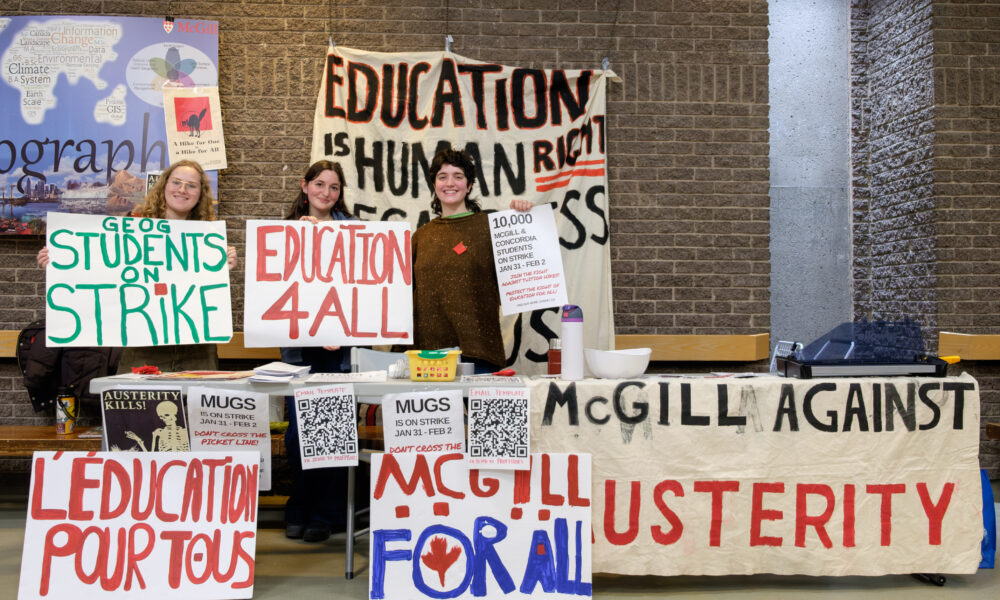
On Jan. 25, the McGill Religious Studies Student Association (RSUS), the Student Association of Sustainability, Science and Society (SASSS), and McGill Undergraduate Geography Society (MUGS) announced that their members would be on strike from Jan. 31 to Feb. 1. The strikes joined Concordia students in responding to the Coalition Avenir Quebec’s (CAQ) tuition increase for out-of-province and international students at Quebec anglophone universities. The hikes triggered dismay throughout the McGill community as a whole, and for good reason––the hikes threaten our right to an affordable education. As such, any effort to reverse them should be applauded. Despite RSUS and MUGS’s admirable sentiment, history warns that without proper organization their efforts could be in vain. To succeed, student strikes have to understand and react to their material conditions. Student strikes demand effective coordination—to truly propel change, students must break into the public sphere and seize collective consciousness. 

Strikes have long been the tool used by unionized workers to make their voices heard; they voice their grievances with employers by refusing to work. For workers, striking is effective because it results in work stopping or slowing and their employer losing out on potential profit. Strikes work because they hit employers where it hurts—collective action leaves those in power with no choice but to listen. Last December, over half a million public-sector workers went on strike in Quebec in response to austerity measures from the CAQ. Workers in Quebec formed the Front Commun, an amalgamation of employees that collectively ratcheted up pressure on the government. The labour disruption’s climax was the seven-day strike in mid-December. As a result, workers were able to stave off the conservative CAQ cuts

Quebec has a strong history of students striking to protect their rights. Since the Quiet Revolution of 1968, students have never been afraid to express their discontent with government bureaucracy. Tradition can be a rallying cry, but it does not do enough to spur change in today’s circumstances. While current movements carry the sentiments of the past, their tactics are misaligned. 

  In 2012, hundreds of thousands of Quebec university students went on strike in what is now known as the “Maple Spring.” The movement rallied against Liberal Premier Jean Charest’s tuition increases for in-province students, eventually forcing the province to rescind the tuition hike and taking Charest’s government down with it. 

How did the Maple Spring achieve this success? By connecting with the public. The 2012 strikes expanded beyond university campuses, both literally and figuratively. Students blocked the Champlain Bridge, causing gridlock in Montreal, and picketed in front of government offices. Organizers formed alliances with some of the largest unions in Canada, who lent support in the streets and financially. By the end of the strike in fall 2012, people of all stripes supported the plight of the students. The 2012 student strikes were effective precisely because they were able to rally support and solidarity outside of campus. 

Workers’ movements force the government’s hand by halting the economy; students alone unfortunately have not pulled the same weight. Linking the students and workers together in struggle, however, has the potential to secure gains for both parties. Greater numbers means greater pressure on the government. Public sector workers prove to be a powerful force time and time again—banding students and workers together would create a formidable force.

 A student-worker alliance would further unions’ collective and broad reach. Take Stanley Grizzle, a leader of Toronto’s Division of the Brotherhood of Sleeping Car Porters elected in 1946. Railway porters in Canada were predominantly Black men who faced intense discrimination and exploitation. Grizzle used his unionized position to successfully advocate for fair treatment for all porters. Integrating students into the labour movement would only further its intersectional scope. 

The McGill and Concordia student strikes mark a solid start of a larger movement. Grassroots initiatives can spark political change, but limiting themselves to a small segment of the population restricts their influence. Social movements must rally broad-based support to make a sizable impact. The right to an affordable education resonates universally; to protect student rights, organizers have to treat it as a cause that matters to all. If strikes remain confined to university campuses they will remain a university issue, giving the CAQ no impetus to hear student interests.

Emerging Trends, Student Life

Are we well-informed at McGill?

In recent years, traditional media has continued its harrowing downward trajectory while audiences turn towards social media for news. On a campus like McGill’s, that emphasizes critical thinking and research skills, do students’ news-consumption habits reflect the digital age of 2024?

Data from Statistics Canada in November 2023 revealed that around 85 per cent of Canadians aged 15 to 34 get their news from social media or the internet. Bill C-18, the Canada Online News Act, which came into effect in December, requires tech companies to pay Canadian media for their content. Meta responded by blocking Canadian media links on Instagram and Facebook.

Where are we getting our news?

Nick Belev, U2 Science, answered this question candidly. 

“At least once a day I’ll see something news-related, usually it’s from a newsletter my mom made me sign up for, or from reels [and] TikTok and I’ll spend about 10 minutes reading it,” he said.

Belev is not alone. In fact, all of the students interviewed said that they receive news through social media, whether indirectly or directly. 

Aliya Frendo, U3 Arts, often relies on TikTok for news. She believes TikTok news, when approached mindfully, offers informative and unique perspectives and also serves as an entry point to other media platforms for more in-depth reading.

“Oftentimes, I’ll come across news clips on TikTok and that will prompt me to leave the app and look them up,” Frendo said. 

Other students, such as Anwyn Woodyatt, U3 Science, have different feelings towards social media as a news source but admit its pervasiveness in daily news consumption is a force to be reckoned with. 

“Indirectly, I end up getting most of my daily news from social media, which isn’t the most reliable source,” she admitted. 

Similarly to Frendo, however, Woodyatt says that she will look for sources beyond social media if the news she receives there is overwhelming or seems to be untrue. 

University’s Uniqueness

Despite the centrality of social media, McGill students interviewed hinted at one specific factor affecting news consumption on a university campus, their area of study. 

Toby Li, U4 Engineering, gets her news mostly from social media and conversations with friends. She feels like her friends in different faculties are definitely better-informed than she is.

“It varies between faculties like there are certain faculties [..]where you have to keep up with the news, like if you’re in research or something,” Li said. “For me in civil engineering, it’s always been the same, like there’s not much new.”

Woodyatt agreed, citing conversations with more politically aware students as a preliminary source of current events. 

“I feel like it’s pretty hard to not be aware of current events when you’re on a campus with people who study these things and are generally pretty up-to-date on these things,” Woodyatt explained. 

How do students feel about their habits?

Habits can change over time; sometimes, seemingly small changes can have a big impact. 

“These days, I’ll be honest, I’m pretty undisciplined about getting the news,” Belev admitted, comparing back to the days when he had to keep updated on current events for his high school political science course.

Becoming a university student has also had an impact on how Li gets her news. 

“Way back, when I was young and newspapers were a thing, I’d read the newspaper because it was delivered to our house,” Li said.  Her newspaper-reading habits stopped when she started University, and the paper was not delivered to her door daily.

While students such as Li and Belev admit that they wish they were more “disciplined” in their news consumption habits, those who are more up-to-date, like Frendo, sometimes struggle with the burden of the current media landscape, finding it tiring at times.

“I’ve fallen out of love with The Globe and Mail and CBC,” Frendo said. “For example, with the situation in Palestine right now, I just don’t find that I have any major news outlet that covers it in a way that doesn’t make me frustrated.”

Students can access various news outlets through McGill, see the McGill Library for more details.

McGill, Montreal, News

Black History Month 2024 opens with a performance by the Montreal Steppers and a panel on Black art

On Thursday, Feb. 1, McGill held its eighth annual Black History Month Opening Ceremony at the Elizabeth Wirth Music Building, hosting around 130 students, staff, and faculty. Breaking away from the tradition of hosting lecturers, this year’s ceremony featured a performance by the Montreal Steppers, followed by a talkback panel discussion regarding the importance of celebrating Black joy through art.

Shanice Yarde—McGill’s Senior Advisor for Anti-Racism and Equity Education—was the primary organizer of the event and the first speaker of the evening. The speech was followed by a performance from the Montreal Steppers—a non-profit organization and dance collective specializing in step. The art of stepping is a Black diasporic dance which uses the body to create a musical beat out of claps, stomps, and chants. The Montreal Steppers are both performers and educators on the history of step—since 2019, they have provided dance workshops to over eleven thousand students across Canada. They included the audience in sections of their performance, encouraging observers to make music and move in tandem with the dancers.

“As we clap, we remember the hands of our people who cultivated crops for the entire world,” Kayin Queeley, a member of the Montreal Steppers and a Case Manager at the Office of the Dean of Students, told the audience during the performance. “As we stomp, we remember the feet of our people who, through displacement, travelled thousands of miles [….] And stepping is a reimagining of the use of the body that was once only viewed as property to create music that we’ve never seen or heard before.” 

Méshama Eyob-Austin, President of the McGill Black Students’ Network, expressed that she found the rousing performance to be joyful and personable in a written statement to The Tribune

“The Montreal Steppers brought much-needed energy and fun to the room, but also took a moment to make us all recognize how special it was to be together in that moment,” Eyob-Austin wrote.

The panellists subsequently took the stage, featuring Queeley, Concordia Professor Angélique Willkie, a performer and teacher of contemporary dance, and McGill Professor Alex Blue V, an assistant professor in the Faculty of Art History and Communication whose research examines the intersections of race and sound. Blue applauded the dance performance, sharing his interpretation of the call-and-response aspect of step.

“If you think about a word like ‘echo,’ which we typically would understand just the sound that happens after the sound, what I saw in that performance […] embodied echoes whether you want to think of ancestry […] but also the way the sound kind of reverberates around the room,” Blue said. “So really the main connections I see have to do with the energy that’s created by echo in a way that can be embodied by step and can also be heard and felt in very real ways.” 

Wilkie added to the sentiment, expressing her thoughts on the interconnectedness of the performers and the audience.

“What was communicated here for me is a kind of […] existential camaraderie, you know, where the bodies move together, are together, speak together,” Willkie said. “And it’s not learned. It is rehearsed, but it is not learned.”

The panellists were asked about the significance of Black movement, and how the body serves as a tool of connection, change, and power.

“Because Black bodies were objectified as property for so long, and that the labour of Black bodies is what has created the society in which we live, it is extremely important to flip that narrative. We have the capacity to do it here,” Willkie said.

Queeley followed suit and explained the way that stepping has found its place in the world of contemporary dance by shifting the narrative of what dance should look like.

“In step, you could do a double step on one foot, but other art forms will tell you ‘No! You go here, then here, then here’, so [step] shifts everything. I think that’s power in itself. [….] It’s disruption. That’s the intention. It’s too organic, too creative, too dynamic, too exceptional,” Queeley said.

Eyob-Austin told The Tribune that she greatly valued the Steppers’ emphasis on Black resilience and courage. 

“For every harmful, oppressive, and devastating part of Black history, there has always been 100 more moments of Black people finding ways to survive, and this is the legacy that the BSN aims to maintain [….] Creating community and spaces for joy and growth are some of the most powerful acts of resilience, courage, and strength and it is very validating that the Montreal Steppers approach Black History Month with this educational angle,” Eyob-Austin wrote. 

In an interview with The Tribune after the panel, Blue expressed the necessity of centring Black joy and excellence through performance, rather than continuously focusing on themes of hardship.

“One of the burdens that Black art often carries is that […] people think that it’s supposed to be about resistance, always about, you know, hardship, and that sort of thing. Obviously, those things are kind of built into a lot of the art, but there aren’t a lot of spaces for Black joy to be expressed. So that was one of the things that I really enjoy about this sort of performance, it allows for you to see just different facets of Blackness that are not always public,” Blue said. 

Wilkie additionally explained that while Black sorrow should be acknowledged, Black hope and happiness should be portrayed through art as well. 

“I think it’s important to recognize the miseries that have existed historically, many of which continue. Unfortunately, you know, I mean, the forms may change […] but they’re still there. But it’s also important for us to be able to speak, not only from a deficiency point of view, but also from a place of pleasure, joy, excellence,” Willkie said in an interview with The Tribune after the panel.

McGill will be hosting events for Black History Month every week, with Dr. Melanie J. Newton’s Keynote lecture on Feb. 8. BSN will also be hosting events all month, with a screening of the African Cup of Nations finals on Feb. 11 and a panel of Black musicians on Feb. 12.


McGill Recommendations, Student Life

Spots to snooze on campus

Hey, I get it, there’s nothing more needed on an exhausting day than a quick nap. But it’s too bitterly cold and far to hike back home—besides you only have an hour until your next class. Eleven years ago, students took to r/mcgill to discuss this pressing concern, and a decade later, they are still struggling to find places to relax on campus. While McGill doesn’t have a dedicated sleeping space, there are plenty of places to drop in for a 40-minute doze. 

The SSMU Lounge

Located to the left of the main entrance, the student lounge in the University Centre is packed with comfy couches and armchairs to rest up before trekking back to your studies. There are sofas in the corner and along the walls so you can get your recommended feng-shui rest. Although the room gets crowded during the afternoon and early evening, it’s nothing that some noise-cancelling headphones can’t fix. If you also prefer a nap not under the focus of fluorescent lights, you may opt for a thick Montreal-style scarf as a nightshade. Not to mention—it’s above Gerts, so you can grab a quick coffee or bite to eat afterward.

3475 Peel Street

Are you one to fall asleep in the cinema? If so, 3475 Peel, with its dim screening and upstairs meeting rooms, is perfect for you. It’s home to Peel Street Cinema, and while the club or other film classes are not in session, the rooms are incredibly private and soundless. However, there aren’t any couches, so it’s best to bring a pillow or two to make it more comfortable. Even with the breathless climb up to this Victorian-style building, this secret spot on campus can finally allow you to exhale all the stress of school.

Islamic Studies Library

Under the wooden stairs of the Islamic Studies Library, there is, as many of you may have noticed, a large red sofa that screams comfort. You sink right into that couch like a swimmer in a scarlet wave. The wooden library halls are quiet, but if the creaky stairs are still a bee in your sleeping bonnet, then just pop in your favourite tunes and you can sail into dreamland.

Birks Building

The Birks Building is a sanctuary, providing ample napping places for weary students. The leather armchairs in the lobby and common areas are sturdy and comfortable. The building has the added benefit of generally being a bit quieter than others, as it houses a chapel and a silent reading room. 

McLennan Library

One has to point out the obvious, of course. Each landing of the upper floors of McLennan is lined with couches, often in shadow. On slow hours there are fewer pedestrians walking by, so it is a great place to snatch a quick snooze. There are also other couches and chairs scattered throughout the study spaces, ready to be heartily weighted. On the fifth floor, in particular, there are several couches between the brick walls and bookshelves, and much fewer people after sunset. McLennan is a labyrinth of possible slumber sofas for your interest, you must only gather your strings and explore. 

Hockey, Sports

Redbirds hockey puts six past Carleton Ravens as they proceed to their final regular season game

On Feb. 3, the Redbirds hockey team (20–5–2) triumphed over the Carleton Ravens (10–11–5) in a 6-2 victory at McConnell Arena. The arena was filled with excitement as the McGill Fight Band created a lively atmosphere supporting the Redbirds and their firm grasp on first place in the OUA East.

The first period opened with sharp passing and skating from the Redbirds. In the third minute of play, Redbirds’ forward Mathieu Gagnon scored the first goal of the game, assisted by Zach Gallant and right winger Charles-Antoine Dumont. However, the lead was short-lived. The Ravens scored a tap-in only 14 seconds later after poor coverage around the McGill crease. A Carleton player pushed McGill goalie Alexis Shank after he saved a shot on goal from the Ravens. Minutes later, tensions rose between the Redbirds and Ravens in front of Carleton’s net, with players on both sides getting in each other’s faces. 

Carleton took the lead in seven minutes into the first after securing a rebound off a shot that hit the crossbar. The Redbirds managed several shots on goal in the ensuing minutes, while Carleton kept up the aggression. 

McGill continued to pressure the Carleton defence heading into the last minutes of the period. Gallant picked up his second point of the night, scoring a goal with two minutes left in the first.  Carleton picked up two penalties in the last two minutes of the period for high sticking and hooking, giving the Redbirds a five-on-three advantage, which McGill forward Eric Uba capitalized on. He scored the third goal of the period, assisted by centre William Rouleau and defenceman Scott Walford, leaving the Redbirds with a 3-2 lead. 

The second period saw no further goals for either team. However, the hostile atmosphere only strengthened.  Both teams got two penalties apiece. McGill left winger Stephane Huard took a slashing penalty just over eight minutes into the period and was quickly followed up by a penalty on the Ravens—this time for roughing after the whistle. 

Two minutes into the third period, following a commotion around McGill’s net, the Redbirds defence had to clear the puck off the goal-line to prevent Carleton from equalizing the game. Although Carleton started the period strong, McGill scored five minutes in to gain a 4-2 lead after the Ravens goalie failed to cover the puck in the crease. Throughout the period, both teams shot aggressive slap shots that the goalies thwarted. After the Redbirds took a timeout, Dumont secured a breakaway and dished it to Gallant, who scored a beautiful goal that brought the crowd to their feet. In a last-ditch effort to even the score, Carleton pulled their goalie with four minutes remaining. Redbirds defenceman Maxime Blanchard scored the final goal of the game on an empty net with just three minutes remaining. 

As the Redbirds head into their final game of the season against Carleton on Feb. 10, head coach David Urquhart explained what the next few weeks will hold. 

“Our main focus is to win that next game because we’ll get [a] bye in the first round [of playoffs],” Urquhart told The Tribune. “In terms of preparation for the playoffs, it’s [what] we’ve been preparing down the stretch […] it’s a style of play that’s more focused on defensive game that allows us to have offensive creativity.”

Moment of the game: With seven minutes left in the third period, the Redbirds got a two-on-one breakaway, leading to a top-shelf goal scored by centre Zach Gallant and assisted by right-wing Charles-Antoine Dumont.

Quotable: “[This win] means a lot, because we’re still fighting for the first spot in the playoffs […] every game is really important [….] We’re not taking anything for granted. And we’ve had a lot of success in the past couple of games, but we’re trying not to sit on our laurels. We’re just trying to treat every game like it’s a playoff game.”

– William Rouleau, on what this result means for the team
Stat corner: Two hockey sticks were broken during the flow of the game, one of which by a Carleton player after attempting a slapshot.

Arts & Entertainment, Fashion

2024 fashion is both futuristic and nostalgic

A threat of danger plagues the foggy underside of the stone bridge as a frenetic figure sprints into the audience’s view. The noir-like dimness of the cobbled structure conceals the silhouette, lit only by distant beams of pale moonlight over the bridge. The shadow stops abruptly, tripping over its feet and assuming a contorted crouch, unnerving and frightening in its severity. Lamp posts brighten to reveal model Leon Dame rising to catch his breath. His tightly corseted waist slithers into the light of the lamps’ bloom, which illuminates his unearthly face: Dame’s skin shines like a porcelain doll covered in an organized mess of pigmented pastels. 

The design aspects of Maison Margiela’s spring 2024 couture show, which premiered on Jan. 25, are avant-garde and unsettlingly strange. Creative director John Galliano’s anti-fashion designs are a retreat into the uncanny, an imagining of physical modernization to the point of bodily dystopia. With Pat McGrath’s ethereal makeup, the collection heightens to a level of contradicting otherworldliness and familiarity. This uniquely 20th-century perspective allows themes of simultaneous technological uncertainty and acceptance to find their way into today’s wardrobes.

Under rapid technological development, the visual elements of art tend to mirror innovations to process these radical changes. Creative processes—fashion styles in particular—are often reactionary, drawing from influences of everyday life to physically emulate social attitudes toward topics such as modernization. Recent advancements in artificial intelligence, communication, and augmented realities support a world reliant on technology for everyday interaction, which poses the question of its creation: What are the extents to which technology is an art form in itself?

This is not the first time that fashion has shifted with attitudes towards advancement. The stylistic futurism of the 1980s directly resulted from artists’ growing fascination with technology’s endless possibilities. Avant-garde fashion styles emerged following the invention of personal computers, cell phones, and digitized music in the form of CDs. Trends of capacious silhouettes altered the form of the body just as computers and cell phones altered life in the public sphere. Iconic ’80s designer Thierry Mugler exemplifies this influence in high fashion with his diverse designs of the exaggerated female form: Sharp shoulder pads, bold colours, and the use of unconventional materials, sometimes combining metals, latex, tulle, and exotic feathers to rebel against stylistic expectation. His work aims to transcend the expectations of traditional fashion and define the essence of the decade, one reliant on experimentation to obtain bodily modernity in a world of unrelenting transformation.

Maison Margiela’s new collection also contains several distinct influences from the ’80s subculture called New Romanticism. The New Romantics, originating in the British New Wave and glam rock music scene, adorned themselves in pale and pigmented makeup styles, androgynous silhouettes, and a sense of overall theatricality as a way of embracing the frivolity of life. New Romanticism took much inspiration from the flamboyance of 18th-century French fashion styles of the Romantic Period. The subculture was a revival of both its style and attitude, known for its ability to combine tradition with the futuristic opinions of the decade, which bears a striking resemblance to the current state of fashion. Maison Margiela’s 23rd look mirrors much of the male silhouettes and styles of the New-Romantic and foundational Romantic period with its slim-straight plaid breeches and tweed suit jacket tapered at the waist. 

By referencing trends of modernism from the past, designers such as Margiela subvert all cyclical expectations. The collection exemplifies the intentions of modern fashion: It embraces the past while carving out its own individuality based on contemporary ideals and attitudes. 

Read the latest issue

Read the latest issue