


Latest News

Features

Canada’s housing crisis has been decades in the making

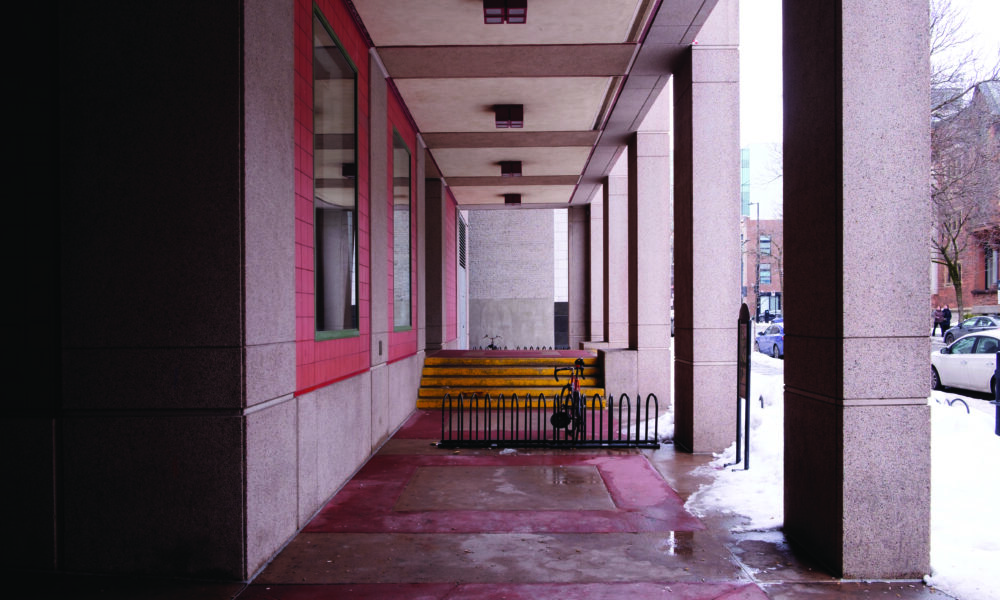
Housing in Canada is reaching its boiling point; many are struggling, unable to pay their mortgages, and most young people can’t afford one. Housing has become a primary concern among Canadians and is poised to be a dominant issue in the upcoming federal election. No city is immune to the rapidly increasing costs of housing, including Montreal, which was long seen as a renter’s paradise.

But understanding how we ended up in this situation can be unclear and difficult to pinpoint—housing is a complex issue, and there have been successful efforts to exploit this complexity and create scapegoats.

Understanding the history of housing policy and exploring potential solutions reveals that there are multiple steps we need to take to address the crisis and underscore how far behind we are. 

What is the housing crisis?

The term “housing crisis” refers to the disconnect between housing needs and housing availability, resulting in a dearth of affordable and quality shelter. However, it’s not a term without controversy.

David Wachsmuth, an associate professor in the School of Urban Planning at McGill whose research focuses on housing, notes that recent use of the term ignores some important history. 

“It’s important to be clear about what we mean by the housing crisis, because you go back 20 or 30 years, and there was very clearly a huge crisis of housing affordability for people who were not on market incomes. That’s a housing crisis. It isn’t usually called that,” Wachsmuth said in an interview with //The Tribune//.

How did we end up here?

//History of housing policy//

During World War II, Canada was in desperate need of new housing. As thousands flocked to the city as war workers, and veterans returned from overseas, the federal government established the Wartime Housing Limited (WHL) crown corporation. From 1941 to 1949, nearly 50,000 housing units were built, including the iconic strawberry box home.

The WHL became the Central Mortgage and Housing Corporation (CMHC) in 1949, and continued, with varying degrees of success, to provide non-market housing. 

It was with the 1973 amendments to the //National Housing Act// that Canada ushered in its most progressive era of housing. It discontinued its urban renewal policies and instead focused on acquiring land for public, affordable, and cooperative housing. Public housing, built both by federal agencies and third-sector non-profit companies, aimed to help both the lower- and middle-class through mixed-income developments and community-based approaches. Throughout the 1960s and ‘70s, an impressive 20-30,000 units of social housing were built each year.

In the mid-1980s, the federal government began rolling back these investments and policies in favour of market-based approaches. This transition led to a significant decrease in the construction of both market and non-market rental units. In 1993, as neoliberalism continued to underpin Canadian politics and policies, Prime Minister Jean Chrétien pulled funding for new social housing and, in 1996, decentralized the responsibility to the provinces.

“There was virtually no longer any federal funding for subsidized housing [….] Responsibility for housing is devolved to the provinces. In general, they kind of devolve it even further down to the municipalities,” Wachsmuth explained. “Now you have cities that just couldn’t possibly keep up with the funding requirements.”

During the 2000s, the effects of neoliberal housing strategies were already apparent, with cities like Vancouver facing record homelessness and a housing supply shortage. Despite this, Prime Minister Stephen Harper refused to directly involve the federal government in housing production. By retreating from the housing sector, the federal government created a patchwork system in which power is scattered, funding is non-existent, and innovation is stalled, allowing the private sector to swoop in and command the housing market. 

//(Over)reliance on the market//

Canada’s housing strategy has always included the market to some extent, but it’s apparent that when policymakers expect the private sector to house everyone, the shortcomings are massive. It’s not an issue unique to Canada: The United Statesand many European countries who have similarly entrusted the market are in the same precarious position.

The market will never meet all housing needs for two reasons: One, housing is expensive, and two, the true value of housing lies in its use as a social and economic tool for the nation. Where there are no direct profits in the sale or rental of the unit, there is no incentive for the market to build.

This is what makes subsidized non-market housing so logical, according to Craig Sauvé, who has represented the Sud-Ouest as a city councillor for over a decade.

“When we can plan around our needs, it’s a good investment in the economy and helps people. It’s going to provide better mental health, stability, and better results in education. I mean, housing is a social determinant of health,” Sauvé explained. “You have to build for the common good.”

//The homeownership monster//

Unravelling this web of issues behind the housing crisis is difficult, in part, because we are dealing with a beast that we helped create. As Wachsmuth points out, Canadians have been sold on homeownership as the strongest means of protecting their wealth.

“There’s a kind of pretty clear preference for ownership housing in Canada. Some of that [is] exogenous, in the sense that it’s not necessarily what’s in people’s hearts, but it’s more like people responding to the incentives of the system,” Wachsmuth explained. “You just can’t borrow money at a cheaper rate than you can get for a mortgage. For most people, it’s the cheapest money they could ever get in their life.”

Any politician who is perceived as threatening those civilian investments, by calling for housing values to drop to an affordable level, is setting themselves up for an impossible campaign.

“To slowly unwind the fundamental policy fixation on keeping housing prices infinitely high, and infinitely higher is a tough problem,” he emphasized. “It would be very, very hard for any government to run on a platform of effectively dispossessing the middle class of its main source of savings.”

What are the solutions?

//Addressing short-term rentals//

In Canadian cities, every one-percentage-point increase in the share of short-term rentals, like Airbnbs and VRBOs, is linked to a 2.3 per cent increase in rent. Regulating this market is therefore a good place to start, according to Wachsmuth. 

“Cities should crack down on short term rentals. It’s by no means the biggest cause of housing affordability problems, but it’s clearly a cause,” he said. “Within a year if they really prioritize it, any given city could return 1000s of units of rental housing to the long-term market.” 

//Addressing zoning limitations//

On most urban land, only single-family zoning (SFZ) is allowed. SFZ limits parcels from housing anything but a single household, keeping large swathes of the city almost permanently at the lowest possible density. Typically, SFZ accounts for 70 per cent of a city’s land but only 20 per cent of its population. Montreal has historically been relatively successful in limiting SFZ, at only 45 per cent of the city’s land – a makeup that helped Montreal maintain its affordability longer than Vancouver and Toronto.

Efforts to move away from SFZ have been gaining momentum. Vancouver recently adopted a policy allowing up to six units per lot across its territory. 

The new federal Housing Accelerator Fund also financially incentivizes cities to upzone areas near transit but whether that is enough is yet to be seen.

Removing parking minimums is another move that’s been gaining momentum, including in Montreal. Without such mandates, developers and cooperatives could use the space for more housing, larger units, or common spaces.

Most importantly, zoning must be malleable and allow for a variety of uses and forms without the lengthy amendment processes. 

//Addressing financialization//

The role of large financial firms in the ownership of rental housing has increased dramatically in recent years. Wachsmuth co-authored a report on the financialization of housing in Montreal, showing that large firms owned four times more rental housing than previously thought.

“These larger financial firms are just very divorced from […] the human element of housing,” he explained. “Areas with more financialized rental housing are where more people were struggling to pay the rent.”

//Following other cities//

Canada should draw inspiration from other cities and countries. For instance, Finland’s ‘housing first’ strategy has been in place since 2007, leading to a substantial reduction in homelessness. It’s a simple premise: Above all else, the first step in helping people is by providing them with secure long-term housing. It has not only been a moral victory but an economic one as well, as providing housing costs less than the Canadian way of policing and managing homelessness. 

Vienna is a model city for housing, as one of the most affordable major cities in Europe, where 60 per cent of residents live in subsidized housing. 

//Building faster//

Speed is key in the housing crisis, according to Avi Friedman, a professor of architecture at McGill, who specializes in affordable housing.

“People do not understand that if you want to build affordable housing, it takes at least four years from the moment you conceive it to the moment you give someone a key,” Friedman explained in an interview with //The Tribune//. “There are a variety of things that we became accustomed to, and we became very spoiled. We want to create buildings that are very complex, where every item is different. And this takes time. And time is money.”

Friedman believes that alternative production methods are one key component.

“We can move far away from the mobile home stigma,” he pointed out. “But you have so many examples of how to produce things much faster with prefabrication. It’s something that we are not doing.”

Other improvements include pre-approved housing plans to simplify and shorten the permit procedure and reduce design costs, an idea recently floated by the federal government.

//Building better density//

Michael Eliason, a Seattle-based architect and founder of the Larch Lab, a “think and do tank” for innovative housing practices, believes that the design of density in North America is deficient, both socially and environmentally.

“The way that we build housing now, it’s basically like these huge hotels. If you’re a family, do you want to live on a floor with 30 to 40 other units where there probably aren’t any other families,” he explained in an interview with //The Tribune//. “It’s just not conducive to a high quality of life.”

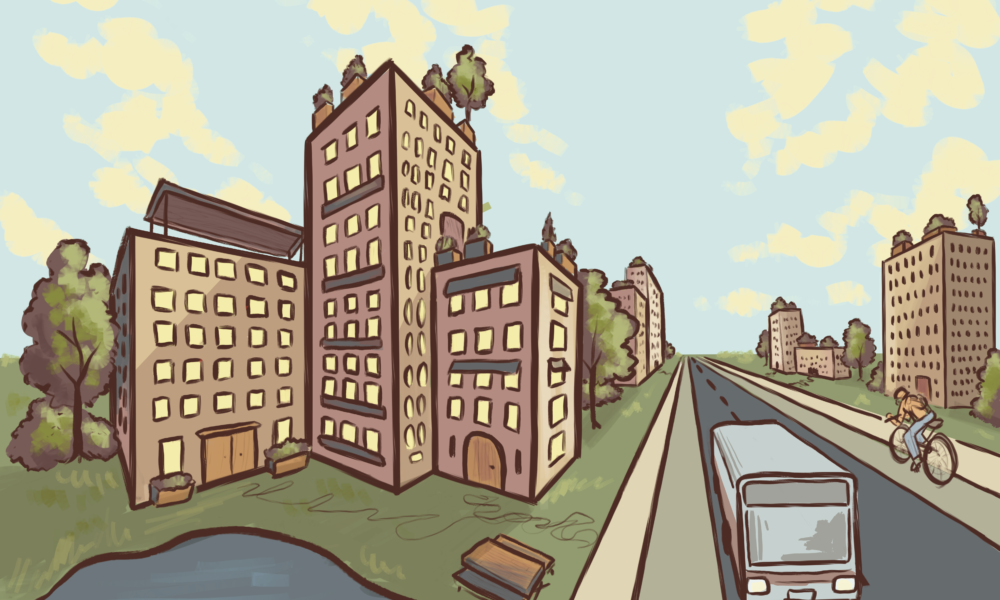
Changes are needed in the way we build density, to improve liveability and attractiveness. Building code reformsallowing single-staircase multi-family units are gaining steam as an alternative to the mandatory double-loaded corridor. This change would increase design flexibility and resident comfort by making it easier to build larger apartments on smaller lots, according to Conrad Speckert, a recent McGill Masters of Architecture graduate who has been advocating for the change.

“It’s a matter of design flexibility, and unit layout is the biggest impact,” Speckert said. “There’s a huge impact on how wide the building might end up being and how much light and air you’re able to get into the floor plan.”

What is not the solution?

//Burning bridges//

All levels of government must work together going forward to solve the housing crisis. Calling mayors incompetent will only strain cooperation and demonstrates a lack of understanding of the policy history that has brought us to this point.

//Blaming immigrants//

Immigrants are not to blame for the housing crisis; all levels of government, to various degrees, ignored decades of warning signs. Our population growth rate remains lower than it was in the 1950s, the difference being that we have since created a structure that prevents us from building at a high enough rate to account for our growth.  Now that the issue has reached the mainstream, and people are demanding answers, politicians have begun pointing fingers at vulnerable groups simply seeking a better life. 

Immigration and temporary foreign workers are key in improving the nation’s building capacity and tackling the labour shortage, without whom, meeting housing targets will be unattainable.

//Ignoring structural issues//

The need to be intentional and unequivocal is vital; patchwork solutions and moderate interventions will not help. Without structural change, any efforts to correct the housing crisis will be ineffective and at best, short-lived. Canada must break from the neoliberal vice grip that has held us down, binding us to a notion of “only the government we need” while ignoring “all the government we need.” 

Housing should primarily be regarded as a fundamental human right, integral to social welfare. For too long, the scale has lopsided, treating housing predominantly as an asset designed solely for accumulating wealth. The asset-owning class has kept their neighbourhoods frozen in amber, preventing housing from being built and blocking newcomers. 

Without changing this paradigm, the problem will only grow over time, widening the wealth gap that has impoverished and exploited Canadians for the benefit of the upper-class.

“It’s going to get even more perverted with our generation, because there will be those in our generation who inherit obscene amounts of wealth and those who don’t,” Speckert explains. “And I think that a policy environment that sets up for nepotism isn’t great.”

Canadian politicians who boast about building an equitable society must ensure coherence between their rhetoric and actions, especially in terms of policy and investment. This requires employing words like compassion and respect, and approaching issues of homelessness with a sense of humanity that recognizes the fundamental need for accessible and quality of shelter. 

Basketball, Martlets, Sports

Martlets basketball suffers another loss against bottom-of-the-pack UQÀM

On Jan. 27, the Martlets’ basketball team (5–7) experienced a disappointing defeat against the UQÀM Citadins (2–8), leaving the Martlets third in the RSEQ conference as they head into the last stretch of the season. 

The game got off to a rough start for the Martlets. The Citadins won the jump ball and got a fast break to the basket, leading them to open the scoring only 10 seconds in. However, McGill quickly responded with a three-pointer scored by forward Seyna Diggs. The Citadins made Love Competition Hall a tough atmosphere for the Martlets, loudly supporting their teammates from the bench. UQÀM continued to dominate in the first quarter, shooting 66.7 per cent from the three-point line, whereas McGill struggled to put points up, shooting a 35.7 field goal percentage. The quarter ended with a score of 12-28 after the Citadins went on an 11-point run. 

The Martlets started the second quarter stronger than the first, with Diggs scoring a three-pointer and just barely avoiding a shot clock violation. Martlets guard Lily Rose Chatila then picked up a shooting foul, but UQÀM failed to score both free throws, and would go on to only shoot 16.7 per cent from the line the entire quarter. Martlets guard Katie Rathwell added her name to the score sheet after making a three-pointer that brought the Martlets within 10 points of the Citadins. Later in the quarter, guard Emma-Jane Scotten found an open lane on offence and scored a layup to bring the Martlets closer, but it was not enough to get the lead. McGill outscored UQÀM 19-13 in the second, but still the quarter ended with a 10 point advantage for UQÀM.  

“We encountered a few unexpected challenges that slightly diverted us from our game plan,” centre Kristy Awikeh said in an interview with The Tribune. “Being on our home court, we anticipated a smoother flow, but unfortunately, some of our shots that usually find their mark just weren’t falling.” 

Diggs opened the scoring again in the second half after nearly a minute of play. McGill started closing the gap to UQÀM after three-pointers and a layup from Scotten and Rathwell brought the score to 43-45. McGill played aggressively, picking up several fouls in the process. However, this was not enough to keep the Citadins at bay, who made several layups and free throws in the last five minutes of the quarter to make the score 47-56. Still, the Martlets ended the quarter well with Scotten making both her free throws after being fouled in the last seconds of play. 

The fourth quarter started well for the Martlets. McGill centre Katerina Stoupas made a contested layup to put the Martlets within seven points of the Citadins. UQÀM started to pull away from McGill as the quarter continued. The game’s rhythm ramped up in the last minutes of the game. Both teams were playing and fouling aggressively. Two UQÀM players fouled out before the game was through. The Martlets implemented a full-court press that the Citadins struggled to break, which led to steals for the Martlets, but it proved to be too little, too late as the game ended 62-71 in the Citadins’ favour. 

Despite the loss, the Martlets showed drive and determination. Their strong effort suggests promise for future games.

“We are really channelling that feeling to get ready and focused on our next four games,” Awikeh said. “These games are super important for us to make it to the playoffs. And personally, I am hungrier than ever for what’s ahead.” 

The Martlets (5–7) will face Laval (10–0) on Feb. 8 at home.

Moment of the game: A successful offensive rebound at the start of the third quarter led to a layup to start the second half off well. 

Quotable: “A lot of my teammates stepped up and brought a lot of energy, both on the court and on the bench which is just as important [….] We have to work on starting our games off better, taking care of the basketball and taking advantage of opportunities where [we] have an advantage to score in transition.”

– Guard Emma-Jane Scotten

Stat corner: The Martlets scored 9-13 of their free throws compared to UQÀM’s 8-16.

Editorial, Opinion

Cutting corners in higher education must be avoided at all costs

Higher education is not immune to the consequences of economic instability in Canada and around the world. Staff, faculty, and students at Queen’s University are all too aware of this, following The Queen’s Journal’s reporting on leaked documents that reveal a drastic budget deficit and the school’s plan to cut classes with less than 10 students enrolled. 

Queen’s, after suffering a $48 million deficit in the 2023-24 fiscal year, attributes this “acute problem” to the Ontario government’s 10 per cent tuition cut for in-province students in 2019 and the ongoing tuition freeze. Though Queen’s faces a particularly dire situation, it is not the only university suffering from a financial crisis, heightened by the recent announcement of a federal cap on international students. As tuition prices rise and budget deficits increase, higher education must reckon with accessibility, inclusion, and transformation. In Montreal, this week’s upcoming strikes from Jan. 31 to Feb. 2 offer domestic and international students across disciplines a movement to gather together and demand change for a better university for all.

Many universities will inevitably choose to implement cuts similar to Queen’s, eliminating classes with low enrollment. This will have particularly harmful effects on fine arts, humanities, and language programs that tend to have lower enrollment rates than sciences, engineering, and social sciences. The smallest classes, which are often those that are culturally specific, such as Indigenous Studies, attract students who have historically been excluded from higher education. Erasing smaller classes abruptly stops the momentum of these disciplines in bigger institutions, affecting programs such as African Studies and South Asian Studies. As these programs fight to solidify their place in universities, administrations must support and invest in them—not discard them. Eliminating these classes continues to perpetuate institutional oppression by making universities less inclusive.

Small classes crucially provide students with the opportunity to forge social bonds. Unlike  conventional, large classes, these classes allow students to connect with their peers and professors in a personal setting—this is the kind of networking that can provide critical opportunities later on in life. Additionally, these small classes afford students the space to discuss, grow, and exchange ideas with students from different backgrounds, yielding vital and nuanced perspectives.

McGill among other universities has implemented hiring freezes to address these budget deficits. Hiring freezes may require post-doctoral students to take up the mantle of teaching classes when there are not enough faculty members. This raises alarming concerns regarding the exploitation of precarious educators. The institution already overworks and underpays graduate and post-doctoral students, who must do this additional work for their tuition and livelihood, without ensured prospects for future employment in academia.

Canadian universities will face further budget constraints following Immigration Minister Marc Miller’s announcement of a two-year international student cap. This cap—which will be applied differentially by province according to population and level of “unsustainable growth”—is expected to reduce the country’s intake of international students by 35 per cent, and accompanies other changes including adjustments to the process for receiving post-study work permits. Announced among growing xenophobia across Canada, the cap not only significantly reduces an integral source of income for universities, but also pins the blame for much broader issues in Canadian society—such as the housing and cost of living crisis—on an already vulnerable population. While the relationship between Canadian post-secondary institutions and international students is rife with exploitation, a cap is not the correct form of redress. International students must be better supported through adequate housing and better protection against predatory practices. 

Universities and their students must acknowledge the essential role that international students play by paying significantly higher tuition than Canadians. International students are a core part of our country and our universities, contributing a diversity of culture and opinion that enhances the educational experience for everyone involved. Universities must hold themselves accountable for their financial troubles by being transparent with their students, staff, and faculty. Higher education must look inward, and students must stand together and demand action by supporting Montreal’s upcoming strikes.

Arts & Entertainment, Theatre

Catching up with Shakespeare

In 1592, the bubonic plague hits London. It isn’t the first time, and it won’t be the last. Theatres—including the Globe—close for almost half a year. William Shakespeare writes King Lear.

In 2020 (cautioned groan), Jessica B. Hill is slated to play two Shakespearean heroines at the Canadian Stratford Festival: Helen in All’s Well That Ends Well, and Lady Anne in Richard III. Stratford cancels the season (spitting on Colm Feore is against CDC Guidelines). 

“I put my scripts under the couch,” Hill said during the lecture. “I couldn’t look at them; that’s how much it hurt.”

As we enter a different stage of the COVID-19 pandemic, we are forced to reckon with how a return to live performance has changed how we view theatre—and what a world without it would lose. 

The Annual Shakespeare Lecture—co-presented by the Friends of the McGill Library and the Stratford Festival—addresses this question, framing it within the broader context of how texts change as the reader’s own lens on life does. 

This was no traditional lecture. Rather, it was a conversation between Paul Yachnin, Tomlinson Professor of Shakespeare Studies at McGill, and Hill—who is now set to play Viola in the Stratford Festival’s 2024 production of Twelfth Night. It was, if you will, somewhat like watching a play (and at one point, Hill recited Viola’s Act I Scene V speech to Yachnin’s Olivia, much to the audience’s delight).

Shakespeare is often conceptualized as the epitome of orthodoxy—but we also often meet the cultural conception of Shakespeare before the man himself. We know him before we read him. What he has to say might surprise us. 

With the 2020 Stratford season cancelled, Hill eventually turned to playwriting in the absence of a stage. On the page, she discovered a side to Shakespeare that she hadn’t seen before. The resulting play is The Dark Lady, an exploration of the enigmatic muse of Shakespeare’s eponymous sonnets. 

“She started to come to life for me, and he started to come for life for me,” Hill said. “This incredible poetess, this incredible proto-feminist, [who] is a huge contender for the Dark Lady Sonnets: Emilia Bassano.”

The Dark Lady looms large over the conversation—Hill and Yachnin highlight what has been omitted from scholarship of the Sonnets for so long: The title “The Dark Lady” may be ambiguous, but the Sonnets themselves are more blatant — Shakespeare says that she’s a Black woman.

“When I finally realized, Shakespeare said, ‘took you a while to get here, didn’t it?’” Yachnin said. “When I teach the Sonnets to undergraduates, or teach Twelfth Night to undergraduates, they’re amazed, because here’s this most canonical of writers—in the world canon—who’s bisexual, and a play also that’s filled with sexual desire that just crosses the borders that they are supposed to respect.”

His words often reach beyond the page. Helen in All’s Well That Ends Well heals an ailing King through medicine—but also through poetry. Shakespeare wrote Twelfth Night—a riotous comedy—around the same time as Hamlet. Both emerge from the death of Shakespeare’s son Hamnet.  

“He writes the scene that he never gets to see his twin daughter have with her twin brother, because he passed away,” Hill said.

When Shakespeare reunites Viola and Sebastian, he reaches beyond the veil and mourns his son by creating another world for him. When faced with chasms, whether they emerge from death, or pandemics, or the plague, stories creep in to fill the spaces left by grief. 

Shakespeare is far from dead. He continues to change, to unfold, to surprise. Too often, students are told to analyze—to examine a text—but not necessarily to feel it. An inarticulable draw to art might not make for neatly packaged argumentation; but sometimes there’s a feeling of something living under the ink—just out of reach, not ready to emerge quite yet, but waiting for someone to come along, and put it into words. Perhaps we’re still developing the vocabulary required to interrogate Shakespeare.

As Yachnin so aptly put it, “Shakespeare’s been waiting for us to catch up with him.”

A recording of the Shakespeare Lecture is available online. Tickets for the Stratford Festival’s Production of Twelfth Night (April 26-October 26) are available on the Stratford Festival website.

Sports, The Tribune Tries

The Trib Explains: McGill Intramural Sports

While many students arrive at McGill having retired from their sport at the end of high school, intramural sports provide an exciting way to relive their athletic glory days. As it says on the intramural website––for those who claim they could have gone pro (if only that knee injury had held off for a few years) or others who want to try a new sport, McGill intramurals are a great place to start. 

How to find a team

If you are interested in a team sport, finding a few friends and forming a team is just one way of going about it! If you and your friends don’t quite have enough players to form a team, or you are looking to join a team on your own, the McGill Intramural Free-Agent Facebook group is a great place to start. Another step to take is to attend the annual free agent meeting held at the Tomlinson Fieldhouse or to fill out the Free Agent Form that is sent out to team captains each season. 

Once you’ve found a team, select a team captain to register the team (or register yourself if you are playing an individual sport) through McGill Athletics’ online services. The captain will pay the team fee and team performance bond. The team performance bond is reimbursed at the end of the intramural season, provided you and your team abide by the rules laid out in the McGill Intramural Handbook.

Intramural sports are open to all McGill students. McGill staff and alumni are able to play by purchasing an “Intramural Access Pass” for $85. Non-McGill community members are also able to purchase an “Intramural Access Pass” for $145 (meaning yes, your friend who goes to Concordia can play). 

What sports are available?

Each season has its own set of sports! While roundnet, volleyball, and soccer are available year-round, sports like three-on-three basketball are offered only in the summer and innertube water polo only in the winter. While the majority of sports offered are team sports, badminton and tennis are offered for those looking to compete in individual sports. A full list is available on the McGill Athletics website. 

Categories

There are three categories available for most sports, open, women, and mixed. The open category is open to all individuals, regardless of gender. The women category is open to women and those who self-identify as women, two-spirit, trans, and gender non-conforming. The mixed category is also open to all individuals regardless of gender; however, teams must adhere to a maximum number of athletes of a single gender on the field of play. For example, in seven-on-seven ultimate frisbee, three women per team must be on the field at all times, or in mixed five-on-five basketball, two women per team must be on the court at all times. 

Levels

Most sports are divided into four or five different levels. Tier one, two, three, and four sports all have playoffs and players compete for a championship mug. 

Tier One: The highest level you can play! This tier is highly competitive, and participants are typically expected to have several years of prior experience. 

Tier Two: Still high level but more intermediate. This tier is still very competitive, and participants typically have some prior experience. 

Tier Three: Players are still expected to have some experience with the sport, but there is lots of room to grow! 

Tier Four: For beginners or those with little prior experience. 

Play-Fun: This tier is for those looking for a very casual sports setting where “overly aggressive and competitive play are not welcome.” Play-fun teams always compete in the open category and some gameplay and rules are modified. 

Why should you play intramurals? 

“Intramurals keep me young,” Jude Sinclair, U3 Engineering, says. Sinclair has played 90 games on 18 different teams since 2021. He has taken home three mugs, all in ultimate frisbee. 

“I love intramurals,” Jonah Mickelson, U2 Statistics, explained. “It makes me feel like a professional athlete.” Mickelson has played 47 games since 2021, earning two mugs in frisbee and one in soccer. 

The Intramural Hall of Fame

Outside of winning a mug, players, team captains (builders), teams, and intramural staff can be nominated to the Intramural Hall of Fame. Those who are lucky enough to have their name enshrined in “McGill’s most prestigious club” receive a white porcelain “Hall of Fame” mug and have their names engraved in plaques and displayed within the McGill Sports Complex. 

For more information, the McGill Athletics website has an intramural specific page and a FAQ page.

Arts & Entertainment, Theatre

‘Legally Blonde’ features stellar vocal performances, a great sense of humour, and a whole lot of pink

This year’s Arts Undergraduate Theatre Society of McGill (AUTS) production of Legally Blonde came with a huge warning label. A week before opening night, the cast learned that asbestos had been found in Moyse Hall. The director, assistant director, and stage managers were left scrambling for a new location, and had to ditch the band, the set, and most of their prepared tech. They opted for a low-tech show held at Trafalgar School for Girls, which was intended to showcase the cast’s hard work despite the staging issue. I was prepared for the worst.

The show opens with the Delta Nu sorority singing the production’s famous “Omigod You Guys.” Perfectly cast, the sorority girls performed with incredible spirit, which they maintained throughout the show. Costuming reinforced their peppy stage presence, decked in glitter and bright colours. Of course, there were also stunning vocals throughout the challenging number by Serena (Ava Burgess, U1 Arts) and Margot (Miranda De Luca, U1 Education). The talented and energetic Mira Cohen, U2 Arts, plays the protagonist Elle, and her tirelessly earnest performance propels the show.

During “Serious,” we meet Warner, the Kennedy-esque motivator for the musical’s plot. The song features Sam Snyders’s, U2 Arts, incredible tenor and convincing frat boy acting—his Warner is just as clueless as Elle but with an added masculine sense of superiority. Their breakup sparks Elle’s journey to Harvard, where we meet her intense TA Emmet (Donovan Burt, U1 Engineering) and deeply pretentious new peers, including a financial software coder (Jessica O’Gorman, U3 Education), a European princess (Natasha Ellis, U1 Arts), and a peace corps lesbian (Kleo Hellman, U3 Education).

We then come across the famously intimidating Professor Callahan, played by Arthur Lyhne Gold (U2 Arts), whose rendition of “Blood in the Water” struck fear into the hearts of future law students in the crowd. When Elle decides to go full Jackie Kennedy and dye her hair brunette, she meets the show-stealing Paulette (Abbie O’Hara, U2 Arts) at the hair salon. Embracing Jennifer Coolidge’s iconic voice, O’Hara boasts a hilarious Boston (or New York?) accent and impressive vocal runs.

The second act begins with “Whipped Into Shape,” led by fitness queen Brooke Wyndham (Rachel Arnold, U0 Arts). Arnold nails Brooke’s manic exercise video energy, and belts throughout some very difficult jump rope choreography. Group numbers like this one showcased the cast’s strong voices from both on- and backstage.

Another iconic scene, the “Bend and Snap,” featured Paulette, cheered on by Elle and the Greek Chorus. Paulette was a force onstage throughout the show, upstaged only by Kyle the Package Guy (Joshua Karmiol, U0 Engineering), who made the audience shriek with his cheesy smile and goofy head-swivelling swagger. I hope whoever stuffed what looked like four socks into his tight shorts was adequately compensated.

My favourite number in the show was “There! Right There!” where the cast asks the eternal question: Is he gay or European? The cast’s frenzied investigation of the silk-shirted preening pool boy (Milan Miville-Dechene, U0 Arts) had the audience in stitches—the question is apparently quite relevant to a Montreal crowd.

Legally Blonde’s comedic production lent well to what could have been a tumultuous show week. While the new music and changes in staging must have been incredibly stressful, the cast weathered any issues with professionalism and good humour. Warner secretly fixed Elle’s mic during an affectionate touch on the head and the cast ad-libbed some great lines during difficult costume changes. The numbers are deeply entertaining, ranging from Irish dancing to a conga line, and the vocal performances are wonderful. I would highly recommend drinking two to three glasses of wine and bringing your friends for the most fun I’ve ever had in a high school gym.

Art, Arts & Entertainment

The McGill Fine Arts Commission brings student art into the spotlight

On Monday, Jan. 22, the McGill Fine Arts Commission (FAC) held its first art exhibition of the year in the MacDonald Harrington exhibition room. The theme was liminal spaces, places of transition or change, expressed in varying forms. According to FAC’s VP Design, Emma Létourneau (U3 Arts), the FAC team selected this theme due to their curiosity about artists’ journeys, havens, and thresholds. They hoped this theme would provide space for artists’ creative expression while also challenging them to reflect on the various ways this idea could be presented.

The FAC is an organization on campus that supports and promotes fine arts at McGill. They also organize various events like exhibitions and workshops. As McGill does not offer any fine arts courses, students must find outlets for their artistic pursuits on their own time. 

“The FAC’s overall goal is to provide the McGill community with opportunities to engage with art, whether it be by making art, or simply appreciating it,” Létourneau said in an interview with The Tribune

Reflecting on their concept, I could see how someone could easily feel lost, staring at a blank canvas or empty photo albums, but nineteen artists found enough inspiration to contribute to the exhibition. Some students presented existing work, others made bespoke pieces for this event, and everyone brought a unique perspective to the theme. Subtle jazz music performed by Felix Hartley (U3 Music) on bass, Yuanlong Jiang (U2 Music) on tenor sax, and Gabe Newman (U1 Music) on guitar accompanied the viewing experience. This added yet another layer of artistic expression, contributing to the intimate and sophisticated atmosphere.

While all of the works were impressive, four collections and pieces with distinct media stood out for their versatile representations of the theme. Marianne Chen-Ouellet’s (U3 Arts) multi-media collection depicted the liminality of the creative process and the hesitation of how to best represent it. The collection featured photo-copied images, coloured pencil drawings, paintings, and zine booklets. 

Charles Cant (U0 Arts) submitted a pair of oil paintings entitled Bedsheets, depicting people on beds. The artist said they were hoping to express a liminal emotional state rather than a physical one. When I asked attendees about their favourite pieces, many cited either Chen-Ouellet’s or Cant’s work.

I found the photography pieces particularly captivating, as they allowed artists to capture fleeting real-world moments in time. Samti Luk’s (U3 Science) photography collection, Gloria’s Motel, Trans-Canada Highway, focuses on an abandoned motel. The artist describes the building, gradually succumbing to the elements, symbolizing the transitional space between humanity and nature.

Coco Jie Wang (U3 Arts) sculpted a piece called Hua, which means flower in Mandarin. I could hardly get a good look at it because of the large crowd inspecting the clay figure. Wang crafted a human torso with dried flowers emerging from its chest, noting that liminal spaces evoke memories of elements that were once familiar but have since changed, much like human bodies.

When I stepped into the room, I saw the faces of people who came to support their friends’ art, as well as others who had simply wandered in. This type of community engagement is a major part of FAC’s mission, and I loved seeing students’ art appreciated by so many. Art can be an especially beneficial break from studying and, with collective support, can be financially accessible to see or make. 

“We can really see we are answering a need by seeing the turnout,” Létourneau said, referring to the more than 250 attendees at Liminal Spaces

FAC’s next exhibition is slated for 2024

Sports

Delving into the world of sportswashing engulfing pro-sports

What is sportswashing? 

Sportswashing has been the buzzword of choice for Western commentators in the sports world for the last three years. In rapid succession, Saudi Arabia’s sovereign Public Investment Fund (PIF) acquired Newcastle United in Oct. 2021 then bought into the top tier of men’s professional golf via LIV Golf, the PGA Tour, and DP World Tour merger. Then, the 2022 World Cup was held in Qatar. To top it off, Saudi Arabia nationalized four soccer teams in their own Saudi-Pro League, providing the league with limitless cash and newfound access to top-tier talent. First to join was Cristiano Ronaldo in Jan. 2023, and the league has since the signed big names such as Karim Benzema, Sadio Mané, and Neymar Jr. and pushed numerous competitions, such as the FIFA Club World Cup final and the SuperCopa de Espana to be held in Saudi Arabia. 

Gulf investment in Western sports began when the Abu Dhabi United Group investment fund bought Manchester City in 2008 and the  Qatar Sports Investment (QSI) fund bought Paris Saint-Germain (PSG) in 2011. While these acquisitions are different in practice, they all stem from these states’ shared desire to diversify their economies away from oil production and engage in sportswashing––a form of propaganda whereby groups, including high profile individuals, private businesses, and governments, use sporting events, competitions, and sponsorships as a means to improve their public reputation. These investments tend to divert attention from scandals stemming from problematic business ventures, corruption scandals, environmental disasters, or human rights violations.

How money took over professional sports

As sports clubs grew in popularity over the years, investors came to see professional sports as a worthwhile business opportunity. An influx of cash led to improvements in infrastructure, creating a professional ecosystem in which team owners collected gate revenue from local supporters, with players being able to make a living playing pro sports. 

However, as the sports industry expanded, costs of operation soared, and financial stability was far from certain. Locally owned teams with limited financial prowess struggled to ensure the survival of their clubs. Many leagues did not have frameworks in place mandating community ownership, leaving the door open for outside investors. These investors come in the form of  individuals, businesses, and governments with deep pockets that were able to pay the freight associated with the increased costs of running these operations. 

The bubble keeps growing

Since then, professional sports franchises’ values have increased exponentially over the years. European soccer club Chelsea F.C. was sold in a deal worth $5.4 billion dollars in 2022, up from the $190 million it was bought for in 2003. A.F.C. Bournemouth, a much smaller club, sold for $147 million in 2022. On our side of the pond, the National Football League’s Chicago Bears were purchased for a mere $100 in 1920 and have a franchise value of $6.3 billion today according to a 2023 Forbes estimate

The value of a professional sports franchise is often difficult to predict. Most are run as private businesses and therefore do not release their financials publicly. However, a certain scarcity in owning a famous sporting franchise lends the asset its value. Even when their associated revenues do not necessarily justify these high valuations, many potential suitors are often vying to purchase any given team when its owner is looking to sell, driving up the eventual price when the asset is sold. 

When any professional sports franchise is sold today, only a small subset of the population can actually afford to buy it. Teams, for the most part, are not being purchased by local business owners, but by wealthy investors. Of course, some of these investors have a personal connection to the team and their community or are motivated by civic pride. Increasingly, however, ulterior motives such as the notoriety of being in an exclusive club of professional sports team owners or the accumulation of personal wealth drive the purchase of teams.

We need to be more critical of sportswashing in all of its forms

When we discuss sportswashing, invariably Gulf investment is at the tip of everyone’s tongues. However, sportswashing is not limited to these––it is endemic to the professional sports ecosystem. 

Front-of-shirt partnerships with gambling companies, such as Brentford F.C.’s renewal of their sponsorship with Hollywood Bets, is a glaring example of sportswashing, as the renewal occurred shortly after the English Football Association banned Brentford’s star striker for eight months for having a gambling addiction. How is this not criticized as sportswashing?

Potential investment into Manchester United from QSI—a group with strong links to the Qatari state—was criticized by fans as anti-competitive, as the QSI owns PSG in France as well, and denounced as sportswashing. Despite that, when Sir Jim Ratcliffe, the CEO of INEOS, invested into Manchester United via the petrochemical company, he did not receive the same amount of backlash. INEOS also owns OGC Nice and their investment is clearly intended to distract from INEOS’s terrible environmental track record.

These examples are not about states, but nevertheless, they are commercial entities using a professional team (or network of teams) to clean up their public image. 

Sports teams everywhere deserve better

The legacy of Reagan- and Thatcher-era market liberalization means that it is not only the world of sports that has embraced investment from morally questionable sources. Sports teams are businesses, but they mean so much more to their communities than purely commercial entities. Ownership by corporations, such as the Red Bull network of clubs, can compromise the beliefs of entire leagues. In the case of Austrian club RB Salzburg, Red Bull erased the 82-year history and identity of the previous club, SV Austria Salzburg, leading to heartbreak for supporters who saw their beloved club fall to ruin. Even in the case of their German club, RB Leipzig, founded in 2011, Red Bull used a loophole in the Bundesliga’s strict 50+1 fan ownership rule to own the club and tie it to their corporate identity. In Germany, football clubs are perceived as having a social duty to their fans rather than being vessels for some ulterior motive, and Red Bull’s conduct with RB Leipzig compromises those morals, making them the country’s most hated club

As described in a 2022 paper in Sports, Ethics and Philosophy, the tragedy of sportswashing is two-fold: Fans, players, coaches, and journalists become complicit in the immoral actions undertaken by problematic owners, and the sporting heritage of local community institutions is compromised. 

The Western world should view the widespread rot of sportswashing as a mirror through which to examine its own faults. After all, how did we get to this point? Who set the rules which allowed this to happen? It should not be up to supporters to give up their childhood club because of morally bankrupt ownership.

Still, there are reasons for hope. The Green Bay Packers are the only non-profit, supporter owned major sports team in North America. The Packers mobilized fan investment to engage in stadium upgrade projects without threatening to uproot the team thereby stiff-arming municipalities into investing public dollars into private infrastructure that does not generate local economic growth. They’ve also won four Super Bowls, most recently in 2010. The Bundesliga is famous for its 50+1 supporter ownership rule, which includes Bayern München, one of the most successful clubs on the planet. The story of Luton Town F.C., promoted to the Premier League last season, is a heartwarming example of the situations of other “phoenix clubs’” saved from ruin by supporters. Community is what sport institutions are rooted in.

Sports teams deserve so much more than to be vessels for the aims of some greater entity, divorced from the reality of community building. It simply isn’t fair to those who sport is actually for, the millions who love the game. The integrity of sport is long gone, and we must bring widespread change or risk losing sight of who sports is actually for. And after we lose that, what else is left?

All figures mentioned in the article are in USD.

Out on the Town, Student Life

Bring on the bubbles

When I embark on my (albeit short) commute to campus every day, it’s hard to miss the steady stream of students flooding into Shuyi, the bubble tea shop across the street from Roddick Gates. By the time I make it into my lecture hall, it seems that I’ve seen more bubble tea cups than I have coffee cups. Are McGill students going bonkers for boba?

Well, yes. But it turns out it’s not just us: Students across North America love this sweet treat. A recent survey found that 94 per cent of young adults aged 20 to 29 bought bubble tea in the last three months—more than coffee.

Wondering where you can get your boba fix in Montreal? The Tribune has you covered with this guide to some of the best bubble tea shops near campus. 

Shuyi Tealicious

Address: 896 Rue Sherbrooke O.

Hours: Monday-Friday 11 a.m.-8 p.m., Saturday-Sunday 12-8 p.m.

Distance from campus: Two-minute walk

Price (out of three): $$$

Shuyi was the first bubble tea place I tried when I moved to Montreal, and it did not disappoint. The shop’s wide range of flavours and proximity to campus make it a hit with students and working professionals alike. However, this shop is on the pricey side, with a regular signature milk tea costing $6.65. For more complex flavours and larger sizes, you can expect to pay upward of $10. But this is the price you pay for the ease of picking up some boba between classes. 

The Alley Montreal

Address: 1256 Rue Guy

Hours: Sunday-Thursday 12-10:30 p.m., Friday-Saturday 12-11 p.m.

Distance from campus: 20-minute walk, 12-minute metro ride

Price: $$

Conveniently located near the Guy-Concordia metro station, The Alley describes itself as a “hybrid destination where unique bubble tea blends and coffees meet.” With enticing flavours such as peach oolong and crunchy tiramisu milk tea, it’s a great place to indulge in a mouth-watering new treat. The shop also comes equipped with individual working pods, a group room, and a lounge area, making it the perfect study destination. 

Ocha

Address: Rue 1651 St. Catherine O.

Hours: Every day 12-10 p.m.

Distance from campus: 21-minute walk, 13-minute metro ride

Price: $$

If you want to enjoy a tasty donut along with your bubble tea, look no further than Ocha. This boba spot located west of campus offers Vietnamese coffee and mochi donuts to go along with your fruit-, matcha-, or milk-based bubble tea. Ocha is also known for its warm, homey atmosphere, filled with indoor plants and lots of natural light, making it a great spot to recuperate after a long day of classes.

L2 Lounge

Address: 71A Rue De la Gauchetière O.

Hours: Sunday-Thursday 11:30 a.m.-10:30 p.m., Friday-Saturday 11:30 a.m.-11 p.m.

Distance from campus: 26-minute walk, 17-minute metro ride

Price:

With nine locations throughout the city, L2 is a great place to go for reliable—and slightly less expensive—bubble tea. Its flavours include Oreo cookie smoothie, pina colada, and winter melon. If none of those appeal to you, L2 also offers a make-your-own-bubble-tea option, where you can choose from a variety of bases, flavours, and toppings.

Kung Fu Tea

Address: 55 Rue Notre Dame O. & 218 Rue St. Catherine E.

Hours: Every day 11 a.m.-9 p.m.

Distance from campus: 32-minute walk, 33-minute metro ride; 27-minute walk, 18-minute metro ride

Price: $$ 

With its main location in Montreal’s Old Port, Kung Fu Tea is a great spot to grab boba while being a tourist in your own city. The shop offers a wide range of authentic Taiwanese teas. Kung Fu Tea also boasts a secret menu and serves egg waffles—a popular dish in Hong Kong. If you’re looking to get bubble tea at a discount, keep an eye on the shop’s Instagram for flash sale announcements.

Montreal, News

Trans health clinic strives to address gaps in mainstream health care

Dozens gathered at the Concordia McConnell Building on Jan. 23 to support the launch of three specialized pop-up clinics that seek to address unmet needs in the public health care system. Delivered by Community Healing Days, a collective of alternative and traditional therapists, they will focus on providing trans, menstrual, reproductive, and perinatal health care.

The clinics will operate approximately once a month, offering low sliding scale rates to make their services more accessible to low-income patients. The clinics are funded by SHIFT Concordia’s Deep Investment Fund and will be run out of Studio 414 in downtown Montreal. The project includes a research component coordinated by McGill assistant professor Suparna Choudhury. This research aims to identify gaps in mainstream healthcare and the demographics most underserved. Organizers at Community Healing Days hope that their pilot project will serve as a model that can be replicated elsewhere in the city and beyond. 

The new trans health care clinic will support patients as they prepare for and heal from gender-related surgeries. This support is offered through workshops and bodywork provided by trans and allied practitioners.

At the launch event, organizers stressed the need for more accessible care, especially amid the current health care crisis in Quebec. Kota Rook, a coordinator for the new trans health clinic, emphasized the difficulties that marginalized communities face when accessing care. 

“We really particularly want to center people with very low income, and people who are racialized, Black, Indigenous, people of colour,” said Rook. “Because the more layers of things we’re experiencing in the world, the more barriers there are to health care.”

The Students’ Society of McGill University (SSMU) adopted a Gender Affirmation Care Plan last year, which expanded the Health and Dental Plan to cover more gender-affirming care procedures. However, Jacob Williams, a representative from McGill’s Trans Patient Union, highlights that the plan has some serious limitations. Currently, the plan requires students to obtain a gender dysphoria diagnosis before undergoing a procedure—despite the fact that this is not a legal requirement for receiving gender- affirming surgeries in Quebec. Furthermore, it does not cover certain procedures such as fertility preservation, nor the supplies needed for recovery after surgery. Additionally, the Plan’s maximum coverage is $5,000 for any one procedure with a lifetime maximum of $10,000. 

“It’s a drop in the bucket,” said Williams. “The coverage amount is so low [that] it’s only really useful for a very small amount of things.” 

Amina Kudrati-Plummer, SSMU’s VP Finance, told The Tribune that although they do not yet have any statistics on the success of the Gender Affirmation Care Plan, they are aware of students’ concerns and are hoping to increase coverage in the future. 

“At SSMU, we are working towards expanding the overall coverage to meet the needs of the students more comprehensively,” said Kudrati-Plummer said.

Some members of the McGill community hope that projects like Community Healing Days’ new clinics can help address the unmet health care needs of students. Choudhury said that there is a disparity between the health care that is needed and what is available. 

“These kinds of modalities have lots to offer and are sorely missing from what’s freely available [and] accessible to students,” Choudhury stated. 

Others, including Keith Bellec-Warrick, finance coordinator of Union for Gender Empowerment at McGill, maintain that larger-scale change is needed to address the health care needs of trans people. 

“It’s a question of a large-scale funding and organizational failure,” Bellec-Warrick said in an interview with The Tribune. “We welcome more changes in the future, but they’re not a favour, they’re not a gift. They are some attempt at addressing long- standing failures,”

Williams echoed Bellec-Warrick’s sentiment on welcoming change while emphasizing the need for wider structural changes to health care. 

“I’m very grateful that projects like these exist [but] this shouldn’t be their job,” Williams said. “And it saddens me that like, basically, community organizers have to be the ones to step in to provide health care when [public] clinics can’t afford to.”


In the Jan. 30 print issue, The Tribune republished the piece “Dozens protest against CAQ’s anti-trans policies” under the title “Trans health clinic strives to address gaps in mainstream health care.” The Tribune apologizes for this layout oversight, to our contributors, and to the members of the queer and trans community who organized these separate events and gave us their time and words in interviews. 

In next week’s issue, the intended article will be reprinted with this correction. We appreciate the opportunity to cover these events, and promise not to make this same mistake again.

Read the latest issue

Read the latest issue