

Latest News

Album Reviews, Arts & Entertainment, Music

Something to give the girls

Pop music has hit a lull in the past few months. Beyoncé and Taylor Swift are busy touring, Dua Lipa is missing in action, and Ariana Grande is busy getting raked over the Twitter coals for her new boyfriend. A few select artists have provided tunes throughout the recent slump—credit to Olivia Rodrigo. But none have emerged as swiftly and decisively as Troye Sivan, whose new album Something to Give Each Other has revived our appetites for the popstar. 

His album release began with “Rush,” a lead single titled after everyone’s favourite brand of poppers. With a house beat and a chant-like chorus, the single lives up to its namesake—an addictive opener. The music video features a sweaty Sivan, hedonistic Euro-summer visuals, and decidedly cheeky choreography. Compared with Sivan’s innocent debut, Blue Neighbourhood, and his less precocious 2018 album Bloom, this release was unabashedly more queer, fun, and sexy. 

His second single, “One of Your Girls,” was an instant hit largely owing to Sivan’s bold music video. Featuring former Disney Channel heartthrob Ross Lynch and Sivan himself in incredible drag, the video immediately flooded Twitter feeds and is currently at 8.7 million views. With seductive choreography and Y2K outfits, the visuals draw heavily on early 2000s pop icons like Christina Aguilera and Beyoncé (note the “Single Ladies”-esque black and white scene with the bar). Sivan is taking pop stardom seriously by calling back to its golden age.

The rest of the album is a great mix of slow tunes and uptempo pop. Sivan includes some inventive sampling, such as an electronic hook from Bag Raiders on “Got Me Started” and a clip of Jessica Pratt’s folky warble in “Can’t Go Back, Baby.” Sivan’s increasing comfort with experimentation is paying off—his music has far exceeded its bedroom pop origins.

With a new commitment to choreography and boy toys in tow, Troye Sivan’s new album asserts that he is every bit the pop diva. He has cornered his market with new maturity and confidence, giving people the pop iconography that they want and need. 

Lacrosse, Men's Varsity, Sports

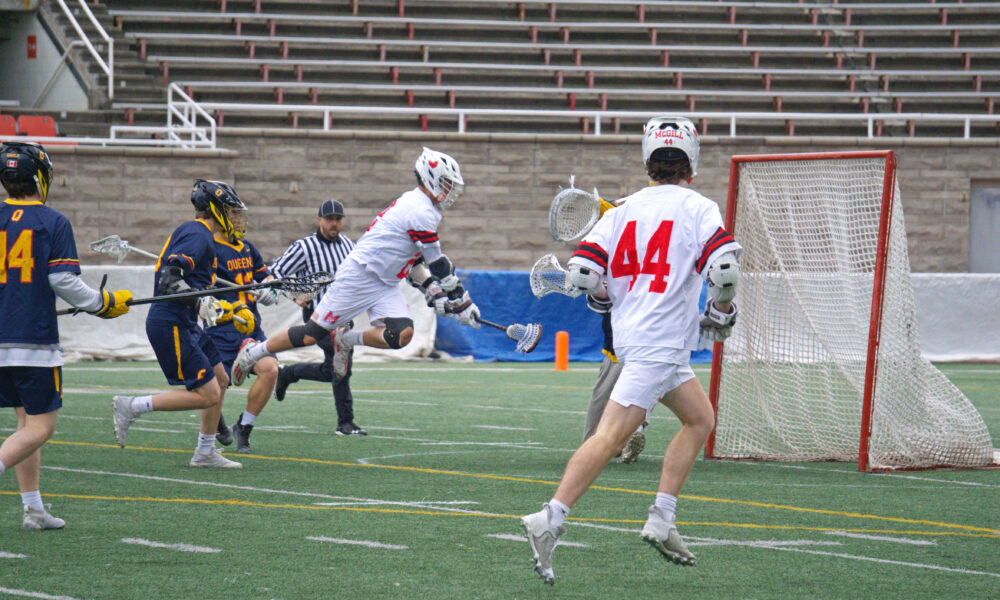
Redbirds lacrosse races to victory against Queen’s University Gaels

On Oct. 29, McGill Redbirds’ lacrosse faced off against the Queen’s University Gaels in a single-elimination playoff game to clinch a spot in  the Canadian University Field Lacrosse Association (CUFLA) playoff tournament, otherwise known as the Baggataway Cup

Motivated and eager to win, the Redbirds opened the scoring mere moments after the opening whistle sounded when captain and attacker Isaiah Cree scored the first goal just 10 seconds into the game. However, the Gaels quickly countered with two back-to-back goals to go up 2-1. The Redbirds struck back thanks to another goal by midfielder Rowan Birrell  giving the Redbirds evening out the score board. Following a few exchanges, Cree had the opportunity to bury his second goal of the afternoon and tie the game.  

The growing goal tally galvanized midfielder Alexander Erbstein, who netted another with under two minutes remaining, and the quarter ended with midfielder Mark Symon’s goal with just 10 seconds left to set the score 5-2.

After a particularly intense first quarter that the Redbirds dominated, the second quarter was quiet until the Gaels shrunk the point gap, scoring with three minutes on the clock. However, midfielder John Miraglia responded with McGill’s sixth goal with just eight seconds left in the half.  

Cree opened the second half of the game with back-to-back goals, giving McGill an 8-2 lead. The Gaels’ frustration erupted into several scuffles. Defender Ryan Badour served his first of four penalties that afternoon for slashing. With two minutes left in the third quarter, defender Kyle Glick suffered an injury following a multi-player collision and had to be escorted off the field. 

This change in pace allowed the Gaels to sneak two goals past Boehm to start the fourth quarter, bringing the score back to 8-4.  After expert passes between midfielders Rowan Birrell and Massimo Thauvette, Birrell buried the ball past the Gael goalkeeper, restoring the five-goal gap.. 

After the Redbirds regained possession, Birrell successfully faked out Queens’ defense and passed the ball. Midfielder Owen Howard successfully picked it up, passing it back to Birrell, who narrowly missed. 

As the game came to a close, the Redbirds continued to apply pressure to Queen’s defense line in an attempt to extend the goal gap. When the referee’s whistle echoed, the score was settled and McGill secured the 9-5 win. 

“I think the big thing today was having our entire lineup really contribute,” assistant coach Maxime Murdoch said in an interview with The Tribune.  “It was really a full team effort. We had a couple of guys that were a little more injured, some starters that we had to take out early. And we had some guys that usually don’t play as much get in there and really play well.” 

The other team, you know, came back really strong at some point,” Murdoch explained. “We kind of just had to, had to do our thing. The biggest thing is really just having all these guys, that usually don’t play, get in there and really contribute to score goals.”

This win allows McGill to compete at the Baggataway Cup at the Trent University Excalibur, last year’s champions, on Nov. 3-5. They will face off against the University of Guelph Gryphons, currently second in the Western division, hoping to advance to the semi-finals. The last time McGill won the Cup was 2015. 

Moment of the Game: After making an incredible save, Boehm pierced through the field to reach the 49-yard line, in front of the Gaels’ goal and passed to a teammate. 

Stats Corner: The game saw seven penalties drawn, including four for McGill’s Badour, and one from Birrell.

Quotable: 

“We win when we move on, we lose once we’re done. So all of them are make-or-break,” Cree said. “I really feel like we can really make a run this year.”

— Senior-year, captain Isaiah Cree reflecting on the significance of this buy-in game for the playoff. 

Hockey, Martlets, Sports

Martlets hockey home opener turns into a frustrating loss against UOttawa’s Gee-Gee’s

On Oct. 26, the Martlets’ hockey team (1–2) suffered a tough loss against the Ottawa Gee-Gees (2–1) in a penalty-filled home opener. 

The Martlets opened the game with a quick shot on goal, followed by forward India Benoit taking a tripping penalty to give the Gee-Gees their first powerplay of the game. The Gee-Gees broke through McGill’s defense in the second minute of play, and pulled off a shot on goal that was saved by goalie Sophie Lajeunesse. Coming out of the box, Benoit passed to forward Mika Chang before attempting a shot on goal. 

Eight minutes in, Ottawa took a tripping penalty to give McGill the advantage. McGill maintained good offensive motion that tested the Gee-Gees’ goalie. A sloppy line change from the Gee-Gees then led to a momentary five-on-zero advantage for the Martlets that excited the crowd. 

10 minutes into the first period, four Martlets and one Gee-Gee went down before Meganne Chailler came off in pain––she later returned to the ice. A minute later, Ottawa opened the scoring with the first goal of the game after careless defending from the Martlets left the Gee-Gees center alone in the slot. Despite their sloppy defense, they managed to get another solid shot on goal and Lajeunesse blocked an attempt from Ottawa in the last minute of play. Both teams matched in their high aggression, which the referees seemed hesitant to call in the first half of the period. The first period ended 1-0 for Ottawa, with eight shots on goal by the Gee-Gees and the Martlets close behind with seven. 

“We will need to be more disciplined and have less penalties,” Beniot told The Tribune.  “Playing on the PK [penalty kill] for a long time and getting momentum [created challenges for us].” 

Although McGill opened the second period strongly with a shot on goal, Ottawa turned the tide by denying the Martlets on a breakaway and pressuring them with two unsuccessful attempts. Following a head-contact call, forward Megan Kronwald was sent to the penalty box for four minutes. The Martlets finally found the back of the net after a misplay by Ottawa’s goaltender, but the goal was ultimately disallowed. The teams traded shots on goal in the last half of the second period. Tensions rose between the players in front of the Martlets net, which led to the referees reprimanding both teams. In the last minutes of the period, Ottawa attempted three more unsuccessful shots on goal, outshooting the Martlets 8-5. 

The Martlets started the third period by picking up another penalty, with forward Anika Cormier being sent to the box for tripping in the second minute of play. Ottawa managed two shots on goal during their power play before picking up a penalty of their own. In the seventh minute of the period, an Ottawa player was knocked to the ground in a multi-player collision and skated off the ice supported by her teammates. McGill defense Mia Giles picked up a penalty for body checking, followed closely by a penalty called on forward Syrine Kacem for holding. In an attempt to even the score, the Martlets pulled their goalie in the last minute of play, but their failed attempts to to put the puck in the back of the net allowed the Gee-Gees to score an empty-netter with eight seconds to go, ending the evening on a 2-0 loss for the Martlets. 

The Martlets (2–2) beat the Carleton Ravens (1–1) 1-0 on Oct. 28 and will play Bishop’s University on Nov. 3

Moment of the game: After deflecting a shot, the Ottawa goalie nudged the puck into the goal before the referees called offside and the goal was disallowed.

Quotable: “We play against Carleton next. We have practice Friday and we will do everything to prepare accordingly for this game and bounce back hard.”

–Forward India Benoit

Stat corner: The Martlets received two penalties for tripping, two for hooking and one penalty each for holding, head contact, and body checking. Four of these penalties occurred in the third period. 

Know Your Athlete, Lacrosse, Men's Varsity, Sports

Know Your Athlete: Dylan James

McGill Redbirds’ Dylan James comes from a lacrosse family. He followed in the footsteps of his older cousins who played and now his younger brother, Austin James, competes in the same league, playing for the Trent University Excalibur.

Although James played ice hockey when he was younger, he eventually shifted his focus to lacrosse.

“Although I did enjoy hockey, it was much more of a social thing. [Hockey] was competitive and I definitely tried at it, but it was much more about enjoying the sport with friends,” James said in an interview with The Tribune. “With lacrosse, I realized that there was a deeper passion and opportunities in the future that I was looking forward to.”

James dreamed of playing university lacrosse since high school. He completed two years of high school in his hometown of Little Britain, Ontario. However, after tenth grade, he transferred to Virginia Episcopal School, an American boarding school whose representatives he met with after playing a lacrosse tournament in the United States. The school offered him a spot on their lacrosse team in pursuit of playing at a university level.

Until he was 13, James primarily played box lacrosse because it was the only option available in such a small town. Then, in grade seven, he tried field lacrosse, where he was able to thrive.

Although James originally hoped to play in the National Collegiate Athletic Association (NCAA), the COVID-19 pandemic pushed him to return home to Canada for university and attend McGill. Now in his second year of eligibility after the pandemic sidetracked the lacrosse program for two years, James has enjoyed his experience as a student-athlete alongside his teammates.

“Playing a varsity sport is a huge commitment to begin with, but it feels like much less of a commitment when you have the community of guys that we have,” he said. “There are definitely going to be days where you’re a little sore, you’re beat up, you just don’t really feel like playing, but then you have teammates that are willing to put in the work but also want to have a good time––it’s a group of friends.”

His personal goal for this season was to be more of a leader in the attack.

“Last year, I didn’t step in the role that I knew I probably could have filled, whether I want to blame that on injuries or it being my first year—all of those are kind of just excuses,” James explained. “The reality is, I just wasn’t stepping up the way that I thought I should have, and that was a big thing for me.”

James also wants to make the most of the time he has left with his team in his last year on the team before he graduates, whether that means enjoying the social events more or just hanging out with his teammates outside of practice and games.

“That has honestly made this year much more enjoyable from a practical standpoint because we’re much closer, I think, this year,” James said.

Outside of lacrosse, James likes to focus on the “student” part of being a student-athlete: He is a McGill psychology major McGill and spends a lot of time studying. He also enjoys socializing with his non-lacrosse friends or doing anything active, especially going for walks outdoors. 

With the team now one game into the 2023 playoffs, James spoke on the team’s mental toughness going into the elimination games.

“I think on paper, we have the opportunity to be the best team in the league,” he said. “But it’s more just making sure that we’re being tough, that we’re being disciplined, that when we go down, we’re not hanging our heads, we’re focusing on getting the next one.”

The Redbirds won their first playoff game 9-5 against Queen’s University on Oct. 29. Next, they will play in the quarter-finals against the University of Guelph on Nov. 3 at the Baggataway Cup.

Student Life

The revival of McGill’s Community Engagement Day

Held in the University Centre on Oct. 26, Community Engagement Day (CED) made a strong reappearance this year. The event, run by the Students’ Society of McGill University (SSMU) and McGill Campus Life and Engagement (CLE), aims to put students in contact with local McGill and Montreal-based volunteering groups. This year, it featured around 30 organizations from the greater Montreal area.

It was a lively scene in the SSMU Ballroom, which was filled with a ring of booths toward one end and an Art Hive workshop pop-up on the other. Free lunch was provided for attendees, who filtered in and out throughout the afternoon.

Maria Radu, BA ‘22 and the current SSMU Community Engagement Commissioner, helped organize Thursday’s event. CED was established in 2012 but hadn’t been run at this scale since 2017.

“I wanted to bring [CED] back, because it’s a really cool event, and I think that it’s a great opportunity for students to get involved,” Radu said. “I did a very small one last year in the winter, just to kind of test the waters and try it out. And it went really well. We got a lot of great feedback. I wanted to do it on a bigger scale this year.”

Radu aims to hold the event annually and grow it to a similar scale as SSMU’s Activities Night.

“There’s a lot of opportunities that I think students don’t know about,” Radu commented. “So I’m happy to help promote them.”

Organizations attending this year’s CED ranged from Big Brothers Big Sisters, an organization that provides mentors to youth with adverse childhood experiences, to Tel-Aide, a volunteer-run mental health hotline.

Community Cooks Collective (CCC) was one of those organizations. Founded in 2020, CCC is a group that seeks to address food insecurity in the Montreal area by delivering home-cooked meals to three local food shelters.

“We’re looking to grow the roster of cooks and build up our organizing team to be able to expand operations further,” Tatiana Townsley, a CCC volunteer explained.

Arabel Morin, U3 Arts, visited CED after finding it on MyInvolvement, a platform connecting students with engagement opportunities at McGill. 

“I was looking for more volunteering opportunities this year, just because it’s my last full year at McGill,” Morin explained. “I want to build new connections and do something good every once in a while..”

Concordia student Diego Fraser-del-Carpio was running the booth for The Refugee Centre (TRC), an organization which aids refuge-seekers in Montreal, providing services such as job searches, housing, and health and wellness support. 

“What volunteers help with most is filling out the refugee claimant application; the first step into getting into the refugee claimant process,” Fraser-del-Carpio said.

Jeanne Marengère, U3 Arts and TRC volunteer, has helped refugee claimants with this crucial step, translating and typing out their stories into the application form. 

“It’s really cool because we get to hear people’s stories from all over the world who are just coming to Canada,” Marengère said. “Oftentimes their stories are really sad and emotional, but it’s also very gratifying to know that you have helped someone find safety in Canada.”

Between internships, clubs, and intramural sports teams, there are many ways that university students can become involved in communities beyond the bounds of the classroom. With all these opportunities to engage, what makes volunteering as a student special?

“A lot of the time McGill can be quite a bubble, that students have trouble stepping out of,” Radu said. “A lot of organizations in Montreal really want student involvement. A lot of people volunteering at these organizations are out of school and have been for a long time, so they want a fresh student perspective.”

Those who were unable to attend can find opportunities on MyInvolvement or check out the Volunteer Bureau of Montreal.

Arts & Entertainment, Film and TV, Music

Bewitching reads and frightening films

With the scariest day of the year approaching, the season of haunted houses, autumn treats, and ghostly costume parties is upon us. But with Halloween landing on Tuesday this year, how can you be expected to keep up with the holiday spirit(s) while still making it to your 8:30 a.m. class the next day? The answer: Kick back, relax, and spend the day recovering from your Halloweekend while you check out our Halloween-themed media recommendations, courtesy of the Arts & Entertainment team. 

We Have Always Lived in the Castle by Shirley Jackson

Isobel Bray, Contributor

This eerie tale revolves around the reclusive Blackwood sisters, Constance and Mary Katherine “Merricat,” who live in a grand house on the outskirts of a fictional American town. Six years prior, their entire family was poisoned except for Uncle Julian and their cat Jonas. Since then, the townsfolk have shunned them, believing one of the sisters to be the murderer. Their lives take an unsettling turn when their long-lost cousin Charles arrives, disrupting their routine by expressing an interest in Constance and the Blackwood estate. Shirley Jackson’s concise writing evokes the atmosphere of a dark folktale. For all its grimness, it is also a darkly humorous story. Merricat narrates the novel, and her childlike innocence and witty observations will draw you in, even as the ominous undertones become increasingly apparent. The deceptive simplicity and sinister ambiance were what made me love this book. The final published work in Jackson’s lifetime, the novel maintains the author’s signature style, as a comforting yet scary story reminiscent of small-town Americana classics.

Rituals On The Bank Of A Familiar River Kiki Rockwell

Suzanna Graham, Arts & Entertainment Editor

This Halloweekend, I’ve been solely interested in a very simple musical niche: Feminine melodies in minor keys with enough percussion and synth to make the hairs on my arm stand on end. Luckily for me, I’ve found just that in Kiki Rockwell’s latest album, Rituals On The Bank Of A Familiar River. While the album has a lot of gorgeous Celtic musical inspiration, Kiki’s inclusion of hostile chatter, frantic screams, and monotone chants in the background make me think that I’m hearing music directly from women amidst the witch trials of the high Middle Ages. However, Kiki refuses to follow history. “Burn Your Village” includes a multitude of women backing vocals and a beat that reflects a quickening metronome, reflecting a group of women ‘witches’ fighting back against those who condemned them. Kiki’s music is that of haunted women, radical solidarity, and suppressed feminine power. It’s raw. It’s powerful. It’s perfect for this bewitchingtime of year. 

The Scream Franchise

Isobel Bray, Contributor

The Scream franchise, renowned for its unique blend of horror, satire, and self-awareness, has stood the test of time. Across the initial four installments, director Wes Craven skillfully deconstructed and subverted conventional horror tropes, offering both a meta-commentary of the genre and genuine scares. While the original 1996 film set a new standard, the franchise’s ability to reinvent itself while preserving its core essence accounts for its enduring appeal. The movie follows Sidney Prescott (Neve Campbell) as she battles masked, knife-wielding killers obsessed with phone calls and scary movies. The first film, which follows high school students in the suburban town of Woodsboro, California, is my favourite—partly because of the iconic 90s aesthetic, and because of its approach to the genre, creating a nostalgic yet relevant horror experience. The most recent releases, Scream (2022) and Scream VI (2023), directed by Matt Bettinelli-Olpin and Tyler Gillett, follow a new generation of Woodsboro students, with appearances from some of the original cast. I did not find the recent films particularly terrifying, especially since the biggest jumpscare turned out to be when McGill’s downtown campus stepped in for New York City in the sixth film.

Science & Technology

Gairdner Foundation celebrates new frontiers of biomedical research

McGill’s Office of Research and Innovation invited two recent recipients of the Canada Gairdner International Award to present their research to the McGill community. Demis Hassabis, CEO and co-founder of Google DeepMind, and Lynne Maquat, J. Lowell Orbison Endowed Chair and professor in the University of Rochester’s Department of Biochemistry and Biophysics, spoke to students and faculty about recent biomedical advancements. 

Hassabis, a 2023 recipient, gave the first lecture, focusing mostly on his work with DeepMind’s AlphaFold project, which uses artificial intelligence (AI) to understand how proteins fold. His lecture began with a brief history of DeepMind and the achievements that preceded AlphaFold. Hassabis co-founded DeepMind—now owned by Google—in 2010. Since the company’s inception, AI research and capabilities have exploded. 

Before AlphaFold, DeepMind made AI history with AlphaGo, a project in which the company’s AI system beat a master Go player in a highly publicized game that had a one-million-dollar bet riding on it. During his presentation, Hassabis explained that the sheer number of possible combinations of moves in the game made it so difficult. 

“One easy way to see how complex Go is is that there are 10 to the power 170 possible positions in Go, which is far more than there are atoms in the universe,” Hassabis said. “So we had to come up with systems that were much cleverer that learned about the structure of Go and learned heuristics about Go so that we could make the search tractable.”

DeepMind initially introduced AlphaGo to ‘strong amateur’ Go players to learn the game. Subsequently, they honed the model’s skills by playing it against increasingly better versions of itself in a process called reinforcement learning. Hassabis explained that the projects to build AI that could master complex games were a means to develop technologies that scientists could then apply to more socially-relevant problems.

“Games were just a means to an end,” Hassabis said. “We wanted to develop these ideas, but we wanted them to be very general, so that eventually, once they got powerful and sophisticated enough, we could transfer them to work on real-world challenges. And specifically, my passion was to apply them to scientific problems.”

The next step for Hassabis was to solve the famous protein folding problem: How a protein’s amino-acid sequence determines its 3D structure. Proteins are essential building blocks in biology and their structures can determine their functions. Understanding how even a single protein folds from just its amino-acid sequence, however, can take years of work. In 2020, AlphaFold 2 won the Critical Assessment of Structure Prediction (CASP)—a contest in which teams of researchers compete to predict protein structures. Not only did DeepMind’s model win, but its result fell within an atomic threshold of accuracy, leading the CASP organizers to designate the problem as solved. Today, the AlphaFold database contains over 200 million protein structures predicted by the model. 

In 2021, Hassabis founded Isomorphic Labs, a start-up and sister company of DeepMind, focused on using AI for drug discovery. 

To conclude his lecture, Hassabis turned to ethical questions surrounding AI. While he sees immense potential for AI to benefit scientific discovery and society, he cautioned against a “move fast and break things” attitude. 

“This is too important to work in that way,” Hassabis explained. “I think we should instead use the scientific method to try and plan ahead of time and do controlled experiments and get a better understanding of what [an AI model] is before we deploy it around the world. So I think transformative technology like [Artificial General Intelligence] requires exceptional care, and what we’re trying to do at Google DeepMind is to be both bold and responsible with the technology.”

Once Hassabis ended his talk, Maquat, a 2015 Gairdner laureate, took the stage to present her pioneering discovery of nonsense-mediated messenger ribonucleic acid (mRNA) decay (NMD). This cellular mechanism degrades abnormal mRNA to regulate cell function in both healthy and pathological conditions in humans.

NMD operates through two primary pathways involving exons—the coding regions of genes located either upstream, closer to the gene’s beginning, or downstream, closer to the gene’s end. The first pathway is reserved for newly synthesized mRNAs that end at a premature termination codon (PTC): A sequence of three RNA building blocks. This process also involves exon junction complexes (EJC)—protein complexes deposited upstream of exon-exon junctions in newly spliced mRNAs. If NMD recognizes a PTC while some EJCs remain downstream, the mRNA undergoes degradation at both the 5′ and 3′ ends. This pathway predominantly targets newly made mRNAs.

The second pathway is distinct, terminating translation upstream of a 3′ untranslated region (UTR). Unlike the first pathway, this one also applies to mRNAs in the steady state in addition to newly made mRNAs. 

Maquat’s lab first described NMD in the context of a condition called mRNA-deficient beta zero thalassemias in 1981.

“What we found were unexpected links between RNA metabolism, the nucleus, and the cytoplasm. These links, we showed, are [EJCs],” Maquat said. “The newly made mRNA is poised and ready to undergo NMD should a PTC be recognized in a downstream EJC.”

Following this observation, Maquat and her colleagues wondered how the cell distinguishes between translation termination codons that trigger NMD and those that do not.

“We came up with a surprising result and that was that the answer was where the introns resided in the pre-mRNA, which was confusing to a lot of people because the introns are gone from […] the fully spliced mRNA that is then targeted for decay,” Maquat explained. “And so we proposed that splicing in the nucleus must deposit a mark on newly made mRNAs that persist until the first round of translation.”

The biggest surprise arose when the researchers discovered that NMD targets newly made mRNAs that maintain their association with the nucleus. This challenged conventional wisdom and revealed a new facet of this quality control mechanism.

“We were able to prove that NMD targets newly made mRNAs on the cytoplasmic side of the nuclear envelope,” Maquat explained during her presentation.

In addition to sharing her groundbreaking discovery of NMD and its crucial role in maintaining the integrity of gene expression and proper cellular functioning, Maquat also shared valuable advice for dealing with the pushback that she received when other scientists in her entourage may have doubted the significance of her research.

“I have to say it was really scary for me but I couldn’t think of another explanation for the data. And I think when one gets data that are controversial, it’s really important not to overinterpret the data,” Maquat said.

She also described the specific role of NMD that eliminates mutated mRNAs. This can result in dominantly inherited diseases in which a single abnormal gene from one parent is sufficient for the disease to manifest.

In their exploration of other NMD factors, Maquat’s lab started studying Fragile X syndrome (FXS). 

“[FXS] is the most common single gene cause of intellectual disability and autism. It affects one in 4000 males [and] one in 6000 to 8000 females,” Maquat explained. 

FXS is caused by the loss of Fragile X mental retardation protein (FMRP), an RNA-binding protein and translational repressor. Maquat’s lab has shown that in FXS, the absence of FMRP causes global NMD hyperactivation. This leads to inefficient neural differentiation—a process that allows unspecialized cells to turn into neurons—and synapse maturation during which the connections between neurons become more efficient.

After the lectures, Hassabis and Maquat sat down for a Q&A period. As AI is increasingly being applied to biomedical research, Maquat mentioned the potential intersection between Hassabis’ research and her own in response to what she considers one of the most challenging problems that science hopes to solve.

“I think the hard problem is figuring out the networks, and there’s competition within the networks, and they’re gonna change during cell differentiation and development,” Maquat said, addressing Hassabis. “So that is a very difficult problem, and you’re approaching it fortunately, as well as ourselves, and hopefully the two will connect.”

Arts & Entertainment, Film and TV

‘Killers of the Flower Moon’ is a terrifying masterwork

Spoilers ahead for Killers of the Flower Moon

Martin Scorsese’s latest film, Killers of the Flower Moon was released in theatres this past weekend after premiering at the Cannes Film Festival to a nine-minute-long standing ovation. Known for directing iconic films such as Taxi Driver and The Wolf of Wall Street, Scorsese moves away from thrilling dramas to delve into the heart of a historical atrocity. Based on a true story, the film is adapted from David Grann’s non-fiction book Killers of the Flower Moon: The Osage Murders and the Birth of the FBI. The events took place in the 1920s, when the Osage Nation of Oklahoma became the richest people per capita after they discovered oil beneath their land. In the following years, the Osage people faced a slow massacre as white settlers began to murder countless members of their community for their oil money. The film shows the devastating consequences of greed and the dark, settler colonial underbelly of the American Dream in the early 20th century. Scorsese achieves this by meticulously portraying the intricate web of cover-ups and betrayal behind the murders and the unsettling nature of their duplicity.

The film centres around Ernest Burkhart (Leonardo DiCaprio), a man who moves to Oklahoma to work with his uncle William “King” Hale (Robert De Niro). Hale poses as an ally to the Osage community while scheming to take ownership of their oil money. Following King’s advice, Ernest pursues a romantic relationship with Osage member Mollie (Lily Gladstone). While obviously beneficial for Ernest, this relationship insidiously chips away at Mollie and the entire Osage community. 

Dicaprio and De Niro are both excellent in their roles, but Lily Gladstone’s performance truly steals the show. Through her stellar conviction, she captures Mollie’s wide-ranging emotional journey. Mollie’s family disapproves of her union with a white man, while when she marries Ernest, he is dissatisfied with her steadfast commitment to her Osage heritage and her resistance to Western medicine. Mollie’s storyline is heartbreaking, as she is forced to endure her family’s gradual demise at the hands of her husband’s greed. The film is brutal and honest, refusing to ignore the gore and destruction of the tragedy. Sitting at close to three and a half hours, this adaptation provides the relevant background information, surrounding details, and insight into each character to provide a full account of the real tragedy.

Despite its acclaim, the film has faced criticism on multiple fronts. Many have raised concerns about the predominantly white cast and crew involvement in a movie centred on Indigenous suffering. Kanien’keha:ka actress Devery Jacobs expressed her concerns about the film surrounding the white saviour element and the excessive violence, which in her opinion, detracted from the core narrative. Kate Nelson, an Alaska Native Tlingit commentator affiliated with the BBC, conveyed a similar perspective. Nelson said that while Indigenous people can appreciate their stories being told, there is still a strong desire for them to be portrayed from their own perspective. Although Scorsese consulted Osage peoples in making the film, it is still yet another rendition of a white filmmaker telling Indigenous stories. Simultaneously, this adaptation is one of the most influential and widespread attempts to shed light on an Indigenous narrative.

Killers of the Flower Moon serves as a compelling revelation of a shockingly-overlooked chapter in history. However, the film also serves as a poignant reminder that these injustices persist; the crisis of missing and murdered Indigenous women, girls, and two-spirit people in North America underscores a disturbing, settler colonial pattern of disproportionate violence against Indigenous peoples. And, the police often overlook their disappearances. While Scorsese has consistently demonstrated a penchant for bringing true stories to the forefront, his latest film works to spotlight a marginalized community that endured an exceptionally devastating history. The movie uncovers a long-neglected historical atrocity but also stands as a stark reminder of the ongoing settler colonial violence that Indigenous peoples face, urging us to confront these enduring issues.

Horoscopes, Student Life

‘The Tribune’ predicts: Halloween horoscopes

The leaves are falling, the sun is setting earlier, and the constellations are forming in eerie ways. The little ghosts floating around your astrological signs are telling you what the stars have in store for you this Halloween. 

Aries (March 21-April 19): Aries, your energy and ability to take everything as a challenge will come in handy this Halloween season. You’d be really good at trick-or-treating—try running around Milton Parc and collecting as much candy as you can. Keep the Swedish Fish for Pisces. 

Taurus (April 20-May 20): For you, Halloween can be a time to seek comfort. Dress up as a set of arms (you figure out what that means) and walk around the Y-intersection giving people hugs. Good for you, good for the world. 

Gemini (May 21-June 20): Sign of the twins: Watch out for your double appearing randomly around you, eerily staring back at you from behind your reflection in the mirror, following you around on campus, hiding under your bed at night. But don’t worry, this should only last for a few hours on Halloween day—consult a medical practitioner if it persists for more than 24. 

Cancer (June 21-July 22): Cozy up with a scary movie, spiderweb cookies, and the strange creature that has inexplicably been following Gemini all day. This Halloween, taking some time to yourself (with a cryptid) is just what you need.  

Leo (July 23-Aug. 22): Luxury and extravagance are in this Halloween. Your costume should stand out from the crowd, both figuratively and literally: Go for something out of the ordinary, but also eye-catching and fun. Don’t worry about the people sitting behind you in Leacock 132––having lights and clumps of feathers sticking out of you isn’t a distraction at all. 

Virgo (Aug. 23-Sept. 22): Your creativity and whimsy are all you need to come up with Halloween costumes for your friends. Here are some suggestions you can bounce off of: Barbie and Ken (fun!); a character from a Pixar movie everyone loves (awww, cute!); Gemini’s likeness (nothing weird about this one!). 

Libra (Sept. 23-Oct. 22): Who cares about Halloween? It’s just a typical Tuesday night for you. Don’t forget you have a big paper due in a few days, and an exam for that bird course you took that might require quite a bit more effort than anticipated. 

Scorpio (Oct. 23-Nov. 21): You love to keep others on their toes with your mysterious and secretive vibes. This Halloween, try dressing up as one of the extras from a show that only aired a handful of episodes a decade ago. Nobody will know what you are (good).  

Sagittarius (Nov. 22-Dec. 21): Sagittarius, you’re always the most loved one at the party, opinionated but kind. This Halloween season, try walking around the room and critiquing everyone’s costumes. Don’t be shy, we all agree that Scorpio’s costume makes no sense. 

Capricorn (Dec. 22-Jan. 19): For you, Halloween should be about coming out of your shell. It’s okay to show some emotions and be a bit silly sometimes. Switch things up for once and impress all your friends by eating the most candy in one go.

Aquarius (Jan. 20-Feb. 18): Master of the liquids, why not give mixology a try? Your weird concoctions aren’t all too odd this weekend. Give your closet kombucha the chance to finally be consumed, instead of just sitting in the dark, under shelves of clothes, for weeks on end.  

Pisces (Feb. 19-March 20): Nobody likes Swedish Fish, but you’re a Pisces, so it’s your duty to take one for the team and eat all of those little chewy, sticky, waxy candies this Halloween. We’re sorry. 

Science & Technology, Student Research

Creating more accurate and realistic spine surgery simulation models

Before performing procedures, surgeons must receive step-by-step training. The traditional method, “See One, Do One, Teach One,” asks trainees in surgical residency to repeat after their instructors. To gain experience, these trainees often practice their surgical skills on cadavers.

Due to the high cost of cadavers and limited availability of resources, researchers have directed their attention to virtual-reality-based surgical simulations. So far, they have developed different surgical simulator models that imitate various procedures.

However, realistically reproducing human tissues remains challenging. In soft tissues such as muscles and blood vessels, it is crucial to replicate their internal dynamics and physical properties, such as viscoelasticity—the tissues’ ability to remain viscous and elastic.

“In practice, [viscoelasticity] means that when you push or pull on tissue, the force it exerts in response is not only dependent on how far that tissue is pushed or pulled, but also, to an extent, how fast,” Harriet Violet Chorney, a master’s student in McGill’s Department of Mechanical Engineering, wrote in an email to The Tribune.

Although researchers have attempted to recreate viscoelasticity, inherent model uncertainties, resulting from imperfect data predictions, presented another problem. Chorney aims to strike the balance between accurate tissue representation and model uncertainty in spine surgery.

With professors James Forbes and Mark Driscoll from the same department, Chorney recently published a paper in Computers in Biology and Medicine that explores viscoelasticity in minimally invasive (MI) spine interbody-fusion surgery. During this operation, surgeons make small incisions through which they introduce microscopic cameras to access spinal nerves, vertebrae, and discs. 

“[MI spine interbody-fusion surgery] is one of the largest surgeries that is associated with low back pain,” Chorney said in an interview with The Tribune. “When preventative measures no longer work, then surgery is what is implemented.”

Simulators can respond to different forces, such as pressure and vibration. This coordination provides valuable information known as ‘force feedback.’ Based on this feedback, simulators for the access-gaining step of MI spine surgery gain high realism, known as fidelity, to replicate as accurately as possible real-world conditions.

To develop a realistic force feedback model for this first step, Chorney built four mathematical models: Maxwell (MW), Kelvin-Boltzmann (KB), higher-order blackbox (HO), and inverted linear (IL). Because soft tissue behaves dynamically, simulation models must incorporate the dynamic frequency signals observed during the surgery, including those emitted by surgeons.

“It is important to design dynamic tests to inform the dynamic models,” Chorney explained in her email. “[B]ecause the surgeons may be pushing or pulling the tissue at different speeds, which can affect the corresponding force that is experienced, and we want the models we design to reflect that.”

MW and KB stand out in viscoelasticity, whereas HO shows the best error metrics—the lowest magnitude of errors compared to actual values. Conversely, IL represents soft tissues less accurately because it contains a static spring, and the applied force is in the opposite direction of other models.

Using these models, Chorney conducted an in-person study with 45 participants from the healthcare sector. In conditions with and without force feedback, participants would try to puncture a rubber tissue for a short time. Afterward, they answered two questions regarding the forces’ and the tissue’s realism.

“The purpose of my tests was to validate the numerical models that we actually built,” Chorney said. “Even though it was only a two or three minute test, it was to validate how many components you need to capture that accuracy, then the tradeoff with the uncertainty in the models itself.”

Overall, the researchers presented HO as the model with the highest similarity to soft tissues, as indicated by participants and mathematical data. This suggests that a model that better captures dynamic signals created in tissue may also be the most realistic, therefore making it the best to use for training.

“We were trying to develop not only the systems themselves being dynamic because tissue behaves dynamically […] but also a surgeon behaves dynamically, and in my paper, we capture both of those things.”

Read the latest issue

Read the latest issue