

Latest News

News, Tribute

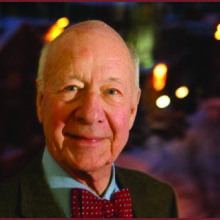
Remembering Professor Peter Hoffmann

Born in Dresden, Germany in 1930, Peter Hoffmann joined McGill as the chair of German History in 1970. His research focused on World War I and II, as well as the German resistance to Nazism, which were the topics of his published books The History of the German Resistance, 1933-1945 (1977), Hitler’s Personal Security (1979), and Carl Goerdeler and the Jewish Question, 1933–1942 (2011). On Jan. 6,  the beloved McGill professor passed away at the age of 92. Some of Hoffmann’s former students shared their memories of the late academic and mentor with The McGill Tribune

Colin Gilmour worked with Hoffmann as a graduate student after asking him to supervise his doctoral studies. 

“I approached Dr. Hoffmann to be my doctoral supervisor in 2011 because, in reading his work, I saw the kind of historian that I wanted to emulate: One whose research was meticulous, writing clear[,] and one who remained faithful above all to the evidence, wherever it led,” Gilmour wrote. 

Hoffmann was not only active in academia. Gilmour recalls the 85-year-old professor walking home and back for lunch some days and opting for the stairs instead of elevators. His physical energy matched the energy he brought to the classroom.

“[T]he snapshot-memories I shall cherish with the greatest fondness are of course of Peter Hoffmann the man,” Gilmour wrote. “Closing my eyes I see him, as always, with his trademark bow tie, sitting amidst the columns of books that went from floor to ceiling in his small office gathering his hand-written notes and green, blue[,] and red overhead transparencies for a lecture.”

Eliza Wood is another one of the many students who enrolled in Hoffmann’s undergraduate courses. Yet, Wood’s academic life was impacted beyond the three credits added to her transcript. 

“Professor Hoffmann’s seminars caused me to abandon my half-hearted plans to work in politics and instead pursue a master’s degree in history at McGill, where I was Professor Hoffmann’s graduate student and his teaching assistant,” Wood wrote to the Tribune.  

Wood, who first attended a class with Hoffmann in the third year of her undergraduate degree, continued her studies in German history with a second Winter seminar on the German Resistance. She remembers Hoffmann jokingly referring to the returning students as “the necessary ‘old dough’ mixed in with the fresh ingredients used to make bread.”

 “He clearly enjoyed our company—inviting his seminar students to his home for tea, and taking his teaching assistants on a shockingly fast walk for lunch at Schwartz’s,” Wood said. “I feel privileged, 10 years since I was last in his classroom, to have visited with him before his passing. It will surprise none of his former students to learn that despite his illness, in our last conversation, he was still teaching.”

Ellen Gilley, who also took Hoffmann’s undergraduate classes, remembers the questions on his history exams to this day. She describes herself as belonging “to the band of McGill History students who painstakingly selected their courses around Professor Hoffmann’s teaching schedule.” In her letter to the //Tribune//, Gilley reminisced on the 18 credits she took with Hoffmann, which she describes as “the equivalent of a minor at the time.”

“In front of a 200+ person classroom at 8:00 a.m. on a cold, dark morning, professor Hoffmann is intimidating—he is formally dressed, appears stoic, and delivers an 80-minute lecture of pure content.  I have no memory of him ever pausing for a drink or using notes.  But approach him outside of these lectures, and his warmth and genuine interest in his students’ success were at the forefront,” Gilley said. 

Gilley extended her “gratitude and appreciation” for all the additional effort Hoffmann put into teaching. Such dedication must have taken “many hours during nights and weekends.” 

Former students agree that Hoffmann was a professor who made the Department of History and Classics a welcoming environment that fostered learning and curiosity. His presence in McGill’s lecture halls and the stairways of Leacock will be missed, as will his passion for learning and dedication to his students.


Read the full tributes:

Hearing the news that Peter Hoffmann had passed away came as a shock, despite his 92 years. Such a sentiment is almost cliché nowadays, but for all who had the privilege of studying under him as I did, Dr. Hoffmann truly was a giant, not only as a member of the McGill History Department but as a scholar whose lifetime of study shaped the way we look at German history.

To say Professor Hoffmann’s impact upon his field was significant would be an understatement. His works on the German resistance to Hitler remain seminal, fuelled by his unending devotion to making known not only the facts of but especially the motivations behind this movement. So unshakeable was this devotion that he withstood controversy and criticism in his homeland, which has long struggled with the memory and legacy of that terrible time. There are few historians to have achieved the heights of impact and respect that he did in his long career; he was one of the greats.

As one of the fortunate young graduate students, indeed the last, to have worked closely with him in that career, though, my memories naturally focus most strongly on what he meant to me. I approached Dr. Hoffmann to be my doctoral supervisor in 2011 because, in reading his work, I saw the kind of historian that I wanted to emulate: one whose research was meticulous, writing clear and one who remained faithful above all to the evidence, wherever it led. Over the following years, he patiently mentored me, spending hour after hour helping me to understand, to challenge and to be confident in my own research. I can almost see the familiar, elegant blue handwriting in the margins of this page right now admonishing me gently (as he often had to) to be more concise! Sorry Professor, not this time.

Aside from my own research, I also learned about teaching from Peter Hoffmann while serving for years as his teaching assistant. His classes always filled quickly, and were among the most popular in the department. By all undergraduate logic, though, this shouldn’t have been the case. His classes were not easy, he brooked no nonsense for ‘dog-ate-my-homework’ excuses, and, most important of all, they were always first thing in the morning. Yet full they were, and it soon became clear why: he was firm but always fair, treating his students as mature scholars and expecting corresponding commitment in return. On many occasions I saw firsthand how many students identified with and appreciated being challenged like this, and left his classes as more capable and confident thinkers.

One memorable example sticks in my mind: After some less-than-stellar midterm results one day, Dr. Hoffmann announced to one of his classes that as part of their final exam he expected them to draw a map of Europe freehand from memory, including political borders, major cities and rivers. Sitting in the front row, I can still remember the audible gasp and angst-filled silence that followed as students saw their GPAs slipping away. Week-after-week, though, Dr. Hoffmann would encourage them that with practice they could do it, and, sure enough, I saw many hunched over pad-and-paper in the coffee-shops surrounding McGill doing just that over the following weeks. When the final exam came, the other T.A.’s and I were surprised at some of the atlas-quality results. Dr. Hoffmann, however, was not; he knew what his students could do. In later years some of these students would recall their “Hoffmann test” to me with fondness, noting with feeling how much they appreciated being pushed and how well the skill had served them since. It was such things, seemingly so small, that made him such a beloved instructor.

Yet, the snapshot-memories I shall cherish with the greatest fondness are of course of Peter Hoffmann the man. Closing my eyes I see him, as always, with his trademark bow-tie, sitting amidst the columns of books that went from floor to ceiling in his small office gathering his hand-written notes and green, blue and red overhead transparencies (!) for a lecture. Likewise, I recall the amused look in his eyes whenever I, the young grad student, would angle towards the elevator when leaving his office. Peter Hoffmann, the then 85-year-old professor, always took the stairs (Indeed, he often walked several kilometres to McGill from home, and sometimes back for lunch!). Most of all, I can hear the low, chuckling laugh that often followed one of his many stories about the farm where he spent much of his free time, as well as the genuine interest on his face as I told him of my own passions, hopes and goals.

For all of these memories, and the deep and lasting presence which shall be sorely missed around the world amongst his students and admirers, I am grateful to have known him. 

-Dr. Colin Gilmour


At the start of my third year at McGill, I registered for a seminar on Interwar German history taught by Professor Peter Hoffmann. I chose this course just because it fit my schedule, and I certainly did not expect Professor Hoffmann to completely change both my approach to learning and my planned career path. 

Professor Hoffmann began the first class by asking our group of around 15 students a series of questions about the First World War. When I raised my hand to confidently answer a question, Professor Hoffmann informed me that my answer was surface-level and mostly incorrect. I was stunned and stayed silent for the rest of the three hours, just listening and trying to repair my wounded confidence. Looking back, that moment was a breakthrough for me–I needed to have my complacency challenged. 

Because of Professor Hoffmann, for the first time in my academic career I began to slow down and appreciate the mental struggle that precedes real learning. I found fulfillment in spending hours on the sixth floor of McLennan, finding obscure sources on German history and revising my papers to meet his expectations. Professor Hoffmann expected us to push ourselves as we attempted to comprehensively understand every facet of a historical event and he taught us the importance of humility in the face of difficult history.

He challenged us and we pushed ourselves, but Professor Hoffmann also expected us to work as a community and lean on one another. He frequently implored us to meet after class to study and share notes. Any inclinations toward academic selfishness were squashed quickly in Professor Hoffmann’s seminars, because in order to succeed, we had to work together.  

After that first semester, I (as well as several other members of the Fall seminar) eagerly signed up for Professor Hoffmann’s Winter seminar on the German Resistance. Professor Hoffmann jokingly referred to the returning students as the necessary “old dough” mixed in with the fresh ingredients used to make bread. In this course, we continued to practice the rigor and collective spirit that he had drilled into us in the first seminar, bringing the “new dough” into the fold. Together we spent hours trying to understand the actions of resistors in one of the darkest moments of history. We all pushed ourselves to exceed our own expectations and meet his. 

Like many of Professor Hoffmann’s students, I found that the standards he had set in his class became the new baseline for my efforts in all my classes. As I studied, I could practically hear his voice in the back of my head if I was considering cutting corners or leaving out important information. To this day if I begin to type the word “importantly,” I laugh to myself and revise. 

Professor Hoffmann’s seminars caused me to abandon my half-hearted plans to work in politics and instead pursue a master’s degree in history at McGill, where I was Professor Hoffmann’s graduate student and his teaching assistant.

Professor Hoffmann was not just an uncompromising historian and teacher, he was also a kind and helpful man who spent hours with his students in his office hours to help them better understand the material–or just to visit with them. He clearly enjoyed our company–inviting his seminar students to his home for tea, and taking his teaching assistants on a shockingly fast walk for lunch at Schwartz’s. I feel privileged, ten years since I was last in his classroom, to have visited with him before his passing. It will surprise none of his former students to learn that despite his illness, in our last conversation, he was still teaching.

Professor Hoffmann has made an indelible mark on me. He set me on my course to graduate school and ultimately to teaching. He inspired me to expect more of myself and look beyond the grades on my transcript and inwardly question whether there is more I could do to better understand the past. In my classroom today, I try to push my students beyond the simple solutions and help them strive for deeper understanding. Professor Hoffmann’s passing is a great loss. The hundreds of students he impacted will miss him and we are grateful for all he taught us. 

-Eliza Wood


What international treaties were signed between 1871 and 1914? What were all the land battles fought on the Western Front during World War I (in chronological order) and what were their outcomes? What five minutes changed the outcome of the War in the Pacific? Any student of Professor Peter Hoffmann’s World War I and World War II history classes will remember the fact-based questions of his exams and his commitment to rooting his research and teaching in primary source documents. The  fact that I can recall some of these exam questions over 15 years later is a testament to the force of his presence and thoroughness of his teaching. 

I belong to the band of McGill History students who painstakingly selected their courses around Professor Hoffmann’s teaching schedule. Through good timing, I was able to take his classes on the history of World War I and World War II, his year-long seminar on the German Resistance to National Socialism, and his two individual seminars on German History from 1918-1933 and from 1933-1945: altogether, 18 credits of Hoffmann (the equivalent of a minor at the time).  Initially, I saw his fact-intensive approach to history as a challenge. I liked reciting timelines with precision and viewing history in these concrete terms.  What became apparent in our smaller seminars, however, was that these facts simply provided an infrastructure for analysis.  The goal was never to stop at a two-dimensional view of history as a timeline or the people as good or bad actors. Rather it was to carefully evaluate each piece of research to gain insight into the complexities of the time—including the personalities, political climate, society, and conflict.  He taught us to evaluate all evidence, question our perceptions, and acknowledge—not obscure—the inconsistencies, limitations, and disagreements across sources.  By doing so, we could first understand what happened and then, to the extent possible, why.

Beyond the academic rigor he demanded, what made Professor Hoffmann such an impactful teacher was his dedication to his students.  Admittedly, it surprised me.  In front of a 200+ person classroom at 8:00AM on a cold, dark morning, Professor Hoffmann is intimidating—he is formally dressed, appears stoic, and delivers an 80-minute lecture of pure content.  I have no memory of him ever pausing for a drink or using notes.  But approach him outside of these lectures, and his warmth and genuine interest in his students’ success were at the forefront.  During one of our meetings, I was frustrated with the progress of a paper, and he could tell. Without my prompting, he suggested I have a week extension, take a few days off, and return to the sources without driving an agenda.  During our small group seminars, he rewarded us with a beaming smile during productive conversations, challenged us with pointed questions and new research, and, every so often, added levity with a joke—of course, delivered so dryly that he had to clarify.  He invited us into his home, spoke of his family history, introduced us to his wife, Helga, and continued to answer questions long after graduation.

It would be hard to overstate the impact Professor Hoffmann has had on me.  Professionally and academically, I continued to study regime changes and the impact on international relations, culminating with a clerkship on an international tribunal.  Analytically, he taught me to be exacting and rigorous and not distracted by initial theories.  Most of all, through his group seminars, he showed me the value of sharing knowledge and seeing others as teammates and colleagues, not competitors. To his family, please accept my gratitude and appreciation for everything he did to prepare for classes and support his students; I can only imagine this took many hours during nights and weekends.  I am a better student, lawyer, and teammate because of him.

-Ellen Gilley

Emerging Trends, Student Life

Bringing the outdoors in: How to make your student apartment greener

A healthy indoor plant is seen as the mark of a student life well-balanced. Not only do they add a touch of colour and life to any living space, but they also provide numerous health benefits. For many McGill students, however, caring for these green babies can be a challenge. From a dearth of sunlight in cramped bedrooms to long breaks with nobody home, keeping indoor plants alive and thriving can be a difficult task. Whether you have a green thumb or are a keen beginner, read on to learn more about the benefits of indoor plants and how to care for them in your student apartment. 

Benefits of indoor plants

Houseplants are an affordable way to add a touch of nature to your indoor spaces and enhance the overall aesthetic of your home. This decorative appeal prompted Eléonore Beauregard, U3 Science, to buy some houseplants for her apartment. 

“They make great décor that is not super expensive and doesn’t encourage overconsumption,” Beauregard said. “When they flower, it’s the best feeling to know that I’ve cared for them so well.”

Indeed, houseplants are known to have certain psychological benefits. Taking care of living creatures, watering and fertilizing them, and removing dead leaves can be therapeutic. Caring for your plants gives you a purpose and, when they bloom, you feel rewarded. 

Additionally, the bright green colours and earthy feeling that these plants produce will reduce stress levels and elevate your mood. 

For Kenza Zarrouki, U3 Arts, living in a windowless bedroom has made caring for plants even more special. 

“I recently purchased several plants, and they bring life into my tiny bedroom,” Zarrouki said. “This is very soothing and makes me feel much better, especially since I don’t have a window and my room can get very dark.”

Through the process of transpiration, plants also add humidity to the air, which can help combat the dryness of cold winters. They also absorb carbon dioxide and release oxygen, helping keep the air fresh. 

Overcoming the challenges of student apartments

Many students find themselves in small apartments with low levels of natural light and, like Zarrouki, often do not have a window in their bedroom. This presents the biggest challenge for indoor plants that need light to grow. To combat this, Professor David Wees, Faculty Lecturer in the Department of Plant Science at McGill, recommends investing in a plant-based alternative. 

“Light will always be a limiting factor. So for someone with a small apartment and the only light is a north-facing window with no direct sunlight, you might want to consider putting in a plant light,” Wees said in an interview with The McGill Tribune.

Another reason why maintaining healthy plants may be challenging for students is the limited time spent at home. Camille Lederer, U3 Environment, finds the time needed to grow most plants a particular challenge as an international student. 

“When I go home for summer or winter breaks, my plants don’t survive,” Lederer said. 

Thankfully, certain plant species, such as succulents, are better adapted for students in these situations, especially for those who are away for long stretches. 

“Plants that people like to use indoors include the spider plant since it is easy to grow,”  Wees added. “Another one is the snake plant––it is very drought-tolerant, so you can forget to water it for months and it will survive. Finally, pothos is great for low light. One thing to look out for is that it’s not as drought-tolerant, so you need to water it at least once a week.” 

Once you have purchased your plant, there are some final things to keep in mind. To ensure your new plant thrives, remember to not over-water it, which can lead to root rot. Also, when introducing a new plant to a room with existing plants, it’s a good idea to place it in quarantine to prevent the spread of bugs or parasites. 

With all of this in mind, you’re ready to start your own plant oasis. Happy gardening! 

Out on the Town, Student Life

A holy site steps away from campus

In the late summer of 1912, a highly anticipated visit to the Montreal Baha’i Shrine, formerly the Maxwell home, located at 1548 Avenue des Pins, made anglophone and francophone headlines all across Montreal. Articles titled “Persian Teacher to Preach Peace” and “Apostle of Peace Meet Socialists” could be found across Montreal publications. Over a hundred years later, the Maxwell home stands as the sole shrine of the Baha’i faith outside of the Middle East. And it’s just a 12-minute walk away from McGill’s Law Library. 

I was eager to learn more about the Baha’i faith from my first introduction to its principles. Rather than being practised through a complex set of rites administered by clergy, the religion places human unity at its centre; it is a highly personal practice, a conversation between the soul and God. 

“Central to the faith is the duty of independently investigating the truth,” Shidan Javaheri, a U2 Engineering student at McGill who grew up in a Baha’i family in Lusaka, Zambia, told me. 

He explained that he decided to become Baha’i at age 15, after the teachings of the faith resonated with him. This notion of religious choice at such an early age was almost as shocking to me as a Roman Catholic as was hearing that Baha’is do not practice confession. Indeed, the confession of sin is forbidden and individuals are encouraged to seek repentance directly with God. At this point in our interview, I started to wish I had heard about this religion sooner—it would have saved me years of Catholic guilt. 

The shrine became a holy site of the Baha’i faith after the 1912 visit of Abdu’l Bahá, one of the three central figures of the faith. The home was owned by May and Sutherland Maxwell, one of the earliest Baha’is in Montreal and one of Canada’s most renowned architects, respectively. Montreal was the only Canadian city Abdu’l Bahá visited during his voyages to the West to spread the Baha’i faith, but this alone was not enough to cement the Maxwell home as a shrine. It was only when Abdu’l Bahá’s declared “this is my home” upon first entering the house that the building could assume sacred status as a shrine. Indeed, Baha’is consider the homes of sacred religious figures as shrines. The Maxwell home became symbolic of the religion’s reach into the West. The Maxwell house is the only Baha’i shrine situated outside of the Middle East. 

Maziar Djoneidi, member of the shrine’s Board of Directors, explained that “the shrine is a space for spiritual refreshment, not just for Baha’is but for people of any religion, or no religion at all.”

They are open two days a week for visits, and receive up to 50 people per day in the summer. So as a McGill student, no matter your faith, or lack thereof, you are welcome at the Baha’i shrine of Montreal for a moment of peaceful reflection. 

“It is open to anyone who wants a moment alone with a higher power,” Javaheri told me.

If you don’t want to make the effort to walk up des Pins, you can still learn more about the faith on campus. Although it is not operating through  SSMU as a student club, Baha’i students work with McGill’s Office of Religious and Spiritual Life and recently hosted both a panel on their faith and a visit to the Shrine. 

If you want to visit the shrine, you can book your slot online. You can also contact the shrine at [email protected], and, if you are interested in learning more about the McGill Baha’is’ activities, you can reach out to [email protected].

Features

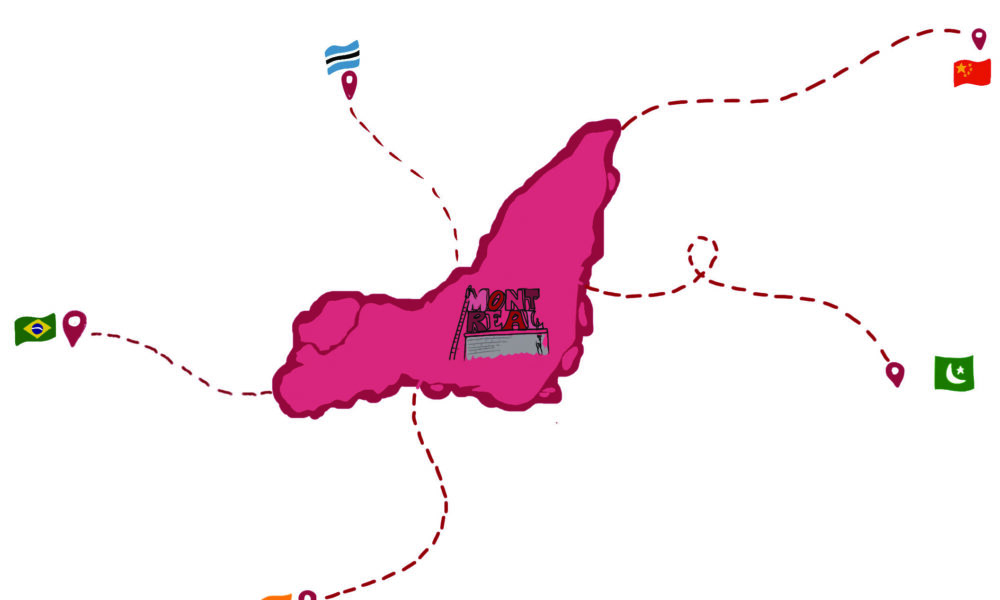
To Montreal, my second love

The Dollarama near my house gets a visit from me every week. Sometimes it’s out of necessity, but mostly it’s because I’m bored and it’s the only place where I can afford to impulsively shop. When I walked in one day this fall, the entire store was covered in shades of orange and yellow, in preparation for Thanksgiving. Shortly after, the store dons an outfit of red, green, and white in anticipation of North America’s most celebrated holiday: Christmas. 

As I see the store changing its dress according to every (Christian) occasion, I see Montreal doing the same. The week leading up to Halloween, for example, I see everyone on the street fitted out in their best costumes, on their way to a party, or perhaps already tipsily walking back from one. All of December, I see every building ornamented, often excessively, and hear Christmas jingles ringing in my ears. As I walk home, they haunt my already-looming fears that my brother—and roommate—has devoured that last bit of cake I left in the fridge. 

But as Montreal changes its colours, I also turn blue, wallowing in a mostly unexplainable sadness. I think back to how my country would be donned in white and green for the month of independence, or how a spirit of joy and celebration would overtake us in anticipation of Eid, or how the sky would be overtaken by colourful polka dots for Basant. Seeing all these families and friends happily celebrating a holiday doesn’t make me nauseous because I’m heartless, but because my heart is mourning its own loss.

So I call my parents up and make some dal chawal and I sit in my bed wearing shalwar kameez—letting the homesickness wash over me as I try to understand why I left home in the first place. Why is it that I rethink my decision twice every week, like it’s a task on my daily agenda set to ‘repeats weekly until eternity’? And then, to make myself feel better, as I’m sitting alone in my room, I tell myself that I’m probably not the only one who feels this way—because suffering in solidarity is the best antidote. Right? 

In all seriousness though, with 30 per cent of the student population being international students, there’s bound to be scores of people on McGill’s campus struggling with the idea of living in a new and strange place, away from their family, away from their feeling of safety, and away from their home. 

This “fish out of the water” experience often registers in the health services that students turn to in their time of need. Homesickness, therefore, is a phenomenon that’s clear to Vera Romano, Director of the Student Wellness Hub

“A Counselling and Mental Health Benchmark study conducted in 2019 indicated that our international students report higher levels of social anxiety than Canadian students,” Romano wrote in an email to the The McGill Tribune. “Loneliness is also a challenge for international students.”

Out of place, everywhere 

When I sought out international students to talk to, I found many who had similar experiences to share. Sarthak Mendiratta, U2 Science, originally from India and President of the Dharma Society, explained that the challenges of being a university student compound when you’ve just relocated your entire life abroad.

“[Moving] is a culture shock, we’re not used to the weather, a lot of us are not used to cooking, a lot of us are not used to cleaning,” Mendiratta said. “So you have a plethora of responsibilities thrown at you at once and then you have to maintain your academic standing. I guess that’s where the impostor syndrome kicks in. 

For many students who come from countries or homes with non-Western or non-Christian cultures, the holidays are a time that exacerbates loneliness. 

“Homesickness hit really hard that very first winter break,” Refilwe Mpai, a PhD candidate in neuroscience, told me. “Given that Botswana is incredibly far away from Canada, it was not possible for me to fly back home for Christmas, and Christmas has always been a time of getting together with family, so not spending that Christmas with my family was really challenging.”

Many international students yearn to spend major holidays and events with loved ones, especially as McGill’s tight academic schedule and Quebec’s public holidays don’t account for the diversity of their students, staff, and faculty.

“I missed home a lot during the World Cup because it’s a big thing for us; like we don’t have school on the days Brazil plays,” Beatriz Neves, U1 Arts, said. “And I had to fix my way around the schedule to watch it now, and I never had to do that before, so it was weird.”

In addition to homesickness and nostalgia, for many international students of colour, entering McGill also carries the additional alienation of entering a white-dominated space and becoming racialized in a Canadian setting for the first time. 

“There aren’t very many Black people in the psychology department,” said Mpai, who also completed her undergraduate degree in psychology at McGill. “Though there’s a decent population in McGill, it’s a lot smaller than what I was used to coming [from] Botswana, so I felt kind of out of place.”

Yupeng Wang, U2 Arts, who moved here from China, is plagued by the feeling of constantly walking on eggshells. 

“I notice that [Canadians] will be more relaxed to the rules, whether they want to follow it or if they think it’s not a good rule, not follow it,” Wang told me. “But, as a Chinese person, I’m always like nervous and cautious, like I did something bad.”

Of course, the added pressure of learning and conversing in a completely new language exacerbates this feeling of being out of place. 

“I think because I’m an anglophone, I do feel like a second class-citizen,” Mpai explained. “Particularly in interactions outside of Montreal, in other areas of Quebec, people kind of look at you weird when you either stumble through a French sentence or respond in English.” 

As Quebec’s French language laws continue to become stricter––most recently with the introduction of Bill 96 which requires most public service communication to take place solely in French, making those services difficult to access for non-French speakers––many international anglophone students may feel increasingly excluded by a city they once thought was going to be a realm of opportunities. 

“I mostly came here for the opportunities, but I don’t speak French so it was definitely a reality shock for me,” said Maria Horta, U1 Arts, who moved to Montreal from Brazil. “I was like ‘oh, I actually can’t really do much here.’” 

Should I stay or should I go? 

So then, knowing that it will be hard and that we will have to struggle, why do we leave our homes and come to this completely new and unknown place—just to then miss our home? “For better educational and career opportunities,” says my annoyingly-pragmatic mind. 

And Horta confirms that my inner cynic is correct. 

“I heard that there were a lot of good opportunities here, more than Brazil, so I thought it would be cool [to move here],” she told me. For Mpai, it was McGill’s international reputation and affordability, compared to the other universities she applied to, that drew her here. 

Montreal may also prove to be a place of safety, freedom, and liberation for some international students who have not experienced that privilege in their home countries.

“The best thing about Montreal is the safety. It’s a very safe place and I know I can walk home at 5 a.m., and I’ll be fine,” Horta said. “Comparing it to São Paulo, most of my friends have been robbed […] and walking home at night is something that you just don’t even consider—for both men and women.”

“[Montreal] is a very diverse city,” Mpai said. “Compared to Botswana it’s a lot more liberal in terms of self-expression, sexuality, gender identity and all of that.”

Wang identifies with a similar feeling of liberation. After experiencing bullying and threats in her hometown, she decided to move to Canada “because it is more liberal and because no one knows me, I can have more freedom […] I can be away from the control of family and also the political control [in my hometown].”

However, is all that justification enough for leaving your childhood home, especially when the stakes are so high? 

When a bachelor’s degree costs $31,500 CAD for international students, success in classes becomes not only tied to your academic standing but also to your ability to pay off accumulating debts and secure a job that will allow you to do so. Recruiters often also exploit international students’ dreams of upward mobility through Canadian education, pitching a pathway from university to permanent residency to a lucrative life, yet refusing to take responsibility for the real challenges of resettlement—namely, the financial. 

So then, is it all worth it? I ask this because if there are students that regret their decision, I can decide whether I regret mine, too. Herd mentality? Perhaps. Indecisiveness? Definitely. 

Finding others, finding ourselves

According to many international students I spoke to who have found a community here, McGill and Montreal begin to grow on you after the tedious first semester (or year… or two). The work of cultural student clubs and organizations on campus, therefore, cannot be overlooked. They give students a glimmer of hope that a future here is possible and help them find comfort in a new and strange world.

“I have a good group of Brazilian friends and the Latin American Association at McGill, too, that would do watch parties for the [World Cup] games, which was very fun and [allowed me to] meet new people who also miss home and be able to talk about it,” Horta told me. 

Shreya Mahasenan and Nancy Kaul, both U3 Science, founded the McGill Dharma Society in 2021 when they realized that McGill does not have adequate representation on campus for students of South Asian religious traditions, particularly  Hindu ones. 

“The primary reason for the foundation of the [Dharma] society […] was representation,” Mendiratta said. “We want students of Dharmic background […] [to] have a safe and comfortable space.”

“I know the McGill African Students’ Society is a good community to establish, and even though it’s not necessarily people from the exact same country as me, just other Africans living in North America, it’s a way to recreate that [community]. And other groups like the Black Students’ Network are a really good resource as well,” Mpai added.  

Mpai’s podcast, Journey Abroad, is another initiative that allows students from Africa to find a community that shares similar struggles, such as navigating holiday seasons without families, mental health issues, and financial challenges.  

“I started Journey Abroad to talk about these things, specifically highlighting the stories of Africans living abroad so we can talk about the challenges […] which has been a good way to recreate the community here,” Mpai said.  

With the help of religious and cultural clubs at McGill, students have found a way to connect and develop a sense of home, despite living thousands of miles away from it. 

“Even though I’m not always necessarily surrounded by other people from Botswana, there’s other people who can speak to the international student experience and try to create a home away from home,” Mpai said. 

Diverse student spaces on campus help international students from different countries to have an immediate point of mutual recognition. Contrary to the classic immigrant narrative of achieving personal and individual uplift through hard work, the religious and cultural communities at McGill and Montreal remind us that, in the face of academia’s atomizing environment, collectivity is a big part of how international students sustain each other. At times, these networks are even enough to make the question of staying an easier one. 

“I feel very welcomed here because there is such a good immigrant community,” Neves said. “Everyone kind of hugs you and knows what you’re going through, even though you’re not from the same country, but [they’re] like, ‘I get you’.” 

When one heart breaks, another mends  

In this process of starting to feel the warmth of home again within Montreal (yes, even in the winter), one begins to wonder whether this inner change is to be celebrated. And whether, in doing so, you are losing an essential part of yourself. 

“I know if I go back, it’s not going to feel the same,” Neves said about her home country Brazil. “I don’t belong there anymore […] Brazil is always going to be my country but Canada could be my home.” 

The question of whether or not to settle in Montreal, therefore, becomes more complicated than just a matter of weighing economic and educational benefits. Horta can relate. 

“The more I speak English, the more I lose Portuguese […] and it just kind of feels like I’m not not even a real Brazilian anymore, and it just builds into this sort of identity crisis,” she revealed. 

In truth, identity and culture are in constant flux. After speaking to so many international students, I’m learning that we can nurture spaces to hold on to our cultural heritage while also making space for new experiences and homes. This has allowed many international students to find an inviting beauty in Montreal.   

“I really love this city and I think the university is so beautiful and I really love how we have a museum and an ice skating rink, I just think it’s something out of a movie, and it would be insane to move out,” Horta said.

This conflicting process, thus, is a lot like falling in love again after heartbreak—you can never really let go of your first love, but your heart slowly starts to make room for one more. Montreal is that second love for many international students, just as it is for me, I’m beginning to realize.

Despite the struggles, the winter, the moving, the construction, and all that French, I realize I’m slowly falling in love again. Lahore will always be my first love. With its sublime street food, its colourful festivals, and its kindhearted people, it will always hold a special place in my heart. However, bit by bit, Montreal is now starting to carve its own shape on there, too.

Even with the copious amount of snow this city is buried under and the unnecessary orange cones outside my house, I still look out of my window every morning and think, “this city is absolutely gorgeous.” After all, love isn’t worth it without its red, or rather white flags, is it?

Cross-Country / Track, Sports

Sparks fly at McGill’s track and field Team Challenge

On Jan. 27 and 28, the Martlet and Redbird track and field teams held their annual McGill Team Challenge at the Tomlinson Fieldhouse. With 538 athletes representing schools and clubs from across Canada, personal bests were achieved, school records were broken, and fans were more than entertained. 

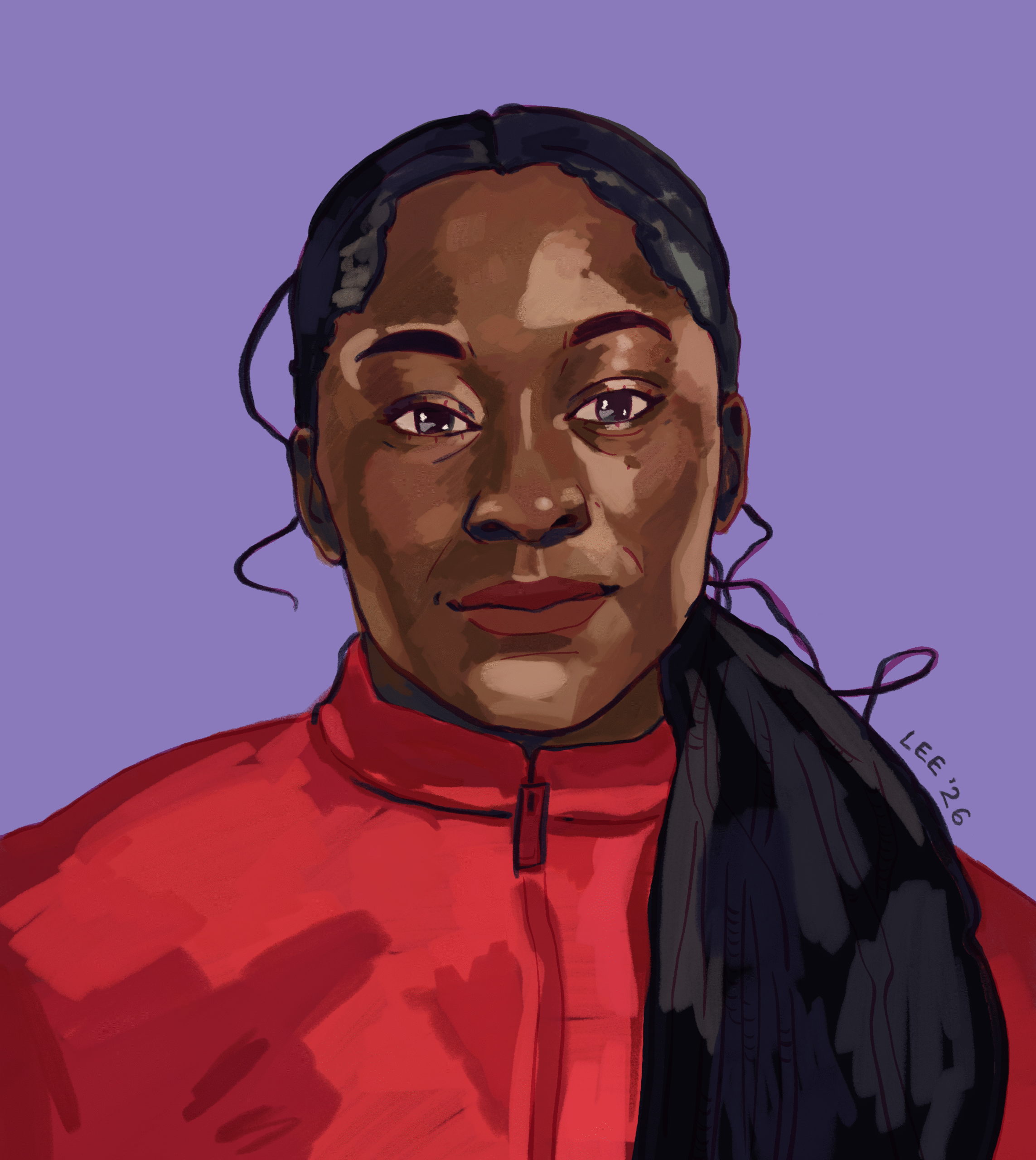
Day one started off with a bang after Donna Ntambue’s stunning performance in the 60-metre dash. The transfer from Northeastern University won her race with a time of 7.38 seconds, beating McGill track alumna Jorden Savoury—who was competing for the Saint-Laurent Seléct club team—by 0.27 seconds.

“I’m still speechless,” said Ntambue in a post-race interview with The McGill Tribune. “Obviously that was one of my goals, but it’s just nice to see it happen. But I’m just grateful for the opportunity to be back on track. And it’s nice to know that I’m actually getting better. So I’m looking forward to [running] faster [and] just enjoying the ride.”

Ntambue later led the Martlets 4×200-metre relay team to a bronze medal with a McGill record finish. 

The longer-distance events held several highlights as well, including Abby McIntosh and Markus Geiger in the 1000-metre race, and Noah El Rimawi-Fine and Sophie Courville in the 3000-metre race. McIntosh managed to dip under three minutes with her 2:58.49 for seventh place, while Geiger put up an intimidating early season performance with a 2:26.37 for fifth place. In the longest races of the weekend, Courville ran an impressive 10:09.93 and El Rimawi-Fine ran a smashing personal best of 8:33.17. The two runners both scored themselves a spot in seventh place in their respective women’s and men’s races. 

Despite some pre-competition frustrations, El Rimawi-Fine reflected on how the race went surprisingly well, but noted that there are still areas to improve. 

“Honestly, I felt pretty good. I didn’t expect that,” said El Rimawi-Fine. “But I felt like the Queen’s guy was slowing down a little bit and I had a lot of energy, so I kind of wanted to make a move. If I had known I had enough in me, I probably would have kicked a bit sooner [….] So I think if I had done that, it could have been a sub four attempt closer than 4:03. But I’m happy with this.”

However, the 1500-metre isn’t El Rimawi-Fine’s main race—most of his season goals revolve around the 3000-metre race, where he placed fifth this weekend with a time of 8:33.17.

Day two was another intense day of racing. Ricardo Percopo finished eighth in the 300-metre, and Geiger followed up his impressive day one performance with an even more remarkable third place in the 600-metre, running 1:20.59. 

In the men’s 1500-metre, a massive McGill presence made for an exciting spectacle for the home crowd. One of the seven McGill runners in that race was Jérôme Jacques, who slid in under four minutes (3:58.89 to be precise) for 11th place in an inspiring display of grit and bold racing tactics. On the women’s side, Courville followed up her 3000-metre performance from the day before with a 12th place finish of 4:47.27 in the 1500-metre. 

Two of the most exciting races of the weekend came courtesy of Matthew Beaudet in the 1000 and 1500-metre races. Despite being passed by two of his competitors in the last 100 metres, Beaudet still managed to pull off an impressive 2:24.76 for third place in the 1000-metre on day one. 

“My main goal for the weekend was to run a good 1000-metre, and I felt I was in shape to run close to the provincial record of 2:21,” Beaudet told the Tribune. “ I think I was a little too anxious during the race as I took the lead early [at about] 550 [metres] and used too much energy there [….] The time was still good considering the tactical mistakes, and it was nice to compete against strong athletes in Montreal.”

On day two in the 1500, Beaudet ran a very similar race. His blistering pace was too much for everyone else in the field except for Queen’s University’s Jude Wheeler-Dee––the same foe who bested him in the 1000-metre––who managed to hang on once again and out-kicked Beaudet in the last stretch of the race. 

“I was pretty tired doubling in the 1500, but I wanted to run with more confidence this year, so I picked up the pace after 850 metres and led until the last 50 metres where I got passed again,” said Beaudet. “I was hoping to run a few seconds faster in this race, but I was happy with how I executed the race plan and I am looking forward to competing in later meets.”

Off the track, McGill dominated with two golds on the men’s side from Mackenzie Stathis in triple jump and Olivier Gregoire in pole vault. The Martlets came home with one bronze medal from pole vaulter Rosalie Lupien. And for those who throw heavy things, McGill took home two bronzes in shot put from Lina Ikhlef and Ella Villeneuve, while Philippe Haddad finished seventh for the men. As for the hurdles, Vanessa Lu Langley took home a silver medal in the women’s 60-metre race.

The Martlets and Redbirds will compete again on Feb. 4 in Quebec City at the Laval Invitational. 

Moment of the Meet:

Ntambue ran the 60m in 7.38 seconds, dominating her toughest university competitors by over two-tenths of a second and setting a fresh school record.

Quotable:

“I’m no better than I was last season…but I’m also not worse.”

––Lucien Louvet, distance runner

Stat Corner: 

With 45 teams and clubs, including 14 universities, over 500 athletes, and more than 800 entries, the 2023 McGill Team Challenge was slotted as the largest indoor track meet in Canada.

Artistic Swimming, Sports

When it rains, it pours: The Martlets’ artistic swimming is back

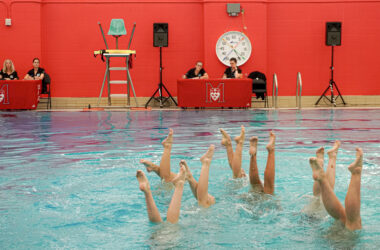
After a two-year hiatus, McGill’s Artistic Swimming Invitational made its long-awaited comeback on Jan. 21. Following back-to-back wins in the 2019 and 2020 editions of the invitational, expectations for the Martlets were higher than ever. 

Events are split into competitor levels ranging from novice (no competition experience at the national or provincial level after the age of 12), competitive (any swimmer who is registered with Canadian University Artistic Swimming League (CUASL)), and experienced (athletes that competed nationally or internationally before joining CUASL, or competed provincially after the age of 12). This year, McGill competed in every event, except for the novice duo, presenting two solos, two teams, and a duo in the experienced category, along with a solo and team in the novice category.

In attendance were five Ontarian universities, as well as four institutions from Quebec as part of the CUASL.

Ten minutes before the start of the competition, the Memorial Gymnasium saw athletes finalizing their preparations, with some reviewing choreographies for the last time, while others touched up their makeup by the side of the pool. The invitational opened with the novice duet events, followed by the experienced duets and trio, where Abbie Carnahan and Catherine McGee presented a graceful choreography to sombre, lyrical music. 

From intense lyrical melodies to upbeat pop songs, from Dua Lipa to Flo Rida and Pitbull, competing teams offered up a wide range of choreographies. However, they all had the same goal in mind: Showcasing their artistry and technical skills to the judges. The requirements between the various events differ slightly across levels and increase in difficulty for the experienced events. 

When the solos came, McGill’s novice soloist Diana Paparelli performed to Madonna’s “Isla Bonita,” delivering a theatrical and technical performance that invigorated those in the stands. Her routine placed her at the top of the soloists and ultimately earned her first place in the event. 

McGill experienced soloist, Clara Thomas, performed a stunning technical choreography and finished in third place on the podium.  

The stands never emptied as family, friends, and curious bystanders rotated in over the course of the afternoon. 

“The energy and cheering was really nice,” first-year swimmer Olivia McLaughlin told The McGill Tribune. “It was definitely very fun to have a home meet for a first competition, it’s a little ounce of security we had, […] you usually don’t have that luxury.” 

The Martlets did not only elicit support from their own stands, but also from the other teams, as those on the poolside yelled and cheered them on. 

“It’s very much a team effort,” McLaughlin told the Tribune. “There’s a certain structure that you kind of follow [….] It makes for a routine that you’re super proud to show off, because you all have your little bits and pieces in there.” 

This year’s artistic swimming team has a young core, with an overwhelming majority of first-years and only a few returning athletes. 

“Most of us never swam together before [….] it can take a while to develop the team dynamic necessary for a good performance, ” explained fourth-year science student April Ozere. “So in this way, we are at a disadvantage to other teams who may have been swimming together for a few years. However, our team dynamics are improving with every practice and I’m confident we will be able to deliver a great performance at Nationals.” 

“We were pretty happy with how we swam, considering the obstacles we had before coming to the competition,” McLaughlin added.

The schedule and competition suits were given to them just days before the event, while their McGill warm-up suits arrived the day of the competition. Since artistic swimming receives little to no funding from McGill, both of their suits were paid for by the athletes themselves, with the help of a fundraiser they organized this past fall. 

The lack of funding from McGill has proven to be a barrier for the team. In 2020, the Martlets had to pay out of pocket for all travel expenses to get to British Columbia to compete in Nationals. 

The McGill artistic swimming team will be hosting a “send-off” water show before Nationals at the end of the semester, after facing CUASL rivals in Ontario for the Eastern Divisionals on March 5-6.

McGill, News

McGill releases updated version of mandatory “It Takes All of Us” program

Content warning: Mentions of sexual violence

McGill launched a new version of its mandatory “It Takes All of Us” program, an online tool meant to educate the McGill community about sexual violence, on Jan. 30. The updated version was created by the Office for Sexual Violence Response, Support and Education (OSVRSE), McGill’s Teaching and Learning Services (TLS), and the Office for Mediation and Reporting (OMR).

The original program, introduced in 2019 and modelled after Concordia University’s version of “It Takes All of Us,” took approximately 45 minutes to complete and contained four modules that used “character-driven scenarios” centred around sexual violence and consent.

Felicia Gisondi founded the student-run non-for-profit Sex and Self to fill the gaps in trauma-informed and intersectional sexual health education. She recounted her experience taking the old “It Takes All of Us” program, which she found perfunctory and performative, to The McGill Tribune.

“I remember it being really easy to skip through,” said Gisondi, who is currently getting a master’s in psychiatry at McGill. “I also feel like it was a very, very easy way to say that your school does sexual health or sexual violence prevention because students are required to do a 45-minute digital training that they could probably do in 10 minutes if you skip through it correctly.”

The new “It Takes All of Us” takes around an hour to complete and is made up of five modules, still featuring “character-driven scenarios.” It is accessible through the MyCourses website and available in both French and English. 

Frédérique Mazerolle, a McGill media relations officer, claims that the university did a “thorough overhaul” of the program, incorporating feedback from students, staff, and at least one postdoctoral researcher who specializes in sexual violence education. 

“The [“It Takes All of Us”] refresh also puts sharper focus on the intersectionality of sexual violence and gender, race[,] and different abilities,” Mazerolle wrote in an email to the Tribune. “Additionally, given the difficult nature of some of the material, the refreshed [“It Takes All of Us”] has added more mindfulness and self-care resources for learners who may feel activated or overwhelmed while doing the program.”

The modules are designed to be completed in multiple sittings, and allow participants to save their progress. The program also has a “take a break” option that will guide users through a breathing exercise. OSVRSE urges any individuals who have or who anticipate having difficulty completing the program to reach out for confidential assistance and accommodations. 

Unlike the old program, there is now only one version for both students and staff. All students and staff who started at McGill before Jan. 31 are required to complete the new “It Takes All of Us” by April 28—even if they had already taken the old version. Students who do not complete the program in time will have a hold placed on their Minerva accounts, making them unable to register for courses. 

Gisondi, whose organization was not consulted during the program refresh, thinks that modules play an important role in sexual violence education, but are insufficient. She urged the university to invest in more counsellors and full-time OSVRSE staff, to recognize the “emotionally laborious” nature of the field, and fix the barriers to accessing care at the Wellness Hub.

I feel like McGill really needs to reinvest in their sexual violence prevention, reinvest in OSVRSE, and make sure that staff are equitably and generously paid for the work that they’re doing,” Gismondi said. “There should not be less than 10 full-time paid staff at OSVRSE at any point in time. McGill has 40,000 students.”

Keith Bellec-Warrick is a longtime member of the Union for Gender Empowerment (UGE) and is the advocacy group’s finance coordinator. Bellec-Warrick, who is currently a graduate student in education, spoke to the Tribune on the day that the new program was released. He believes that the program has strengths, such as the module on consent, but also found the structure confusing at times. He pointed to a lack of continuity between modules, and thought that the section concerning sexual violence against men was not thorough enough.

One of Bellec-Warrick’s main grievances was that the new program frequently references the availability of OSVRSE’s services and fails to suggest alternatives like the Sexual Assault Centre of the McGill Students’ Society (SACOMSS). OSVRSE, although now open after a temporary closure, has very limited appointment availability according to  their online booking tool.

“It just seems so irresponsible to release this program now when they don’t even have a functioning office,” Bellec-Warrick said. “I go on their website, there’s no information, it just shows a blocked out calendar where I can’t book an appointment, there’s no announcement that makes it obvious what the situation is. Imagine that I’m in a vulnerable situation.”

Like Sex and Self, UGE says it was not contacted during the remaking of the program. Bellec-Warrick thinks that this lack of consultation played into mistakes that he found while reviewing the program, such as poor French translations.

“The university doesn’t pursue or value the expertise of students, even though we have a lot to offer—and that’s a problem,” Bellec-Warrick said.

For any member of the McGill community in need of support regarding sexual violence, OSVRSE can be reached at 514-398-3954 or [email protected]; SACOMSS can be reached at [email protected] or over Zoom using the instructions on sacomss.org; the OMR can be reached at [email protected]; and the province-wide Sexual Violence Helpline can be reached at 1-888-933-9007.

McGill, News, The Tribune Explains

Tribune Explains: McGill Alumni Association and Scarlet Key Society

In a season when many are searching for summer opportunities, taking advantage of the university’s alumni network can be a useful tool. The McGill Alumni Association (MAA) offers various events and opportunities to students and graduates worldwide, including networking services such as McGill Connect, the McGill News Alumni Magazine, and McGill Crowdfunding. The Scarlet Key Society is an exclusive society for both alumni and current students that provides similar networking benefits. The McGill Tribune looked into the employment, mentorship, and learning opportunities that both groups offer.

How do you start networking using the McGill Alumni Association? 

McGill graduates automatically become members of the MAA. Graduates can connect with over 300,000 McGill alumni across the globe by signing into the McGill Alumni directory using their McGill credentials. 

The MAA, in partnership with a virtual networking platform called Ten Thousand Coffees (10KC), designed McGill Connect—an exclusive networking platform that allows McGill alumni, current students, and faculty to link with one another. The platform even allows recruiters to search for new hires within the McGill graduate pool. 

McGill Connect works through a three-pronged system. First, members complete a quick matching quiz to determine the personalized connection suggestions they will receive. Then, they can search the platform based on a number of factors, including location, expertise, and industry. Finally, alumni can connect with their matches through discussion boards, messages, and calls. 

What other services and opportunities does the McGill Alumni Association offer?

Along with McGill Connect, the MAA boasts a range of activities, initiatives, and benefits for its members. Events range from a Roller Skate Party in Switzerland, Winter Pancakes and Maple Syrup Brunch in Paris, to a Student-Alumni Networking Cocktail in Montreal. Events are either free or charge an attendance fee.

The MAA also publishes the McGill News Alumni Magazine, which highlights the achievements of McGill’s graduates and reports on the latest developments at McGill. 

Members of the MAA enjoy benefits such as discounts on insurance rates and credit card services. When members sign up for these perks, McGill’s affinity partners return a percentage of the premiums collected to McGill. Members can also peruse discounted accommodations across the world and pay reduced rates at McGill facilities. 

Along with collecting private donations for the university, the MAA also runs McGill Crowdfunding, a fundraising platform for individuals in the McGill community to raise money in support of educational initiatives and research.

What is the Scarlet Key Society?

The Scarlet Key Society strives to bring together students who have shown outstanding leadership and generosity in the McGill community and provides a space for them to continue their service. According to the group’s Constitution, the Society holds a few events a year and also supports a number of charitable causes.

The Society consists of members of the original Scarlet Key and Red Wing Societies, honourary members appointed by the Scarlet Key executive, and recipients of the Scarlet Key award. This exclusive award is granted to student leaders who show extraordinary leadership and ambition, and go above and beyond in their communities.

Candidates for the award can be self-nominated or nominated by others in the McGill community. All nominations must be done through an online application. Candidates must have completed at least two full-time semesters and be in satisfactory standing or be a McGill alumnus, but grades are not considered beyond this requirement. Candidates must also have taken on a significant project that has had a positive impact. 

The 2022-2023 “pinning” ceremony for chosen Scarlet Key award recipients will take place on March 23.

Commentary, Opinion

The truth behind so-called sustainable vehicles

In December 2022, Federal Environment Minister Steven Guilbeault gave the go-ahead for a new lithium mine in northern Quebec. The James Bay project represents the only lithium mine in North America, and the materials are slated to help meet the surging demand for electric vehicles. Although the shift away from fossil fuels is an important step in fighting climate change, the Cree community of Eeyou Istchee has led the charge to oppose the project. Various other Indigenous communities have similarly raised concerns about the environmental effects of mines and the fact that lithium-powered machinery is not as sustainable as advertised.

When looking to purchase new vehicles, consumers should question the narrative surrounding the sustainability of said products before deciding to pump money into the industry. To truly engage in the fight against the climate crisis, consumers must commit to curtailing patterns of overconsumption, which will decrease demand for materials such as lithium. Beyond consumption patterns, consumers must pressure their governments to not invest in industries that are complicit in environmental destruction and human rights abuses under the guise of sustainable development. 

While Guilbeault stated that the project is not expected to have serious environmental effects and will be built in partnership with local Cree communities, we must consider the Canadian government’s history of broken promises. Despite commitments to allegedly defend Indigenous sovereignty and land, communities such as the Wet’suwet’en continue to protest the construction of pipelines such as Coastal GasLink, whose non-consensual construction ensues despite violent police repression

Lithium mining itself in Quebec has already faced staunch resistance from Indigenous communities. When another Quebec lithium mine was proposed in November 2022, members of the Long Point First Nation opposed it and the exploitation of their land, but the project is set to go ahead. 

Beyond its immediate overstepping of Indigenous sovereignty, lithium mining is linked to grave human rights concerns due to its reliance on cobalt production—a key ingredient in lithium-ion batteries. Seventy per cent of the world’s cobalt is produced in the Democratic Republic of the Congo under inhumane working conditions and using child labour. This type of exploitation is the lived reality of millions of people in the supply chain that the Quebec government is choosing to take part in. 

While electric vehicles, whose production requires lithium, are generally the more environmentally-friendly option, consumers must consider the effects of the emissions linked to lithium production and automobile manufacturing. China’s production of lithium batteries—which constitutes the majority of global production—is fuelled by coal. The production of an electric vehicle’s battery and fuel both produce more emissions and are more resource-intensive than the manufacturing of a standard automobile engine. The improved energy efficiency of electric vehicles, however, makes up for these higher environmental costs. Nonetheless, the demand for lithium-ion battery materials is growing, which will undoubtedly lead to increased global emissions that cancel out the effects of electric cars.

When consumers overlook the big picture of vehicle production, they only further contribute to overconsumption. If the exorbitant demand for private vehicles continues—even if they are electric—the environment will continue to severely degrade. Although electric vehicles and the shift away from fossil fuels are positive steps forward, we must still acknowledge that our unquenchable thirst for the latest and most advanced technology continues to perpetuate the destruction of our environment.

McGill students have embarked on noteworthy initiatives to help build new patterns of sustainability, such as the Sustainability Projects Fund. While initiatives like these are great for students to create more sustainable living and consumption patterns, those residing in Quebec must also fight against government projects that make them complicit in environmental devastation. On the journey to climate justice, one of the first steps must be active lobbying against destructive mining funded by the government.  

Read the latest issue

Read the latest issue