Latest News

Sports, Varsity Round UP

Varsity Report Card: Winter 2026

Martlets Artistic Swimming: A+

The Martlets delivered a historic 2025–2026 campaign, establishing themselves as the undisputed top program in the country. They swept every event they entered at the Canadian University Artistic Swimming League (CUASL) National Championships, finishing first among 16 teams and capturing all six gold medals across both the experienced and novice categories. Their dominance extended all season, with first-place finishes at the Eastern Divisional meet (nine teams) and the McGill Invitational (eight teams). At nationals, McGill claimed all five major trophies, including top overall program, while Sonia Dunn and Hailey Hertzog earned Experienced and Novice Athlete of the Meet honours, respectively. Under head coach Lindsay Duncan, this performance secured the program’s 18th national title and further cemented its status as a powerhouse in Canadian university artistic swimming.

Redbirds Ice Hockey (19170): B+

Redbirds Hockey battled through another demanding season, finishing third in the Ontario University Athletics (OUA) East before their run came to an end in the quarterfinals with a two-game sweep at the hands of the Queen’s University Gaels, the eventual OUA bronze medallists. The season showcased standout performances from several key players. Charles-Antoine Dumont led the way with an OUA First Team All-Star selection and a nomination for McGill Male Athlete of the Year due to his remarkable offensive capabilities, while Thomas Bélzile secured a spot on the OUA Second Team All-Stars. The Redbirds made meaningful contributions off the ice as well, with Mikisiw Awashish being recognized with the OUA Equity, Diversity, and Inclusion Award. With five seniors set to graduate, the Redbirds will look to build on this year’s positives as they prepare for a new chapter next season.

Martlets Ice Hockey (4–27–0): C

The Martlets endured a challenging 2025–2026 season, finishing with a 4–27–0 record and 4th place in the Réseau du sport étudiant du Québec (RSEQ). Despite the results, there were notable individual contributions, as captain Anika Cormier led the team offensively in points and goalie Jade Rivard-Coulombe started 25 of 31 games. The season concluded with a tough matchup against the Concordia University Stingers, who went on to claim silver at the U SPORTS National Championship. Throughout the year, the team embraced a rebuilding phase, focusing on developing a young and resilient roster. The Martlets also gained valuable experience competing against the Italian National Team during their pre-Olympic training camp in Montreal. A bright spot for the team came in the form of rookie Élodie Boutin, who earned recognition with a selection to the RSEQ All-Rookie Team, a nod to the exciting potential of this team’s future.

Swimming: Martlets A+ / Redbirds A+ 

McGill Swimming had another incredible season, with both the Martlets and Redbirds finishing first in every RSEQ University Cup meet they entered. At the RSEQ Championships in Sherbrooke in February, the number three-ranked Martlets claimed their sixth straight RSEQ title and their 24th consecutive conference meet victory. The Redbirds matched them, claiming their sixth consecutive men’s banner. Two of the younger athletes truly stood out this season, with freshman Rebecca McGrath breaking two records, winning five gold medals, and earning Swimmer of the Meet and Athlete of the Week honours at the RSEQ championship. Sophomore Loïc Courville-Fortin swept the 100 and 200 backstroke and the 200 individual medley, breaking both school and RSEQ records on his way to earning RSEQ Athlete of the Year. Head Coach Peter Carpenter was named RSEQ women’s coach of the year for the seventh time, the cherry on top of a successful season.

Martlets Women’s Basketball (17–11): A

This was the season Martlets Basketball re-established themselves as strong competitors within Canadian basketball. Under Head Coach Rikki Bowles, who has guided the team through consistent improvements during her tenure, McGill finished second in the RSEQ regular season and advanced to the league championship game for the first time since 2018. There, they delivered the upset of the year: Second-seeded McGill defeated the division-leading Laval University Rouge et Or 51-45 to claim the program’s 14th provincial banner, with Daniella Mbengo scoring 18 points off the bench to solidify the victory. Bowles was voted RSEQ Coach of the Year, while Lily Rose Chatila, who averaged 16.3 points per game, earned first-team all-star honours, and Emilia Diaz-Ruiz was named to the second team and received the league’s Leadership and Citizenship Award. The Martlets made their first trip to the U SPORTS National Championships since 2018, falling to third-seeded University of Calgary Dinos 58-45 in the quarter-finals. Although the season may not have ended how they had hoped, it is safe to say the program is on an undeniable upward trajectory.

Redbirds Men’s Basketball (3–20): C

It was a difficult year for Redbirds Basketball, though they still had flashes of promise and success throughout the season. McGill finished the first half of their schedule at 17, heading into winter exams on a tough break. The second semester followed the first’s track record, with the Redbirds falling to 112 at one point, ultimately missing the playoffs and finishing fifth in the five-team RSEQ conference. That said, the margins of each game were often thin: A last-second three-point attempt was blocked away as the Rouge et Or escaped with a 69-67 win, a game McGill very nearly had in the bag. Third-year forward Saransh Padhy was the team’s anchor, averaging 12.3 points and 6.7 rebounds per game. Padhy shot 56.0 per cent from the field and earned a spot on the RSEQ second all-star team. First-year guard Sean Duff was also a strong contributor, ranking second in the RSEQ with 33 three-pointers and was voted the conference’s top rookie. With a young roster gaining experience, the program’s trajectory is pointing upward.

Track & Field: Martlets B+ / Redbirds A-

This was a season of overwhelming strength and triumph, despite heartbreak off the track. In November, McGill announced the elimination of its 125-year-old track and field program, along with 23 other varsity teams and clubs. The decision drew fierce backlash: A petition to reinstate the program drew over 10,000 signatures, and Athletics Canada called the cut a blow not just to one program but to athlete development across the country. The athletes responded by having one of the best seasons in recent memory. The Redbirds captured five gold medals at the RSEQ Championships, broke two school records and one conference mark, and finished second among 10 schools. Long jumper Robert Gerstner earned the RSEQ’s major award for most outstanding field performance of the year after leaping 7.56m at the University of Massachusetts Lowell Invitational, a new school record and the top mark in U SPORTS this season.

The Martlets captured three gold medals and finished third at the RSEQ Championships. Pole vaulter Julie Bortolato won gold at the RSEQ Championships with a vault of 3.76 metres, a jump that surpassed the long-standing McGill record of 3.65m set in 2004. Alongside Bortolato, jumper Rebecca Warcholak also won gold at the RSEQ Championships, giving the Martlets two individual champions to anchor their podium haul. It was clear to see that the athletes left everything on both the track and the field for their final season.

Redbirds Badminton (9–3): A-

The Redbirds had an impressive season, building off their results from last year. The team finished in second place overall in the RSEQ. At the start of the season, McGill Men’s Badminton dominated the league, with significant wins over all teams, except the Université de Montréal (UdeM) Carabins. However, at their second meeting, the Redbirds prevailed, pulling off a narrow 3-2 victory. Their performance at the Canadian College/University Championships was also spectacular, with senior Nicolas Germain leading the team to a seventh-place finish over the Université de Sherbrooke. Germain notably reached the quarter-finals of both the men’s singles and doubles draws. Geramin is the only McGill Badminton player ever to reach two quarter-final rounds in two separate events.

Martlets Badminton (7–5): B+

Martlets Badminton had another successful season, finishing in third place in the RSEQ standings. The team started the season by dominating the first two meets in September and November with decisive wins over Université du Québec à Montréal (UQÀM) Citadins, Université du Québec à Trois-Rivières (UQTR) Les Patriotes, École de technologie supérieure (ÉTS), and Université de Sherbrooke. However, in November, the Martlets narrowly lost to Laval University and UdeM. Unfortunately, the Martlets were not able to muster a comeback, falling to Laval in the semi-finals of the RSEQ Championships.

Martlets Volleyball (8–17): C+The Martlets had an anti-climactic season, ending with a 615 record in the RSEQ Conference. The team started off their regular season with tough three-set losses to the UQÀM Citadins, UdeM Carabins, Université de Sherbrooke, and the UQTR Patriotes. However, in the latter half of the season, the Martlets stormed back, beating ÉTS in a thrilling five-set match. The team ultimately still fell short of catching the second-ranked team in the league, Laval. Despite the late-season resurgence falling short, the Martlets closed out the year ranked sixth in the RSEQ, with senior Selima Guidara earning RSEQ second-team all-star honours.

Student Life

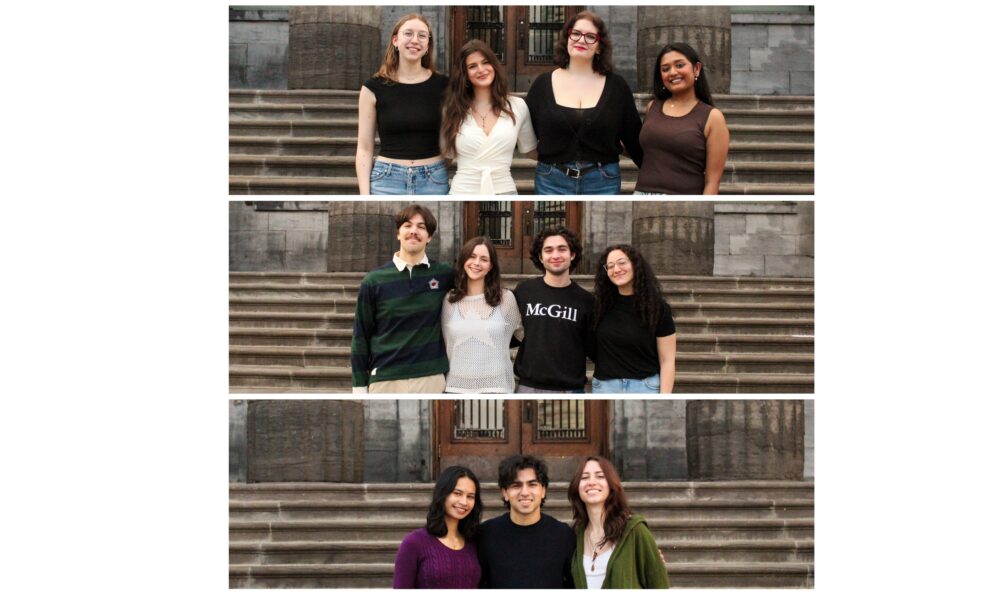
Farewell to The Tribune: Last words from our graduating editors

Mia Helfrich Creative Director:

I can’t remember what pulled me into The Tribune. I showed up to an Arts and Entertainment pitch meeting before classes began in my first year at McGill. My memories of university simply start here. After writing articles for a few months, I became curious about layout design, and started contributing to the illustration section. Next thing I know, I’m accepting positions as Design Editor, then Creative Director. I am endlessly grateful to be a member of our tight-knit community of creatives, and for the mentorship I received in my graphic design, drawing, photography, and writing. For me, university begins and ends with The Tribune—it would not be the same without it.

Nell Pollak, Managing Editor:

Would you believe me if I told you that I started at The Tribune as a spy? Well, maybe not an adversarial spy, but a mole—sent by a Communications professor I was researching for, tasked with writing for each McGill student paper to map their editorial structures. The Tribune was my first target. I walked into the board room having no clue what to expect, but found myself inexplicably drawn to the art of an op-ed—the slow alchemy of a broad opinion hardening into a sharp argument, the rabbit holes of research, the thesaurus searches to find the word I didn’t even know I was looking for. By the end of that first piece, my original undercover mission had slipped from my consciousness entirely. That next month, I applied to be an Opinion Editor; the following year, Managing Editor. I arrived to observe, and I leave having been intrinsically altered by the incredible community I found.

Malika Logossou, Managing Editor:

I first discovered The Tribune when a friend shared a News article with me in my first year. Later, after the incoming Editor-in-Chief encouraged me to get involved, I formally encountered it. I joined, scared of the outcome or of not liking it. But what I originally signed up for as a simple extracurricular activity became such an important part of my years at McGill. As a commuter, finding a community on campus isn’t always easy, but I found a sense of belonging through the strong connections I built at this paper. I am so privileged to have read and edited such outstanding pieces, and I will miss this deeply rewarding experience. I cannot wait to see what The Tribune does next year, knowing it’s in competent hands.

Defne Feyzioglu, Opinion Editor:

As I walked down McTavish Street after our last editorial board meeting, I kept thinking about how strange it is to find yourself in a place you least expect. I started my McGill journey with nothing but a lot of confusion and a sharp sense of unbelonging. In a new city across the ocean, and knowing so little about myself, I just tried: Picked up new hobbies, went to gatherings, considered changing faculties, partied at Café Campus (though, in retrospect, not the greatest site of self-discovery), and drifted. But somehow, it was at The Tribune’s pitch meeting that something clicked. Somewhere in that room, I discovered my love for journalism and grew into my voice. I now leave The Tribune with more gratitude than one final paragraph could ever contain.

Gregor McCall, Student-Life Editor:

When I joined The Tribune earlier this year, I was, in all honesty, scared to death. My experience in student journalism was next to nothing—only a single piece in Science and Technology two years before I applied to be an editor. What I found was unlike anything another campus organization could have offered me. The Tribune gave me a chance to pursue truly important stories on campus. With the help of my brilliant Managing Editor, Nell Pollak, and amazing Co-Editor, Tamiyana Roemer, we gave Student Life both a more serious tone, following campus protests and activism, and also brought back some much-needed whimsy with a number of hilarious satirical pieces. I’ve loved every article I had the privilege to write, and I will cherish every minute I got to spend with our incomparable Editorial Board.

Ethan Kahn, Sports Editor:

Whenever someone wraps up a major chapter in their life, the goal for many is to finish that time without any regrets. Unfortunately, I have one regret about my four years at McGill: I waited until my third year to join The Tribune.  I can say without a shadow of a doubt that being a part of The Tribune for the past two years has been the most rewarding experience I could have imagined. I’ve had the privilege of working with so many incredible, driven, and caring writers and editors. A massive thank you to my Managing Editors, Mairin Burke and Kaitlyn Schramm, and my co-editor Clara Smyrski for making me feel so welcomed, and of course to all of the fabulous writers who worked tirelessly throughout the year. I’m immensely proud of the work we have done, and I am so excited to see how the paper evolves in the future.

Jenna Durante, Features Editor:

Last year, I came into the Trib as a SciTech Editor and had the privilege of switching over to Features this year. Anxious about starting the new role, I was eager to see all that we would accomplish in the Features section. What a joy it has been to be part of such a brilliant team of editors and designers for the past two years. I am beyond grateful to have worked one-on-one with the editors to help develop their investigative articles every week—I learned so much from everyone. I cannot thank them enough for their time, care, and dedication to making this section come to life, and for sharing the stories that are so close to their hearts.

Leanne Cherry, SciTech Editor:

I attended my first-ever SciTech pitch meeting towards the end of my first year, with the hope of finally trying out scientific writing. However, at the time, the thought of doing an interview scared me so badly that I didn’t go through with the article. It took me until the beginning of my third year to finally return to those pitch meetings. Looking back now, I can confidently say that becoming a contributor and an editor for The Tribune was the best choice I’ve made at McGill, not merely because it showed me that I was capable of science writing, but because I have truly found some of the kindest and smartest people I have ever known. I cannot overstate my gratitude for this newspaper and the people who make its existence possible.

Armen Erzingatzian, Photo Editor:

My regrettably short journey at The Tribune started because all I really wanted to do was take perfect, pretty little pictures. My year at the paper turned out to be by far the most influential of my five years at McGill. Covering protests and other events as a photographer and the occasional interviewer-writer made me feel like I had a finger on the pulse of my hometown. It helped me understand the issues that affect my community and think critically about them. Through assignments and team meetings, I built incredibly meaningful relationships with the brightest, kindest and most driven people around. They made me a stronger, more responsible, and more empathetic person, and taught me more than I dared to imagine. Thank you, Trib. I’ll miss you.

Rupneet Shahriar, Web Editor:

I hadn’t planned to join The Tribune in my final year at McGill. For most of my time, I believed journalism and I were meant to run parallel, and I was content watching from the sidelines. That changed when a friend mentioned they were looking for someone with coding skills. I stepped in hesitantly, unsure if I had the voice or confidence to belong. But I soon found myself surrounded by people who are incredibly thoughtful, fearless, and deeply passionate about what they do. Their commitment helped me to trust my ideas and express them more freely. In doing so, I rediscovered my love for storytelling. I’m incredibly grateful to The Tribune for that, and it’s bittersweet that my journey here was so short. Nonetheless, I’m excited for what comes next!

Serena Elsammak, Video Editor:

Throughout my entire undergraduate experience at McGill, I always looked up to The Tribune; its value for honest, independent, and against-the-mainstream journalism resonated deeply with me. In a time where dominant news narratives have demonized people from my community and my family members back home in Lebanon, I have been especially grateful for The Tribune’s humanizing and justice-oriented work. For a long time, I flirted with the idea of applying for a role at The Tribune, but every time I wanted to apply, something else came up that wouldn’t let me go all-in. Finally, this last semester, the application for Multimedia Video Editor went up, and I was immediately drawn in. Using editing software creatively and simply documenting have always been passions of mine. The Tribune allowed me to re-explore this creative side of myself, and for that, and much more, I am extremely grateful. 

Anna Seger, Photo Editor:

I joined The Tribune in the fall of my second year. The splendour of Montreal’s autumn is always a source of inspiration for me, albeit a fleeting one, fading slightly as the leaves drop from their branches and a bitter chill fills the air. These past two years, though, the brilliant minds I’ve met through The Tribune have been a steady source of inspiration, not only because of their ambition and intelligence but also because of their kindness and sincerity. I am constantly moved by your creative spirits, your thoughtful contributions, and our truly countless meaningful discussions. I cannot wait to see the wonderful things you all go on to do.

Commentary, Opinion

Bill 28 entrenches the devaluation of feminized labour

Trigger warning: mentions of violence

In 2018, a nurse in Beauce had a miscarriage after a patient kicked her in the stomach. In 2020, a nurse in Montérégie-Est was strangled for several minutes. In 2023, a high‑school teacher in Laval was assaulted with scissors by a student in her classroom. Last spring, a youth‑protection worker was thrown head‑first into a brick wall at the Sherbrooke courthouse.

Violence should not be part of any job. Yet, for educators, healthcare professionals, and social workers in Quebec, such attacks are not outliers but the norm. In Quebec’s classrooms, 90 per cent of teachers report having faced violence at work. Violence-related lost-time injuries in healthcare and social services are rising at three times the rate of police and correctional officers. These are among the most dangerous workplaces in the province. However, unlike workers in fields such as construction and transport, they are denied access to the full protections of Quebec’s general occupational health and safety prevention program.

Law 28, which originated in Labour Minister Jean Boulet’s Bill 101, An Act to improve certain labour laws, explicitly carves hospitals, schools and social‑services institutions out of the workplace violence prevention program. On Feb. 23, major labour organizations filed constitutional challenges before the Quebec Superior Court to have these exclusions invalidated. Given that women make up 81 per cent of Quebec’s healthcare workforce, 75 per cent of elementary and secondary teachers, and nearly 90 per cent of social workers, the groups argue that Bill 101 exacerbates the precarious working conditions of women across Quebec. 

The court must respond to the unions’ challenges by repudiating what Bill 28 truly represents: not merely an administrative gap in workplace safety, but the legislated devaluation of feminized labour. By entrenching full prevention rights for male‑dominated industries while relegating care and education to a second‑tier system, this law codifies a hierarchy of suffering in which injuries sustained within women-dominated fields are marginalized.

Without a general prevention program for women workers, the consequences are concrete. Institutions are no longer obligated to collaborate with workers on prevention plans, accident registers become difficult to maintain, inspections slow, and occupational health and safety representatives are granted fewer hours and narrower mandates. When the province says it cannot afford full prevention in these workplaces, it is making a political choice tantamount to declaring that injuries in feminized sectors are simply not worth the cost of preventing. Research consistently shows that every dollar spent on prevention returns several in reduced injury and compensation costs—making the government’s framing not only discriminatory but economically incoherent.

According to a Quebec labour and safety commission report, healthcare, social work, and education sectors account for roughly 12.5 per cent of active establishments in Quebec but amount to more than 30 per cent of occupational injuries. The same data further discloses that in 2024, more than half of all claims by pregnant workers requesting removal from unsafe working conditions came from the health and social services sector alone. This violence is gendered not only in who endures it, but in who inflicts it—men perpetrate nearly two‑thirds of workplace violence cases in healthcare. The risks are well-documented and concentrated precisely where women work. 

The devaluation of feminized labour remains pervasive in Canadian policy. At the federal level, social workers are excluded from Canada’s definition of public safety personnel, barring them from occupational stress injury benefits afforded to police officers, firefighters, and paramedics—positions that are between 67 to 95 per cent filled by men.

Research consistently demonstrates that as women come to dominate a profession, its perceived prestige, compensation, and institutional protections decline—regardless of qualification or skill. This disparity reflects a long‑standing assumption that the dangers of feminized work are simply natural extensions of the work itself—supposedly neutralized by women’s ‘innate’ care skills—and therefore undeserving of the same structural intervention afforded to other sectors. Women are not more drawn to fields that are disparaged or underresourced; a field becomes devalued as women dominate it.

 In 2021, Quebec overhauled its occupational health and safety regime on the promise of finally extending full prevention mechanisms beyond traditional industrial sectors to hospitals, schools, and social services—sectors that had otherwise been excluded since 1979. Four years later, Bill 28 writes that inequality back into law, protecting the assumption that the indispensable women in our communities who care, teach, and intervene are inherently built to absorb harm the state refuses to prevent.

McGill, News, SSMU

SSMU Legislative Council discusses athletic clubs and constitutional amendments

The Students’ Society of McGill University (SSMU) called to order its penultimate Legislative Council (LC) of the academic year on March 26. As the semester draws to a close, members are moving to finalize key decisions for a smooth transition into the summer months.

Early in the session, Speaker Acadia Knickerbocker explained the notice of suspension issued to Dentistry Councillor Brian Kim.

“A few weeks ago, the Secretariat and I issued a notice of suspension to Councillor Kim after [he] was absent without regrets for three consecutive meetings,” Knickerbocker said. “The councillor did not decide to issue an appeal, and so now, [the Steering Committee] are moving towards suspension.”

Vice-President (VP) Clubs and Services Hamza Abu Alkhair then presented his executive report. He announced that multiple clubs have been approved to officially operate under SSMU, including the Chinese Drama Club and the Nigerian Students Association.

Athletics Councillor Anette Yu asked whether there were any updates regarding McGill Athletics, referring to the 25 cut varsity teams and clubs. Abu Alkhair explained that while he had previously said that the notice in motion would be ready for the present meeting, extenuating circumstances have delayed the consultation process. Yu noted that this delay could compromise the ability of teams to recruit and organize before the fall athletics season. Abu Alkhair affirmed that concerned athletes should book office hours with him for further clarity on SSMU’s timeline.

In her executive report, VP University Affairs Susan Aloudat recounted her meeting with McGill’s new Chief Security Officer (CSO) Tom O’Neill. The CSO oversees all aspects of campus security operations and is responsible for engaging with the university community to understand their concerns and improve security measures. Over the past few years, and amid student protests and strikes against the university’s involvement in the ongoing genocide in Palestine, tension between students and security has been high.

“I think that the [CSO’s] intentions are in a really good place [….] We did go into cultural sensitivity and […] cultural awareness as part of this initiative, and so we made recommendations about doing the humanizing before doing the integrating.”

VP External Seraphina Crema-Black presented the Motion Regarding a Statement on Proposed Quebec Legislation Restricting Prayer and Faith-Based Spaces in Postsecondary Institutions for approval. The motion was informed by her conversations with religious student groups and the internal council about Bill 9. The motion was ultimately passed.

Much of the discussion time was spent on the Motion Regarding Constitutional Amendments 2025-2026. Members considered how to balance the retention of qualified applicants with an even representation across faculties when constructing its board composition.

“I think it’s important that we have even representation and diverse representation,” Crema-Black said.

Between four voting options, councillors passed an amendment that will prohibit more than five voting directors from the same faculty.

Moment of the Meeting 

Aloudat highlighted the tension between the goal of the Community Engagement Fund to foster community building and its allocation of $5,000 CAD to the McGill Law Student Association, which she said can be exclusionary toward students outside the Faculty of Law who may wish to use their spaces.

Soundbite

“There was a referendum regarding an institutional boycott of Israeli [universities]. It passed by a simple majority, but [that is] currently being contested both through internal McGill regulations as well as through external proceedings [….] [The judge] heard arguments today, so we’ll have a little bit more clarity tomorrow.”—Law Councillor James Scott.

Montreal, News

Montreal police expand surveillance with Project Aurora 

The Service de police de la Ville de Montréal (SPVM) says its new Project Aurora has already led to 20 arrests in just over six weeks, as part of a strategy aimed at preventing serious crimes such as arson, shootings, and home invasions through social media monitoring. 

Described by police as an innovative and disruptive project, the program focuses on detecting criminal activity before offences are carried out. According to the SPVM, it relies on structured surveillance active around the clock, with specialized cybercrime teams monitoring platforms where offers of criminal contracts are believed to circulate.

Police say the program involves analyzing coded vocabulary, identifying potential threats, and coordinating between investigative units. Information gathered by the cybercrime unit is shared with other divisions, including anti-gang teams and firearms units, which can then initiate investigations. 

In a written statement to The Tribune, Samantha Velandia, a representative from the SPVM Media Team, explained that the unit conducts continuous monitoring to identify and assess potential criminal activity. The SPVM affirms that social media has played a significant role in recruiting young people, who are rarely paid as promised after carrying out illegal acts. 

“The cybercrime unit of the SPVM is conducting a proactive and continuous monitoring of social media platforms to identify and assess potential criminal activity,” Velandia wrote.

However, some Montrealers have raised concerns about whether the initiative could reinforce existing biases. Noah Weisbord, associate professor in the Faculty of Law, explained in a written statement to The Tribune that the program risks targeting certain ethnicities. 

“SPVM’s racial profiling record means there is a danger that Aurora, without robust safeguards, could unfairly target racialized kids online, hitting some communities harder than others.”

Project Aurora builds on previous efforts, such as outreach to businesses, which focused on in-person engagement and crime prevention. In 2025, the SPVM reported 86 violent incidents targeting business owners, with 46 suspects arrested, including minors. The new initiative adds an intelligence-driven layer that targets the online environments where criminal activity is increasingly organized. 

The strategy reflects a broader trend in policing that emphasizes prevention based on digital behaviour rather than crimes committed. Similar efforts have been made at the federal level, including initiatives by the Royal Canadian Mounted Police (RCMP) to monitor criminal activity through online data collection. Federal programs like the RCMP’s Project Wide Awake show that large-scale monitoring of social media is not new in Canada.

In a written statement to The Tribune, McGill’s Socialist Fightback Club warns that this signals a broader trend of suppressing activism in the province. 

“While the Quebec government is parading this new project as a way of stopping crime and bringing people to justice, in reality these are just new tools that the state will have at its disposal to further crack down on activism at McGill and throughout the rest of the province,” Socialist Fightback wrote. “However, these measures will not scare us off. We will continue openly calling for students and workers at McGill to fight back against any cuts that might come.” 

The expansion of social media surveillance has raised legal and ethical questions, pointing to challenges in interpreting online evidence in court. Weisbord commented that while online communications can provide valuable evidence, they also present risks of misinterpretation.  

“Screenshots and logs hold up in court if properly authenticated. One danger is [that] police, prosecutors, and judges might misread slang, jokes, or emojis as real intent, charging protected speech. Courts need full context to avoid punishing thoughtcrimes,” Weisbord wrote. 

Nonetheless, the SPVM reaffirmed that safeguards are in place. Prosecutors at the Directeur des poursuites criminelles et pénales will review cases involving youth, and the police have emphasized that prevention programs remain part of their approach alongside enforcement. 

“A small number of cases do involve youths facing significant challenges, the majority of those who are arrested or investigated are individuals with prior criminal histories or who are already facing charges for other offences,” Velandia wrote. “This approach supports a balanced response that emphasizes prevention and support, while ensuring appropriate accountability when required.”

As Project Aurora continues, questions remain about how to balance crime prevention with privacy and legal protections in the digital landscape. Weisbord emphasized that Project Aurora is still susceptible to political exploitation. 

“Aurora has already demonstrated it can help stop violence early. [However], surveillance systems like Aurora don’t stay neutral: Once built, they tend to grow, and in the wrong political moment, they become tools of authoritarian control,” Weisbord wrote.

Montreal, News

Post-secondary and CEGEP students strike against austerity in education

From March 23 to March 27, over 65,000 post-secondary and Collège d’enseignement général et professionnel (CEGEP) students participated in a week-long strike against austerity in education. The strikes were organized by the Coalition de résistance pour l’unité étudiante syndicale (CRUES), a union of 30,000 students in local and regional levels in Quebec. The strike called for a higher education budget in the province in response to Minister of Finance Eric Girard’s budget for the 2026-27 fiscal year. 

The 2026-27 budget attempts to balance funding for public services with economic stimulation. While the budget established a 2.4 per cent increase in education spending, it is insufficient to cover the increasing costs of public education, which would require a 3.8 per cent increase. In all categories other than education and health, where a 2.3 per cent increase is required to keep up with growing costs, spending will decrease by 1.2 per cent.

In a written exchange with The Tribune, Elki Mercier, a coordinating officer at CRUES, highlighted the government’s failure to invest in education.

“Despite last fall’s student mobilization and the struggles of community groups and workers against austerity and budget cuts, the government continues to turn a deaf ear to our demands,” Mercier wrote. “This is very clear in the new budget, in which the government is failing to invest sufficiently in education.”

Over 20 student groups participated in the week of action through organized strikes, with the majority coming from the Université du Québec à Montréal. 10 CEGEPs and universities participated in the week of action, organizing students across Quebec. 

The Association étudiante du cégep de Saint-Laurent (AECSL), a student group with 4,900 members participating in the week-long strike, emphasized their commitment to creating change in a written response to The Tribune.

“This movement shows that students of Quebec are getting tired of governments that cut in public services to the advantage of the elite,” AECSL wrote. “For now, we have not seen actual change from the government, only a weak budget that does not cancel past budget cuts and that does not properly refinance education. We demand clear change, not half measures. Until then, the strike and protest situation is only going to escalate.”

Simone Bélanger, a spokesperson at l’Université du Québec à Rimouski (UQAR)’s strike movement Population Unie Contre l’Austérité et la Précarité, spoke on the changes the Quebec government needs to make for students. 

“Students hope for a massive reinvestment in post-secondary education. We are asking for a serious reform of the [Student Financial Assistance] program, paid internships for all students, the lowering and indexation of international students’ tuition fees, which have been instrumentalized by the government for years to narrow its deficit, as well as the preservation of our social safety net.”

To close the week of action, CRUES organized a protest on March 27 at Dorchester Square. While not on an official strike, the McGill contingent joined the protest. McGill students, in addition to protesting austerity in the Quebec budget, also rallied against McGill’s investments in weapons manufacturers and previously in fossil fuel companies.

As the week of action came to an end, Mercier emphasized the importance of student involvement beyond the March strikes and how students can further fight against the budget changes.

“There are other concrete ways to get involved in the fight against austerity: Participate in general assemblies, join or start mobilization committees, stay informed about ongoing struggles through student newspapers, associations, or CRUES’s social media, and organize direct actions,” Mercier wrote. “CRUES also encourages student associations to ally with workers’ unions on their campuses, since austerity affects us all.”

Research Briefs, Science & Technology

Dark matter and energy: What we know about the unknown

When we think of what the physical world is made of, atoms come to mind—but it turns out the story is far more complex. In reality, atomic matter makes up only five per cent of the universe. The rest, however, is made of dark matter and dark energy, which have puzzled scientists for nearly a century. In hopes of better understanding these components, The Tribune attended a talk by McGill’s Trottier Space Institute (TSI) on March 26. 

Katherine Freese, one of the first women admitted to Princeton University and now director of the Weinberg Institute for Theoretical Physics and the Jeff & Gail Endowed Chair of Physics at the University of Texas at Austin, led the discussion. She explored where current scientific research stands and what it reveals about the nature of dark matter and energy. 

Before asking what dark matter is, one must understand how scientists discovered it. The first person to suggest such a thing could even exist was Fritz Zwicky, a Swiss scientist who, in 1933, studied the motion of hundreds of galaxies clustered together, known as the Coma Cluster. The laws of physics dictate that the closer a galaxy is to the centre of its cluster, the faster it should spin. However, Zwicky’s observations showed that galaxies further away from the centre travelled differently than expected. 

“[Zwicky] saw some that were really whizzing, going really, really fast. If there’s not enough material inside there, then those galaxies should just escape. And based on the other galaxies that he was able to see, that’s what should have happened. There shouldn’t be these rapidly whizzing galaxies at larger distances from the centre,” Freese said. “A potential solution is [to] add more matter, more gravitational pull that would hold in those galaxies to keep them [closer to the center] even though they’re moving so fast.”

In the 1970s, American astronomer Vera Rubin definitively demonstrated that dark matter was the additional matter behind these strange observations. Additional support comes from Einstein’s theory of gravitational lensing—which describes how light and time bend around massive objects—and from recent observations such as the Bullet Cluster,  where two galaxy clusters collide. These phenomena can both be attributed to the presence of dark matter.

So the real question remains: What is dark matter? The short answer is that scientists don’t know yet. There is a large experimental effort trying to determine the answer to this very question. As of 2026, two particles are thought to make up dark matter: Weakly Interacting Massive Particles (WIMPs) and axions

Freese highlighted why WIMPs remain a favourable candidate, pointing to a concept referred to as the ‘WIMP Miracle.’ After the cooling of the universe—a consequence of the Big Bang—the density of WIMPs left over happens to be 26 per cent of the universe, matching the observed amount of dark matter. Axions, the other top contender, are proposed particles that are weakly interacting like WIMPS; however, they do not have a fixed mass. 

While dark matter acts as a type of glue for the universe, dark energy, making up the other 69 per cent, behaves differently. From the theoretical and observational side of things, there isn’t a strong understanding of what exactly dark energy is. What we do know is the universe is not only expanding, but its expansion is accelerating—an acceleration best understood as some form of repulsion. The existence of dark energy would explain said repulsion, leading scientists to confidently believe in its existence, even if we can’t see it.

With these answers only come more questions. Talks like Freese’s remind us of the many great mysteries of our universe waiting to be unravelled.  

To learn more about dark matter and energy, “The Cosmic Cocktail”by Katherine Freese expands on this topic.

Artistic Swimming, Sports

McGill artistic swimming stays in perfect sync to sweep CUASL nationals

Martlets Artistic Swimming left the University of Laval’s Aquatic Centre on March 22 as the undisputed 2026 champions of the Canadian University Artistic Swimming League (CUASL), sweeping every event they entered across three days of competition.

This marked the program’s eighth championship in the past 12 seasons, and its 18th national title overall. Head Coach Lindsay Duncan, who has directed the program since 2014, described it as something she had never witnessed in her time at McGill.

Results like this do not happen by accident. They are the product of depth, preparation, and belief. McGill’s program has slowly built one of the most impressive dynasties in Canadian artistic swimming history.

Artistic swimming is one of the most physically demanding disciplines in competitive sport, and one of the most underappreciated. Athletes must synchronize every movement across an entire team, both above and below water, while executing choreography timed to the second—all without letting the audience see how hard they are working. With the slightest miscommunication, or the tiniest lapse in timing, a detailed plan can quickly unravel. It is a sport that rewards obsessive attention to detail and punishes anything less.

That is exactly the standard McGill’s Martlets met from start to finish.

McGill returned home with five major trophies: The Evelyn Young Trophy as the top overall university program, the John Drake Trophy for winning the experienced division, and the Wendy Yule Trophy for topping the novice division. 

The Martlets also secured permanent possession of the Geraldine Dubrule Trophy, awarded to the league’s historically dominant program, a fitting distinction for a school that has claimed the national title more than any other since the CUASL’s founding in 2002. Named after Geraldine Dubrule, who spent 34 years coaching the program before her induction into the McGill Sports Hall of Fame in 2024, the trophy now belongs to the Martlets for good. The championship also marked an enthusiastic bounce-back from last year’s runner-up finish among 15 teams in Victoria.

The experienced division belonged entirely to third-year Pharmacology student Sonia Dunn. The Ottawa native swept her category, claiming gold in the solo, duet, and team events, and earning Experienced Athlete of the Meet honours—the top individual distinction available in her division. In the duet, Dunn partnered with Microbiology senior Clara Thomas, also from Ottawa, posting a score of 211.1759 to top the podium.

What made the result even more striking was that McGill claimed all three podium spots in the duet event, with the other two Martlet pairs taking silver and bronze while performing routines of difficulty unmatched by any other school. A clean sweep of a single event at a national championship is remarkably rare, and is the kind of outcome that underscores the prowess of McGill in the pool.

Dunn was also central to McGill’s gold-medal-winning experienced team, which performed a “Cirque du Soleilthemed routine flawlessly. The 10-swimmer lineup drew on athletes at every stage of their careers, from younger contributors to fifth-year veterans like Master’s in Biology student April Ozere. Two additional McGill routines by the experienced team placed fifth and 14th, a pair of commendable performances to round out the weekend.

McGill equally dominated the novice division. First-year Education student Hailey Hertzog from Dollard-des-Ormeaux mirrored Dunn’s sweep perfectly, winning gold in solo, duet, and team events while earning Novice Athlete of the Meet honours. Hertzog’s duet partner was Stella Xu, and their novice team—which featured Natalia Romero, Cassandra Maheu, Laura Zhang, Quinn Varty, and Katherine Heald—turned in a strong performance.

Sweeping an entire division at a national championship is exceptional for any athlete. In a sport like artistic swimming—where precision, timing, and composure typically grow with experience—Hertzog’s performance shows the program’s future is exceptionally bright.

The fact that McGill produced both the experienced and novice athletes of the meet on the same weekend tells you everything you need to know about where this program stands.

As the Martlets head into their 75th anniversary season, they do so with five trophies, 18 national titles, and the confidence of a team that continues to set the standard in Canadian artistic swimming.

Editorial, Opinion

McGill shields Israeli institutions at the expense of its students

The McGill administration’s recent effort to obstruct the Law Students’ Association’s (LSA) referendum epitomizes its blatant disrespect for student expression and democracy. From March 19–21, students in the Faculty of Law voted in favour of a referendum endorsing the Academic and Cultural Boycott of Israel (PACBI). The referendum, introduced by the LSA, passed with 57.3 per cent support and a 67.3 per cent voter turnout. The referendum called for a formal boycott of all exchange and collaborative partnerships with Israeli academic institutions, collaboration with the PACBI Committee, and academic initiatives promoting solidarity with Palestinian scholars.

However, ten minutes before the ballots opened, then-interim (since declared full) Dean of Law Tina Piper and McGill Provost and Executive Vice-President (Academic) Angela Campbell sent a joint letter to all law students and professors dissuading the referendum’s passage, dangerously labelling it as discriminatory toward Jewish students and in breach of the LSA-McGill Memorandum of Agreement (MoA). Piper and Campbell’s intervention is a reprehensible violation of McGill students’ right to free and fair democracy, with administrators using disinformation and fearmongering as tools to obstruct student expression. 

The referendum’s focus on institutions is not incidental, as Israeli universities are not merely neutral sites of learning, but active participants in the production of legal, military, and ideological frameworks that shield state violence from accountability. By conflating a boycott of Israeli institutions with antisemitism, McGill has diluted the impact of a word representative of horrifying hatred and violence. Administrators must confront antisemitism on campus as a pressing issue, not weaponize anti-Jewish violence to shield their suppression of student democracy and obscure the political and legal role of academic institutions in Israel’s assault on Gaza. 

The LSA referendum is explicitly framed around institutional relationships, not individuals. It calls for the severance of academic partnerships and in no way targets individuals on the basis of  Israeli ethnicity, nationality, or background. The institutions are not being singled out arbitrarily by the LSA; Israeli universities have played a legal and political role in helping justify, sanitize, and legitimize the occupation and genocide in Gaza. Tel Aviv University’s (TAU) Institute for National Security Studies, for instance, brings together academic experts and senior security personnel to produce legal and policy guidance for the Israeli state and military. A referendum that targets institutional partnerships is not antisemitic; insisting otherwise irresponsibly collapses political critique into bigotry and shields complicit institutions from accountability.

In response to the referendum, Jonathan Amiel, Faculty of Law Advisory Board Chair, has resigned and withdrawn financial support for the university. In his resignation letter, he warned that if McGill failed to respond, the university would suffer reputational damage, weakened recruitment, lower employer confidence, declining alumni engagement, and donor erosion. His stance has framed a democratically-adopted student referendum as a threat to the faculty’s financial stability and institutional standing, presenting the issue as a crisis requiring administrative intervention and containment. 

McGill’s response reveals an emerging pattern of administrators obstructing and delegitimizing resolutions reached through democratic channels. In April 2025, Students’ Society of McGill University (SSMU) members voted to ratify the Policy Against Genocide in Palestine with a 71.1 per cent majority. In response, McGill threatened to terminate its MoA with SSMU, which would have been detrimental to the Society’s ability to support student groups on campus. Similarly, students passed divestment policies through the SSMU in 2022, and 2023, both of which were blocked by the administration. McGill has repeatedly characterized student mobilization as violating its policies—but when students attempt to use existing democratic structures to advance their goals, the university is quick to bulldoze their efforts. It seems that there is no palatable form of activism to McGill, so long as it objects to their complicity in genocide. 
By sending alarmist memos that claim to speak for all Jewish students, the university both misrepresents the politically diverse communities it claims to protect and weaponizes grounded fears of rising antisemitism to delegitimize student democracy. McGill must cease its attempts to frame the referendum as discriminatory, stop using administrative power and MoA threats to obstruct its implementation, and acknowledge that a boycott of Israeli institutions is not, by default, a danger, but a crucial form of political expression.

Arts & Entertainment, Theatre

‘Hookman’: A story about the confrontation of guilt, grief, and change as we grow

Trigger warning: This piece contains mentions of sexual violence.

Tuesday Night Café Theatre (TNC)’s production of Hookman explores grief through the metaphor of a masked killer representing guilt. The show ran from March 17 to 20, under the direction of Andrea Alcaraz (U1 Education). The play, written in 2012 by Lauren Yee, follows first-year college student Lexi (Alyssa Yeung)’s attempt at navigating life after witnessing her childhood friend Jess (Gemma Martin-Fung)’s death in a car crash. Throughout the play, this scene reoccurs as Lexi begins to recollect clarity of that night, most notably remembering the masked killer who was hunting her down.

Upon first introduction, one would likely assume Hookman, who wears a ghoulish mask and boasts an unsettling aura, to be the killer. Perhaps we even expect his dramatic unmasking—but this is not the case. Hookman is instead revealed to be a physical manifestation of the suffocating grief and regret of losing a loved one. 

A pivotal moment in the play is a conversation between Lexi and Jess, where Lexi opens up about a time when she was sexually assaulted. However, rather than being supportive, Jess questions the validity of her friend’s experience. This scene thus explores the impacts of victim-blaming and complicates Lexi and Jess’s friendship. 

A very important aspect of this production was the lighting design. Much of the play takes place in the dark, with a small spotlight on Lexi. While this was likely done to master the creepy feeling of a thriller, it created an emotional connection between the audience and Lexi. The distinct spotlight expresses her loneliness and vulnerability, and places the audience in the surrounding darkness. Through her powerful facial expressions and line deliveries, Yeung also excellently expressed frustration, confusion, and sadness, luring the audience in. 

The people surrounding Lexi often claimed that her hardships were inevitable. This sentiment and belief were echoed throughout the play as the cast did not make eye contact with Lexi, and the hugs given to her out of compassion for her suffering did not feel genuine. However, by the end of the play, Lexi finds the strength to fight back. She expresses that violence against women is not inevitable and that these situations should not be approached passively. Her newfound strength is a turning point in the play, pushing the other characters to later empathize with her—though victims should not have to fight for compassion in the first place. 

Despite the play’s heavy theme, there are comedic moments in the dialogue. These express to the audience that even when going through traumatic times, there is still a way to find moments of laughter with loved ones.

The play’s final scene is the third and final flashback of Jess’s death. In this flashback, Lexi finally confronts Hookman. Instead of a dramatic fight, the play ends with them sitting together in a car, demonstrating Lexi’s acceptance of feelings she once feared. 

The TNC did a fantastic job tackling a play that is both dark and comedic at the same time, with actors seamlessly navigating between comedy and sorrow. Lexi’s endearing awkwardness does not go unnoticed, as it balances the play’s heavy theme. Overall, this production was an authentic representation of the complexities of grief. Not only did this play create an opportunity for important discussions about grief and assault, but it also demonstrated how important it is to counter passive reactions to violence. True change can only occur when we overcome the fear of “taboo” topics and instead face them head-on.

Read the latest issue

Read the latest issue