Latest News

Campus Spotlight, Student Life

A conversation on the repercussions of cultural appropriation

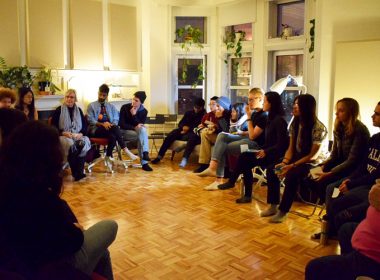
Within the context of Halloween—when people sometimes don costumes that cross a line —and the #ChangeTheName protest, the McGill Indigenous Studies Program and SSMU Indigenous Affairs organized a Nov. 1 panel titled “Understanding Cultural Appropriation” to inform students about the phenomenon and the groups it harms.

The panel featured Jennifer Guiliano, a history professor at the Indiana University-Purdue University Indianapolis, whose research focuses on Native American mascotry and university sports. Guiliano was joined by McGill’s Rachel Zellars, professor at the Institute for Gender, Sexuality, and Feminist Studies, as well as Stephen Puskas, a local Inuk artist and filmmaker. The three speakers, each from different backgrounds and research fields, had a compelling conversation on the consequences of cultural appropriation for black, indigenous, and other racialized groups.

Throughout the discussion, the speakers pointed to the consequences of cultural appropriation as well as how people can show appreciation for; indigenous groups without appropriating their culture. Zellars, who was once a DJ, explained the repercussions of cultural appropriation in music, which is common in EDM and house music production.

“Black folks who were in Chicago and Baltimore were the people who created a particular type of sound and artistry,” Zellers said. “These names are completely erased from these lineages. I’m thinking of folks, like, Masters of Work and Juan Atkins. And it’s often like young white kids like Calvin Harris who profit from these influences today.”

The panel underscored the importance of remembering the histories and sources of cultural influences and ensuring that their work and contributions are honoured. When asked how to support Indigenous culture without appropriating it, Stephen Puskas explained that it is imperative to support indigenous artists and creators.

“There are different forms of material culture,” Puskas said. “There is food, which we are happy to share with other people. Then there’s material culture that is for sale; culture that we make for other people to wear. Then there’s culture that we make for ourselves and culture that is sacred, which we don’t intend for the public to see [….] You have to understand where your indigenous material culture fits in those categories.”

Puskas’ response shed light on a different way of looking at cultural appropriation and where the line between appreciation and appropriation lies. The panel also stressed that before buying clothing, accessories, or other cultural items, one should ensure that they are made by the racialized group that they are trying to support, so they are able to benefit from the financial profit.

Although cultural appropriation comes up most when discussing Halloween costumes, Zellers, Guiliano, and Puskas all expressed that the repercussions of the practice impact indigenous, black, and other racialized groups of people year-round. People often think of cultural appropriation only in the realm of fashion and clothing, but the panel emphasized that appropriating culture extends to the economic, psychological, and historical contexts of racialized groups.

McGill, News

McGill community mourns in wake of synagogue shooting

A crowd of over one hundred McGill community members gathered at the Y-intersection on Oct. 30 to hold a vigil in memoriam of the victims of a recent shooting in Pittsburgh, Pennsylvania. The shooting, in which 11 members of the Tree of Life Synagogue were killed, took place on Oct. 27. The shooter, Robert Bowers, has been indicted on 44 federal charges, 32 of which are punishable by death. After a swath of his anti-semitic posts on the social-media website Gab were publicized, it became clear that he’d targeted the synagogue purposely.

The vigil was hosted by a coalition of 19 Jewish community and religious groups including Am McGill, JQueer, Ghetto Shul, and the McGill Office of Religious and Spiritual Life. During the gathering, the group recited traditional Jewish prayers and sang commemorative songs. Executives of Jewish student groups spoke to the crowd, condemning the shooting, remembering the victims, and exploring how the McGill community could best respond. Finally, 11 candles were ceremoniously lit in remembrance of the victims. Dean of Students Chris Buddle, Vice-Principal Communications and External Relations Louis Arseneault, and Principal Suzanne Fortier were present at the event. Buddle and Arsenault lit the first candle.

Noah Lew, president of the Hillel Montreal Leadership Council, and co-organizer of the vigil, condemned the violent, anti-semitic events in Pittsburgh and violence against religion in general.

In an interview with The McGill Tribune, Lew stated that the vigil was an important exhibition of resilience.

“Things like anti-semitism and other hatreds often start with words and progress into actions,” Lew said. “We felt this was a poignant reminder to stand up against hatred worldwide.”

Lew also remarked that it was especially encouraging to have members of the administration come in support of the event.

“I think having [Fortier, Arseneault, and Buddle] there with us and participating in the ceremony was a good reminder to our community and McGill students that they are standing with us,” Lew said.

The speakers emphasized the importance of unity in religious and student communities throughout the vigil. Ariana Kaye, president of JQueer and executive member of Hillel McGill, evoked the broader consequences of the shooting.

“One of the people who was murdered was an AIDS doctor,” Kaye said. “He was really receptive and warm to patients, so I think it was also a loss in that way for the LGBTQ community.”

Kaye also commented on the importance of including intersectional identities in the Jewish community and how the vigil was an excellent example of that.

“We all suffer together, we’re all here together, we’re all mourning together,” Kaye said. “It makes me feel so great that the McGill community can all be here together no matter your race, sex, gender, class, anything.”

Rabbi Shmuly Weiss, co-director of the Chabad Student Centre of downtown Montreal, closed out the vigil by reciting “El Malei Rachamim”a prayer for the victims. Weiss emphasized how crucial it is to avoid divisiveness in light of this event.

“Human beings are allowed to have differences,” Weiss said. “[But at synagogue], you leave it at the door, you try to connect and focus on the similarities we share.”

Weiss further stressed the importance of a collective response.

“For someone to come in and try and take that [connection through unity] away, it’s the same thing with the shooting at the mosque last year, it’s the same idea,” Weiss said. “[Perpetrators of violence] are trying to terrorize every type of thing that offers sanctuary. We have to respond by saying that we will not stop showing up, that we will not be deterred.”

The Tree of Life Synagogue is accepting donations to aid the families of victims on their website.

Emerging Trends, Student Life

Art therapy as a form of self care

Starting Nov. 1, the Montreal Museum of Fine Arts (MMFA) will waive entrance fees for visitors with doctor’s prescriptions. Throughout a one-year trial period, the museum will conduct research on art’s healing capabilities with the goal of promoting the physical and psychological benefits of a cultural outing. The city-wide program is particularly valuable for students as art is effective in decreasing anxiety, stress, and depression.

Art therapy is a form of treatment which promotes self care through artistic expression and viewing. A recent study at Texas State University found that students who partook in art therapy experienced a significant decrease in anxiety compared to another group of students who received standard forms of therapy.

The MMFA’s new program will provide McGill students with an opportunity to experience the effects of art therapy in a world class setting. While there are several McGill support groups on campus, such as the McGill Art Hive Initiative (MAHI), for students to gain relief for a range of health issues, this new alternative offers a more diverse array of facilities. Nathalie Bondil, director general and chief curator of the MMFA, piloted the program in partnership with physicians from Médecins francophones du Canada (MdFC). She hopes that the initiative will popularize creating and viewing artwork as a form of self care.

“Cultural experiences will benefit health and wellness, just as engaging in sports contributes to fitness,” Bondil said. “Just as doctors now prescribe exercise, they will be able to prescribe a visit to the MMFA.”

Social work graduate student Salima Punjani, an intern in the art therapy sector of the museum, explained that this program serves as a new way for students to augment their current self-care routines.   

“I would absolutely recommend that McGill students take time out of their days to come to the MMFA,” Punjani said. “I think it is important to take breaks and to also stimulate your mind in different ways through different textures, colours, and forms. I think listening, reading and writing are great tools for learning but it is important to step out of the box.”  

McGill students who wish to take advantage of the pricing discount will need a prescription from a physician who is a member of the MdFC; however, visitors without the proper documentation can partake in the other programs offered by the museum and its community partners. According to Stephen Legari, art therapist at the MMFA, the museum’s opportunities range from a typical trip to the museum to utilizing their educational and therapeutic services to reap the benefits of art therapy. Among these facilities is the Art Hive, an open-access space for visitors to create art with the guidance of art therapists.

“I like to think of the museum in terms of its doors,” Legari said. “There are all of these different doors [through which] you can enter the museum. You can enter through the front door as a visitor, tourist, [or] member, or you can enter through the side doors as a student, […] but how we approach these doors really depends on what the individual is looking for and what are they hoping to achieve.”

Though there are art hives across the world, the MMFA Art Hive is the only one situated inside of an art museum. Legari explained that the MMFA hive’s museum setting creates a particularly distinctive experience.  

“When art therapy is practiced in a community centre, in a school, or in a clinic, it tends to look a lot like a mental health service, with the important exception that we are always working with art,” Legari said. “The foundation of our practice is [that] we believe in nonverbal communication as a means of helping people through whatever they are living with.”

Most McGill students have a non-stop schedule and often put their mental health health aside in stressful times. However, art therapy programs, such as those offered at the MMFA, provide a way for students to take control of their mental health through new and creative outlets.

Arts & Entertainment, Music

No shame, no apologies: Lily Allen sparkles at Corona Theatre

Following the June 8 release of her electropop record No Shame, English singer-songwriter Lily Allen brought a spirited energy to Corona Theatre on Oct. 27. A few hundred concert-goers, damp and cold from the first snow of the fall, convened near the stage in anticipation of Allen’s performance.

Accompanied by her two-man band, Allen embodied a neon dream, decked from head to toe in a glitzy ensemble. Citing an ongoing cold, she ingested her medicine and began the show, emphasizing her sickly-sweet demeanor as a pop-star. She opened with the first track off her new record, “Come On Then,” in which she describes the obsessive press coverage of the breakdown of her marriage, and how humiliating it was to be the subject of public scrutiny. Filling the room with vigour, she continued on with standouts from No Shame, such as “What You Waiting For?” and “Everything to Feel Something,” which explores Allen’s past struggles with substance abuse. She also performed hits from earlier albums: “Smile” and “Knock ‘Em Out” from her first record Alright, Still “Not Fair,” and “Who’d Have Known,” from her second album It’s Not Me, It’s You, demonstrating both her growth as an artist and the timeless appeal of her music.

Allen performed an unreleased single titled “Party Line,” recalling life on tour and adventures with her friends and bandmates. Exhilarated from her performance, the crowd received the song warmly in great anticipation of its upcoming release.

The room’s energy shifted from lively to pensive when Allen performed her hit “The Fear,” which is speculated to be about celebrity culture and fame; however, Allen insists that the song is a broader commentary on social media’s influence on day-to-day life. Allen used “The Fear” to reflect on the tragic shooting at the Tree of Life synagogue in Pittsburgh, which had occurred earlier that day. Allen recounted that when she read about it on her phone, she “just kept scrolling,” citing an overwhelming sense of dread. She reminded her audience to always stay informed and aware in the face of trivial distractions.

While Allen’s more upbeat songs were energetic enough to goad fans of all ages into a frenzy, she still had a commanding ability to quiet the room. Allen performed her slower and more intimate songs, “Apples,” “Family Man,” and “Three” from No Shame with a beauty and honesty that effectively stunned the crowd into silence. These songs delve into the more private parts of her life—a contemplation on her romantic relationships, parents, and children.

“Apples” compares Allen’s marital failures to the demise of her parents’ relationship by ruminating on the decisions that led to her divorce.

Four years and you’ve given me my beautiful babies, but it was all too much for me,” Allen sang. “Now I’m exactly where I didn’t want to be, I’m just like my mummy and my daddy, I guess the apple doesn’t fall far from the tree.”

A silence fell over the venue when Allen began “Three,” a song written from the perspective of one of her young daughters, expressing her sadness and disappointment about Allen always being away on tour.

To wrap up an emotional rollercoaster of a performance, Allen performed “Trigger Bang,” which energized the crowd enough to finish with “Fuck You,” her iconic hit from It’s Not Me, It’s You.

“I originally wrote this song after observing George W. Bush’s presidency from across the ocean, but little did I know there would be something much worse coming. Donald J. Trump, this one’s for you!” Allen quipped.

Allen’s willingness to accept her flaws and turn them into engaging music is part of what makes her such a dynamic artist. No Shame is, fundamentally, a record built on Allen’s vulnerability. The singer-songwriter’s ability to convey emotions live allowed the crowd to experience emotional highs and lows alongside her and dance through them all the same.


Creative, News

The McGill Tribune – Fall 2018 General Assembly Recap

The McGill Tribune recaps the most important parts of the Students’ Society of McGill University’s fall general assembly.

Video by Kyle Dewsnap.

McGill, News

Journalists discuss hyper-polarization in the media

On Oct. 30, McGill’s Max Bell School of Public Policy and Media@McGill hosted a panel titled Responsible Journalism in the Age of Hyper-Polarization on partisan division in the media. The talk, moderated by Andrew Potter, assistant professor at the McGill Institute for the Study of Canada, brought together Policy Options Editor-in-Chief Jennifer Ditchburn, Mark Lloyd, professor at the University of Southern California-Annenberg School of Communication, and VICE Quebec Editor-in-Chief Phil Gohier.

The panelists first discussed how journalists should responsibly report on groups with extreme political stances, explaining that, historically, journalists have avoided covering groups until they are firmly in the public eye. They agreed that social media has made it harder for media outlets to ignore radical groups gaining traction online, complicating the question of whether journalists do more harm than good by providing far-right groups with a platform.

“I think it’s a very fine line,” Ditchburn said. “It’s tricky when journalists sort of appoint themselves as the arbiters of who’s worth covering and who’s not. Each case gets decided in each newsroom in a different way [.…] I don’t think we can have in any story or any issue a kind of rule that applies because it’s just always moving.”

The panelists also reflected on whether modern journalists are engaging in  ‘both-side-ism journalism,’ an excessive commitment to balanced coverage of all sides of a story at the expense of truth. Using the left-leaning coverage of the most recent American presidential election as a recent example, Ditchburn pointed out that equality and fairness are what give people confidence in journalism.

Lloyd, who has worked as a journalist for CNN and served as associate general counsel at the U.S. Federal Communications Commission, believes that objectivity in journalism is a valuable and useful modern goal but that readers should never assume that the content they are consuming is impartial.

“The check is other media, and the people that consume the journalism,” Lloyd said.

Ditchburn expressed her frustration with attempts to cover catchy yet shallow news stories, citing what she sees as excessive media coverage of President Trump’s Twitter account as an example.

“Journalism outlets have a choice,” Ditchburn said. “We don’t have to go to [every] photo-op [….] We can do something else, and we can spend our time and our money, which is in short supply, covering something deep and profound.”

The panel discussed New York University professor Jay Rosen’s idea that journalists should recognize their biases outright. Ditchburn and Lloyd argued that Rosen’s proposition was naive, as most journalists are not aware of the structural biases at play in their reporting.

“[I don’t think] Canadians journalists have done a big reflection on colonialism in journalism, [or on] overarching views about the economy, what we accept as a truism,” Ditchburn said. “When Jay [Rosen] talks about declaring your biases, I think politicians think of the biases being about liberal, conservative, or, in the States, Republican or Democratic, but the biases run way deeper than that.”

To conclude, Potter asked speakers to comment on the place of trust in journalism, and whether it should be integral to the practice.

“Journalists should aspire to be trusted,” Lloyd said. “You can earn your audience’s trust if you do good work consistently [….] Should the audience just automatically, blindly,  trust journalists? Absolutely not.”

Gohier dissented in part, arguing that relevance is a more fundamental metric.

“I look at trust as a double-edged sword,” Gohier said. “Trust is conflated with likeability [….] I think relevance is a better thing to aim for.”

The Max Bell School of Public Policy will host another event on Nov. 20, which will centre on the major public policy issues surrounding monetary policy frameworks.

Off the Board, Opinion

Learning to love my big nose

I love my big, crooked nose, but that hasn’t always been the case. The first time I was made aware of its size was when my aunt asked me if I had broken it. Her sentiment made me feel sick. I pushed aside my childhood ambitions of becoming a writer or journalist, and instead set my sights on the ultimate achievement: A nose job. As I grew older, I fell into a chasm of self-loathing. My white-passing, thin, green-eyed mother was always my model of a perfect person, and I was her opposite. My dad and I share the same big noses, big lips, brown eyes, and thick, dark hair. My mom was always reflected in mainstream media, while my father and I were sidelined.

I remember early mornings sitting at the breakfast table, my mother struggling to comb and style my frizzy hair before school in a futile attempt to try and get it to match hers. Throughout elementary school, I would draw myself with long, straight, blonde hair and green eyes—I also remember my teachers’ confused looks when I handed in my questionable portraits. I remember when kids in my high school class would try to hide pencils in my thick hair to see if I’d notice, or ask to touch it and see if it was real. I remember pinching at my stretch marks in front of the mirror, using heaping amounts of SunIn with no effect, and learning how to use Photoshop just so I could see what my nose would look like after surgery. As soon as I was old enough to take care of myself, I stopped. I suffered from an eating disorder throughout high school, I bleached and destroyed my once fluffy curls, and I wore Spanx every time I left the house—my mom bought me my first pair.

My insecurity was not just a product of vanity, but also a safety concern. Visibly Egyptian, I was never able to escape long security checks at airports, racist cat-calls, and targeted bullying, fellow students would call me an ‘ugly Egyptian,’ amongst other slurs. Even during my time at McGill, I am constantly racially fetishized. In my first year, I was followed home at night by a man who was yelling slurs at me. This wasn’t the first, nor the last time, but, now, every time I walk on St. Catherine street, I hold my breath.

No matter where I went in the world, my appearance was a point of contention. Even in Egypt, Eurocentric colonial standards of beauty still persist, as British colonialism only officially ended in 1956—the year my dad was born. The streets are littered with billboards for Fair & Lovely, a skin lightener, and hair relaxers that my cousins would recommend to me.

Eventually, I became frustrated with constant physical self-awareness. I looked for strong Egyptian role models who looked like me, such as Mona Eltahawy and Nawal El-Saadawi: Two intersectional-feminist writers. I learned about my heritage, albeit sometimes through Wikipedia. Therapy also helped. As I began to discover more about my rich ancestry, I began to decolonize my beauty standards, and I started to love myself.

I have the crooked nose of my ancestors; I carry my history in every one of my facial features. I am now glad to be my father’s lookalike. I have come to recognize that I am like my mom in a lot of ways, too—we both have the same deafening laugh, fiery courage, and ability to bulldoze every barrier in our way. My nose is huge, as are my lips and brown eyes—and I love them.

trauma
Commentary, Opinion

Cross-border sympathy

Once again, the world stopped to mourn American mass shooting victims. On Oct. 24, a white supremacist killed a black couple in a supermarket in Louisville, Kentucky. On Oct. 27, a white supremacist killed 11 people in a synagogue during a Shabbat service because they were Jewish. On Nov. 3, a man killed two women in a yoga studio in Tallahassee, Florida. Words cannot describe the heartbreak I feel every time this happens, and it happens too often. These murders do not exist in isolation, but instead belong to a long tradition of gun violence, radicalization, and bigotry in American history and politics. As an American living in Canada, I feel some level of separation from this trauma. In a time when a horrendous amount of horrific news comes out the U.S., I am torn between burying my head in the sand and facing reality.

It’s a little easier to avoid American news in Canada. However, crossing the border is a privilege that few enjoy. I’m lucky to be at McGill and to be a white, middle-class student who doesn’t live under the threat of violence, deportation, or bigotry. It would be much simpler for me to keep my head down, do my schoolwork, and pretend that I don’t care about what happens in the United States. I know people who don’t follow the news and choose to ignore what’s happening at home. But, when I try and push the American news cycle aside, it feels like I’m abandoning my family and friends back home who are constantly inundated with stories of mass shootings, imprisoned children, voter suppression, or any number of grim reports churned out every day. Ignoring current events—no matter how disheartening—would be shirking my responsibility as a citizen and a member of the electorate. So, when my mom asks me, every time she calls, if I’m keeping up with the news, I tell her that I have to. I’m privileged to be a citizen, to be able to vote, to study and learn about the world around me, and I refuse to squander that opportunity.

Still, it’s hard to pay attention to current events due to the very real possibility that someone I love could be a victim of gun violence. This December will mark the 26th anniversary of the mass shooting at Bard College in Great Barrington, Massachusetts, only 25 kilometres away from where I grew up. My niece just started preschool, and sometimes I can’t help but think about Santa Fe, Sandy Hook, and Parkland. I don’t know how fast I could get home if something happened.

There’s nothing for me to do but wade through gut-wrenching news. The American student group Democrats Abroad is helpful in providing a forum where fellow progressives can talk about current events. Somehow, it toes the line between commiserating and deliberating. It’s a comfort to have other people who are equally interested in what is happening at home and who share similar frustration and despair about U.S. news. In a similar way, the March for Our Lives protest on Mar. 24 was an incredibly cathartic show of support and sympathy for the people who live under the threat of violence every day. The best way to cope is to stay engaged and fight from afar through organizations like Democrats Abroad. If I can’t be physically present with my friends and family amidst the chaos back home, at least I can be there in spirit.

McGill, News, SSMU

SSMU Legislative Council discusses quorum and grades

The Student’s Society of McGill University (SSMU) Legislative Council convened on Nov. 1 to discuss the upcoming referendum and the Satisfactory/Unsatisfactory (S/U) grading option. The Council also approved the May 31, 2018 fiscal year end report by Fuller-Landau, the accounting firm that audits SSMU’s finances, and called for a more concerted effort to livestream the Council meetings. In regard to the upcoming referendum, which will take place Nov. 9-12, the Council approved the motion on discretionary funding for the Sexual Assault Center of the McGill Students’ Society (SACOMSS) and changes made to the Environment and Anti-Violence Fees.

Council also discussed last month’s Children of the Corn party, for which SSMU had to spend an additional $10,000 to cover the cost of transportation when six of the seven buses they chartered failed to provide return trips downtown. The buses claimed that students had violated their policies by drinking, smoking, and vomiting on board. Currently, Vice-President (VP) Internal Matthew McLaughlin is looking into reimbursing students for their personal transportation costs.

“The last possible option for transportation was to have students order taxis or take Ubers to get back home and have SSMU members pay for that,” McLaughlin said. “So, that’s what ended up happening [….] It’s tragic because of the expense, but we’ve launched a portal [….] So far we’ve had 79 requests total.”


Late motion regarding reduction of GA quorum postponed

SSMU President Tre Mansdoefer submitted a motion to reduce quorum of the General Assembly (GA) from 350 to 150 after the Fall 2018 GA on Oct. 29 had only 49 students in attendance.

“I do not like it being 150, I want to figure out other ways to do this,” Mansdoefer said. “[But] I do not feel like we have another choice.”

Arts Representative Andrew Figueiredo critiqued the motion as unjust and pointed out that Mansdoefer had submitted it late, not giving students enough time to contemplate it.

“0.75 per cent of the student body, less than that, actually, shouldn’t be able to dictate the direction of [SSMU],” Figueiredo said. “I think that is fundamentally undemocratic. This is an abomination to bring something up with this much gravity and to try and rush it onto the November ballot doesn’t give people the chance to organize ‘No’ campaigns or ‘Yes’ campaigns on this.”

The motion was postponed indefinitely by Arts Councillor Ana Paula Sanchez.


VP University Affairs (UA) motion advocates for S/U grading option  

Upholding his platform promise, VP University Affairs Jacob Shapiro proposed the Motion Regarding VP UA Mandate to Advocate for S/U Grading Option. In the motion, Shapiro asks that SSMU approve his mandate to lobby for students to be given the option to switch to a letter grade in their S/U courses. Shapiro reasoned that the S/U system would continue to encourage students to venture out of their comfort zones, with the possibility of a letter grade also incentivizing them to do well.

“It kind of gives people a fail-safe,” Shapiro said. “If more are taking classes pass-fail, more people can deprioritize the course if they’re [having] a rough or rocky semester, and I think a lot of students would appreciate the value of taking a class pass-fail.”

Senate Caucus Representative Andre Lametti disagreed with Shapiro’s reasoning.

“For me, I believe that motivation to get an A is not the only motivation to take a course,” Lametti said. “If you have the option to change an S/U option into an A […], the motivation to get the grade might still exist. I enjoyed taking courses with the S/U option, and I think that removing the [pre-existing] S/U option removes this and is bad for educational standards, and goes against [the] VP University Affairs Mandate.”

Ultimately, the motion passed with 17 in favour, four opposed, and four abstentions.

Council will reconvene on Nov. 15 in McConnell Engineering 603.

Martlets, Sports, Volleyball

Martlet volleyball beats UdeM in three sets

On Nov. 2, the McGill Martlets (5-0) won in three sets against their crosstown rival Université de Montréal (UdeM) Carabins (4-1) and took their fifth consecutive victory in front of a crowd of nearly 300 fans. With the win, they stayed atop the RSEQ and cemented their number six spot in the U Sports national rankings.

After dropping the first set 25-18 and narrowly winning the second set 25-23, the Martlets dominated the third 25-15.

“We know that the Carabins are a really offensive team,” third-year power hitter Claire Vercheval said. “We knew that we would have to be patient […] and do our own thing […], and that worked.”

Defence was vital in the win. Vercheval, fifth-year power hitter Emilie Matte De Grasse, had nine digs and fourth-year libero Lea-Marie Duguay had eight digs for the game. First-year middle blocker Charlene Robitaille led McGill with four blocks throughout the evening.

Matte De Grasse, who scored a Martlet-high 11 points, noted that their teamwork was a deciding factor.

“Today, we showed up as a whole team and worked really well together,” Matte De Grasse said. “We were really ready for it today.”

Vercheval had nine points of her own, with six kills and two aces. She agreed that team chemistry played a significant part in the win.

“We really worked as a team and really concentrated on trying to bring all of our skills [together],” Vercheval said. “[We didn’t want] to be individuals on the court.”

Beyond teamwork, McGill Head Coach Rachele Beliveau also emphasized the development of many of the Martlets.

“The majority of the group are only third-years, and, when they came in, they had a lot of potential,” Beliveau said. “They are getting better and better, and, hopefully, we can keep improving.”

With 14 games left in the season, the Martlets will look to keep improving and extend the winning streak as the season progresses.

“[We need to] improve decision making,” Beliveau said. “It’s getting better, and we saw some good digs tonight. Staying sharp on the game plan and knowing when to execute [is also important], and we’re always working on skills.”

Matte De Grasse also emphasized the mental component of their game.

“We’re [working on] our attitude and how we show up on the court,” Matte De Grasse said. “We know we have the skills to win, so we want to build a consistent team that plays well together to be able to go to nationals.”

Moment of the Game:

The Martlets came out firing in the final set, taking the first five points. They went into the technical timeout with a lead of 16-4, and won the set 25-15.

Quotable:

“We knew there were going to be big plays and that they would be strong, but we had to do our own thing on our own side, and we knew it was going to work.” – Claire Vercheval on how the team’s mentality affected play.

Stats Corner:

McGill’s 33 kills dominated the Carabins’ 21.

Read the latest issue

Read the latest issue