
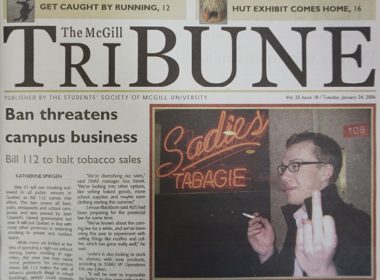
December 1984 The Quebec Court of Appeals ruled that the French-only provision of Bill 101, which mandated that French be the sole official language of Quebec, ran contrary to Quebec’s Bill of Rights. Pro-independence activists responded with graffiti and violence, including several bomb threats and fire bombings around downtown Montreal.[Read More…]
Latest News
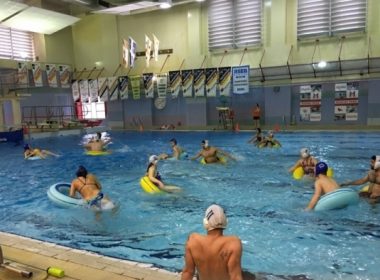
Intramurals at McGill: The social side of sports
Given that over 40,000 students attend McGill every year, it’s not surprising that many were athletes before coming to McGill. For some, sports were not only a passion growing up, but a way to connect with peers. While McGill has a variety of varsity and club teams, not every student[Read More…]
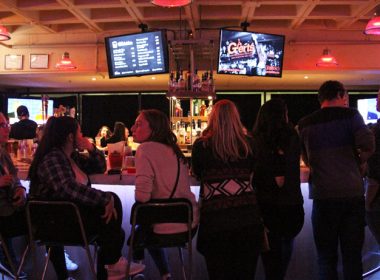
SSMU building closure disrupts campus clubs
Student clubs and services previously housed within the Students’ Society of McGill University (SSMU) building encountered logistical burdens in their search for alternative work spaces after the building closed on March 17. The closure was the the first step in a long-term schedule of renovations and repairs which are planned[Read More…]
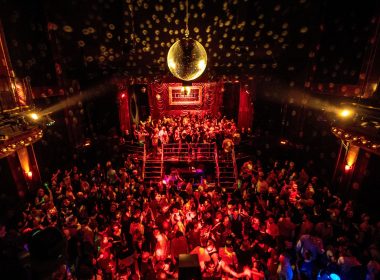
Dance your heart out: McGill dance parties that cater to often un-included communities
Montreal’s party scene can be hard to navigate. For many McGill students, it often feels as though the only places to dance and have fun lie along a four-block strip of Saint-Laurent Boulevard. And while Tokyo and Apt. 200 have their merits, these spaces aren’t everyone’s cup of tea—nor are[Read More…]
A tribute to the best toys of the ’90s and 2000s
Any McGill student can argue that everything was better in the ‘90s. Toys “R” Us was still in business, and Britney—not Kendall—was the queen of Pepsi. In terms of toys, the best have come from that decade and the early 2000s, when Bop It, Mr. Potato Head, and those strange[Read More…]
Giggle Juice: The science behind booze
A few drinks into one Saturday night in late November, my brother and I made a sacred pact to speak exclusively in freestyle. Walking along the pavement, I giggled as the city spun slightly, my stomach soaring with euphoria. My brother was in what he calls “the happy place”—a state[Read More…]

Ed Talks Episode 1: SSMU
Editors at the McGill Tribune talk about voter apathy, how fall reading week created single-issue voters, and both the outgoing and incoming SSMU executives.
Is McGill depriving your right to smoke?
Is McGill depriving your right to smoke? Contributor Heng Jiang addresses McGill’s new smoking policy. How will it affect students (smokers and non-smokers alike)? Where will the designated smoking areas on campus be? Will you be able to smoke weed on campus when it is legalized? Is this the right first step in McGill’s mission to phase-out smoking on campus entirely?
Professional Portraits: Then and Now

Gap-Toothed Women
In preparation for getting her braces on, my 13-year-old sister Noa recently met with her orthodontist for a consultation. The two agreed that she would have her braces on for about three years, that her elastics would be a neutral white instead of the bright pink and green for which[Read More…]