Latest News

Commentary, Opinion

To close the gender gap, STEM fields need to change from the inside out

During a recent studying session in Trottier, my friend—a female engineering student—overheard two male students heatedly critiquing the call for women in engineering. The two students asserted that female engineers are “taking jobs away from the men who need to provide for families.”

While most students today would agree that this mindset is archaic, gender disparity sadly persists across science, technology, engineering, and mathematics (STEM) fields, and contributes to an unwelcoming atmosphere toward women pursuing STEM careers. In Canada, women represent only 33 per cent of STEM university graduates, a statistic that is still lower in engineering and mathematics-based degrees. At McGill, less than one third of engineering students are female. Bringing women into male-dominated STEM fields is crucial for rectifying the gender wage gap. However, methods for addressing the lack of women in STEM need to go beyond meeting short-term quotas. Institutions must also aim to reform the fields in the long-run, by tackling gender bias and dismantling patriarchal norms so that women are valued and respected both today, and in the future.

A report published on March 8 by the Canada-U.S. Council for Advancement of Women Entrepreneurs and Business Leaders details methods for boosting the proportion of women in STEM careers. Its recommendations include developing outreach programs for high school students and increasing female role models—such as female professors—in STEM faculties to make women feel more welcome. The council also advises universities to increase support within STEM faculties by developing networks for women that boost the chances of retaining female students. McGill’s Scientista is an example of this kind of group: The campus organization supports and empowers women in STEM by connecting them with fellow female students pursuing degrees in similar fields.

The council’s prescriptions appear to be effective. The University of Toronto, for example, attributes its unusual 40 per cent female engineering class ratio to its new pre-university outreach program. The program supports incoming female students using strategies including targeted personal follow-ups with female applicants and incentivizing scholarships. The council’s recommendations are tangible, evidently effective ways to boost female representation in STEM. Given the persisting gender gap in fields like engineering and computer science at McGill, the university administration should consider implementing strategies from the report—such as high school outreach—as interim solutions for boosting female representation.

While there are plenty of successful women in STEM, internal biases remain prevalent and continue to hamper female participation.

However, the report’s recommendations fail to provide long-term plans for tackling the underlying gender bias in STEM that repeatedly deters women from these areas of study. Professional fulfillment comes partly from feeling valued in one’s place of work, and if women are repeatedly underestimated or unwelcome in STEM, those fields will not be as attractive to them. Changing this will require reworking fundamental gender perceptions; pouring women into STEM careers to fill a gender quota is not a sustainable way to solve the issue. If women are going to thrive in these fields, the fields themselves must change from the inside out.

Gender bias in STEM arises from socialization processes that promote the notion that men and women have distinct roles they’re supposed to fill. These traditional norms present STEM fields as male domains, thereby discouraging women from participating. While there are plenty of successful women in STEM, internal biases remain prevalent and continue to hamper female participation.

Ismael Mourifié, associate professor of economics at the University of Toronto, recognizes this issue and recommends that governments disrupt gendered career perceptions by investing in childhood education intervention. He points out that when girls are repeatedly shown that STEM roles are primarily for men, they may feel inadequate or deterred from those fields. Moreover, gender bias influences how men think of and treat women—including underestimating or resenting them in what they see as male fields (think: Trottier guys). If people are taught from a young age to see STEM as gender-neutral, females are less likely to be deterred from pursuing those professions, and males in STEM are more likely to respect their female colleagues.

While Mourifié’s suggestions don’t necessarily offer a quick fix for institutions that want to solve the lack of women in their STEM faculties, he raises an important point. Gender bias remains the root of the gender gap in STEM fields. To eliminate the gap, perceptions of women in STEM need to be disrupted. In addition to short-term methods for meeting gender quotas, institutions must also consider how to change the perception of women in STEM over time. Only then will they fully resolve the deeper issues contributing to this gender disparity.

Hockey, Sports

Cassie Campbell-Pascall resigns as CWHL governor

Within the world of North American women’s hockey, there is a growing movement to unite the two professional leagues: The Canadian Women’s Hockey League (CWHL) and the National Women’s Hockey League (NWHL). This movement has gained significant momentum after hockey icon Cassie Campbell-Pascall—three-time Olympic Medalist and former captain of the Canadian women’s hockey team—voiced her support.

On March 20, Campbell-Pascall stepped down from her position as a governor of the CWHL. Her main reason for resigning was the ability to publicly speak about her beliefs regarding the merging of the CWHL and the NWHL.

The most prominent advantage to unifying the leagues would be pooling talent. A unified, more competitive league would make it easier to attract fans and grow the sport because of increased star-versus-star matchups.

The CWHL includes seven teams across Canada, the United States, and China, and has been in existence since 2007. The NWHL, meanwhile, debuted in 2015 and includes four teams based exclusively out of the United States.

News of Campbell-Pascall’s choice to leave the CWHL comes after comments by NHL commissioner Gary Bettman in an interview with Calgary radio station Sportsnet 960, in which he opined that there should be one women’s league, and that it is difficult for the NHL to engage with two leagues.

“I think there probably isn’t enough talent for two leagues right now,” Bettman said. “Having two leagues makes it more difficult for us to get involved [.…] Women’s hockey need to get stronger, particularly if there’s going to be a meaningful pro league. Fragmentation doesn’t help in that pursuit.”

Indeed, a single unified league represents the best path for the sport moving forward. A unified league would mean that the game’s best players would be concentrated in one place, resulting in a higher level of competition—which would attract fans and grow the sport. The increased competition could also improve the talent of future generations of players, further perpetuating growth.  

In speaking out on the creation of a combined professional women’s league, Campbell-Pascall voiced frustration with the commissioners of each league: CWHL commissioner Brenda Andress and NWHL commissioner Dani Rylan.

“Both commissioners know what needs to happen,” Campbell-Pascall said on Sportsnet 960. “You have to point the finger at both commissioners. If I’m commissioner and I hear Gary Bettman finally come public and say those comments, what am I waiting for and what am I doing?”

In a later interview with The Canadian Press Campbell-Pascall reiterated that her focus was for the two leagues to join.

“I’m not at odds with the Canadian Women’s Hockey League, and I’m not at odds with the National Women’s Hockey League,” Campbell-Pascall said. “I’m at odds with why we haven’t become one.”

Her actions have prompted a plethora of players from both leagues to speak out about the matter, taking to social media using “#oneleague”, in a mass show of support.

Regardless of the importance of having one professional women’s league to fans and players alike, the logistics of merging the two leagues could prove problematic. But, from all accounts, it appears as if the topic is not something on the radar of either Andress or Rylan. Their lack of dialogue is certainly inhibiting the beginning of the process.

When Hilary Knight signed with Les Canadiennes earlier this month, the possibility arose that she might one day play alongside Olympic rival Marie-Philip Poulin, who took the end of the season off after participating in the PyeongChang Winter Olympic Games. With one league, matchups and rosters like these will become the rule rather than the exception. It is important for professional sports leagues to market their stars, and a unified women’s league would certainly be conducive to this.

News, PGSS

PGSS Council debates motion to amend commissioner roles

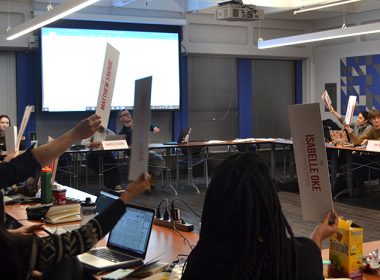
The Post-Graduate Students’ Society of McGill University (PGSS) Council held a meeting on March 21 during which they announced an accessibility audit of Thomson House and discussed a motion to amend the responsibilities of PGSS commissioners.


Audit of Thomson House

PGSS Financial Affairs Officer Matthew Satterthwaite announced that a review of the Society’s accessibility is currently underway at Thomson House. Occupational Therapy students at McGill have partnered with the organization Accessible Montreal to conduct the audit, which will take place between March 12 and May 11.

“What we want to do at Thomson House is not only address the physical barriers but also expand our notion of what accessibility is in terms of services that are being provided, usability of spaces, and disabilities like visual impairment,” Satterthwaite said.  


Motion to Amend the PGSS Society Activities Manual to Amend Commissioner Roles and Duties

The main discussion of the meeting concerned a motion to amend the roles and duties of PGSS commissioners—PGSS officials that pursue a variety of advocacy portfolios independently of PGSS executives. Broadly, the motion delineates whom commissioners report to, what their responsibilities are, and how much they are paid. The most divisive clauses addressed mandating PGSS executives to supervise commissioners and creating a stipend amounting to six hours of work per week at a rate of 15 dollars per hour for commissioners.

The PGSS executives explained that these changes are necessary to accommodate the commissioners’ expanding portfolios and to provide them with sufficient support to achieve their goals.

“When you bring in a new commissioner, you are bringing in the brightest and most motivated people in the bunch who want to take on these initiatives, […but] over time all these initiatives pile up and snowball,” Satterthwaite said. “So, the spirit behind this motion and these amendments is really to better define the role and the scope of the commissioner portfolio within the PGSS, align commissioners with specific executive portfolios, and allow commissioners better access to PGSS resources.”

Equity Commissioner Tim Hadjis and Health Commissioner Freddy Lee were present at the meeting. They spoke in support of the motion and described its potential benefits.

“It’s about better streamlining information and resources so that we can accomplish our initiatives better at PGSS,” Hadjis said. “It’s not about taking away power, that’s not what they’re doing, it’s just facilitating the process of accomplishing initiatives at PGSS.”

According to PGSS External Affairs Officer Hocine Slimani, this motion was endorsed by both the PGSS Executive Committee and the commissioners as the best way to rectify the structural inefficiencies that led a number of commissioners to resign in 2017.

“What’s proposed here is what we think, as [commissioners and executives], is the best solution according to our current reality,” Slimani said. ”We think it is better than the current model because, in the last year, three commissioners left.”

Nonetheless, many graduate students present at the meeting did not support the motion, emphasizing that it could restrict commissioners. Among its detractors was Amir Nosrat, a graduate student with Desautels Doctoral Students.

“Commissioners are the first line of defence against the executives making mistakes and in actually holding the executive accountable to the policies and values that our membership has,” Nosrat said. “Executives are essentially hijacking the commissioners [….] This is to me is a motion that is all about concentrating power, it’s about concentrating authority, and it’s about reducing accountability.”

The motion failed to pass in council. However, the clause establishing a six hour work week for commissioners will be moving forward to the Governance Committee for approval.

“Unfortunately council did not approve of these changes [other than the six hour week], although they were endorsed and seen as very positive changes by Executives and Commissioners,” Satterthwaite wrote in a message to The McGill Tribune.

Student Life

How to avoid someone on campus

We’ve all been there: You’re walking on campus and you take a moment to look up from your phone, only to spot someone 20 steps away who you would much rather avoid seeing. Instead of sucking it up and just engaging in that one-second interaction, we would rather avoid any acknowledgement of their existence. To help students avoid the unavoidable in the least-obvious way, The McGill Tribune has a few tips on how to escape an unwanted on-campus encounter.

Avoid eye contact

First and foremost, if you spot this person and don’t want to deal with small talk, do not make eye contact. If you pretend that you never see them, the chances are that they will likely not go out of their way to engage with you either. If you both happen to spot each other at the same time, act aloof. After you see them, pretend that you have not just yet processed their presence. The other person will probably be confused as to why you completely avoided them, and, in turn, may avoid you in the future—so keep that in mind.

Do some studying

In order to avoid a conversation with an approaching peer, pretend you’re on your way to the most important exam of your McGill career. Pull out your notebook—or even better, a textbook—and do some “reading” on your walk to class. If you look laser-focused, the person will feel rude if they try to interrupt you for a quick chat.

Duck into the nearest classroom

This solution is not always the best as you may walk into an uncomfortable situation—like an important meeting between a student and a professor or a fourth year’s seminar presentation. However, if you’re desperate for a more elaborate escape, darting from the path you’re on into a hidden location is guaranteed to help you avoid someone. If possible, try not to stop in your tracks and walk in the opposite direction—nothing could be more obvious.

Drop your belongings

When you see that unwanted someone coming your way, drop everything in your grasp. By making it look like their sight distracted you enough to make you drop your most prized possessions, they will feel so guilty that they won’t dare approach you. The best part is that while they walk by, you’ll be too busy picking up whatever you dropped to feel inclined to say anything. Although this may result in a broken iPhone screen, it’ll be worth it.

Pretend you’re on an emotional phone call

If the person you’re trying to avoid always acknowledges you and forces uncomfortable small talk even when it’s obvious they should just let you be, it may be necessary to take additional steps in ignoring them. If you’ve tried it all and can’t get them off your back, consider embarrassing yourself, and pretend you’re on an extremely emotional phone call. Although you may get some strange looks on campus, pulling out the water works and crying for your mom on the phone is a sure-fire way to make sure that unwanted someone leaves you alone the next time they pass you.

Arts & Entertainment, Film and TV, Joke

You think you’re better than me, kid?

The McGill Tribune is excited to introduce guest columnist Gino Adamson, A&E editor Dylan’s recently retired uncle. His interests include going to the movies, being naked longer than comfortable in gym locker rooms, large khaki pants, hanging out at the barber shop, and hitting on young waitresses. Following a particularly inflammatory family dinner appearance, Gino signed up for an account with twitter.com. Though his Logan Paul op-ed was too explicit to publish, he’s here today to give us two cents on Call Me By Your Name superstar Timothée Chalamet.

————————-

So I heard about this kid the other day. Real big-shot, “it boy”-type kid. Name’s “Timothée Chalamet.” For real, that’s his name. With the accent ‘eh-goo’ and everything. Sounds more like a bottle of vino than a man. Like some perfume my wife would wear or something. So anyways, I was on the Twitters, just scrolling the tweets, and I come across this flippy haired, dreamboaty little twerp. And all the girlies just love him. He’s Timberlake, he’s Patterson—or whatshisname—that vampire creep, he’s Eddy Norton, the girlies just can’t get enough of him. They tweet out their little heart eyes and the hashtag “baes”, it’s enough to make you hurl. So I get on the Google, I’m looking him up—turns out the kid’s in everything these days. I watch some interviews. Kid’s on Kimmel, he’s on Ellen, talking about some chick flicky Kiss Me By His Name or Tweety Bird. I wanna know—which one’s he playing, the tweety or the bird? And I haven’t said nothing about the gays, mind you. But the kid’s a pipsqueak, I’m not even kidding around. “Lil Timmy,” I call him. “Timmy Two-Pounds.” He’s wearing these all-white suits at these fancy award shows, give me a break. My five-year-old niece could whoop this kid’s ass. I tell you, if any daughter of mine ever brought this punk home for dinner, I’d have him out the door before you can say Al Pacino.

So anyways, and I’ll have my nephew put the YouTube in, I’m watching Toys ‘R Us Timmy on the Ellen DeGeneres TV show—I love her, by the way, very funny woman, which is something you don’t often see—and Timmy’s got the wavy hair coming down over his eyes, he’s wearing his little skinny pants, acting like a regular mooch. He’s all nervous and fidgety, but he has this way of speaking that makes you feel less nervous when you’re watching him talk. He’s joking around with his big buddy there, that Winkelvoss weirdo, they’re telling their funny stories from the movies. You can practically feel everyone in the room falling in love with the kid. There’s this one part—Ellen, God love her, plays this embarrassing clip of Tiny Timmy when he was a kid—and you see Timmy on the show rubbing his face in his hands and acting all shy, his hair’s falling all over his face, and I could just die. I mean. I could just. I could. He’s so beauti—. I could die because he’s such a pipsqueak. What am I saying? You think you’re better than me, kid? You think you’re some kind of Hollywood bigshot? Come around to my neighbourhood sometime punk, I’ll show you bigshot. Kids these days—I tell you—they have no respect. None.

Editorial, Opinion

Uncontested SSMU executive: Show students why you deserved their votes

The results of this year’s Students’ Society of McGill University (SSMU) executive elections are out. The short of it: Nearly every candidate on the ballot won, because nearly every candidate ran uncontested. For the presidency—the only contested position—Tre Mansdoerfer edged out Corinne Bulger by only 69 votes. Voter turnout was higher than previous years, at 32.8 per cent. Yet, for multiple candidates, more students abstained than voted “Yes.” If one counts abstentions as a candidate, “Abstain” actually came second for the presidency, with 38 more votes than Bulger.

The outcome of this election means two things for next year’s SSMU executive committee. First, the incoming executives have to prove they are worthy of being on the executive committee, despite running unopposed. They must demonstrate that they are the right people for the job, and, crucially, that they will be accountable to students. Second, this election shows, as usual, that SSMU and the McGill community have serious work to do when it comes to engaging students with their society.

That is not to say that next year’s executives are unqualified. Many seem more than cut out for their positions. However, right now, their most relevant qualification as a team is that they actually wanted to be SSMU executives. Now that they are SSMU executives, they must demonstrate everything else that they bring to the table, and rise to the challenge of being the responsive, accountable, and competent leaders that McGill students deserve.

This will be more challenging for some executives than others: Next year’s team has a wide range of levels of experience with SSMU, and The McGill Tribune has expressed serious concerns about at least one incoming executive’s qualifications. That only makes it more important that the president and vice-presidents-elect form a cohesive team. They should learn from the conflicts that have plagued this year’s executive, and work to support, not undermine each other.

Moreover, election by a voter turnout of just over 30 per cent—never mind the fact that all candidates received at least 30 per cent abstentions—doesn’t make for much of a democratic mandate. It is therefore essential that these executives make concerted and ongoing effort to hear out student voices, and put concrete, specific action into maintaining and improving the society’s accountability.

By showing students what a functioning society does for them, SSMU shows students why they should be engaged in their student union, and maybe even be involved.

SSMU must be functional and effective next year, for immediate pragmatic reasons, such as the building closure, but also for the society’s longer-term interests: Namely, re-engaging student engagement and involvement in SSMU. Between allegations of anti-Semitism at the Fall 2017 General Assembly and executives’ various internal conflicts throughout the year, student attitudes toward the society currently range from status-quo apathy to active resentment. The result is yet another election with a dearth of candidates and tepid voter engagement.

Incoming executives often cite the importance of renewing student interest in SSMU. And, while often failing to also provide workable solutions, they’re not wrong: SSMU can’t ignore the problem of student disengagement indefinitely. The society is, ultimately, run by students—if no students step up to the job, it can’t exist. However, student disinterest in SSMU isn’t inevitable, nor unsolvable. By showing students what a functioning society does for them, SSMU shows students why they should be engaged in their student union, and maybe even be involved.

Demonstrating SSMU’s full value is admittedly a tall order. While students can see firsthand what campus groups and services do for them, SSMU’s administrative role in making those groups and initiatives possible is more behind-the-scenes. Improving information sharing and transparency around executives’ day-to-day responsibilities are good places to start, both during election periods and throughout the year. When students see how SSMU can impact them in concrete, positive ways, they pay attention. Response to the referendum question on a Fall reading week policy is a testament to this: Only 6.1 per cent of voters abstained.

Student groups on campus have a role to play on this front, as well. Campus press, organization included, serve to hold SSMU accountable, but also to keep students informed and engaged enough to do the same. Reporting on SSMU regularly, accurately, and compellingly is something we continue to work on.  An electorate motivated to vote conscientiously is also in clubs’ and services’ best interests. After all, these groups can only function effectively with a SSMU executive competent enough to support them.

Student apathy toward SSMU is a campus-wide problem, and demands a campus-wide solution. That starts with a strong executive team showing students why they should care in the first place. The 2018-2019 president and vice-presidents-elect have their work cut out for them. It’s up to them to prove their worth.  

Student Life

Four McGill friendships everyone is guilty of having

With over 40,000 students, McGill is a hub for social interaction, where every conversation between students has the potential to initiate a lifelong friendship. In addition to their ride or dies, all students have a couple of friends that they may not want to admit to having. To highlight these overlooked partnerships The McGill Tribune created a list of friendships that all students share.

The One With All The Lecture Notes (TOWATLN)

This reliable friend is one that everyone’s thankful to have. We all know that one person who miraculously always makes it to every 8:30 a.m. lecture and whose notes look like they could be something out of an Oxford textbook. In addition to being super cool, super nice, and maybe even super funny, this is the friend who will be there to guide you through your final exam. Have a Wednesday 8:30 a.m. conflicting with your Tuesday Café Campus plans? No worries, TOWATLN’s got you. Haven’t been doing the readings all semester long? TOWATLN has them in  a compact, two-page, bulleted document ready for you to look over. And when the murky tide of final exams rolls in and threatens to drown you whole, don’t forget to save TOWATLN a seat in McLennan for your last minute tutoring session.

The Forgotten Frosh Bestie (TFFB)

Remember the joyous days of Frosh when the sun was shining, the birds were singing, and everything smelled of new beginnings and beer? Specifically, remember that one friend you shared those days with, who, although you had only just met them, managed to see you at your best and definitely at your worst all in four days? We call this one TFFB because— chances are—even though you thought you two would be besties forever and live out your McGill career side by side, your paths diverged within two days of Frosh week ending. TFFB knows all your darkest secrets that you drunkenly confessed while they were holding back your hair after power hour, has seen you get wet and wild at Beach Day, and is always there to exchange an awkward ‘hey’ when you bump into each other at the Y-intersection.

The One You Know from High School (TOYKFHS)

While some students are lucky enough to have made it to McGill with a high school bestie, chances are most of us came to McGill with one or two acquaintances that we would have never described as anything more than just “classmates” back home. This is the pal you always knew existed but never spoke a word to in all four years of high school. Fast-forward to a few months after high school graduation, and here you are running into those same people—in a new school, new city—on the other side of the country or halfway across the world. And whether it’s been months or years since those high school days, you still find yourself forcing an awkward smile and wave as you run into them amid the confused crowd of students rushing in and out of Leacock 132. But don’t worry: You’re sure to have plenty of time for more painful small talk when you inevitably find them sitting next to you on your flight back home.

The One With The Cute Friend (TOWTCF)

Now although you love TOWTCF, you love how cute their friend is even more. Spending time with TOWTCF is always a blast—as long as they bring the cute friend along. Let’s be real, all you want is an excuse to get closer to their friend in hopes of a potential hookup or romance. We won’t call this friendship opportunist, but hey, it’s the survival of the fittest out here and you’re doing nothing but using your opportunities wisely.

McGill, News

Compost Pilot Project to tentatively launch in La Citadelle Residence

As part of the McGill Vision 2020 plan to introduce environmentally-sustainable operations on campus,  McGill’s Facilities Management and Ancillary Services department is implementing the Zero Waste Project, which will introduce compost bins across campus.

Composting is the natural biological process in which various microorganisms decompose organic wastesuch as food scraps, paper, and grass clippings—and convert it into an organic soil fertilizer, which is better for the environment than using chemical fertilizers in agriculture. It is also a sustainable way to dispose of garbage as, according to Environment Canada, organic waste accounts for 40 per cent of residential waste. Currently, the Zero Waste Project is centred around five campus buildings: La Citadelle, Brown, Trottier, McConnell Arena, and the Students’ Society of McGill University (SSMU) building.

The first compost bins were originally planned to be placed at La Citadelle residence starting in April, but have since been delayed to the fall. After examining whether waste is being put in the correct bins and obtaining feedback from students, cleaning staff, and building managers, the Zero Waste Project team aims to expand the project’s reach to the remaining four buildings before the Winter 2019 semester.

“The pilot is going to start probably by next month and once we get the feedback from the pilot project we will make changes to the bins and the ways we are implementing this project,”  Zero Waste Project student volunteer Aditya Jain said.

One of the primary aims of the project is to mitigate compost contamination by educating  students on what they can and cannot compost.

“Previously, we had a few compost bins and the biggest complaint we received from the service provider was that the compost was highly contaminated and that they had to literally throw it out,” Jain said.

Sustainability coordinators at McGill Student Housing and Hospitality Services, with the help of the Zero Waste Project, have already created a video to educate students on composting. Additionally, the Zero Waste Project team plans to place rotational screens on waste bins that indicate the types of waste that should be deposited in each bin. Finally, to facilitate proper waste sorting, Facilities Management and Ancillary Services will implement a standardized colour scheme to differentiate waste bins on campus.

“We want to put up good, clear signage and make sure it is unified across campus,” Zero Waste Project student volunteer Antonia Butler said. “People are confused because they see different colours, so it has to be very unified.”

One of the challenges Jain and Butler faced in implementing the project was a lack of data on McGill’s waste diversion rate and previous attempts at composting. In light of this, one of the core strategies of the Zero Waste Project is to record the amount of compostable, landfill, and recyclable waste each building produces.

“There was no data available on campus about what the waste rate was and what the diversion rates were,” Butler said. “We just got a few volunteers and we said ‘go to trash bins for two weeks and count the items.’ That was our waste audit. The data showed there was a lot of non-trash waste going into garbage bins. So, obviously, there was a need for composting.”

Additionally, the Project hopes to put its compost infrastructure to use by distributing compostable utensils and food containers at all food locations on campus.

For the time being, La Citadelle residents are excited to pioneer this project and hope that it will be expanded to other residences in the near future.

“I think it’s a really great initiative,” Cristina Lau, U0 Management, said. “I remember when me and my roommate first moved in we were really disappointed that the closest compost station was at RVC cafeteria. I’m really excited to see how residence transforms into a more environmentally conscious environment in the next few years.”

Student Life

Making the most of failed midterms: Frostbite consoles failing students with free ice cream

By this time of the semester everyone is extremely stressed. Asking a friend how their recent midterm went offers a high chance of inspiring an emotional breakdown. Luckily, Frostbite—located in McConnell Engineering Building and operated by the Engineering Undergraduate Society (EUS)—is ready to console any student who gets below a 30 per cent on their midterm or final with free ice cream, as long as the midterm or final makes up for more than 15 per cent of the student’s entire course grade.

While dessert is the cure to all pain, buying endless pints of Häagen Dazs from Montreal dépanneurs is a big hit on anyone’s bank account. Rather than having to bear the cost of an ice-cream cone in addition to the cost your recent midterm will have on your GPA, just show up to Frostbite with a physical copy or a screenshot of your failed midterm grade on MyCourses, and walk away with a free small ice cream. With flavours ranging from vanilla to strawberry daiquiri, anyone can raise their spirits with the help of Frostbite.

“No matter what you’re going through, it’s hard to be sad when there’s ice cream around and bumping jams are playing”, Jacqueline Liu, U3 chemical engineering student and Frostbite employee said.“When midterms come around, it’s hard to stay positive under the high stress. It’s even worse when you fail a midterm that you’ve studied really hard for.”

Although located in the Engineering Building, Frostbite offers frozen solace to McGill students across all faculties and departments.

“There are some notorious courses in engineering, with midterm averages in the 30s to 40s,” Liu said. “Those midterms have surely caused a lot of unnecessary stress and tears. But we don’t want that at Frostbite. We might not be able to change those horrible midterms, but at least we can cheer people up with some free ice cream and offer some positive words of encouragement.

For Rande Gearing, U3 Arts, Frostbite offered much needed consolation after receiving a highly unfortunate first year midterm grade.

“I had a linear algebra class in my first year that I decided to never go to because I didn’t really like my prof,” Gearing said. “The day before the midterm I tried to teach myself everything I needed to know for the exam, but I ended up just texting all my friends instead. The next day, during the midterm, I giggled because I knew nothing. But when I got the midterm back, I found out I only got one out of eight answers right. I was disappointed with my grade but was happy when I found out I could get free ice cream from Frostbite for it.”

While receiving a horrible grade can be discouraging for any student, Frostbite brings light and laughter to the situation, reminding all at McGill that they’re not alone.

“The funniest moments are when multiple groups of people per day start coming to Frostbite to collect their failed-exam ice creams, you know a horrific exam must have been handed back recently,” Liu said.

Next time you receive a failing grade on a midterm or exam, dry your tears, stop planning ways to poison your professor, and make your way over to Frostbite to forget the pain. Once you show them your grade—they won’t judge—and enjoy a delicious scoop of ice cream, that exam will be the last thing on your mind.  

Read the latest issue

Read the latest issue