Latest News

Elections, News, SSMU

SSMU Election 2017: VP Internal

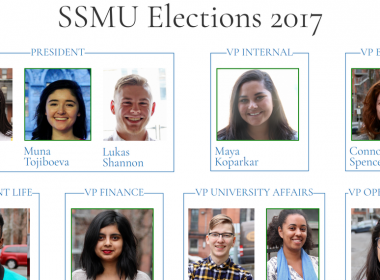
Maya Koparkar is the only candidate running for the position of Vice-President (VP) Internal, which is tasked with overseeing the Students’ Society of McGill University (SSMU) first-year outreach activities, communications, and student engagement. Koparkar aims to expand the portfolio of VP Internal in order to diversify the events offered to promote first-year engagement.

The VP Internal’s first major project is overseeing Frosh at the start of the Fall semester. Koparkar proposed to act as a mediator between frosh coordinators in order to facilitate collaboration with smaller faculty froshes. In addition, she proposed ways of promoting health and wellbeing through frosh, in line with recent years’ efforts to make frosh more accessible and put less emphasis on drinking and partying for new students with other interests.

“I want to speak to departmental internals about creating cohesive programming [and] better guidelines for student about how to Frosh,” Koparkar said. “For example, taking naps, rest, drinking water, [and providing] accessible food options and [beverage] options besides alcohol during Frosh. Maybe Frosh [would want] to organize morning zumba or yoga, that could be looked into as well.”

Tofunmi Odugbemi, President of the McGill Political Science Students Association (PSSA), raised the issue that the SSMU listserv neglects to include content relating to departmental events. Current VP Internal Daniel Lawrie has sought to reduce the amount of content included in weekly listservs, making selections based on content that he believes will appeal to the largest amount of the student body. Koparkar suggested collaborating with departmental organizations in order to facilitate communication with SSMU.

“A lot of the standardized process for submitting content to the listserv is set in stone, but I would look forward to working with departmental organizations,” Koparkar said. “[There are] lots of things [departments] can offer to students that [SSMU] can effectively promote [….] For example, I want to work [with] departmental organizations to better engage them with SSMU events.”

Furthermore, given recent scandals involving SSMU executives, Koparkar intends to mend the relationship between the society and its members.

“I want to create channels for students who don’t usually get involved with SSMU,” Koparkar said. “[….I will] create engagement in terms of diversifying the events portfolio. [Something] I learned as a member of the [Students’ Society Network Program (SSPN)] for two years [is that] events don’t need to be large to engage students. [They] could be small, [like providing] food during exams. [I aim to] collectively engage campus away from politics.”

In her closing statement, Koparkar explained the importance of mending SSMU’s image.

“[I have] lots of passion for providing students with [a] great connection to SSMU,” Koparkar said. [I want to] humanize SSMU by taking away the bureaucratic elements. People see the role of VP Internal as a party planner, but there’s more to offer students. Building from the ground up with first-year engagement can create a more unified SSMU and student body moving forward.”

Elections, News, SSMU

SSMU Election 2017: VP Student Life

The Students’ Society of McGill University (SSMU) Vice-President (VP) Student Life manages relations between SSMU and its clubs, services, and independent student groups. In pursuit of this, the position is tasked with helping student groups coordinate events, assisting student groups with resources, managing the Society’s mental health initiatives, and collaborating with university staff from Student Services.

Jemark Earle is the only candidate for VP Student Life. His platform features a significant focus on projects that complement student mental health services, including training all faculty student executives in Mental Health First Aid and creating a Mental Health minor.

During the press conference on March 6, Earle described the specifics of his plan to address mental health on campus.

“Right now we have the Career Support Centre […] which deals extensively in helping destigmatize mental health and allowing students to speak when speaking to a professional is too intimidating,” Earle said. “[Training student executives in mental health would] create a space where [executives] would be […] more approachable, more empathetic to situations, and create a space to talk.”

At the debate on March 9, Earle spoke more on his emphasis on mental health.

“My platform deals extensively with mental health and this is because I’ve seen how detrimental this can be on campus,” Earle said. “What’s missing from the equation is student input and as your VP Student Living I plan on dealing with the administration because I don’t believe they’re being transparent in how they deal with students.”

Incumbent VP Student Life Elaine Patterson asked Earle about conflict mediation, with Earle explaining his approach.

“What I believe helps or is beneficial in dealing with student conflicts is sitting with both parties and acting as mediator between them, ask them to say what the conflict is […], working towards asking them what they want from the other party, and what the other wants from them,” Earle said.

Patterson also inquired into how Earle will balance his time between supporting his personal projects, mental health, and over 150 student groups on campus—Patterson believes that the latter is the largest part of the portfolio. Earle clarified his priorities.

“In the first few months I know a lot of the job is going to be dealing with clubs and services, we have activities night so I’ll have to be responding to a lot of emails and talking to a lot of clubs and services representatives,” Earle said. “So I think that dealing with the mental health and the clubs and services […is] what I will prioritize over my personal projects.”

Private, Student Life, The Tribune Predicts

The Tribune Predicts: March Horoscopes

        Image Credit: Winnie Lee     

        Capricorn: As you enter into the month of March, you are still feeling the effects of the solar eclipse that occurred on Feb. 26. Enjoy the enchanting mood the eclipse leaves as you enter the new month and make your return to school after reading week. This eclipse phase can aid you in making your personal dreams a reality if you focus on your natural talents and strive to be the best you can be. You will find that this opens up new opportunities in your romantic and financial life, and the new connections you’ll make this month will help with this. The Pisces Sun is also moving through your social third house, so make sure to find time to reach out and meet new people. Although you may enjoy your close circle of friends, you will draw energy and happiness from expanding your horizons. Perhaps joining a new club as the final months of school arrive will allow you to get involved and branch out.
        Activity to try this month: This month is full of energy for you, but try taking a minute to focus on an important topic by attending the Muslim Student’s Association (MSA) McGill’s discussion on Women in the Quran on March 17.     


        Aquarius: This month is alive with an energetic spirit for you, Aquarius! Midterms might be over for you, and your social life will pique: You will find yourself travelling and making time for exciting days and nights out with friends. The Pisces Sun will also be moving through your diplomatic and career-driven zone making this a work-hard, play-hard month. Be aware of new job opportunities—within your current workplace, or a new one—as this is the perfect time to make advancements in your employment. However, don’t let the potential stress of focusing on your career stop you from enjoying the cosmic energy you’re feeling and ringing in March with some memorable experiences.     

Activity to try this month: Support a McGillian musician, Jillian Blair, by bringing your friends out to her upcoming show at Club Balattou on March 12.     


        Pisces: Prepare yourself, Pisces: The energy flowing from the February solar eclipse will continue to affect you into March. March is also a birthday season for your sign, so use this continued enlivened spirit to prepare for fun and excitement as you celebrate. The sun is also moving through your second house of luxury and decadence—even more good news for your birthday month. March may be the month to upgrade your closet, try a new popular restaurant, or invest in purchases that will serve you into the future, such as a new spring coat!     

        Activity to try this month: Treat yourself to a birthday present that is sure to be a blast and buy tickets to the Lumineers concert at the Bell Centre on March 18.     


        Aries: Embrace this month as a time for reflection. As the the sun in Pisces will be illuminating your house of solitude and relaxation, make sure to take time for yourself and remain restful as you make your return to McGill after reading week. Take care of yourself by going for a run, putting on a face mask, or reading that book you’ve been waiting to pick up. Venus will also be in retrograde in your sign this month, so be open to new love interests as your alluring spirit will send many new admirers your way!     

Activity to try this month: Learn how to make the household products you use for self-care—like shampoo, toothpaste, and toiletries—more eco-friendly at the Science Undergraduate Society’s DIY Household Products workshop on March 13.


Taurus: This is the month for you to get involved! This March, the sun is flying through Pisces and your eleventh house of community, so enjoy the energy of returning to your McGill community. Participate in a club by messaging executives or signing up for their listservs, attend an event, or even make plans with your circle of friends. However, Venus, your governing planet, will be in retrograde, so there may be some complicated roadblocks to come in your personal life. Prepare for these obstacles by remaining on top of homework and by focusing on maintaining good relationships with your loved ones. Most importantly, take time to reflect and take care of yourself when necessary.

Activity to try this month: Take the time to get in a good laugh with some friends at Bring Your Own Juice, McGill’s sketch comedy group’s Three Nights of Live Sketch Comedy show from March 16-18.


Gemini: March is an exciting month for you, Gemini! As the sun shines in Pisces, it brightens your tenth house of success. This month will put a spotlight on you and your career accomplishments. Now is the time to network and explore opportunities for employment. It looks as though this month holds a prestigious chance to advance yourself professionally; remain confident, and don’t forget that whatever opportunities come your way, you’ve earned them!

;Activity to try this month: Staying engaged on campus can be essential to your professional development. Attend the McGill Indigenous Student Alliance’s (ISA) one day conference, “The Power of Indigenous Arts: Resistance and Revitalization” on March 18 to learn more about the importance of Indigenous representation in the arts.


        Cancer: With the sun in Pisces enlivening your 20th house of travel and wanderlust, now is the time to explore some new places! Forget staying at home and relaxing; get out and seek some adventures. Look for an affordable weekend travel plan to cities such as Burlington, Quebec City, or Boston. Or perhaps, as midterm season is still in full swing, plan a daytrip to a neighbourhood you’ve seen in the Greater Montreal area to enjoy a relaxing staycation. The recent solar eclipse may also afford you success in your career. Look out for club applications and call-outs for new volunteers, as these exciting opportunities could help you climb the job ladder.

        Activity to try this month: Shred the gnar with some fellow ski and snowboarding lovers at SSMUSki’s Jay Peak Overnighter from March 17-19.


Leo: This month will be a steamy one for you, Leo. Make sure to be your outgoing self for the first couple weeks of March as the Pisces sun will be shining in your seductive and private eighth house. However, remember to guard your feelings as a spiritual activation of your chart will heighten your emotions. Although this month may not be one to be thinking of deep romantic relationships, it is certainly one for spontaneous dates and fun! Take this time to explore your sexual and romantic sides by putting yourself out and joining the dating pool of eligible singles in the Montreal area, maybe by creating a Tinder account or asking a friend to be your personal matchmaker. This month will surely guarantee a spark.

Activity to try this month: Make a first date exciting this St. Patrick’s Day at Gerts Bar’s celebration on March 17.


Virgo: This month is all about romantic relationships for you, Virgo. With the sun shining in your romantic 7th house all month long, prepare yourself for a fairy tale romance to sweep you off your feet. As the sun meets Neptune—your planet of fantasy—you may feel a bit overwhelmed with passion, so make sure to follow your intuition and innate feelings in difficult situations. Through the excitement of a new potential romance, make sure to remember that self-love is the most important type of love and be your own soulmate in case this new lust fades more quickly than you had hoped.

Activity to try this month: As love is in the air for you this month, take this opportunity to bring your date to Effusion A Capella’s show, Iridescence, on March 19 at Le National!


Libra: This month opens with feelings of excitement, chaos, and inspiration with Jupiter in your sign opposing Uranus in March. This may incite some stress, but remain rooted in yourself and your well-being to combat negative vibes that may come your way. The sun in Pisces is also beaming into your 20th house of wellness. With spring right around the corner, this is the perfect time to begin daily health regimens. Whether that be going to the gym or eating healthier, focus on your health and energy this month.

        Activity to try this month: Attend McGill’s Comparative Health Systems Program’s informative and interactive workshops to learn about different clinical and social aspects related to women’s health at their annual conference on March 11.


        Scorpio: With the sun in Pisces illuminating your fifth house of flamboyance, don’t be afraid to be a little “extra” this month, Scorpio. Be reassured in your amazing self and show off just how much you have to offer! This is the month to show some self expression through art, work, or parties. Enjoy yourself this March—you have cosmic permission to extend your spring break a little longer. However, at the beginning of the month, Jupiter will be in Libra throughout the month—opposing Uranus—your house of responsibility. This will lead to a loss of motivation that may ultimately cause you some stress at school or work. To overcome this obstacle, try new strategies for managing your time and focus, like to-do lists and calendars, in order to continue to be your determined self.

        Activity to try this month: Discover your artistic side at the Chagall: Colour & Music exhibit at the Musée des beaux-arts all month long.


        Sagittarius: As you enter March, the family and home sector of your chart will be beaming, Sagittarius. Take time to enjoy quality bonding with your relatives and loved ones. Make your family your priority and build your relationships when you can. This month will also be a month of surprises in your social circle as your ruling planet Jupiter opposes Uranus. Expect your social network to expand—a new exciting and opportunistic person may enter your life.

        Activity to try this month: Take the time to to learn and participate in the discussion of a very important issue at the “Yemen Conflict Panel Discussion – A Forgotten Emergency” hosted by McGill Students for UNICEF on March 14.

News, SSMU

SSMU President Ben Ger resigns, citing personal reasons

This is a developing story. Please check back for details, as more information becomes available.

The Students’ Society of McGill University (SSMU) President Ben Ger resigned from his position on March 9, citing personal reasons. He is the second member of the SSMU executive team to resign in a matter of weeks, following Vice-President (VP) External David Aird’s resignation on Feb. 22 after multiple allegations of sexual assault.

“Due to personal reasons, he felt that he was unable to continue in his duties as a representative of members of the Society,” read a statement released by the rest of the executive committee on March 9.

The president is the chief executive of SSMU and coordinates and supports the actions of the rest of the executive board. The president is also responsible for the wider vision of SSMU and represents the society on bodies including the McGill Senate and Board of Governors. For the remainder of the semester, Ger’s responsibilities will be divided between the remaining five members of the SSMU executive committee and other permanent staff members.

“These positions in general, from the very beginning, are very heavy positions to take on,” SSMU VP Student Life Elaine Patterson, who will be taking on spokesperson duties for the society, said. “While recent issues have been particularly trying for all of us on the exec team, all of us have had nine months worth of being in [our positions] since last June and all of that building up can create a lot of pressure, especially on the president.”

SSMU has been at the centre of controversy on campus this semester since former Arts Councillor and Director Igor Sadikov tweeted “punch a zionist [sic] today” from a personal Twitter account on Feb. 6, leading him to resign on March 8. Ger’s resignation also comes after Science Senator and Director Sean Taylor stepped down from the SSMU Board of Directors (BoD) due to a loss of faith in the body, from which Sadikov resigned on Feb. 23.

According to Patterson, Ger’s resignation creates problems for the BoD as Directors were in the process of choosing next year’s board, but no longer have quorum after the vacancies caused by Taylor, Sadikov, Aird, and Ger’s resignations.

SSMU executive elections for the 2017-2018 academic year are currently in progress with the voting period lasting from March 13-16 and results due to be announced on March 16 at 3 p.m. The winners of the President and VP External positions will be given the option to assume their portfolio in a managerial position ahead of the normal May 1 turnover date.

“Whether or not they choose to do that is entirely up to them,” Patterson said. “It’s still kind of up in the air, who wants to take on the responsibility while being a full-time student. They will be remunerated for doing those jobs. It’s entirely up to them if they want to take it on.”

It is currently unclear whether Ger will be helping in the transition and producing an exit report

On Feb. 21, the Community Disclosure Network (CDN), a group of sexual assault survivors and allies, released a statement calling for Aird’s resignation from his position. The CDN wrote that Aird had committed gendered and sexualized violence—based on testimonies from survivors—and called for SSMU to undertake a number of supportive initiatives to address future cases. Aird stepped down on Feb. 22 and issued an apology for his behaviour on Feb. 23, although the apology was removed when he deleted his Facebook account.

Sadikov faced many calls for his resignation and votes by the BoD and the Arts Undergraduate Society (AUS) Legislative Committee to remove him from his positions. BoD voted on Feb. 13 to retain Sadikov in his position as Director, but issued a formal censure against him and released a statement from Sadikov apologizing for his actions. Sadikov subsequently resigned from the BoD on Feb. 23, citing pressure from the McGill administration.

“Due to the interference of the administration, my continued membership on the [BoD] is, at this juncture, a legal liability for the Society, and it is in the Society’s best interest that I resign my position,” Sadikov wrote in a statement on Feb. 23. “It has been a privilege to serve the Society as a director, and I hope to continue contributing to the Society’s activities through other avenues.”

On Feb. 22, AUS Legislative Council voted 22-16 not to remove Sadikov. A motion to remove him was due to be voted on at the March 9 SSMU Legislative Council meeting but Sadikov resigned as Arts Councillor on March 8. His decision came a few days after allegations surfaced that he had been abusive in a previous relationship with another McGill student. His statement of resignation cited his mental health and personal reasons for his departure.

Patterson explained how Ger was a key part of the SSMU executive team and that his presence will be missed by the remaining members.

“I think that Ben was a really good teammate. I’m sad to see him go,” Patterson said. “It’s gonna be tough. He’s just a very good person in terms of listening and he was always there to listen when I vented. I think that a lot of the other execs would agree with me. [It’s good to see someone] in a presidential role who can also be a support system.

Letters to the Editor, Opinion

Letter to the Editor: SSMU’s independence should not come before student safety

I respectfully disagree with the Feb. 21 editorial, “McGill Administration must support independence of student societies.” Igor Sadikov advocated for violence toward Zionists, which includes Zionist students at McGill. I am a proud Arts Graduate of McGill, and I identify as a Zionist. I know many others at McGill who would say the same. Sadikov advocated violence against students that he represents, and the administration was right to speak out against it.

Igor Sadikov tweeted, “punch a zionist [sic] today,” and in doing that he called for violence against many McGill students. He has since resigned from the Students’ Society of McGill University (SSMU) Board of Directors, but remains on an Arts Undergraduate Society as a SSMU representative. The job of Arts Representative to SSMU is to represent the Faculty of Arts to the student government. Sadikov cannot do that job because he called for violence toward many of the students he supposedly represents. He cannot be allowed to represent student interests anymore.

The editorial argued that the administration imposing a course of action on SSMU violates the independence of the student society. However, student representatives do not have unlimited power. Igor Sadikov was elected Arts Representative to SSMU. His job is to represent the Faculty of Arts. This entitles him to advocate on behalf of the Faculty of Arts to the student government. It does not allow him to advocate violence towards students. When Sadikov overstepped the bounds of his job to advocate violence, it meant this was no longer a student society issue but a safety issue.

Students at McGill have chosen to attend this university, but students do not have a choice to join SSMU—SSMU fees are mandatory. If McGill mandates that students join a student society, then SSMU must represent the interests of every student. While SSMU cannot do a perfect job, students have a right to be represented by someone who does not advocate violence against them. If SSMU is not willing to protect students from the violent threats of their representatives, it is the administration’s duty to step in.

Maintaining the independence of SSMU would be ideal. However, there are some things that are more important than the independence of student societies. Violence cannot be permissible from any McGill student—let alone a student government representative. Sadikov does not have an unconditional right to serve as Arts Representative, this was a privilege granted by his fellow students. He lost that privilege when he advocated violence against Zionist students. Students must feel safe from violence at McGill. If the student society will not step in, the administration must. Violence against a religious or political group cannot be condoned in any way at McGill or any university campus.

Norman Yallen

McGill Arts Graduate, '16

Chill Thrills, Out on the Town, Private, Student Life

Viewpoint: A first-timer’s look at Nuit Blanche

Every winter, the streets of Quartier des Spectacles in downtown Montreal light up in celebration of Montreal en Lumière, one of the largest winter festivals in the world. The festival began in 2000 as a way of introducing people to Montreal’s winter scene. Combining performance art, gastronomy, unique art exhibits, and family-friendly activities, Montreal en Lumière showcases the best of Montreal’s diverse culture over two-weeks. Nuit Blanche, which literally translates to “White Night,” is a night-time festival that wraps up Montreal en Lumière each year. On March 4, over 200 events occurred in tandem in many different locations around the city, sending a pulse of energy through Montreal’s already bustling nightlife for the evening.

Despite the sub-zero temperatures and chilly winds blowing in my face, I was determined to make the most of Nuit Blanche. I started off the night at Atrium le 1000, an indoor skating rink inside the building 1000 de la Gauchetiere. Although I hadn’t skated in nearly eight years, and the prospect of going on the ice was daunting, I squeezed on my skates and made my way to the ice. The rink was lit up in hues of neon light—bright greens, pinks, and blues and, combined with the Beatles music playing overhead, the setup resembled a retro roller skating rink.

The actual skating part was difficult at first but I found myself more enthralled watching the people who were on the ice on a Saturday night. A mix of teenagers, young children with their parents, and couples were skating around in circles under the bright lights. This diversity gave the arena a very welcoming feeling, pointing to Nuit Blanche’s unique ability to bring out many different demographics on this singular winter night. Not long after I found my balance, the rink became incredibly full, which I took as my cue to move on to my next stop for the evening.

[metaslider id=51287]

The Montreal Museum of Fine Arts was my next destination. It hosted a stained glass workshop inspired by the museum’s current main exhibit, Marc Chagall’s Colour and Music, a multidisciplinary exhibit heavily influenced by Russian music and folklore. The workshop took on an arts and crafts approach, giving people the freedom to paint their own makeshift stained glass using plastic film and acrylic paints. The stained glass workshop included a free vodka and pretzel-tasting session, as well as live jazz performances. Although the lineups were incredibly long—especially for the vodka—the mood was festive. With the jazz ensemble playing in the background, people in line danced along to the music. While was fun, what was notably missing from the evening was an educational aspect, and I left with a desire for more information on how stained-glass is actually created.

I ended the night at Place des Festivals, an outdoor area that hosted many different activities. The area was full of attendees: Crowds danced to EDM, waited in line for the ferris wheel, and sipped coffee inside the warmth of tents. The winter weather encouraged a communal atmosphere among the festival’s attendees, as people crowded around fire pits with sausages and marshmallows to roast over the open fire. I enjoyed chocolate stuffed waffles from a food truck with hot chocolate, and suddenly the cold didn’t seem so biting anymore.

Despite the chilly weather and long lineups, my first Nuit Blanche experience was incredibly interesting, and I left feeling a stronger sense of community with fellow Montreal residents. I got to see a fun, artistic, and cultural side of Montreal, meeting new people at each of the events I attended. The one downside is that it only occurs once a year—now all that’s left is to wait for next winter.

McGill, News

UPenn professor presents study on American and Canadian trade opinions

On Feb. 24, Diana C. Mutz, a professor of Political Science and Communication at the University of Pennsylvania (UPenn), gave a presentation at Thomson House on her study “Mass Opinion Toward Trade in the United States and Canada.” The event was sponsored by the Centre for the Study of Democratic Citizenship and was open to the public.

Political science postdoctoral researcher at Université de Montréal (UdeM) Valérie-Anne Mahéo introduced Mutz, explaining that the professor’s work focuses on the instability of opinions on international trade.

“We know now how this is such an important topic and is covered so much in American politics,” Maheo said. “A few years back, [Mutz] started to look at globalization of trade. Now, we see how hot of a topic this is and we have [U.S. President] Donald Trump and [Canadian Prime Minister] Justin Trudeau talking daily on the phone about that.”

Mutz said there are many factors that influence opinions towards trade in the U.S., including peoples’ level of education.

“[…Education] is a huge predictor of trade support,” Mutz said. “People who are more educated are more supportive of international trade and that is true across many different countries.”

Racism or prejudice can also impact attitudes towards trade, according to Mutz. Her study found that racial minorities are more likely to support international trade due to fewer racist attitudes in those groups.

“Measures of domestic racism predicted trade attitudes,” Mutz said. “If you ask Latinos, Blacks, and Whites on how they feel about each other, that’s a really strong predictor of attitudes towards international trade. Peoples’ opinions towards ‘others’ tends to generalize and that can relate to foreigners as well.”

Mutz plans to expand her research to examine U.S. trading partners other than Canada. Mutz started to research Canada due to its proximity and perceived differences in opinions on trade found in other studies.

“I am interested in looking at all of [the U.S.’s] trading partners,” Mutz said. “[….] I also knew from the American context that it would be good to have a place with different attitudes towards trade as a whole. Canada is far more positive towards trade. The main difference is that the [U.S.] values competition to an extreme extent, it is unmatched.”

Mutz elaborated that the survey she gave to Americans and Canadians tried to be nationally representative of each country. As part of her study, she found that a higher percentage of Americans supported isolationism than Canadians.

“The studies themselves were a two-part design, virtually the same,” Mutz said. “I did a nationally representative survey in both the [U.S.] and Canada. They were not [conducted at] exactly the same time, but both were pre-Trump. We did it on 3,000 people, then we went back to those people and ran a survey experiment.”

According to Mutz’s survey results, the high competitiveness of Americans can be seen through their opinion of the ideal outcome with a trade partner.

“We found the Americans were in favour of a win-lose situation, where the [U.S.] would win and another country would lose, while Canadians were in favour of a win-win situation, where Canada and its trading partner would both benefit,” Mutz said.

Mutz also gave presentations at Univeristié Laval on Feb. 21 and UdeM on Feb. 23, and said that visiting Canadian universities is crucial to further understanding the population’s perspective.


“It is important [to go to universities, like McGill] because people here have a lot more expertise of Canadian views,” Mutz said. “It’s good to understand each other.”

Science & Technology

Douglas Mental Health Institute identifies new target for slowing cancer growth

Postdoctoral student Silke Kiessling and McGill Psychiatry Professor Dr. Nicholas Cermakian conducted a study out of the Douglas Mental Health Institute to better understand how people’s biological clocks affect cancer cells. Specifically, they examined whether cancer cells’ growth can be inhibited by targeting the biological clock.

The study was published in the journal BMC Biology in February. It was based on a simple question: If the circadian rhythm of a tumour cell is fixed, will it slow its growth?

Tumour cells are different from healthy cells because their growth is unconstrained. Most healthy cells consistently divide every 24 hours due to their circadian clock. Also known as the “biological clock,” the circadian clock governs the body’s sleep-wake cycle, as well as regulating many physiological processes. The circadian clock can influence how and at what speed cells divide. Cancer gives rise to daughter cells in a way that’s not controlled.

This is the first study to show that the development of a tumour cell is remarkably slowed when its biological clock is targeted. The first experiments to prove the hypothesis took approximately a year and a half to complete, but the follow-up experiments to disprove that other variables might be affecting the results took over three years.

“[There were] many experiments to rule out other explanations,” Cermakian explained.

Previous research has shown that a circadian disruption in an individual, such as a shift worker, can increase his or her risk of cancer. When the researchers discovered that there was a correlation between the circadian clock and tumour growth, they wanted to understand how to inhibit that growth.

The research team worked with skin cells and colon tumours in mice and activated the circadian clock in these cells to compare cell cycle gene expression, cell cycle phase distribution, and tumour growth.

Cermakian emphasized that this experiment will affect cancer treatments by, hopefully, leading to preventative therapies and giving patients more time to fight the disease.

“You, me, and everyone in the population have disturbed rhythms,” Cermakian said.

While nobody’s circadian clock is perfect, this insight could lead to new targets for cancer treatment.

Now that there is a proven link between circadian rhythm hygiene and cancer risk, the hope is that the general population will do more to prioritize regulating their sleep-wake cycle.

The next step for this study is to see how the treatments used on cells in mice could be applied to humans, but it will take many more experiments before the researchers can get to that stage.

In the meantime, there are steps everyone can take to improve their circadian rhythm hygiene. Often, the first step is following the advice parents have told their kids for years, such as maintaining a uniform eating schedule, limiting screen time before bed, and sleeping at night as opposed to taking naps during the day.

Science & Technology

Zoos: Prisons or protection?

Animal lovers everywhere can relate to the excitement and wonder associated with going to the zoo. However, many are also dismayed by the small enclosures and the often oppressed and miserable-looking animals trapped inside.

Not surprisingly, animal welfare organizations, such as PETA, have spoken out against zoos, condemning their push for profits, as well as the unnatural and depressing environment in which many animals live.

They have a point, but PETA tends to paint the issue as black and white when, in fact, the reality is far more complex.

In contrast, organizations, such as the American Humane Association (AHA), are intent on elevating the welfare standards of zoos and aquariums worldwide. While the AHA acknowledge the problems in the system and the existence of notorious “bad actors,” like roadside zoos, they claim that, in general, zoos “ultimately enrich and protect the lives of animals.”

Dr. Jonathan Davies, associate professor in McGill’s Department of Biology, explained that it’s important to remember that life in captivity doesn’t impact all species equally.

“Invertebrates might be largely unaware they are in a zoo; whereas large vertebrates, especially primates, may suffer disproportionately,” Davies wrote in an email to The McGill Tribune.

Davies said that zoos may benefit individual animals, such as those rescued from private collectors or those injured in the wild that are no longer able to survive by themselves. In addition, zoos act as hubs for important research and can aid in captive breeding programs that increase the population numbers for reintroduction to the wild.

Captive breeding programs have saved numerous species, like the European bison, the red wolf, and the Arabian Oryx, from extinction. The Biodome in Montreal is involved in numerous research projects, ranging from the conservation of the golden lion tamarin in Brazil to the creation of a network of acoustic inventories of Quebec bats.

Still, most animals in zoos are not endangered and captive breeding programs are often not very successful. This is partially due to the fact that it is extremely difficult to release species back into the wild.

Some argue that the money used for merchandise and enclosure renovations might be better spent on protection efforts in the wild. Zoos often seem to place economic gain and entertainment above the welfare of the animals.

“[Zoos] can give the impression that animals can be treated as commodities and that their purpose is our entertainment,” Davies said.

The suffering of individual species that are sensitive to captive environments is also an apparent shortcoming.

“Some species should perhaps never be kept in captivity,” Davies said. “Zoos should never be seen as an alternative to preserving the natural environment.”

Extremely social animals, such as elephants and primates, as well as ones that roam, such as polar bears, do not do well in captivity. Great white sharks simply refuse to eat–the record length of time that a great white has been kept in captivity is only 44 days.

Still, zoos can instill a desire to help preserve biological diversity and connect people to the natural environment, albeit in artificial settings. Beyond zoos, it’s important to remember that the natural world has more potential for wildlife education, research, and conservation.

“You can think of a spectrum from books with pictures and wildlife documentaries, through natural history museums to wildlife safaris and the game parks of Africa, and finally to ecotourism that can allow us to see species in the wild,” Davies said.

Read the latest issue

Read the latest issue