Latest News

Behind the Bench, Soccer, Sports

Spain’s young sensation: Dominating the pitch and defying the doubters

By the end of this past European Championship, it became impossible not to know the name “Lamine Yamal” and the story of the young star the world celebrated all summer. On June 15, 2024, Yamal made history by becoming the youngest player featured in the tournament, making his debut against Croatia at only 16 years old. Yamal consistently draws both praise and criticism, yet always manages to come out on top.

Luis de la Fuente, Spanish Men’s National Football Team head coach, did not just place Yamal on the starting roster to break age-based records. Yamal played well beyond his lack of experience, serving as a crucial piece to Spain’s undefeated journey to the finals. By providing four assists throughout the divisional round, including three in the knockout stage, Yamal became the first player to score or assist in the quarterfinals, semifinals, and final of a single Euro Cup. 

With his impressive skill, one would believe that Yamal’s support would remain unwavering throughout the tournament. Nevertheless, where there is talent, there will be talk, and despite all of his accomplishments, many critics of Yamal seem to still be asking for more. Such was seen for the first time before the Euro semi-finals between Spain and France, when French midfielder Adrien Rabiot criticized Yamal.

“It’s up to us to put pressure on him and to take him out of his comfort zone,” Rabiot said. “And to reach a final at the Euros, he needs to do more than he’s done up until now.”

Undermining Yamal’s efforts was crucial to La Roja remaining the top team to beat all summer. However, Rabiot would regret his comments hours later, as Yamal entered the semi-final match and scored his first goal of the tournament. Noting his opponent’s concerns, Yamal stated, “Speak now” in celebration back to Rabiot, later posting “checkmate” to his Instagram story. Yamal not only broke another record but also made a joke of the veteran player questioning his efforts, ending the competition with both the Euro Cup and the honour of being crowned the Young Player of the Tournament

One would believe that after Rabiot’s embarrassing attempts to talk down to the young star, players would steer clear from questioning Yamal. Unfortunately, former Dutch footballer turned commentator Rafael van der Vaart did not catch this memo. Last week marked the Union of European Football Associations Nations League qualifying round for the semi-finals, where many familiar faces, including Yamal and the Spanish men’s football team, competed again. The tournament remained business as usual up until Spain’s final match against the Netherlands, with both teams hoping to move on to the final four rounds, played in June. Before the match, van der Vaart launched unprovoked negative comments at Yamal, including commenting on Yamal’s loose shorts, his supposed lack of effort, and superficial gestures after scoring.

“[There are] things that are starting to bother me a little,” van der Vaart said. “No matter how good you are, at that age, you have to prove it every minute and in every game.”

And prove himself, Yamal certainly did. Scoring Spain’s third goal in a pulsating 3-3 draw, he brought his team into a penalty shoot-out, winning a ticket to the semifinals. Upon taking his goal, Yamal solidified his win. After tugging down his pants and posing for the camera as a goal celebration, he later wrote on his Instagram, “Pants down, a goal, a missed penalty and INTO THE SEMIFINAL, COME ON SPAIN,” serving as a mockery towards his most recent hater. 

Despite his age, Yamal has never shied away from responding to criticism from senior or retired players. If those in the league have learned anything about Spain’s star, it’s that he will continue to break records and, in the end, always get the last laugh. 

McGill, News

AGSEM’s Academic Casuals unit holds first negotiation meeting with McGill

Representatives from Unit 3 of the Association of Graduate Students Employed at McGill (AGSEM) sat down with the university on March 27 for the first time to negotiate a collective agreement (CA). Unit 3 represents Academic Casual workers such as tutors, graders, course assistants, and graduate teaching fellows. AGSEM’s Units 1 and 2 represent teaching assistants (TAs) and invigilators, respectively.

This first meeting comes two months after AGSEM reported McGill had been slow to begin the negotiation process. 

During the session, Unit 3’s bargaining committee presented their non-monetary demands to the university, including calls for better protections for unit members against harassment and discrimination. 

In a written statement to The Tribune, Bronwyn Walsh, a member of the Unit 3 bargaining committee, emphasized the importance of these protections, given that McGill’s Policy Against Harassment and Discrimination is currently under review by the university. 

“Since this policy is being reviewed/reworked this year and we don’t yet know what the policy will look like, it is important that we ensure our membership is protected through the Collective Agreement as well,” Walsh wrote. “Additionally, there are some things [that] are not currently covered by McGill’s policy such as deadnaming and misgendering, and harassment of academic casuals by students.”

The McGill Media Relations Office (MRO) explained to The Tribune that the university is reviewing the Policy Against Harassment and Discrimination as required per section 10.1 of the document, which states that the policy will be reviewed every 3 years. McGill declined to comment on the bargaining meeting. 

“As a general rule, we avoid commenting on labour negotiations that are underway,” MRO wrote.

According to Donnie Morard, another member of the bargaining committee, other non-monetary demands included that McGill create a conflict of interest policy and standardize its hiring process for academic casuals. 

Morard highlighted that like AGSEM’s Unit 1 TA negotiations with the university during the 2023-2024 academic year, Unit 3’s CA will be developed through open bargaining “to make use of workers’ expertise of their diverse roles and working conditions on campus.” This means all members of Unit 3 are invited to attend negotiations with McGill and share thoughts on the proceedings. 

“These negotiations are important as this first contract will provide protections to over 800 workers on campus in positions such as graders, course assistants, and graduate teaching fellows, along with roles in the McGill Writing Centre not previously unionized,” Morard wrote. “We hope for a quick negotiation that will give these workers a strong contract that recognizes the value they bring to campus.” 

Walsh noted that AGSEM is “excited” to begin this new bargaining process, reaffirming the union’s aim of securing stronger safeguards for academic casuals.

“[W]e look forward to building a contract that greatly improves the working conditions of Unit 3,” Walsh wrote.

Commentary, Opinion

‘Flora’ and the price of digital discipline

When the smartphone was invented, to have access to such a coveted—and expensive—piece of technology was an extreme privilege. Now, the smartphone is virtually ubiquitous—with over 90 per cent of Canadians owning one—and 21st-century users must confront a new problem: How to stop using it. 

Phantom buzz, obsessive notification-checking, and social media addiction are plaguing young people, leading to the pursuit of unconventional methods to prevent phone overuse. Teenagers buy flip phones to internet-detox, purchase phone lockboxes with timers, set their screen to grayscale to decrease its stimulating appeal, and even go as far as to buy something called the “nophone,” a piece of plastic with a weight and size equivalent to a real phone’s. Yes, you read that right: People are spending money on non-functioning plastic blocks to mimic the presence of a phone in their back pockets. The placebo phone retails for an astonishing $34 CAD.

Yet, the phone addiction fighter that has claimed the most significant popularity among university students is the Flora app. The app has amassed over 2.5 million users with its creative premise: Users cultivate a digital “garden,” in which every study session they log in the app “grows” a tree, plant, or flower. Users set a personalized study time commitment—whether it be 10 minutes or three hours—that, if completed, results in the growth of a tree. Should a person violate their study commitment by exiting the Flora app to access social media, messages, the internet, or any other app, their tree is killed—an outcome that is shared with every one of their Flora friends. Users also have the option to wire their credit cards to their account, meaning that every time they kill a tree, their bank account is charged a user-designated amount between $5 CAD and $100 CAD.  

Of course, the majority of phone users do not use this feature of the app, but its presence serves as a testament to a broader theme: Tech companies have realized that the fight against phone addiction is something that can be commodified. Like a vape to a cigarette, Flora emphasizes the negative connotations of addiction while simultaneously gaining from them. In this circular addiction economy, someone is always making a profit, whether it’s the smartphone industry or wellness app inventors. The developers of Flora, with a profit motive to maximize engagement and user downloads, had an incentive to design the app with its own addictive quality. After all, would users even employ the technology if it wasn’t colourful, full of graphics, and highly gamified? Flora, therefore, has an ironic, paradoxical nature in which its purpose may be to reduce phone use, but its solution requires downloading another app. Users then end up deepening their reliance on technology, worsening the very addiction they intended to fight and making Flora a relief mechanism, not a solution.

Although the Flora app has merit as a potential harm-reduction tool, its users must be conscious of the fact that the quest to beat phone dependency has yet to be won. There are multiple means through which true liberation from phone addiction can be achieved: Periodic tech detoxes; the use of physical—as opposed to digital—software such as paper books, planners, or calendars; and building habits and hobbies that take place off the internet, including knitting, reading, and creating art. These methods will, of course, have varying degrees of success from person to person. There is no singular or ultimate solution. However, this much is clear: Phone addiction will only be eased—not solved—by the presence of commodified technology solutions like Flora.

Arts & Entertainment, Film and TV

David Lynch at midnight

One of Montreal’s most beloved theatres, Cinéma du Parc, is currently screening the filmography of late filmmaker David Lynch for their “Parc at Midnight” series. The retrospective, named David Lynch: In Our Dreams, began on March 7 and ends on April 27.

Since launching in 2017, the theatre’s “Parc at Midnight” series has established a dedicated fanbase. Initially screening films at 11:30 p.m. (hence the name), the event now offers more accessible showtimes: Fridays and Saturdays at 9:30 p.m. and Sundays at 2:30 p.m.

Jean-François Lamarche, the theatre’s programming director, spoke to The Tribune regarding the series’ origin.

“‘Parc at Midnight’ was this idea of bringing back the nostalgia of [cult] films and this kind of feeling for people to see these films late [at] night,” he said.

The theatre had initially been preparing other programs for the upcoming edition of the series but decided it was only right to pay homage to Lynch following his recent passing. His death on Jan. 16 was devastating for many film lovers, including Lamarche, who has considered the filmmaker a key influence throughout his life.

“I’m still mourning, you know,” he said. “I’ve been listening to all his [film’s] music since then. I have a lot of his soundtracks on vinyl.”

The theatre is screening the films in the order in which Lamarche first encountered them. His introduction to Lynch’s work came by chance when he stumbled upon a VHS copy of Twin Peaks: Fire Walk With Me at a local video store. Intrigued by the film’s cover, he watched it over and over again, utterly astonished and bewildered by Lynch’s unconventional style. 

“I think I watched it twice or three times back to back,” he recalled. “It was really a revelation. I never saw anything like that. It was brand new.”

That moment marked the beginning of Lamarche’s lifelong fascination with Lynch. During his cinema studies at Cégep, his appreciation for Lynch deepened. Whether it was watching Blue Velvet at a local cinema or hunting down a hard-to-come-by VHS copy of Eraserhead, Lamarche became absorbed into Lynch’s surrealist world.

Jean-François even recalls how, in 2006, Lynch’s final feature film, Inland Empire, helped keep the theatre afloat by attracting a large turnout. Lynch, he says, is perhaps the most adored filmmaker at Cinéma du Parc, by audience and staff alike. 

“It’s like, for Cinéma du Parc, David Lynch is a rockstar,” he told The Tribune. “After the screenings, it’s really like a rock show. People are standing in line to buy merchandise to have a memory of him at home.”

“[Lynch’s] legacy is in the ability to dream,” audience member Mark Paterson said in an interview with //The Tribune//. “I think that his films are going to be something that we can always go back to and see what’s possible.”

Another attendee, Lucile Gazquez, reflected on the ongoing relevance of Lynch’s work.

“Because we are in a violent world right now, what I like—like we see in the end of Blue Velvet—is that in violence, we still have hope,” she said.

Consistently selling out, the screenings have received overwhelming enthusiasm, drawing fans of all ages eager to admire Lynch’s films on the big screen.

“There’s a lot of people who are discovering David Lynch now,” Lamarche said. “So this is incredible, you know. There’s a younger generation that is discovering this incredible movie maker.”

With each screening, Cinéma du Parc keeps Lynch’s unforgettable vision alive. The retrospective is a heartfelt tribute to the beloved filmmaker, celebrating his unique style and lasting influence on cinema, ensuring his legacy lives on.

David Lynch: In Our Dreams is screening until April 27 at Cinéma du Parc. Tickets are available online: Student tickets are $11.00 CAD, and general admission tickets are $15.25 CAD.

Arts & Entertainment, Film and TV

Twelve Vacancies opens portals to strange, tender, and bold cinema

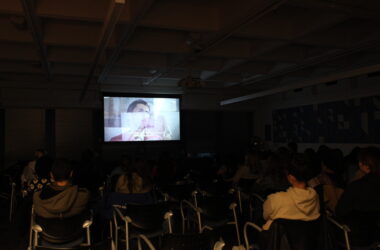
Stepping into the screening room for this year’s Twelve Vacancies Film Festival felt like entering a pocket dimension—one shaped by a brilliant lineup of experimental short films from young filmmakers around the world, gathered to share and appreciate their work. Filled with film enthusiasts, the energy in the room was both electric and eerie. Excited chatter quieted down as the lights dimmed, and anticipation took over the crowd. 

The festival’s focus on screening visually innovative films paid off: Each piece felt distinct, often unconventional, and always driven by intention. Whether through textured animation, surreal imagery, irony or detailed sound design, each move was intentional. Every frame reflected a sharp artistic vision and the filmmaker’s willingness to take risks.

Standouts included Itch by Maggie Zeng, a symbolic exploration of anxiety. The film follows Manon, a young woman waiting for her date to arrive. As she sits on a bar stool, an uncontrollable itch overtakes her—first as physical irritation, then as phantasmic monsters. Itch’s pink and red colour palette adds to its audience’s unease, mirroring the unravelling of Manon’s sense of control. The short film blurs the line between metaphor and real-life unease, using the itch as a symbol of psychological burden and agitation. It reveals the cerebral discomfort of anxiety through visceral embodiment.

In an interview with The Tribune, Zeng revealed that Itch—animated entirely in Krita, a free software program—was her graduation film at Concordia University. It has since screened at Montreal’s own Fantasia Festival, among others internationally. 

“What inspired me was a series of bad dates and a flare of eczema before my last year at uni started,” Zeng said. “I wanted to combine my feelings about love and desire with how something emotional can leave a lasting mark on your body. And I’m a fan of horror, so it felt natural to take a body horror approach.” 

Another standout was Reverend Mother by Mia Buono, which uses the framework of confession to examine a morally complex young Catholic woman through the framing of confession and the strain it creates in her romantic relationship. The film’s writing is sharp, full of ironic detachment and quiet moments of emotional clarity. A unique aspect of Buono’s filmmaking was her decision to film analog on 16mm film

“It seems to really connect every piece of the process on set in a way that digital doesn’t,” she told The Tribune. “We have very limited takes. I couldn’t see a monitor, so I have to just watch the actors, etc. It just requires a degree of coordination and trust that I feel like really strengthens the film.” 

The choice to film in an actual church with a choir added indispensable richness to the dark but comedic tone.

At the end of the screening, the audience voted for their favourite film. My Friend in the Jingle Truck by Sima Naseem was awarded as the Fan Favourite. Set in Karachi, the film follows a young girl who encounters a magical bird in a traditionally painted truck. Via her journeys through vibrant scenes of Pakistani culture and heritage, the story explores themes of friendship, imagination, and letting go. The use of stop-motion and 2D animation brought the magical world to life, highlighting the intricate details of handcrafted Pakistani artwork. The film was both whimsical and moving, capturing the wonder of childhood in frames layered with texture, colour, and care.

Twelve Vacancies Film Festival made room for risk, honesty, and experimentation; it was a space that challenged and pulled viewers into unfamiliar realities. As the last film’s credits rolled and the lights came back up, what stood up was not just the talent on display but also the sincerity behind it. It was a reminder that sometimes, the strangest images are the ones that feel most true. 

Through 14 short films, the festival opened up many new ways of seeing the world: Distorted, delicate, frightening, and real. It was proof that emerging artists aren’t just experimenting with form; they’re carving out space for new stories, new emotions, and new ways of being. 

Twelve Vacancies Film Festival ran from March 20-21.

Science & Technology

Less is more: How efficient crop water use promotes environmental sustainability

Freshwater plays a pivotal role in global food production, with over 70 per cent of available freshwater supplies used in agriculture for pumped irrigation and rainwater harvesting. While the water cycle ensures freshwater regeneration through a continuous movement of water between the surface and atmosphere, our current usage of freshwater significantly exceeds the planet’s ability to restore its water supplies. 

Climate change further complicates this balance by making precipitation patterns more unpredictable, leading to extreme droughts and intense rainfall. As global temperatures rise, evaporation rates increase, further reducing available water resources and exacerbating agricultural water stress.

In light of these challenges, efficient water management practices are essential in ensuring global food security. Without proactive conservation efforts, freshwater shortages could lead to declining crop yields, increased food prices, and greater food insecurity worldwide. 

Water scarcity also threatens rural livelihoods, as many farmers depend on reliable water access for their agricultural production. Recognizing these challenges, researchers and policymakers are working to develop solutions that promote more efficient use of freshwater resources in agriculture.

In a recent paper, Xinchun Cao, a former visiting professor in McGill’s Department of Bioresource Engineering, and his colleagues constructed a water conservation model that optimizes water use through the Water-Energy-Food-Ecosystem (WEF) Nexus. This approach examines the interconnectedness of water use, energy consumption, and food production while exploring how improved water management can reduce carbon emissions. 

“The purpose [of the model] is to understand the key drivers of crop water footprints and provide insights into strategies for improving water resource management in agriculture,” Cao said in an interview with The Tribune

The WEF nexus highlights a key issue: Irrigated crop water requires energy to be extracted, transported, and distributed, emitting carbon at every stage. By reducing crop water consumption, we can simultaneously lower energy use and decrease carbon emissions, making agriculture more sustainable. 

To achieve this, Cao and his team calculated the total amount of freshwater used across seven regions in China and analyzed its relationship with seasonal variations, total area of the irrigated land, fertilizer consumption, and economic conditions. They then used this data as input for the Non-dominated Sorting Genetic Algorithm-II (NSGA-II)—an optimization algorithm within the computing platform MATLAB—to minimize crop water footprints and carbon emissions while maximizing economic benefits, such as higher crop yield and reduced production costs. 

By properly identifying how different factors and conditions influence crop water consumption, the researchers gained valuable insights into how current water supplies can be used more efficiently.

“While [the model] is based on data from mainland China, its methodology can be applied to other regions as well,” Cao noted. “By adapting the data inputs, the model can be used to assess crop water footprints and water conservation strategies in different geographical contexts.” 

The model revealed that using fertilizer reduces crop water efficiency as it not only increases carbon emissions but also contributes to water pollution, rendering polluted water unusable and requiring more irrigation. 

While the water conservation model is currently focused on agriculture, its potential extends to broader applications in policymaking and regional water management planning. Authorities could use this tool to better understand the factors driving crop water use and develop targeted strategies for conservation.

Freshwater use in Canadian agriculture increased by over 45 per cent from 2005 to 2021, a concerning figure given that Canada holds more than 20 per cent of the world’s available freshwater. Implementing more efficient water management practices could help ensure sustainable use of this critical resource. 

“This research could be used to refine water conservation models, develop region-specific strategies for improving water use efficiency, and guide sustainable agricultural practices,” Cao said. “It could also contribute to broader efforts in addressing global water scarcity issues by providing a better understanding of the relationship between agricultural practices and water resources.”

Arts & Entertainment, Comedy, Theatre

McGill Drama Festival showcases six student productions

From the throes of budding romance complicated by a tragic accident in Small Death to the aftermath of a long-term partner abandoned at the altar in I Don’t, the McGill Drama Festival (MDF), which took place from March 24 to 28, brought something to the table for everybody. Exploring the ups and downs of romance, mortality, and politics, the ambitious lineup of plays showcased a variety of student talent, with each play written, directed, and produced entirely by students. 

On the comedic end of the spectrum, The Great God Pan is Dead imagines a handful of academics eulogizing their professor-turned-comedian former colleague (complicated by the presence of that colleague’s ghost at the funeral). On the flip side, Hesperus, Phosphorus! went full Downton Abbey, featuring a tumultuous romance between a Russian countess and her Marxist tutor in the final years of the Tsar’s reign. If linear storytelling isn’t your thing, Things Aren’t Looking Too Good flips between moments of a young woman’s life, unfolding its story through fragments and glimpses. 

Alexis Mezzarobba, U3 Science and the writer behind Dress Rehearsal, spoke to The Tribune about the challenges and rewards of writing a comedy, and the anxiety that comes with hoping people will enjoy your jokes as much as you do. Luckily for Mezzarobba, it seems people did—Dress Rehearsal won both the Best Script and Best Directing awards.

“It’s so rewarding to hear the roars of laughter come to life when it all started as some words on a Google Doc I wrote as I was procrastinating my other tasks,” Mezzarobba added. “I’m just glad people found it funny.”

She also spoke on the experimental nature of the script, playing with the boundaries between audience and cast. 

Dress Rehearsal is interesting because although it is a simple concept, the spontaneity makes it special,” Mezzarobba wrote in a statement to The Tribune. “Starting with a regular play, then realizing it’s about the actors working on the play and not the play itself, then discovering that they all have inner issues that need to be worked through, […] you never know what’s going to happen next. It gave me the opportunity to test the limits of live performance.”

The show’s director, Danielle Brooks (U3 Arts) emphasized the importance of the cast and crew coming together to make this unique production shine.

“I had so much fun putting that show together, and this year has been just as exciting,” she wrote. “Directing Dress Rehearsal with such a great team has been a blast. Everyone really understood the comedic style of the piece, and what we needed to put into it to make it stand out.”

The Tribune also spoke to Siya Pandit, U2 Arts and coordinator of the McGill Drama Festival, about putting on a festival with so many moving pieces. 

“We have a little community we build each year with everyone involved,” Pandit said. “It is so much fun running into other actors backstage and wishing them luck, seeing everyone’s faces during their bows, and getting to congratulate everyone on a job well done.”

While there’s a lot to do just to keep the lights running for each of the six productions, Pandit emphasized that having students come together and collaborate for the festival makes it all worth it.

“I have always loved MDF. I’ve been taking part in it since my first year at McGill, and each year, I get to meet so many talented people,” Pandit said. “Especially as governments and institutions cut funding for the performing arts, I think it is so important to remind students that there is a community of people who care and who will support them. Student theatre such as Players’ gives students a chance to practice their craft.”

Science & Technology

Do we really choose our groceries, or does habit choose for us?

How do we decide what to buy when we go grocery shopping? Why do we purchase the same items time and time again? Do we really choose our groceries, or do we pick what we buy based on habit alone?

Hiroshi Mamiya, a professor in McGill’s Department of Epidemiology, Biostatistics, and Occupational Health, is trying to answer these questions. In a paper recently published in the International Journal of Behavioral Nutrition and Physical Activity, Mamiya explored patterns of co-purchased foods in Montreal.

“When we buy food, we buy different foods together, and that’s important from a public health sense, because we want to know whether people are eating healthy food or not,” Mamiya explained in an interview with The Tribune

Mamiya and his team analyzed anonymized grocery store loyalty card data from a single Montreal grocery store chain between 2015 and 2017, allowing them to identify which foods were most frequently purchased together.

“We found that sodas and salty snacks tend to be bought together. This is kind of common sense, because when we go to the store, they are always side by side, and intentionally lined up together  to make us buy them,” Mamiya said.

Along with the co-purchasing of soda and salty snacks, they found that fruit is often purchased with foods such as yogurt and nuts, and that vegetables are often purchased with fresh or frozen fish.

“We used very sophisticated science to prove what everybody kind of knows, but someone has to prove these things empirically. Our project has a lot to do with confirming common sense using science,” Mamiya explained.

Their project also confirmed some widely held assumptions: People who buy soda tend to buy more unhealthy foods, including sweets, highly processed foods, red meat, and ready-made meals, as compared to people who do not buy soda.

In contrast, those who purchased fresh fruits and vegetables were more likely to have healthier diets overall, with fewer processed foods and more whole ingredients.

Having analyzed these findings, Mamiya is particularly interested in how these purchasing patterns may shift in response to the current food insecurity crisis

“In the age of increasing food insecurity, we want to know if the rising prices of vegetables and other healthy foods will cause people to buy more junk foods,” Mamiya said. “Do people tend to buy junk food to get the same level of caloric intake? Whether people give up buying healthy food or not is what I think is probably important, because we want to help make sure people’s diets are not compromised because of the price of food.” 

Government initiatives, such as taxes and subsidies, could help steer people toward healthier eating habits. By identifying which foods are commonly purchased together, policymakers can better determine which products to tax or subsidize to encourage nutritious diets.

Mamiya highlighted how these policies can help remind people of what they are buying.

“We don’t always know what we buy, because we kind of buy things almost as a habit, right? Even if prices increase, people still buy Pepsi and potato chips together. Everybody does it, it’s a habit,” Mamiya explained.Trying to break these ingrained purchasing habits and actively making more intentional food choices at the store can help improve our diet quality. Since nutrition plays a critical role in preventing many chronic health conditions, such as diabetes and cardiovascular diseases, being mindful of grocery shopping habits is a crucial step toward better health.

On the Table

Deep dish blueberry bacon pie

I am a big fan of the Broadway musical Waitress which follows a waitress and master pie-maker named Jenna. In the musical, Jenna invents a new pie every single day for Joe’s Pie Diner where she works. The very first pie Jenna invents in the show is deep dish blueberry bacon pie, which has always seemed like an intriguing flavor profile to me. 

I’ve wanted the opportunity to make it “real.” While there exists online a few recipes for deep dish blueberry bacon pie, this is my take on it. The use of bacon fat to replace some butter in the crust creates a tender and slightly savory crust that balances the tart filling and sweet crumble topping well. With sugar, butter, and flour, this is a pie of contrasts: Flaky crust, juicy filling, crumbly and soft topping, crispy bacon. With maple syrup sprinkled throughout, it’s like a warm diner breakfast in a slice of pie. May we all be so lucky to enjoy a slice.

Time required: 10 hours, including chilling crust, assembly, baking, and cooling.

Servings: 8-10

Ingredients:

For the crust:

  • ½ cup unsalted butter, cold and cubed
  • 2 tablespoons bacon fat, cold and cubed
  • 1½ cups all-purpose flour
  • 2 tablespoons granulated sugar
  • ½ teaspoon kosher salt

For the blueberry filling:

  • 3½ lbs blueberries, fresh or frozen
  • ¾ cup granulated sugar
  • ¼ cup cornstarch
  • The zest of one lemon (about 2 tablespoons)
  • The juice of three lemons (about ⅓ cup)
  • 1 teaspoon vanilla extract
  • 1 tablespoon maple syrup
  • 2 teaspoons ground ginger
  • 1½ teaspoons ground cinnamon
  • ½ teaspoon ground nutmeg
  • ½ teaspoon kosher salt

For the crumble topping:

  • 1 cup all-purpose flour
  • 1 cup rolled oats
  • ⅓ cup packed dark brown sugar
  • ½ teaspoon ground cinnamon
  • 6 strips of cooked, chopped bacon
  • 2 tablespoons maple syrup
  • ½ cup unsalted, softened butter

Directions: 

  1. Arrange six slices of bacon in a cold pan over the stove, and heat the pan to medium-high heat. Cook the bacon until browned on one side, flip, and cook until fully browned. Set the bacon on a paper towel-lined plate and pat dry. Let cool and chop into bacon bits.
  2. Pour the bacon fat from the pan into a small bowl and freeze or refrigerate until fully solidified. 
  3. Make the crust: In a large mixing bowl, combine 1 1/2 cups flour, 2 tablespoons sugar, and 1/2 a teaspoon of kosher salt. Using a fork or pastry blender, cut 1/2 cup of butter and 2 tablespoons of bacon fat until pieces of butter and bacon fat are no bigger than a pea. Drizzle in 6 tablespoons of ice water and mix with your hands until the dough is just combined. Some dry bits are okay. Compact the dough into a ball and wrap in plastic wrap. 
  4. Make the blueberry filling: In a large mixing bowl, combine all the ingredients listed above for the filling and let sit for 30 minutes.
  5. While the filling is sitting, make the crumble topping: In a bowl, combine the flour, oats, dark brown sugar, cinnamon, and salt. Next drizzle in the maple syrup and add in the softened butter, working it into the dry ingredients until it forms a crumbly, sandy mixture. Add in the chopped bacon and mix until just combined.
  6. Place a large, tin foil-lined baking sheet in the oven and preheat to 400 degrees.
  7. Remove the pie crust from the fridge. Roll out into a circle and drape over the pie plate. Lift and drop the crust to fill the plate, being careful not to stretch it too much. Press the crust into the plate, remove the excess crust around the edges, and crimp the edges however you please. 
  8. Fill the pie crust with the filling, and cover with the crumble topping.
  9. Bake for 20 minutes at 400 degrees Fahrenheit before lowering to 350 degrees Fahrenheit and baking for 50 more minutes, or until the crumble topping is golden brown and juices bubble around the edge.
  10. Let cool completely, about 4-5 hours. Slice and serve with a scoop of vanilla ice cream. Enjoy!
On the Table

A winter wonderland of drinks

Now that the weather has gotten colder, all I want in my hands is a warm beverage. So, to spread the warmth, here are my three favourite winter drinks I have enjoyed this season. 

#1 Mulled Wine

Mulled wine is a classic drink often found at Christmas markets. Served warm, this is a rich beverage filled with flavours of citrus and various spices. While this recipe takes a bit more time than others, it’s worth the effort, and as a bonus, your whole apartment will smell delectable for the next few hours! One important thing to note is that if you heat the wine for too long, the alcohol will evaporate.

Time Required: 45 minutes 

Servings:

Ingredients:

  • 1 bottle of red wine (a fruitier wine is better, but use whatever is cheapest or what you have on hand)
  • 2 cups of apple cider 
  • ¼ tablespoons of honey or maple syrup (add more or less to the desired sweetness level)
  • 1 orange sliced into rounds
  • 8 whole cloves
  • 2 whole star anise 
  • 4 green cardamom pods 
  • 4 full cinnamon sticks 
  • ¼ cup Amaretto or Brandy (amaretto will make a sweater mulled wine) 

Directions:

  1. Add wine, cider, honey, and orange slices to a large pot and stir until just combined.
  2. Next, add the cloves, cardamom, cinnamon stick, and star anise.
  3. Bring to a simmer over medium-high heat. 
  4. Reduce the heat to low and let it simmer for 30 minutes (do not let it come to a boil). 
  5. Stir in the Amaretto/Brandy, and it’s ready to serve.

#2 London Fog

The London Fog is the perfect accompaniment to a cozy afternoon inside on a cold winter’s day. It warms you up and keeps you awake with its small amount of caffeine. In this recipe, there is a splash of vanilla for those of you who have a sweet tooth, but this can always be substituted for a sugar-free vanilla or taken out altogether. What makes this drink so great is how little time it takes to prepare! 

Time Required: 15 minutes

Servings: 1 

Ingredients:

  • One Earl Grey tea bag (If you don’t like Earl Grey, you can make this drink with another tea you have on hand.)
  • 1 oz vanilla syrup or ¼ teaspoon vanilla extract 
  • 8 oz of your milk of choice 

Directions:

  1. On the stovetop, warm your milk to around 150 C to 160 C or until it is steaming (alternatively, microwave the milk in the microwave for 30-second intervals).
  2. Take your pot off the stovetop and place your Earl Grey tea bag into the milk. Steep for 3 to 5 minutes (note that the length of time you steep your tea will change the strength of the tea flavour). 
  3. Pour the vanilla into a mug and mix in your steeped milk mixture. 

Tip: I enjoy my London Fog with some biscuits! 

#3 Snickerdoodle Hot Chocolate

Grab your favourite mug and get ready to try a new staple winter drink, the Snickerdoodle hot chocolate. This recipe is for those who like their drinks on the sweeter side. 

Time Required: 15 minutes

Yields: 4 servings

Ingredients:

  • 4 cups of milk of your choosing 
  • ¼ teaspoon Kosher salt 
  • ⅔ cup of white chocolate chips
  • 1 teaspoon of ground cinnamon 
  • 1 teaspoon of vanilla extract 
  • ⅛ almond extract 
  • Whipped cream* (can be store-bought or homemade)

Directions: 

  1. Combine all the ingredients in a saucepan over medium-high heat, stirring continuously, until all ingredients are combined and the chocolate chips have melted. 
  2. Serve, adding whipped cream on top.

Read the latest issue

Read the latest issue