Latest News

a, Martlets, Men's Varsity, Sports

Fall 2015 team previews: Part 3 – Martlet and Redmen hockey


  • Martlet Hockey

    After a blowout loss to the lower-ranked Western Mustangs in the finals of the 2015 CIS National Championship, the Martlets are setting their sights on another shot at the title this season.
    Last year’s loss came after a 16-4-0 regular season record which landed the team the first seed entering the playoffs. The 2015-2016 Martlets have similar expectations for success, propelled by promising beginnings for players both new and old. Rookie forward Olivia Atkinson is poised to make her mark after a standout pre-season in which she scored the game-winning goal against University of Vermont on Sept. 27. Expect another strong season from Canadian Olympic gold medalist and former CIS Rookie-of-the-Year Melodie Daoust, who has amassed six points in six pre-season games in her fourth year playing for McGill. The team posted a tepid record of 3-7-0 over this span, but should pick up steam as the Martlets get used to playing without the irreplaceable Leslie Oles and Katia Clement-Heydra, who graduated last season. The teams enters the regular season ranked fourth in Canada.
    The team dipped below the border this weekend for their annual Ivy League circuit, where they visited Dartmouth, Harvard, and Yale. This year’s road trip proved frustrating for the Martlets, who went 1-2 and brought their overall NCAA record to 41-60-7. The Martlets’ regular season begins this Friday with a game at Montréal at 7 p.m., followed by Concordia at home on Saturday.


  • Redmen Hockey

    The Redmen hockey squad hopes to rebound from a mediocre 2014-2015 season that saw them squander a berth in the CIS Final 8 Championship with a loss in the OUA bronze medal game last March. The fresh-faced team enters the regular season, which began last Friday, ranked fourth in the nation.
    Though the team had 16 seniors graduate last year, including All-Canadian Cedric McNicoll and team captain Benoit Levesque, this year’s group is far from inexperienced. Twelve players have experience in professional leagues such as the QMJHL, AHL, and the OHL. The group’s varied playing backgrounds make for a versatile and potent skill set that should serve the Redmen well in their 2015-2016 campaign.
    Few players on this year’s team have been as electrifying thus far as Liam Heelis, a 25-year-old graduate student who won CIS Player-of-the-Year honours last year with Acadia. Heelis has racked up five points on four goals and an assist in his first three games with the Redmen. The star joins offensive powerhouses Patrick Delisle-House and Dominic Talbot-Tassl, as well as dual-threat blueliner Samuel Labrecque in hopes of leading the Redmen into the playoffs and beyond this season.
    The Redmen are 3-1-0 to start the regular season, and will play games against UQTR and Concordia at home next weekend.


a, Science & Technology

Leaked documents reveal critical information regarding U.S. drone programs

On Oct. 15, The Intercept released a number of articles based on leaked documents about the U.S. drone program. The articles showcased the processes by which objective enemies are tracked, targeted, and then neutralized by a drone strike. This information was acquired by The Intercept via an anonymous source and also included profiles and rankings of potential U.S. targets and accounts of operations in Yemen, Somalia, and Afghanistan. Considering the fact that two of The Intercept’s editors are Glenn Greenwald and Laura Poitras—journalists who worked with Edward Snowden in the release of his NSA documents—the impact of these articles could be enormous.

So far, three American citizens have been killed by drone strikes in Yemen. Of the three, only one was an intended target—the radical preacher, Anwar al Awlaki, who released online videos encouraging Muslims to go to war with the U.S.. Samir Khan was killed when Awlaki’s vehicle was hit by a drone. The third was Awlaki’s son, Abdulrahman, who died shortly afterwards in a subsequent drone strike. A senior official within the CIA described this as an outrageous mistake—Abdulrahman was only 16 years old at the time of his death. 

The killing of American citizens without due process raises a number of questions about the power of the government and its drone program. This, in turn, raises larger legal, moral, and journalistic questions about the importance of whistleblowers. On one hand, the leaking of classified documents can aid enemies of the state—revealing covert operatives, informants, and military strategies—which can lead to the loss of American life. On the other hand, holding these documents’ classified status as sacred allows the government to act without fear of being held accountable. For example, the U.S. government is not at war with Yemen or Somalia, a fact acknowledged by the leaked documents, yet this has not stopped U.S. military involvement in those areas.

The chain of command for the drone program, as shown on The Intercept, moves through several different levels, ultimately ending up with the president of the United States, who must authorize a strike before it occurs. The president has knowledge of all strikes and their intended targets before they occur, and presumably, the results of each operation. Once authorized, the strike can be made at any time in the next 60 days, provided that there are two separate sources of intelligence locating the targeted individual, no contradicting sources, and ‘low’ collateral damage estimations—although a definition of what low entails is not made clear in the slides themselves.

(Infographic courtesy of: The Intercept.)

The documents further reference a number of problems that the current drone program faces, including the inability to maintain a “persistent stare,”—a 24/7 video feed from a drone—on the area of operation, due to the drone’s refuelling requirements. To address this, one of the leaked documents included a recommendation that more drones be put into orbit. However, it’s doubtful that more drones in the air would lead to more accurate strikes. The success rate of drone strike programs for the period between May 1 and Sept. 15 2012 was over 70 per cent, with 19 out of the 27 intended targets killed; however, 155 bystanders, labelled Enemies Killed In Action (EKIA), were also killed, despite little or no evidence that they were combatants, according to the unnamed whistleblower. Having more drones in the air might increase the frequency of the strikes, but would likely do little to reduce collateral damage incurred in such operations.

(Infographic courtesy of: The Intercept.)

This is compounded by the fact that currently, the Joint Special Operations Command (JSOC), responsible for the U.S. drone program, operates only one venture. The CIA makes use of air force personnel for its own drone operations in Pakistan that operate under different directives, use different methods, and accomplish different goals than JSOC, all of which are shrouded from the public eye. Leaks to the press have shown that President Obama waived the CIA’s requirement to show that strike targets posed an imminent threat to the U.S., which suggests that the collateral damage caused by drone strikes is worse than this leak shows.

The success rate of drone strike programs for the period between May 1 and Sept. 15 2012 was over 70 per cent, with 19 out of the 27 intended targets killed; however, 155 bystanders, labelled Enemies Killed In Action (EKIA), were also killed, despite little or no evidence that they were combatants, according to the unnamed whistleblower.

Whistleblowers are not well protected in the Western world, as evidenced by Snowden’s continued exile in Russia, Julian Assange’s house arrest at the Ecuadorian embassy in London, and Chelsea Manning’s conviction under the Espionage Act. In the age of the internet, however, this aggressive persecution of whistleblowers has not stopped leaks—showcased by this current situation.

This new form of whistleblowing generally follows two methods. The first, which Snowden made use of, is more traditional. Confidential documents are released to journalists whom the whistleblower trusts (in Snowden’s case, Greenwald). The journalists then make use of government contacts and their own experience to vet the documents, eliminating information which could prove harmful to operatives or to national security at a whole. The chosen information is then released to the public. This allows discretion to be used when handling sensitive information, allowing the sanctity of the story to be maintained without damaging the nation’s security.

The other method was popularized by Assange and WikiLeaks. In this case, there is no professional journalist combing through the documents for what’s relevant and what could prove dangerous. Instead, the information is released en masse to the public, allowing for general perusal. Without discretion, this could put the lives of overseas military personnel in danger.

(Infographic courtesy of: The Intercept.)

However, WikiLeaks does have some built in discretion in choosing what to release and when to release it. For example, after acquiring the draft of the Trans-Pacific Partnership (TPP) agreement, WikiLeaks chose to only release the chapter on intellectual property law. The scope of the agreement is much larger than that—the TPP aims to universalize legal standards and barriers to trade along the Pacific Rim. The rest of the document is scheduled to be released after the Canadian election on Oct. 19. Additionally, during Manning’s trial for releasing classified documents to Wikileaks, Robert Carr, a counterintelligence officer, stated that there was no specific example of a named operative within the leaked documents losing their life as a result of the leak.

Despite the differences between these methods, the message is the same. Whistleblowers need to exist and they need to be protected. They remain one of the only ways to inform the public of their government’s actions. As much as U.S. officials believe they can justify civilian deaths by calling them EKIAs, or undertake public mass surveillance by claiming internal security measures, the general public is concerned—and rightly so. Their government is killing people overseas, including their own citizens, with no repercussion and no due process. 

PGSS Thomson House
a, News, PGSS

PGSS unanimously passes divestment motion

The Post-Graduate Students’ Society of McGill (PGSS) hosted its first General Meeting (GM) on Wednesday, Oct.14, passing a motion to divest holdings in companies within fossil fuel industries, updating members on the new Quebec student federations, and reviewing the Sustainability Projects Fund (SPF).


Divest McGill


A motion calling upon McGill to remove investment from oil and gas industries was unanimously passed. The vote followed a presentation by Victor Frankel, PGSS environment commissioner and member of Divest McGill—a group that aims to encourage McGill to divest from its holdings in fossil fuel industries.

“This isn’t about bankrupting the fossil fuel companies, this is about taking away their social license to operate,” Frankel said.

McGill currently has roughly eight per cent of its endowments invested in fossil fuels, which is equivalent $70 million invested in petroleum companies, including Chevron, Suncor, and Enbridge. Divest McGill has asked the administration to divest from companies within the next three to five years.

“[The motion starts] from the things that are the least contentious,” Frankel said.  “Like [recognizing] that climate change is real, to things that are fairly reasonable like freezing or having a moratorium on any new investments in fossil fuels […] to the more contentious issues […] which says that PGSS strongly endorses divestment from fossil fuel companies and also supports efforts of its senators and members at the board of governors to strongly support divestment.”

According to Frankel, through this motion, Divest McGill hopes to follow the example of schools such as the University of Glasgow and Syracuse University, which have successfully divested. Full divestment has yet to be achieved by any Canadian university.


Report on new Quebec student federations


PGSS External Affairs Officer, Bradley Por, reported on the status of the PGSS in relation to the two new student federations forming in Quebec. Both PGSS and the Students’ Society of McGill University (SSMU) have participated in the formation of both federations, the Union étudiante du Quebec (UÉQ) and the Association for the Voice of Education in Quebec (AVEQ). PGSS has signed a document to commit to the formation of the UÉQ, but has not yet become an affiliated member of either.  

“Over the course of that new federation being created, there was a rift […] and the regional unions left to start creating [another federation] what is now called the UÉQ,” Por said. “So now, PGSS is sitting at both tables, despite that initial signing.”

According to Por, PGSS is looking into the most effective way of joining a federation, while participating in working groups to form the association until a democratic decision is made to affiliate with one.  

“At the moment, I have Conor [Farrell], our PGSS researcher, working on how affiliations [have] been done in the past so we can put together a referendum question that lets the student body decide on which one to [join],” said Por.

Both federations will be coming to campus to talk to students, and prior to the upcoming referendum, PGSS will host a closed session with representatives from the federations.


Sustainability Projects fund’s fiscal year 2015 annual report


SPF Officer Kim McGrath presented an update to the PGSS on the fund’s performance over the past year.

The fund entails a 50 cent contribution by students in SSMU and PGSS, per credit, which is matched dollar for dollar by the McGill administration. This culminates in an $850,000 fund per year.

“Three areas were our main focus for projects: Connectivity, operations, and education,” said McGrath. “Connectivity was more of a focus for PGSS this year. In operations, the focus was […] on lab waste—preventing it and reducing [it]. And there was also the Thomson House community garden […. In the faculty of] Education, one significant project […was]  outdoor eco-learning.”

This year, the annual report, which spanned from January 2014 to April 2015, saw 49 applications for funding—26 of which were approved—at a total value of $740,000.

The fund, which grants the money to projects through a system of reimbursement, will try to reduce repayment lag in the coming year.

“We’re almost on track financially,” McGrath said. “There was some overspending before the new team came in, and we’re almost at the same level for allocation and […]expenditures.”

Other areas of focus for this academic year are outreach, monitoring and reporting, in addition to the creation of more committees and SPF ambassadors.

a, Student Life

Fall fashion to stay sleek and stylish

The leaves are falling, the temperature is dropping, and midterm season has students in its grips. Don’t let the drawbacks of autumn get you down. Here are some staple fall pieces to look adorable, stay warm, and survive the rest of October in style.

Fingerless gloves

If you’re not ready to commit to encasing your entire hand in wool just yet, or if you just can’t forsake the ability to use your touch-screen smartphone, fingerless gloves are the alternative way to go this fall. Generally considered to be popular in ‘scene’ culture, in reality these gloves can be incorporated into a variety of different outfits as they can both toughen up and soften a look. Karl Lagerfeld has been sporting leather studded fingerless gloves since the dawn of time, and consistently pairs them elegantly with a white shirt and black jacket. This stylish albeit standoffish uniform keeps your body warm and your appearance cool throughout these colder months, and is an infallible fall combo. Another route to take is to slip on a cozy, knitted style. They’re easy to pair with a boxy jean jacket and your favourite black skinny jeans for a relaxed feel, or with a camel wool coat and matching ear-muffs for a more preppy, put-together look. In any case, they’re mostly just fun to wear, and bring back a sense of nostalgia for a time when these were the raddest accessory to sport to school.

Turtlenecks

Whether the goal is to look like a 1960’s Parisian philosophy student or to prevent the Montreal chill from creeping down your neck, turtlenecks are the perfect solution. They are now available in so many different styles that it’s nearly impossible to settle for just one. There’s the classic fitted turtleneck sweater that tops off any pair of jeans perfectly and luckily comes in almost every colour in the rainbow. Feel free to add a simple pearl choker to this look to dress it up. Next comes the more avant-garde, sleeveless, long turtleneck. This chic new addition to the turtleneck family beautifully complements the straight leg trousers that are in style this year. This look is both minimalist and professional. Finally, the comfiest style is the loose-fitting turtleneck dress. With many silhouettes to choose from, there’s something for everyone. They look amazing with tights, knee socks, and tall boots, so keeping your legs warm won’t mean sacrificing a trendy look.

White sneakers

This one might not be an obvious fall staple but it deserves mention on this season’s list: Any fall outfit seems to be complemented by a pair of white sneakers, whether they are adidas Stan Smiths, Nike Air Max, or classic Supergas. They are the perfect way to dress down outfits that are otherwise too stuffy or uptight for a regular school day. Skirts look less formal paired with white sneaks, and become more wearable on a day-to-day basis. Trench coats, wool coats, and moto jackets all also become slightly more casual with white sneakers, and make for a foolproof outfit for those days when mornings are insufferable and deciding what to wear is the last thing on your mind. Any pieces in your wardrobe that haven’t seen the light of day because they are deemed just a touch too dressy can now be worn regularly. Sneakers are insulated enough to keep your feet warm (with socks on, of course) and also have a comfortable sole that is ideal for trekking around campus all day.


a, Opinion

Integration of upstream mental health services necessary at McGill

As Mental Health Awareness Week commences, students and faculty alike should consider spaces for improvement in the structures available on campus. Providing upstream services, which are preventative support measures, can promote well rounded health care on campus. Mental Health Services does the utmost it can to help all students with appointments, but financial resources and lack of awareness among the student body limit its capabilities. The mission, therefore, has to be to find alternative methods that will help contribute to the mental health and well-being of all students on campus. More work can be done on a faculty and individual level to encourage upstream services in all facets of student life.

The Schulich School of Music has the right idea in educating students about mental health and support immediately upon their arrival to campus. The Faculty of Music has made integrating mental health into its program a priority in the past year, with special emphasis on ways of addressing the unique needs of music students. Integrating mental health means making mental health awareness and self-care a core part of what students study and experience on campus. Through new first year programs, such as a music professional development course and a mentorship program with upper-year students, students are taught about mental health and provided with tools to assist them in adjusting to university. Other faculties should follow Schulich’s example in developing services to ensure that more students receive the individualized care they need and do not fall through the cracks.

Faculty-specific wellness programs would complement existing initiatives such as the Peer Support Network and McGill Students’ Nightline in providing upstream mental health services. But with more faculty-specific programs come higher costs and difficulties. The Faculty of Arts, for example, is much bigger, making it harder to integrate mental health awareness and well-being into the lives of every student. It may also lead to inequalities between the faculties in terms of services they can allocate to mental health; some faculties simply have more resources than others. Nevertheless, by incorporating these measures at faculty level, students will have improved access to McGill’s mental health resources.


Mental health issues are not going to vanish if we stop talking about them.

Making mental health an increased focus within each faculty would ultimately benefit the McGill community as a whole and provide needed support to the programs that already exist. In an ideal world, mental health crises are prevented and mitigated before-hand by knowledge in mental self-care and a strong support network. Other student initiatives have taken place to encourage a dialogue about mental health on campus, such as the Students in Mind Conference, in order to increase awareness and services to students who might be unaware of, or unwilling to take advantage of mental health services on campus. The conference also aimed to empower participants to be more aware of their own mental health, and to destigmatize mental health so that more people can honestly admit when they need help. Such initiatives increase the salience of mental health care in circles on campus while providing students with self-care and peer-support tools.

Mental health issues are not going to vanish if we stop talking about them. By focusing on upstream services, as well as grassroots and faculty-level initiatives, students will integrate mental health awareness and resources into their lives. Integrating upstream services that focus on preventative care is a more efficient and personal way to deal with mental health issues on campus. With a combination of mental health services and upstream care, students will be empowered to help their peers as well as themselves.


Norman Yallen is a U3 McGill student majoring in history and minoring in sociology.


a, Martlets, Men's Varsity, Sports

The week that was for McGill Athletics: Oct. 19

In this week's edition of the week that was for McGill Athletics the McGill Tribune Sports team looks at Dianna Ros and Alexander Goldmant, our athletes-of-the-week;  Redmen Baseball and Redmen Football; as well as our weekly edition of by the numbers.

Beyond the box score

REDMEN BASEBALL

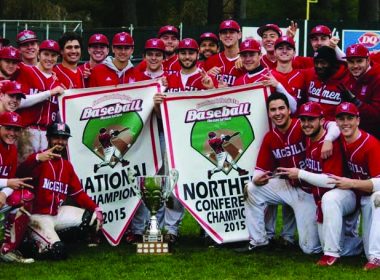
McGill defeated Carleton 10-5 on Saturday to advance to the CCBA Championship Finals. The Redmen, who hosted the inaugural Championship in 2014, will try to defend their title as they head east to the University of New Brunswick for a four-day, six-team tournament.

REDMEN Football

McGill (3-3) fell to Sherbrooke (3-2) 45-10 on Saturday, falling to .500 for the first time this season. It was an all-round trouncing by the Vert et Or, with the Redmen only managing to score three points on a field goal through the first three quarters. Meanwhile, Sherbrooke’s offence went off for six touchdowns on 408 net yards of offence, with quarterback Jérémi Roch throwing for 216 of those to set a new CIS all-time career passing record with 10,964. Rookie Redmen quarterback Nicholas English went 16 for 39 with 162 yards and a one-yard rushing touchdown. McGill will host Concordia in next week’s homecoming game, needing a victory by a margin of at least 13 points to win the tiebreaker and qualify for the playoffs.

Tribune Athletes-of-the-Week

Dianna Ros

Martlet Basketball

Senior – Physical Therapy


Point guard Dianna Ros was awarded MVP of the McGill’s annual Redbird Classic tournament, as she led the Martlets over the Laurier Golden hawks in the final on Sunday. Ros recorded 31 points, 12 assists and 8 rebounds over the course of the tournament and was a key factor in McGill’s smooth offence during the tournament. McGill had an excellent pre-season, going 4-0 against CIS opponents, and they will start the RSEQ regular season on November 6.

Alexander Goldman

Setter, Martlet Volleyball

Freshman – Arts


Alexander Goldman scored one of McGill’s most important goals of the season—his first in a McGill jersey. Last Friday at Molson Stadium, his goall gave McGill a 1-0 lead over Concordia, a lead they maintained until the final whistle. That goal and the victory ensure that McGill are still in the hunt for the RSEQ playoffs with four games left in the regular season. Next week McGill will face the last place Sherbrooke Vert et Or.


By the numbers

Hover over the numbers to learn more. If you're on mobile all you have to do is click!

31


Points scored by Tournament MVP Dianna Ros over the three-game tournament.


66


Yards racked up by Redmen receiver Louis Brouillette on six catches


11


Games needed for the Redmen Lacrosse team to clinch the regular season pennant


(Photos courtesy of McGill Athletics)

Peter Pan
a, Arts & Entertainment, Film and TV

Pan, dreamlike and worrisome

In the search to escape adult life, look no further than Pan, Director Joe Wright’s latest film that brings back the wonderful world of childhood imagination. Pan is the magical telling of the origin story of J.M. Barrie’s children’s literature hero Peter Pan (Levi Miller), as he travels from an orphanage run by evil nuns in war torn London, to the journey between worlds on a flying pirate ship, to the terrible mining pits controlled by the pirate Blackbeard (Hugh Jackman) and the fantastical dangerous tropics of Neverland.

Peter is a mischievous character with striking blue eyes, who is innocent, honest and brave. The villain, Blackbeard is larger than life, introduced while overlooking his mines where millions of his workers begin chanting Nirvana’s “Smells like Teen Spirit.” Though Blackbeard is very entertaining, he is quite a dark character who rules as a dictator over miserable anarchy where children are thrown from the plank to fall to their deaths. The plot centres around Blackbeard’s secret objective to mine for magical pixie dust that will allow Blackbeard to live together; however, this industrialization is rapidly destroying nature and poses a great threat to the health of Neverland. Along the way, Peter builds a friendship with Hook, (Garret Hedlund), who in this adaptation sheds his former villain image and instead plays an Indiana Jones-esque character. Peter is further given support by Tiger Lily (Rooney Mara), who helps him discover who he is and changes both Peter’s and Hook’s perspective of Neverland and helping them save the day.

The worlds created in Pan are distinctive, contrasting between the darkness of war-torn London and the vivid, dangerous Neverland. The latter is truly a dream world—an overwhelming experience full of vivid colors, magical animals, mermaids, alligators, and fairies. This setting is fully detached from the real world and one of pure fantastical imagination.

One unfortunate point of the film is the representation of the ‘Tribe,’ specifically the casting of Mara. Tiger Lily is an explicitly Native American character and should have been played by a Native American actress rather than being another instance in which Hollywood white washes a minority group. All directors are entitled to creative freedom, yet this must be balanced by their responsibility to society. Wright should have taken the opportunity to allow minority groups to depict themselves and their culture on screen.

At times the storyline is lacking, and the audience is left wanting a greater explanation of the character’s actions. Also, the darker aspects of the film—child labor, warfare and uncontrollable industrialization—are not well addressed and remain difficult to reconcile with the rest of the film. The friendship of Hook and Peter is a nice twist on the original Peter Pan stories but falls into the repetitive trope of the goodness in traditional villains, reminding us all once again that characters and neither completely good or bad, expressing their greater humanity.

Overall, although the film has problems, Pan is ultimately a success; teaching the audience all of the power of believing. Though it can seem stupid when people say “Believe in yourself,” serves as a poignant reminder that having faith in oneself is the most vital element to achieving one’s dreams. Just like Peter, everybody faces moments where they stand at the edge of the cliff and must jump off believing they can fly.

a, Martlets, Men's Varsity, Sports

Basketball: Martlets dominate Redbird Classic, Redmen rout Lions and Warriors

Martlets

Coming off an impressive 2014 season that culminated in an RSEQ Championship and a silver medal at the CIS National championships, the McGill Martlets swept the Redbird Classic with wins over Victoria Vikings, Thomas Rivers University (TRU) WolfPack, and Laurier Golden Hawks.

In the first game, Victoria hung around early, but a 20-point fourth quarter by the Martlets proved to be the difference, as McGill downed the Vikings 84-66. Third-year centre Alex Kiss-Rusk recorded a double-double off the bench, including a team-high 16-points. Point-guard Dianna Ros was hot from beyond the arc with 12 of her 13 points coming from three. McGill, however, dealt with turnover issues all game. They coughed the ball up 20 times, leading to 24 points off turnovers for the Vikes. But any fast break points conceded were more than made up for by the Martlets’ inside dominance. McGill out-rebounded Victoria 43-14, led by the high-flying senior forward Mariam Sylla.

The Martlets cleaned up their sloppy play in game two of the tournament, pummeling the TRU 79-55. The WolfPack jumped out to an early lead, but McGill shut it down after the first frame, outscoring TRU by 27 over the final three quarters. After a disappointing first game, Gladys Hakizimana found herself starting the game on the bench against the WolfPack. The first-year guard, however, responded by dropping a game-high 17 points on 78 per cent shooting when she came on. Overall, McGill’s stingy defence was too much to handle, as the Martlets held the WolfPack to a horrid 34 per cent shooting from the field.

McGill wrapped up the weekend with a commanding 82-55 victory over the Laurier Golden Hawks. Sylla, former RSEQ Player-of-the-Year  led the way for the Martlets, recording her first double-double of the pre-season with a game-high 18 points and 15 rebounds. Once again, McGill was overwhelming in the paint, registering 52 rebounds including 23 on the offensive glass.

The Martlets start the RSEQ season at home on Nov. 6 against the Laval Rouge et Or. They’ll certainly be RSEQ favourites in 2015-2016 after losing only one game last year. An undefeated season isn’t out of the question, but a CIS Championship would be even sweeter.

Redmen

This pre-season, the Redmen basketball team proved that it is a force to be reckoned with, winning two of three games in Toronto in early October before sweeping a pair of games this weekend against the York Lions and Waterloo Warrions.

The Redmen came out firing in the first game last weekend, scoring 43 first-half points en route to an impressive 77-58 victory over the Lions. Junior point guard Jenning Leung led the way for McGill, registering 22-points, including 15 from beyond the arc. Leung has improved dramatically since taking over the starting point-guard job halfway through last season.

“Coming into the year I felt a lot more established,” Leung said. “That feeling has allowed me to focus […] on being more vocal.”

Game two marked Head Coach David DeAverio’s 100th victory behind the Redmen bench in a dismantling the Waterloo Warriors 108-56. Second-year shooting guard Jawara Pedican was red-hot, dropping a career-high 20 points, including 12 from distance. The victory impressed team captain Vincent Dufort, who filled the score sheet with 14 points, seven rebounds, and four assists.

“We have a good mix of young talent and experienced players,” Dufort said. “We feel like this could be a special year for us.”

The Redmen head out to Ottawa for a three-game tournament on Oct. 30 before a pair of games south of the border against Loyola Maryland and Harvard on Nov. 5 and 7, respectively. Their regular season starts Nov. 14 against the Bishop’s Gaiters, the same team that knocked McGill out of the CIS Championships in last season’s RSEQ final.

Sound bites

“This is the most unselfish team I've ever played on. Any one of our guys can be the leading scorer on a given night.” – Vincent Dufort

Stat of the Tournament

The Redmen hit 24 three-pointers against York and Waterloo on 44 per cent shooting from deep.

Moment of the Tournament

Veteran point-guard Dianna Ros was named Tournament MVP after leading the Martlets to victory.

The Game Documentary 2
a, Arts & Entertainment

Album Review: Documentary 2 – The Game

2015 has, thus far, been a ridiculously good year for hip-hop. Almost every current popular artist—looking at you, Kanye—has put out some kind of project within the past 10 months, and there is still more to come. There has been such a flood of stellar music that projects like Kendrick Lamar’s To Pimp a Butterfly and Drake’s If You’re Reading This It’s Too Late seem to have dropped a lifetime ago. The bar was set high early this year, but many artists have managed to deliver.

The Game’s Documentary 2—the sequel to his debut album—falls just short of this trend. In a year where hip-hop became increasingly introspective, where Drake can wonder on a diss track if he was in the wrong, where 2-Chainz can imagine how terrible of a father figure he would be, and where Dr. Dre can tell us he keeps a ‘diary,’ The Game’s album seems a little out of place. An entire song concerning how a “bitch ain’t shit” seems a little tired. Additionally, aside from Dre in Compton, “slut” hasn’t been used in a rap for a while, and that’s a good thing. Much of the album is either classic braggadocio—Game is hard, Game used to bang, and Game might just “fuck your bitch”—or Game dealing with a difficult relationship in a stereotypically masculine way: “This bitch always flipping pushing buttons like a sidekick / That's when I hop in my Jeep and pull it out the toxic.” Only the later parts of the album—“New York, New York” and“Just Another Day”—see him let up his own reflections on life in his city and the rap game.

Documentary 2 is not at all short on positives, though: The production on all tracks is incredible, capturing all eras of the West Coast sound. “On Me,” featuring Kendrick, turns the To Pimp a Butterfly sound into something you can ride to. “100” is a big hit, as any track Drake hops on tends to be. In fact, the features (from Ice-Cube to Yeezus himself) provide some of the best moments on the album. The breaks from Game’s overwhelming persona of a Blood-turned-MC, with a flow now more consistent than ever, are very welcome. Not to say that it isn’t particularly fun to listen to The Game spit about how real he is—there’s just been too much of that, and 2015 has called for rap to explore alternative meanings to “keeping it 100.”

city and colour if i should go before you
a, Arts & Entertainment

Album Review: If I Should Go Before You – City and Colour

City and Colour’s fifth album, If I Should Go Before You (IISGBY), signifies the return of the band after its two-year musical hiatus, and is naturally accompanied by a heightened level of expectant anticipation and excitement. City and Colour has previously provided two types of songs: Indie acoustic gems like the band’s popular singles “The Girl” and “Northern Wind,” as well as more grungy indie rock hits like “Comin’ Home.” Unfortunately on this album, the group is unable to fully satisfy its potential, coming off as both frustratingly unreliable and wildly predictable.

Singer-songwriter Dallas Green’s lyrical work in IISGBY is less than stellar, and his creativity is hindered by an incessant amount of musical repetition, which, rather than making tracks sound cohesive, instead evokes a sense of déjà vu. That said, Green manages to conjure up a few poignant key moments that redeem the album from boredom and disappointment.

Aerosmith-inspired rock characterizes the first song, “Woman,” which is one of IISGBY’s saving graces. It’s a transcendent nine minute number that marries rawness and sensuality; however, this level of nuance is short lived. The album dips into four or five songs of electric-guitar-solo-laden mediocrity, and although each song has its individual—if not very subtle—distinctions, the tracks are indistinguishable from each other when listened to back-to-back.

The title track, “If I Should Go Before You,” holds its own. Green’s preoccupation with sadness manifests itself in his gorgeous falsetto and a new romantic and waltz-y vibe that departs from the rock/blues ‘love lost’ ballad theme characterizing an uncomfortable chunk of songs.

The genre of the album undergoes a nervous reversal halfway through—Green’s attempt to create a louder and more aggressive sound doesn’t effectively pair with his more classically recognized style. The second half of the record switches abruptly into an acoustic, stripped-down, and wistful sound that, while more in tune with Green’s earlier work, is a dissonant and confusing departure from the first half of the album while also being unoriginal and unremarkable.

A few other tracks are unique and aesthetically-pleasing. The album recovers from its rut in its last two numbers, “Friends” and “Blood,” which are both familiar and fresh. The songs draw on the happy medium between the indie rock and folk/country Green is known for while retaining silky new lyrics and pleasant unpredictability.These tracks are fantastic bookends for an otherwise disappointingly unfulfilled, non-cohesive album that seems to struggle to live up to its own expectations—much less listeners’.

Al

Read the latest issue

Read the latest issue