Latest News

a, Fact or Fiction, Science & Technology

Fact or Fiction: Are you born a morning person?

Some individuals find themselves waking up with the birds, while others are falling asleep to them. People who wake up late have been stigmatized by society as being lazy, while those up at the break of dawn were perceived as the go-getters; however, studies are showing that the inverse is most likely true. Research conducted in 2010 at the London School of Economics and Political Science showed that people with higher IQs are more likely to be nocturnal. Furthermore, a person’s sleep schedule is almost entirely genetically predetermined and certainly not a mark of competence. 

A study published in the journal Annals of Neurology in 2012 discovered variations within a specific gene, PER1, which is among a group of genes that affect human behavioural rhythms. These can then be linked to the circadian system—the body’s internal 24-hour clock. 

The team first determined participants’ daily activity peak—known as the acrophase—over a week-long period via actigraphic measurements (a device similar to a wrist-watch to measure a person’s activity). By then, comparing the genomes of individuals to the genes researchers believed were correlated to sleep rhythms specific polymorphisms—single nucleotide mutations within the genome—were detected. These were then paired with the actigraphic records of the participants, and allowed the researchers to determine how specific polymorphisms affected an individual’s daily rhythm. The research suggests that a single change in PER1 can alter your waking time by by as much as an hour.

For some, it seems impossible that a point mutation in one gene could cause such a dramatic change in sleep preferences. However, these differences are seen elsewhere too.

“Night owls [have] significantly less white matter [in their brains], and as a result, there are fewer pathways for feel-good hormones such as serotonin or dopamine to travel through,” explained the host Mitchell Moffitt in an ASAPScience video. “But it’s not all bad for the late-nighters. In fact, they tend to be much more creative, have been found to have higher cognitive abilities, and are known to be risk-takers.

While the cause of this decrease in white matter is unclear—some scientists attribute it to a sort of ‘social jet lag’ experienced by night owls—it’s presence is linked to increased susceptibility to depression and disruptions of normal cognitive functions. 

Individual dispositions to sleep or wakefulness have huge impacts on cognitive performance and lifestyle, even beyond uncontrollable physical traits. In today’s society, an early bird lifestyle is favoured; most work and school days are structured in an 8 a.m. to 5 p.m. manner. By forcing night owls to go against their body’s natural rhythm, late-risers are more vulnerable to depression, sleep disturbances, and substance abuse.

“[Early birds] tend to get better grades in school, which gets them into better colleges, which then leads to better job opportunities,” explained Christopher Randler, a biology professor at the University of Education in Heidelberg to PsychologyToday. “Morning people also anticipate problems and try to minimize them. They’re proactive.”

By forcing night owls to go against their body’s natural rhythm, late-risers are more vulnerable to depression, sleep disturbances, and substance abuse.

To further understand and narrow the definitions of individuals based on sleep-preference, The American Academy of Sleep Medicine categorized individuals based on their disposition to sleep and wakefulness; people can be categorized as early (EC), late (LC) or intermediate (IC) chronotypes. In the study, researchers showed that LC individuals had lower first-year university GPAs than EC students, however, for the most part had comparable GPAs by their last year in university. The scientists believe that this is due to students understanding their chronotypes and taking courses accordingly; however, following re-entry into structured society, these individuals once again suffer in order to adapt. 

The solution to this, many scientists have theorized, is to allow employees to work at their most productive hours of the day—be it night or day. However, the challenge remains in how to accommodate all of these individuals. 

a, McGill, Montreal, News

Kahnawake Mohawk nation sends seizure notice to McGill

On Sept. 12, a notice of seizure was sent to McGill University by Kahentinetha, a kahtihon’tia:kwenio—the aboriginal term for woman title holder­—from the Kahnawake Mohawk nation. The letter claims that McGill has fraudulently taken Mohawk land and funds, as well as violated the beliefs of the Kahnawake people.

“We never gave permission for McGill to be on our land,” Kahentinetha said in the notice. “And McGill has never been able to produce anything to show that we gave them permission.”

The letter also called for the settlement of a debt from 1847,  where Upper Canada withdrew funds from the Six Nations Trust Fund of Grand River in order to finance a loan to McGill that kept the university from closing. The Trust Fund had been created as a depository for payments from settlers renting Mohawk land.

“There’s no argument about any of the facts that we put out, the money is owed to us,” Kahentinetha said. “It’s been 185 years since that money was taken, and it still has not been paid back.”

Kahentinetha explained that she sent the letter of seizure after discovering Demilitarize McGill’s campaign to end research at McGill which develops military weapons.

“We knew that […Demilitarize] McGill were trying to put a stop to the making of these weapons,” she said. 

“So that’s when I decided as a woman title-holder; I seized McGill [….] I have a duty to protect my people, and I carried out my duty.”

This is not the first time McGill was made aware of the debt. Phil Monture, the former director of the Six Nations Land and Resources Office, was one of the people who originally discovered it.

“We’ve known for years now about this debt, but we just want to protect our investments and work out a partnership,” he said. “Let’s move forward instead of this going around and around.” 

Andre Costopoulos, dean of students, explained that the issue of the debt was resolved from McGill’s point of view.

“There was an interaction between McGill and Six Nations Grand River, I believe it was in the late ’80s [or] early ’90s,” he said. “McGill […] found that the debt had been repaid to the federal government. As far as I can tell […] the question is settled.”

Neverthless, Costopoulos underscored that McGill is engaged in discussion with Indigenous communities.

“McGill is very very active in building and maintaining relationships with aboriginal partners,” he said. “We have staff in my office, whose full-time job it is to recruit aboriginal students to increase access to university for aboriginal students.”

Costopoulos continued to highlight that in addition to current programs, McGill was developing new resources to support indigenous students during the course of their undergraduate studies. 

“Now we’re designing […] Portage McGill, which is a transition to university program for youth who are facing significant barriers to access,” he said. “There’s a lot of stuff happening in the university. There’s an aboriginal affairs working group that I chair. There’s Indigenous awareness week.”

Costopoulos also explained that he had contacted Kahentinetha over the weekend.

“We’re doing a lot, I think, and we’re always open to doing more. We’re always listening to our partners in indigenous communities,” he said.

Leslie Anne St. Amour, U3 Arts, explained that she would like McGill to be more active in discourse about indigenous issues.

“I would like to see McGill make more of an effort to acknowledge the land that they are on, and also maybe doing things that have a bigger impact,” St Amour, an Indigneous Studies minor, said. “[McGill] could take the [Indigenous Studies] minor and turn it into a major, or even expand the minor to include more classes that are [within the] Indigenous Studies [department], of which currently there are only two.”

St. Amour says that the the letter has sparked a conversation among students. 

“In an ideal world, yes, Six Nations would be paid back and McGill would make much more of an effort to acknowledge the land that [it is] on,” she said. “Even if that doesn’t happen, it still raises awareness of the issues and it helps to educate people.” 

Jessica Dolan, a PhD candidate in Anthropology, hopes that the university will increase its efforts to accommodate indigenous students.

“I would like to see McGill work with the Six Nations Development Corporation and the people here who are so involved in indigenous education to figure out how to properly honour the debt,” Dolan said. “[McGill] could pay back Six Nations or create a scholarship fund for Haudenosaunee students. They have one like that at Syracuse University called the Haudenosaunee Promise.”

Additional reporting by Jenna Stanwood

McGill Safety Week
a, McGill, News

McGill Safety Week facilitates emergency awareness on campus

From Sept. 14 to 18, McGill hosted Safety Week, a series of events and informational services aimed at promoting preparedness across campus. McGill’s Safety Planning Officer Alysia Quirke explained the importance of remaining attentive in every day situations.

“When we’re so busy, we can often become really complacent about safety,” she said. “Or you’re [too] busy, until you realize you’re in a situation where you don’t know what to do [….] We’ve had our fair share of experiences [at McGill], between floods and fires. We had a fire at RVC just this year.”

As part of Safety Week, Diane Gauvin, the academic dean of Dawson College, spoke about her experience as a victim of the 2006 on-campus shooting on Sept. 16, three days after the ninth anniversary of the Dawson College shooting that killed one student and wounded 16 others.

“I was in the director general’s office […] and I heard a group of students screaming, […] then I saw one of the student’s [faces] and I thought there was really something [wrong],” she said. “From then on I heard shots and they were very, very loud and they kept echoing. I was quite far from the shooting but I still heard it [….] In my mindset, we [needed] to evacuate. So I went and evacuated as much as I could the wings of the college, as far as I could.”

Gauvin also stressed the importance of thinking quickly when in an evacuation situation.

“If you’re able to, hide your cellphone [and take] your own keys,” she said. “Some people didn’t have access to their home keys for two to three days after, because they left everything where they were.”

In the aftermath of the shooting, Gauvin underscored that Dawson College sought to re-establish a safe learning environment through well-coordinated measures.

“We did not want to become […] a school with security guards everywhere,” she explained. “We [had] to remain focused on education. We [had] to provide a safe environment that was critical upon return. We wanted to reopen as soon as possible so we sought a lot of support.”

Director of Campus Public Safety, Pierre Barbarie, addressed the importance of learning about active shooter protocols.

“We felt as a committee that it would benefit our constituents to hear from an individual that wanted to speak about the incident, but most importantly how [Ms. Gauvin] and [her] colleagues dealt with this tragic event,” he said.

McGill’s Department of Campus Public Safety described the Get Out, Hide Out, or Take Out method of reacting to an active shooter situation. These principles include following an escape route, hiding out of the shooter’s view, and, as a last resort, using force when in imminent danger.

"There is nothing we can do to prevent [an active shooter situation].” Barbarie said. “But what we can do is educate individuals. So look out for signs to how to best react to a situation should it occur.

a, Martlets, Men's Varsity, Sports

The week that was for McGill Athletics: Sept. 21

In this week's edition of the week that was for McGill Athletics the McGill Tribune Sports team looks at Audrey-Ann Coughlan and Louis Brouillette, our athletes of the week, Martlet Soccer and Redmen Football, and our weekly edition of by the numbers.

Beyond the box score

MARTLET SOCCER

Sophomore striker Audrey-Ann Coughlan recorded her second multi-goal game of the season to lead the Martlets (3-1) past the UQTR Patriotes 3-0 on Friday. The Martlets have already recorded two shutout wins this season, and have outscored their opponents 12-4 through four games. Captain Rebecca Green added another goal in the 60th minute to put the game out of reach, and junior goalkeeper Sarah Dubois saved all four shots she faced to earn her first shutout. McGill defeated UQÀM 4-1 on Sunday night to win back-to-back games for the first time this season.

REDMEN FOOTBALL

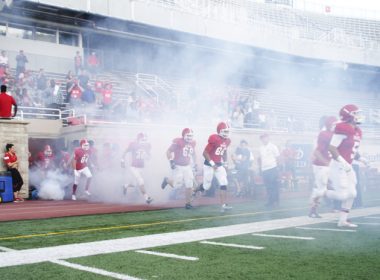
McGill couldn’t overcome an early deficit, falling for the second straight year to Concordia in the annual Shrine Bowl this past Saturday 33-21. Receiver Louis Brouillette, a senior from Sherbrooke, QC, put on a performance for the ages, suiting up as the team’s kicker after back-up Remi Bertillin left the game due to injury. In addition to his 101 receiving yards on seven catches, Brouillette went 2-for-2 on field goal attempts, and punted three times in the game. The Redmen trailed 26-3 after three quarters, and even a furious 18 point rally orchestrated by quarterback Joel Houle wasn’t enough to dig the squad out of the hole. McGill will host Acadia next Saturday, with kickoff set for 6 p.m.

Tribune Athletes-of-the-Week

Audrey-Ann Coughlan

Soccer, Forward

Sophomore – Sciences


Coughlan, a sophomore striker from Longueuil, QC, has been a stabilizing force at the heart of a Martlet soccer team that has overcome an inconsistent first few games to settle into third place in the RSEQ. She currently leads the squad with four goals through four games. With the departure of graduated veteran forward Meghan Bourque, Coughlan has stepped up as a primary scoring threat, displaying a scary combination of finishing skills and speed.

Louis Brouillette

Football, Wide Receiver

Senior – Engineering


Brouillette had a career night in the 29th annual Montreal Shrine Bowl against cross town rivals Concordia. He dominated with seven catches for 101 yards, and even added in five passing yards. The wideout, however, was asked to do more than receive. Punter Remi Bertillin left the game injured and Brouillet was assigned kicking duties. He responded with two field goals and punted 90 yards on three kicks. It was truly great all-around performance.

By the numbers

Hover over the numbers to learn more. If you're on mobile all you have to do is click!

54


The Redmen lacrosse team’s goal differential through five games, best in the CUFLA


266


Amount of yards racked up by Redmen football wide receiver Louis Brouillette against Concordia on Saturday


7


Goals scored by the Martlet soccer team in two victories over the weekend against UQTR and UQÀM


(Photos courtesy of McGill Athletics)

Back to school McGill
a, Arts & Entertainment, Music

Trib mix: Back to school edition

Add-Drop is almost over and it can’t be denied any longer—school is back in session. To celebrate the start of the new year (or mourn the impending loss of the warm weather) the staff at the McGill Tribune has compiled 25 tracks that define what back to school means for them. Remeber to scroll down to the end to check out the Spotify playlist and happy listening! 

Donnie Trumpet and the Social Experiment – “Wanna Be Cool”

The movies have always told us that university was the time when kids could reinvent themselves into something bigger and better than their pubescent high school selves. “Wanna Be Cool” is the ultimate anthem that reminds students that when high school is over, it is actually over, and no one needs to be defined by a set cultural standard. It’s a re-education of social prescription that is laid out in smooth yet peppy verses by Chance the Rapper, Big Sean, and KYLE, who neatly cinches up the message with the line: “If a cool guy’s cool in the middle of a forest / Man, nobody fucking cares.”

This track is so incredibly joyful that it’s hard to not want to bounce and smile along. As with many of Chance’s songs, you can hear his smile come through when he raps his opening lines. Big Sean’s verse oozes the honesty that has defined his sound, but he’s able to skillfully avoid the trap of seeming preachy and overdramatic, a necessity for making the lines “Spend all this time for you to say I’m fine / I really should have spent it tryna find myself” sound sincere. KYLE’s verse, as already mentioned, is where the moral of the song shines through over quick beats. The additional accompaniment of Jeremih on the intro and outro along with Donnie Trumpet’s horn provide a well-rounded and lighthearted romp into the often over-contrived theme of loving yourself. Start your day with this track and you’ll feel confident and positive all week.

Morgan Alexander

Lana Del Rey – “Music To Watch Boys To”

Lana Del Rey is not one for sounding upbeat; however, she breaks from her relatively melancholic aesthetic on her fantastic new single, “Music To Watch Boys To” from her most recent album, Honeymoon. On the opening enigmatic line, Del Rey sings “Pink flamingos always fascinated me,” conjuring up images of a hot, tropical paradise. With summer coming to an end and the ever-growing chill of winter present in the air, this song offers a retreat into Del Rey’s warm and languid world.

It’s a summer anthem through-and-through, but it acknowledges the inevitable changing of the season with the lines “Nothing gold can stay / Like love or lemonade / Or sun or summer days.” The pulsing beats and multi-layered vocal tracks evoke a sense of warmth and tranquility but there’s also a definite air of sensuality about it as well. The track feeds to many emotions and moments, tying them all together with impeccably-crafted production and vocals. The song begins slow, but builds near the end, with all underlying beats, synths, and ethereal vocals coming together for a stunning final chorus before dreamily fading out. In fact, if there was a song that was the definition of “dreamy,” this would be it. Best of all, though, is the title of the song itself: “Music To Watch Boys To” provides a soundtrack for lounging, people watching, and enjoying the few sunny days that we have left.

Jack Neal

R.E.M. – “Nightswimming”

As school begins, summer winds down, and the chill of autumn starts to creep into the air, it can help to find solace in memories of the past four months. R.E.M.’s “Nightswimming” lives in this space, looking back to a spontaneous evening of swimming on a quiet end-of-summer night. Realized in beautiful specificity, the lyrics follow the song’s protagonist through a remembrance of that night,from the lowness of the moon, to the “fear of getting caught / the recklessness in wate,r” and further to stolen laughs and whispers in the back of the car with someone close.

Musically, it perfectly captures that late-August wistfulness, with a simple piano melody playing under frontman Michael Stipe’s soft crooning. Towards the chorus, lush strings start to kick in, and the mind can’t help but turn to similar memories of driving home after an excursion, exhausted and exhilarated, making quiet conversation with friends who have shared the experience. What the song understands is that this type of memory is impossible to experience with the same mindset as the past. Naivety and innocence, by definition, are taken for granted and “replaced by everyday.” Life moves forward as people steer their gaze towards the future, getting caught up in the work and stress of the city. And that’s okay. Summer might be ending, but the memories it leaves behind can be enough to get you through the school year.

Christopher Lutes

Lana Del Rey Honeymoon
a, Arts & Entertainment

Album Review: Lana Del Rey – Honeymoon / Interscope & Polydor


“All I want to do is get high by the beach,” Lana Del Rey croons on the lead single to her newest album, Honeymoon: It’s an aloof and somewhat carefree sentiment that rings true throughout the entirety of the album’s lazy state. Del Rey told the Inquirer that for this follow-up to her ‘70s-rock-inspired Ultraviolence (2014) she was, “ready to go into a more ‘Lucy In the Sky With Diamonds’ surrealist place.” Keeping her promise, Honeymoon sees Del Rey leaving behind the gritty sound of live guitars and echoing drums and replacing them with trap-inspired instrumentals.

“Terrence Loves You” is a stunning ‘50s-esque piano-driven song featuring distorted vocals. “Music To Watch Boys To,” with its understated progression and stunningly interweaved vocals, is one of the finest songs Del Rey has crafted, while “Swan Song” reflects British singer Jessie Ware’s minimalistic material to a tee. But while the tracks are individually succinct, there is a disjointed feeling to the album. For example, it’s hard to believe that the trap-infused “High By the Beach” and string-heavy cover of the 1964 song, “Don’t Let Me Be Misunderstood” are even on the same record.

What is consistent throughoutHoneymoon, though, is Del Rey’s vocals. Her ethereal voice floats from a sultry whisper to soaring croon effortlessly, transforming and bringing to life songs like “The Blackest Day” through her sensual and smoky delivery. But repeated listens reveal some of the lurking absurdity: “You’re so Art Deco / out on the floor […] Baby you’re so ghetto / you’re looking to score” is a prime example of one of many eyebrow-raising examples of the cringe-worthy lines.

Honeymoon is an interesting album. While Ultraviolence saw Del Rey play with tongue-in-cheek lyrics about the way she is perceived, she is much more direct here. “I’ve got nothing much to live for / ever since I found my fame,” she sighs on “God Knows I Tried.” Unfortunately, her oft-too-straightforward lyrical style threatens to leave behind the ‘surrealist’ vibe she was apparently going for. The interlude, “Burnt Norton,” is a case in point: Del Rey mumbles half-formed existential sentences that dance blindly on the surface of attempted philosophical. There is a difference between descriptively eluding to a story or emotion and heavy-handedly blurting it out, and unfortunately Honeymoon is full of the latter. For all of Del Rey’s stated ‘LSD' talk about letting go,Honeymoon feels remarkably constrained, even uninspiring The weighty literary, historical, and pop-culture references within the lyrics don’t quite translate to the same original intention once played out over production this sparse and through lyrics this blunt.

In early interviews discussing the album, Del Rey stated that she had ideas for a song about “shadows passing in front of [faces],” and the album as a whole reflects this vaguely shallow state of existence. Fans will find nuance in the album after multiple listens; for example, the growing progression of instrumentals and haunting background vocals on the fantastic “24.” But whereas the brilliant Ultraviolence oozed a rich, timeless quality, the songs on this follow up are so hazily produced and stretched out in length that the entire album ends up feeling like one long whisp of smoke trailing up into the air. It’s something that’s dazzling in its existence, but lacking no real substance and ultimately vanishing into thin air. Regrettably, while Honeymoon admittedly feels like a grower, it doesn’t feel much of a keeper.

Standout Tracks: “Music To Watch Boys To,” “Terrence Loves You,” & “24”

David Marvin Street Chronicles
a, Art, Arts & Entertainment

Street Chronicles: Impressions of Montreal

Along a crowded sidewalk in downtown Montreal panels of mounted photographs overlook McGill College Avenue. At first glance, the photographs offer a simple glimpse into the past, but on closer look, they are mementos of individual lives that have been touched by the city. On another level, the photographs offer a poignant perspective on the evolution of the city. The black and white photographs offer a moment to take a pause and discover what lies hidden, yet is available for all who wish to look.

The McCord Museum’s current outdoor exhibition, David W. Marvin: Street Chronicles 1965-1975, is a display of Marvin’s finest work. His images inspire a direct dialogue between the past and present, as the viewer engages with the people in the photographs and the city at large.

The succession of images give insight into the development of Montreal through depictions of the city landscape juxtaposed with the simplicity of the everyday experience. Marvin communicates individuals’ experiences in a rapidly transforming city, which makes viewers feel as if they are simply a passerby.

Marvin’s version of Montreal exists through his personal lens as an artist and shines in street corners, alleyways, and busy roads. Marvin—an orphan who came to Montreal as a teenager—worked as a proofreader at The Montreal Star and spent his spare time photographing people and the streets of Montreal. Through his photographs, viewers can catch a glimpse into Montreal life amidst great social changes. The people in his photographs remain anonymous, despite the iconic backdrop of their surroundings.

The 1960s and 1970s marked a transformative time in Montreal, with vast construction and building projects that gave rise to a more urban lifestyle. The succession of images give insight into the development of Montreal through depictions of the city landscape juxtaposed with the simplicity of the everyday experience. Marvin communicates individuals’ experiences in a rapidly transforming city, which makes viewers feel as if they are simply a passerby.

Just as the city is accessible through the photos, so is the exhibit. Seeing the photographs displayed along the street evokes the era when they were taken. Essentially, what was once a contemporary scene can now be seen through a historical lens. The choice of location is a testament to how Montrealers experience city life and the photographs are presented in such a way that allows for individual reflection and pleasure. The exhibit captures the movement and the ever-changing city through a single lens and although the frame remains still, one can feel the individual’s interacting with their surroundings.

Marvin exposes the simultaneous drama and simplicity present in the everyday moment; drawing our attention to the beauty of the present. He brings together a narrative and creates a montage of shared experiences linked together by Montreal and a new urban lifestyle. The photographs are as much a remembrance and look into the past as they are a look into the heart of the modern city.

David W. Marvin: Street Chronicles 1965-1975 will be on display from June 12 – October 18, 2015 on McGill College Avenue.

Street Chronicles: Impressions of Montreal

SSMU McGill
a, News, SSMU

SSMU Council approves creation of ad-hoc committees, review executive reports

On Thursday, the Students’ Society of McGill University (SSMU) Council met for the first time this year to highlight recent events on campus, and to discuss the creation of ad-hoc committees.

Approval of motion regarding the creation of ad-hoc committees

Council approved a motion proposing the creation of seven different committees to address issues within SSMU such as club consultation, student engagement, internal regulation review, and finances. The committees will disband once their goals are achieved.

VP Internal Affairs Lola Baraldi, however,  spoke in favour of the committees becoming permanent additions.

“This was mandated for Council last year and was never really followed through with, so I hope that after this year there will be Standing Committees,” Baraldi said.

SSMU President Kareem Ibrahim clarified the decision to make the Internal Regulation Review Committee a temporary one.

“The reason that [the Internal Regulation Review Committee] is Ad-Hoc is because we strive to have general regulations that are consistent and viable and make a society that doesn’t necessarily undergo overhaul on a consistent basis,” he said. “Every time we review [the regulations] there is a little bit of instability that ensues because of having to function with different regulations on a regular basis.”

VP Finance and Operations, Zacheriah Houston, expressed concern over the creation of an Ad-Hoc Finance Committee, as past finance committees were disbanded due to lack of expertise among councillors.

“I feel that the committee was misused in the past,” he said. “[It reviewed] the investment portfolio, which you would need […] accounting experience to do. I would rather see this committee [help] advise the VP Finance regarding resource allocation, for which you don’t need a degree or experience to do.”

Reports by SSMU Executives

Vice-President University Affairs

VP University Affairs Chloe Rourke shared the results of an earlier survey of the student body with regards to instituting a Fall Reading Week.

“The results of the survey sent out in the winter semester showed that approximately 70 per cent of students were in favour of a Fall Reading Week after reviewing the tradeoffs,” she wrote in her report.

According to Rourke, the most preferred tradeoff to makeup for the school days missed as a result of the Fall Reading Week was to have exams held on Saturdays. A proposal will be brought forward to suggest a five-day break that will coincide with Canadian Thanksgiving but will likely not be implemented for another two to three academic years.

Vice-President Internal

Baraldi reported changes in management of this year’s Orientation Week. This year saw an emphasis on inclusive programming and minimization of the impact of Frosh on the community surrounding McGill. Although most feedback was positive, logistical shortcomings occurred on  Beach Day causing many students to arrive late to the event.

“The students who got to Beach Day late were contacted and were offered something to make up for their inconvenience, but they kindly declined, acknowledging the logistical difficulties of running such a large event,” Baraldi’s report said.

President

Following  of SSMU General Manager Jennifer Varkonyi’s resignation the SSMU office has experienced instability according to Ibrahim. Varkonyi will remain with SSMU until Sept. 29, after which an interim general manager will be hired and staff will work on tasks that are normally assigned to the general manager.

“A lot of my work has unfortunately been put on the back burner and may remain that way for a long while,” Ibrahim said.

An external hiring firm will be used to hire a new general manager.

PGSS Thomson House
a, News, PGSS

PGSS Council approves motion to adopt Traditional Territory Acknowledgement

The Post-Graduate Students’ Society  of McGill (PGSS) came together for its first Council meeting of the academic year this past Wednesday. Several motions were passed including the adoption of a Traditional Territory Acknowledgement Statement, and an increase in graduate student fees due to ongoing legal costs associated with the Canadian Federation of Students (CFS). Council additionally discussed plans for McGill’s financial divestment from the fossil fuel industry.

Traditional Territory Acknowledgement

PGSS proposed a motion to adopt a Traditional Territory Acknowledgement Statement to recognize Indigenous land claims made to the property of McGill University. The statement was drafted in collaboration with Indigenous members of the McGill community, the Kahnawake Cultural Centre and Indigenous Studies scholars across Canada.

“McGill University is located on land which has long served as a site of meeting and exchange amongst Indigenous peoples, including the Haudenosaunee and Anishinabeg nations,” the statement reads. “McGill University honours and respects the diverse Indigenous peoples connected to this territory on which we gather today.”

The motion mandates that it will be displayed prominently on the PGSS website and recited before PGSS Council sessions, meetings, and assemblies.

External Affairs Officer Bradley Por addressed the concern that this statement initially received.

“A lot of that [resistance] has been about the text of the statement,” he said. “I guess [it] was fear of land claims, and there’s really no chance of that happening. The current statement doesn’t specifically say that this is someone else’s land. “

Por also stated that it was the responsibility of PGSS to acknowledge the Indigenous ties that McGill’s land has.

“It’s up to us to recognize the history and the truth of this land and it’s an important statement for us to make as a council,” he said.

Increases in Special Projects, Membership Fees

Financial Affairs Officer Behrang Sharif announced that following PGSS’ withdrawal from the CFS, an organization that lobbies at the federal level for student rights, in 2010, the PGSS budget has accrued a deficit of $611,000. A large part of this deficit comes from the costs of ongoing legal cases PGSS has with CFS.

“In 2010 we decided to get out of CFS,” he said. “We were charged about $120,000 a year for membership in this Federation and they were doing nothing. [PGSS] decided to get out of that Federation, […] stopped paying [membership fees] and started litigation against CFS. “

To address the deficit, PGSS passed a motion raising certain fees for all graduate students. The Special Projects Fund, which was created in response to the need for legal costs, will have its fees raised from $4.60 to $6.60 per semester, and PGSS membership fees will be raised from $32.59 to $35.85 per semester. These increases will be tied to inflation until 2027 and will be implemented starting January 2016.

“In exactly 11 semesters, if we do everything perfectly, we could recuperate that $611,000,” Sharif said.

Divestment

PGSS Environmental Co-Commissioner Victor Frankel expressed interest in reducing McGill’s involvement in the fossil fuel industry. McGill’s current endowment contains significant investments in this sector, including energy companies such as Shell, Chevron, Enbridge, and Suncor. Frankel explained that Divest McGill  has taken a 160-page report and petition concerning divestment to McGill’s Board of Governors.

“We’re moving forward with petitioning the Board of Governors, [who] received our petition last year, to freeze all investments in fossil fuels, which is a tanking economy, but also to consider the petition to divest on grounds of social injury,” Frankel said.

Additionally, Divest McGill will be hosting Fossil Free Week from September 21 through 25, aimed at furthering McGill’s plans to combat climate change.

“We’re going to be having workshops, teachings by professors, special speakers, and indigenous peoples,” Frankel said. “We will also have a march from Community Square to the CBC studios where the [Canadian Federal leaders] will be debating next Thursday.”

Frankel also announced his plans to submit a motion for re-endorsement of the petition towards divestment at the next Council meeting.

a, News, SSMU

SSMU general manager resigned in August, citing personal circumstances

Jennifer Varkonyi, general manager of the Students’ Society of McGill University (SSMU), resigned in late August after a six-month tenure.

“My decision for stepping down from the role of general manager of the SSMU was made due to personal circumstances,” Varkonyi wrote in an email to the Tribune. “The Executive Committee is working hard on the recruitment strategy. My last day is planned for September 29, 2015.”

The position of general manager, outlined in Article 12 of the SSMU Constitution, is the only permanent staff position to be constitutionally entrenched. The general manager’s responsibilities include consulting on long-term matters of planning and administration, maintaining SSMU’s financial stability, and to assist the SSMU president in managing internal human resources.

“The general manager [is someone] I like to refer to as the institutional memory hub of the SSMU,” Kareem Ibrahim, SSMU president, said. “We have an annual turnover [of SSMU Executives], which is inherently destabilizing. The general manager is supposed to be the person who stays around for at least five to seven years, hopefully a decade at a time.”

Varkonyi was hired in February 2015. She succeeded Pauline Gervais, who retired after serving as SSMU’s general manager for 12 years. Gervais cited the difficulties of the position as part of the reason she chose to retire.

“It was time for me to leave because I was getting tired of starting over year after year […] with new executives and having to train them,” Gervais said. “It is very hard on the [permanent] staff to deal with different people every year, different mentalities and different ways and visions […] because the staff remains there, and the executives are replaced every year.”

Following Varkonyi’s hiring, certain tasks under the job description of the general manager were delegated to SSMU executives or other SSMU staff members in order to lessen some of the challenges she might have faced during the transition period.

"The general manager [is someone] I like to refer to as the institutional memory hub of the SSMU,” Kareem Ibrahim, SSMU president, said. “We have an annual turnover, which is inherently destabilizing. The general manager is supposed to be the person who stays around for at least five to seven years, hopefully a decade at a time.

“The position of general manager has an incredibly steep learning curve, and the transition has historically been challenging," Ibrahim said. “This past summer saw an unprecedented level of work in the SSMU office and we faced many difficulties. We did a lot of shuffling of tasks to try and ensure that no single staff member was met with an unmanageable workload. We regret seeing Jennifer leave, as she contributed a lot to the organization and supported the team during a time when many changes were taking place.”

Gervais explained that she had minimal involvement in Varkonyi’s transition to the position.

“I don't think she had enough training,” Gervais said. “I offered, because I was available to stay with her a couple weeks to do day-to-day stuff [….] For me, it was very, very important that SSMU didn't suffer because of me leaving after that long, but they had chosen not to have me help.”

According to Ibrahim, the hiring process for a new general manager following Gervais’ resignation was rushed.

“The past executive decided to do an internal recruitment and not spend money on an external firm—which is typically the process for positions as big as these,” he said. “That internal recruitment was only done by the president and the [human resources] advisor and the outgoing general manager, which we will be doing differently.”

Although Varkonyi’s last day as general manager is in September, she may stay on in a part-time role through October. SSMU will seek a new general manager through an independent head-hunting firm. SSMU may additionally consult a hiring committee composed of members of the McGill community. In the meantime, SSMU may potentially seek an interim hire to fill the position.

Read the latest issue

Read the latest issue