Latest News

sayid points a gun to the viewer
a, Arts & Entertainment, Film and TV

Through the looking glass: Perspective from the Lost writers’ room

If you’ve watched any high-quality TV drama in your life, then there’s a good chance that you’ve been taken aback by at least one perfectly executed scene or storyline—one that made you shake your head and marvel at the writers who were able to come up with something so brilliant. (more…)

a, McGill, News, PGSS, SSMU

Daycare space for McGill limited, waiting list over 700 children long

The Post-Graduate Students’ Society (PGSS) is seeking to reapply to open a daycare centre after having been denied twice by the provincial government. Currently, members of the McGill community face a shortage of daycare spaces, with university waiting lists for daycare spaces running over 700 children.

According to PGSS Member Services Officer Brighita Lungu, 16 per cent of graduate students and 30 per cent of post-graduate students have children, accounting for approximately 1,000 PGSS members. The lack of a daycare for the PGSS poses a series of problems for student parents trying to focus on academia, while also having to take care of their children.

“I can imagine parents can’t focus on their studies, [and] can’t dedicate their time as much as possible,” Lungu said. “That has repercussions. Their quality of performance, [including] writing papers, going to conferences [are impeded] because they have kids, and that’s quite unfair.”

Many PGSS parents have attempted to place their children in other daycares on campus, including the Student Society of McGill University (SSMU) daycare and the McGill Childcare Centre (MCC).

The SSMU daycare has 40 spots available, 10 of which are guaranteed for children of graduate students. According to SSMU VP of Clubs and Services Stefan Fong, graduate students often utilize the majority of spaces.

“Statistically, there are fewer undergraduate students [with kids],” Fong said. “Last year, there were maybe 10 undergrads to 30 [graduate students].”

The waitlist for the SSMU daycare currently has 40 people on it, the majority of whom are graduate students, as children of undergraduate parents have priority in being admitted to the daycare.

The MCC provides 106 spaces for children of faculty, staff, undergraduate, and graduate students at McGill. However, according to a report released in October 2013 titled “Childcare Access at McGill University: an Overview of the Current Situation,” there are 749 children on the MCC waitlist, with the children of graduate students comprising of the largest proportion at 259 spots.

According to Diana Tosi, assistant director of the MCC, the daycare has previously attempted to expand their spaces in order to reduce the waitlist, but was also denied by the government.

“We applied two different times when the government opened the doors to new projects,” Tosi said. “The first one I believe was two years ago, and we were denied. We applied for 80 spaces and then the government opened up more spaces a year later and we applied again […] last June, and we were denied again. Very few spaces were given to the downtown core, so we probably didn’t even have a chance.”

PGSS and the MCC’s failed attempts to expand their daycare operations are the result of limited financial support from the provincial government because every space for a child is subsidized by the government, there are large costs associated with providing additional daycare spaces provided.

“Its hard to open a daycare now; we’re happy we opened one [10 years] ago because now the rules are a lot more strict, because there are too many daycares in Quebec,” explained Fong. “Every time [the provincial government] adds a new daycare to the list, they have to add more money in subsidies.”

“Parents pay only $7 a day, and that includes two snacks and a lunch,” Tosi explained. “The rest of it is subsidized by the government. So this $7 a day program is very costly for the provincial government.”

The minimum daily fee for provincial daycare is expected to go up to $7.30 this October, Tosi explained, also highlighting the impact of subsidies on daycares.

Even without a daycare, PGSS has attempted to provide support and services for student parents. This includes creating family-friendly events for PGSS members to participate in, and improved parental support services on their website.

PGSS is also implementing a Study Saturday program, where student volunteers take care of children of students on one Saturday a month while the parents focus on their studies.

“Study Saturday is a cool program,” Lungu said. “We had a huge turnout: Around 40 parents with about 50 kids that expressed interest. We only made the budget for around 30 kids.”

Lungu explained the previous reasons that PGSS was denied permissions to start a daycare.

“One time, [we were denied] because the space was too small and not considered a success, and the last application they submitted last year was [denied] based on zoning,” she said. “[The space is] not considered a residential area, and there is not high [enough rate of] immigration [….] Its not a high priority on the Ministry’s list for this area to have a daycare specifically for PGSS.”

The PGSS does intend to apply for a daycare again, though a concrete plan has yet to be developed.

“Unless you have new facts and information and present the problem in a different light I don’t think we [will] have much success,“ Lungu said.  “We’re trying to retune the project and basically put the documents together. Likely by the end of this year we are going to apply again.”

a, Martlets, Men's Varsity, Sports

Martlets, Redmen battle the elements in McGill Open

Under unpredictable weather conditions, the Martlet and Redmen golf teams hosted the McGill Open this past weekend. The wet winds are characteristic during this time of year and did not discriminate when affecting performance.

“The first day was really windy and it affected just about everybody,”  Redmen Junior Jonathan Whelan explained. “If you went with a little bit of spin [to the left], the ball would end up 30 yards left. It was […] hard to mentally be able to still play.”

The climate didn’t get the better of the teams as the Martlets, who finished third in the five-team field, continued their string of solid performances, while the Redmen finished a respectable fifth out of 11. The two-round tournament, held at Club de Golf Le Victorien in Mirabel, Quebec, was the second RSEQ-sanctioned event and fourth tournament of the season.

Justin Smith, a sophomore Arts student from Toronto, Ontario, finished tied for seventh and shots +3 to lead the team, while Whelan, a Science student from Rothesay, New Brunswick, finished one shot behind as the second-best Redmen golfer in the tournament. Both, however, shot considerably better in round two compared to round one, an improvement that Whelan attributes to nicer weather and added time on the course.

“It was a lot calmer [in terms of] conditions and because it was a little bit wet, everything just held on the greens,” Whelan said. “It also helped [on the second day] because I didn’t get a practice round in before.”

Juliette Pollet, who has been the team’s highest-placing finisher in all four tournaments so far this season, once again led the Martlets. Pollet, a first-year Management student, finished +9 over the weekend and had an especially strong Sunday, finishing seven shots better than her total in round one, good for fourth overall.

“With Juliette coming in, it added another strong player to the team,” Head Coach Robert Dubeau said. “With only three scorers out of four players that count […] it’s given us a chance to be up there. At our first tournament, we finished second on the first day and tied for second on the second day […] so it’s made a big change to the women’s program.”

Rookie Alice Hwang and sophomores Valentin Bougaud and Alisha Corringham finished 10th through 12th. The Martlet team shows promise as a very young squad that should remain a fixture near the top of the RSEQ leaderboard for the coming future.

“They’re a young team […] but if we add one more good player, we have the chance to be really competitive,” Dubeau said, while also hinting at potential internal development. “Alice has great potential. It’ll take another year but […] she could be a major player on our team and bring us a long way.”

Both McGill squads will travel to Laval for the RSEQ Championship from Oct. 5 to 7. A top-five finish for the Redmen and a top-three finish for the Martlets are certainly within the realm of possibility, but a berth to the National Championships will require a determined effort from the Redmen.

“Each round is a separate tournament […] so finishing second or third in any particular round gets you a lot of points in terms of who goes to lead the board at the end of the season,” Dubeau said. “We started really poorly […] but things are looking good—I’m much more pleased than I was three weeks ago.”

Although the squad faces an uphill battle, Whelan believes that a strong finish is within reach.

“It’s happened in the past where McGill has shot [well] the last two days of provincials and gone to Nationals, so it’s possible to do it again,” Whelan said.

a, McGill, Montreal, News

McGill IRSAM volunteers host Freedom Relay Canada event at Dawson College

Last Wednesday, students at Dawson College participated in workshops and held a demonstration to raise awareness about human trafficking. (more…)

Martlets, Men's Varsity, Sports

The week that was for McGill Athletics: Sept. 23

athleteoftheweek

Beyond the Box Score

Martlet Soccer–Two 1-0 away defeats, first to the Laval Rouge et Or on Friday and then to the Montreal Carabins on Sunday, left the Martlets pointless this past weekend. McGill goalkeeper Cassandra Fafalios did have strong outings, saving a combined 11 shots. Her defensive efforts were not enough ,as the Martlet attack was unable to generate ample chances against Laval and finish with certainty against Montreal. The two losses push the team back to fourth place, where they sit five points behind Sherbrooke in the RSEQ standings ahead of two pivotal home games next weekend.

Redmen Soccer–McGill was defeated by the Laval Rouge et Or 4-2 at Stade Telus Friday. Star sophomore forward Massimo Di Ioia scored in the eighth minute on an assist from junior midfielder Henri Ashe-Taylor to put the Redmen up early. However, Laval’s precision passing quickly wore out McGill’s offence as the game wore on. Amaury Fauvergue and Kevin Cossette each scored twice for the Rouge et Or, and Laval’s defence limited the Redmen to just two shots on net after allowing Di Ioia’s early goal to slide through.

Redmen Football–The Redmen fell to the Montreal Carabins 43-17 at Stade CEPSUM Friday. McGill has yet to win a game this season, and the loss marked Montreal’s 16th-straight victory over the Redmen. Freshman quarterback Joel Houle made his first career start for the Redmen in the absence of injured starter Dallon Kuprowski. A porous and injury-ravaged offensive line ledHoule to be sacked eight times, but the rookie showed promise under pressure, completing 11 of 24 attempts without a single interception. McGill will have to better contain its opponents’ ground attack as they look to get in the win column against national powerhouse Laval in Quebec City on Saturday.

By the Numbers

.776:

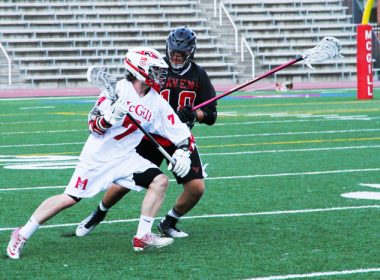
Sophomore lacrosse goaltender William Waesche’s save percentage over 120 minutes of play this past weekend.

6:

Number of points tallied by Martlet hockey forward Leslie Oles in a thrilling shootout win against the Wilfrid Laurier Golden Hawks in pre-season play on Sunday.

1:

Number of hits the Redmen baseball team needed to defeat the Université de Montréal 3-1 on Friday. Freshman outfielder James Pavelick tallied McGill’s lone hit. Montreal managed five hits on the game, but was undone by three costly errors.

mojitos
a, Recipes, Student Life

Two easy cocktails to ease the back-to-school blues

The changing weather signifies the end of summer and the beginning of warm-weather nostalgia. Here are some fun cocktails recipes for those looking to take a break from chilly winds and midterms—an easy throwback to the carefree days of summer.

 1. The “Math-Break” mojito

Serves 4 cups.


Ingredients:

1/2 cup lime juice

3 tbsp sugar

32 fresh mint leaves

1 cup white rum

1/2 cup chilled club soda

Approximately 9 cups ice


Directions:

In a cocktail shaker, add 1/2 cup of freshly squeezed lime juice, 3 tablespoons of sugar and 32 fresh mint leaves.

Use the end of a wooden spoon to mix the mint into the lime juice and sugar.

Stir in 1 cup of white rum, then pour the mix into a glass filled ice to fill the entire glass, with 1 inch left at the top to be filled with club soda.

Optional: Add a garnish of lime and mint.


 2. The “Since when is Montreal an Island?” Long-Island ice tea

Serves 1 cup.


Ingredients:

1/2 oz each of:

Vodka,

gin, tequila,

and rum

1/2 oz freshly

squeezed lemon

juice

1/2 oz triple sec

1 tsp sugar

1 can of Coke

1 slice of lemon


Directions:

In a cocktail shaker, mix 1/2 ounce vodka, 1/2 ounce gin, 1/2 ounce tequila, 1/2 ounce light rum, 1/2 ounce freshly squeezed lemon juice, 1/2 ounce triple sec, 1 teaspoon of sugar, and shake.

Strain the mix into a tall glass with ice, then fill the rest of the glass with Coke and stir.

Garnish the glass with a slice of lemon.


a, McGill, News, SSMU

Senate discusses consent, mental health policies

Deputy Provost (Student Life and Learning) Ollivier Dyens stated that two new sections would be added to the McGill University Athletics and Recreation Guide to Varsity Sports for Student Athletes to further define varsity student-athlete context and varsity sport guiding principles and policies, in response to a question raised by SSMU Senator Kareem Ibrahim and VP University Affairs Claire Stewart-Kanigan.

McGill Athletics had also agreed to become the first department in the university to train staff and coaches in a bystander intervention program. Dyens added that the varsity document will be available to the public after legal review.

The discussion was held in light of McGill’s controversial responses to an ongoing sexual assault case last year involving three Redmen football players. In a follow-up question, Stewart-Kanigan inquired about the possibility of institutionalizing consent training for athletes.

According to Dyens, varsity athletes should not be treated differently from other students.

“My position is that we’re not going to target one group of students for these kinds of things,” he said. “We want to promote this to all McGill students [….] This being said […] we have asked the varsity council to meet with our harm reduction councillor to develop policies with [athletes] and develop training with them.”

Stewart-Kanigan also brought up the topic of suspension of position for individuals in ongoing sexual assault cases.

“If [disciplinary officers] feel that it is necessary, they can use Article 21 [of the Student Code of Conduct] to exclude students from either part or the entirety of campus or McGill activities while the investigation is ongoing,” said Andre Costopoulos, dean of students. “If [Article 21] is used twice with the same student, it requires intervention [….] So it is a measure that we can use to address situations in which we have concerns about a specific individual on campus.”

Mental health

Senate also saw discussion of questions regarding McGill’s commitment to implementing pre-arrival mental health advising for students in transitional periods of their academic life.

As a result of the Joint Board-Senate meeting on mental health last year and the recommendations of a report by the Mental Health Working Group, McGill is anticipating the appointment of a two-year contract for a mental health consultant in January 2015, with the goal of working with stakeholders across the university.

“We’re developing a plan for trying to involve all stakeholders in our community, so it’s going to take some time,” said Executive Director of Student Services Jana Luker.

According to Costopoulos, McGill has also been increasing mental health resources for students, including McGill 101 videos that provided incoming students with information about counselling.

“[Campus Life Engagement] has been doing a lot of work [for] outreach [to] incoming students about pre-arrival tools,” Costopoulos said. “There are a number of [resources] that are new this year—McGill 101 being one of them.”

Provincial budget and impact

Another topic of discussion involved McGill’s release of information regarding changes to the university’s operating budget as a result of cuts to government funding. McGill stated that a projected operating grant in April 2014 of $360 million had dropped to $345 million after an update from Quebec on Sept. 3, 2014.

Principal Suzanne Fortier stated that the $15 million drop in budget would not result in any fiscal disasters.

“We had anticipated at McGill that the [2015] budget would not have the kind of resources talked about [in April],” Fortier said. “Although the figures are not what we would like to see, we were prepared for them. We’re not in a crisis situation at this university, because we had anticipated these lower levels of investments.”

a, Opinion

Commentary: On the Members of Parliament as ‘trained seals’

Members of Parliament (MP) have recently released statements expressing frustration with being treated like ‘trained seals’ and having little to no power within political parties. (more…)

a, Sports

10 things you didn’t know about Equitation

  1. Equitation is split into two main styles: English and Western. With markedly divergent historical origins, these two styles have distinct gaits, tack (equipment), attire, competitive events, and overall philosophies.

  2. English riding evolved from fox hunting, and encompasses the most well-known competitive events including show jumping, dressage, and horse racing. Smaller saddles allow for close contact between the horse and rider, and also allow the horse to move more freely, while bridles are designed to give the rider’s hands direct contact with the horse’s mouth.

  3. Western riding originated on cattle ranches in the American west, where endurance and power were priorities. Consequently, Western riding features much larger, more stable saddles, and uses one-handed neck-reining (directing the horse with light pressure on the neck with the reins) to allow the rider to work cattle with a lasso in the other hand.

  4. An English riding outfit reflects the sport’s affluent origins: breeches, a fitted jacket, gloves, and tall boots are standard. Traditional Western riding attire features a cowboy hat, jeans, and Western-style boots. Many English riding disciplines place emphasis on the presentation of the horse, whereas Western styles do not.

  5. International equestrian sports are dominated by English disciplines. The three Olympic equestrian sports consist of dressage, eventing, and show jumping. These events happen to be the only Olympic events that involve animals, and are also not segregated by gender, age, or any defining factor other than nationality.

  6. Equitation is one of the few sports where age and gender have no impact whatsoever. The youngest ever winner at Spruce Meadows, an annual international tournament held in Calgary, was American Caitlin Ziegler, who won the Grand Prix event in 2011 at the age of 16.

  7. At the other end of the spectrum, Canada’s own Ian Millar, age 67, took home his third championship this year at the 2014 Spruce Meadows Master’s. Millar, who has earned the nickname ‘Captain Canada’ during his illustrious international equestrian career, holds the world record for most Olympic games attended at 10.
  8. While age and gender may be irrelevant in riding, socioeconomic class is not. Equitation is historically a privileged sport, feasible only for upper-class families. The costs of lessons and leasing one’s own horse, as well as the limited availability of facilities, make equitation a prohibitively expensive and exclusionary sport.

  9. The Paralympics feature para-equestrian dressage as a discipline, where conventional dressage rules apply but competitors are divided into classifications based on their disabilities.

  10. The art of horse-riding is still prevalent in fields other than equitation today: mounted police have the advantage of height, mobility, and increased visibility, which help deter crime. Equine therapy is used to help those suffering from emotional or physical problems to heal in an environment designed to create connections between horse and patient.

Read the latest issue

Read the latest issue