


Latest News

a, McGill, News

SUS Council looks to address low attendence at equity-related events

The Science Undergraduate Society (SUS) council addressed issues of low attendance at equity events during its Feb. 17 Council meeting. Council also heard updates regarding the budget of the Special Projects Fund, and on the most recent Senate hearing.


Equity events question


SUS Vice-President (VP) External Mary Helmer-Smith, brought up the lack of attendance at events hosted by the SUS Equity Committee, specifically the ‘CommuniTea Series’ which is intended to function as a safe discussion space. 

“The event series was aimed towards different marginalized groups,” Helmer-Smith said. “[It] would open a space for people to come and discuss their experiences, drink tea, and hang out.”

Participation at these events has been low in the past—there have been zero attendees on some occasions. These low levels of attendance are thought to be attributed to a lack of interest within the student body, and minimal promotion and communication from the SUS; Helmer-Smith explained potential solutions to the problem. 

“The Equity Committee is not really well known, […as] it doesn’t necessarily reach a lot of people,” Helmer-Smith said. “We’re not targeting people […] well enough.” 

Helmer-Smith attributed this problem to the off-campus location for events, such as the Educational Community Living Environment (ECOLE). 

“For some reason students seem to be apprehensive to go off campus,” Helmer-Smith said. “[ECOLE] is an unknown space for a lot of people, so they might be less willing to go to that space.”

Council approved a motion to include questions regarding the continuation of events for different marginalized groups for the upcoming referendum. These questions would determine whether students see a general importance with the continuation of such events, and if marginalized students are themselves interested in attending future events. 

“The Equity committee thought it would be appropriate to ask the student body if this is something that interests them,” said Helmer-Smith. “Because if not, then there is no point in putting our time into it. But if so, then we just need to promote it better so that more people could come to it.” 


Fall Reading Week


Science Senator Marina Smailes gave a report on the response of the Senate regarding a potential Fall Reading Week. 

“There is a huge pushback from the Faculty of Science in particular,” Smailes said.  “[The faculty believes] there are issues with making up labs, and in general […] issues that [the Faculty of] Science sees as something that they just don’t think the cost of that is worth giving students less stress.” 

Smailes explained that the position of the Faculty poses problems, because nearly all other faculties have endorsed this initiative.  

“We are going to be working with specifically the Science faculty and administrators to try to figure out a way to resolve this, as students really want it.”


Special Projects Fund


VP Finance Sibat Anam addressed the lack of money in the Special Projects Fund, as a result of the events hosted this year and events planned for later this semester. 

“At this point, the original funding amount for the special projects fund has been used up,” Anam said. “We have plans to see if we can replenish that fund somehow. If that does not work out then congrats, this is the first year in the three years I’ve been on this committee that the fund has been used up completely.”

Anam added that in the future, more finite guidelines are planned to be put in place so that future funds can also be used up completely and efficiently.
a, McGill, News

McGill on track for $10.2 million budget deficit, according to Manfredi

McGill’s budgetary deficit is expected to be nearly $6 million more than was approved for the 2016 fiscal year, according to the Feb. 17 Senate meeting. Senate also discussed equity practices in hiring tenure-track professors and creating a new school of public policy.

Open discussion on employment equity at McGill

Professor Angela Campbell, the current chair of the Joint Board-Senate Committee on Equity, led the discussion and focused on the issue of diversity among tenure-track professors.

 “The policy has not had a significant impact on diversifying the McGill community, particularly at the level of tenure-track faculty.” Campbell said.

Faculty of Medicine Senator Edith Zorychta urged McGill to improve their mentoring system for new faculty members.  

 “If we had a mentoring program where [new faculty members] got two mentors—one in their field to deal with the area of expertise, and another  related to their own background that they feel comfortable with—[new faculty members] would be happier, less stressed, and perhaps more likely to succeed in their initial years,” Zorychta said. “It would level the playing field.”

Chloe Rourke, vice-president (VP) University Affairs of the Students’ Society of McGill University (SSMU), also raised concerns about McGill’s equity record when compared to other Canadian universities.

Campbell responded that the comparisons between McGill and other post-secondary institutions were, at times, inaccurate, as they often dealt with different subject matters—SSMU’s report compared McGill’s data on tenure-track professors with data on faculty members in general at other universities.  

“We’re not comparing apples to apples,” Campbell said. “It’s relevant to look at it, but it’s not decisive. We really have to measures ourselves against a benchmark that can help us in a meaningful way to make progress in which we’re proud.”  

Since Fall 2015, McGill has required that academic search committees to confirm with the Office of the Provost and VP (Academic) that at least one member of a minority group is on their candidate shortlist. 

Budget planning report

Christopher Manfredi, provost and VP (Academic), delivered the budget planning report for the 2016-2017 school year, and spoke to McGill’s anticipated budgetary deficit.

“There was an approved budgetary deficit of $4.7 million for the 2016 fiscal year,” said Manfredi. “[But] right now, [McGill] is tracking towards a $10.2 million deficit.”  

The increase is owed, in part, to lower than budgeted tuition revenues, and a lower Quebec grant. Manfredi also confirmed that McGill’s deficit is comparable to the deficit faced by other Quebec universities.

 “We are [… at] the middle of the range,”Manfredi said. “[McGill’s] total cumulative finance deficit is a little less than $100 million, [and] we’re trying to make sure that we keep that at less than 15 per cent of our total budget.”  

Manfredi also said that McGill has seen some recent positive variances, including the unanticipated sale of Redpath property for approximately $20.6 million. Faculty of Arts Senator John Galaty, expressed concern over these sales. 

“In general it’s not a great idea to pay the bills by selling off assets,” said Galaty. 

 To reassure the Senate, Michael Di Grappa, vice principal (Administration and Finance) asserted that the deal was in the best interest of the university. 

“In calculating the amount [McGill] would derive from the remaining 30 years of the lease versus the amount they offered up front, we thought it was in the best interest of the university to take this particular deal, it had nothing to do with balancing the budget,” Di Grappa said. “This particular sale has allowed [McGill] to make a provision in the budget to support a very important project in sustainability sciences.”  

Report of the ombudsperson  

McGill University’s new ombudsperson for students, Professor Dimitrios Berk, addressed the Senate on the rate and nature of complaints lodged by students since 2010.

“There are two major areas: academic and interpersonal issues,” Berk said. “For academic issues, the vast majority is about grades [….] The report shows that academic issues are declining; 60 complaints were lodged in 2011, versus only 17 this year—this is the good news. The bad news is that the rate of [interpersonal] issues between course instructors and students has remained constant.”  

Berk concluded his presentation with a word of advice for professors and faculty members.

“Listen to the students […] it is very very important [….]” Berk said. “Most issues can be resolved just by listening”      

McGill School of Public Policy 

The Senate also carried a motion to create McGill’s first School of Public Policy. According to Manfredi, the program will draw from and build on McGill’s interdisciplinary knowledge and reputation, focusing on a wide range of policy-making issues.

“Many of the policies reflect McGill’s expertise,” Manfredi said. “They include health and social policy, environmental policy, education policy, governance and public service delivery [….] It goes across a whole range of things.” 

According to Manfredi, the School will initially be situated within the Faculty of Arts.

 “Once the school is up and running it will [become] a living organism, that will develop as other parts of the university see interest in it,” Manfredi said. “Though situated in the Faculty of Arts, the school is designed to be a multi-faculty and multi-disciplinary school.”  

a, News, SSMU

Breaking down the SSMU GA motions

Motion Regarding the Procurement of Products Containing Conflict Minerals

This motion concerning divestment from sourcing of conflict-free minerals from Congo was moved by Ceci Steyn, U2 Arts.

“I moved this motion because while many other divestment movements are well known, most people aren't aware that the minerals in their electronics profit violent rebel groups in the Democratic Republic of Congo,” Steyn said. “This motion aims to have SSMU demonstrate that there's a clear demand for companies to invest in responsible mining in Eastern Congo.”

The motion calls the SSMU to join the Conflict-Free Campus Initiative and for the SSMU Financial Ethics Research Committee (FERC) to update its purchasing guidelines to take conflict caused by mineral sourcing into account.

“It’s important that this motion passes in order to send the message that consumers, particularly students, care about the ethics behind products,” Steyn said. “If SSMU passes this motion, it will become part of the Conflict-Free Campus Initiative, a movement that encourages universities to demonstrate their support for companies that minimize the use of conflict minerals.”

Motion for an Increase in Indigenous Content at McGill University

The indigenous content motion calls for the vice-president (VP) University Affairs to lobby McGill regarding indigenous class offerings and the hiring of indigenous professors. The motion was moved by NDP McGill with the support of various SSMU representatives, including VP University Affairs Chloe Rourke.

“McGill is located on traditional Kanien’kehá:ka territory. It is an institution whose graduates go on take up important positions in Canadian society,” NDP McGill said in a statement to the Tribune. “We feel it has an obligation to offer courses, languages, and programs that reflect indigenous perspectives and priorities.”

VP University Affairs Chloe Rourke stated that SSMU has taken steps in the past to advocate for indigenous studies and more equitable hiring and aims to continue this work.

“The spirit of the GA motion aligns well with SSMU's ongoing advocacy towards the Indigenization of the institution,” Rourke said. “Students played a large role in the establishment of the Indigenous Affairs minor. We have also led considerable advocacy on the issue of Employment Equity within McGill, of which the concerning lack of Indigenous professors is certainly a big part of. I believe this motion is also very timely considering the release of the Truth & Reconciliation Report last year which specifically calls for action within the educational system.”

Motion Regarding Support for the BDS Movement

This motion calls for the SSMU to support BDS campaigns and lobby the McGill Board of Governors in support of BDS campaigns.

Michael McCauley, U1 Arts, is an organizing member with the McGill Boycott, Divest, and Sanction (BDS) Action Network.  He stated that the motion aims to support campus campaigns associated with the BDS movement, as opposed to direct organization of boycotting or divesting from Israeli goods or investments.

“[M]any students seem to believe that this motion would directly cause SSMU, or the university, to fully implement boycotts, divestment, and sanctions against Israeli products and institutions,” McCauley said. “This is not true.  The motion would only provide SSMU's support to BDS campaigns at McGill, in the same way that it supports Divest McGill, McGill against Austerity, and Demilitarize McGill.”

McCauley stated that the incentive to implement this motion stems from a call made by the Palestinian civil society in 2005.

“The motion is being brought forward as a response to the call by 171 Palestinian civil society organizations in 2005 for people around the world to implement boycotts, divestment and sanctions initiatives against Israel until it complies with international law and universal principles of human rights,” McCauley said.

a, News, SSMU

Live updates from the Winter 2016 SSMU GA

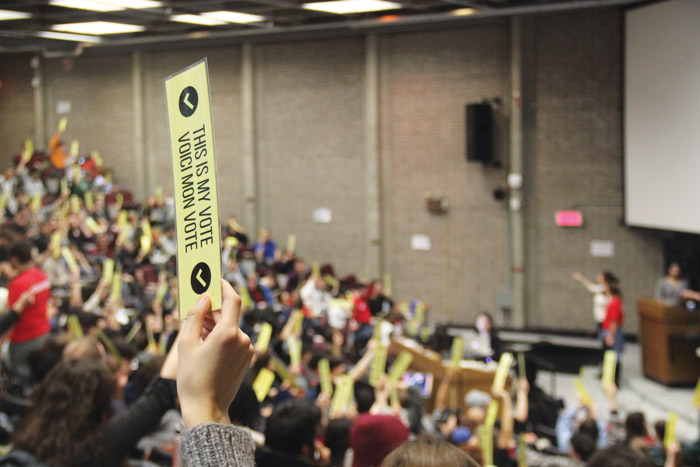
Can't be at the Students' Society of McGill University (SSMU) Winter 2016 General Assembly (GA)? We've got you covered with live updates. There are a variety of motions being discussed. Additionally, the GA will also see a discussion regarding whether McGill should be a smoke-free campus. The Tribune Editorial Board has also made endorsements on the motions. 


McGill University Bookstore
a, McGill, News

Students opinions considered in McGill bookstore’s future

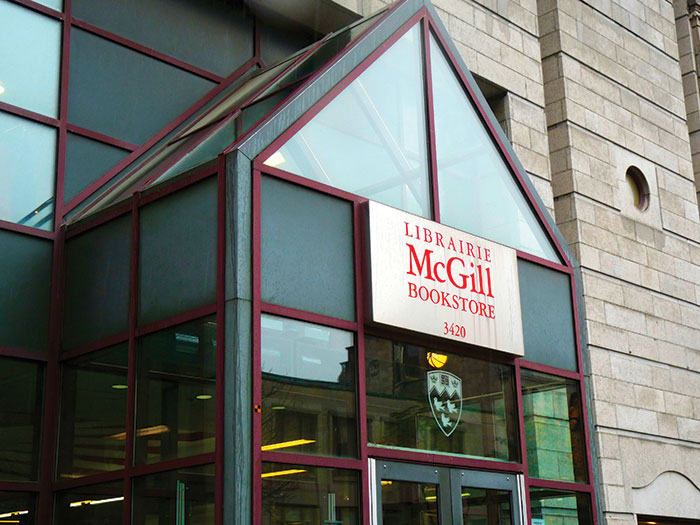
In Fall 2014, the McGill Bookstore announced its plan to move to a new, undetermined location on campus to allow the Faculty of Management to expand into the location by Winter 2016. In an effort to gain student perspective on potential changes, bookstore management installed white boards in various buildings around campus for students to share their input. According to Jason Kack, the manager of the Bookstore, the white boards project also served as a reminder of the upcoming changes.

“I’d say [the objective] was twofold,” Kack explained. “It was also to keep it active in the mind of the community that [the bookstore move] was happening.”

Each board featured a different question, such as “What would you like to see in your bookstore?” or “What is your favorite clothing item at the bookstore?” and the questions were changed regularly to collect a variety of student opinions.

“We’d actually rotate the questions, so depending on which one you saw [at which time], it might have been a different question,” Kack said.

The results were collected frequently in order to keep track of the responses and  to erase the boards for new ideas.

“We did record them all and kept track on an Excel sheet,” said Kack. “Two students […] would go around with their cell phones, they’d snap [photos] on a fairly regular basis, and they’d pull out the pictures and decipher all the [responses].”  

Some examples of ideas that were written on the board include reading rooms, a greater variety of apparel, a free book exchange section, and a space to hold events, such as a cafe; however, despite student consultation, nothing pertaining to the bookstore move is certain yet.

“We will move out of this location somewhere between the end of spring, beginning of the summer,” Kack said. “Whether that [new area] will be our permanent new location or a temporary one while our location is being prepared is still up for grabs.”

According to Kack, efforts to reach out to students for feedback are often impeded by the issue of textbook prices.

“I will say we’ve been pretty bad at having a dialogue with the campus and specifically student groups, seeing their needs, often because the conversation will [quickly turn] to price and that’s a very hard conversation to have given that we don’t set the price of the vast majority of course material, it’s the vendor,” said Kack.

The boards have been well received by students according to Kack. Marie Plamondon, U2 Arts, agrees that the boards reflect a good effort from the bookstore to engage with students, but worries that they might not be the best venue of communication.

“I think white boards are a great way to let the student community express itself,” said Plamondon. “However, I thought the bookstore could find a more efficient way to seek the students’ opinion.”

Until the move is finalized, students can expect to continue to see the white boards around campus. Idea brainstorming and recording may increase through more direct engagement with the community, in order to collect as much suggestions as possible.

“The white boards [are] less of a dialogue, [and]  more of a kind of heads-up,” said Kack. “We’re going to look into getting a focus groups going.”

Meanwhile, students can use the white boards, the bookstore’s Facebook page, and its website to speak out and give their comments.

a, Letters to the Editor, Opinion

Letters: SSMU Winter GA 2016 Boycott, Divestment, and Sanctions

Editor's note: Ahead of the Students' Society of McGill University (SSMU) Winter General Assembly (GA) the Tribune will be accepting letters on the subject of the "Motion Regarding Support for the Boycott, Divestment and Sanctions Movement." If you would like to join the conversation please send a 400-word letter (any letter above the word limit will not be accepted) to [email protected]. If you would like to join in on the conversation for any of the other motions being debated at the GA we welcome your opinions as well. We look forward to publishing the McGill community's thoughts on the issue. – Mayaz Alam, Editor-in-Chief


Why I support BDS

Sophie Heisler

U1 Arts


I am in support of the motion calling for SSMU to support the BDS movement.While this movement does not claim to be a foolproof or all-encompassing solution to the conflict, it is a powerful way for those who live outside Palestine and Israel to effect change by placing economic pressure on Israel to comply with its core demands: The end of the occupation, the recognition of Palestinian human rights, and the right of return for Palestinian refugees. Being students at an academic institution that holds global financial influence through its investments provides us with a position of power that many people our age do not occupy. In instances like the SSMU GA, we are given the opportunity to influence whether or not our institution will continue to be complicit in human rights violations. Israel, as an apartheid state, to its core is a state that undermines the basic human rights of the Palestinian peoples. Be it through land seizure, devastating bombings, or limiting caloric levels of those in the Gaza Strip to just above starvation, Palestinians are continually dispossessed, marginalized, and made subject to senseless violence at the hands of Israel. These actions are severely unethical and abhorrent, and it is imperative that we make it clear to our administration that we will not tolerate McGill’s involvement in them in any way, shape, or form.

Simply put, I support the BDS movement because I support basic human rights. It is my responsibility to use my position in this institution to do what I can for those who are being oppressed. Palestinians are being oppressed, and we must respond to their call. The illegal occupation of Palestine is a human rights issue, and I refuse to support my university’s complicity in it.  I strongly encourage McGill students to vote in support of this motion at the GA. Now is the time to exercise our rights as students and show our solidarity with those whose voices are being institutionally silenced and whose lives and freedoms are always under threat.


The situation in the Middle East is the result of a lengthy and multifaceted territorial conflict in which neither Israel nor its neighbours have been without blame. The narrative upon which the Boycott, Divest, and Sanction (BDS) motion is based is inherently flawed because it ignores this fact. That is why I will be voting “No” at the SSMU GA.  Specifically, this motion does not account for the historical context of the present day situation in Israel-Palestine, and propagates the fact that it is only Israel obscuring the prospect of peace.

This motion intentionally fails to address that prior to 1967 the West Bank was occupied by Jordan and the Gaza strip by Egypt. Israel only seized control of these territories as a result of a defensive operation it launched in response to the unprovoked war of aggression waged against it by several Arab countries. After Israel amassed the Territories, before any Israeli settlement was laid on the ground, the Arab League unequivocally rejected United Nations Security Council Resolution 242 at its 1967 summit. The Resolution called for the “acknowledgment of the sovereignty, territorial integrity and political independence of every state in the area and their right to live in peace within secure and recognized boundaries free from threats or acts of force.” Instead, they passed the Khartoum Resolution, which called for “no peace with Israel, no recognition of Israel, and no negotiations with it.”

One of the motion’s demands is for Israel to relinquish control of “all Arab lands captured.” However, on many occasions, Israel has disengaged from areas under its control, developments which did not bring about peace. In 2005, thousands of Israeli citizens were uprooted from Gaza in an attempt to forge peace, an act which was reciprocated by Hamas' re-engagement in terrorism and belligerency. Further, Israel offered to withdraw from the West Bank in both 2000 and 2008. The Palestinian Authority categorically spurned these proposals and articulated its intention to abstain from any further dialogue.

To solely blame Israel for the conflict, or to solicit concessions from Israel and Israel alone, is to observe historical realities through a warped lens. There are ways to engage in meaningful discussions, there are ways to promote an atmosphere of coexistence, and there are ways to justly advance the cause of humanity. BDS, by placing blame on one actor, and not even considering the actions of others, is not one of them.

a, Editorial, Opinion

Winter 2016 SSMU General Assembly Endorsements

Editor's note: Ahead of the Students' Society of McGill University (SSMU) Winter General Assembly (GA) the Tribune will be accepting letters on any of the motions being presented If you would like to join the conversation please send a 400-word letter (any letter above the word limit will not be accepted) to [email protected]. We look forward to publishing the McGill community's thoughts on the issue. – Mayaz Alam, Editor-in-Chief


Motion Regarding SSMU's Procurement of Products Containing Conflict Materials— "Yes with reservations"

This motion, moved by a student from the Faculty of Arts, calls for the Students’ Society of McGill University (SSMU) to declare itself as part of the Conflict-Free Campus Initiative, which encourages universities to pressure electronic companies to invest responsibly in the Congolese mining industry, and call on electronic companies and other industries to remove conflict minerals from their supply chain. The Tribune endorses a “Yes with reservations” vote at the Winter 2016 General Assembly (GA).

While the declaration itself would be purely symbolic, the clause that calls to influence industries that make use of conflict minerals is vague and gives no indication of how SSMU would accomplish this. It should therefore be modified to reduce the opacity or be struck from the motion. Moreover, the inclusion of the Financial Ethics Research Committee (FERC) must clearly detail the need for consultation with experts on the issue of conflict minerals so that the investment decisions are both well-informed and productive. Without adequate research, the decision to invest in a company based on the extent to which it uses conflict minerals may do more harm than good. The motion falls into the trap of conflating the cause of conflict in the Democratic Republic of Congo with the perpetuation of the conflict. Embargos on conflict minerals, rather than having the intended impact on warlords and perpetrators of violence in the Congo,may in fact serve to disenfranchise labourers and those working to earn a living wage for themselves and their families. As a result, warlords gain more power relative to ordinary citizens, and unemployed former-labourers become militarized, thereby perpetuating the cycle of violence. As such, this motion should be adapted so that the emphasis is on updating the FERC plan in consultation with those who are well-informed regarding the various implications of conflict minerals.

Motion Regarding An Increase In Indigenous Course Content At McGill University— "Yes with reservations"

In light of McGill’s lagging progress behind other Canadian universities, the vice-president (VP) University Affairs (UA) of SSMU should lobby to increase the amount of Indigenous content available to students, as well as the number of Indigenous professors to be represented throughout all faculties at McGill. The recently created Indigenous Studies minor has seen success since its introduction, and the addition of a major, a process that is already beginning to be undertaken by the university, will similarly satisfy the significant student interest in Indigenous Studies. A major in Indigenous Studies would also expand the variety of multidisciplinary courses that students could select to fulfill other degree requirements. This is one of the benefits of programs such as North American Studies, which includes courses from a variety of different programs. Similarly, the introduction of an Indigenous Studies major would stand to benefit a wide population of students within the Faculty of Arts by increasing course offerings.

While expanding the visibility of indigenous history and culture on campus is a goal that SSMU should pursue, the top-down implementation of a mandatory course in Indigenous Studies for all McGill students is not the solution. A mandatory course could be difficult to incorporate into the degree plans of students who enter from CEGEP or with advanced standing credits, of which McGill has many, and could be difficult to implement university-wide. Instead, SSMU should focus its efforts on lobbying individual Faculties, who could then implement more mandatory indigenous content or introduce an Indigenous Studies course that is more appropriate academically to that individual Faculty. This would allow such courses or requirements to be better adapted to the specific needs of each Faculty’s students. For the Faculty of Arts, for example, such a course could be conceivably incorporated into the Freshman Program. This motion should therefore be adapted to give Faculties the discretion on the method of implementing mandatory indigenous course requirements.

Motion Regarding Support For The Boycott, Divestment, and Sanctions Movement— "Abstain"

The “Motion Regarding Support for the Boycott, Divestment and Sanctions Movement” is a highly contentious one—this is the third time in the past two academic years that a motion regarding the situation in Palestine and Israel has been brought to the GA and each time it has surfaced it has succeeded in dividing students. This motion has prescriptions and clauses that are far clearer and more direct than its predecessors; for example, it cites exactly which companies it seeks McGill to divest from and shows how they are related to the situation. This being said, the Tribune endorses an “Abstain” vote for this motion.

Yes, SSMU has a commitment to “demonstrating leadership in matters of human rights and social justice,” as outlined in its constitution. Proponents of the BDS movement at McGill commonly cite the historical precedent with actions taken against Apartheid-era South Africa. Indeed, the weight of the international community’s condemnation did have an effect on the dismantling of the system of oppression in place at the time.

The situation in Palestine and Israel, however, is far less binary. It may be among the most, if not the most, complex geopolitical issues of our time. In contrast, the way that this debate has been framed on campus lacks nuance. Voting “Yes” for this motion brings with it implications that reach far beyond the specific prescriptions that the motion calls for. Similarly, those who vote “No” are rarely given the opportunity to express why they disagree with the motion.

Moreover, the third clause of the motion states that "this call for BDS states that such campaigns are to remain in place until Israel meets its obligation to recognize the Palestinian people’s inalienable right to self-determination [….]” Although this clause is not binding to SSMUas per its Internal regulations SSMU's stance would be valid for up to one year—it implies entrenching SSMU’s position over a long time period, which does not consider that the composition of the society represented will change.

Students have demonstrated that they wish to have a forum to discuss this issue; however, the SSMU GA, as it is currently constructed, has proven to be ineffective, especially given the budgetary constraints that prevent the GA from being held in a larger external site such as Leacock 132, as it was in Winter 2015.

One of the inherent problems with a motion such as this one is that it inspires a debate of a political issue that is firmly entrenched within individuals’ identities. When a debate that is as integrally personal as this one turns awry it threatens students’ personhoods. The risk of alienating a large portion of the student body through a decision on this motion is unjustifiable.

a, Letters to the Editor, Opinion

Letter to the editor: Crowdfunding and austerity

Thank you for your thoughtful editorial on the relationship between philanthropy and government funding (“When austerity strikes, McGill turns to crowdfunding,” Feb. 9). I agree wholeheartedly with your central argument that fundraising – whether through crowdfunding or other mechanisms – is no substitute for a government funding model that fully supports McGill’s needs and ambitions. This is something I hear from donors nearly every day, and which the principal and others are working hard to address in their discussions with the Quebec government.

I do want to address one important statement near the beginning of your editorial that misstates the level of transparency in McGill’s fundraising operations.

You say that funds raised from donors to McGill “go into the university’s operating budget, a relatively opaque process, so some donors do not necessarily see where their money has gone.” In fact, the opposite is true: Virtually all of the donations we receive—large or small, and whether by cheque or through our online portals—are designated to specific purposes identified by the donors themselves, whether it’s creating a new bursary or scholarship, or supporting a wonderful program like the Arts Internship Office.

I am delighted that Seeds of Change, which the University Advancement team launched in 2014, is providing students with a much-needed platform to raise funds for the projects they believe in, but the same principle of highly directed support applies to nearly every gift we receive. Regardless of the method of giving, it is private donations, targeted to the causes near and dear to the hearts of our donors, that allow McGill to maintain its margin of excellence despite having an operating budget that is dwarfed by many of our peer universities.

Respectfully,

Marc Weinstein

Vice-Principal, University Advancement

a, Hockey, Men's Varsity, Sports

Hockey: McGill on cloud nine, dominate Concordia

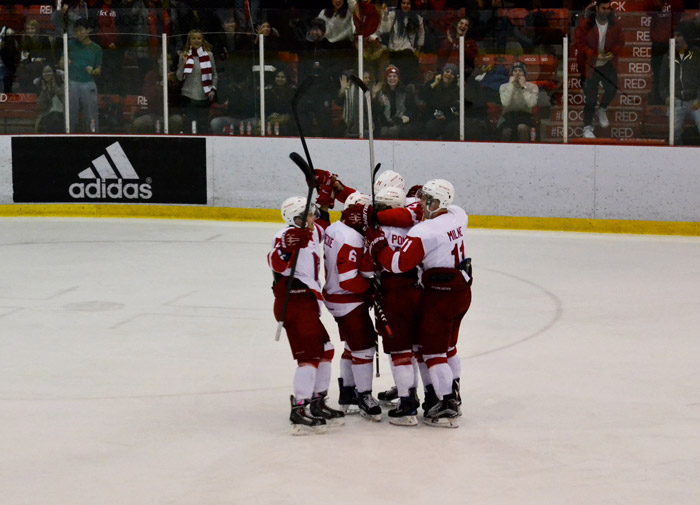
‘Relentless’ is a word that summarizes the McGill Redmen Hockey team’s (21-6-1) dominant 9-2 victory over crosstown rival Concordia (10-12-6) at McConnell Arena on Wednesday. From the puck drop to the final buzzer, the Redmen played a physical, skillful, and disciplined style to capture a 1-0 series lead in the OUA East quarter-final.

“You try to play the same way, try and stick to your plan,” Head Coach Kelly Nobes said. “And I think we did a good job of that tonight. We played a full 60 minutes, and that’s what it takes this time of year.”

Of the two sides, McGill generated the best chances in the first period, most notably a fifth minute thread-the-needle pass by centre Liam Heelis. At 11:35, senior centre Mathieu Pompei’s nasty slide-by dangle and shot past the goalie opened McGill’s account for the post-season. Concordia replied swiftly, scoring a minute after a McGill penalty kill. McGill reclaimed its lead at the end of the first period as forward Patrick Delisle-Houde scooped up a blocked shot rebound to find the top of the net. 

From the second period onward, McGill dictated the game’s pace; at the 2:18 mark of the second period, a point shot from McGill was deflected onto the stick of rookie winger Rock Regimbald, whose no-look behind-the-back pass found rookie winger Christophe Lalonde for the goal. Even though Concordia tied the scores five minutes later, the Redmen were still in charge. A double penalty at the 12 minute mark led to four-on-four play; a great sliding breakup by rookie defenceman Dominic Talbot-Tassi in the Redmen’s own zone led to a counterattack goal scored by Talbot-Tassi himself.

“It’s a 200 foot play,” Nobes said. “It’s a great defensive play that gets you rewarded at the other end of the ice and that’s how the game works all the time.”

McGill asserted their will at the end of the second period with a beautiful transition three-man-weave that led to rookie centre Frederic Gamelin scoring. The Redmen entered the third period with a 33-20 shot advantage and a 5-2 lead.

McGill dominated Concordia in the third period; three minutes in, sophomore winger Simon Tardif-Richard squeezed the puck into the front of the net. Frustrations began to boil over for the Stingers, and the visitors’ Frederick Roy received a five minute major and a game misconduct for fighting (Gamelin also received two minutes for roughing). Despite the tensions, McGill continued to play with great drive: The team’s seventh and eighth goals, both on power-plays, were scored by Lalonde and Jonathan Bonneau, respectively. Bonneau also added McGill’s final and ninth goal of the game—he  exploded past the defender on the right side of the ice, sniping a stunning shot into the top-left corner of the net. 

McGill went on to win the second game and the series at Concordia in a hard fought 4-3  overtime win on Friday, Feb 19. Simon Tardif-Richard scored twice, including the game-winner, to help the Redmen advance to the next round of the OUA playoffs against the Carleton Ravens on Feb 24.

Quotable

“I think that it’s the playoffs, it’s a short series, [so] you need to be ready from the start, need to play 60 minutes, I don’t think that was a factor in tonight’s game.”—Nobes on whether McGill’s rivalry with Concordia influenced their performance.

Stat Corner

Concordia was only 1-7 on the power-play, and McGill had a decisive shot advantage of 43-29. 

Play of the Game

A great end-to-end play by the Redmen during four-on-four, with a great diving breakup, translated to a great goal from the slot on the other end by Talbot-Tassi. 

a, Opinion

Any outcome of the BDS motion will not reflect McGill students’ positions

Editor's note: Ahead of the Students' Society of McGill University (SSMU) Winter General Assembly (GA) the Tribune will be accepting letters on the subject of the "Motion Regarding Support for the Boycott, Divestment and Sanctions Movement." If you would like to join the conversation please send a 400-word letter (any letter above the word limit will not be accepted) to [email protected]. If you would like to join in on the conversation for any of the other motions being debated at the GA, we welcome your opinions as well. We look forward to publishing the McGill community's thoughts on the issue. – Mayaz Alam, Editor-in-Chief


Next Monday, a divided and emotive topic will return to the Students’ Society of McGill University (SSMU) General Assembly (GA) as students debate and vote on a motion proposed by the McGill Boycott, Divest, and Sanction (BDS) Action Network. Previous debates regarding the Israeli-Palestinian conflict exposed incompatible views and severed hope for any consensus on the issue. The “No” campaign made it clear in the debates before and during last year’s GA  that many students feel anxious about the BDS movement. On the other hand, the motions' proponents, Solidarity for Palestinian Human Rights (SPHR), demonstrated that their proposals were passionately driven by the urgent need for a change in the Palestinians’ continually worsening situation. This latest motion—the inevitable consequence of mutual distrust, reciprocated blame, and a lack of compromise on both sides—has no hope of accurately representing the views of McGill students. While a motion that satisfies all students is impossible, a motion that addresses each other's compatible concerns would at least capture the sentiments of more students with a stronger united voice. Instead, this motion ignores the very concerns previously expressed.

The most recent motion threatens to deepen distrust by ignoring many students’ worries regarding the support of the BDS movement at large. Consequently, any decision that comes from next week's motion cannot be reflective of the perspective of the McGill student body. Rather than abandoning reconciliatory efforts and taking an escalated approach, the various stakeholders on campus should find an alternative motion that genuinely considers the legitimate concerns of all sides. These issues include Israel’s security, the focus on Israel as a sole perpetrator, the effects of the BDS movement on all Israelis, as well as the urgent need for change. While a vibrant discussion is necessary to address each other’s concerns and determine which are compatible, opponents to previous motions must be willing to take a stance.

Dialogue alone cannot address the need to take concerted steps to change the situation facing the Palestinian people. Although SSMU’s role in international affairs will always be symbolic, a public condemnation and official statement that represents the views of students can send a powerful message; however, rather than making amendments to last year’s motion to condemn Israeli action in Gaza, the “No” campaign successfully tabled the motion indefinitely. By shutting down debates and claiming the issue is beyond SSMU's jurisdiction, the “No” campaign failed to address the pressing need to have an immediate impact on the worsening conflict. Groups like Israel on Campus (IOC) must realize that not taking a stance on the matter is complicit with the status quo.

If there is any hope for compromise on this issue at McGill, students with genuine concerns regarding the BDS movement must first recognise the urgent need for change. If neither side shows a willingness to change their approach, legitimate concerns will continue to be ignored. Rather than attempting to address each other’s concerns, both sides will attempt to get as many of their voters into the SSMU building as possible, degrading the debate to a tribal numbers game. Just a few votes may change this year's outcome, but whatever happens, the result has no hope of sufficiently representing the views of McGill students.

Read the latest issue

Read the latest issue