


Latest News

2016 Oscar Nominated Short Films
a, Arts & Entertainment, Film and TV

2016 Oscar Nominated Short Films: An in-depth review of the competition

Once again the world gathers to see what the pinnacle of human cinematography has to offer: The time of the Oscars are upon us. Whether or not the motion pictures presented at this year’s awards are representative of every race or ethnicity, a highly important matter in and of itself, all of the pictures offered up for the best animated short film (Sanjay’s Super Team, World of Tomorrow, Bear Story, We Can’t Live Without Cosmos, and Prologue) and for best live-action short film (Ave Maria, Day One, Shok, Stutterer, and Alles Wired Gut (Everything Will be Ok)) are nonetheless all excellent productions that each tell unique stories in their own respective ways. Which one, however, is worth a 34.3 cm tall golden statue?

Oscar Animated Shorts

Sanjay’s Super Team

A competition for best animation shorts almost wouldn’t be one without Disney and Pixar making an appearance, and they’re back again this year in all their aesthetically cute, yet verbally quiet, glory with Sanjay’s Super Team. The short, directed by Sanjay Patel and inspired by his own childhood, tells the tale of a Hindu father trying to reconnect his young son, who much prefers the cartoon action of his favorite show ‘Super Team,’ to the Hindu faith. In the spiritual search that ensues, Durga, Vishnu, and Hanuman combat the raging Ravana with the assistance of a much bewildered Sanjay. In the standard Pixar style, the film tells a short, sweet, and simple tale that resonates a positive message of familial and spiritual bonding particular to the modern era.

World Of Tomorrow

Departing the realm of traditionalism, World Of Tomorrow, directed by Don Hertzfeldt, somehow manages to touch on feelings of childish joy and existential depression at the same time. Animated in a style that crosses adorably crude fifth grade drawings with very minimalist modern representations, this short gives an overview of the future human condition through the lens of a Emily, a small child, and her future self, and through the course of their travels highlights the technological advancements, such as the ‘outernet,’ time travel, and cloning, that await humanity in the future. Due to the strong juxtaposition between young Emily’s innocent interjections and future Emily’s often emotionless statements, the future, according to this short, may not be so great.

We Can’t Live Without Cosmos

Picking up on the themes of human progress touched on in World Of Tomorrow, Konstantin Bronzit’s production, We Can’t Live Without Cosmos, tells the tale of two astronaut B.F.F.’s, dubbed 1203 and 1204, and the pursuit of their ultimate dream, the final frontier of space. Without any dialogue, the film manages to forge a strong bond between 1203 and 1204 who, under constant criticism by the observing scientists every time they show some form of human emotion, comically compete to enter the space program. Animated in a style reminiscent of recent Adult Swim cartoons, We Can’t Live Without Cosmos, delivers a powerful message about the human drive for scientific progress peppered with moments of unscientific hilarity.

Bear Story

Bear Story, directed by Gabriel Osorio, leaves aside comedy altogether and focuses on the rather dark story of the aftermath of a bear’s struggle against the oppressive, fascist-like, institution that is—from an animal’s perspective—the circus. The short utilizes a steampunk-ish animation style that’s loaded with mechanical gears, sewed-on buttons, and patchwork paintjobs that brilliantly conveys the notion of a once ‘working,’ pre-circus world that is now barely rattling on.

Prologue

Finally, Prologue, animated by the iconic Richard Williams responsible for legendary works such as Who Framed Roger Rabbit, really pushes the boundary between reality and animation with his hyperreal style of animation. Consciously avoiding a clear plot line, the short focus on a combat situation between ancient four Greek warriors and the nature surrounding them, and proceeds to depict the ensuing scenes in an entirely hand drawn fashion that’s both aesthetically awesome and technically inspiring given the sheer amount of effort that must have accompanied each frame.

Predicted Winner: We Can’t Live Without Cosmos

Ultimately, We Can’t Live Without Cosmos, despite not breaking any boundaries on the animation side of things, takes the cake due to its clever interplay of gravity and levity narratively. Prologue and Bear Story seem to focus too much on animation at the expense of the story, while Sanjay’s Super Team follows the Pixar formula a bit too closely. World Of Tomorrow posits a close second, but that remains for the judges to decide when the Oscars happen on Feb. 28.

Oscar Live-Action Shorts

Ave Maria

Directed by Palestinian-British Director Basil Khalil, Ave Maria looks at the Israeli-Palestinian conflict from the perspective of ordinary people. In the West Bank of Palestine, a Jewish couple and the man’s mother crash into a statue of the Virgin Mary outside a convent and must rely on the nuns for help. What follows is a kind of comedy of religious restrictions. Moshe (Shady Srour) can’t operate the phone because it’s past Shabbat but the nuns have taken a vow of silence making them reluctant to make the call. The various religious rules seem to be irksome formalities preventing the characters from doing what is practical. Despite the prejudices and culture clash, both groups are polite and civil to each other. While the vignette shows us that yes, Jews and Arabs can be polite and friendly with one another, the larger Israeli-Palestinian situation seems omnipresent. Both the Arab nuns and the Jewish family have accepted the precarious situation as an unchangeable reality.

Day One

If Ave Maria was a comedy of cultural restrictions, Day One is a tragedy of cultural restrictions. Day One is directed by American Director Henry Hughes and is based on a true story of his own combat experience in Afghanistan. Feda (Layla Alizada) is a female interpreter on her first assignment with the US military in Afghanistan. She must navigate the male-dominated culture of both the military and pastoral Afghanistan. Yet it’s her uniquely feminine presence that allows her to go above the call of duty where her male colleagues cannot. It allows her to step into a home to be the one source of comfort to a woman giving birth. Dr. Nasir (Navid Neghaban) an Afghani doctor refuses to deliver the woman’s baby, showing that even when a woman’s life is on the line the culture of gender segregation in rural Afghanistan is impenetrable. What’s truly remarkable about Day One is its ability to pack suspense, plot twists and emotion into only 15 minutes.

Shok

Shok takes place during the conflict in Kosovo during the 1990s. The film opens on two young Albanian boys, Petrit (Lum Veseli) and Oki (Andi Bajgora) going for a joyride on a bicycle. The playful, optimistic attitude of both boys distracts the audience from realizing that there is a war going on at all. The short is a coming of age tale, as Petrit must decide where his loyalties lie, both to his country and to his friend. Both boys must decide right from wrong in a time when the lines between right and wrong are blurred. The two young actors deliver strong performances, capturing the struggle the two boys face to retain their childhood during violent times.

Stutterer

Stutterer follows Greenwood (Mathew Needham) a typographer in London who struggles with a speech impediment but whose internal monologue is observant and witty. An online relationship brings joy to his lonely life, but it soon becomes a source of stress with the potential of a real-life meetup. Greenwood’s observations of people he passes on the street or in the tube give the film a playful sense of humour. And the cinematography is enchanting with delicate natural lighting and long musical shots. Yet ultimately the plot is predictable and the trope of a creative wordsmith struggling with a speech impediment feels cliché. If you’re unfamiliar with short films, Stutterer is exactly what you would imagine live action shorts to be, with few characters, sparse plot, long beautiful shots, and minimal dialogue.

Alles Wired Gut (Everything Will be Ok)

German Director Patrick Vollarth shows us what begins as a fun weekend between a divorced father and his 8-year-old daughter. Yet the action quickly takes a darker turn. Michael, played by Simon Schwarz invokes our sympathy, even pity, and yet as we watch his choices unfold, he becomes terrifying. A strong performance from Julia Pointner who plays the 8-year old Lea, the film shows that children can be more emotionally mature than the adults, and often sharper than adults assume. The title phrase, “everything will be ok” is repeated again and again, usually to Lea who knows everything will definitely not be ok.

Predicted Winner: Day One

Day One manages to pack as much emotion, drama and suspense of a feature length film into 15 short minutes. It almost redefines what a short film can be, as it seamlessly integrates not just a main-plot, but sub-plots. It tackles issues of feminism, culture, poverty, and military intervention in subtle yet striking ways. It will haunt you long after the last scene.


a, Opinion

SSMU’s mind on its money, money on its mind

In the past couple of years, the Students’ Society of McGill University (SSMU) has had trouble obtaining a mandate from students to spend their money. The student body recently rejected SSMU’s special referendum question for a membership fee increase, which would have increased the base fee by $5.50 per term. A similar situation happened to SSMU with the building fee referendum, which was rejected in Winter 2014 and then passed when a similar question was posed in Fall 2014. SSMU is currently putting together a second package of fees to make up for a budget shortfall. Now, according to Vice-President Finances & Operations Zacheriah Houston, budget adjustments and cuts will be to the tune of $100,000. In spite of this urgency, only 16.3 per cent of students voted. Although the membership fee only failed by 17 votes, this result is only the most recent example of the broken dialogue between the student body and SSMU; the majority of students either did not hear the urgency of the request or did not listen. The future success of SSMU requires students to trust SSMU to spend money properly, and to see that dialogue with SSMU is necessary to improve student life at McGill.

In light of the failure of the fee increase, SSMU needs to allocate its money more effectively. For example, this past fall’s 4Floors event was budgeted to sell out for 1,000 people at $25 a ticket. In the end, only 533 tickets were sold, resulting in a loss of $8,000. Students need to be able to trust SSMU to spend money on things that matter. In Winter 2014, SSMU opened the Student Run Café (SRC), The Nest, which lost $20,000 its first semester of operation. SSMU then opened a second student-run café while The Nest was losing money. While SSMU had the admirable intent of promoting student spaces, it was not sensible to operate two cafés at a loss during a budget shortage. It sends the wrong message to students when SSMU requests a fee increase while emphasizing seemingly non-essential events and services at a heavy loss.

SSMU can be a strong advocate for students, but only if students empower them.

The problem that SSMU faces is circular: To gain students’ approval, they need to spend money ‘effectively,’ but obtaining adequate funds to provide these services is dependent on the faith of the student body. If students disapprove of SSMU’s use of funds, the answer is not to cut SSMU off. Students need a functioning student society to support basic clubs and services, and to advocate for students to the administration and the province. A strong representative on campus is essential in this time of austerity and budget cuts. SSMU can be a strong advocate for students, but only if students empower them. At the moment, students have trouble believing SSMU will spend money they receive effectively.

To rebuild this relationship, there needs to be a dialogue between the student body and SSMU about the best use of student funds. SSMU’s event to discuss the future of the SSMU building is a positive step towards involving students in the process of how money is allocated to student-run initiatives such as The Nest and the SRC. Another step SSMU could take with students is to release its finances for events, clubs, and services by email periodically to improve transparency and show students that their money is being spent appropriately. Student representatives must also do more to increase the flow of information from Council to students. At the moment, budget information is most transparent to those involved in student politics. While representing students on SSMU Council, representatives must recall their obligation to open channels of information to students within their faculties beyond faculty societies and departmental associations.

Such a dialogue is necessary to build participation in SSMU, but is also dependent on the involvement of students. If SSMU is to rebuild its financial viability while extending and improving the services it provides, students need to consider how their lack of participation is harmful to the very services they want.

Students should be prepared when SSMU opens a dialogue on the future spending of funds. For SSMU to best serve student needs, students must participate in the process. SSMU is putting forward an alternative package of club fees for students to vote on. Rather than simply voting “No” on future referendums regarding fees, students should listen to what SSMU has to say. Yes, referendum questions should be responsive to the demands of students. But it is time that students stop treating every referendum as a vote of confidence on the entire institution of SSMU. The future viability of SSMU depends on an active partnership between students and the union.


Norman Yallen is a U3 history major.


a, Off the Board, Opinion

Social activism not enough to break down structures of success

According to philosopher-writer Albert Camus, “the only way to deal with an unfree world is to become so absolutely free that your very existence is an act of rebellion.”

It is harder for a woman of colour to achieve the same metrics of success as a white man. The very definition of success is built around capitalist and patriarchal ideals: You’re successful if you have a prestigious career, earn a certain amount of money, and command the respect of people who are equally as successful. Women of colour face additional pressures when striving for ‘success,’ to be successful by traditional standards while advocating for social justice. Unfortunately, the two worlds don’t always mix. To be successful, sometimes I feel that I cannot stand up for the things that I believe in.

Injustices are both institutionally sanctioned and perpetuated by people who, though they may not intend to, perpetuate harmful ideas. Institutional inequalities are evident by the disproportionate amount of black men and people of colour incarcerated in the United States and Canada, the fact that people of colour have lower wages and socioeconomic outcomes compared to white people, and in the appalling truth that indigenous women have a homicide rate 4.5 times higher than other women in Canada. These inequalities take place day-to-day, in the workplace, and on university campuses.

The pressure to embody mainstream success while also being an activist often comes from like-minded people who care about righting the structural inequalities of society. But oftentimes activism is, by default, the responsibility of the individual who would most benefit from change. There have been many times where I’ve had to swallow my pride and laugh when mentor figures, friends, and work associates have made comments about my name, or tried to greet me with namaste-esque gestures, or said that the rice and chicken I’m having for lunch is exotic.

To be clear, there’s nothing wrong with striving for success; however, as long as that success is externally defined, achieving a certain career entails participation in a society that is resistant to social activism.

I used to be the type of person that would point out every time a movie had an all-white cast, or every time a person used a racial slur in a casual conversation. Initially, I thought that the people I spoke to would stop what they were doing, become suddenly enlightened, and go henceforth as a paragon of social justice. It rarely worked that way: Most people’s reactions ranged from confused, to defensive, to angry. On top of that, I don’t have an infinite amount of energy to patiently explain my point of view and educate every person who says something slightly offensive. Keeping my silence was, I thought, the best way for me to be liked and progress in school or at work. Yet it takes a huge toll to remain silent in these situations because I feel like I am betraying a part of myself. As wonderful as it would be, it’s unrealistic to expect every single woman of colour to act as an activist in their everyday lives. Some women may only care for mainstream success, some only for activism, and some for neither, or for both.

To be clear, there’s nothing wrong with striving for success; however, as long as that success is externally defined, achieving a certain career entails participation in a society that is resistant to social activism. This is apparent by the fact that most prestigious organizations—whether they are universities, governmental institutions, major media outlets, or Fortune 500 companies—are mostly run and staffed by white men, who, consciously or not, benefit from societal inequalities.

Succeeding in society doesn’t necessarily mean working as an activist to combat such inequities. One does not necessarily need to be a grassroots activist; one need only consider the discussion that followed Beyonce’s “Formation” video to realize the various forms that activism can take. But not everyone has the means, energy, or mental health to be a full-time activist while also achieving mainstream success.

The way in which society is structured means that achieving mainstream success often comes at the cost of working to erase the barriers that prevent other women from achieving the same. While that is a bitter pill to swallow, it’s also the reality of society. We must not demonize the women who choose to work within the system, or do not have the resources or ability to work outside it. Instead, we should work as much as we can to erase these structural inequalities so no one will need to make a choice between mainstream success and social activism.

The tragedy of this situation is that change rarely comes from working within the system, and so activism is the crucial piece in bringing about any societal transformation. I suspect that this is why the pace of change is so slow: In an ideal world, we’d all stop subscribing to notions of mainstream success and build a new, egalitarian system from scratch. But in an imperfect world, one must understand that underprivileged groups are in a unique position: They face pressure to achieve mainstream success within a system that works against them. Their other option is to work towards dismantling the system, but this process is slow, laborious, and is not likely to garner respect within mainstream society.

Shrinkhala Dawadi is a writer and managing editor at the McGill Tribune.


a, Science & Technology

Game design thinking and the realm of possibility

Founded in 1992 by current CEO Remi Racine, Behaviour Interactive is one of the largest and most successful independent game developers in Canada. Their team is made up of  over 300 employees and is headquartered here in Montreal. 

In the last year, Behaviour has worked on games like the award-winning iOS game Fallout Shelter, which the organization made in partnership with Bethesda Game Solutions. The team also worked on $92 million Kickstarter project, Star Citizen—the biggest crowdfunded video game ever developed for Microsoft Windows and Linux. Their success has been tied to their ability to make their games interactive, artistic, and above all, fun.

“Fun is very complicated,” Creative Director Peter Hammer explained. “The only thing you know is when you’re having it and when you’re not having it.”

With this in mind, Behaviour has curated a series of key universal ingredients to creating fun in video games. This is what Senior Vice-President Dominique Lebel calls “game design thinking.” 

A study conducted by Microsoft revealed that humans’ attention span has dropped from 12 to eight seconds due to smartphone usage. This means that a game must be designed as a first time experience. Its virtual world must contain a set of rules that remain persistent, unchanging, and therefore learnable to the user. There needs to be easily identifiable goals to reach and a motivating reason as to why those goals should be reached. The game must be simple and include engagement and re-engagement tools. There must be visible progress, a tangible feeling of moving forwards. Social involvement, competitiveness, and cooperation are also key. Finally, a fun game requires the idea of winning.

(forbes.com)
(forbes.com)

What Behaviour Business Solutions found, however, was that these exact same ingredients—this game design thinking—can be applied outside of videogames, and be just as effective. Although the idea of using game mechanics in business, specifically marketing, has existed for a long time, it hasn’t evolved much. Known as ‘gameification,’ the process of using games in business never evolved beyond simple tactics such as a game of spin-the-wheel to win a cup of coffee. Now, however, most people carry smartphones, which Behaviour Business Solutions aims to target to revolutionize experiences through game mechanics.

“Imagine if I was coming into work every single day [and] it was a fair world where the rules were incredibly simple; I had clear goals, there was an engagement mechanism, and I knew what I had to do to win,” Hammer stated. “[That] would be a perfect world. These mechanics exist in a game but they don’t exist in our everyday world, [which] makes it imperfect.”

Behaviour believes the problem with the real world is a lack of immediate validation. When short term results are not visible, motivation goes down. Behaviour is utilizing game design thinking to fill that gap. One of the first ways they have begun doing this is by revolutionizing the work experience. The goal is to engage employees, increase motivation, and transform learning.

“[Behaviour] is not only taking the old way of teaching and doing it digitally, but we are creating a new way of teaching,” Lebel stated.

To test their theory, Behaviour has been working with large firms such as Air Canada and Sobeys to transform their employee training processes. Infusing game mechanics into training is the distinction between a dreary test and a fun trivia game. Behaviour has also been working to employ virtual reality technology in training. This means effective use of the same technology that develops first person shooter games to create highly realistic first person training simulations. Although they are currently working largely with private corporations, this development is heading towards the public sector, specifically in education.

“Students are actually used to engaging with everything they’re doing, they’ve got all these two-way communication channels,” Hammer said. “They’re playing games; they’re completely connected at all times. Then, they go to school and the mechanics are ancient.”

Somewhere between elementary and middle school, education changes from a reward orientation to a punitive orientation. Whereas younger children are rewarded for good behaviour, older kids are being punished for bad behaviour. This extends into university and eventually the workforce. This system encourages students to prioritize grades over acquiring knowledge, which means they retain very little of the information that is important. Game design thinking will be able to make education engaging.

“It’s not a very fair system today,” Hammer said. “[The education system] values a [specific] form of academia. Some people are used to taking tests and they know how to get through the system. Are they the best? They’re the best at something. With game mechanics through design, [education] can value the best of many things.”

“Fun is very complicated,” Creative Director Peter Hammer explained. “The only thing you know is when you’re having it and when you’re not having it.”

The US government has already begun funding initiatives to change the way people are educated. This process will begin with the younger groups who are more adaptive to new technology but will expand into more serious fields that require a long and theoretical education such as medicine.

“[Behaviour] is not only taking the old way of teaching and doing it digitally, but we are creating a new way of teaching,” Lebel stated. 

Healthcare is the next public sector where game design thinking hopes to change. To do this, they want to shift the focus from treatment during illnesses to preventative care. In order to accomplish this, Behaviour aims to use the concept of immediate validation. 

“The only reward in staying healthy […] is ‘I won’t get sick,’” Hammer said. “That’s a very obscure reward compared to [a] vice, which feels good.”

For example, a person may go out for drinks with friends or eat a bag of salty chips because it feels good immediately, whereas the long term health benefits of not doing those things feels bad.

Game design thinking can add immediate validation for someone who is trying to make healthy life choices when there are no visible, physical forms of immediate validation. To do this, Behaviour Interactive hopes to link users with health insurance premiums. Insurance companies can reward its users for good behaviour, such as eating healthy and quitting smoking.

The last sector that game design thinking will be able to tackle is environment. The idea of process is key here; through game mechanics, people will become more motivated to recycle if their garbage is able to tell them exactly how much carbon emission they eliminated. Game design thinking is filling the gap that is limiting rational decisions because the payoff is not evident.

These projects take a long time to complete and perhaps longer to become fully integrated. However, they are big steps towards a dramatic change in human behaviour. The idea of game design thinking is relatively new but packed with potential. Companies like Behaviour  Interactive are paving the way towards a bold paradigm shift. 

(bhvr.com)
(bhvr.com)
a, Recipes, Student Life

Recipe: Red Lentil Soup

Now that midterms season has graced McGill students, any prior New Year’s resolutions to cook fancy, elaborate meals have gone out the window. Enter this red lentil soup recipe, which is fast and simple; it only has three steps, and the last one is opt-outable if you’re tight for time. It’s affordable for students since the main ingredient is lentils, and the rest of the ingredients can probably be found around the house already. For those looking for a vegetarian option, the chicken broth can be swapped out for vegetable broth. Lastly, students can cook up a jumbo batch to eat at the library throughout the week; the soup freezes well, and can be warmed up for a quick snack between stints in the library. 

Ingredients

2 tbsp of olive oil

2 carrots, diced

2 cloves of garlic, minced

1 onion, diced

½ tsp of salt

1 tbsp of tomato paste

2 cups of red lentils

8 cups of chicken broth 

2 bay leaves 

Black pepper

Cayenne pepper

DIRECTIONS

1. Cook olive oil, carrots, garlic, onion, salt, for 5 minutes, covered, over medium heat.

2. Add the rest of the ingredients to the pot and bring to a boil. Turn down to heat to low and simmer covered until lentils fall apart. This should take approximately 20 minutes.

3. For a thicker consistency, purée half the soup. 

a, Science & Technology

Police interrogations can be impacted by TASER shocks

The Thomas A. Swift Electric Rifle, known more commonly as a TASER, has historically been seen as the less deadly hand-held alternative to the gun. The device works by dispatching an average of 50,000 volts of shock through two wires that can shoot from up to 10.6 metres away. This jolt has the ability to generate involuntary constrictions of muscle tissue, rendering the recipient immobilized. According to Amnesty International, between 2001 and 2008, 334 Americans died after being shocked by a TASER. 

Various studies have been done to evaluate the physical impact of being tased, most of these have focused on evaluating disturbances to cardiac rhythm, breathing, metabolism and stress. The outcome of these tests have shown that TASERs don’t present an increased risk of injury or death to adults in healthy physical shape. The majority of deaths that have occurred because of tasers have been due to a combination of variables such as drug or alcohol abuse and pre-existing medical conditions.

While the physiological aspect of TASER shocks has been evaluated, the impact of TASERs on neurological health has not yet been thoroughly explored. This information is especially relevant for the time period immediately after a TASER shock because this is usually the time frame during which many suspects are interviewed. If the claim that suspects enter a state of significant disorientation after being tased, as the new study by Drexel University and Arizona State University titled, TASER Exposure and Cognitive Impairment: Implications for Valid Miranda Waivers and the Timing of Police Custodial Interrogations, suggests, then the legitimacy of statements taken during this time is brought into question.

A bewildered suspect may not be aware of the fact that they are waiving their rights of protection from self-incrimination. The study, conducted by Robert Kane, professor of the Drexel’s Criminology and Justice Studies Department and Michael White, a professor at Arizona State University’s School of Criminology and Criminal Justice, involved 142 participants who were screened for substance issues, and cardiac and psychological problems. There was a control group to which nothing was done, a group that was made to mirror the adrenaline rush of a police encounter by repeatedly pummeling a punching bag, a third group that was tased in five-second bursts and a final group that underwent a five-second TASER burst after hitting the punching bag.

The tests for cognitive ability were conducted at four different intervals: Before the test, right after, an hour later and after a week had passed. One of the tests, the Hopkins Verbal Learning Test, which assesses verbal learning and short-term memory recall ability, showed the greatest fluctuations. A quarter of the participants experienced a reduction of about four words recalled correctly (from 26.68 to 22.53 with a perfect score being 36) 

“[This] represents the mean level cognitive functioning for 79-year-old adults, placing participants within the range of mild cognitive impairment,” read a press-release posted by Drexel University.

This effect generally wore off before one hour had passed.

“The findings from this study suggest that people who have been shocked with a TASER may be unable to understand and rationally act upon his or her legal rights,” Kane stated in the press release. 

Innocent people are at risk of unintentionally implicating themselves, whereas guilty parties might not be in a state to give accurate information. This first-of-its-kind study opens up a conversation about how to conduct the most effective interrogations. Even the slight possibility that an investigation could be compromised due to a TASER’s unforeseen mental side effects is reason enough to revisit policy regarding interrogation procedure for a victim of a TASER shock. 

TASER shocks can derail the decision-making process of an individual and these researchers propose that waiting an hour after someone has been shocked to interrogate them might be all that is needed to avoid miscommunication. And when trying to prove whether someone is guilty or not guilty, a miscommunication can mean life or death.

a, McGill, News, SSMU

New McGill Sexual Assault Policy draft released

On Feb. 16, McGill’s Sexual Assault Policy Working Group released its final version of the proposed Sexual Assault Policy (SAP) to the public. The working group formed in 2012, after allegations of sexual assault against against three former Redmen football players brought greater awareness to the fact that McGill has no university-wide sexual assault policy.
According to Cecilia MacArthur, a member of the working group, the SAP institutionalizes a lot of the informal practices that McGill had previously adopted, while additionally creating the new position of the sexual assault resource coordinator (SARC).
“The bulk of [the SARC’s] role will be just helping people navigate the policy, showing them the resources that exist,” she said. “The idea would be [that the Sexual Assault Centre of the McGill Students’ Society (SACCOMS) and the SARC] would work together and supplement each other, but that the SARC would be less of an immediate support person, understanding that sometimes, if you have an office of the SARC, people who are in crisis might go there, so […] ultimately, they’re probably going to have […] some crisis support training.”
According to Andre Costopoulos, dean of students, the potential hiring of a SARC is an implementation matter rather than a policy one.
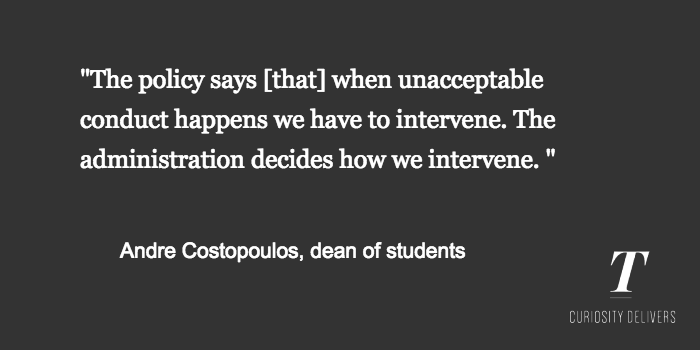
“Some of the elements in the [SAP] [are] clearly implementation, and some of them are policy, and you have to separate the two,” he said. “The policy says [that] when unacceptable conduct happens we have to intervene. The administration decides how we intervene. How do we make sure that the spirit of this policy is respected in this community [….] That’s completely different to the policy conversation. Implementation is […] the university administration in partnership with the student associations.”
Talia Gruber, another member of the SAP working group, explained that the benefit of writing procedures into a policy was the policy’s permanence.
“Right now, we have a lot of things in the policy that [the McGill administration] would like to see in the implementation guide,” she said. “The reason that we want so many things in the policy is that policies are institutionalized and once they’re passed you can’t change what’s in them. We’ve come up with some really good compromises […] like putting things in the implementation guide, but having a caveat in the policy that says, ‘There is this guide, and it’s going to be used.’”
Costopoulos explained that other avenues of discussion between the working group and the McGill administration include the interpretation of a McGill Context, as outlined in Article 8 of the Code of Student Conduct. The current interpretation of the Article is that events held by student associations off-campus do not fall within the McGill context. Consequently, McGill will be unable to conduct a disciplinary investigation into any alleged sexual assaults that occur during such an event.
“It’s one of the points that we’ve been discussing and I think we’re going to continue to be discussing,” he said. “It’s a matter of how we’ve interpreted it over the years, and interpretations are always subject to revision because the context in which we live changes all the time.”
MacArthur explained that many individuals have been involved in shaping the SAP in the two years since its inception, include students, administration, faculty members, as well as campus groups.
“At a certain point last year, about March, we were considering […] bringing [the SAP] to Senate,” she said. “But […] stakeholders were feeling like we could do more consultation with regards to the anti-oppression aspect of the policy [….] At that point, we stopped the trajectory we had set out and started doing more consultation. [This February,] I think we felt like we had done as good of a job as we could of incorporating different experiences, [and] different approaches [into the SAP].”
Going forward, the SAP will be reviewed by members of the administration, including the dean of students and the office of the deputy provost (Student Life and Learning). Following any revisions to the SAP, the group hopes to tentatively present the policy to Senate this March.

a, News, PGSS

PGSS Council discusses $40,000 membership fee surplus

The Post-Graduate Students’ Society of McGill University (PGSS) learned of a $40,000 surplus in general membership fees from the latest budget fact sheet presented at its Feb. 17 council meeting. Council also heard two presentations from representatives of new student federations: The Association for the Voice of Education in Quebec (AVEQ), and the Quebec Student Union (QSU).

Budget surplus

Due in part to the PGSS Special Projects Fund deficit, mainly from legal fees incurred after their disaffiliation from the Canadian Federation of Students (CFS) in 2009, PGSS as a whole runs a current deficit of over $600,000.  In contrast, the most recent budget fact sheet made available to PGSS membership highlighted a $40,000 surplus in the society activities fund.

“The $40,000 that's projected for next year, that means money that we had budgeted for this year to spend, and we will not,”  PGSS Member Services Officer Brighita Lungu said. “The $40,000 comes from these budget lines that I have picked that could have been much better spent.”

This surplus is from the pool of money coming directly from student fees, paid into by all PGSS members. Lungu expressed urgency to spend this money soon, despite PGSS running deficits in other areas of its budget.

"My personal opinion is that we've been hearing bankruptcy all year, and that does not encourage anybody to spend anything," Lungu said. "This is money we have to use, that we have to spend. We cannot end the year and not have your money spent, because this is your fee."

These funds do not alleviate deficits in other areas of the PGSS budget, which will be worked out in the coming semester.

“We have to make what we have in hand work for the next year,” Financial Affairs Officer Behrang Sharif explained.  “Definitely, we are going to have discussions about how we are proposing the budget that next year we will not have this deficit increase more and more. It's currently $611,000, [and] by the end of the year we are hoping to be in the same place.”

AVEQ and QSU

Representatives from AVEQ and QSU gave presentations on the structure of their respective student federations, and how they differ from one another in terms of membership and voting.  Sofia Guerrieri, an internal relations coordinator for AVEQ, explained how the federation’s financial and institutional structure will serve PGSS, by virtue of a separate commission, funded separately, for graduate studies students.  

“In student organizing, especially at the provincial level, there's often an overrepresentation of undergraduate students,” Guerrieri said. “By giving graduate students a commission […] with its own budget, it’s recognizing that graduate students have different priorities, different rights, and [that] those need to be addressed at a different level [….] By having its own budget, the graduate studies body is granted relative autonomy within the association.”

QSU set itself apart from AVEQ in terms of its voting system. While AVEQ uses a one association, one vote method, QSU requires a motion to go through two different rounds of voting.  

“For a motion to pass…it has to go through two votes,” explained Caroline Aubry, General Coordinator of QSU.  “First […] a majority of associations has to be in favor of a motion for it to pass to the next level, and the next level is a semi-proportional system. This level aims to make sure we have at least 40 per cent of individual members that are in favor.”

PGSS Equity and Diversity Commissioner, Régine Debrosse, highlighted this difference as fundamental to PGSS’s decision on which federation to ultimately decide to affiliate with.

The way [AVEQ’s] voting system works is one association has one vote,” Debrosse said. “[This] means that the biggest student unions in Quebec— the biggest universities— will not go with them.  If you have 60,000 members and you’re being told you’re going to have as much power as a student union that has 2,000 […] these people are not going to jump in that boat [….] It means that AVEQ is going to be small […] and QSU will be the bigger boat. PGSS's decision is the following: Are we jumping as big player in a small boat, or as a small player in a big boat?”

Black Power and Beyonce
a, Arts & Entertainment, Music

Black lights over America: How Black Power is transforming pop culture

Between Beyoncé’s Super Bowl show, Kendrick Lamar’s Grammy performance, and Kanye West’s assault on reason, Black Power is igniting every pop culture barricade in sight in defiance of convention.

When Beyoncé released “Formation,” fans expecting another version of the club-ready recycled trap hit “7/11” were left distraught. Gone was the gif-ready, pointlessly sexualized Bey. Instead, they heard Beyoncé, the “Texas bama” representation of Southern blackness. In the video, the only white people shown are police raising hands in defeat to a breakdancing black boy as Louisiana bounce artist Big Freedia say “I like cornbread and collard greens, bitch.” Among images of ravaged Louisiana, Creole culture, and police brutality, Beyoncé intensifies her already ferocious self-strengthening aura by going deeper inside her blackness.

Set in contrast to a canned Coldplay performance at the Super Bowl, “Formation” showed why Coldplay needs to play songs from over a decade ago and Beyoncé can release a song at random and have the world eating Red Lobster with her. Her Blank Panther uniform only stressed that “BELIEVE IN LOVE” only works when thousands are forced to hold up placards on TV.

A week later at the Grammys, as other artists were playing tribute songs and pop hits, Lamar came in, no compromises, guns blazing with a medley of the self-loathing, dystopian “The Blacker the Berry,” the determined anthem “Alright,” and a searing unreleased verse on the black abuse and white brutality.

On “Blacker the Berry,” Lamar reclaimed black culture: “Vandalize my perception but can’t take style from me.” He then throttled his audience, shoving self-determination down their throats, “As we proceed to give you what you need.” With the subsequent “trap our bodies but can’t lock our minds” then “lock our bodies but can’t trap our minds” chants, Kendrick shattered the traps and locks of institutionalized racism. On the call to arms of “Alright,” Lamar sermonized the audience on perseverance on a stage of fire. For the final song, he flew into a frenzied verse on the destruction caused by the Trayvon Martin murder, accelerating into a final defiant Compton-inscribed image of Africa as the lights went out.

Throughout his performance, Lamar conjured up and fused together Nat Turner, Bobby Seale, the Watts Riots, the Rodney King Riots, and Trayvon Martin. While Taylor Swift won the Album of the Year over him and brought the Grammys back to 1989, Kendrick brought the world back to 2012, 1992, 1965, 1831, then finally into the time-transcending reminder that modern Black Power is a “conversation for the entire nation. This is bigger than us.”

If Kendrick is the polemicist, Kanye is the paragon and impresario of new black power. On his new, densely-cluttered, densely-combative (unfinished?) album, The Life of Pablo (TLOP), Kanye fires at everything from Nike to Taylor Swift to greed to himself. TLOP, as a self-proclaimed gospel “album of life,” features a heavy dose of iconic samples ranging from Nina Simone to Ghostface Killa to a new protégé Desiigner to the most self-reflexive of all, himself. Climbing to fame through his production skills, Kanye will however always have a stronger musical ear than a musical voice. And he knows it. As such, Kanye takes it upon himself to make music for and by his community. On TLOP, a slew of notable and rising rappers are featured: Chance the Rapper, Travi$ Scott, Young Thug, and Ty Dolla $ign. Yet, affirming the power and scope that Kanye holds, he also features the youngest ever Pulitzer prize-winning composer Caroline Shaw on a track with Frank Ocean.

In the most unconventional of album rollouts, Kanye captivated the world with a series of legal-pad tracklists, an otherworldly—perhaps totalitarian—fashion show, a Saturday Night Live-esauqe tour de force, all buttressed by Twitter rants ranging from “Don’t tell me Lebron had a bad game. What yo jump shot look like???” to “There is so much positive energy right now … Let’s stay on this Ultra Light Beam…” That Kanye can take the world hostage over an unfinished album and mildly crazy twitter musings marks the cultural territory gained by the new Black Power Movement.

It is then no surprise then that all these artists have royal epithets. A new, black, cultural power is deriving from Queen Bey, King Kendrick, and Yeezus. We’re just here to bear witness.

Martlet volleyball
a, Martlets

Volleyball: Martlets advance to RSEQ Finals and clinch CIS Championship berth

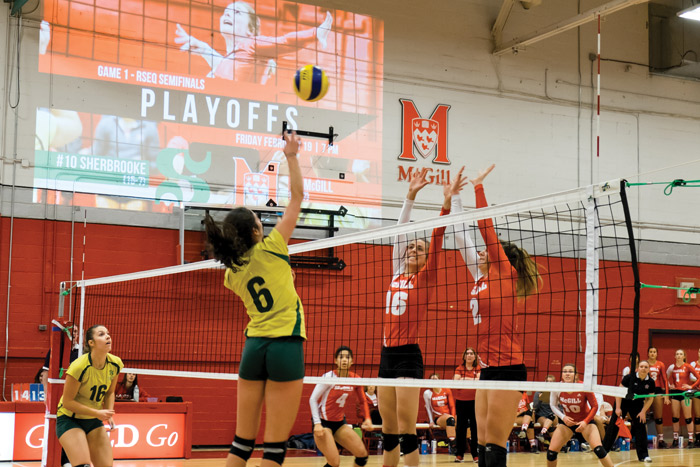
Despite dropping a 3-0 loss to the Sherbrooke Vert et Or (15-7) in their first game in the RSEQ semifinals on Friday, the Martlet volleyball team (15-7) rebounded on Saturday and Sunday to not only advance to the RSEQ Finals, but to clinch a berth at the CIS Championships. Though statistically, Sherbrooke came away with a rather commanding win, the Martlets steadily found their groove throughout the game, losing the respective sets by scores of 25-19, 25-18, and 25-23, with the most exciting game play coming in the last stanza, when the Martlets nearly stole the win in the set. The momentum generated towards the end of Friday’s game helped translated into two consecutive wins on Saturday and Sunday by scores of 3-2 and 3-0 respectively.

“Sherbrooke served really well today, and very aggressive,” Martlets Head Coach Rachele Beliveau said after the loss on Friday. “We couldn’t play our offence like we usually play.”On Saturday and Sunday, McGill improved their offence game by game to overwhelm Sherbrooke. On Friday, Sherbrooke bested McGill offensively in hitting proficiency, kills, aces, and blocked shots. Defensively for the Martlets, miscommunication led to rogue balls being missed on more than a few occasions. Similarly, on Saturday, McGill once again dominated Sherbrooke in digs, but fell short in kills, blocks, and aces; however, enhanced defence and aggressiveness allowed the Martlets to cling to the win. The weekend saga culminated full circle in the deciding match on Sunday, with the Martlets displaying more confidence, poise, and tenacity than they had all weekend–besting Sherbrooke in digs, aces, and kills to dominate the game. Beliveau credits the comeback to increased aggression on the ball and enhanced execution of the game plan.

“We need the ball to be at the net, and then we’ll become very good offensively,” Beliveau elaborated. “And the ball wasn’t there [on Friday]. It wasn’t bad, but it wasn’t there on the net.”

Despite the disappointing loss, McGill progressively improved their game throughout the match. At the beginning of the second set, McGill and Sherbrooke traded points, with McGill hanging onto the lead up until midway through the set. In the second half, key missed blocks led to a ommanding lead lead for Sherbrooke, which they managed to hang onto despite a late-set surge by the Martlets, led by energizing blocks by Robitaille and powerful shots by junior power-hitter Marie-Eve Dorion.

In Friday’s third set, the Sherbrooke defence looked sharp, saving what looked like sure points for McGill. The end of the set was the high point of the game for the Martlets, with McGill back coming from a deficit to tie the game 23-23. Sherbrooke would ultimately pull ahead after an aptly placed spike, and then win the game off the technicality of a Martlet player accidentally touching the net. The last set on Friday would set the tone for the Martlets for the rest of the weekend, giving them indispensible momentum and positivity that contributed to the series win, even in the face of a rowdy crowd at Sherbrooke on Saturday and a fervent Sherbrooke comeback attempt after McGill put them down 2-0.

“At the beginning, I think [our players] were nervous,” Beliveau said. “And then at some point they just started to get it together but it just gave the momentum to Sherbrooke, and if you do that with Sherbrooke, they’re going to go up.”

Though Sherbrooke commanded the win on Friday, the Martlets shook their nerves and wrestled back the momentum. Sherbrooke notably ended the Martlets Championship hopes last year by beating them out of a playoff berth, but this season, the Martlets bested Sherbrooke 4-3 through seven matches. With the strong response in a tightly contested game on Saturday at Sherbrooke, followed by a dominant performance on Sunday, the Martlets have finally solidified their superiority over their cross-provincial foes. The Martlets look forward to their next series, the RSEQ Finals against Université de Montreal, coming up this weekend.

“Our programs have been working really hard to be in the top two of our league, and this is what we’ve reached this year,” Beliveau concluded. “Now, we have to make it concrete with the playoffs.”

Read the latest issue

Read the latest issue