

Latest News

a, Student Life

Ask Tribby

Dear Tribby, 

This summer I met the most amazing guy at my internship in California. We met on the first day of work and hit it off immediately. While he’s studying finance at UCLA, I’m a management student at McGill. We still communicate through Skype and text messages every day, but I feel like the distance between us is getting farther and farther. We never defined what was going on between us or talked about our plans after the summer. Is this just a summer fling or an actual relationship?

—Distance Makes the Heart Grow Fonder?


Dear Distance Makes the Heart Grow Fonder:

Summer flings—they end as fast as they come. They’re fun while they last, but aren’t too serious. Before you get too bogged down by what he’s thinking, ask yourself where you want this relationship to go; you’ve got some stake in this too.

If you’re unsure of what he thinks of you, try looking for hints through your conversations with him. Did he ever refer to you as his partner? How did he introduce you to his friends in California? If he hasn’t made it clear that he wants this relationship between you two to continue, there’s a good chance he viewed this relationship as a summer fling.

Also, what makes you feel like you’re drifting apart? Could it be that you’re preoccupied with the start of classes and a new semester? Does he start replying in one-word texts and constantly have reasons to postpone your Skype sessions? This may also tell you what he thinks about this relationship, and whether he values it as much as you do. If you feel like the desire to stay together isn’t reciprocal, let it end and enjoy the new school year at McGill! Who knows what will happen next?

However, if you feel that both of you want to take this relationship to the next level, keep in mind that although the long distance is difficult, it certainly isn’t impossible. Making it last requires a lot of communication. Discuss with him your plans for your future with him and what you want out of this. You have to make sure that both of you are on the same page for your relationship to work. Whatever ends up happening, just remember that you had a great summer meeting this amazing guy, and make the good memories last.

Yours truly,

Tribby


Dear Tribby,

I came back to my apartment after a summer away only to discover little bugs in my dried oats and pasta that I kept in my kitchen cabinet over the summer. What are they and what should I do about it? Help!

—Bugged Out


Dear Bugged Out: 

Throw it away! It is never a good sign when there are bugs in your food.

Although they contain a ton of protein and nutrients, they contain even more bacteria and induce allergic reactions in some people. Don’t be too hard on yourself though; whether or not you’re completely devoid of hygiene, these insects probably weren’t your fault. Often food from the supermarket contains insect eggs, which only hatch in warm and humid summer conditions.

With bugs in your dried oats and pasta, chances are there are also bugs in other food items that you left behind over the summer. My suggestion for you is to look through your entire kitchen—toss those old Oreo cookies that you left in your cabinet, and throw away that carton of milk you forgot about in your fridge! Turn it into a kind of spring—I mean fall—cleaning!

Yours truly,

Tribby

a, Arts & Entertainment, Music

Album Review: Sultans of String – Symphony!

Sultans of String have always had an interest in expansion.  Though the band started off in 2007 as a duo, they eventually grew to a quintet.  On their latest album, Symphony!, they take that growth to a new level with the addition of a full symphony orchestra.

It’s a risky gambit that pays off remarkably.  Though performances by non-classical musicians with orchestras frequently feel gimmicky or forced, the combination has yielded rich, evocative arrangements for the Sultans’ music.

This isn’t to imply that the compositions would have been dull without the addition of the orchestra. The fluidity with which the Sultans transition between, and combine styles from around the world, is extraordinary.  Opening track “Monti’s Revenge” has a rhythm that is heavily influenced by Klezmer music, a Yiddish/Isreali genre, while the next track, “Palmas Sinfónia,” starts off with a funky guitar lick reminiscent of Nelly’s “Ride Wit Me” and quickly moves to a rumba-like rhythm.  On “Emerald Swing,” the Sultans manage to combine a Western hoe-down feel with a gypsy jazz-inflected melody.

Unfortunately, the Sultans don’t always play to their strengths.  Certain aspects of the album’s four ballads are enjoyable; “Sable Island” sounds like the love child of David Gilmour and Graham Parsons, and the strings on “Luna” call to mind Arcade Fire’s “Neighborhood #1 (Tunnels).” But overall, these songs are fairly indistinguishable from one another.

Thankfully, in general, the Sultans, stick to a brightly paced and highly interactive musical pastiche, making Symphony! an engaging and worthwhile listen.

a, News

University rankings: what are they worth?

Last Tuesday, McGill lost its claim as the top university in Canada to the University of Toronto, according to the 2013 Quacquarelli Symbols (QS) World University Rankings. With the release of more rankings approaching next month, the Tribune set out to understand what university rankings actually mean, and how students—both current and prospective—should approach them.

Ranking systems for higher education institutions have existed for over a century at regional, national, and international levels. According to Alenoush Saroyan, a professor in McGill’s department of educational and counseling psychology, students pay attention to university rankings because of the large financial investment involved in a university degree.

“There’s an absence of information about universities and a desire to have some kind of a comparison between institutions,” she said. “In the absence of any other framework that provides them with that information, the ranking exercise fills the gap.”

According to Associate Registrar of Recruitment at McGill, Jocelyne Younan, there are three major rankings that compare the world’s universities—the QS Rankings, the Times Higher Education World University Rankings, and the Shanghai Rankings. In each case, universities are given an overall score using quantitative data from the institutions, as well as qualitative measures of assessment like surveys.

“You have to look at what a particular ranking measures—publications, presence of Nobel-prize winners amongst faculty or alumni, research activity, teaching, etc.—to determine which ranking suits your particular academic interest,” Younan said.

As one of the most widely recognized international rankings, QS considers over 2,000 universities every year and ranks the top 800. Danny Byrne, editor of TopUniversities.com—the website that publishes QS rankings—said that their methodology is the result of a collaboration between journalists.

“QS World University Rankings were first launched in 2004 as a way to give a rapidly expanding contingent of internationally mobile students a more objective way of comparing universities around the world,” he said. “We wanted to produce an alternative ranking that took into account areas of more direct relevance to students, like academic reputation, employability and student-to-faculty ratios.”

However, international rankings such as QS have also been criticized for evaluating the quality of an educational experience based on broad and often subjective criteria such as academic reputation. McGill Principal Suzanne Fortier said that McGill’s drop from 18 to 21 in the QS Rankings this year is not “significant.”

“These aren’t very accurate scientific studies, so the margin of error is big,” Fortier told the Tribune. “However, we must watch to see whether this is a trend or a blip. And more importantly, we must look carefully at the data these rankings will provide us, and take advantage of these to see where we can put our efforts, particularly where it aligns with the goals of our university.”

For Saroyan, the methodology of international rankings is ultimately flawed for numerous reasons. One of these is that they base categories such as university reputation on survey results. For the Times World Rankings, these surveys only have a one per cent return rate. Additionally, the use of “proxy indicators” such as the ratio of students to faculty, assumes that a university fulfilling these criteria will automatically provide a good educational experience.

“If University X has a Faculty of Law [or a] Faculty of Medicine that has a very high reputation, that reputation overflows to other aspects of that university,” Saroyan said. “So even though Faculty of Religious Studies or Arts in that university may actually be pretty bad, it benefits from the overall reputation of the university.”

“There’s an absence of information about universities and a desire to have some kind of a comparison between institutions.”

Byrne, however, said that the measures they employ are deliberately generic.

“One of the major difficulties in compiling an international ranking is that many of the data sources that make sense on a national level—say, average exam grades of students admitted—aren’t always globally available or straightforwardly comparable,” he said. “We therefore have chosen to measure broader performance areas such as academic and employer reputation, that are of clear relevance to students and of importance to all universities, as opposed to narrow and prescriptive measures that reward a given university model or system at the expense of another.”

Byrne pointed to the QS World University Rankings by Subject as one way that QS has addressed the tendency of overall rankings to privilege large universities over specialist institutions. He said that ultimately students should take international university rankings with a grain of salt when deciding which university to attend.

“We would never recommend that anyone base their university choice purely on a ranking table,” he said. “But they can provide an invaluable starting point in identifying institutions around the world that are strong in a given field, or in an area that is of particular importance to you.”

While the methodology of university rankings may be widely debated, Post-Graduate Students’ Society (PGSS) Secretary-General Jonathan Mooney said students are also highly aware that the financial situation McGill currently faces is a cause for unease when considering the university’s ability to maintain its international reputation.

“McGill does not have the same level of funding as its peers, and cannot continue to offer a top-quality education with insufficient resources indefinitely,” he said. “I think Quebec society needs to come together and make clear that properly funding education should be a top priority.”

Ultimately, Younan said there is no need to “push panic buttons” when considering McGill’s lowered position in this year’s QS rankings. She  pointed to the fact that McGill’s QS score this year (90.6) was almost exactly the same as last year’s (90.43), and that McGill actually increased their score in the Shanghai Rankings from 63 to 58. However, she said McGill will continue to pay attention to their international rankings and seek to improve them as the university looks to the future.

“The competition for top student and profs (sic) is global and fierce, so we need to stay in the game and continue our focus on excellence in teaching and research for which we are known around the world,” Younan said.

a, Student Life

Making the call when it comes to alcohol

Although frosh has come to an end, the consequences of frivolous alcohol consumption are an ongoing reality for many university students. Often the responsibility of caring for a queasy companion falls on a friend or a residence floor-mate.

During this year’s frosh and Orientation Week, the McGill Student Emergency Response Team (M-SERT) acted as the primary first-aid coverage for the week’s events. A group comprised of student volunteers who are all certified first responders, M-SERT treats emergencies from muscular-skeletal injuries to anaphylaxis, but the majority of their calls pertain to alcohol and drug-related problems.

M-SERT’s chief objective during this year’s frosh was to get out the message that as soon as an individual recognizes an emergency situation, one should call for help rather than try to handle the situation themselves. Students should call M-SERT if it occured at a McGill event or in residence, and an ambulance if it’s elsewhere.

“In the past, we had issues where coordinators and frosh leaders were in the way of the call and trying to [give treatment] themselves,” Director of M-SERT Thomas Schamhart says. “Legally, [if you’re giving any form of first aid, as a responder] you’re completely liable for anything that happens if you’re neglectful and drinking alcohol.”

As a preventative measure to stay safe, students should be prepared and know in advance where they’re going, with whom they’re going out, and how they’re getting home.  Schamhart’s advice is simple: “Never be alone; you need someone to recognize that you are [in] a first-aid emergency.” In cases where you do find yourself alone, Schamhart recommends McGill’s Walk Safe and Drive Safe services, which facilitate safe travel at night.

If you’re in a situation where you think a friend has had a few too many drinks, the number one thing to remember is communication. The first step is to assess their level of consciousness—is the person alert and responsive to voice, to pain, or not responsive at all?

“Ask them: do they know where they are; do they know their name; do they know what day it is? If [someone] can’t answer those questions, that’s a bad sign,” Schamhart explains.

For this reason, checking in and re-evaluating your friend’s state is crucial. If you’re familiar with a friend’s reaction to alcohol, it may be easier for you to determine whether this is actually a cause for concern or not.  For a person you are less familiar with, communication is even more important.

Asking an individual if they want an ambulance is one way of evaluating the situation. “People kind of forget [that] it’s a good question to ask, even if it’s your friend,” Schamhart explains. “It also saves you from making the decisions. They’re the one making the decisions. They’re the one [ultimately] going to the hospital.”

Also look out for and inquire about other potential injuries. You should ask questions like “Did you fall?” and “Did you hit your head on the counter?” says Yassmin Behzadian, M-SERT vice-president training. “Head injuries are very serious, it’s almost immediately 911.” The same goes for vomiting up anything abnormal, like blood, she added.

When a friend just needs to turn in for the night, there are other ways you can help out. You may want to get a blanket or sweatshirt, because alcohol depresses activity in some areas of the brain, thereby dulling the senses, and your friend may not realize how cold they are.  Consuming alcohol also causes dehydration, which may be compounded if a person is vomiting. Giving a friend a glass of water will help re-hydrate them and reduce symptoms like headaches, muscle cramps, and dizziness.

Once your friend is in bed, try to check on them once in a while to make sure they’re okay, and that they haven’t rolled over into a weird position or vomited in their sleep.

The M-SERT staff stress that students should not hesitate to seek help, whether it is from a sober roommate, floor fellow, M-SERT, poison control (mainly in the case of drug use), or 911. According to Schamhart, people are often deterred by the potential repercussions of being caught using substances.

“Do not be afraid of the consequences, as keeping your friend healthy is the most important choice you can make,” Schamhart advises. If you’re not in a condition where you can provide that care, it’s your responsibility to find someone who can.


M-SERT’s office is located in room B23 in the SSMU Building. A team is situated in Molson and La Citadelle Residences every evening from 6p.m.- 6a.m. They can be reached by contacting McGill Security Services at (514) 398-3000. Office telephone: (514) 398-5216.

a, Opinion

Syria situation demands critical analysis

In my final year of high school, I took a course on current affairs. My teacher was very enthusiastic about instilling an interest in being informed, but recognized our unwillingness to spend hours reading and writing during the dog-days of spring before graduation. Thus we spent most of our time debating social issues about which we were already relatively knowledgeable, and stayed away from discussing international issues that would require more in-depth background research to truly understand.

It is not surprising that some tend to shrink away from international issues. The world is a complicated place, full of cultures and political systems totally unfamiliar to us. This lack of familiarity in turn can deter people from staying informed—there may be a wealth of information out there, but the breadth of such information in and of itself is intimidating. Where do we start? What sources do we trust? How much do we have to know before we can express an opinion without it getting shot down by someone who knows more, or who has more conviction in their ideas?

In August, we learned of accusations that the Assad regime in Syria had perpetuated a mass chemical weapons attack on its citizens. The attention dedicated to this event made it more of a faux pas to remain ignorant about foreign affairs. There are several reasons for this. First of all, the nature of events like this are easily compartmentalized and made accessible. It is a lot easier to read breaking news on the UN’s investigation in Syria than it is to follow the day-to-day logistics of its two-year, brutal civil war. Moreover, people are naturally more inclined to tune in when it seems that the news might affect them personally—the tense negotiations between the U.S., Russia, and Syria have left many Western citizens and scholars uneasy about the prospect of international war.

This leads to the question of whether or not our periodic interest in these crises overseas actually increases our overall awareness about the topic in question. What is the true effect of reading a New York Times article or two about Syria? It could be highly informative, or procure some unintended consequences. When people only pay attention to current events at such crisis points, it leaves them more vulnerable to unreliable and biased information. At best, critical consumers will acknowledge these limitations  when forming opinions. At worst, we might ignore it, and proceed to make assumptions that undermine the complexity of the issue at hand.

American public opinion on Syria, for example, has been shaped enormously by the effects of war fatigue from Afghanistan and Iraq, as well as the effects of the Arab Spring.  The anniversary of the 9/11 attacks also impacted many opinions on the prospect of negotiations and a possible military strike. As often occurs with such controversial topics, politicians, media outlets, and ordinary citizens alike have a disconcerting tendency to make demons of important players in the struggle—comparing President Bashar al-Assad to Adolf Hitler or insinuating that the motivations of rebel groups are purely jihadist. The reality of Syria’s civil war is far more complex than these statements imply; while many acknowledge this, harsh rhetoric that whitewashes difficult issues create sound bytes that leave lasting impacts on unsuspecting consumers of information.

At the basic level of consumption that most people employ, there will always be a trade-off between the acquisition of knowledge and the inadvertent acquisition of false premises that we use to construct our opinions. This does not mean that we must comb through every possible news outlet to form an opinion, or otherwise avoid the news at all costs. Rather, we must always be curious, but humbly acknowledge our own ignorance and remain skeptical of everyone, including ourselves.

a, Science & Technology, Student Research

McGill’s medical clubs

There are a variety of medical clubs at McGill that provide undergraduate students with resources and unique opportunities. In case you were overwhelmed at Activities Night, SciTech interviewed two of these organizations to find out what they’re all about. 

Medical Direction

Medical Direction is one of McGill’s Pre-Med clubs that reaches out to any undergraduates interested in a career in medicine. The club hopes to act as a reliable source for students considering the field by providing them with as much information and resources as possible.

“Ultimately, we want to help students make an informed decision and guide them in the right direction,” VP Academic Marian Chen explained. One of the most popular services offered by Medical Direction is their shadowing program, which provides students with the opportunity to interact with doctors and gain a better understanding of the profession.

Through Medical Direction, students can also get involved with Global Medical Training (GMT) —a program that provides students the opportunity to observe and assist in healthcare for medically deprived communities in Central American countries. With so much work in the classroom, GMT offers students the chance to apply their knowledge by participating in medical assessments and treatment of patients who have limited public healthcare systems. Chen encourages all students passionate about healthcare to look into the program.

Medical Direction’s next event is a medical school symposium on Thursday Sept. 19th from 6-7:30p.m. in Leacock 132. You can find more details about the event at md.sus.mcgill.ca


Student Association for Medical Aid

The Student Association for Medical Aid (SAMA) is a non-profit, student run organization at McGill. It provides students with the opportunity to actively participate in various healthcare initiatives with the goal of helping vulnerable individuals and communities around the world.

According to U2 quantitative biology student and three-year member Alex Hofkirchner, SAMA has two main focuses: promoting local initiatives and medical aid abroad. During the school year, the club devotes its time to fundraisers for its summer projects, such as club nights, samosa sales, and its annual Bachelor/Bachelorette Auction. However, it also participates in various Montreal-based volunteering initiatives like Santropol Roulant, which provides a “meals-on-wheels” program to older citizens.

Over the summer, SAMA sends its members around the globe to carry out humanitarian aid projects. Hofkirchner explains that the focus of the projects is the organization of a temporary mobile clinic to screen and treat individuals in the most impoverished communities. Current projects are planned for Ethiopia, Kenya, and Uganda.

Hofkirchner joined SAMA because it stood apart from other clubs with similar goals. “I noticed how close existing SAMA members were. Meetings felt more like class reunions than weekly gatherings,” he said.

He also liked that SAMA gave its new members a variety of responsibilities. “Even in my first year with SAMA, I was taking on responsibilities from scheduling fundraiser shifts to helping with coat checks and designing promotional posters.  The inclusivity of the group really drew me in.”

Like many members, Hofkirchner’s favourite part of his involvement was the trip abroad. “Along with three other members, I travelled to Namatala, Uganda where we organized a three-day medical clinic that treated 1633 individuals,” he explained. “The experience was truly incredible.”

SAMA will be having its recruitment meeting this Thursday at 7p.m. in Macintyre Medical Building Room 522

a, Arts & Entertainment

The dirty dozens

12 Years a Slave is agony in the fullest sense of the word. Chronicling the life of Solomon Northup, a free black man from New York kidnapped and sold into slavery in 1841, the film sees director Steve McQueen (Hunger; Shame) at the very zenith of his formidable artistic talent. It takes a horrific portrayal to capture a horrific institution. 12 Years is a mesmerizing, intoxicating tale of man’s capacity for both unspeakable cruelty and incalculable courage.

Solomon (Chiwetel Ejiofor) is first introduced as a prosperous and cultured family man. After temporarily traveling to perform with a pair of unscrupulous circus performers, one bad night of drinking is all it takes for him to wake up in chains. Initially, Solomon is defiant and indignant, as one might expect. “I don’t want to survive,” he says; “I want to live.” This attitude is quickly beaten out of him.

This, in fact, is the main reason why 12 Years a Slave is easily one of the most agonizing films of the year. McQueen has never been known to pull punches, and he certainly doesn’t here. The violence is swift, brutal, and often unexpected. There are several scenes so ghastly, so terrifying, that I trembled and flinched in ways I have never done before during a film. Yet, the pain one feels sitting in the audience is infinitesimal to the misery experienced by someone born and sold into slavery. This is the absolute worst aspect of the film’s on-screen cruelty: the entire time, one’s mind is racing with the words, “This once happened. People did this. People still do this.”

It is true that Solomon’s story is full of wickedly inhuman humans; as Paul Giamatti’s slave trader says, “My sentimentality extends the length of a coin.” Yet, this brutality also makes the flashes of courage all the more formidable and inspirational.

Lupita Nyong’o gives a breathtaking performance as Patsey, a slave encountered by Solomon once he is sold to the Epps plantation. Patsey is a raw personality within an equally raw film, and Nyong’o captures the character with a fullness and deftness that belies her relatively nascent career.

The other knockout performance comes from Ejiofor. He succeeds in imbuing the role of Solomon with gravitas and grace, but Ejiofor’s best moments are when the fragility of the character shines through. Solomon is neither hero nor saint, and Ejiofor’s portrayal is entirely human. The twin powerhouse performances of Ejiofor and Nyong’o are impactful even with an exceptionally talented supporting cast (including the always-on-form Michael Fassbender and Brad Pitt).

The smart screenplay by John Ridley is impressively nuanced, capturing much of the complex intersections of race, gender, and economic status that existed among slaves and slaveholders. Hans Zimmer’s score features deliciously dissonant percussive turmoil, in addition to the typical panoply of melancholic strings. These aspects, as well as the film’s impeccable pacing, editing, and cinematography, makes 12 Years one of the crown jewels at this year’s Toronto International Film Festival.

Here, Steve McQueen achieves one of the holy grails of cinema—12 Years a Slave holds up a mirror to the darkest forces of humanity, and forces us to look. I shed tears, not just for Solomon Northrup, but also for the countless souls who have suffered and continue to suffer under the barbarous practice of slavery. And judging by the chorus of sniffles rising from the audience, I wasn’t the only one.

12 Years a Slave received its world premiere at the 2013 Toronto International Film Festival, winning the People’s Choice Award. It is set to be released Oct. 18.

a, Arts & Entertainment

A fresh angle on human relationships

Visitors pass through a small room, full of bold, layered colour, that leads them into to Fahmida Hossain Urmi’s contemporary expressionistic Angles of Relationships exhibition at Ame-Art.

Ame-Art is a non-profit collective that houses Mile End artists’ work and displays one gallery at a time, currently Urmi’s second exhibit. After receiving her masters in art in her native country of Bangledesh, Urmi moved to Canada to create and display her work, slowly integrating with Montreal culture after learning French and English. At the vernissage of Angles, Urmi explained  that her greatest joy from the show is finally feeling like a true member of the art community.

Urmi’s paintings portray this theme of interpersonal connections through layered colour and inconsistently-shaped bodies. They are made with thick layers of paint, creating a heavy effect.

“Each colour represents the synopsis of a feeling,” Urmi explains. The paintings are so full because people always carry many emotions, but only present the one currently felt the most.

Without faces, or even defined shapes,  the colours express the entirety of the paintings’ message. There are some human forms silhouetted in several pieces, but they have neutral stances and only convey expression through their surrounding colour and proximity to similar silhouettes. Each painting presents itself as a collection of distinct shapes and colours that somehow flow together and evolve with further examination.

“They capture an emotion. Certain moments we feel, but don’t notice. Then there’s a spotlight and you realize your connections to those around you,” Urmi says.

Angles of Relationships 06, 07, and 08 are a set of paintings which centrally feature what is vaguely the same facial shape outlined in black, with an assortment of individual colours and details. Each of the three display a different feeling based on the same shape: 06 is chaotic, 07 is playful, and 08 is inspiring. These three pieces include magazine pictures, making them the only ones to include a medium besides paint. The picture on 08 includes the caption “Life’s Too Short,” and, painted underneath, “Live it!”. These are the only words in the entire exhibition.

Of Urmi’s 23 pieces, 11 bear the title Angles of Relationships, while the rest are either Sans Nomer or from her previous exhibition, Prismatique Relations. These other paintings are not as dramatic as her newer work, but add to the theme of the gallery. Regrettably,  even with these additions, the works only take up one room.

Although this exhibition includes interesting paintings that may be enjoyable to ponder, there is only one room at Ame-Art, and the quality of the art does not make up for its small quantity. For this reason, Angles of Relationships does not merit the 20 minute bus or bike ride from McGill campus. However, if somebody were to find themselves within a block or two of the galleries, they might want to take a few minutes and peek inside.

Angles of Relationships is on at Ame-Art (5345 Ave. du Parc) until Sept. 22. Admission is free.

a, News

What happened last week in Canada?

Nova Scotians demand action against mill

Residents of Pictou, Nova Scotia, are demanding that the Northern Pulp Nova Scotia Corporation mill be held accountable for damages to health and to the environment caused by its pollution since its opening in 1967.

Discussion surrounding the mill and its effect on residents has been a point of contention, as it remains a source of employment for approximately 250 residents of the area and puts millions of dollars into the economy of the region.

According to residents, pollution from the mill has begun to take a toll on the environment and the health of residents. The mill’s production of paper products results in the release of toxins into the air and waste being dumped into the surrounding natural area.

The town has the nation’s seventh highest rate of cancer per 100,000 residents of Canada’s 106 health regions. Residents who believe that the high cancer rate is due to pollution caused by the mill are demanding change.

Two local residents have created an online petition called, “Premier Darrell Dexter: Clean up the Pictou Country Pulp Mill,” which urges the premier to address the issue. The petition has received nearly 1,700 signatures to date.


G20 officer convicted three years later

On Thursday, Constable Babak Andalib-Goortan became the only police officer to date to be found guilty of using excessive force during the G20 protests of June 2010.

1,105 demonstrators were detained by police as a result of the G20 protests over three years ago, and many have criticized police for using excessive force. Thursday’s ruling found Andalib-Goortani guilty of using violence while arresting protestor Adam Nobody and detaining him in jail for over 30 hours.

The constable, whose sentence will be announced in November, faces a maximum sentence of 18 months jail time or a $5,000 fine. He is also charged with assaulting a member of the media with a weapon, a case that will proceed to trial in February.

The plaintiff, Nobody, is pursuing a $14.2 million lawsuit against officers implicated in the event. Multiple other civil cases, including a class-action lawsuit launched by 1,000 people, are awaiting court dates.

Yasmin Nakhuda loses court case to reclaim IKEA monkey

On Sept. 13, Darwin, the infamous monkey found strolling around an IKEA parking lot last year, was placed in the custody of an animal sanctuary.

He was seized from Nakhuda by Animal Services and placed in the care of Story Book Farm Primate Sanctuary in Sunderland, Ontario. Nakhuda, who had signed over ownership of the monkey to the City of Toronto earlier this year, sued the Sanctuary, claiming that the seizure of Darwin was unlawful on the basis that he was domesticated.

Ontario Superior Court Judge Mary Vallee dismissed Nakhuda’s claim, citing that Nakhuda’s ownership of Darwin was no longer valid the moment he escaped from her care.

“A high onus regarding provision of secure housing for wild animals is appropriate to place on their owners,” Vallee’s decision reads “Wild animals, particularly exotic ones, can be dangerous to the public.”

Aptly nicknamed the “IKEA Monkey,” Darwin originally lived with his previous owner, Yasmin Nakhuda, her husband, and their two children. Last December, at an IKEA in North York, Ontario, Darwin escaped from Nakhuda’s car and, soon afterwards, an image of him wandering the parking lot dressed in a shearling coat went viral.


Montreal student released from Filipino jail

Université de Montreal student Kim Chatillon-Meunier, age 24, returned to Canada on Sunday after spending several days in jail in the Philippines.

Chantillon-Meunier was in Manila for a government-funded internship working with impoverished women, when she was arrested on Friday at the Ninoy Aquino International Airport as she was about to board a plane out of the country.

Her quick release from jail can be attributed to pressure from the human rights organization KARAPATAN, and lawyers from the Philippines’ National Union of People’s Lawyers.

The Philippines’ Bureau of Immigration officers took her into custody Friday night due to her participation in one of multiple anti-government protests on July 22, many of which were deemed illegal for failing to gain a permit from the government to hold a demonstration. Chantillon-Meunier’s boyfriend  Emile Kinley-Gauthier, who was not arrested, said the two were merely observing the rallies.

The demonstrations fell on the day of President Benigno Aquino’s state-of-the-nation address, and were in protest of his administration’s alleged abuses of human rights.


Senator Wallin pays off falsely claimed expense money

On Friday, Canadian Senator Pamela Wallin finished paying off the last of the expenses that she had wrongly claimed, starting in December 2010 until November 2012. Wallin paid back the $100,600.98 plus interest—an additional $13,938.19—in personal cheques to the federal government.

Wallin’s senate expense scandal began in May of this year, when it was found that she was using taxpayer dollars for extra travelling expenses.

After paying her expenses Friday, Wallin made a public statement in which she accused the auditing firm who conducted the review of her expenses, Deloitte, as well as the Senate internal economy committee of treating her unfairly.

“Evidence that casts doubt on the correctness of the amounts owing was either ignored or disregarded during the review,” Wallin said in a statement released by her office.

Despie the scandal, Wallin has also said that she does not plan to resign as a Senator.

a, News

Principal Suzanne Fortier’s first week on the job

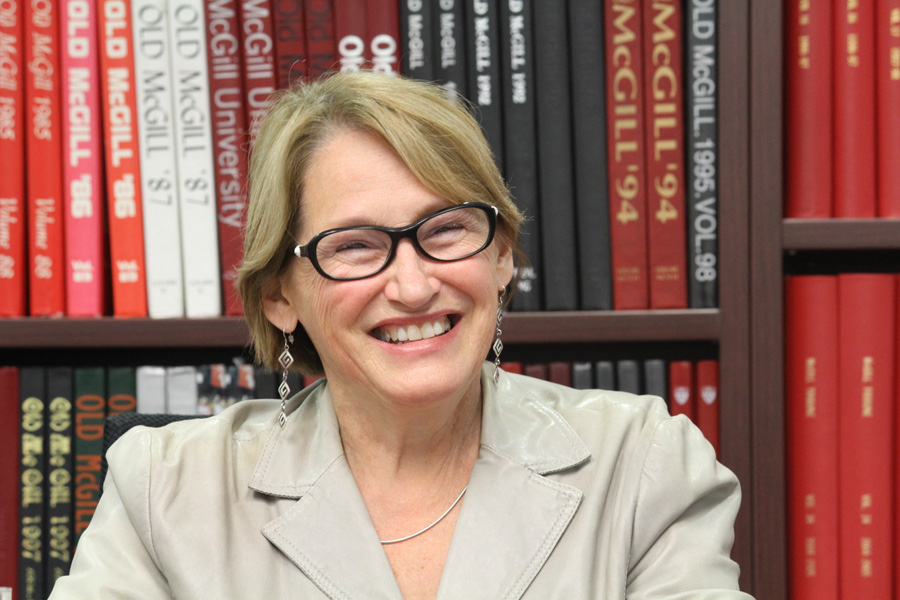
Having completed her B.Sc. and PhD at McGill, Suzanne Fortier returned to her alma mater on Sept. 5 as McGill’s first francophone principal, second female principal, and 17th principal overall. After her first few days, Fortier sat down with the Tribune to discuss how being an alumnus has influenced her life, the value of a McGill degree, and her first week on the job.

Fortier grew up in Saint-Timothée, Quebec, a small former-municipality located on an island less than an hour’s drive from McGill. According to Fortier, her rural background had a strong influence on her attitude when she entered the university as an undergraduate.

“One thing I had not expected coming to McGill—because I was pretty ignorant, there was no one who went to university before me in my family—was that I’d be surrounded by the best people in their field in the world,” she said. “It’s inspiring. You’re a young person […] and these giants, people whose names you read in your textbooks, [were] there and talk[ed] to you. They were people who allowed me to think ‘I could do that, too.’ ”

Following her PhD, Fortier held several leadership positions at Queen’s University including vice-principal (academic), before becoming the president of National Sciences and Engineering Research Council of Canada (NSERC) in 2006.

Fortier credits McGill’s international reputation with opening doors for her throughout her career, and expects it will continue to do so for students despite the challenges facing the university. Among these challenges are the $38.3 million cuts to McGill’s budget, which were announced by the provincial government last December.

“Everyone here has such a strong commitment to students,” she said. “Having to take some [budget] cuts­—that’s the most challenging because people don’t want to see any diminishing of the quality of the environment for students.”

McGill has also recently received media attention for its drop in the Quacquarelli Symonds (QS) International Universities Rankings. Previously ranked 18 in the world, McGill fell to 21 this year, falling behind the University of Toronto for the first time.

“These aren’t very accurate scientific studies, so the margin of error is big,” Fortier said, adding that the university will examine the data from the rankings to assess the ways in which McGill can improve. “A degree from McGill right now is worth a lot, because the reputation of McGill worldwide is strong. It’s not strong based on marketing or publicity; it’s strong based on accomplishments. It’s strong because of the many, many people before us who have built the reputation of this university.”

Fortier may also have to address current political issues, such as the Parti Québécois’ (PQ) current attempt to pass the Charter of Values, which would ban most religious clothing and symbols worn by government employees at work. If this legislation passes, McGill would face the possibility of opting out of the regulations for a five-year period.

“One of my personal values is that it is important, when you are part of a community, to allow that community to express itself, particularly when it comes to values and principles,” she said. “It is difficult for me, having this value myself, to declare five days into the job, what this university will do. However, I know the university has done quite a bit of work in the past on diversity and inclusiveness, and that’s what we need to refer to as a community.”

Since becoming principal, Fortier has been quick to immerse herself into the community, including appearances at Open Air Pub (OAP) and the Students’ Society of McGill University’s (SSMU) Activities Night.

“The centre of what we do is the learning environment that we provide to students; and to do it well, we have to work together as partners,” she said. “[The students] are the centre of this university, so you’ll see me a lot on campus because I want to learn about the community.”

While Fortier is still settling into her new role, Fortier said she will be paying close attention to what is needed at McGill.

“I’m keenly aware of the importance of human talent; that means we must try to offer people opportunities for doing their best, for developing their potential,” Fortier said. “The challenge for all universities around the world is to think about what it means to be a learning community in this century. That’s to me the biggest challenge of all universities, because it’s a transformation, probably, that we have to be looking at.”

For a full transcript of the interview, visit www.thetribune.ca.

Read the latest issue

Read the latest issue