



Last year was an exciting year in space. In 2015, the Dawn orbiter visited the dwarf planet Ceres, scientists photographed the surface of Pluto in unprecedented detail, and Matt Damon even got stuck in space again. But knowing what’s already happened is easy—it’s predicting the future that’s hard. But that doesn’t stop scientists from trying. Here are the astronomical and astrophysical events scheduled and predicted to occur in 2016.
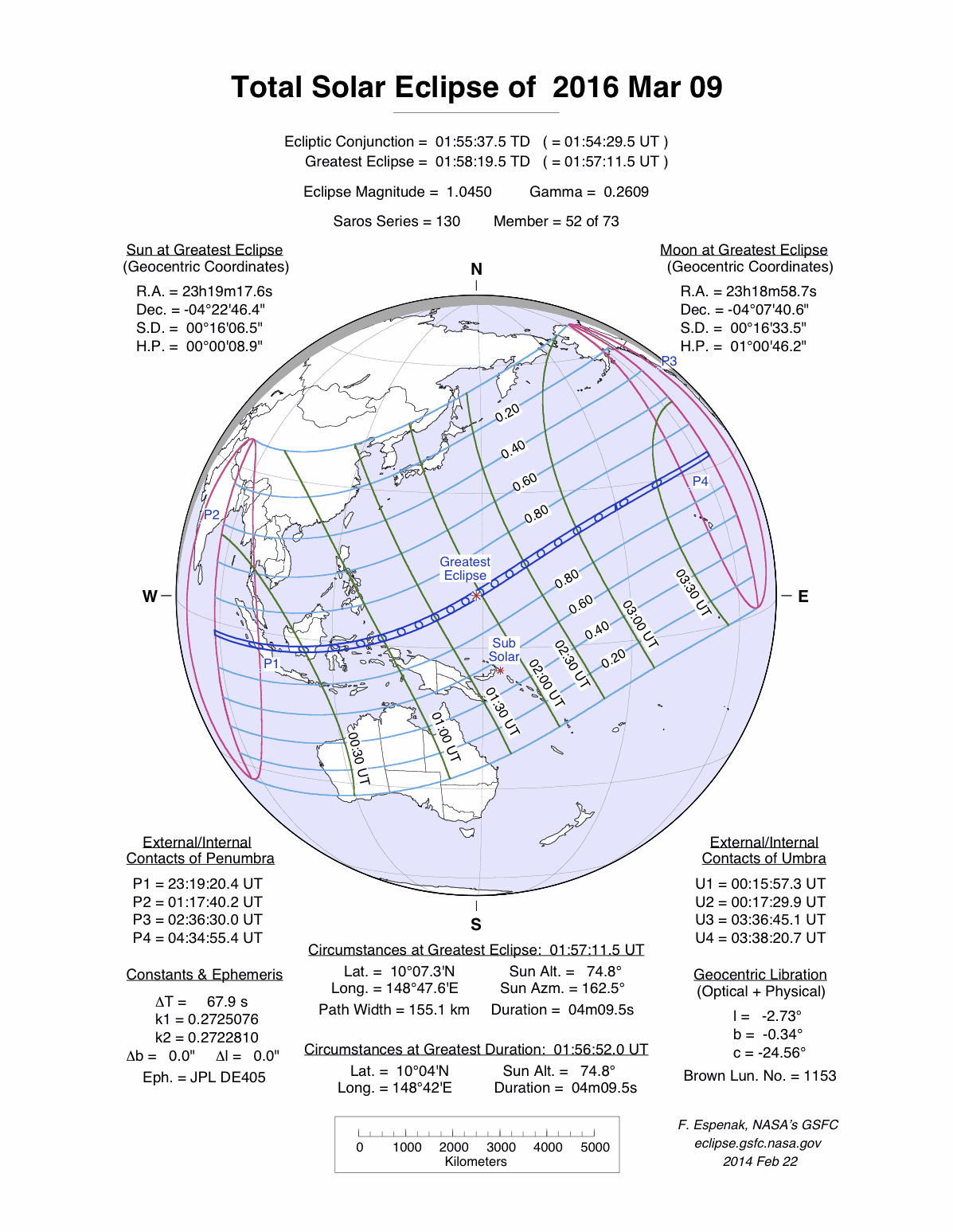
Total solar eclipse
What: The moon will pass directly between the Earth and the Sun, completely obscuring it and casting a dark shadow.
When: March 9, 2016
Where: The event will be visible from much of the Pacific Ocean, as well as most of Asia and Australia, who will only see a partial eclipse.
Annular solar eclipse
What: Solar eclipses usually come in pairs due to interactions between orbits. About 177 days after an eclipse on the southern intersection of the orbit will be another eclipse on the northern intersection. This will not be a total eclipse, but rather an annular (ring-like) one, as the sun will still be visible as a bright ring around the edges of the moon.
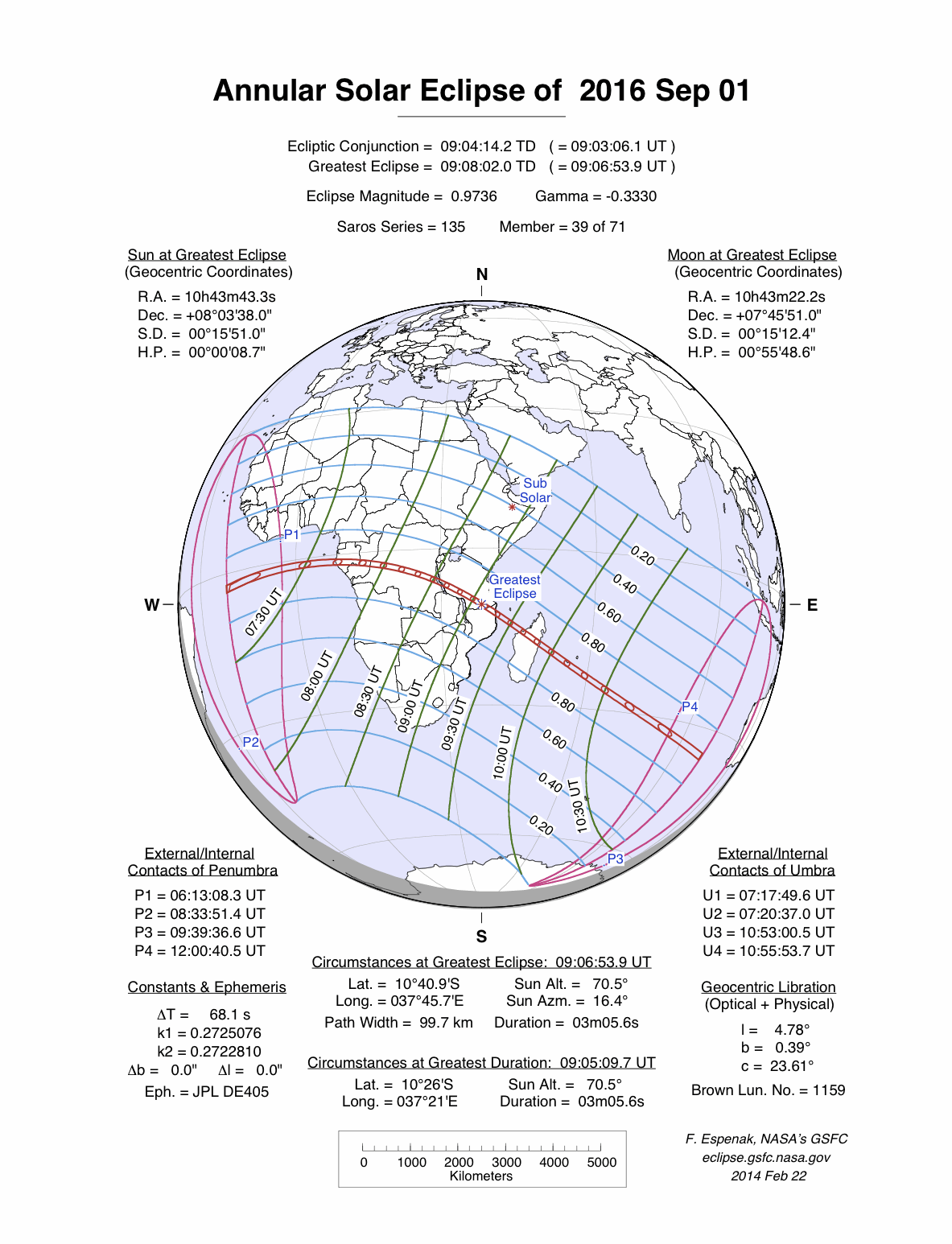
When: Sept. 1, 2016
Where: Visible from almost anywhere in Africa.
The ExoMars trace gas orbiter
What: A probe designed to search for trace amounts of methane and other gases that are signs of organic activity. It will be launched by the European Space Agency and Russia’s Roscosmos.
When: March 14, 2016 The launch was originally planned for Jan. 7, but was delayed due to technical reasons.
Where: Mars
First partial lunar eclipse
What: As the moon will pass through the Earth’s penumbra, but not its umbra (i.e., if you were standing on the moon, you would see the Earth block part of the sun, but not all of it), the event is not a total eclipse, but will be striking, and visible from Canada.
When: March 23, 2016
Where: Visible to the naked eye from most of the world except Europe and Africa.
Second partial lunar eclipse
When: Sept. 16, 2016
Where: Visible from anywhere except the Americas.
Transit of Mercury
What: A planetary transit occurs when a planet passes directly between the Earth and the Sun, and shows up as a black dot on heliograph plates (like a solar eclipse, it is harmful to observe with the naked eye).
When: May 9, 2016
Where: Visible (with a sun telescope) from any point on Earth except the Far East and Australia.
Juno meets Jupiter
What: The Juno spacecraft is a NASA research probe which will offer new data on Jupiter’s history and makeup using microwave radiation as a sort of lower-frequency radar.
When: The probe is scheduled to arrive on July 4, 2016. It was launched in August of 2011 and is expected to provide useful information well into 2017.
Where: The orbit around Jupiter
Perseid meteor shower
What: One of the most striking and visible meteor showers, easily viewable because of its frequency (about a meteor per minute) and brightness. The spectacle occurs when the Earth passes through the debris trail of the Swift-Tuttle comet, which orbits the sun every 133 years, and the meteoroids burn up in the Earth’s atmosphere. The meteors have been referred to as “The Tears of Saint Lawrence.”
When: August 12 to 13, 2016
Where: Anywhere, but ideally in a grassy park, at night, far from city light pollution.
China builds FAST
What: The behemoth Five hundred meter Aperture Spherical Telescope (FAST), when completed, will be the largest and most precise radio telescope in the world. It is similar to the famous Arecibo Observatory in design, but will greatly surpass the South American telescope in ability.
When: Slated to be complete by September 2016 (construction began in 2011).
Where: The Tai Wo Taipa depression, a karst depression—a type of large natural basin—in Guizhou Province, China.
NASA sends probe to collect samples from asteroid
What: The OSIRIS-REx craft (Origins, Spectral Interpretation, Resource Identification, Security, Regolith Explorer) is a part of the New Frontiers Program, and its mission is to collect rock samples from the 495m-long asteroid 101955 Bennu, discovered in 1999. Bennu is cited as one of the most potentially dangerous asteroids likely to strike Earth in the near future.
When: Launch set for September 2016. If on schedule, the craft will return to Earth with the samples in 2023 after reaching Bennu in 2019.
Where: In an irregular orbit, well outside the more populous asteroid belt between Mars and Jupiter.