
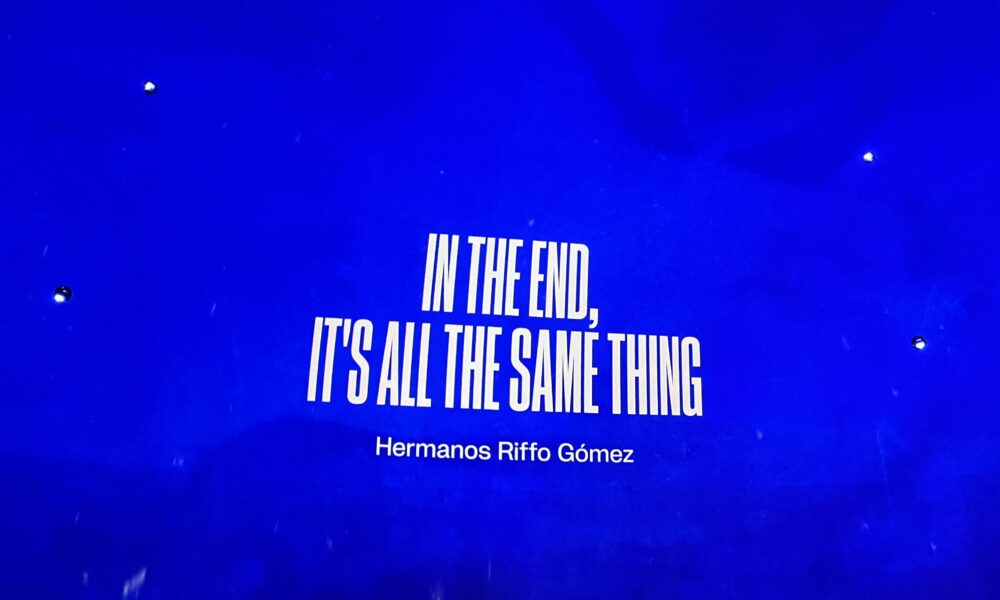

Brothers Cristo Riffo and Francisco Riffo Gómez explore cultural roots, memories of family, and the nostalgia around having moved away from their home country of Chile in their audiovisual experience In the end, it’s all the same thing, projected at the Société des arts technologiques (SAT) from July 28 to Sept. 18.
What started out as a live artistic performance project was partially adapted into an immersive 40-minute recording, projected in the looming dome-shaped theatre of the SAT—a space that allows you to melt into a beanbag and slip into a unique sensory universe.
Viewers first voyage into a 3D-modeled projection of the Andes. The globe presents a disorienting virtual reality (VR) world of deserted nature that weightless watchers drift through. Your gut twists with building motion sickness from the immersive journey; the camera traverses grass blades and canyons before leading you into a house nestled in the mountains.
Suddenly, the screen turns plain. Messy handwriting scribbles messages that blend English and Spanish expressions—“familia,” “hogar,” “Who are you?” The dome becomes a whiteboard, recording cultural confusion and nostalgic memories of the brothers’ native Chile. Cristo Riffo’s face appears against a blurry background, erasing those final words—“Who are you?”—with slow, swaying movements, his cheeks pressed against the screen to silence the attempt to question his identity.
From handwritten notes and verses by Chilean poet Enrique Lihn to a VR exploration of the inside of a soccerball, the project’s contrasting scenes retrace an intimate story of belonging through sensory immersion in multiple acts.
“It’s an opera [….] Every act is very well-defined and talks about different problems […] and then, by the end, it makes sense,” Francisco Riffo Gómez explained in an interview with The Tribune.
With its 93 speakers and eight video projectors, the theatre dome brings to life the brothers’ artistic partnership: While Cristo Riffo designed the visuals for the project, Francisco Riffo Gómez composed the music.
“My brother has been working with this concept of home, genetics, human relationships, and microorganisms in time. He has this theory that microorganisms behave very similarly to human societies,” Francisco Riffo Gómez said.
Cristo Riffo took videos of microorganisms interacting with each other under a microscope to feature them in the project. After seeing his brother’s visual work, Francisco Riffo Gómez composed the pressing electronic and experimental music that completes it. The project heavily relies on audiovisual synergy. According to Fracisco Riffo Gómez, the creative process followed a very instinctive flow.
“The microscope part where you see all of these things and then this repetitive music, it reminded me of a film called Koyaanisqatsi,” said Francisco. “It’s a very visceral feeling. In the first three seconds, I was like, that’s the music that has to go there.”
The creative duo does not shy away from incorporating digital technology into a personal performance rooted in intimate creation. They built In the end, it’s all the same thing not only from handwritten messages, but also using JavaScript, microscopic images, and 4K resolution cameras.
“We just don’t separate human sensitivity from technology. Technology is just something we use,” Francisco Riffo Gómez stated. “Every tool has its way of expressing a different idea of humanity. That was one of the most beautiful things about the show, in my opinion.”
The Riffo Gómez brothers let you float within a scene and sit with the feelings it evokes. The fact that the movie itself is a recording of a live, partly-improvised performance is what makes In the end, it’s all the same thing feel so alive. The film is only one take—one recorded version of the brothers’ multiple and mutable live performances.
“I think the role of improvisation was to make sure that [technological instruments] are [used only as] tools and that we’re not fixing anything in time,” Francisco Riffo Gómez explained. “We wanted to add our own quota of humanity [to every take] [….] It was really refreshing to see how [one live version] would change at a certain moment.”