
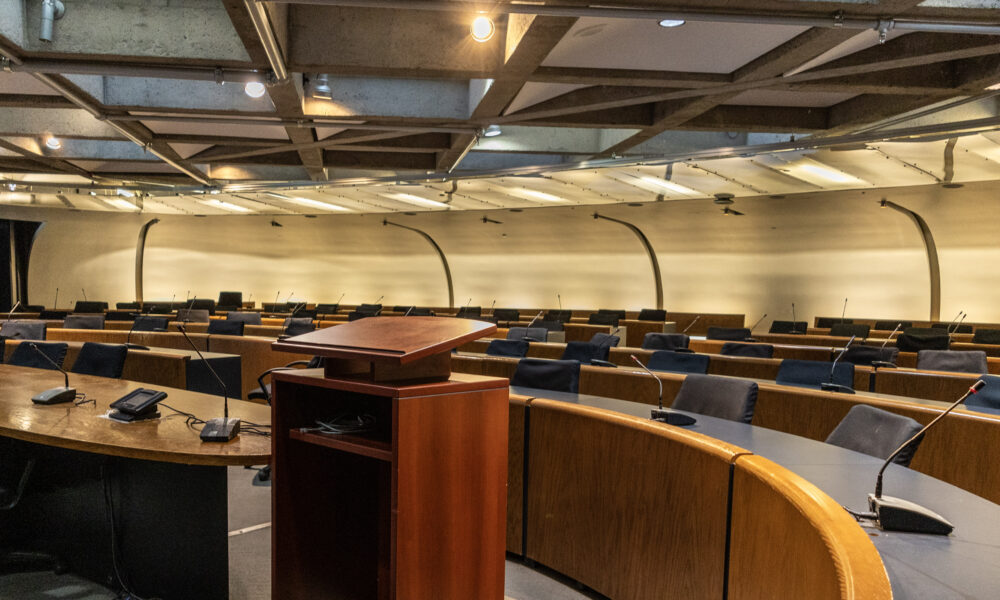

The McGill Senate convened on March 18 for its third meeting of the Winter 2026 semester. The meeting began with a memorial for the late Professor David Harpp in the Department of Chemistry. McGill’s President and Vice-Chancellor Deep Saini shared his Feb. 25 speech for the Montreal Chamber of Commerce with the Senate, as well as his visit to India with Prime Minister Mark Carney to discuss the opening of a Centre for Excellence in AI.
Next, Vice-President (VP) of Administration and Finance Fabrice Labeau opened the discussion with a revised identification (ID) policy proposal following the policy’s initial proposal in the Senate’s Jan. 14 meeting. The proposal would allow authorized personnel to request student identification on campus property for “legitimate purposes” outlined in the policy.
Post-Graduate Students’ Society University Affairs Officer Amina Bourai raised questions regarding the initial proposal’s academic necessity and potential safeguards, referencing an open letter from the McGill community opposing the proposed policy.
“[The open letter] has now been signed by over 500 members of the McGill community, including undergraduate and graduate students, staff, alumni, and faculty,” Bourai said. “This reflects a broad and urgent level of concern across the university about both the necessity of this policy and its potential impacts.”
Furthermore, among other concerns of the policy’s safeguards, Bourai questioned the need to change McGill’s current security apparatus.
“What remains unclear is why [the existing frameworks] are inadequate and why a broad identification policy that doesn’t require any suspected wrongdoing is a proportionate response [….] How exactly is security supposed to handle the exclusion of people? Physically carry them outside or are we calling the police?”
In response to Bourai’s initial questions, Labeau presented his revised proposal with consultations from other senators. Labeau cited increased theft on campus as a reason for the policy, while also taking into account concerns about discretion in asking for ID.
“We heard a lot of comments about the fact that too many people had too much power and that was never the intent. We’ve clarified in this version that the role of an individual that is qualified to ask for identification is really limited to a specific place and time,” Labeau said.
Labeau acknowledged that the consultations were useful, yet the policy’s passing would ultimately go through the Board of Governors (BoG), a point echoed by Saini. Labeau also clarified the definition of “authorized personnel” allowed to request ID, listing exam invigilators, campus security, and faculty or staff acting in an official capacity at on-campus events.
Faculty of Law Professor Victor Muñiz-Fraticelli then raised a question about the administration’s intention with the proposal and the practical application of this policy.
“We’re a bit like Athens under Pericles and not like Sparta,” Muñiz-Fraticelli said. “We are open to the world with Sparta, maybe Yale perhaps as a point of comparison, which closed itself from surrounding the community. And no one in Canada is asked to carry government-provided ID when they walk around the street.”
Additional concerns included adequate training for campus security under the policy and its potential effect on peaceful protests on campus. Particularly, the need for sufficient efforts to prevent profiling was brought up by Faculty of Dental Medicine and Oral Health Professor Alissa Levine.
“The only times in my life when I’ve been asked to produce ID have been when I was in the presence of a friend or colleague of colour,” Levine said. “I am concerned there will be no records kept. I think the intent was to reassure and it actually might have the opposite effect in terms of how it’s carried out.”
The BoG will vote to pass the proposal at its next meeting on April 23.
Soundbite:
“I’m wondering if McGill intends to post guards at the entrances and gates of the university, to ask any tourist who wants to see the arts building, or any cyclist who wants to commute, to produce their papers or be excluded from the publicly funded campus.”—Senator Victor Muñiz-Fraticelli.
Moment of the Meeting:
Senators voted to add a 12th day to the examination period for the Fall 2026 term to alleviate evening exams, in turn shortening Winter break.