
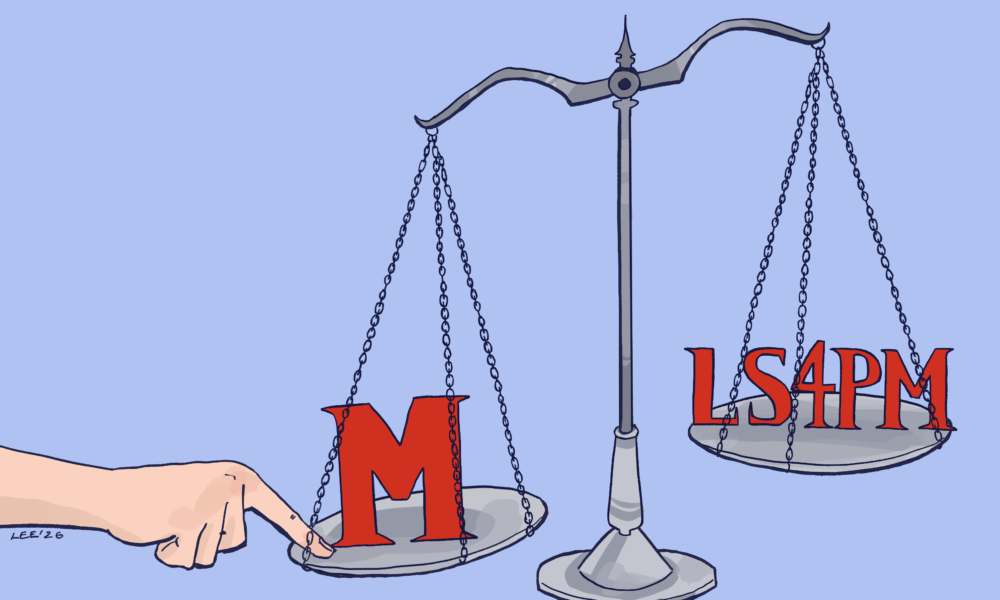



On March 19, voting for the Referendum Regarding the Academic and Cultural Boycott of Israel to Preserve Academic Freedom (PACBI) opened to all members of the Law Students’ Association (LSA). The motion, put forward by Law Students for Palestine at McGill (LS4PM) and McGill Radical Law Students’ Association (RadLaw), called on the LSA to modify its constitution to terminate all academic ties with Israeli post-secondary institutions complicit in Israel’s ongoing genocide in Palestine.
Citing the targeted bombing of all 12 universities in Palestine and the killing of thousands of students and professors, in addition to statements made by the United Nations, LS4PM argued that the systematic destruction of academic freedom in Palestine breaks Canada’s Crimes Against Humanity and War Crimes Act.
10 minutes before the voting period began, Provost and Executive Vice-President Academic Angela Campbell, along with then-interim, now-official, Dean of Law Tina Piper, sent a joint letter to all law students describing the amendment as “objectionable.” They stated that its mandate to terminate all academic exchanges with Israeli post-secondary institutes is discriminatory toward Jewish students both at McGill and in Israel. The letter also affirmed that Campbell and Piper do not take a particular political position on the matter, but oppose the PACBI motion due to concerns from Jewish students. As the LSA’s constitution prevents any parties directly involved in the referendum item from campaigning during the voting period, LS4PM was not able to address these allegations until after the referendum outcome was announced.
In an interview with The Tribune, four representatives from LS4PM, Jamie*, Robin*, Sasha*, and Sam*, described the letter as interference with the LSA’s democratic process. Highlighting the potential danger of a precedent in which the McGill administration swings voters in their favour, these representatives explained the reasoning behind the proposed modifications to LSA by-laws, as well as the concerns behind McGill administrators depicting the Jewish community as a monolith.
“We were told to stop campaigning. Yet, [McGill’s administration] effectively got two more days where it was constitutionally impossible for us to say anything in response. That is the procedural injustice in this,” Jamie said.
Sam added, “We follow the rules, but they are free to run over our democracy.”
According to the LS4PM representatives, the letter followed a list of frequently asked questions (FAQ) sent out by the LSA at 11:00 p.m. on March 18. The FAQ stated that if the PACBI referendum passed, the LSA would, by default, be in breach of its Memorandum of Agreement (MoA) with McGill. The letter went on to forecast a three-year arbitration with administration, which they estimated would cost around $40,000 CAD. The LSA’s letter also included anonymous statements from professors in the Faculty of Law, ranging from disapproval of LS4PM’s motion to threats of stopping classes should it pass.
The four representatives agreed that although the LSA showed solidarity with LS4PM by denouncing McGill’s letter as an attempt to influence voters, the mass FAQ email sent to students likewise advised students to vote against the motion.
“All of these negative messages had the effect, in our opinion, [of saying] that the LSA was against the referendum, and all of this information confused the voters,” Sam said. “The effect of these cherry-picked testimonies, and of this worst-case scenario forecast, was to interfere with the student vote [….] We understand the need to provide information from the LSA, especially about the threat of litigation. However, the way the information was provided was unbalanced and did not account for the myriad of factors that could influence the cost of arbitration.”
McGill’s Jewish Law Students’ Association (JLSA) ran a Vote No campaign against the referendum prior to the voting period. The JLSA cited concerns that the LSA taking an official stance would impose a singular viewpoint on the whole Law Faculty based on a subset of voters. They further deemed the motion discriminatory toward students who disagree with LS4PM’s reasons to boycott Israeli institutions, referring to the group’s stance on genocide, apartheid, and war crimes in Israel.
In a written statement to The Tribune, a JLSA executive elaborated on these concerns, stating that the motion may be used to scrutinize or stigmatize minority groups on campus. The executive also mentioned ongoing worries regarding how the referendum was conducted, specifically whether the required threshold for adoption was met. The executive stated that they are looking into the matter through the appropriate channels.
“[The motion] appears poised to curtail the ability of Jewish and Israeli students to participate fully and equally in academic and campus life. Students risk being excluded or ostracized based solely on their belief in the right of a Jewish state to exist,” the executive wrote. “All law students—regardless of religion, nationality, or political belief—should feel welcome on campus and free to express their identities and pursue their academic interests. That must apply equally to members of the JLSA and to members of LS4PM.”
In response to these concerns, Sasha explained that nothing in the motion itself suggests that it would lead to an increase in antisemitism.
“There’s a lot of language that the community feels unsafe [….] Jewish students have this unfair burden. Jewish faculty feel unsafe [….] [There have been] no reports of intimidation or discrimination,” Sasha said. “Using this language of safety, harm, making students and faculty feel scared to be at school, really is exaggerating what this actually is into something that seems like conflict when really it’s a student-led movement for a vote. It couldn’t be any less violent.”
Sam further emphasized that this mischaracterization of LS4PM as an antisemitic organization not only discredits them unfairly as a student group, but also takes away from the seriousness of these allegations.
“You’re essentially emptying anti-oppression language from its meaning to then uphold the status quo and interfere in student democracy, […] which means that this advocacy can be characterized as racist, when we are fighting racist apartheid,” Sam explained.
Referring to the letter sent by Piper and Campbell, Jamie, who is Jewish, explained that the claims of antisemitism levied against the motion ignore members of the Jewish community at McGill who advocated for the referendum, clarifying that the boycott doesn’t apply to individuals, but to institutions that support and perpetuate Israel’s actions against Palestinians’ academic freedom.
“I genuinely have not read such an antisemitic message in so long,” Jamie said. “It literally says if your Jewish identity is not tied to the State of Israel, we do not see you. We don’t care about your feelings.”
“There are tons of Jewish students in LS4PM [….] It’s really frustrating that this is McGill’s take toward the Jewish community on campus, framing it as one monolithic perspective, which in itself is antisemitic,” Sasha added. “Painting it as one collection of ideas and thoughts that are all aligned toward the same thing, just to advance [administrators’] own objectives.”
Emphasizing their support for the democratic process, the representatives explained how the administration’s reaction to the PACBI should concern all students, regardless of their political affiliations.
“Equating democratic action with violence essentially makes it impossible for students to come forward with any sort of political movement in the faculty without being labelled as violent or threatening the safety of the community and the faculty,” Sasha added.
Despite the interference, the motion passed with 67.3 per cent of LSA members voting, 57.3 per cent in favour. This marks the highest voting turnout in the LSA’s recent history.
Now passed, LSA bylaws have been modified to terminate academic exchanges with Israeli institutions, notably Tel Aviv University (TAU). One Jewish student has filed a court injunction against the adoption of these modifications. McGill’s Media Relations Office (MRO) clarified in a written statement to The Tribune that no court judgement has determined the referendum to be discriminatory or exclusionary as of April 5, and that the case is ongoing. Jonathan Amiel, the chair of the Faculty’s Advisory Board, course lecturer, and donor, has resigned from his position in protest of the motion, explaining his reasoning in a public letter.
“An institution once defined by intellectual rigour and principled debate has, in too many instances, become an environment where being Jewish, identifying as a Zionist, or maintaining any association with the State of Israel carries professional and personal risk,” Amiel wrote. “It is particularly concerning that, at a time when Jewish communities face heightened vulnerability, the Law Faculty has not provided a constructive or unifying response. Instead, a majority of its students have supported a measure that isolates leading academic institutions and risks further division within its own community.”
A student has since brought a petition to the Quebec Superior Court against the LSA, seeking to overturn the referendum results. McGill President and Vice-Chancellor Deep Saini has endorsed her position, stating in an email to students that the motion’s mandates fall outside the purview of a student association on campus, and therefore cannot be implemented.
Still, faculty opinion is divided. In a written statement to The Tribune, Law Professor Omar Farahat expressed concern about the administration’s approach.
“We must distinguish between intervention by university administrators and potential review of those student actions through the judicial system,” Farahat said. “Anyone is entitled to resort to the judiciary in the event that they feel that a violation of their legal or constitutional rights has occurred [….] University administrators, in my view, have an even higher burden [than students] to protect and respect the students’ freedom of speech and freedom of association.”
Farahat went on to explain that the administration’s interference risks setting a dangerous precedent for student activism on campus.
“It is one thing to argue that a specific measure by a student group may technically give rise to tensions concerning the group’s agreements with the University, but it is a completely different thing to portray this act of student activism as discriminatory, racist, or dangerous without any objective justification of those claims,” Farahat wrote. “This is a very troublesome approach as it sends the message that morally conscious activism—which is precisely what we expect from young critical minds—will be met with institutional resistance and reprimand, which, I personally worry, could hurt our standing as a major institution of learning and thinking not only in our region but globally.”
*These names have been changed to preserve the speakers’ anonymity.