


Latest News

Science & Technology

How can ChatGPT be an asset in your research project?

Disclaimer: Different professors have varying opinions and rules about the appropriate use of ChatGPT, and in many cases have serious consequences for misusing it in their classes. While some only have restrictions against using text written by ChatGPT, others also restrict the use of ChatGPT for outlining and research. It is important to check with your professors about their guidelines to avoid being penalized for plagiarism.

At this point, many students are familiar with ChatGPT’s weaknesses: Creating boring, bland text and making up erroneous citations, for example. But what about its strengths? When used carefully, ChatGPT can be a powerful tool to enhance your research. 

Generating search terms

One of the most frustrating moments of a research project is when you know that answers to your question exist on the internet, but you can’t figure out the right search terms to type into the library database to find them. This can often happen because you simply haven’t found the right synonym or combination of words to tap into the literature on a given subject. ChatGPT is excellent at coming up with different paraphrases for the same concept, so you can type in something like “I’m trying to find research papers on [your topic]. What are some search terms I could use to find them?” 

One of the great things about ChatGPT is that you don’t have to spend any time trying to compose your research question in a machine-readable way. Simply type your question out exactly as you might explain it to a friend, and it will usually get the gist. You can always give follow-up instructions if the results aren’t exactly what you are looking for. 

Paraphrasing abstracts in simple language

We’ve all had the experience of reading through an abstract two or three times, only to realize we still have no idea what it means. The abstract is a unique and highly structured form of writing that prioritizes information density and the usage of specialized terminology. It’s crucial, though, to accurately understand them to quickly determine whether the rest of the article will be relevant to your project and to make sure you aren’t misinterpreting the article’s main point. 

While ChatGPT’s simple writing style produces bland essays, this can actually be an asset for making complicated concepts easy to understand. You can copy and paste the full text of the abstract into ChatGPT along with a command like: “Paraphrase the following biology research paper abstract in simple, non-technical language.” 

Getting a basic understanding of terminology

Sometimes, you can understand most of an abstract or research paper, but there are a couple of terms you haven’t seen before. While it’s important to remember that ChatGPT can produce wrong answers or hallucinate, it functions fairly well as a basic, interactive dictionary. Try asking it something like “Explain the term cryobiology in simple language.” And if you don’t understand part of the answer, ask for a follow-up! ChatGPT remembers previous parts of the conversation, so you can build a string of answers to get more relevant results and gain a deeper understanding of a given topic. Make sure to specify what field you are interested in to make sure you don’t learn that a mole is “a small, burrowing mammal known for its subterranean lifestyle,” when you really want to learn about the unit of measurement. 

Finding gaps in your research approach

Many who conduct work with large language models such as ChatGPT have remarked that they are good at going broad, but not really at going deep. This is one area we still have an advantage as human researchers: Doing in-depth research on specific questions and thinking about them in complex and novel ways. 

However, it’s natural that human researchers may miss certain approaches to a research question simply because it didn’t occur to them. This is common, especially for students, who lack the background and intuition in a given field to notice their blind spots. The best way to notice these gaps is to talk to professors and friends in the field, but ChatGPT can provide a good first pass, just to get your bearings. Use a prompt like “I’m interested in learning more about [your research question]. What are some research directions I should explore?”


Editorial, Opinion

McGill must confront its reliance on SPVM’s racist policing

Historically, police units have been known to target unhoused, queer, transgender, disabled, mentally ill, lower-income, Indigenous, Black, and other marginalized communities. Unhoused individuals sleeping on a park bench in Montreal can get fined up to $1000 CAD. Atif Siddiqi, who is transgender, alleged that the police laughed at them when they attempted to report their assault and robbery. Most recently, the Superior Court of Québec confirmed that racial profiling is a systemic issue within the city’s police force, establishing that Service de Police de la Ville de Montréal (SPVM) uses discriminatory and racist policing tactics. 

Taking all of this into account, McGill continues to make the deliberate choice of calling SPVM on campus for student and staff demonstrations. Beginning in November 2023, President Deep Saini called police on pro-Palestine demonstrators. SPVM officers were onsite again on Feb. 22 during the Bronfman Building blockade. Months later, on June 6, the university called the SPVM on students occupying the James Administration Building, with the police making at least 15 arrests after pepper spraying and forcefully pushing students away from the building. 

Unwarranted police presence goes beyond the university’s perceived threat from pro-Palestine students. In March 2024, McGill called the police on the Association of Graduate Students Employed at McGill (AGSEM) picketers, with the justification that it was illegal to intimidate others or disrupt operations and academic activities on campus. To add, the Tribunal Court ruled that the university was in obstruction of the Labour Code in reference to their interactions with the Association of McGill Professors of Law. Even dating back to 2011, Montreal riot police brutalized McGill students who were protesting against tuition hikes. It seems as though the university suppresses opposition of any kind. It is clear that McGill uses security as an intimidation tactic, actively discouraging students and staff from exercising their essential rights to protest and assemble. 

Throughout this, students have repeatedly condemned McGill for its police reliance. The consensus within the student body is clear: More police on campus does not make people feel safer—it does the contrary. By enlisting what is known to be a violent institution upon its students at any point of dissonance with the administration, McGill signals threatening rhetoric that dissenters are dangerous, compounding fear and tension on campus. 

The administration’s willingness to rely on police as a first resort to manage campus activism and discord sets a dangerous precedent, as the criminalization of young people perpetuates a cycle of violence that disproportionately targets racialized students and community members. McGill is sending a consequential message that student movements and protests should be suppressed rather than engaged with, undermining the university’s supposed commitment to fostering critical thought and positive change. By normalizing obedience and silencing dissent, McGill risks stifling the next generation of passionate activists and thinkers.

More importantly, McGill needs to get cops off campus because it normalizes discrimination and vigilant policing of BIPOC students. The more that over-policing is normalized on campus, the more that students will internalize the notion that protesting is an inherently aggressive act that warrants police presence. Students are afraid to participate in movements in which they fear their university will target them—especially brown, Arab, and Palestinian students in the Pro-Palestine protests. As long as the McGill administration endorses and commissions SPVM’s racist policing, students are not safe. 
As a prominent public university, McGill’s primary obligation to its students is to provide a safe and conducive learning environment, meaning that all students deserve to feel protected on campus. How can racialized students feel secure in an environment where a police force that is proven to engage in racist practices is welcomed, rather than denounced? It is abhorrent that the university would ever jeopardize student safety to promote their own interests. It appears as though safety is a privilege reserved only for some at McGill—the administration itself and those who do not challenge it.

Letters to the Editor, Opinion

Letter to the Editor: What’s Left Unsaid of Unionization at McGill—On Abuse of Power and the Impetus for Structural Reform

Last week, the Labour Tribunal ordered McGill to cease meddling in the activities of the Association of McGill Professors of Law (AMPL), the first faculty union at McGill. This decision, rendered amid a strike that resumed on Aug. 26, garnered national media attention, with many beyond the McGill community expressing confusion and surprise over the administration’s blatant disregard for its legal obligations. However, these actions are neither surprising nor out of character in the context of McGill’s history of administrative abuse of power.

Through this lens, unionization presents an opportunity to reshape the governance structure and, whether intended or not, becomes a matter of accountability. In the eyes of many, McGill’s opposition to unionization appears to be driven by greed, but the stakes are far more complex. Administrators have restructured their roles and accumulated conflicting mandates. They have justified these changes by lining their pockets, blurring the lines between offices, and disguising misconduct along with its far-reaching impact.

The Faculty of Law exemplifies the structural decentralization of a university burdened by administrative abuse of power. Take AMPL’s findings that the Law Faculty Dean’s salary increased by over 65 per cent between 2017 and 2022, while professor salaries increased by only seven per cent in the same period. This figure becomes more concerning considering the Dean’s multivalent role as an administrator, professor, and legal advisor to both the Provost and the President. While these overlapping responsibilities might not seem inherently problematic, they become significant when abuses arise within the Faculty of Law. Despite the establishment of the Office of Mediation and Resolution following longstanding demands and public student advocacy by the Black Law Students’ Association in 2020, the Provost still oversees the final stage of investigations under the Policy on Harassment and Discrimination, extending the conflicts of interest.

Moreover, unlike most universities, McGill’s Equity Team is embedded within the Provost’s office, insulating it from equity oversight. This structure creates a clear conflict of interest, further exacerbated by the fact that the former Associate Provost, responsible for Equity, is also a professor of Law at the university. Despite the increasing number of cases of harassment and discrimination being reported and declared as founded, the position of Associate Provost Equity has been removed from the list of administrators, and unusually, there is no one serving in an acting capacity. This abrupt absence raises serious concerns about the university’s commitment to addressing misconduct, especially at a time when oversight is more crucial than ever after the former Provost Academic Lead and Advisor on the Anti-Black Racism Action Plan stepped down over a year ago, with no replacement since. McGill’s troubling retreat from accountability has only heightened the need for oversight. 

In this time of reform and opposition, McGill unions have the opportunity to address critical governance issues by championing structural changes. These include replacing the Associate Provost for Equity with a Vice-President of Equity who reports directly to the President, as called for by the Dr. Kenneth Melville Black Faculty Caucus. Measures must be introduced to avoid conflicts of interest. For instance,  the Provost will be removed from harassment and discrimination cases to guarantee independent oversight. The Dean of Law will not be involved as a legal advisor in disputes involving members of his Faculty or anyone he reports to. Greater oversight will be established regarding the influence of donors and the allocation of administrative roles, from Chancellors to Associate Deans. This is particularly important to prevent financial influence from outweighing accountability and student safety.  The Black Student Affairs Advisor will be relocated from the Equity Office to the Office of the Dean of Students while formalizing his obligations of confidentiality towards Black students. These changes will promote transparency, fairness, and accountability within the university’s governance structure, making the mobilization efforts for a non-decree-like collective agreement transformative and worthwhile for the entire McGill community. Most importantly, these recommendations serve as a critical reminder to all emerging Faculty unions that, while their mobilization is groundbreaking,  they carry the responsibility not to erase an institutional history plagued by abuse, which extends beyond their call for collegiality and solidarity

News, The Tribune Explains

The Tribune Explains: Phishing email scams

Phishing scams are nothing new to McGill staff and students, but some have reported feeling like the number of fraudulent messages in their university inboxes is increasing. The Tribune unpacks the threats phishing poses to members of the university, McGill’s efforts to mitigate it, and what staff and students should do if they are targeted by a phishing attempt. 

What is phishing?

Phishing refers to a type of fraudulent message designed to trick recipients into providing scammers with personal or financial data. They often take the form of fake offers, such as employment opportunities or sales discounts, designed to entice the target into clicking malicious links or offering private information. 

In an email to The Tribune, the McGill Media Relations Office (MRO) highlighted that phishing scams are on the rise in Canada, and that the university is a particular target for these cybersecurity threats. 

“Generally speaking, organizations are more attractive phishing targets than individuals because organizations have more resources to exploit (e.g., financial information, research data),” the MRO wrote. “People may, therefore, experience more phishing attempts on their organizational accounts (e.g., school or work emails) than on personal accounts.”

In addition, the MRO noted that a perceived increase in phishing may also result from greater awareness of cybersecurity risks, allowing individuals to more consistently identify scam emails as phishing. 

What cybersecurity risks does phishing pose?

Cybercriminals can use information stolen in phishing scams to access financial assets, research data, and even to extort victims. The MRO explained that those conducting phishing scams may also try to access digital resources, such as academic journal subscriptions, and take advantage of an organization or individual’s trusted reputation to create other scams.

What does McGill do to mitigate phishing attempts?

According to the MRO, the university has “security measures (for example, malware and phishing detection, threat intelligence, etc.)” in place designed to “reduce the volume of phishing emails that make it through to McGill inboxes.”

McGill also has enhanced anti-phishing protection, which includes scanning incoming messages for signs that they are fraudulent. When a suspicious email is detected, this feature warns the recipient that they do not often receive messages from the sender, alerting them to a potential phishing attempt. In July 2023, McGill also introduced a “Report Phishing” button in the university’s Outlook accounts to alert IT Services of it.

The MRO went on to stress the importance of cybersecurity literacy, especially as the complexity of phishing schemes increases. The university conducts free training courses on cybersecurity awareness for staff and students and offers informational resources on cybersecurity through the McGill IT Knowledge Base to help community members better identify and respond to phishing.

To increase cybersecurity awareness, the university also conducts phishing simulations for academic and administrative staff. In November 2021, eight per cent of the 12,000 recipients of a scam simulation email clicked on a malicious link, and just three per cent reported it to the IT Service Desk as McGill recommends.

What to do if you discover or interact with a phishing attempt in your university inbox

McGill recommends using the “Report Phishing” button in Outlook to notify IT Services of any phishing attempts. Reporting the message will automatically remove it from your inbox. Phishing scams on a personal email account can be reported to the Canadian Anti-Fraud Centre.

If you interact with a phishing email on a McGill-owned device or give away your McGill credentials, the university recommends calling the IT Service Desk to disable the compromised McGill account. If you expose your financial information in a phishing scam, McGill suggests notifying your bank and calling a credit reporting agency to place a fraud alert on your credit report. 

Consult McGill’s“Phishing 101” guide for more information on phishing scams.

Arts & Entertainment, Film and TV

TV writer Samantha Shier is on the rise

It is no secret that the entertainment industry is crawling with nepotism babies. For those of us without our parents’ illustrious networks, the path to a career within the industry is unclear and unpredictable, but McGill alumna Samantha Shier (BA ‘14) is climbing the ranks. Starting as an undergraduate at McGill’s Faculty of Arts, she is now a Staff Writer on FX’s English Teacher, which premiered on Hulu and Disney+ on Sept. 2.

In an interview with The Tribune, Shier emphasized that she does not define her undergraduate years by the things she did, but by the people she met.

“I was still trying to figure out who I was,” Shier said. “I had friends who started doing improv and stand-up […] and I never really found my footing while I was there, but I made connections.”

Shier’s narrative—of feeling stuck and uncertain about where to go or how to get there—is one that undergraduates don’t hear very often, but reflects the inevitable hurdles of young adulthood. Now, at 31, Shier’s credits include Emmy-winning series What We Do in the Shadows and The Bear, highlighting that it’s not only okay to feel lost, but it’s part of the journey.

When she moved home to Toronto and pursued a Television Writing and Producing Diploma at Humber College, her innate ability and genuine desire to seek out fellow TV enthusiasts proved crucial. In the entertainment industry, it is often those skills that, more than anything, propel careers to new heights.

“We weren’t handing scripts to anyone, we were just gabbing […] because all of those things count,” she explained.

Upon completing her diploma, Shier worked at various production offices in Toronto, running errands and filing paperwork for big shows. By the time she received an offer to be an Office Production Assistant on What We Do in the Shadows, Shier had begun moving up the ladder as an assistant on other American shows. She was familiar with the 2014 movie of the same name that inspired the series and seized the opportunity to join the production.

“It was a movie I had seen and if it was going to be a TV show, that’s the best I’m going to get,” Shier said. “I immediately said yes, knowing that it’s the lowest position, but that I’d be so happy to be in that situation [….] And that is the show that changed everything for me.”

While working for Shadows, Paul Simms (Girls and Atlanta), a writer and Executive Producer for the series, hired Shier as his assistant after the first season. In this coveted role, she frequently corresponded with the show’s writers and executives at FX, which helped her land a writer’s assistant job in the same company. Finally, in 2022, the network promoted her to Associate Producer on Shadows

Shier joined The Bear for its third season as a Writer’s Assistant and Script Coordinator. Five years after she began working on Shadows, Shier presented her spec script to Simms and comedian Brian Jordan Alvarez, who were developing a new show at FX. At last, Simms and Alvarez offered Shier a spot as a Staff Writer for English Teacher. In many ways, it was a dream come true for her.

“My main goal was to work on a half-hour comedy. It’s the only thing I’ve been interested in,” Shier expressed. “TV has always been in my body. I feel like all of my home videos are of me glued to a TV screen.”

Anyone who loves TV knows how important it is for a show to have writers who are as passionate about the material as the viewers. Between her work on Shadows, The Bear, and English Teacher, her trajectory has not always been clear, but seeing Shier work her way into the writer’s room to accomplish her dreams will inspire a new generation of McGill writers to do the same.
English Teacher, The Bear, and What We Do in the Shadows are available to stream on Disney+ and Hulu.

All Things Academic, Student Life

Best spots to lock in on campus

Although the semester has just begun, time at McGill flies by quickly, and it’s essential to prepare for the demanding coursework ahead by finding the best study spots. Look no further! The Tribune has some fantastic recommendations to help you make the most of your study sessions.

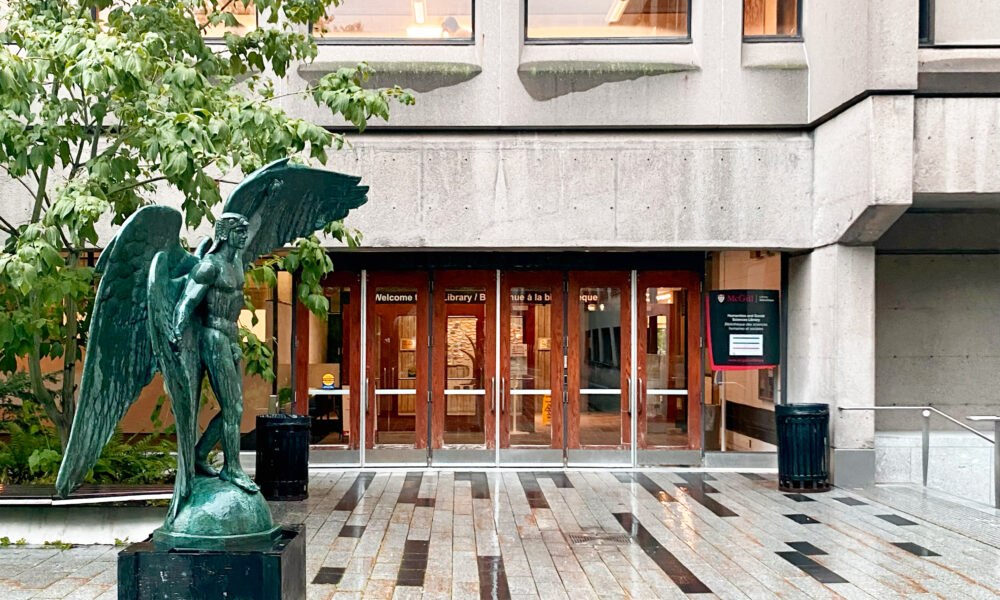
Nahum Gelber Law Library

Address: 3660 Peel Street

If you’re aiming for a productive day and can handle the extreme silence, the Law Library is the perfect spot for you. The library features modern glass windows and multiple desks with built-in lamps. With its five floors, spacious basement, and second floor reachable via a charming spiral staircase, you can always find the perfect seat in this place.

Pro: A quiet environment ideal for serious study sessions.

Con: Situated between Dr. Penfield and Pine, the walk-up is a bit of a hike, especially in the winter.

Islamic Studies Library

Address: Morrice Hall, 3485 McTavish Street

If you’re searching for a noise-free setting paired with gothic architecture, the Islamic Studies Library is the ideal spot for you. This library has two floors and a cozy couch which can come in handy during midterm season. If you have a moment between assignments, stop into the Octagon Room to check out Maison Palestine’s exhibit on Arab art in Mandate Jerusalem

Pro: The aesthetic setting makes you feel like you’re in a movie.

Con: It’s not the best choice for group study, as finding spots for more than one person can be challenging.

Birks Reading Room

Address: 3520 Rue University second floor

If you need another study spot with old architecture, take a trip over to the School of Religious Studies. If you’re looking for a bustling but studious atmosphere, the Birks Reading Room will fulfill your expectations. Studying under the enchanting glow of the library’s green lamps and enormous stained glass windows is a must.

Pro: Very peaceful and serene.
Con: No shoes allowed, which might be inconvenient for some—remember to wear socks!

Marvin Duchow Music Library

Address: Elizabeth Wirth Music, 527 Sherbrooke St W, third floor

The Marvin Duchow Music Library is a big, modern library that is calm and offers several spots to study. The first floor is ideal for group studies, with several conference and group rooms that feature instruments, which can add a fun element to your sessions.

Pro: There are always study spots available.
Con: The sleek, modern architecture can feel a little impersonal.

Burnside Basement

If you’ve ever wished for a subterranean study space without the pesky distraction of windows, the Burnside Basement is the place for you. With multiple plugs, seats, and tables available, it’s a functional space for a quick stop between classes. If you’re feeling gloomy, make sure to look up and catch a glimpse of the fake sky through the ceiling tiles!

Pro: Conveniently located next to the Soupe Cafe.
Con: The basement’s lack of visual appeal makes it better suited for a nap than a study session.

Honorable Mention: Redpath-McLennan Library

Address: 3459 McTavish Street

Last but not least, while the Redpath-McLennan Library is not a hidden gem, as almost everyone on campus has passed through it, it is a reliable study space. The Redpath Library has a main floor where you can talk with friends, chill, charge your phone and electronic devices, or simply study in silence. It also has many floors of study space, including a basement where you can use Cyberthèque Pods.

Oddly enough, whereas McLennan is also very crowded, it is quieter, making it better suited for intense study sessions. McLennan-Redpath is open from 8:00 AM to midnight—including weekends starting on Sept. 8th—and starting from Oct. 20, the library complex will be open 24/7 until the end of the semester, making it the best spot to lock in for a late night. 

Pro: It has the most extensive opening hours of any campus library.
Con: The library’s modern look lacks a cozy appeal that induces productivity.

Behind the Bench, Sports

Strava: The new dating app?

Online trends constantly come and go, and this year, running seems to be what’s in. While running used to take a backseat to pilates and lifting, it has now come to the forefront of attention. Its popularity has been attributed to the countless viral TikToks claiming that running clubs are becoming the new way to meet people. With this newfound attention, Strava—an activity-tracking app used to record and post runs, hikes, and other forms of activity—has skyrocketed in popularity as a social media platform and even a dating app.

Strava users can follow and connect with friends, deal out “kudos,” and comment on friends’ activity posts; in a sense, Strava is becoming the Instagram of athletic apps. Its growth is seen in the increasing number of users of the app, with 120 million users in 2023 and roughly two million joining each month. 

Strava’s growth has simultaneously added to the development of running clubs, encouraging users to join local groups, view routes, and more. Running clubs have taken off with more and more people in their twenties becoming inclined to join. Although it is typically used by a younger demographic, Strava and running groups encourage people of all skill levels and experience to take part in keeping an active lifestyle. 

The app acts as a way to connect with new people, and allows us to break away from our devices and interact in person, spurring organic meet-cutes. For example, running groups act as mediators in forming new relationships, using Strava athletes to meet up to run together and often attend a post-run social. Some running clubs host events, where single runners wear one colour shirt and runners in relationships  wear another, explicitly making the club a matchmaking space. 

Countless TikToks poke fun at this aspect of running clubs with some women joking that dating apps have become so bleak that they need to “start acting clueless at run club” to meet partners. Imagine post-running club drinks, you see someone cute from across the room, you walk over and dazzle them with a fool-proof opener: “What’s your Strava?” From there, you give them a couple of kudos’ on their Strava activity posts and the love story of a century is born.

But now the question arises: Are Strava and running clubs really an effective way to meet people and potential partners? Will Strava actually encourage face-to-face interactions and decrease the use of online dating apps in a world where social media is so prevalent in our daily lives? Or will we remain stuck behind a screen, comparing paces and giving kudos to our crushes?

There are still criticisms of having apps such as Strava as the facilitators of new relationships. It is unclear how these kinds of apps could affect our behaviours online; like Instagram, it could turn into another place where people curate their posts rather than sharing organic moments from their lives. The consequences of using social media to connect with others still leave us in harm’s way by cultivating unhealthy online habits and, in turn, creating the possibility of further negatively affecting one’s mental health.

However, unlike other forms of social media and dating apps, Strava presents a solution—encouraging users to get outside. Strava encourages us to stay active and meet people in person, facilitating face-to-face interactions, and potentially creating new relationships. So lace on your running shoes, prep your pick-up lines, put those headphones in, and start up your Strava app—it is the time to join a running club!

McGill, News

Fleeting Form Studio forges community-based climate action

“We created this workshop not to enrich the community, but to build community,” co-founder of Fleeting Form Studio Hannah Marder-MacPherson said at the onset of the group’s inaugural event on Sept. 6. The organization, supported by McGill’s Sustainability Projects Fund (SPF), is hosting a series of six workshops inviting various artists to share their work, followed by creation sessions and discussions with the goal of fostering climate action through art.

Their first workshop invited artist Tina Marais—a visual artist who creates large, intricate textile pieces—to explore the theme of environmental change and degradation. After a brief lecture from Marais, the roughly 30 attendees broke out into discussion groups. The workshop ended with each attendee sewing together a small horn-like denim structure, guided by Marais, which she will put together into a collective piece.

Evelyn Logan, U2 Arts, told The Tribune that she was initially drawn to the workshop by her interest in fine arts, but she was pleasantly surprised by the community-building she found.

“I feel like we’re at a point where community is something that we all thirst for,” Logan said. “It’s so important to have even small-scale events like this, where you can meet new people and just feel a sense of oneness with the people that you meet and with the spaces that surround you.”

Fleeting Form Studio is the brainchild of McGill undergraduate students Saskia Morgan, Ava Williams, and Marder-MacPherson. The idea came from a project Morgan and Williams worked on for the class FSCI 198: Climate Crisis and Climate Actions. Over the summer, they decided to pursue it and applied for funding from the SPF.

The SPF is a fund valued at about $1 million CAD annually and supports students and faculty members’ sustainability initiatives on campus. Since its inception in 2010, it has provided funding to over 350 projects, including McGill Feeding McGill and Campus Crops. The funding comes from a $0.55 CAD-per-credit student fee from the Students’ Society of McGill University, the Macdonald Campus Students’ Society, and the Post-Graduate Students’ Society. Money received from student fees is then matched by the university.

“The Sustainability Projects Fund is a valuable resource that catalyzes student ideas into reality,” Shona Watt, Associate Director, Operations & Engagement at the McGill Office of Sustainability wrote to The Tribune

For Fleeting Form Studio, aid from the SPF went beyond just financial support. The organizers told The Tribune that they also got help brainstorming their idea and finding a space to hold it in: McGill’s Critical Media Lab.

“If I tried to do this project alone, it would just be lacking so much of the beauty that we created together,” Morgan said. “Every step of the way, I’ve felt so inspired that the SPF is there. I think it’s one of the best assets that McGill has—a platform for students to take action themselves.”

As students in fields such as Environment and Geography, the trio felt their coursework had disproportionately focused on the environmental degradation caused by humans with little emphasis on society’s capacity for change. This is a pedagogical gap they hope to fill.

“You get no inspiration from destruction, you just get despair, and that’s not a way to go about solving any problems,” Marder-MacPherson said. “So finding that unity in creation and that inspiration in creation is really what we wanted to do with this project.”

For Morgan, Williams, and Marder-MacPherson, fostering a space for dialogue and creativity is crucial when trying to spur climate action.

“Life […] is just full of compromises and you have to forge that safe space for yourself,” Marder-MacPherson said. “You’re always going to be operating within institutions bigger than yourself that make decisions and have financial power […] and that doesn’t mean that you can’t […] forge your own path that is still working to create something that’s very safe and very beautiful.”

​​

Student Life, Word on the Y

Word on the Y: Returning students’ legacy

Starting your journey as a first-year university student is an opportunity for a fresh start. Your first few weeks will likely be dedicated to balancing academic deadlines, navigating campus, creating a social life, and learning how to live away from home. Some students show up with a game plan, while others enter the year with an open mind, ready to dive into the unknown. In any case, every single student will have something to learn. The unknown—as exciting as it can be—is scary. Here are some things that upperclassmen would have wanted to know when first arriving at McGill.

In a huge university like ours, it can sometimes feel like you lack guidance. Organizing your degree is not an easy task, especially when you’re trying to do it on your own, without any counselling. 

In an interview with The Tribune, Jeanne Lotz, U2 Arts, urged students not to be afraid of asking for help.

“What I’ve told the Froshies is that there is help at McGill. Sometimes it can feel a bit overwhelming,” she said. “There is help, you just have to always reach out for it because no one is going to come and be like ‘Do you need help?’ [….] I know [that] for a math class, the Faculty of Engineering organized free tutoring where you just show up […] and there is also intense training before exams.”

Reaching out for help also includes meeting with your department advisor to get advice and make sure that you’re on track to meet your degree requirements. 

It can be tempting at the beginning of the year to focus on building up a solid social life at the expense of academics. This is especially true with the whirlwind of moving into residence, Frosh, and Open Air Pub. However, at some point, the carefree summer months must turn to fall. 

For Colette Ayissi, LLM Law, focusing on your courses as soon as school starts is crucial to avoid getting caught off guard by work later in the semester. 

“My advice would be to start working from the beginning of the year and not wait for October and November because you get the midterms and everything at the same time,” she explained. 

However, your first year of university shouldn’t just be a slog through endless coursework. 

Qetsia Misenga, U2 Science, emphasized that while school should remain a top priority, having fun activities to look forward to is crucial to a healthy lifestyle.

“My advice is make the most out of your first year by joining clubs and associations and making friends in a bunch of different settings, because you are going to need them,” Misenga told The Tribune

Attending Activities Night, which will be held from Sept. 11 to 12 in the Fieldhouse, is a great way to get to know the school’s clubs and other student organizations. That’s where you’ll be able to register for a variety of clubs and talk to existing members about what they do.

McGill is known for being a cosmopolitan school, with roughly 30 per cent of its students coming from outside of Canada. International students might feel even more disoriented than others when first settling into Montréal. Diane Potignon, U2 Arts, relates to that feeling and advises international students to live in residence. 

“When you’re an international student […] your English is usually not as good as other people here so it’s easier to communicate with people who speak [my] language for me personally […] and it’s hard finding that outside of [residences],” she explained. 

Overall, the best advice you can receive as a first year is to try things out. That’s the only way you’ll figure out how to make the most of your university experience.

Diane Potignon’s quote was translated from French to English.

Behind the Bench, Soccer, Sports

Alex Morgan’s most iconic moments

American soccer player Alex Morgan announced her retirement on Sept. 5, signalling the end of an era as she closes off her well-decorated career with the San Diego Wave match on Sept. 8. Morgan spent most of her playing career in the United States, playing for teams in the National Women’s Soccer League (NWSL)—including six seasons with the Orlando Pride, her most with any club—and brief stints abroad in Lyon and north London. Internationally, she is in the top fifteen for most-capped women’s soccer players, and she was part of the United States Women’s National Team (USWNT) squads that won the 2015 and 2019 FIFA World Cups, the 2012 Olympic gold medal, and the 2024 CONCACAF W Gold Cup. She has also routinely been a champion for gender equity in the sport and has hopes of investing in women’s sports even after retirement. Here is a look at some of the iconic moments of her career, both on and off the field.

Pink pre-wrap

Morgan’s signature hairstyle includes a headband made out of pink pre-wrap. This had soccer girls everywhere rushing to stores to buy pre-wrap and try the look themselves. In Morgan’s prime, most girls’ soccer games in the U.S. featured at least a few girls imitating the style of their idol as part of their gameday outfit. Her look is more than just a fashion statement—she began wearing pink pre-wrap as a show of her support for her mother-in-law, who was diagnosed with breast cancer.

Her goal and tea celebration vs. England

Sorry Brits—it had to be done. Alex Morgan’s tea-sipping celebration, which came after she scored the winning goal against England in the 2019 World Cup semifinal, was in part meant to be a way of saying “that’s the tea” along with a cheeky nod towards the fact that they were playing England; however, it ended up being taken as an insult to English tea-drinking culture. Although she was criticized across the pond, it is a memorable moment in women’s soccer history and contrasts the narrative that women’s soccer players should conduct themselves in an overly humble manner.

Stoppage time header against Canada in the 2012 Olympics

The U.S. was up against Canada in the semifinals of the 2012 London Olympics, and by the end of the second half of extra time, it appeared that the game would be decided with penalty kicks. The game had been steadily back-and-forth up until that point, with Canada going ahead in three separate instances and the U.S. equalizing each time. However, in the 123rd minute—three minutes into stoppage time of the second period of extra time—Morgan got her head on the end of a Heather O’Reilly cross and scored the winning goal, which is now one of the most famous goals in USWNT history. The USWNT went on to beat Japan in the final, winning their fourth gold medal.

Five goals against Thailand

The 2019 World Cup also saw the USWNT win 13-0 against Thailand in the group stage, a game that still holds the record for the largest scoreline in the competition. Morgan was the standout player in this game by a long shot – she scored five goals and assisted three others, achieving a FotMob rating of 9.9. Her goal tally tied the record for the most goals scored in a single game for both the men’s and the women’s World Cup.

Filing the complaint that led to the equal pay agreement

In 2019, players on the USWNT were still being paid less than the men—despite the fact that the USWNT had generated more revenue than the men in the three years prior. That year, Morgan was one of five USWNT players who filed a class-action lawsuit against the U.S. Soccer Federation (USSF) on the grounds of gender discrimination—a lawsuit  they won in 2022 in a milestone moment. As a result of the case, USSF gave players a lump sum back payment, opportunities for post-retirement funding, and a commitment to equal pay.

Read the latest issue

Read the latest issue